Terms read 19 October 2026 Leaf C03, revision 1
An instrument that left every British cashier on one date, and the test that leaves behind
A £50.00 credit is expected to close at £30.00 under the multiple a British licence permits and at minus £30.00 under the multiple an uncapped cashier asks. Sixty pounds separates the two readings, and the single thing that settles which one applies can be read off a payment list in a few seconds. This leaf works the sixty pounds and writes the test out.
Stated on the banner Not named A promotion’s face says nothing about which instruments will be accepted for it, and nothing obliges it to. Stated, once you go and look 14 April 2020 The day a licence condition took one instrument off the payment lists of everything operating under a British licence, published and free to read. Not stated before the money goes in £60.00 What £50.00 of credit gains or loses between a ceilinged multiple and a free one, decided by which side of that date a cashier stands on.
Offers taking a card payment as the qualifying payment
Every destination in this file is bought advertising. The site is paid a fee if a reader goes on to register, and no figure printed below moves because of it.
Bonus Spins UK Slip 01
Betportal
Ceiling as a multiple
The drop
€15.00
€1.00 in the euro
The claim reads €15.00. Once the terms beside it have applied, €0.00 of it can leave. The difference is the drop.
7 of the 15 terms on this slip could not be read before the money went in
Spins priced at this site's own 10p a spin, which the operator does not publish
Stated
€15.00
The claim as it is printed, before a single term has been applied to it.
Headline paid as spins
150 spins at 10c each, which is €15.00 of the figure above.
6 Nowhere
What one spin is worth
No unit is published for a spin, so the count is priced at this site's own 10p a spin. At half that price every figure below halves with it.
Match and other credit not priced
300% of three deposits, to a ceiling of €1,000. A share of a deposit nobody has made yet is not a sum, so no figure stands on this line and none is carried below.
Qualified
-€14.40
Written down somewhere, and taking part of the claim back. Each term carries the place it is written and the sum it takes.
2 Written terms at a distance this record does not establish
Play-through -€14.40
Carrying €14.40 through 35 times stakes €504.00 and costs €20.16 of it at 96 per cent return. That prices above the €14.40 there is to charge it against, so the whole of the credit goes and the line is held at that. The multiple sits on the bonus.
2 Written terms at a distance this record does not establish
Game weighting not priced
Slots only count towards the play-through. No contribution percentage is published, so the line above has been worked at full weight, which is the kindest reading there is.
2 Written terms at a distance this record does not establish
Ceiling on the winnings not priced
5x the bonus.
2 Written terms at a distance this record does not establish
Clock on the credit not priced
14 days.
2 Written terms at a distance this record does not establish
Largest stake while it runs not priced
€5.
3 Public record
Licence, and who holds it not priced
Licensed in Anjouan, Comoros, held by BetPortal Gaming Ltd, with Excite Ultra Media Ltd, reference ALSI-202601040-FI2. A register entry settles who holds a licence and what it permits. It does not settle who is running the site this morning.
4 Cashier
Smallest qualifying deposit your money
€20 a stage. That is €20.00 of your own money, and it is never netted into a drop.
5 On the way out
Checks before a withdrawal not priced
Documents before the first withdrawal.
Unstated
-€0.60
Applying without having been published anywhere, and costing money all the same.
6 Nowhere
What a spin hands back -€0.60
Staking a spin returns 96 per cent of it, so that share of the batch is the house's before a reel turns. This site works at that return and the operator publishes none where the claim is made.
6 Nowhere
Forfeited by rule cost unknown
Nothing is published under this heading, and it applies regardless.
6 Nowhere
Charge on the way out cost unknown
No charge on the way out is published as a figure, so nothing comes off this line. A charge that exists unpublished would come straight off whatever survives.
6 Nowhere
Smallest withdrawal allowed cost unknown
No smallest withdrawal is published as a figure. A floor nobody has published is still a floor, and it decides whether a small balance can move at all.
No Great Britain licence
Terms read 19 October 2026
Bonus Spins UK Slip 02
WinBeast
Ceiling as a sum
The drop
€50.00
€1.00 in the euro
The claim reads €50.00. Once the terms beside it have applied, €0.00 of it can leave. The difference is the drop.
8 of the 15 terms on this slip could not be read before the money went in
Spins priced at this site's own 10p a spin, which the operator does not publish
Stated
€50.00
The claim as it is printed, before a single term has been applied to it.
Headline paid as spins
500 spins at 10c each, which is €50.00 of the figure above.
6 Nowhere
What one spin is worth
No unit is published for a spin, so the count is priced at this site's own 10p a spin. At half that price every figure below halves with it.
Match and other credit not priced
50% to 100% of five deposits, each to a ceiling of €1,000, and a €650 free bet. A share of a deposit nobody has made yet is not a sum, so no figure stands on this line and none is carried below.
Qualified
-€48.00
Written down somewhere, and taking part of the claim back. Each term carries the place it is written and the sum it takes.
2 Written terms at a distance this record does not establish
Play-through -€48.00
Carrying €48.00 through 40 times stakes €1,920.00 and costs €76.80 of it at 96 per cent return. That prices above the €48.00 there is to charge it against, so the whole of the credit goes and the line is held at that. The multiple sits on the bonus and the winnings from the spins.
2 Written terms at a distance this record does not establish
Game weighting not priced
Slots, titles vary by country count towards the play-through. No contribution percentage is published, so the line above has been worked at full weight, which is the kindest reading there is.
2 Written terms at a distance this record does not establish
Ceiling on the winnings not priced
€100 a batch of spins.
2 Written terms at a distance this record does not establish
Clock on the credit not priced
7 days, spins 1 day.
3 Public record
Licence, and who holds it not priced
Licensed in Curaçao, holder not named on the site. A register entry settles who holds a licence and what it permits. It does not settle who is running the site this morning.
4 Cashier
Smallest qualifying deposit your money
€20 a stage. That is €20.00 of your own money, and it is never netted into a drop.
5 On the way out
Checks before a withdrawal not priced
Documents before the first withdrawal.
Unstated
-€2.00
Applying without having been published anywhere, and costing money all the same.
6 Nowhere
What a spin hands back -€2.00
Staking a spin returns 96 per cent of it, so that share of the batch is the house's before a reel turns. This site works at that return and the operator publishes none where the claim is made.
6 Nowhere
Largest stake while it runs cost unknown
Nothing is published under this heading, and it applies regardless.
6 Nowhere
Forfeited by rule cost unknown
Nothing is published under this heading, and it applies regardless.
6 Nowhere
Charge on the way out cost unknown
No charge on the way out is published as a figure, so nothing comes off this line. A charge that exists unpublished would come straight off whatever survives.
6 Nowhere
Smallest withdrawal allowed cost unknown
No smallest withdrawal is published as a figure. A floor nobody has published is still a floor, and it decides whether a small balance can move at all.
No Great Britain licence
Terms read 19 October 2026
Bonus Spins UK Slip 03
EliteSpin
Longest spin window
The drop
£50.00
£1.00 in the pound
The claim reads £50.00. Once the terms beside it have applied, £0.00 of it can leave. The difference is the drop.
8 of the 15 terms on this slip could not be read before the money went in
Spins priced at this site's own 10p a spin, which the operator does not publish
Stated
£50.00
The claim as it is printed, before a single term has been applied to it.
Headline paid as spins
500 spins at 10p each, which is £50.00 of the figure above.
6 Nowhere
What one spin is worth
No unit is published for a spin, so the count is priced at this site's own 10p a spin. At half that price every figure below halves with it.
Match and other credit not priced
50% to 100% of five deposits, each to a ceiling of £1,000. A share of a deposit nobody has made yet is not a sum, so no figure stands on this line and none is carried below.
Qualified
-£48.00
Written down somewhere, and taking part of the claim back. Each term carries the place it is written and the sum it takes.
2 Written terms at a distance this record does not establish
Play-through -£48.00
Carrying £48.00 through 40 times stakes £1,920.00 and costs £76.80 of it at 96 per cent return. That prices above the £48.00 there is to charge it against, so the whole of the credit goes and the line is held at that. The multiple sits on the bonus and the winnings from the spins.
2 Written terms at a distance this record does not establish
Game weighting not priced
Slots count towards the play-through. No contribution percentage is published, so the line above has been worked at full weight, which is the kindest reading there is.
2 Written terms at a distance this record does not establish
Ceiling on the winnings not priced
5x the bonus.
2 Written terms at a distance this record does not establish
Clock on the credit not priced
7 days, spins 3 days.
3 Public record
Licence, and who holds it not priced
Licensed in Costa Rica, held by PrimeTier Limited. A register entry settles who holds a licence and what it permits. It does not settle who is running the site this morning.
4 Cashier
Smallest qualifying deposit your money
£20 a stage. That is £20.00 of your own money, and it is never netted into a drop.
5 On the way out
Checks before a withdrawal not priced
Documents before the first withdrawal.
Unstated
-£2.00
Applying without having been published anywhere, and costing money all the same.
6 Nowhere
What a spin hands back -£2.00
Staking a spin returns 96 per cent of it, so that share of the batch is the house's before a reel turns. This site works at that return and the operator publishes none where the claim is made.
6 Nowhere
Largest stake while it runs cost unknown
Nothing is published under this heading, and it applies regardless.
6 Nowhere
Forfeited by rule cost unknown
Nothing is published under this heading, and it applies regardless.
6 Nowhere
Charge on the way out cost unknown
No charge on the way out is published as a figure, so nothing comes off this line. A charge that exists unpublished would come straight off whatever survives.
6 Nowhere
Smallest withdrawal allowed cost unknown
No smallest withdrawal is published as a figure. A floor nobody has published is still a floor, and it decides whether a small balance can move at all.
No Great Britain licence
Terms read 19 October 2026
Bonus Spins UK Slip 04
Crown Jewelz
Multiple unpublished
The drop
NOT WORKED
The multiple is not published in the operator's own terms. Since the sum cannot be worked around it, none is worked.
9 of the 14 terms on this slip could not be read before the money went in
No drop worked
Stated
£15.00
The claim as it is printed, before a single term has been applied to it.
Headline paid as spins
150 spins at 10p each, which is £15.00 of the figure above.
6 Nowhere
What one spin is worth
No unit is published for a spin, so the count is priced at this site's own 10p a spin. At half that price every figure below halves with it.
Match and other credit not priced
200% of the first deposit, then 150% twice, each to a ceiling of £1,000. A share of a deposit nobody has made yet is not a sum, so no figure stands on this line and none is carried below.
Qualified
NOT WORKED
Written down somewhere, and taking part of the claim back. Each term carries the place it is written and the sum it takes.
2 Written terms at a distance this record does not establish
Play-through not priced
40x the bonus, reported rather than published by the operator.
2 Written terms at a distance this record does not establish
Game weighting not priced
Slots count towards the play-through. No contribution percentage is published, so the line above has been worked at full weight, which is the kindest reading there is.
3 Public record
Licence, and who holds it not priced
Licensed in Curaçao, number not verified, holder not named on the site. A register entry settles who holds a licence and what it permits. It does not settle who is running the site this morning.
4 Cashier
Smallest qualifying deposit your money
£20. That is £20.00 of your own money, and it is never netted into a drop.
5 On the way out
Checks before a withdrawal not priced
Documents before the first withdrawal.
Unstated
NOT WORKED
Applying without having been published anywhere, and costing money all the same.
6 Nowhere
Ceiling on the winnings cost unknown
No ceiling is published. Nothing is assumed in its place.
6 Nowhere
Clock on the credit cost unknown
Nothing is published under this heading, and it applies regardless.
6 Nowhere
Largest stake while it runs cost unknown
Nothing is published under this heading, and it applies regardless.
6 Nowhere
Forfeited by rule cost unknown
Nothing is published under this heading, and it applies regardless.
6 Nowhere
Charge on the way out cost unknown
No charge on the way out is published as a figure, so nothing comes off this line. A charge that exists unpublished would come straight off whatever survives.
6 Nowhere
Smallest withdrawal allowed cost unknown
No smallest withdrawal is published as a figure. A floor nobody has published is still a floor, and it decides whether a small balance can move at all.
No Great Britain licence
Terms read 19 October 2026
Every figure in the second and third columns is this site's own working and nothing an operator has published. A claim is priced as printed, then the share a spin hands back at 96 per cent return comes off it, then what playing the multiple through costs at the same return, and then whatever a published ceiling, a charge on the way out or a floor on the smallest withdrawal takes from what has survived. The drop is the difference between the first figure and the last. The two columns add back up to it exactly, so no money leaves a slip without a term and a place beside it.
Which column a term falls in is settled by one question: has anybody written it down. A charge a reader meets at the payment screen is written down, and it stands in the second column with the cashier against it. A condition that binds without ever having been set down stands in the third, whatever it costs. Inside each column the terms run outwards from the banner, so the order itself says how far a reader would have had to go.
A count of spins has no unit until one is supplied. Where an operator publishes what one of its own spins is worth, that figure is used and the first column says it is theirs. Where none is published, this site's own 10p a spin stands in its place and every figure below moves in proportion with it. Where the multiple itself is unpublished, no drop is worked at all, because that is the one figure the sum cannot be done without.
Three words stand where a figure cannot. Not priced is a term that is written down and carries no number the arithmetic can take. Cost unknown is a term nobody has written down, costing something nobody has put a number on. Your money is money of the reader's own, which is never netted into a drop.
None of the operators in this file holds a Great Britain licence, so none of the duties that licence carries reaches them. Each of those duties is published in its own right, which is what makes its absence here something a reader can check rather than take on trust. Every gambling company licensed in Great Britain belongs to Gamstop Online, so a reader who has shut themselves out through the scheme is not shut out here. Social Responsibility Code 5.1.1 has held a play-through to a maximum of ten times the bonus funds since 19 January 2026, and it binds a licence holder and nobody else. Asked in a post of 21 October 2025 what is lost along with the licence, the Gambling Commission's Director of Enforcement and Intelligence answered: "unfair gaming practices, financial loss, and a lack of recourse if things go wrong". The same post puts blocked payouts, and withdrawal limits pitched high enough to be unreachable, among the behaviour the Commission has recorded. Nobody under 18 may hold an account at any of them.
Terms are reproduced in the wording their operator published, and each slip is dated with the day somebody sat down and read them. 19 October 2026 is the oldest of those dates. Anybody claiming an offer is bound by that operator's full terms, which are elsewhere, and never by a line standing here.
1
An instrument absent from a payment list, and the date it went
Pages grouped beside this one price something a payment screen puts up. This one prices something it never puts up at all, which is harder to notice and easier to settle, because an absence with a date on it is the most checkable thing in this whole subject.
On 14 April 2020 one instrument stopped being available for gambling anywhere a British licence applies. Not discouraged, not subject to extra checks, not limited by amount. Gone, by a condition attached to the licence itself, and gone from a list of licence types broad enough to take in nearly everything a reader would recognise as a gambling business.
That makes the absence a fact settled in the public record, which is the third of the six places this site sorts by and the only one written by somebody with no commercial interest in how it reads. A reader can open the rule, read the sentence and note the date without an account, a payment or a registration of any kind.
The useful consequence runs the other way round. Because the rule is a prohibition rather than a permission, the instrument’s presence on a payment list says something definite, while its absence says nothing at all. Presence is evidence. Absence is the ordinary condition of any till inside the system and of a good many outside it.
No way of paying for gambling on credit is suggested anywhere on this leaf, and the rule is not treated here as an inconvenience to be got round. The rule is a protection, the page is written on the assumption that a reader wants it, and what the page offers is a use for it that has nothing to do with payments: it is the fastest licence check available anywhere.
2
What the condition forbids, and which licences it binds
One sentence does the work. A licence holder may not take money for gambling from a credit instrument, and a second sentence puts the indirect route in the same position by naming the case where a money service business stands midway along the chain. What is barred is where the funds come from, not the mechanics of the transfer, which is why routing changes nothing.
Scope is where the detail sits and it is wide. The regulator’s summary of the change takes in every remote licence, names two ancillary remote categories, adds three categories of betting off the wire, and leaves out three that never run a cashier at all. The table below sorts them.
| Category of licence | Reached by the rule | What that means at a payment screen |
|---|---|---|
| Remote casino, remote bingo, remote betting | Yes | The instrument cannot be offered |
| Ancillary remote betting, and the lottery equivalent | Yes | Both named where the scope is set out |
| Betting off the wire: general, pool, intermediary | Yes, all three | So it is not a remote-only bar |
| Machine technical, software supply, hosting | Outside it | No cashier to attach a rule to |
The practical shape sits in the right-hand column. Any category that can show somebody a payment screen is caught, and the three left out are the three that never show anybody one. Those exclusions are therefore not gaps in the drafting. They record that a supplier of software has no till for the rule to bite on.
The date deserves one further line, because it is older than most readers assume and younger than the rest of this site’s furniture. Six years and more have passed, which is long enough for the instrument to have disappeared from the habits of anybody gambling inside the system, and that is exactly what makes its reappearance informative.
3
A check that runs in seconds, and its single conclusion
Here is the whole procedure. Open the page listing what a till will take, which is a thing settled at the cashier and nowhere above it. Read down the list. Where an instrument drawing on credit is taken there for gambling, that till is not doing it under a British licence, and the conclusion follows from part two rather than from anybody’s opinion.
No account is needed, no payment is needed, and no judgement is involved. Compare that with every other check available on this subject. Reading a bonus document takes minutes and produces a multiple that still has to be priced. Checking a public register takes a search and produces a row that has to be interpreted. This produces a binary from a list.
It is the only check on this entire site that runs on a cashier’s own page, needs nothing from any third party, and has no interpretive step in the middle. The reason it works is that the rule it rests on is a prohibition with no exceptions and no thresholds: there is no sum small enough and no arrangement clever enough to put a credit instrument legitimately on a British payment list.
Two words of care about what it concludes. It establishes something about the licence standing behind the cashier. It establishes nothing about whether a promotion is generous, whether a payout will arrive, or who owns the business, and a reader who stretches it past the one conclusion has turned a sound test into a guess.
One payment list, read in seconds, settling which of two multiples a £50.00 credit stands under
4
What that conclusion is worth, worked two ways
Put a figure on the binary. Take £50.00 of credit, an ordinary size for a matched offer, and spend this site’s house assumptions on it: a press at 10p, four pence in every pound kept by the reels, weighting held at one. Under a British licence the multiple written over bonus funds stops at ten. Beyond it the multiple is whatever a document says, and forty is what gets published out here.
At ten times the expected close is £30.00. At forty times it is minus £30.00. Sixty pounds separates them, and the sign turns over somewhere in between at 25, which is one divided by four hundredths and is arithmetic rather than anything a market decided.
Expected close under the capped multiple £30.00 Expected close where nothing caps it minus £30.00 What one glance at a payment list settles £60.00
Sixty pounds comes out of a second calculation that shares nothing with the first, and the agreement is the reason it can be printed without qualification. Count the staking instead of the balance. Ten times £50.00 is £500.00 pushed across the reels, four hundredths of which is £20.00 of expected cost. Forty times is £2,000.00 pushed across, costing an expected £80.00. Eighty less twenty is sixty, and no step of that working appears in the paragraph above it.
Convert the staking into presses and the second reading gets a physical size. Two thousand pounds at 10p a press is 20,000 individual presses, against 5,000 under the capped multiple. The capped version is a long evening and the uncapped one is a fortnight of long evenings, on a credit whose face value never changed.
| Multiple written over it | Staking it asks | Presses at 10p | Pressed at the licensed floor | Expected close | Where the number comes from |
|---|---|---|---|---|---|
| Ten, the ceiling | £500.00 | 5,000 | 3 h 28 min | £30.00 | A licence carries it |
| Twenty-five, where the sign turns | £1,250.00 | 12,500 | 8 h 41 min | £0.00 | Arithmetic alone |
| Forty, the published band | £2,000.00 | 20,000 presses | 13 h 53 min | minus £30.00 | What gets written out here |
| Sixty, the cited level | £3,000.00 | 30,000 | 20 h 50 min | minus £70.00 | A figure the regulator printed |
Two columns of that table deserve a note. The bottom row is nobody’s invention here: sixty was put in print by the regulator while explaining what the ceiling was for, described as the level some licence holders were then applying. Across this whole site it is the one market multiple answering to a regulator rather than to an assumption of ours.
The hours column is this leaf’s own arithmetic against the minimum interval a licensed build has to leave between game cycles, which is 2.5 seconds on a reel. It is printed for every row to show the shape, and it describes none of the lower three honestly, because the multiples in those rows are found where no interval is set by anything.
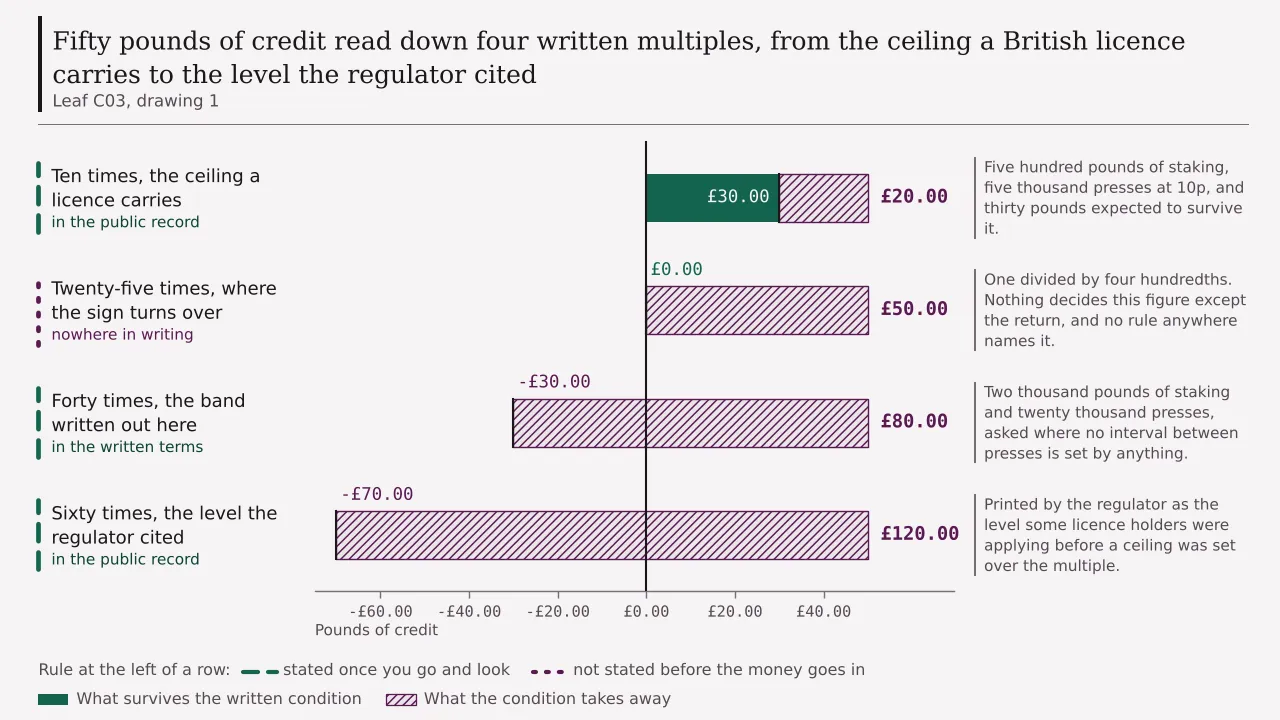
An irony sits in the third row and is worth printing because it is arithmetic rather than rhetoric. Twenty thousand presses could not be got through on a licensed build in under 50,000 seconds, those being the hours in the fourth column. The multiple asking for twenty thousand of them is found only where nothing sets that floor, so the heavier obligation and the missing floor turn up together.
5
The detour, priced in pounds and in working days
A reader who intended to pay by credit at a British cashier has to do something else instead, and which instruments are taken is a thing settled in the written terms and again on the payment page. The something else is worth pricing honestly rather than dramatically. The instrument removed is the only one that supplies money which is not there yet. Everything replacing it moves money that already exists.
In pounds the detour costs nothing. A £50.00 payment is a £50.00 payment whether it comes off a debit instrument, out of a bank account or through a wallet funded from one of those, and the arithmetic in part four is untouched by the choice. The balance is the same, the multiple is the same, the expected close is the same.
In days it costs between nought and three working days, which is this leaf’s own band rather than any published schedule, and it depends entirely on which rail replaces the one that is gone. A debit instrument and a wallet settle at once. A bank transfer takes a day or so to clear in, and the same again coming back.
What the detour costs in neither unit is the quantity the prohibition was drafted over. Money already held is a different object from money borrowed, and a payment screen accepting only the first has shut off any balance bigger than the account behind it. That is a constraint on the size of the arithmetic rather than on its rate.
So the fairest statement of the detour is a pair of figures and a sentence. Nought pounds, up to three working days, and a ceiling on what can be committed that is set by whatever is actually in the account. A reader looking for what the rule costs them will find the first two figures small and the third one the entire point of it.
6
Where the law places the activity, and who commits what
Part three stands on a licence condition, and the condition stands on the statute making a licence necessary in the first place. Three features of that statute decide how far the test reaches, and two pages of the legislation carry all three.
Fifty-one weeks is the longest sentence section 33 carries for running gambling facilities with no operating licence behind them, with a level five fine standing as the alternative, or both at once. In Scotland that fifty-one weeks is read as six months. Every limb of the section is drafted around whoever supplies the facilities.
No matching offence is laid on the customer anywhere in the Act, and this leaf puts that carefully in both directions. Liability under the section belongs to the operator. What does not follow is that a cashier beyond the system is therefore a comfortable place to be, since the whole of what this page prices is apparatus gone missing rather than any exposure to a court.
Geography supplies no escape, which is what gives the test its reach. Section 36 treats the place of supply as immaterial, then catches remote gambling on either of two footings: equipment standing here, or, where none does, facilities being put to use here. The second footing turns on what the supplier knew or ought to have known about where the use was happening.
1 November 2014 is the date those two footings replaced a single earlier one, which had reached remote gambling only through equipment sited in this country. Twelve years, then, for the question of where gambling happens, and six for the question of which instrument may pay for it, with the second sitting on top of the first.
7
The limits of the check, stated before anybody leans on it
A test that runs in seconds invites more weight than it can carry, so the limits belong in their own part rather than in a footnote. There are three of them and each one narrows the conclusion in a different direction.
The first is the direction of the inference, which part one set out and which is the limit most often lost. An instrument drawing on credit appearing on a payment list tells a reader the cashier is outside the British system. The same instrument missing from a list tells them nothing whatever, because a till inside the system is obliged to omit it and plenty outside the system omit it as well, for reasons of their own that have nothing to do with any licence.
The second is that a payment list is a page on a website and pages change. A list read on one morning describes that morning. Nothing about it is a public record in the sense the register is, nobody is obliged to keep an archive of it, and a reader quoting what they saw has a screenshot rather than a citation.
The third is about what sits behind an instrument. Some instruments present themselves at a payment screen in a form that does not announce what is funding them underneath, which is a subject with a page of its own on this site. A reader running this check is reading a list of labels, and a label is not the same object as the account the money eventually comes from.
None of those limits weakens the positive case, which is the one worth having. Where the instrument is accepted, the conclusion holds completely, and it holds without a register search, without an account and without a single assumption of this leaf’s being spent on it.
8
Everything else absent at the same moment
Where an instrument drawing on credit sits on the list, that cashier holds no Great Britain licence, and a chain of conditionals runs out of the single fact. Every link is a duty owed because of the licence, so every link departs with it, and each one has been priced somewhere above.
If the licence is absent then the ceiling in part four is absent, so the £30.00 becomes minus £30.00 and the sixty pounds of difference is not a hypothetical. If the ceiling is absent then nothing holds the staking in the third row of that table down, and 20,000 presses is a floor on the obligation rather than a ceiling on it.
If the licence is absent so is the floor under the gap from one press to the next, which leaves the hours in the fourth column of part four with nothing holding them up and lets the obligation run at any rate a build will support. More presses and quicker pressing come out of a single absence.
And if the licence is absent then the statutory architecture in part six applies to the operator and not to the reader, which is the sentence this leaf is most careful about. The person who loses something is the customer, what they lose is the apparatus, and the offence described in section 33 is somebody else’s entirely.
One protection goes with the rest and belongs here because the subject is a payment instrument. A registration with Gamstop Online reaches the operators taking part in it, which is the ones licensed in Britain, so a cashier failing the test in part three is a cashier that registration does not touch. Anybody who has used it should read the result of that test as the end of the exercise rather than the beginning of one, and the block below gives the better addresses.
9
The whole procedure, written out in order
Four steps, none of them taking more than a few seconds, and the order matters because the first step answers a question that makes the rest of them cheaper. Run it before reading a bonus document rather than afterwards.
Step one, open the cashier’s list of ways to pay in and read it. Step two, look for an instrument drawing on credit rather than on a balance. Step three, where one is present, stop: the sixty pounds in part four is live and nothing further needs establishing. Step four, where none is present, note that the test has returned nothing and go and look the operator up in the public register instead, which is slower and settles a different question.
Two habits make the result durable. Write down the date the list was read, because part seven’s second limit means a list is a statement about a morning. And write down what the test did not settle, which is everything about the promotion, the payout, the ownership and the speed, so that a binary about a licence is not quietly promoted into a verdict about an offer.
The arithmetic to attach to the result is the subtraction this site performs everywhere. Print what a credit is worth under the capped multiple. Print what the identical credit is worth under the multiple that applies where nothing caps it. Rule off the difference. At the house figures a £50.00 credit reads £30.00 under one and minus £30.00 under the other, which rules off at sixty pounds.
The honest summary is that this is the cheapest serious check in this corner of the subject, and also the narrowest. It costs seconds, it needs no account, it rests on a published prohibition with a date, and it answers exactly one question. Most checks on this site trade breadth for cost. This one trades everything for speed and gets a clean answer back when the answer is yes.
Questions
- Can a credit card be used to gamble in Britain?
- No, and the prohibition carries a date: 14 April 2020. A licence condition stops a holder taking money for gambling from a credit instrument, and a second sentence puts the indirect route in the same position by naming the case where a money service business stands midway along the chain. What is barred is where the funds come from rather than the mechanics of the transfer. No route round that appears here, the rule being a protection this page assumes a reader wants.
- Which gambling businesses does the rule cover?
- Any category that can show somebody a payment screen. The regulator’s summary of the change takes in every remote licence, names two ancillary remote categories, adds three categories of betting off the wire, and leaves out three others: machine technical, the supply of gambling software, and hosting. Not one of those three runs a till, so the exclusions record a fact about cashiers rather than a gap in the drafting.
- What does it mean if a cashier still accepts one?
- That the cashier is not operating under a British licence. The conclusion follows from the prohibition itself rather than from anybody’s judgement, because the rule carries no exceptions and no thresholds: there is no payment small enough and no arrangement indirect enough to put a credit instrument legitimately on a British payment list. The reading is a warning about the cashier rather than an opportunity.
- What is that one conclusion actually worth in money?
- Sixty pounds on £50.00 of credit, with a press at 10p and four pence in each pound kept by the reels. Under a British licence the multiple written over bonus funds stops at ten, leaving an expected close of £30.00. At the forty written out here the identical credit closes at an expected minus £30.00. Which of the two readings applies is settled entirely by which side of the rule a cashier stands on.
- How is the sixty pounds confirmed by a second calculation?
- By counting the staking rather than the balance. Ten times £50.00 is £500.00 pushed across the reels, four hundredths of which is £20.00 of expected cost. Forty times is £2,000.00 pushed across, costing an expected £80.00. Eighty less twenty is sixty. No step of that working appears in the balance calculation, which is why the agreement between them can be printed without qualification.
- What does the detour cost a reader who wanted to pay on credit?
- Nought pounds and up to three working days, the second being this leaf’s own band rather than a published schedule. A £50.00 payment is £50.00 whether it comes off a debit instrument, out of a bank account or through a wallet funded from one of those, and the arithmetic is untouched by the choice. What the rule genuinely removes is the possibility of a balance larger than the account behind it, which is a constraint on size rather than on speed.
- Is it against the law for a player to gamble at such a site?
- The statutory liability belongs to whoever supplies the facilities. Fifty-one weeks is the longest sentence section 33 carries for running gambling facilities with no operating licence behind them, with a level five fine standing as the alternative, or both at once. In Scotland that fifty-one weeks is read as six months. No matching offence is laid on the customer anywhere in the Act. What does not follow is that playing there is comfortable: this page prices apparatus gone missing, which is a different kind of thing from exposure to a court.
- Does an operator escape the rule by being based abroad?
- No. Section 36 treats the place of supply as immaterial, then catches remote gambling on either of two footings: equipment standing in this country, or, where none does, facilities being put to use here. The second footing turns on what the supplier knew or ought to have known about where that use was happening. Those two footings replaced a single earlier one on 1 November 2014, and the earlier one had reached remote gambling through sited equipment alone.
- If the instrument is not on the list, what has been proved?
- Nothing at all, and this is the limit most often lost. The inference runs one way. Presence establishes that a cashier is outside the British system; absence is the ordinary condition of any till inside it, and of plenty outside it that omit the instrument for reasons of their own. A reader who reads an absence as a clean bill has turned a sound check into a guess.
- Are there other reasons the check can mislead?
- Two. A payment list is a page on a website, so a list read on one morning describes that morning, nobody is obliged to keep an archive of it, and a reader quoting what they saw holds a screenshot rather than a citation. And some instruments present at a payment screen in a form that does not announce what is funding them underneath, so a reader running this check is reading labels rather than the account the money eventually comes from.
- What else is missing when the test comes back positive?
- A chain of things, every link following from the one absent licence. No ceiling over the multiple, so £30.00 turns into minus £30.00. Nothing holding the staking down, so twenty thousand presses is a floor under the obligation rather than a limit on it. No floor under the gap from one press to the next, so the hours that many presses would take on a licensed build have nothing propping them up. And a registration with Gamstop Online reaches the operators taking part in it, which does not include a cashier failing this test.
- What order should these checks be run in?
- Payment list first, register second, bonus document last. The first step costs seconds and can end the exercise outright, which makes everything after it cheaper. Write down the date the list was read, and write down what the check did not settle, which is the promotion, the payout, the ownership and the speed. Then print what a credit is worth under each multiple and rule off the difference.