Terms read 19 October 2026 Leaf A10, revision 1
An hour of pressing when the price of a press will not hold still
A licensed reel permits at most 1,440 turns in an hour, and at 10p each that is £144.00 over the counter and an expected £5.76 gone. Let the unit the stake is denominated in drift 20 per cent across the same hour, which this page assumes and no document states, and the figure runs anywhere between £5.18 and £6.34. This site’s subtraction needs a second term, and the term has no address.
Stated on the banner £5.76 What an hour is expected to cost where a press is 10p and ninety-six pence comes back on the pound, the two figures a face value supports. Stated, once you go and look £0.58 The term a 20 per cent drift adds to that hour. Written terms reach it only by fixing a stake in the drifting unit rather than in pence. Not stated before the money goes in £11.52 What the same hour costs on top of the first reading where the true return sits eight points under the published one, which nothing on an unlicensed reel is obliged to print.
Reel offers priced in a moving unit, with their terms read
Every destination in this file is bought advertising. The site is paid a fee if a reader goes on to register, and no figure printed below moves because of it.
Bonus Spins UK Slip 01
Betportal
Ceiling as a multiple
The drop
€15.00
€1.00 in the euro
The claim reads €15.00. Once the terms beside it have applied, €0.00 of it can leave. The difference is the drop.
7 of the 15 terms on this slip could not be read before the money went in
Spins priced at this site's own 10p a spin, which the operator does not publish
Stated
€15.00
The claim as it is printed, before a single term has been applied to it.
Headline paid as spins
150 spins at 10c each, which is €15.00 of the figure above.
6 Nowhere
What one spin is worth
No unit is published for a spin, so the count is priced at this site's own 10p a spin. At half that price every figure below halves with it.
Match and other credit not priced
300% of three deposits, to a ceiling of €1,000. A share of a deposit nobody has made yet is not a sum, so no figure stands on this line and none is carried below.
Qualified
-€14.40
Written down somewhere, and taking part of the claim back. Each term carries the place it is written and the sum it takes.
2 Written terms at a distance this record does not establish
Play-through -€14.40
Carrying €14.40 through 35 times stakes €504.00 and costs €20.16 of it at 96 per cent return. That prices above the €14.40 there is to charge it against, so the whole of the credit goes and the line is held at that. The multiple sits on the bonus.
2 Written terms at a distance this record does not establish
Game weighting not priced
Slots only count towards the play-through. No contribution percentage is published, so the line above has been worked at full weight, which is the kindest reading there is.
2 Written terms at a distance this record does not establish
Ceiling on the winnings not priced
5x the bonus.
2 Written terms at a distance this record does not establish
Clock on the credit not priced
14 days.
2 Written terms at a distance this record does not establish
Largest stake while it runs not priced
€5.
3 Public record
Licence, and who holds it not priced
Licensed in Anjouan, Comoros, held by BetPortal Gaming Ltd, with Excite Ultra Media Ltd, reference ALSI-202601040-FI2. A register entry settles who holds a licence and what it permits. It does not settle who is running the site this morning.
4 Cashier
Smallest qualifying deposit your money
€20 a stage. That is €20.00 of your own money, and it is never netted into a drop.
5 On the way out
Checks before a withdrawal not priced
Documents before the first withdrawal.
Unstated
-€0.60
Applying without having been published anywhere, and costing money all the same.
6 Nowhere
What a spin hands back -€0.60
Staking a spin returns 96 per cent of it, so that share of the batch is the house's before a reel turns. This site works at that return and the operator publishes none where the claim is made.
6 Nowhere
Forfeited by rule cost unknown
Nothing is published under this heading, and it applies regardless.
6 Nowhere
Charge on the way out cost unknown
No charge on the way out is published as a figure, so nothing comes off this line. A charge that exists unpublished would come straight off whatever survives.
6 Nowhere
Smallest withdrawal allowed cost unknown
No smallest withdrawal is published as a figure. A floor nobody has published is still a floor, and it decides whether a small balance can move at all.
No Great Britain licence
Terms read 19 October 2026
Bonus Spins UK Slip 02
WinBeast
Ceiling as a sum
The drop
€50.00
€1.00 in the euro
The claim reads €50.00. Once the terms beside it have applied, €0.00 of it can leave. The difference is the drop.
8 of the 15 terms on this slip could not be read before the money went in
Spins priced at this site's own 10p a spin, which the operator does not publish
Stated
€50.00
The claim as it is printed, before a single term has been applied to it.
Headline paid as spins
500 spins at 10c each, which is €50.00 of the figure above.
6 Nowhere
What one spin is worth
No unit is published for a spin, so the count is priced at this site's own 10p a spin. At half that price every figure below halves with it.
Match and other credit not priced
50% to 100% of five deposits, each to a ceiling of €1,000, and a €650 free bet. A share of a deposit nobody has made yet is not a sum, so no figure stands on this line and none is carried below.
Qualified
-€48.00
Written down somewhere, and taking part of the claim back. Each term carries the place it is written and the sum it takes.
2 Written terms at a distance this record does not establish
Play-through -€48.00
Carrying €48.00 through 40 times stakes €1,920.00 and costs €76.80 of it at 96 per cent return. That prices above the €48.00 there is to charge it against, so the whole of the credit goes and the line is held at that. The multiple sits on the bonus and the winnings from the spins.
2 Written terms at a distance this record does not establish
Game weighting not priced
Slots, titles vary by country count towards the play-through. No contribution percentage is published, so the line above has been worked at full weight, which is the kindest reading there is.
2 Written terms at a distance this record does not establish
Ceiling on the winnings not priced
€100 a batch of spins.
2 Written terms at a distance this record does not establish
Clock on the credit not priced
7 days, spins 1 day.
3 Public record
Licence, and who holds it not priced
Licensed in Curaçao, holder not named on the site. A register entry settles who holds a licence and what it permits. It does not settle who is running the site this morning.
4 Cashier
Smallest qualifying deposit your money
€20 a stage. That is €20.00 of your own money, and it is never netted into a drop.
5 On the way out
Checks before a withdrawal not priced
Documents before the first withdrawal.
Unstated
-€2.00
Applying without having been published anywhere, and costing money all the same.
6 Nowhere
What a spin hands back -€2.00
Staking a spin returns 96 per cent of it, so that share of the batch is the house's before a reel turns. This site works at that return and the operator publishes none where the claim is made.
6 Nowhere
Largest stake while it runs cost unknown
Nothing is published under this heading, and it applies regardless.
6 Nowhere
Forfeited by rule cost unknown
Nothing is published under this heading, and it applies regardless.
6 Nowhere
Charge on the way out cost unknown
No charge on the way out is published as a figure, so nothing comes off this line. A charge that exists unpublished would come straight off whatever survives.
6 Nowhere
Smallest withdrawal allowed cost unknown
No smallest withdrawal is published as a figure. A floor nobody has published is still a floor, and it decides whether a small balance can move at all.
No Great Britain licence
Terms read 19 October 2026
Bonus Spins UK Slip 03
EliteSpin
Longest spin window
The drop
£50.00
£1.00 in the pound
The claim reads £50.00. Once the terms beside it have applied, £0.00 of it can leave. The difference is the drop.
8 of the 15 terms on this slip could not be read before the money went in
Spins priced at this site's own 10p a spin, which the operator does not publish
Stated
£50.00
The claim as it is printed, before a single term has been applied to it.
Headline paid as spins
500 spins at 10p each, which is £50.00 of the figure above.
6 Nowhere
What one spin is worth
No unit is published for a spin, so the count is priced at this site's own 10p a spin. At half that price every figure below halves with it.
Match and other credit not priced
50% to 100% of five deposits, each to a ceiling of £1,000. A share of a deposit nobody has made yet is not a sum, so no figure stands on this line and none is carried below.
Qualified
-£48.00
Written down somewhere, and taking part of the claim back. Each term carries the place it is written and the sum it takes.
2 Written terms at a distance this record does not establish
Play-through -£48.00
Carrying £48.00 through 40 times stakes £1,920.00 and costs £76.80 of it at 96 per cent return. That prices above the £48.00 there is to charge it against, so the whole of the credit goes and the line is held at that. The multiple sits on the bonus and the winnings from the spins.
2 Written terms at a distance this record does not establish
Game weighting not priced
Slots count towards the play-through. No contribution percentage is published, so the line above has been worked at full weight, which is the kindest reading there is.
2 Written terms at a distance this record does not establish
Ceiling on the winnings not priced
5x the bonus.
2 Written terms at a distance this record does not establish
Clock on the credit not priced
7 days, spins 3 days.
3 Public record
Licence, and who holds it not priced
Licensed in Costa Rica, held by PrimeTier Limited. A register entry settles who holds a licence and what it permits. It does not settle who is running the site this morning.
4 Cashier
Smallest qualifying deposit your money
£20 a stage. That is £20.00 of your own money, and it is never netted into a drop.
5 On the way out
Checks before a withdrawal not priced
Documents before the first withdrawal.
Unstated
-£2.00
Applying without having been published anywhere, and costing money all the same.
6 Nowhere
What a spin hands back -£2.00
Staking a spin returns 96 per cent of it, so that share of the batch is the house's before a reel turns. This site works at that return and the operator publishes none where the claim is made.
6 Nowhere
Largest stake while it runs cost unknown
Nothing is published under this heading, and it applies regardless.
6 Nowhere
Forfeited by rule cost unknown
Nothing is published under this heading, and it applies regardless.
6 Nowhere
Charge on the way out cost unknown
No charge on the way out is published as a figure, so nothing comes off this line. A charge that exists unpublished would come straight off whatever survives.
6 Nowhere
Smallest withdrawal allowed cost unknown
No smallest withdrawal is published as a figure. A floor nobody has published is still a floor, and it decides whether a small balance can move at all.
No Great Britain licence
Terms read 19 October 2026
Bonus Spins UK Slip 04
Crown Jewelz
Multiple unpublished
The drop
NOT WORKED
The multiple is not published in the operator's own terms. Since the sum cannot be worked around it, none is worked.
9 of the 14 terms on this slip could not be read before the money went in
No drop worked
Stated
£15.00
The claim as it is printed, before a single term has been applied to it.
Headline paid as spins
150 spins at 10p each, which is £15.00 of the figure above.
6 Nowhere
What one spin is worth
No unit is published for a spin, so the count is priced at this site's own 10p a spin. At half that price every figure below halves with it.
Match and other credit not priced
200% of the first deposit, then 150% twice, each to a ceiling of £1,000. A share of a deposit nobody has made yet is not a sum, so no figure stands on this line and none is carried below.
Qualified
NOT WORKED
Written down somewhere, and taking part of the claim back. Each term carries the place it is written and the sum it takes.
2 Written terms at a distance this record does not establish
Play-through not priced
40x the bonus, reported rather than published by the operator.
2 Written terms at a distance this record does not establish
Game weighting not priced
Slots count towards the play-through. No contribution percentage is published, so the line above has been worked at full weight, which is the kindest reading there is.
3 Public record
Licence, and who holds it not priced
Licensed in Curaçao, number not verified, holder not named on the site. A register entry settles who holds a licence and what it permits. It does not settle who is running the site this morning.
4 Cashier
Smallest qualifying deposit your money
£20. That is £20.00 of your own money, and it is never netted into a drop.
5 On the way out
Checks before a withdrawal not priced
Documents before the first withdrawal.
Unstated
NOT WORKED
Applying without having been published anywhere, and costing money all the same.
6 Nowhere
Ceiling on the winnings cost unknown
No ceiling is published. Nothing is assumed in its place.
6 Nowhere
Clock on the credit cost unknown
Nothing is published under this heading, and it applies regardless.
6 Nowhere
Largest stake while it runs cost unknown
Nothing is published under this heading, and it applies regardless.
6 Nowhere
Forfeited by rule cost unknown
Nothing is published under this heading, and it applies regardless.
6 Nowhere
Charge on the way out cost unknown
No charge on the way out is published as a figure, so nothing comes off this line. A charge that exists unpublished would come straight off whatever survives.
6 Nowhere
Smallest withdrawal allowed cost unknown
No smallest withdrawal is published as a figure. A floor nobody has published is still a floor, and it decides whether a small balance can move at all.
No Great Britain licence
Terms read 19 October 2026
Every figure in the second and third columns is this site's own working and nothing an operator has published. A claim is priced as printed, then the share a spin hands back at 96 per cent return comes off it, then what playing the multiple through costs at the same return, and then whatever a published ceiling, a charge on the way out or a floor on the smallest withdrawal takes from what has survived. The drop is the difference between the first figure and the last. The two columns add back up to it exactly, so no money leaves a slip without a term and a place beside it.
Which column a term falls in is settled by one question: has anybody written it down. A charge a reader meets at the payment screen is written down, and it stands in the second column with the cashier against it. A condition that binds without ever having been set down stands in the third, whatever it costs. Inside each column the terms run outwards from the banner, so the order itself says how far a reader would have had to go.
A count of spins has no unit until one is supplied. Where an operator publishes what one of its own spins is worth, that figure is used and the first column says it is theirs. Where none is published, this site's own 10p a spin stands in its place and every figure below moves in proportion with it. Where the multiple itself is unpublished, no drop is worked at all, because that is the one figure the sum cannot be done without.
Three words stand where a figure cannot. Not priced is a term that is written down and carries no number the arithmetic can take. Cost unknown is a term nobody has written down, costing something nobody has put a number on. Your money is money of the reader's own, which is never netted into a drop.
None of the operators in this file holds a Great Britain licence, so none of the duties that licence carries reaches them. Each of those duties is published in its own right, which is what makes its absence here something a reader can check rather than take on trust. Every gambling company licensed in Great Britain belongs to Gamstop Online, so a reader who has shut themselves out through the scheme is not shut out here. Social Responsibility Code 5.1.1 has held a play-through to a maximum of ten times the bonus funds since 19 January 2026, and it binds a licence holder and nobody else. Asked in a post of 21 October 2025 what is lost along with the licence, the Gambling Commission's Director of Enforcement and Intelligence answered: "unfair gaming practices, financial loss, and a lack of recourse if things go wrong". The same post puts blocked payouts, and withdrawal limits pitched high enough to be unreachable, among the behaviour the Commission has recorded. Nobody under 18 may hold an account at any of them.
Terms are reproduced in the wording their operator published, and each slip is dated with the day somebody sat down and read them. 19 October 2026 is the oldest of those dates. Anybody claiming an offer is bound by that operator's full terms, which are elsewhere, and never by a line standing here.
1
A stake that is a different number of pence on each press
Readers who have landed here while trying to work their way past something they set up to stop themselves should leave the arithmetic and use the telephone instead. GamCare answers 0808 8020 133 at no charge whatever, on any day and at any hour, and that number is the useful thing on this page for anybody in that position, with GamCare.org.uk and BeGambleAware.org reachable alongside it. This page explains nothing about getting hold of, keeping or shifting a unit of any sort, says nothing about which sort of lobby asks less of anybody, and contains nothing of use to a person wanting to undo a registration with Gamstop Online.
Everything on this site rests on one subtraction: a figure read alone, the same figure once everything else applies, and the gap ruled off underneath. That subtraction has a hidden premise, which is that the unit of account holds still while the arithmetic runs. On an ordinary reel it does. Ten pence is ten pence at the first press and at the ten-thousandth, so an hour of pressing has one cost and the only question is what the terms do to it.
Where a stake is fixed in something other than pounds, that premise fails, and it fails continuously rather than once. The quantity staked per press stays constant in its own unit and varies in pence, so an hour contains as many different pound stakes as it contains presses. Nothing about the offer has changed. The measuring stick has.
So this page does the subtraction twice over. Part two prices an hour with the unit nailed down, which is the reading a reader would act on. Part three prices the same hour with the unit drifting by an amount this page assumes and labels as an assumption every time it carries a figure, since no source this site may rely on publishes a movement for any unit. What separates the two readings is the second term, and it is nowhere in writing because nothing in an offer’s documents concerns it.
Two further quantities get taken apart afterwards. The British ceilings on what may be staked in one turn are written in pounds and pence, which makes them unusable as a comparison against a stake denominated somewhere else, and part five works out what that actually means rather than asserting it. And a claim that a draw can be verified is a claim about the draw, which part six separates from the return and prices the distance between them.
Reels of this build hold no Great Britain licence. What matters most here among everything that removes are the rules written in something measurable, pounds in two cases and seconds, acts or prohibitions in the rest. Part seven lists which of them an unlicensed reel keeps, which is none, and what each was measuring while it applied.
2
An hour priced with the unit standing perfectly still
Begin with the count of presses, because every figure on this page is built on it. A reel inside a British licence waits 2.5 seconds from one cycle opening before the next may open, so an hour of 3,600 seconds carries 1,440 turns at the very most. That is a ceiling rather than a rate, and it is the gentlest reading available: a reel outside the licence is held to nothing, so a real hour may contain considerably more.
At a press worth 10p, the value this site holds to and one no primary source fixes for anybody, 1,440 turns push £144.00 across the reel in an hour. The reel keeps four pence of every pound where ninety-six come back, so the expected cost of that hour is four hundredths of £144.00, which is £5.76.
Keep hold of that figure, because it is the one quantity here a reader could reach from two numbers and no documents at all. Five pounds and seventy-six pence an hour is not a prediction about any session: it is the rate at which a 4 per cent margin takes money from £144.00 of turnover, and every other figure below is this one disturbed by something.
1,440 turns an hour at the most, £144.00 over the counter, and £5.76 of it expected to stay behind
Scale it and the shape holds. At 5p a press the hour turns over £72.00 and costs an expected £2.88. At 20p it turns over £288.00 and costs £11.52. At the £5.00 a British licence allows a reel to take in one turn, the hour tops out at £7,200.00 of turnover and £288.00 of expected cost. Every one of those figures is 4 per cent of the one before it on its own line, which is the whole of the arithmetic and the reason stake size changes the speed and never the direction.
Nothing in this part describes any particular build, and no return figure is invented anywhere here for one. Ninety-six in the hundred is a working assumption, stated as such on every line where it is spent, and part six prices the consequences of not knowing the true figure rather than gesturing at them.
3
The same hour once the unit is allowed to drift
Now let the measuring stick move. Assume the unit a stake is denominated in travels 20 per cent across the hour, evenly from the first turn to the last. That 20 per cent belongs to this page, is read off nothing whatever, and no source this site may rely on publishes a movement for any unit across any stretch of time. It is a size chosen to be large enough to show the mechanism and small enough to be unremarkable.
Take the rise first. A press worth 10p at the start of the hour is worth 12p at the end, and a straight path between them averages 11p. Turnover becomes 1,440 multiplied by 11p, which is £158.40, and the expected cost becomes 4 per cent of that, which is £6.34 once rounded from £6.336.
An hour with the unit nailed down £5.76 The same hour at an assumed 20 per cent rise £6.34 The second term this subtraction needs £0.58
Fifty-eight pence arrives a second way without touching either hourly total. The drift added £14.40 of turnover, being £158.40 less £144.00, and the margin takes four pence in each pound of it, so 4 per cent of £14.40 is £0.576. Rounding gives £0.58 from both directions. One route subtracts two hours from each other and the other multiplies a change in turnover by a rate, and their agreement is what shows that the second term is a property of the drift rather than of the rounding.
The fall runs the same machinery backwards. A press worth 10p falling 20 per cent reaches 8p and averages 9p, turnover drops to £129.60 and the hour costs an expected £5.18, rounded from £5.184. So across a drift of 20 per cent in either direction the hour sits somewhere in a band £1.15 wide, taking the unrounded figures, with £5.76 in the middle of it.
| Assumed drift across the hour | Where the drift is settled | Average press | Turnover | Expected cost | Second term |
|---|---|---|---|---|---|
| Down a fifth | nowhere in writing | 9.00p | £129.60 | £5.18 | minus £0.58 |
| Down a tenth | nowhere in writing | 9.50p | £136.80 | £5.47 | minus £0.29 |
| Down a twentieth | nowhere in writing | 9.75p | £140.40 | £5.62 | minus £0.14 |
| None at all | 10.00p | £144.00 | £5.76 | £0.00 | |
| Up a twentieth | nowhere in writing | 10.25p | £147.60 | £5.90 | £0.14 |
| Up a tenth | nowhere in writing | 10.50p | £151.20 | £6.05 | £0.29 |
| Up a fifth | nowhere in writing | 11.00p | £158.40 | £6.34 | £0.58 |
Read the last column and the second term is plainly linear in the drift: half the movement gives half the term, every time, because the term is nothing more exotic than 4 per cent of the turnover the drift created. A reader wanting the figure for a drift this page has not tabulated can take the percentage, halve it, apply it to £144.00 and take 4 per cent of the answer.
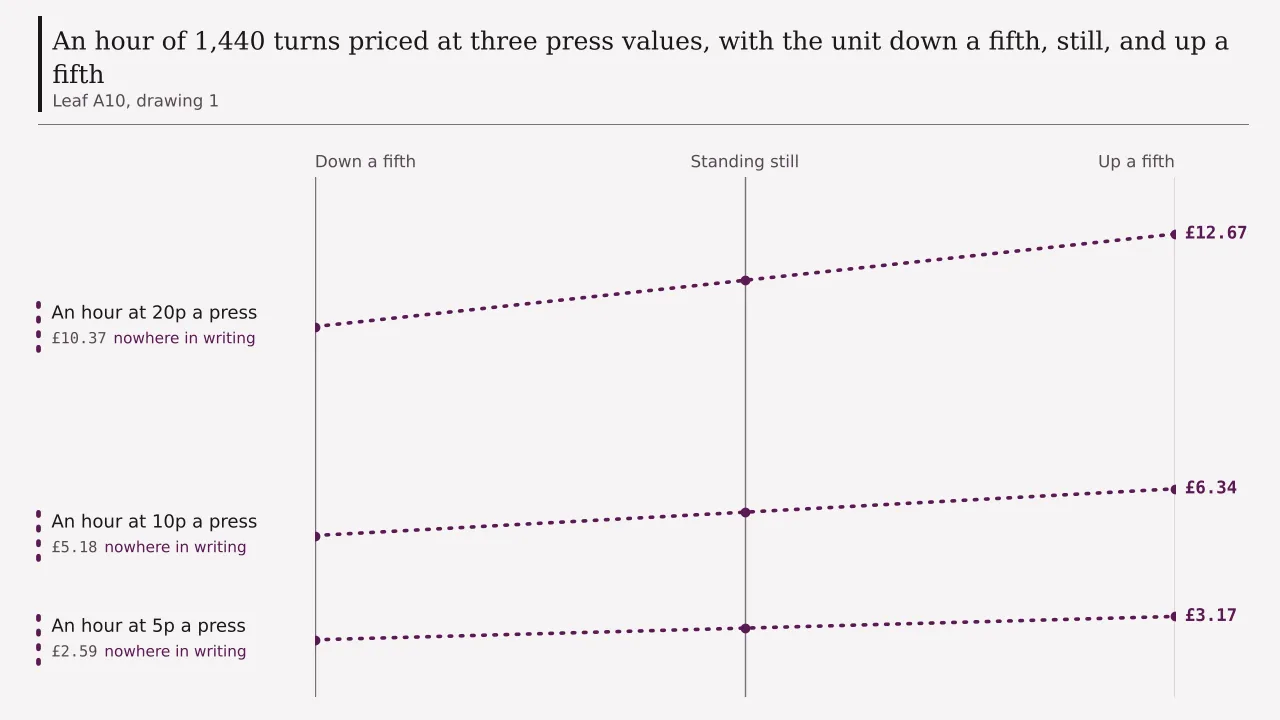
The drawing makes one property obvious that the table only implies. The band widens in exact proportion to the press value, so a reader at 20p a press carries a second term four times the size of a reader at 5p, and the two bands never overlap. Choosing a larger stake does not merely speed the first term up. It enlarges the term that nobody has written down.
An honest qualification belongs here and it cuts against the page. Movement is symmetrical, so a reader whose unit falls across the hour has an hour that costs less in pounds than the steady reading, by exactly as much as a rise would have added. Nothing here says the second term runs one way. It says the hourly cost in pounds is not a constant, which means a sentence beginning with the words an hour costs is incomplete in a way nobody has flagged.
4
Two ceilings written in pounds, and exactly what they reach
Two figures, and both are statutory rather than regulatory in origin. SI 215 of 2025, dated the twenty-fifth of February that year, caps the total one individual may stake against a single game cycle: two pounds for anybody under twenty-five, five pounds once they are twenty-five or older. Those are the only published British figures for what a single turn of a reel may cost, which is why a reader reaches for them and why this part has to explain what they do.
It bolts that ceiling onto every remote casino operating licence, those granted beforehand included, and describes the game it bites on as a reel-based one played online, a reel-based game being one in which shifting imagery settles whether any prize or advantage is won at all. The definition is doing real work: it decides what counts as the thing being capped, and it is drawn around the mechanics of the display rather than around anybody’s marketing.
The two dates belong to the regulator rather than to the instrument, which gives a sum where a calendar would be: six weeks counted from the day of making. Against that, the regulator’s own guidance attaches 9 April 2025 to the five pound figure and 21 May 2025 to the two pound one, with a transitional stretch of six weeks between them during which five pounds applied to everybody whatever their age. The same guidance is equally plain about scope, confining these ceilings to online slots and setting roulette and blackjack outside them.
So the list of what the two figures reach is short and exact. They reach a reel-based casino game played online, through a remote casino operating licence, old licences as well as new. They do not reach a table game, a card game, a lottery or anything the definition leaves outside. They say nothing whatever about an hour, a day or a session, being written against one cycle with no word on how many cycles may be run. And they do not reach a build with no British licence behind it, which is the whole of the market this page is about.
| Ceiling on one game cycle | Where it is settled | Turnover an hour can hold | Expected cost of that hour |
|---|---|---|---|
| £5.00, individual aged 25 or over | in a published rule | £7,200.00 | £288.00 |
| £2.00, individual under 25 | in a published rule | £2,880.00 | £115.20 |
| 10p, this site’s working press value | nowhere in writing | £144.00 | £5.76 |
| No pound ceiling at all | nowhere in writing | Unbounded | Unbounded |
The distance between the first two rows is £172.80 of expected cost an hour, which is 4 per cent of the £4,320.00 of turnover the older bracket may add. Put plainly, the line Parliament drew between a person of 24 and a person of 25 is worth about a hundred and seventy-three pounds an hour at full stretch, and neither bracket will meet that in practice, since almost nobody stakes at a ceiling for 1,440 consecutive turns.
£172.80 an hour between the two pound ceilings at full stretch, against no ceiling whatever where a stake is denominated elsewhere
5
A ceiling in pounds against a stake that is not in pounds
Part four fixed what the two figures reach. This part works out what happens when somebody tries to use them as a yardstick anyway, which is the thing readers most often attempt and the thing that cannot be done.
A ceiling written in pounds is a comparison against a pound quantity. A stake fixed in a drifting unit is a pound quantity only at an instant, and it is a different pound quantity at the next instant, so the comparison has an answer at the moment it is asked and a possibly different answer by the time the turn resolves. Nothing is being evaded by anyone. The two things are simply measured in different scales, and only one of the scales holds still.
Work it with the page’s own assumed drift. Take a press fixed at whatever quantity is worth £4.90 at the top of the hour, which sits under the £5.00 figure with ten pence to spare. Let the unit rise a tenth, this page’s assumption again, and the identical quantity is worth £5.39 at the bottom of the hour. The stake never changed. It began under a pound ceiling and finished over it, and the reader pressing the button did nothing differently at either end.
The same thing happens against the smaller figure and at a smaller scale. A press standing at £1.95 is comfortably under £2.00, and a tenth of upward drift carries it to £2.15. Set the two together and a single unchanged stake crosses the under-25 ceiling and the over-25 ceiling on the same assumed movement, which is as plain a statement as this page can make that a pound threshold and a non-pound stake are not comparable quantities.
| Stake fixed in the drifting unit | Worth at the top of the hour | Worth after a tenth of drift | Against the £5.00 figure | Against the £2.00 figure |
|---|---|---|---|---|
| A larger press | £4.90 | £5.39 | Under, then over | Over at both moments |
| A middling press | £1.95 | £2.15 | Under at both moments | Under, then over |
| A small press | £0.10 | £0.11 | Under at both moments | Under at both moments |
Three readings and two of them flip. That is the finding of this part, and it holds whatever the drift turns out to be, because the only thing needed for a flip is that the stake began within one movement of a threshold. A smaller assumed drift narrows the band of stakes that can flip and never closes it.
Which produces the sentence this part exists for. The caps in part four are not loose on a stake of this kind, and they are not strict on it either. They have nothing to act on, because the quantity they would act on is not expressed in their units, and no conversion fixes that, since a conversion is true at one instant and the rule is written about a game cycle rather than about an instant.
The honest half of this is that the caps do not reach these builds in the first place, licence or no units. A reader could therefore say the whole comparison is beside the point. It is not beside the point, for one reason: the caps are the only published British statement of how much a single turn of a reel may cost, so they are the natural yardstick a reader reaches for, and a page on this subject owes an explanation of why reaching for it returns nothing.
6
Checking the draw settles the draw and nothing about the return
A reel priced in a drifting unit commonly comes with a claim that each draw can be verified afterwards. The claim is a real one and this page does not sneer at it. What it does is separate two quantities that the claim is routinely read as covering, and price the distance between them.
Quantity one is the draw. A verifiable draw means a reader can satisfy themselves, after the turn, that the outcome was fixed before they pressed and was not chosen in the light of their balance. That is a genuine assurance about process, and under a British licence the same assurance comes out of a published standard instead of out of a calculation, since results there have to fall out acceptably random and an adapting game is barred.
Quantity two is the return, and the draw says nothing about it. A return figure is a property of the paytable and the symbol distribution together, not of the randomness of the selection. A perfectly verifiable draw over a table paying little is verifiably poor. A reader who checks a draw has established that the shuffle was fair and has established nothing at all about what the deck contains.
Price that separation on the hour from part two. An hour of 1,440 turns at 10p turns over £144.00, so each percentage point of return is worth £1.44 of that hour, being a hundredth of the turnover. The published 96 in the hundred gives an expected cost of £5.76. Assume the real figure is eight points lower at 88, which is this page’s assumption and is not a figure read from anywhere, and the expected cost becomes 12 per cent of £144.00, which is £17.28.
An hour where ninety-six pence comes back on the pound £5.76 The same hour at an assumed 88, draw verified £17.28 What verifying the draw leaves unsettled £11.52
Eleven pounds and fifty-two pence comes out a second way from the sensitivity rather than from the two totals. Each point of return is worth £1.44 an hour, the gap between 96 and 88 is eight points, and eight multiplied by £1.44 is £11.52 exactly. One route subtracts two expected costs while the other multiplies a per-point rate by a count of points, and the agreement tells a reader the figure belongs to the return itself and owes nothing to the assumed 88.
Set the two sorts of assurance against each other and the comparison is uncomfortable for both. A verified draw at an unknown return leaves £1.44 an hour riding on every point nobody has stated, and the verification settles not one of them. An unverified draw at a published return hands a reader £5.76 an hour that can be computed, and leaves them trusting that the process behind it was not interfered with. Neither gives both halves, and a reader who assumes that the first gives both has paid for the assumption at £1.44 a point an hour.
A last point of fairness. On a licensed build nobody has to choose, the process assurance being a published standard and the chance information reachable ahead of any commitment. Outside that licence the two halves come apart, and a verifiable draw is the half that is cheap to supply.
7
Rules written in pounds and in seconds, and what an unlicensed reel keeps
The British rules bearing on one turn of a reel share a property worth naming: each is written in something a person can measure. Two are counted in pounds, one in seconds, two in acts the system must require or may not offer, and one in a prohibition on how a machine may behave. Between them they are the only published arithmetic on what a turn may cost and how quickly turns may arrive.
Counted in pounds: the two ceilings of part four, fastened to a remote casino operating licence, reaching a reel-based game played online and reaching nothing else.
Counted in seconds: a licensed reel waits 2.5 seconds from one cycle opening before the next may open, which is what holds an hour down to 1,440 turns and therefore holds down every figure in part two. A start control, or whatever stands in for one, has to be let go of and worked again at each turn, so a finger held down begins nothing.
Counted in acts, two more. Autoplay has no place on licensed online gaming, each cycle needing to be committed to by itself, with the solitary carve-out covering blinds that post themselves in poker played between players. And a licensed system may not hand anybody a way of bringing the result forward, which rules out the turbo button, the quick spin and the slam stop alike, while a feature round carrying no fresh stake is left alone.
Counted in a prohibition, the rule part six leaned on. Results have to fall out acceptably random, and a game that adapts, meaning one shifting its probabilities in the light of what has gone before, is barred. The guidance bars interference of either sort, by hand or by machine, and expects results to arrive in the proportions theory gives. A licensed reel also withholds any celebration from a return at or under the stake just gambled, so a turn giving back less than it took gets no fanfare for doing it.
Reels priced in a drifting unit hold no Great Britain licence, and the way into that loss here is to ask what each rule measured and then take the measurement away. The pound ceilings measured the largest cost one turn could carry, so without them the £288.00 an hour of part four has no figure above it. The 2.5 seconds measured the shortest gap between turns, so without it the 1,440 that every sum on this page rests on turns into a floor under an hour rather than a ceiling over it, which makes every cost printed here the smallest version of itself. Committing to a cycle measured deliberateness, and the bar on hurrying a result measured the same thing from the far side; with neither, an hour can hold a great deal more than 1,440 turns while asking for fewer decisions on the way. The randomness prohibition measured the process, which is the single item part six found a verifiable draw able to supply on its own. Six measurements, five gone with nothing put in their place, and the sixth replaceable by arithmetic a reader runs without anybody.
That last sentence is the fair one, and it is why this part is laid out as measurements rather than as protections. A verifiable draw really does the work the randomness rule did, for a reader willing to do the checking. Nothing substitutes for a figure written in pounds and nothing substitutes for a gap written in seconds, both being limits on quantity rather than assurances about process, and no calculation anybody performs can impose a limit on anyone.
8
Why the second term is met on the way out
The drift is public. Anybody may watch a unit move, in any direction, at any hour, without an account or a permission, which makes it the most observable thing on this page. So the question this section puts to every page applies with force here: how can a term built on a public quantity be something discovered while leaving.
Because the term is not the drift. The term is the difference between two hourly costs, and a difference needs two readings before it exists. On the way in there is one reading. A stake is chosen, a balance appears in the drifting unit, and the pound cost of an hour is a number nobody has had occasion to compute, because the hour has not happened.
It becomes computable at exactly one point: the balance is converted back. That is where a reader first has a pound figure at both ends of the session and can subtract. Until then the arithmetic is available in principle and has nothing to act on, which is the definition this whole section works to.
Put a scale on the gap between those two moments. A credit of £50.00 asked to be turned over forty times wants £2,000.00 across the reel, which at 10p is twenty thousand turns, and at 1,440 turns an hour that is 13.89 hours of pressing. Across getting on for fourteen hours a unit has ample room to move, and the whole of that movement is reconciled in one figure at the end rather than press by press on the way through.
One more property makes the discovery sharper. The second term is invisible inside the session by construction, since the balance is denominated in the drifting unit and reads as a constant while the pound value underneath it changes. A reader watching their own balance sees nothing move except through play. The quantity this page prices is the one quantity a running balance in that unit cannot show.
Which marks this page off from those about conditions a reader could have opened for themselves. A wagering clause is written down, and somebody who left the document shut could have opened it. The second term is written nowhere, is unknowable in advance, is not a condition anybody imposed, and is settled by a market that has never heard of either party. That is a different kind of absence and it is why the page sits where it does.
9
What can be fixed before the first press of the hour
Three things on this page can be settled in advance and the rest cannot. Listing which is which is the useful output, since everything above is arithmetic a reader can rerun with their own numbers in a couple of minutes.
Fixed in advance, the first: the count of turns an hour can hold, and therefore the turnover. At a measured interval between turns an hour has a maximum, 1,440 where the interval is two and a half seconds. Multiply by whatever a press is worth in pence at the moment of asking and the first reading of the hour is settled.
Fixed in advance, the second: the first term of the subtraction. Four pence in each pound turned over at a 96 per cent return, so £5.76 on £144.00, scaling exactly with the press value and with nothing else. A reader who knows the press value and the return knows this figure before pressing anything.
Fixed in advance, the third: the fact that a pound ceiling cannot be compared with a non-pound stake. That is a statement about units rather than about markets, and it is true before any drift happens and would stay true if the drift turned out to be nought.
Not fixed in advance, and no amount of reading settles any of them: the size of the drift, which is why the 20 per cent above wears its label on every line where it appears; the direction of the drift, which decides the sign of the second term; and the real return, which the verifiable draw does not establish and which nothing outside a licence obliges anybody to publish.
Two habits carry the method onto any hour a reader wants to price. Put the press value in pence at a stated moment and carry the moment with the figure, since a press value without a timestamp is not a quantity. And compute the hour twice rather than once, with the unit still and with it moved by whatever a reader thinks plausible, then print both and rule off the difference, which is what every page here does with every condition it meets.
The shortest honest summary of the subject is four figures. An hour of 1,440 turns at 10p costs an expected £5.76 with the unit nailed down. A 20 per cent drift moves that anywhere inside a band £1.15 wide. A return eight points below the published figure adds £11.52 to the same hour. And the two British pound ceilings on one turn, £5.00 and £2.00, have nothing to compare against where the stake is not denominated in pounds.
Questions
- Why is a stake priced in a moving unit not a fixed stake?
- Because the quantity staked stays constant in its own unit and varies in pence, so an hour holds as many different pound stakes as it holds turns. Nothing about the offer changes and nothing in the terms moves. The measuring stick moves. That is enough to stop the hourly cost in pounds being a constant, which is the premise every other subtraction on this site quietly relies on.
- What does an hour of pressing cost with the unit standing still?
- An expected £5.76. A reel inside a British licence waits 2.5 seconds from one cycle opening before the next may open, so an hour of 3,600 seconds carries 1,440 turns at the very most. At a press worth 10p, the value this site holds to, that is £144.00 over the counter, and at ninety-six pence back on the pound the reel keeps four of every hundred, which is £5.76.
- How much does an assumed drift add to that hour?
- Fifty-eight pence on a rise of a fifth, and the same figure the other way on a fall. The 20 per cent is this page’s own assumption and no source it may cite publishes a movement for any unit. A press worth 10p rising to 12p across the hour averages 11p, turnover becomes £158.40, and 4 per cent of that is £6.34. The £0.58 also comes out as 4 per cent of the £14.40 of extra turnover, which is the check on it.
- Does the second term run in one direction only?
- No, and the page would be writing nonsense if it suggested otherwise. A fall of a fifth takes a 10p press to 8p, averages it at 9p, drops turnover to £129.60 and prices the hour at £5.18. So the whole band on a drift of a fifth in either direction is £1.15 wide on the unrounded figures, with £5.76 sitting in the middle. The claim here is not that the term is a cost. It is that the hourly cost in pounds is not a constant.
- What are the British stake limits on one turn of a reel?
- Two figures out of a statutory instrument, SI 215 of 2025, dated the twenty-fifth of February that year: the total one individual may stake against a single game cycle is capped at two pounds for anybody under twenty-five and five pounds once they are twenty-five or older. The regulator’s guidance attaches 9 April 2025 to the larger figure and 21 May to the smaller, with six transitional weeks in between where five pounds covered everybody regardless of age.
- What do those two figures not reach?
- They reach no table game, no card game and nothing else the definition leaves outside, the guidance confining the ceilings to online slots and setting roulette and blackjack beyond them. They say nothing about an hour, a day or a session, being written against one cycle with no word on how many may be run. And they do not reach a build without a British remote casino operating licence, which is the market this page is about.
- Why can a pound ceiling not be used on a stake fixed elsewhere?
- Because a ceiling written in pounds compares against a pound quantity, and a stake fixed in a drifting unit is a pound quantity only at an instant. Take a press worth £4.90 at the top of the hour, ten pence clear of the £5.00 figure, and let the unit rise a tenth on this page’s assumption: the identical stake is worth £5.39 at the bottom of the hour. It began under the ceiling and finished over it while the reader did nothing differently.
- How far apart are the two pound ceilings in money?
- £172.80 of expected cost an hour at full stretch. At £5.00 a turn an hour of 1,440 turns can hold £7,200.00 of turnover and costs an expected £288.00; at £2.00 it holds £2,880.00 and costs £115.20. The difference is 4 per cent of the £4,320.00 of extra turnover the older bracket may add. Neither bracket will meet those figures in practice, since almost nobody stakes at a ceiling for 1,440 consecutive turns.
- Does a verifiable draw tell me the return?
- It tells you nothing about it. A verifiable draw establishes that an outcome was fixed before the press and not chosen in the light of a balance, which is an assurance about process. A return figure is a property of the paytable and the symbol distribution. A perfectly verifiable draw over a table paying little is verifiably poor, so checking the draw establishes that the shuffle was fair and establishes nothing about what the deck holds.
- What is the difference between those two assurances worth?
- £11.52 an hour on this page’s worked assumption. An hour of 1,440 turns at 10p turns over £144.00, so each percentage point of return is worth £1.44. At a published 96 the hour costs an expected £5.76; assume the real figure is eight points lower at 88 and it costs £17.28. The same £11.52 arrives as eight points multiplied by £1.44, which tells a reader the figure belongs to the return itself and owes nothing to the assumed 88.
- What does a reader lose where a reel is priced this way?
- Reels priced in a drifting unit hold no Great Britain licence, so every measurement in part seven goes. The pound ceilings measured the largest cost one turn could carry, and without them £288.00 an hour has no figure above it. The 2.5 seconds measured the shortest gap between turns, so the 1,440 every figure here rests on turns into a floor under an hour rather than a ceiling over it, and every cost printed is the smallest version of itself. Committing to a cycle, and the bar on hurrying a result, measured deliberateness. Only the randomness prohibition has a substitute, and a verifiable draw is it.
- Why is the second term met on the way out rather than at the start?
- Because a difference needs two readings and there is only one on the way in. A stake is chosen, a balance appears in the drifting unit, and the pound cost of an hour is a figure nobody has had cause to compute. It becomes computable when the balance is converted back, which is the first moment with a pound figure at both ends. A balance held in that unit reads as a constant while its pound value changes underneath, so the quantity priced here is the one a running balance cannot show.