Terms read 19 October 2026 Leaf A06, revision 1
USDT casino balances, and the one quantity a peg actually holds still
On a £25.00 balance, holding the unit’s price still removes an assumed £2.00 of swing and leaves £27.40 of other exposure exactly where it stood. That is 6.80 per cent by money and 14.29 per cent by a count of the conditions involved, and this leaf works out why the two readings differ by a factor of more than two.
Stated on the banner One to one A unit written to track a national currency, which is the entire published promise and is kept. Stated, once you go and look Swing of £2.00 What that promise is worth across an assumed 48 hours of holding at an assumed eight per cent of movement either way. Not stated before the money goes in Another six Who answers a dispute, whose registration reaches the site, which ceilings exist, whether a payment can be undone, how long a release takes, and when documents get asked for.
Offers settled in a pegged unit, with their terms read
Every destination in this file is bought advertising. The site is paid a fee if a reader goes on to register, and no figure printed below moves because of it.
Bonus Spins UK Slip 01
Betportal
Ceiling as a multiple
The drop
€15.00
€1.00 in the euro
The claim reads €15.00. Once the terms beside it have applied, €0.00 of it can leave. The difference is the drop.
7 of the 15 terms on this slip could not be read before the money went in
Spins priced at this site's own 10p a spin, which the operator does not publish
Stated
€15.00
The claim as it is printed, before a single term has been applied to it.
Headline paid as spins
150 spins at 10c each, which is €15.00 of the figure above.
6 Nowhere
What one spin is worth
No unit is published for a spin, so the count is priced at this site's own 10p a spin. At half that price every figure below halves with it.
Match and other credit not priced
300% of three deposits, to a ceiling of €1,000. A share of a deposit nobody has made yet is not a sum, so no figure stands on this line and none is carried below.
Qualified
-€14.40
Written down somewhere, and taking part of the claim back. Each term carries the place it is written and the sum it takes.
2 Written terms at a distance this record does not establish
Play-through -€14.40
Carrying €14.40 through 35 times stakes €504.00 and costs €20.16 of it at 96 per cent return. That prices above the €14.40 there is to charge it against, so the whole of the credit goes and the line is held at that. The multiple sits on the bonus.
2 Written terms at a distance this record does not establish
Game weighting not priced
Slots only count towards the play-through. No contribution percentage is published, so the line above has been worked at full weight, which is the kindest reading there is.
2 Written terms at a distance this record does not establish
Ceiling on the winnings not priced
5x the bonus.
2 Written terms at a distance this record does not establish
Clock on the credit not priced
14 days.
2 Written terms at a distance this record does not establish
Largest stake while it runs not priced
€5.
3 Public record
Licence, and who holds it not priced
Licensed in Anjouan, Comoros, held by BetPortal Gaming Ltd, with Excite Ultra Media Ltd, reference ALSI-202601040-FI2. A register entry settles who holds a licence and what it permits. It does not settle who is running the site this morning.
4 Cashier
Smallest qualifying deposit your money
€20 a stage. That is €20.00 of your own money, and it is never netted into a drop.
5 On the way out
Checks before a withdrawal not priced
Documents before the first withdrawal.
Unstated
-€0.60
Applying without having been published anywhere, and costing money all the same.
6 Nowhere
What a spin hands back -€0.60
Staking a spin returns 96 per cent of it, so that share of the batch is the house's before a reel turns. This site works at that return and the operator publishes none where the claim is made.
6 Nowhere
Forfeited by rule cost unknown
Nothing is published under this heading, and it applies regardless.
6 Nowhere
Charge on the way out cost unknown
No charge on the way out is published as a figure, so nothing comes off this line. A charge that exists unpublished would come straight off whatever survives.
6 Nowhere
Smallest withdrawal allowed cost unknown
No smallest withdrawal is published as a figure. A floor nobody has published is still a floor, and it decides whether a small balance can move at all.
No Great Britain licence
Terms read 19 October 2026
Bonus Spins UK Slip 02
WinBeast
Ceiling as a sum
The drop
€50.00
€1.00 in the euro
The claim reads €50.00. Once the terms beside it have applied, €0.00 of it can leave. The difference is the drop.
8 of the 15 terms on this slip could not be read before the money went in
Spins priced at this site's own 10p a spin, which the operator does not publish
Stated
€50.00
The claim as it is printed, before a single term has been applied to it.
Headline paid as spins
500 spins at 10c each, which is €50.00 of the figure above.
6 Nowhere
What one spin is worth
No unit is published for a spin, so the count is priced at this site's own 10p a spin. At half that price every figure below halves with it.
Match and other credit not priced
50% to 100% of five deposits, each to a ceiling of €1,000, and a €650 free bet. A share of a deposit nobody has made yet is not a sum, so no figure stands on this line and none is carried below.
Qualified
-€48.00
Written down somewhere, and taking part of the claim back. Each term carries the place it is written and the sum it takes.
2 Written terms at a distance this record does not establish
Play-through -€48.00
Carrying €48.00 through 40 times stakes €1,920.00 and costs €76.80 of it at 96 per cent return. That prices above the €48.00 there is to charge it against, so the whole of the credit goes and the line is held at that. The multiple sits on the bonus and the winnings from the spins.
2 Written terms at a distance this record does not establish
Game weighting not priced
Slots, titles vary by country count towards the play-through. No contribution percentage is published, so the line above has been worked at full weight, which is the kindest reading there is.
2 Written terms at a distance this record does not establish
Ceiling on the winnings not priced
€100 a batch of spins.
2 Written terms at a distance this record does not establish
Clock on the credit not priced
7 days, spins 1 day.
3 Public record
Licence, and who holds it not priced
Licensed in Curaçao, holder not named on the site. A register entry settles who holds a licence and what it permits. It does not settle who is running the site this morning.
4 Cashier
Smallest qualifying deposit your money
€20 a stage. That is €20.00 of your own money, and it is never netted into a drop.
5 On the way out
Checks before a withdrawal not priced
Documents before the first withdrawal.
Unstated
-€2.00
Applying without having been published anywhere, and costing money all the same.
6 Nowhere
What a spin hands back -€2.00
Staking a spin returns 96 per cent of it, so that share of the batch is the house's before a reel turns. This site works at that return and the operator publishes none where the claim is made.
6 Nowhere
Largest stake while it runs cost unknown
Nothing is published under this heading, and it applies regardless.
6 Nowhere
Forfeited by rule cost unknown
Nothing is published under this heading, and it applies regardless.
6 Nowhere
Charge on the way out cost unknown
No charge on the way out is published as a figure, so nothing comes off this line. A charge that exists unpublished would come straight off whatever survives.
6 Nowhere
Smallest withdrawal allowed cost unknown
No smallest withdrawal is published as a figure. A floor nobody has published is still a floor, and it decides whether a small balance can move at all.
No Great Britain licence
Terms read 19 October 2026
Bonus Spins UK Slip 03
EliteSpin
Longest spin window
The drop
£50.00
£1.00 in the pound
The claim reads £50.00. Once the terms beside it have applied, £0.00 of it can leave. The difference is the drop.
8 of the 15 terms on this slip could not be read before the money went in
Spins priced at this site's own 10p a spin, which the operator does not publish
Stated
£50.00
The claim as it is printed, before a single term has been applied to it.
Headline paid as spins
500 spins at 10p each, which is £50.00 of the figure above.
6 Nowhere
What one spin is worth
No unit is published for a spin, so the count is priced at this site's own 10p a spin. At half that price every figure below halves with it.
Match and other credit not priced
50% to 100% of five deposits, each to a ceiling of £1,000. A share of a deposit nobody has made yet is not a sum, so no figure stands on this line and none is carried below.
Qualified
-£48.00
Written down somewhere, and taking part of the claim back. Each term carries the place it is written and the sum it takes.
2 Written terms at a distance this record does not establish
Play-through -£48.00
Carrying £48.00 through 40 times stakes £1,920.00 and costs £76.80 of it at 96 per cent return. That prices above the £48.00 there is to charge it against, so the whole of the credit goes and the line is held at that. The multiple sits on the bonus and the winnings from the spins.
2 Written terms at a distance this record does not establish
Game weighting not priced
Slots count towards the play-through. No contribution percentage is published, so the line above has been worked at full weight, which is the kindest reading there is.
2 Written terms at a distance this record does not establish
Ceiling on the winnings not priced
5x the bonus.
2 Written terms at a distance this record does not establish
Clock on the credit not priced
7 days, spins 3 days.
3 Public record
Licence, and who holds it not priced
Licensed in Costa Rica, held by PrimeTier Limited. A register entry settles who holds a licence and what it permits. It does not settle who is running the site this morning.
4 Cashier
Smallest qualifying deposit your money
£20 a stage. That is £20.00 of your own money, and it is never netted into a drop.
5 On the way out
Checks before a withdrawal not priced
Documents before the first withdrawal.
Unstated
-£2.00
Applying without having been published anywhere, and costing money all the same.
6 Nowhere
What a spin hands back -£2.00
Staking a spin returns 96 per cent of it, so that share of the batch is the house's before a reel turns. This site works at that return and the operator publishes none where the claim is made.
6 Nowhere
Largest stake while it runs cost unknown
Nothing is published under this heading, and it applies regardless.
6 Nowhere
Forfeited by rule cost unknown
Nothing is published under this heading, and it applies regardless.
6 Nowhere
Charge on the way out cost unknown
No charge on the way out is published as a figure, so nothing comes off this line. A charge that exists unpublished would come straight off whatever survives.
6 Nowhere
Smallest withdrawal allowed cost unknown
No smallest withdrawal is published as a figure. A floor nobody has published is still a floor, and it decides whether a small balance can move at all.
No Great Britain licence
Terms read 19 October 2026
Bonus Spins UK Slip 04
Crown Jewelz
Multiple unpublished
The drop
NOT WORKED
The multiple is not published in the operator's own terms. Since the sum cannot be worked around it, none is worked.
9 of the 14 terms on this slip could not be read before the money went in
No drop worked
Stated
£15.00
The claim as it is printed, before a single term has been applied to it.
Headline paid as spins
150 spins at 10p each, which is £15.00 of the figure above.
6 Nowhere
What one spin is worth
No unit is published for a spin, so the count is priced at this site's own 10p a spin. At half that price every figure below halves with it.
Match and other credit not priced
200% of the first deposit, then 150% twice, each to a ceiling of £1,000. A share of a deposit nobody has made yet is not a sum, so no figure stands on this line and none is carried below.
Qualified
NOT WORKED
Written down somewhere, and taking part of the claim back. Each term carries the place it is written and the sum it takes.
2 Written terms at a distance this record does not establish
Play-through not priced
40x the bonus, reported rather than published by the operator.
2 Written terms at a distance this record does not establish
Game weighting not priced
Slots count towards the play-through. No contribution percentage is published, so the line above has been worked at full weight, which is the kindest reading there is.
3 Public record
Licence, and who holds it not priced
Licensed in Curaçao, number not verified, holder not named on the site. A register entry settles who holds a licence and what it permits. It does not settle who is running the site this morning.
4 Cashier
Smallest qualifying deposit your money
£20. That is £20.00 of your own money, and it is never netted into a drop.
5 On the way out
Checks before a withdrawal not priced
Documents before the first withdrawal.
Unstated
NOT WORKED
Applying without having been published anywhere, and costing money all the same.
6 Nowhere
Ceiling on the winnings cost unknown
No ceiling is published. Nothing is assumed in its place.
6 Nowhere
Clock on the credit cost unknown
Nothing is published under this heading, and it applies regardless.
6 Nowhere
Largest stake while it runs cost unknown
Nothing is published under this heading, and it applies regardless.
6 Nowhere
Forfeited by rule cost unknown
Nothing is published under this heading, and it applies regardless.
6 Nowhere
Charge on the way out cost unknown
No charge on the way out is published as a figure, so nothing comes off this line. A charge that exists unpublished would come straight off whatever survives.
6 Nowhere
Smallest withdrawal allowed cost unknown
No smallest withdrawal is published as a figure. A floor nobody has published is still a floor, and it decides whether a small balance can move at all.
No Great Britain licence
Terms read 19 October 2026
Every figure in the second and third columns is this site's own working and nothing an operator has published. A claim is priced as printed, then the share a spin hands back at 96 per cent return comes off it, then what playing the multiple through costs at the same return, and then whatever a published ceiling, a charge on the way out or a floor on the smallest withdrawal takes from what has survived. The drop is the difference between the first figure and the last. The two columns add back up to it exactly, so no money leaves a slip without a term and a place beside it.
Which column a term falls in is settled by one question: has anybody written it down. A charge a reader meets at the payment screen is written down, and it stands in the second column with the cashier against it. A condition that binds without ever having been set down stands in the third, whatever it costs. Inside each column the terms run outwards from the banner, so the order itself says how far a reader would have had to go.
A count of spins has no unit until one is supplied. Where an operator publishes what one of its own spins is worth, that figure is used and the first column says it is theirs. Where none is published, this site's own 10p a spin stands in its place and every figure below moves in proportion with it. Where the multiple itself is unpublished, no drop is worked at all, because that is the one figure the sum cannot be done without.
Three words stand where a figure cannot. Not priced is a term that is written down and carries no number the arithmetic can take. Cost unknown is a term nobody has written down, costing something nobody has put a number on. Your money is money of the reader's own, which is never netted into a drop.
None of the operators in this file holds a Great Britain licence, so none of the duties that licence carries reaches them. Each of those duties is published in its own right, which is what makes its absence here something a reader can check rather than take on trust. Every gambling company licensed in Great Britain belongs to Gamstop Online, so a reader who has shut themselves out through the scheme is not shut out here. Social Responsibility Code 5.1.1 has held a play-through to a maximum of ten times the bonus funds since 19 January 2026, and it binds a licence holder and nobody else. Asked in a post of 21 October 2025 what is lost along with the licence, the Gambling Commission's Director of Enforcement and Intelligence answered: "unfair gaming practices, financial loss, and a lack of recourse if things go wrong". The same post puts blocked payouts, and withdrawal limits pitched high enough to be unreachable, among the behaviour the Commission has recorded. Nobody under 18 may hold an account at any of them.
Terms are reproduced in the wording their operator published, and each slip is dated with the day somebody sat down and read them. 19 October 2026 is the oldest of those dates. Anybody claiming an offer is bound by that operator's full terms, which are elsewhere, and never by a line standing here.
1
One quantity held still, measured in pounds
A unit written to track a national currency makes one promise and keeps it. The number of pounds a holding is worth stops wandering while somebody holds it. That is a real property, it is not a marketing claim, and nothing below is an argument that the promise is broken.
The argument is about its size. Set £25.00 against that promise and assume the sum sits where it is for 48 hours between the moment somebody decides to collect it and the moment anything reaches a bank, and assume an unpegged unit would move eight per cent either way across that stretch. Both of those are figures this leaf has chosen in order to have something to multiply, and neither is published anywhere.
Eight per cent of £25.00 is £2.00. That two pounds is the whole of what the promise is worth over those 48 hours, and it is the only figure on this leaf that the promise touches. Everything else that can change what reaches a bank carries on exactly as it did, and parts two and three put a number on each piece.
Anybody reading this because a self-exclusion is in force against them has come to the wrong page for what they want and the right page for what helps. Talk to GamCare.org.uk or BeGambleAware.org, or ring GamCare’s National Gambling Helpline at no cost, on 0808 8020 133, staffed round the clock and every day of the week. A registration with Gamstop Online reaches operators licensed in Britain and, by the scheme’s own written account of itself, reaches nobody else. That boundary is a fact about the protection and not an invitation, this leaf prints no route across it, and none of the sums here gets better for finding one.
The sorting this site runs applies to a pegged unit as it applies to anything else. The promise is settled , because tracking a currency is the whole of what the unit is advertised as doing. The six conditions in part two are settled elsewhere, and four of the six are settled on the way out, which is why they belong in this group of leaves while the promise does not.
What this leaf wants to know is therefore narrow and answerable. Of everything able to change how many pounds a £25.00 balance turns into, what share does a steady price remove. The answer comes in two readings, 6.80 per cent and 2.52 per cent, each well under the impression the promise leaves.
2
Six conditions a steady price does not reach
Six things decide whether a balance becomes money, and a held price is none of them. Taking them one at a time is slower than listing them and produces a figure at the end, which listing them does not.
The complaint route. Where a sum is disputed, what matters is whether anybody is obliged to answer and within what period. Holding a unit’s price still has no bearing on that, and the honest position is not that the route disappears. One offshore rulebook this site can read publishes six months in which a complaint may be raised and four weeks in which it must be answered, with one written extension of the same length available, giving eight weeks at the outside. What goes is not the existence of a route but whose rules govern the end of it, and that is taken up in part seven. The sum at stake when a route fails is the balance in full, £25.00.
The exclusion cycle. A registration that closes accounts follows a British licence rather than a payment method, so a unit holding its price steady does nothing to it in either direction. Among the seven, this alone carries no pound figure beside it, because what is at stake is a fact about the person rather than a fact about the balance, and inventing a figure for it would be worse than leaving the cell empty.
The limit settings. Whether a reader can cap what goes in, over what periods, how fast a reduction takes effect and how slowly an increase does are properties of the account rather than of the unit. A peg does not supply a ceiling, and nothing about a steady price prevents £25.00 going in where a reader had meant £10.00 to be the most. The sum at stake is whatever sits above the ceiling that was never offered.
The reversal window. Once a payment has gone, the question is whether any mechanism exists to pull it back, and the peg is silent. A steady price makes the amount that cannot be pulled back easier to state and no easier to pull back. At stake is the payment itself, £25.00.
The operator’s hold. Between a request and a release sits a period nobody publishes a length for. The unit’s price being steady during it changes the pounds not at all and the waiting not at all. This item moves no money and moves the whole of the timing, which is why its cell reads as a length rather than a sum.
The identity round. Where documents are first demanded at the exit rather than at the start, the balance waits on paperwork, and a reader who cannot satisfy it is holding a sum that stays on a screen. A pegged unit keeps that sum legible. It does not pay it out. At stake, again, is £25.00.
| What can change the sum | Where a reader would settle it | At stake on £25.00 | Touched by a steady price |
|---|---|---|---|
| The unit’s price across an assumed 48 hours | £2.00 | Yes, and it is alone in that | |
| A transfer charge nobody quotes in advance | on the way out | £2.40 | No |
| A complaint with nobody compelled to answer | in the written terms | £25.00 | No |
| A payment in that cannot be undone | on the way out | £25.00 | No |
| Documents first demanded at the exit | on the way out | £25.00 | No |
| A release period of unpublished length | nowhere in writing | Timing only | No |
| Whether a registration shuts the account | in the public register | Not a sum | No |
Seven rows, one yes. The £2.40 charge in the second row is an assumed figure carried across from the arithmetic on a neighbouring leaf, where a transfer priced by demand rather than by a published schedule is taken apart properly. It appears here only as a line in a denominator.
3
The proportion, worked two different ways
Adding the fourth column needs a decision taken in the open, because three of those rows can each take the whole £25.00 and they are plainly not independent of one another. A balance lost to an unanswerable dispute is not then lost again to a document demand. So there are two defensible denominators and this part prints both rather than choosing.
The wide denominator adds every line as written: £2.00 of swing, £2.40 of charge, and three separate routes by which the whole £25.00 fails to arrive. That totals £79.40. Two pounds against £79.40 is 2.52 per cent.
The narrow denominator refuses to count the same twenty-five pounds three times. Take the largest single thing that can happen, which is the balance not arriving at all, and add only the two quantities that act on top of a balance that does arrive: the charge and the swing. That totals £29.40, and two pounds against £29.40 is 6.80 per cent.
What can move a £25.00 balance, before the promise £29.40 What can still move it, with the promise applied £27.40 What holding the price still actually removes £2.00
Six point eight per cent is the kindest reading available, reached by discarding two of the three ways a balance can fail to arrive. The unkind reading of 2.52 per cent is reached by counting all three. Anybody who prefers a single number should take the kind one, because a page that quotes the harsh end of its own range is doing the same trick in reverse.
£2.00 of swing removed from a £25.00 balance, against £27.40 of exposure the promise never reached
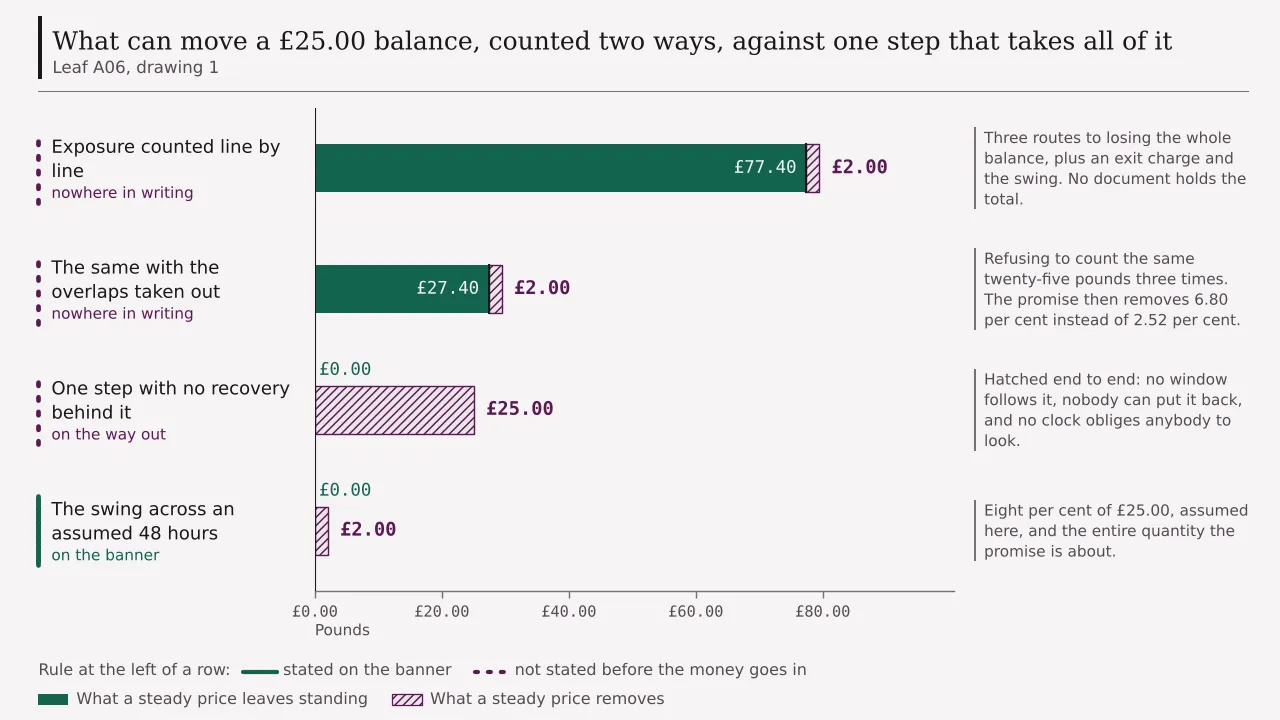
The first two bars on that drawing are nearly solid, and the sliver taken off each one is the whole of what this subject contributes. The third bar is hatched end to end, which is what a condition with no recovery behind it looks like when it is drawn rather than described. Part six prices that bar.
4
Why counting the conditions flatters the promise
Count the rows in part two instead of adding them and a different answer appears. Seven things can change the sum, a steady price reaches one, and one in seven is 14.29 per cent. That figure is arithmetically correct and it is the one a reader reaches without meaning to, because a list invites counting.
Set it beside the money and the gap is the finding. Against the kind denominator, 14.29 divided by 6.80 is 2.10. Against the harsh one, 14.29 divided by 2.52 is 5.67. So counting the conditions overstates what the promise does by somewhere between twice over and nearly six times, depending on which denominator anybody prefers.
| How the share is worked | What the promise removes | How far it overstates |
|---|---|---|
| By counting conditions, one in seven | 14.29 per cent | The comparison |
| By money, overlaps taken out | 6.80 per cent | 2.10 times |
| By money, every line added | 2.52 per cent | 5.67 times |
The reason is structural rather than rhetorical. A count gives every item the same weight, and the item a peg covers is the smallest item on the list by a wide margin. Two pounds of drift sits beside three separate routes to losing twenty-five, and a count cannot see the difference between a drift and a total.
That is worth generalising, because it applies well beyond this subject. Any promise covering the smallest variable in a set will look large when the set is counted and small when the set is priced, and the party making the promise has no reason whatsoever to do the pricing. A reader who wants the honest figure has to supply the denominator themselves, which is what part three did.
5
One name, several networks, and a step nobody can take back
The second thing worth knowing about a unit of this kind has nothing to do with its price. The same name exists on more than one network, the versions are not interchangeable, and a reader moving a balance passes through a moment where one of them gets chosen.
That moment has a property almost nothing else in this field has. It is final. There is no window afterwards in which a choice can be reconsidered, no party sitting behind it with a power to put things back, and no clock running during which anybody is obliged to look. Where a conventional payment has a period in which it can be challenged, this step has none, which is a structural fact about the chain and not a complaint about anybody’s conduct.
This leaf sets out no procedure for any of that, and it would be the wrong place to look for one. Nothing here describes how a unit is obtained, kept or sent, which network carries which version, or what a reader should check before doing anything. What this part does is price a consequence, which is a different activity from describing a method, and the consequence is the only part of it a reader needs in order to do arithmetic.
The consequence is stated in one line: where the choice goes wrong, the balance is gone, in full, with nobody to ask. Not reduced by a charge, not delayed by a hold, not held pending documents. Gone, and the sum involved is whatever the balance was.
Settle that against the six conditions in part two and the difference in kind is plain. Five of those six can be argued about, waited out, satisfied with paperwork or answered by somebody. This one cannot be argued about at all, and it sits on the way out like the others, met for the first time by a reader who has already decided to leave.
6
What a single unrecoverable error costs when nothing is recoverable
Put the two spines of this leaf against each other and the arithmetic is one division. Holding the price still is worth £2.00 on a £25.00 balance over an assumed 48 hours. An unrecoverable step costs the whole £25.00. Twenty-five divided by two is 12.5.
So the entire benefit of the promise is cancelled by one total loss in every 12.5 exits, which is a rate of 8.00 per cent. Above that frequency the promise is worth less than the structure it arrives inside. Below it, the promise is ahead. The crossing point is exact and it needs no assumptions beyond the two already declared.
What nobody can supply is which side of 8.00 per cent the real rate falls on. Nothing citable here carries a failure rate for a step of that sort, and no figure has been invented to fill the hole. Saying so is the result rather than a dodge, because an unknown rate against a known crossing point is still a useful object: it tells a reader precisely which quantity they would need in order to finish the sum.
| Balance at the exit | Swing the promise removes | Cost of one total loss | Exits per loss that cancels it | The rate that cancels it |
|---|---|---|---|---|
| £10.00 | £0.80 | £10.00 | 12.5 | 8.00 per cent |
| £25.00 | £2.00 | £25.00 | 12.5 | 8.00 per cent |
| £100.00 | £8.00 | £100.00 | 12.5 | 8.00 per cent |
| £400.00 | £32.00 | £400.00 | 12.5 | 8.00 per cent |
The fourth column holds at 12.5 whatever the balance, and the reason is that both quantities scale with the same number. An assumed eight per cent of swing and a total loss are both fractions of the balance, so the balance divides out of the ratio and disappears. A reader with ten pounds and a reader with four hundred face the same crossing point, which is a thing the pounds themselves hide.
The two right-hand columns say one thing twice, and the repetition is not a slip. A swing set at eight per cent of a balance is cancelled by one total loss in every 12.5 exits, and the reciprocal of 12.5 is eight per cent again. Whatever fraction the promise covers is therefore the exact failure rate that wipes it out, which holds for any assumed swing and not only for this one.
7
Settings a licence would have put in a reader’s own hands
Nothing on this leaf is advertised under a Great Britain licence, and the duties that go missing with one are, on this subject, the duties about controls a reader operates themselves rather than controls anybody operates for them. A peg is not one of those controls. Three published sets of them exist in Britain and none has anything to do with the price of a unit.
The first set is about ceilings a customer sets for themselves. The live standard on financial limits puts the facility within reach from the instant an account opens, asks for a figure during sign-up or at a first payment, and insists that figure be typed rather than picked off a short menu. It has to bite at account level at the very least. Three spans have to be on offer, running a day, then a week, then a month. Declining is still possible and takes a deliberate act, since the standard makes having one the starting position.
Fold that into this leaf’s figures and it bites on part two’s third row. Somebody who had put a £10.00 ceiling on one day’s payments in cannot then send £25.00 across that day. Where two periods run at once the tighter governs, and the regulator’s own worked instance makes it concrete. A ceiling of ten pounds on one day, standing next to a hundred across seven, yields a week capped at seventy, because seven lots of ten reach seventy and the larger figure is never arrived at. No pegged unit produces that arithmetic, and a steady price does not produce it either.
The second set is about the speed those ceilings move at, and it runs deliberately unevenly. A reduction lands immediately unless something has technically broken. Loosening one waits a full day at minimum, and will not take hold until its owner has come back a second time to say so. Tightening is therefore a single act and loosening is two, separated by a day, which is a published asymmetry a reader can lean on.
The third set looks at the money going in rather than at the account. Light-touch financial checks attach to a monthly figure for net deposits, set at £500 a month when it began on 30 August 2024, then cut on 28 February 2025 to £150 a month. On the balance worked throughout this leaf, £25.00 sits comfortably under either, and the point is not that a threshold would have caught it. The point is that a threshold exists, applies by rule rather than by choice, and travels with a licence rather than with a way of paying.
One honest qualification belongs beside all three, because the offshore side is not uniformly looser. One rulebook this site can read holds an increase back for seven days, against the 24 hours Britain requires as a minimum, so on that single setting it is the tighter of the two. Printing that is part of being accurate rather than part of making a case, and it leaves the other two sets exactly where they were.
Last, the registration that shuts accounts. Taking part in the national scheme follows from holding a licence to operate in Great Britain, which is why it appears in part two against a public register rather than against a cashier or a set of terms. A unit that tracks a currency has no bearing on whether a site takes part, and the scheme’s own terms are explicit that it cannot help against organisations that do not. That sentence is printed here as a limit on a protection, which is what it is.
Set the three sets together and the shape of the loss is specific rather than rhetorical. What falls away is a group of switches the customer works, with published durations, a published default, a published asymmetry between tightening and loosening, and a published threshold. What does not fall away is the price of the unit, which was never one of the switches and was never going to be.
8
Reading any promise that covers a single variable
The method generalises and it is short. Write down the promise. Write down every separate thing that can change the number the promise is about. Put a pound figure beside each. Then divide the promise by the total, and print the division rather than the list.
Step two is where most of the work is and most of the failures. A list assembled by the party making the promise will be short, and a list assembled by somebody sceptical will be long, so the honest version declares its own length and says what was left out. This leaf used seven items, priced five of them, left two deliberately unpriced, and said which two and why.
Step three is the one that forces a decision into the open. Overlapping exposures cannot be added without inflating the denominator, and refusing to add them deflates it. Print both totals, label which is which, and let the reader see that the answer moved from 6.80 per cent to 2.52 per cent on a modelling choice rather than on a fact.
Step four is the sentence worth keeping. A promise is worth what it removes, not what it is about, and the two are different quantities whenever the thing removed is small and the thing it is about is prominent. Two pounds removed from a £25.00 balance is a true and useful statement. A unit that tracks a currency is a true and much less useful one.
Applied to this leaf’s own case the method yields five figures and no recommendation: £2.00 of swing removed, £27.40 of exposure untouched, 6.80 per cent on the narrow reading, 2.52 per cent on the wide one, and a crossing point at one total loss in every 12.5 exits. The last of those is the only figure that would survive every assumption on this leaf being replaced, because it is a ratio of two quantities that both scale with the balance.
Questions
- What does a unit that tracks a currency actually remove?
- Movement in what a balance is worth while somebody holds it, and nothing else whatever. On a £25.00 balance held for an assumed 48 hours, at an assumed eight per cent of movement either way, that is £2.00. Both of those figures are chosen by this leaf so that there is something to multiply, and neither is published anywhere. The promise is kept in full and the question worth asking is how large it is rather than whether it holds.
- How much of my exposure does a steady price actually cover?
- Between 2.52 per cent and 6.80 per cent of it, depending on how the denominator is built. Counting every line that can change the sum gives £79.40 on a £25.00 balance and the promise removes £2.00 of it. Refusing to count the same twenty-five pounds three times gives £29.40 and the same £2.00. Both readings are printed here because the choice between them is a modelling decision rather than a fact.
- Does a peg do anything about who answers a complaint?
- Nothing at all, and the honest position is not that a route vanishes. One offshore rulebook this site can read publishes six months in which a complaint may be raised and four weeks in which it must be answered, with one written extension of the same length available, giving eight weeks at the outside. What changes is whose rules govern the far end of that process and who approves whoever settles it. The sum at stake when a route fails is the balance in full.
- Why does counting the conditions give a bigger answer than pricing them?
- Because a count gives every item equal weight and the item a steady price covers is the smallest on the list by a wide margin. One in seven is 14.29 per cent. Against money that becomes 6.80 per cent or 2.52 per cent, so the count overstates by between 2.10 and 5.67 times. Two pounds of drift is sitting beside three separate routes to losing twenty-five, and a count cannot tell a drift from a total.
- What is the step that cannot be undone?
- Choosing between versions of one unit that exist on more than one network and do not move between them. That choice is final. No window follows it in which it can be reconsidered, no party behind it holds a power to put things back, and no clock runs during which anybody must look. This leaf describes no procedure, no route and nothing to check, because pricing a consequence and describing a method are different activities and only the first one is arithmetic.
- What does one unrecoverable error cost?
- The balance, in full, with nobody to ask. Not reduced by a charge, not delayed by a release period, not held pending paperwork. On the £25.00 worked throughout this leaf, that is £25.00 against the £2.00 the promise removes, so twenty-five divided by two gives 12.5 and one total loss in every 12.5 exits cancels the whole benefit. That crossing point is a rate of 8.00 per cent.
- Does the crossing point change with the size of my balance?
- No, and that is the most useful thing on this leaf. The swing removed is a fixed fraction of the balance by assumption and a total loss is the whole of it, so the balance divides out of the ratio and vanishes. Ten pounds, twenty-five, a hundred and four hundred all give 12.5 exits per loss. A reader with a small balance and a reader with a large one face identical arithmetic, which the pounds themselves conceal.
- Is the real failure rate above or below that crossing point?
- Unknown, and no figure is invented here to close the gap. Nothing citable here carries a failure rate for a step of that sort. What the arithmetic does produce is a precise statement of what anybody would need to finish the sum, which is one number: how often the step goes wrong. An unknown rate set against an exact crossing point is a usable object rather than an evasion.
- What controls are lost by using an offer of this kind?
- A set of switches a customer works themselves, none of which a pegged unit supplies. No Great Britain licence stands behind these offers, so nothing requires a ceiling facility reachable the instant an account opens, a typed figure instead of a short menu, compulsory spans running a day, then a week, then a month, a ceiling offered as the starting position, a reduction landing at once against a day’s wait on any loosening, or the net-deposit threshold set at £500 a month when it began on 30 August 2024 and cut on 28 February 2025 to £150 a month.
- Is an offshore rulebook weaker than the British one on every point?
- Not on every point, and saying so is part of being accurate. One rulebook this site can read holds an increase back for seven days, against the 24 hours Britain requires as a minimum, so on that single setting it is the tighter of the two. On the national exclusion scheme the gap runs the other way, because taking part follows from holding a Great Britain licence and the scheme says plainly in its own terms that it cannot help against organisations outside it.
- How should I read any promise that covers one variable?
- Write the promise down, list every separate thing that can change the number it is about, put a pound figure beside each, then divide and print the division instead of the list. Declare how long your own list is and name what was left off it. Where exposures overlap, print the total with them added and the total with them removed, and label which is which, because the answer moves from 6.80 per cent to 2.52 per cent on that choice alone.