Terms read 19 October 2026 Leaf A05, revision 1
Ethereum casino payouts, and the charge nobody can quote you beforehand
An assumed charge of £2.40 taken out of a £25.00 balance is 9.60 per cent of it, and the same assumed charge against £250.00 is 0.96 per cent. Both readings are of one unpublished number. Nothing printed anywhere settles which one a reader will meet, because the number is fixed by how busy a network is at the instant a balance tries to leave.
Stated on the banner £0.00 The cost of leaving, as given where the offer itself is published, on the offers giving any figure for it. Stated, once you go and look Borne by you A payments clause hands the transfer cost to the account holder and names no sum, since at the hour of drafting the sum has not been produced yet. Not stated before the money goes in £0.60 to £9.60 The band this leaf assumes the charge travels across, plus a payment floor, a document round and a hold, none of them priced in advance.
Offers settled in a network unit, with their terms read
Every destination in this file is bought advertising. The site is paid a fee if a reader goes on to register, and no figure printed below moves because of it.
Bonus Spins UK Slip 01
Betportal
Ceiling as a multiple
The drop
€15.00
€1.00 in the euro
The claim reads €15.00. Once the terms beside it have applied, €0.00 of it can leave. The difference is the drop.
7 of the 15 terms on this slip could not be read before the money went in
Spins priced at this site's own 10p a spin, which the operator does not publish
Stated
€15.00
The claim as it is printed, before a single term has been applied to it.
Headline paid as spins
150 spins at 10c each, which is €15.00 of the figure above.
6 Nowhere
What one spin is worth
No unit is published for a spin, so the count is priced at this site's own 10p a spin. At half that price every figure below halves with it.
Match and other credit not priced
300% of three deposits, to a ceiling of €1,000. A share of a deposit nobody has made yet is not a sum, so no figure stands on this line and none is carried below.
Qualified
-€14.40
Written down somewhere, and taking part of the claim back. Each term carries the place it is written and the sum it takes.
2 Written terms at a distance this record does not establish
Play-through -€14.40
Carrying €14.40 through 35 times stakes €504.00 and costs €20.16 of it at 96 per cent return. That prices above the €14.40 there is to charge it against, so the whole of the credit goes and the line is held at that. The multiple sits on the bonus.
2 Written terms at a distance this record does not establish
Game weighting not priced
Slots only count towards the play-through. No contribution percentage is published, so the line above has been worked at full weight, which is the kindest reading there is.
2 Written terms at a distance this record does not establish
Ceiling on the winnings not priced
5x the bonus.
2 Written terms at a distance this record does not establish
Clock on the credit not priced
14 days.
2 Written terms at a distance this record does not establish
Largest stake while it runs not priced
€5.
3 Public record
Licence, and who holds it not priced
Licensed in Anjouan, Comoros, held by BetPortal Gaming Ltd, with Excite Ultra Media Ltd, reference ALSI-202601040-FI2. A register entry settles who holds a licence and what it permits. It does not settle who is running the site this morning.
4 Cashier
Smallest qualifying deposit your money
€20 a stage. That is €20.00 of your own money, and it is never netted into a drop.
5 On the way out
Checks before a withdrawal not priced
Documents before the first withdrawal.
Unstated
-€0.60
Applying without having been published anywhere, and costing money all the same.
6 Nowhere
What a spin hands back -€0.60
Staking a spin returns 96 per cent of it, so that share of the batch is the house's before a reel turns. This site works at that return and the operator publishes none where the claim is made.
6 Nowhere
Forfeited by rule cost unknown
Nothing is published under this heading, and it applies regardless.
6 Nowhere
Charge on the way out cost unknown
No charge on the way out is published as a figure, so nothing comes off this line. A charge that exists unpublished would come straight off whatever survives.
6 Nowhere
Smallest withdrawal allowed cost unknown
No smallest withdrawal is published as a figure. A floor nobody has published is still a floor, and it decides whether a small balance can move at all.
No Great Britain licence
Terms read 19 October 2026
Bonus Spins UK Slip 02
WinBeast
Ceiling as a sum
The drop
€50.00
€1.00 in the euro
The claim reads €50.00. Once the terms beside it have applied, €0.00 of it can leave. The difference is the drop.
8 of the 15 terms on this slip could not be read before the money went in
Spins priced at this site's own 10p a spin, which the operator does not publish
Stated
€50.00
The claim as it is printed, before a single term has been applied to it.
Headline paid as spins
500 spins at 10c each, which is €50.00 of the figure above.
6 Nowhere
What one spin is worth
No unit is published for a spin, so the count is priced at this site's own 10p a spin. At half that price every figure below halves with it.
Match and other credit not priced
50% to 100% of five deposits, each to a ceiling of €1,000, and a €650 free bet. A share of a deposit nobody has made yet is not a sum, so no figure stands on this line and none is carried below.
Qualified
-€48.00
Written down somewhere, and taking part of the claim back. Each term carries the place it is written and the sum it takes.
2 Written terms at a distance this record does not establish
Play-through -€48.00
Carrying €48.00 through 40 times stakes €1,920.00 and costs €76.80 of it at 96 per cent return. That prices above the €48.00 there is to charge it against, so the whole of the credit goes and the line is held at that. The multiple sits on the bonus and the winnings from the spins.
2 Written terms at a distance this record does not establish
Game weighting not priced
Slots, titles vary by country count towards the play-through. No contribution percentage is published, so the line above has been worked at full weight, which is the kindest reading there is.
2 Written terms at a distance this record does not establish
Ceiling on the winnings not priced
€100 a batch of spins.
2 Written terms at a distance this record does not establish
Clock on the credit not priced
7 days, spins 1 day.
3 Public record
Licence, and who holds it not priced
Licensed in Curaçao, holder not named on the site. A register entry settles who holds a licence and what it permits. It does not settle who is running the site this morning.
4 Cashier
Smallest qualifying deposit your money
€20 a stage. That is €20.00 of your own money, and it is never netted into a drop.
5 On the way out
Checks before a withdrawal not priced
Documents before the first withdrawal.
Unstated
-€2.00
Applying without having been published anywhere, and costing money all the same.
6 Nowhere
What a spin hands back -€2.00
Staking a spin returns 96 per cent of it, so that share of the batch is the house's before a reel turns. This site works at that return and the operator publishes none where the claim is made.
6 Nowhere
Largest stake while it runs cost unknown
Nothing is published under this heading, and it applies regardless.
6 Nowhere
Forfeited by rule cost unknown
Nothing is published under this heading, and it applies regardless.
6 Nowhere
Charge on the way out cost unknown
No charge on the way out is published as a figure, so nothing comes off this line. A charge that exists unpublished would come straight off whatever survives.
6 Nowhere
Smallest withdrawal allowed cost unknown
No smallest withdrawal is published as a figure. A floor nobody has published is still a floor, and it decides whether a small balance can move at all.
No Great Britain licence
Terms read 19 October 2026
Bonus Spins UK Slip 03
EliteSpin
Longest spin window
The drop
£50.00
£1.00 in the pound
The claim reads £50.00. Once the terms beside it have applied, £0.00 of it can leave. The difference is the drop.
8 of the 15 terms on this slip could not be read before the money went in
Spins priced at this site's own 10p a spin, which the operator does not publish
Stated
£50.00
The claim as it is printed, before a single term has been applied to it.
Headline paid as spins
500 spins at 10p each, which is £50.00 of the figure above.
6 Nowhere
What one spin is worth
No unit is published for a spin, so the count is priced at this site's own 10p a spin. At half that price every figure below halves with it.
Match and other credit not priced
50% to 100% of five deposits, each to a ceiling of £1,000. A share of a deposit nobody has made yet is not a sum, so no figure stands on this line and none is carried below.
Qualified
-£48.00
Written down somewhere, and taking part of the claim back. Each term carries the place it is written and the sum it takes.
2 Written terms at a distance this record does not establish
Play-through -£48.00
Carrying £48.00 through 40 times stakes £1,920.00 and costs £76.80 of it at 96 per cent return. That prices above the £48.00 there is to charge it against, so the whole of the credit goes and the line is held at that. The multiple sits on the bonus and the winnings from the spins.
2 Written terms at a distance this record does not establish
Game weighting not priced
Slots count towards the play-through. No contribution percentage is published, so the line above has been worked at full weight, which is the kindest reading there is.
2 Written terms at a distance this record does not establish
Ceiling on the winnings not priced
5x the bonus.
2 Written terms at a distance this record does not establish
Clock on the credit not priced
7 days, spins 3 days.
3 Public record
Licence, and who holds it not priced
Licensed in Costa Rica, held by PrimeTier Limited. A register entry settles who holds a licence and what it permits. It does not settle who is running the site this morning.
4 Cashier
Smallest qualifying deposit your money
£20 a stage. That is £20.00 of your own money, and it is never netted into a drop.
5 On the way out
Checks before a withdrawal not priced
Documents before the first withdrawal.
Unstated
-£2.00
Applying without having been published anywhere, and costing money all the same.
6 Nowhere
What a spin hands back -£2.00
Staking a spin returns 96 per cent of it, so that share of the batch is the house's before a reel turns. This site works at that return and the operator publishes none where the claim is made.
6 Nowhere
Largest stake while it runs cost unknown
Nothing is published under this heading, and it applies regardless.
6 Nowhere
Forfeited by rule cost unknown
Nothing is published under this heading, and it applies regardless.
6 Nowhere
Charge on the way out cost unknown
No charge on the way out is published as a figure, so nothing comes off this line. A charge that exists unpublished would come straight off whatever survives.
6 Nowhere
Smallest withdrawal allowed cost unknown
No smallest withdrawal is published as a figure. A floor nobody has published is still a floor, and it decides whether a small balance can move at all.
No Great Britain licence
Terms read 19 October 2026
Bonus Spins UK Slip 04
Crown Jewelz
Multiple unpublished
The drop
NOT WORKED
The multiple is not published in the operator's own terms. Since the sum cannot be worked around it, none is worked.
9 of the 14 terms on this slip could not be read before the money went in
No drop worked
Stated
£15.00
The claim as it is printed, before a single term has been applied to it.
Headline paid as spins
150 spins at 10p each, which is £15.00 of the figure above.
6 Nowhere
What one spin is worth
No unit is published for a spin, so the count is priced at this site's own 10p a spin. At half that price every figure below halves with it.
Match and other credit not priced
200% of the first deposit, then 150% twice, each to a ceiling of £1,000. A share of a deposit nobody has made yet is not a sum, so no figure stands on this line and none is carried below.
Qualified
NOT WORKED
Written down somewhere, and taking part of the claim back. Each term carries the place it is written and the sum it takes.
2 Written terms at a distance this record does not establish
Play-through not priced
40x the bonus, reported rather than published by the operator.
2 Written terms at a distance this record does not establish
Game weighting not priced
Slots count towards the play-through. No contribution percentage is published, so the line above has been worked at full weight, which is the kindest reading there is.
3 Public record
Licence, and who holds it not priced
Licensed in Curaçao, number not verified, holder not named on the site. A register entry settles who holds a licence and what it permits. It does not settle who is running the site this morning.
4 Cashier
Smallest qualifying deposit your money
£20. That is £20.00 of your own money, and it is never netted into a drop.
5 On the way out
Checks before a withdrawal not priced
Documents before the first withdrawal.
Unstated
NOT WORKED
Applying without having been published anywhere, and costing money all the same.
6 Nowhere
Ceiling on the winnings cost unknown
No ceiling is published. Nothing is assumed in its place.
6 Nowhere
Clock on the credit cost unknown
Nothing is published under this heading, and it applies regardless.
6 Nowhere
Largest stake while it runs cost unknown
Nothing is published under this heading, and it applies regardless.
6 Nowhere
Forfeited by rule cost unknown
Nothing is published under this heading, and it applies regardless.
6 Nowhere
Charge on the way out cost unknown
No charge on the way out is published as a figure, so nothing comes off this line. A charge that exists unpublished would come straight off whatever survives.
6 Nowhere
Smallest withdrawal allowed cost unknown
No smallest withdrawal is published as a figure. A floor nobody has published is still a floor, and it decides whether a small balance can move at all.
No Great Britain licence
Terms read 19 October 2026
Every figure in the second and third columns is this site's own working and nothing an operator has published. A claim is priced as printed, then the share a spin hands back at 96 per cent return comes off it, then what playing the multiple through costs at the same return, and then whatever a published ceiling, a charge on the way out or a floor on the smallest withdrawal takes from what has survived. The drop is the difference between the first figure and the last. The two columns add back up to it exactly, so no money leaves a slip without a term and a place beside it.
Which column a term falls in is settled by one question: has anybody written it down. A charge a reader meets at the payment screen is written down, and it stands in the second column with the cashier against it. A condition that binds without ever having been set down stands in the third, whatever it costs. Inside each column the terms run outwards from the banner, so the order itself says how far a reader would have had to go.
A count of spins has no unit until one is supplied. Where an operator publishes what one of its own spins is worth, that figure is used and the first column says it is theirs. Where none is published, this site's own 10p a spin stands in its place and every figure below moves in proportion with it. Where the multiple itself is unpublished, no drop is worked at all, because that is the one figure the sum cannot be done without.
Three words stand where a figure cannot. Not priced is a term that is written down and carries no number the arithmetic can take. Cost unknown is a term nobody has written down, costing something nobody has put a number on. Your money is money of the reader's own, which is never netted into a drop.
None of the operators in this file holds a Great Britain licence, so none of the duties that licence carries reaches them. Each of those duties is published in its own right, which is what makes its absence here something a reader can check rather than take on trust. Every gambling company licensed in Great Britain belongs to Gamstop Online, so a reader who has shut themselves out through the scheme is not shut out here. Social Responsibility Code 5.1.1 has held a play-through to a maximum of ten times the bonus funds since 19 January 2026, and it binds a licence holder and nobody else. Asked in a post of 21 October 2025 what is lost along with the licence, the Gambling Commission's Director of Enforcement and Intelligence answered: "unfair gaming practices, financial loss, and a lack of recourse if things go wrong". The same post puts blocked payouts, and withdrawal limits pitched high enough to be unreachable, among the behaviour the Commission has recorded. Nobody under 18 may hold an account at any of them.
Terms are reproduced in the wording their operator published, and each slip is dated with the day somebody sat down and read them. 19 October 2026 is the oldest of those dates. Anybody claiming an offer is bound by that operator's full terms, which are elsewhere, and never by a line standing here.
1
A price set by demand is not a price list
A tariff is a document. Somebody writes it, somebody publishes it, and a reader can open it before deciding anything. Whatever else is true of a tariff, the figure in it was settled before the transaction rather than during it, which is why a tariff can be checked and why this site treats the checking as the thing worth money.
A transfer charge on a public network is a different object entirely. It is not written down by the operator, not written down by the network, and not written down by anybody else either. It emerges from how many other transfers are competing for space at the moment one more joins the queue. There is no document to open, because the quantity did not exist until the queue did.
That puts the cost of taking money out squarely on the way out, which is the fifth of the six places this site sorts terms into. It is not hidden, not buried in small type and not qualified in a second document. It is absent, in the strict sense that the figure has not been determined yet, and the person it will fall on cannot be told what it is because nobody knows.
Every charge, band, floor, hold and interval on this leaf is this leaf’s own assumption, stated as one in the sentence that spends it, and none is a published figure taken from any rule or any operator. The shape underneath them is not an assumption at all. A quantity nobody settles ahead of a transaction cannot be read ahead of one, whatever number turns up at the end.
Two quite different reasons bring people to a page of this sort, and only one of them is arithmetic. Anybody here because a registration has already closed their accounts should take the support route rather than the sum. GamCare.org.uk, BeGambleAware.org, and a helpline GamCare staffs around the clock on 0808 8020 133. The scheme’s published conditions, whose revision is dated 20 May 2026, say in terms that it cannot block services run by organisations standing outside it. Treat that as the edge of the protection and not as a seam to pick at. No sentence here describes a way past it, and none of the pounds below improves for trying.
The arithmetic this leaf runs is the one every page here runs. Set down what the balance comes to read entirely alone. Set down what the same balance comes to once the far end has had its turn. Then rule off the gap. The difficulty peculiar to this subject is that the far end carries no value until it is met, so the second figure arrives as a range and the gap arrives as a width.
2
A band where a figure ought to be, and what the width costs
Take a balance of £25.00 standing on an account screen. That figure is settled, visible and arithmetically useless on its own, because what reaches a bank is the balance less whatever the transfer costs on the day. This leaf assumes the charge travels between £0.60 and £9.60, with £2.40 as a working middle, and those three figures are assumptions of this leaf and not a schedule anybody publishes.
At the foot of that assumed band, £25.00 leaves as £24.40. At the assumed middle it leaves as £22.60. At the top it leaves as £15.40. The three figures differ by £9.00, which is 36.00 per cent of the balance, and the reader chooses none of them.
| Reading of the assumed band | Where it gets settled | What reaches a bank |
|---|---|---|
| At the foot, an assumed £0.60 | on the way out | £24.40 |
| At the assumed middle, £2.40 | on the way out | £22.60 |
| At the top, an assumed £9.60 | on the way out | £15.40 |
| The written terms covering any of it | nowhere in writing | Not settled |
The fourth row is the one that distinguishes this subject from a fee a cashier prints. A fee has a sentence behind it somewhere, even a badly placed one. Here the clause in the payments document says who bears the charge and stops, because a drafter cannot name a sum that will be produced by traffic three months after the drafting.
Balance read off the account screen £25.00 Once the top of the assumed band applies £15.40 The price of a charge with no schedule behind it £9.60
Nine pounds sixty on twenty-five pounds is the worst reading of the assumed band, and printing it alone would overstate the case. The honest quantity is the width rather than the top: £9.60 less £0.60 is £9.00, and that £9.00 is what a reader cannot plan around. Somebody who budgeted for the foot of the band and met the top is out by £9.00 on a balance of £25.00, which is more than a third of it.
£9.00 of width between the two ends of an assumed charge band, standing against a balance of £25.00
Width behaves differently from size, and the difference matters to anybody doing arithmetic. A large charge that is known can be subtracted once and planned around for ever. A small charge that is unknown has to be assumed at its worst every time, because assuming it at its best produces a figure that is wrong in only one direction. Prudence therefore costs the whole width, not the average.
3
One flat charge measured against seven balances
Hold the charge still at the assumed middle of £2.40 and move the balance instead. This is the table the leaf was built around, because a charge that does not scale with the sum it is taken from behaves like a tax on being small, and the proportions fall out of one division repeated seven times.
| Balance at the exit | Assumed charge | Left after it | The charge as a share | Presses at 10p it would have bought |
|---|---|---|---|---|
| £5.00 | £2.40 | £2.60 | 48.00 per cent | 24 |
| £10.00 | £2.40 | £7.60 | 24.00 per cent | 24 |
| £20.00 | £2.40 | £17.60 | 12.00 per cent | 24 |
| £25.00 | £2.40 | £22.60 | 9.60 per cent | 24 |
| £50.00 | £2.40 | £47.60 | 4.80 per cent | 24 |
| £100.00 | £2.40 | £97.60 | 2.40 per cent | 24 |
| £250.00 | £2.40 | £247.60 | 0.96 per cent | 24 |
The rightmost column never changes, and its refusal to change is the entire argument. Twenty-four presses, priced at the ten pence a press used everywhere here, is what the assumed charge buys, whether the balance beside it is five pounds or two hundred and fifty. The fourth column falls by a factor of fifty down the table while the fifth sits still.
Read the share column from the top and the shape is a hyperbola rather than a slope. Halving the balance doubles the proportion, every time, with no floor under it, so there is no balance so small that a flat charge becomes proportionally mild. At £2.40 exactly, the charge is the whole of the balance and 100.00 per cent of it, and under that figure the transfer is not a bad deal but an unavailable one.
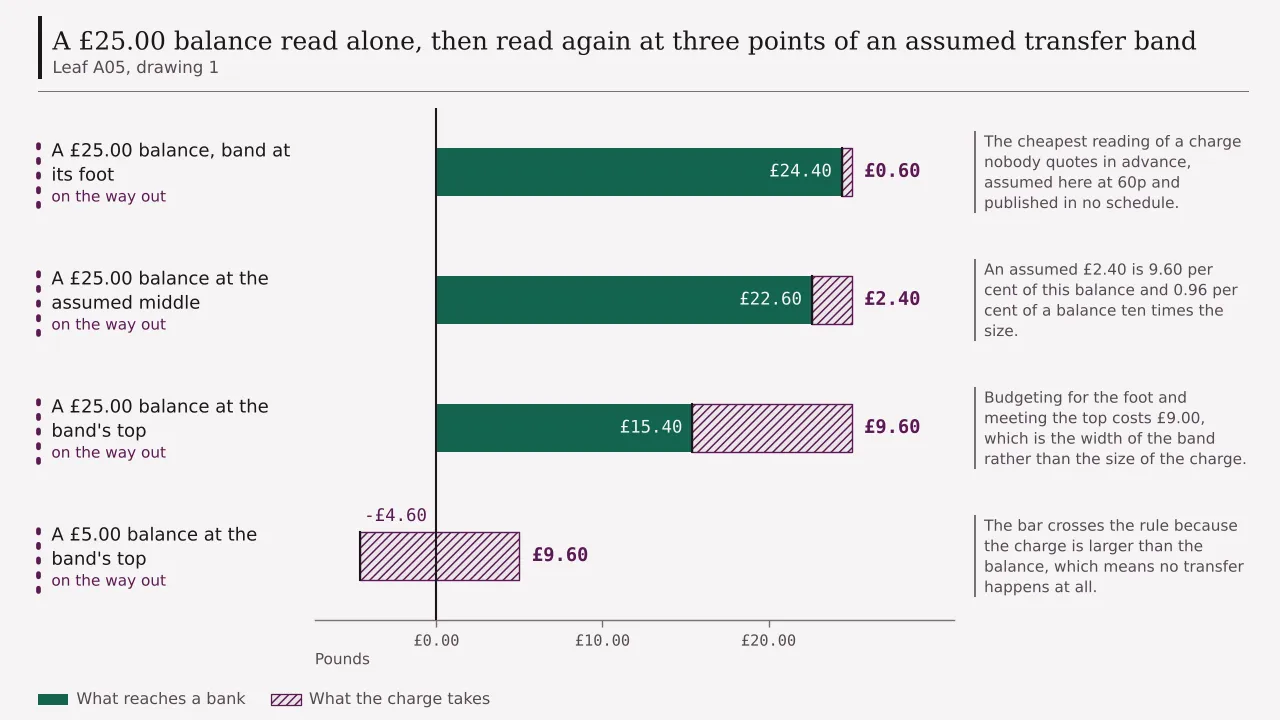
The last bar on that drawing crosses the rule, and it is drawn that way because the arithmetic goes there. A £5.00 balance meeting an assumed charge of £9.60 is short by £4.60, which does not mean a bank account ends up £4.60 lighter. It means the transfer does not happen and the balance stays where it is, and where the address carries no Great Britain licence that becomes the separate problem part seven takes up.
4
Where leaving and staying put cost precisely the same
A reader holding a balance has two things they can do with it, and this part prices both against each other without recommending either. Taking it out costs the assumed charge. Leaving it where it is costs whatever the house margin takes out of it, which at the 96 per cent return worked throughout this site is four pence in each pound that crosses the reels.
So put the whole balance across once and the expected cost is 4.00 per cent of it. Set that equal to the assumed charge of £2.40 and solve: 0.04 multiplied by the balance is £2.40 when the balance is £60.00. At sixty pounds the two costs are identical to the penny.
What the assumed charge takes off £60.00 £2.40 What one pass across the reels is expected to take £2.40 Separating the two at that balance £0.00
That nought is the sharpest figure on this leaf and it needs its honest qualification immediately. The two costs are equal in expectation and nothing else. One pass across the reels has an enormous spread around its expectation and can take the entire balance; the charge has no spread at all once it is quoted. Equal expected cost is not equal risk, and a sentence that stopped at the equality would be the sort of sentence this site exists to correct.
Underneath £60.00 the assumed charge is the more expensive of the two, which is the finding worth printing. A charge designed to be negligible on a large transfer is not negligible on a small one, and below sixty pounds it costs more than the margin on the entire balance. That is a statement about where a flat charge falls and about nothing else, and it is not a reason to press anything.
The crossing point moves with the charge and nothing else moves it. At the foot of the assumed band the equality lands at £15.00, because 0.04 multiplied by £15.00 is £0.60. At the top it lands at £240.00. So the balance at which the two costs meet is itself a band £225.00 wide, settled on the way out and never before.
5
Hours against pence, and a rate that falls as you hold on
A reader meeting a charge they consider too high has exactly one lever, and it is delay. Demand on a public network rises and falls, so a transfer that is dear at one hour is cheaper at another. This part prices that lever rather than recommending it, and every interval and every charge below is assumed here to show the shape of the trade, observed nowhere and reported by nobody.
Assume the charge stands at £2.40 when a reader first looks, and assume it settles towards the foot of the band the longer they hold on. Four waits, four savings, and a rate for each.
| Hours held on, assumed | Charge assumed to be met | Saved against £2.40 | Pence an hour | What the saving is capped at |
|---|---|---|---|---|
| 2 | £1.80 | £0.60 | 30.0p | £2.40, the charge itself |
| 6 | £1.20 | £1.20 | 20.0p | £2.40, the charge itself |
| 12 | £0.90 | £1.50 | 12.5p | £2.40, the charge itself |
| 24 | £0.60 | £1.80 | 7.5p | £2.40, the charge itself |
The rate falls from 30.0p an hour to 7.5p an hour across that table, by a factor of four, and it goes on falling for as long as anybody holds on. The reason is in the rightmost column. A saving cannot exceed the charge it is saved from, so the numerator is capped at £2.40 while the denominator grows without limit. Divide a fixed ceiling by a rising number of hours and the quotient goes to nothing.
Put it at the extremes and the shape is unmistakable. Holding on for a week to see the charge drop from £2.40 to its assumed floor of £0.60 saves £1.80 across 168 hours, which is 1.07p an hour. Holding on for a month saves the same £1.80 across 720 hours, which is 0.25p an hour. The saving never improves, because there is nothing left under the floor to save.
This is the opposite of how most waiting behaves, and the inversion is worth stating plainly. Waiting for a sum to grow pays better the longer it runs. Waiting for a cost to shrink pays worst at the end, because the cost has a floor and the hours do not. Anybody weighing the two is therefore weighing a bounded gain against an unbounded stretch of time.
6
The balance beneath which no amount of holding on matters
Two separate figures answer that, and they disagree, so it is worth putting twice rather than once. One of them comes out of the charge itself. The other comes off a payment screen, and the payment screen wins comfortably.
The charge’s own answer is the foot of the assumed band. At £0.60 a transfer cannot get any cheaper, so a balance under £0.60 cannot move at any point in the band and delay changes nothing whatsoever. That is arithmetically exact and practically trivial, because nobody is deciding what to do with fifty-nine pence.
The payment screen’s answer is the one that bites. Assume a withdrawal floor of £20.00. That twenty pounds is set here for the sake of the sum and appears in no rule this site is able to cite. A floor of that kind is settled at the cashier and appears no earlier than a payment page, so it is not in the band, not in the charge and not in any advertisement. Under it, no transfer is offered at any charge, and holding on cannot produce one.
Set the two answers side by side and the floor beats the band by a factor of thirty-three. Between £0.60 and £20.00 the transfer is arithmetically affordable and commercially unavailable, which is a gap of £19.40 where the charge is not the thing stopping anybody. Reading the charge as the obstacle across that whole range gets the cause wrong and therefore gets the remedy wrong.
| Balance on the account | What stops the transfer | Whether holding on helps |
|---|---|---|
| Under £0.60 | on the way out | No, the charge has a floor under it |
| £0.60 to £20.00 | at the cashier | No, the payment screen refuses the sum |
| Over £20.00 | Nothing stops it; the charge only prices it | Yes, by a bounded amount |
So the answer to the question this part asks is £20.00 and it comes from a place the charge has nothing to do with. Above that balance, delay always saves something and the rate always falls. Below it, delay saves nothing at all, and the entire apparatus of parts two to five stops applying for a reason settled on a screen the reader has not reached yet.
7
Four duties that used to stand between a balance and its way out
A payout settled in a network unit reaches a reader from an operator over whom no Great Britain licence stands, and what goes missing alongside that licence, on this leaf’s own subject, is a short set of written duties about what may be done to a balance at the far end. Not one of them would fix the charge. Every one of them would change what the charge is permitted to stand beside.
The first concerns friction, and the technical standard governing how a licensed product is designed runs at it from two sides. Handing a customer any means of undoing a withdrawal after the request is in is forbidden, and the licensee is told to strip friction out of the route a payment takes. Set that beside part five. A charge falling £1.80 over 24 hours pays somebody 7.5p an hour to leave their money untouched, which is friction counted in pence rather than in clicks.
The second concerns whose money it is while that hour count runs. Licence condition 4.2.1 puts three questions to a licensee sitting on customer money and makes it answer all three in its own terms. Does the money come through an insolvency, how far does the protection reach, and by what mechanism is it achieved. The answer follows a rating the regulator lays down rather than a form of words the business picks, it goes to the customer in writing, and the customer has to acknowledge it before any of it may be staked.
There are four such ratings. Two carry the words “Not protected”, separated by “No segregation” against “Segregation of customer funds”. Above them sit “Medium protection” and, at the top, “High protection”. Somebody deciding whether to hold on for 24 hours to save £1.80 is, under that apparatus, holding a sum whose rating has a name. Out here the same sum has the same charge standing over it and no name whatsoever.
The third is a clock bolted to the weakest of those four. Paragraph 3 of the same condition took effect on 31 October 2025. Twice a year, a licensee carrying a rating of that sort has to tell the customer once more that an insolvency would take the money, print the sum being held for that person, and collect a fresh acknowledgement before play resumes. No balance threshold was adopted, so the half-yearly warning reaches a £5.00 balance and a £5,000.00 one alike.
The fourth is about ceilings rather than costs, and of the four it is the one readers run together with the rest most often. A ceiling written over a deposit balance is barred outright for a British licensee, and the regulator goes as far as printing an example of drafting it will not accept, one capping the daily sum and the weekly sum together. That bar runs against a ceiling somebody wrote. It reaches nothing that merely varies, and a flat £2.40 standing against £5.00 achieves through division what a drafted ceiling achieves through words.
Nothing in the preceding five paragraphs says an unlicensed exit is slower or dearer than a licensed one, and this leaf has no sourced basis for saying it. What the paragraphs establish is narrower and checkable: the four duties above bind the holder of a British licence, no offer of the kind this leaf describes holds one, and the difference is a difference in what is written down rather than in what happens on any particular day.
8
Running this subtraction on any charge quoted after the fact
The method is four lines and it works on anything priced after a decision rather than before it. Write the balance down. Write the widest and narrowest charge the subject could carry. Subtract both from the balance, and print the two answers side by side rather than averaging them into one.
Averaging is the step worth refusing, and it is the one most readers take without noticing. The mean of £0.60 and £9.60 is £5.10, and a reader planning around £5.10 is planning around a figure that will never arrive. The useful output of a band is not its centre. It is its width, which on this leaf is £9.00 and which is the entire quantity the subject contributes.
Then ask which places the remaining obstacles come from, because they are not all the same kind of thing. The charge sits on the way out. The withdrawal floor sits at the cashier. Whether a licence stands behind the address at all sits in the public register or nowhere. Three obstacles, three different places, and only one of them is about money.
Last, keep the two readings of the balance attached to each other permanently. Twenty-five pounds on a screen and £15.40 reaching a bank are the same balance described from two ends of one transfer, and a reader who carries only the first figure forward is carrying a number that was never available. The whole of this site is an argument for carrying both.
Applied to this leaf’s own worked case, that produces six figures and no advice: £25.00 on the screen, £0.60 at the foot, £9.60 at the top, £9.00 of width, £60.00 where the charge and one pass across the reels cost the same, and £20.00 as the balance under which an exit does not exist at any price. Five of the six are this leaf’s own assumptions, and the sixth, the width, is the only one that would survive every assumption changing.
Questions
- Why can nobody tell me what a withdrawal will cost before I ask for it?
- Because the charge is produced by competition for space on a public network at the instant a transfer joins the queue, so it does not exist until the transfer does. A tariff is a document somebody wrote in advance and a reader can open. This is not a document at all, which puts the cost of leaving on the way out, the fifth of the six places this site sorts terms into, and makes it the one term here that cannot be read early however hard anybody looks.
- How much of a small balance does a flat transfer charge take?
- On an assumed charge of £2.40, which is this leaf’s own working figure and not a published one, it takes 48.00 per cent of £5.00, 24.00 per cent of £10.00, 9.60 per cent of £25.00 and 0.96 per cent of £250.00. The charge itself never moves across those seven readings, and in presses at the 10p this site assumes it is worth twenty-four of them every single time. Halving the balance doubles the proportion with no floor underneath it.
- What is the real cost of a charge that is quoted as a range?
- Its width rather than its size. Assume a band running from £0.60 to £9.60 and a reader who budgeted for the cheap end meets the dear end £9.00 worse off, on a balance of £25.00 that is more than a third of it. The mean of the band, £5.10, is a figure that will never actually arrive, so averaging the two ends throws away the only quantity the subject supplies.
- Is it cheaper to take a small balance out or to leave it alone?
- Those two costs are equal at £60.00 and this leaf prices both without recommending either. At the 96 per cent return worked throughout this site, one pass of a balance across the reels is expected to cost four pence in the pound, which on £60.00 is £2.40, the same as the assumed charge. Under £60.00 the charge is the dearer of the two. The equality is an equality of expected cost only, since one pass has a very wide spread around its expectation and a quoted charge has none.
- Does holding on until the charge drops actually pay?
- By a bounded amount, at a rate that gets worse the longer it runs. On this leaf’s assumed figures, two hours saves £0.60 at 30.0p an hour, twelve hours saves £1.50 at 12.5p an hour, and a week saves £1.80 at 1.07p an hour. A saving can never be larger than the charge it is saved from, so the numerator is capped at £2.40 while the hours are not capped at anything, and the quotient falls towards nothing.
- Is there a balance where holding on can never pay at all?
- Two of them, and the larger one is decided somewhere else entirely. Below the assumed floor of the charge band, £0.60, a transfer cannot get cheaper and delay changes nothing. Far more important is an assumed withdrawal floor of £20.00 at the payment screen, since under it no transfer is offered at any charge whatever. Between £0.60 and £20.00 a transfer is arithmetically affordable and commercially unavailable, which is £19.40 of range where the charge is not the obstacle.
- What does a British licence say about charges at the exit?
- Nothing about their size, and several things about what they may stand beside. No licensee may hand a customer a way of undoing a withdrawal once it is requested, and each is told to strip friction out of the exit. Condition 4.2.1 makes it declare, against one of four set ratings, whether customer money comes through an insolvency, and since 31 October 2025 its third paragraph has made the weakest rating carry a half-yearly repetition of that warning with no balance threshold under it. A deposit balance may carry no withdrawal ceiling whatever.
- What happens if the charge is larger than the balance?
- The transfer does not take place and the balance stays where it is. An assumed £9.60 charge against a £5.00 balance is short by £4.60, which does not mean a bank account ends up lighter; it means the exit is closed at that moment. At £2.40 exactly the charge is 100.00 per cent of a £2.40 balance, and under that figure the transfer is not expensive but unavailable.
- What protection is given up by taking a payout this way?
- A short set of written duties about the far end, not one of which would have fixed the charge. A payout settled in a network unit comes from an operator with no Great Britain licence standing behind it, so nothing obliges anybody to strip friction out of the exit, no named rating describes the sum while somebody waits on it, no half-yearly warning arrives, and the outright bar on a deposit balance ceiling binds nobody. A flat £2.40 set against £5.00 does by division what a drafted ceiling does by words, and no rule reaches division.
- How should I read any charge that is only quoted after the fact?
- Write the balance down, write the widest and narrowest the charge could be, subtract both and print the two answers rather than their average. Then name the place each remaining obstacle comes from, because a transfer charge sits on the way out, a withdrawal floor sits at the cashier, and whether any licence stands behind the address sits in a public register or nowhere. On this leaf that produces £25.00, £0.60, £9.60, £9.00 of width, £60.00 and £20.00, of which only the width survives every assumption changing.