Terms read 19 October 2026 Leaf T11, revision 1
A bingo credit whose condition can only be worked off while a room is open
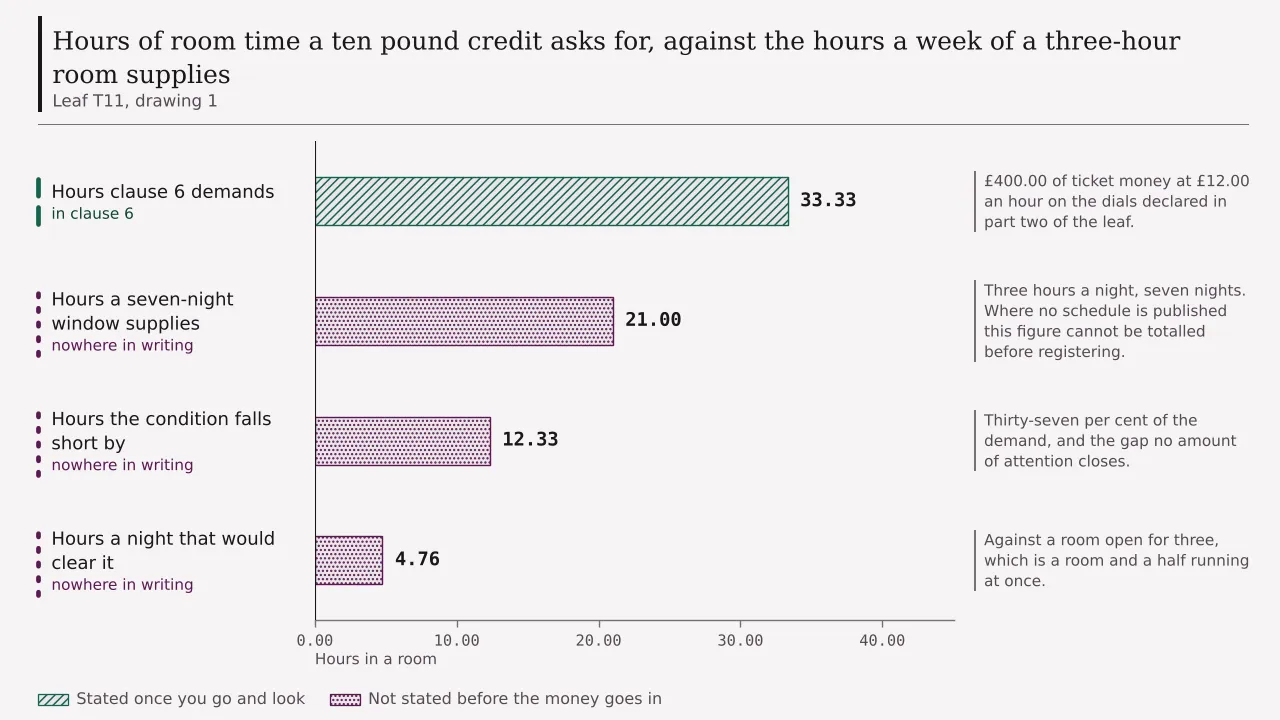
Ten pounds of bingo credit at forty times wants £400.00 of ticket money, which on the model declared in part two is 33.33 hours inside a room. A window of seven days over a room open three hours a night supplies 21 hours. The multiple is written in clause 6. The hours are written in a schedule, or in nothing at all, and that is where the offer is decided.
Stated on the banner £10.00 A round credit against a round payment, with no mention of tickets, rooms or hours anywhere near it. Stated, once you go and look £400.00 Clause 6 asks forty times, so the credit has to be spent on tickets forty times over before any of it can leave. Not stated before the money goes in 12.33 hours The gap between the room time the condition needs and the room time a published schedule would have shown, had there been one.
Bingo credits on registration, terms read
Every destination in this file is bought advertising. The site is paid a fee if a reader goes on to register, and no figure printed below moves because of it.
Bonus Spins UK Slip 01
Betportal
Ceiling as a multiple
The drop
€15.00
€1.00 in the euro
The claim reads €15.00. Once the terms beside it have applied, €0.00 of it can leave. The difference is the drop.
7 of the 15 terms on this slip could not be read before the money went in
Spins priced at this site's own 10p a spin, which the operator does not publish
Stated
€15.00
The claim as it is printed, before a single term has been applied to it.
Headline paid as spins
150 spins at 10c each, which is €15.00 of the figure above.
6 Nowhere
What one spin is worth
No unit is published for a spin, so the count is priced at this site's own 10p a spin. At half that price every figure below halves with it.
Match and other credit not priced
300% of three deposits, to a ceiling of €1,000. A share of a deposit nobody has made yet is not a sum, so no figure stands on this line and none is carried below.
Qualified
-€14.40
Written down somewhere, and taking part of the claim back. Each term carries the place it is written and the sum it takes.
2 Written terms at a distance this record does not establish
Play-through -€14.40
Carrying €14.40 through 35 times stakes €504.00 and costs €20.16 of it at 96 per cent return. That prices above the €14.40 there is to charge it against, so the whole of the credit goes and the line is held at that. The multiple sits on the bonus.
2 Written terms at a distance this record does not establish
Game weighting not priced
Slots only count towards the play-through. No contribution percentage is published, so the line above has been worked at full weight, which is the kindest reading there is.
2 Written terms at a distance this record does not establish
Ceiling on the winnings not priced
5x the bonus.
2 Written terms at a distance this record does not establish
Clock on the credit not priced
14 days.
2 Written terms at a distance this record does not establish
Largest stake while it runs not priced
€5.
3 Public record
Licence, and who holds it not priced
Licensed in Anjouan, Comoros, held by BetPortal Gaming Ltd, with Excite Ultra Media Ltd, reference ALSI-202601040-FI2. A register entry settles who holds a licence and what it permits. It does not settle who is running the site this morning.
4 Cashier
Smallest qualifying deposit your money
€20 a stage. That is €20.00 of your own money, and it is never netted into a drop.
5 On the way out
Checks before a withdrawal not priced
Documents before the first withdrawal.
Unstated
-€0.60
Applying without having been published anywhere, and costing money all the same.
6 Nowhere
What a spin hands back -€0.60
Staking a spin returns 96 per cent of it, so that share of the batch is the house's before a reel turns. This site works at that return and the operator publishes none where the claim is made.
6 Nowhere
Forfeited by rule cost unknown
Nothing is published under this heading, and it applies regardless.
6 Nowhere
Charge on the way out cost unknown
No charge on the way out is published as a figure, so nothing comes off this line. A charge that exists unpublished would come straight off whatever survives.
6 Nowhere
Smallest withdrawal allowed cost unknown
No smallest withdrawal is published as a figure. A floor nobody has published is still a floor, and it decides whether a small balance can move at all.
No Great Britain licence
Terms read 19 October 2026
Bonus Spins UK Slip 02
WinBeast
Ceiling as a sum
The drop
€50.00
€1.00 in the euro
The claim reads €50.00. Once the terms beside it have applied, €0.00 of it can leave. The difference is the drop.
8 of the 15 terms on this slip could not be read before the money went in
Spins priced at this site's own 10p a spin, which the operator does not publish
Stated
€50.00
The claim as it is printed, before a single term has been applied to it.
Headline paid as spins
500 spins at 10c each, which is €50.00 of the figure above.
6 Nowhere
What one spin is worth
No unit is published for a spin, so the count is priced at this site's own 10p a spin. At half that price every figure below halves with it.
Match and other credit not priced
50% to 100% of five deposits, each to a ceiling of €1,000, and a €650 free bet. A share of a deposit nobody has made yet is not a sum, so no figure stands on this line and none is carried below.
Qualified
-€48.00
Written down somewhere, and taking part of the claim back. Each term carries the place it is written and the sum it takes.
2 Written terms at a distance this record does not establish
Play-through -€48.00
Carrying €48.00 through 40 times stakes €1,920.00 and costs €76.80 of it at 96 per cent return. That prices above the €48.00 there is to charge it against, so the whole of the credit goes and the line is held at that. The multiple sits on the bonus and the winnings from the spins.
2 Written terms at a distance this record does not establish
Game weighting not priced
Slots, titles vary by country count towards the play-through. No contribution percentage is published, so the line above has been worked at full weight, which is the kindest reading there is.
2 Written terms at a distance this record does not establish
Ceiling on the winnings not priced
€100 a batch of spins.
2 Written terms at a distance this record does not establish
Clock on the credit not priced
7 days, spins 1 day.
3 Public record
Licence, and who holds it not priced
Licensed in Curaçao, holder not named on the site. A register entry settles who holds a licence and what it permits. It does not settle who is running the site this morning.
4 Cashier
Smallest qualifying deposit your money
€20 a stage. That is €20.00 of your own money, and it is never netted into a drop.
5 On the way out
Checks before a withdrawal not priced
Documents before the first withdrawal.
Unstated
-€2.00
Applying without having been published anywhere, and costing money all the same.
6 Nowhere
What a spin hands back -€2.00
Staking a spin returns 96 per cent of it, so that share of the batch is the house's before a reel turns. This site works at that return and the operator publishes none where the claim is made.
6 Nowhere
Largest stake while it runs cost unknown
Nothing is published under this heading, and it applies regardless.
6 Nowhere
Forfeited by rule cost unknown
Nothing is published under this heading, and it applies regardless.
6 Nowhere
Charge on the way out cost unknown
No charge on the way out is published as a figure, so nothing comes off this line. A charge that exists unpublished would come straight off whatever survives.
6 Nowhere
Smallest withdrawal allowed cost unknown
No smallest withdrawal is published as a figure. A floor nobody has published is still a floor, and it decides whether a small balance can move at all.
No Great Britain licence
Terms read 19 October 2026
Bonus Spins UK Slip 03
EliteSpin
Longest spin window
The drop
£50.00
£1.00 in the pound
The claim reads £50.00. Once the terms beside it have applied, £0.00 of it can leave. The difference is the drop.
8 of the 15 terms on this slip could not be read before the money went in
Spins priced at this site's own 10p a spin, which the operator does not publish
Stated
£50.00
The claim as it is printed, before a single term has been applied to it.
Headline paid as spins
500 spins at 10p each, which is £50.00 of the figure above.
6 Nowhere
What one spin is worth
No unit is published for a spin, so the count is priced at this site's own 10p a spin. At half that price every figure below halves with it.
Match and other credit not priced
50% to 100% of five deposits, each to a ceiling of £1,000. A share of a deposit nobody has made yet is not a sum, so no figure stands on this line and none is carried below.
Qualified
-£48.00
Written down somewhere, and taking part of the claim back. Each term carries the place it is written and the sum it takes.
2 Written terms at a distance this record does not establish
Play-through -£48.00
Carrying £48.00 through 40 times stakes £1,920.00 and costs £76.80 of it at 96 per cent return. That prices above the £48.00 there is to charge it against, so the whole of the credit goes and the line is held at that. The multiple sits on the bonus and the winnings from the spins.
2 Written terms at a distance this record does not establish
Game weighting not priced
Slots count towards the play-through. No contribution percentage is published, so the line above has been worked at full weight, which is the kindest reading there is.
2 Written terms at a distance this record does not establish
Ceiling on the winnings not priced
5x the bonus.
2 Written terms at a distance this record does not establish
Clock on the credit not priced
7 days, spins 3 days.
3 Public record
Licence, and who holds it not priced
Licensed in Costa Rica, held by PrimeTier Limited. A register entry settles who holds a licence and what it permits. It does not settle who is running the site this morning.
4 Cashier
Smallest qualifying deposit your money
£20 a stage. That is £20.00 of your own money, and it is never netted into a drop.
5 On the way out
Checks before a withdrawal not priced
Documents before the first withdrawal.
Unstated
-£2.00
Applying without having been published anywhere, and costing money all the same.
6 Nowhere
What a spin hands back -£2.00
Staking a spin returns 96 per cent of it, so that share of the batch is the house's before a reel turns. This site works at that return and the operator publishes none where the claim is made.
6 Nowhere
Largest stake while it runs cost unknown
Nothing is published under this heading, and it applies regardless.
6 Nowhere
Forfeited by rule cost unknown
Nothing is published under this heading, and it applies regardless.
6 Nowhere
Charge on the way out cost unknown
No charge on the way out is published as a figure, so nothing comes off this line. A charge that exists unpublished would come straight off whatever survives.
6 Nowhere
Smallest withdrawal allowed cost unknown
No smallest withdrawal is published as a figure. A floor nobody has published is still a floor, and it decides whether a small balance can move at all.
No Great Britain licence
Terms read 19 October 2026
Bonus Spins UK Slip 04
Crown Jewelz
Multiple unpublished
The drop
NOT WORKED
The multiple is not published in the operator's own terms. Since the sum cannot be worked around it, none is worked.
9 of the 14 terms on this slip could not be read before the money went in
No drop worked
Stated
£15.00
The claim as it is printed, before a single term has been applied to it.
Headline paid as spins
150 spins at 10p each, which is £15.00 of the figure above.
6 Nowhere
What one spin is worth
No unit is published for a spin, so the count is priced at this site's own 10p a spin. At half that price every figure below halves with it.
Match and other credit not priced
200% of the first deposit, then 150% twice, each to a ceiling of £1,000. A share of a deposit nobody has made yet is not a sum, so no figure stands on this line and none is carried below.
Qualified
NOT WORKED
Written down somewhere, and taking part of the claim back. Each term carries the place it is written and the sum it takes.
2 Written terms at a distance this record does not establish
Play-through not priced
40x the bonus, reported rather than published by the operator.
2 Written terms at a distance this record does not establish
Game weighting not priced
Slots count towards the play-through. No contribution percentage is published, so the line above has been worked at full weight, which is the kindest reading there is.
3 Public record
Licence, and who holds it not priced
Licensed in Curaçao, number not verified, holder not named on the site. A register entry settles who holds a licence and what it permits. It does not settle who is running the site this morning.
4 Cashier
Smallest qualifying deposit your money
£20. That is £20.00 of your own money, and it is never netted into a drop.
5 On the way out
Checks before a withdrawal not priced
Documents before the first withdrawal.
Unstated
NOT WORKED
Applying without having been published anywhere, and costing money all the same.
6 Nowhere
Ceiling on the winnings cost unknown
No ceiling is published. Nothing is assumed in its place.
6 Nowhere
Clock on the credit cost unknown
Nothing is published under this heading, and it applies regardless.
6 Nowhere
Largest stake while it runs cost unknown
Nothing is published under this heading, and it applies regardless.
6 Nowhere
Forfeited by rule cost unknown
Nothing is published under this heading, and it applies regardless.
6 Nowhere
Charge on the way out cost unknown
No charge on the way out is published as a figure, so nothing comes off this line. A charge that exists unpublished would come straight off whatever survives.
6 Nowhere
Smallest withdrawal allowed cost unknown
No smallest withdrawal is published as a figure. A floor nobody has published is still a floor, and it decides whether a small balance can move at all.
No Great Britain licence
Terms read 19 October 2026
Every figure in the second and third columns is this site's own working and nothing an operator has published. A claim is priced as printed, then the share a spin hands back at 96 per cent return comes off it, then what playing the multiple through costs at the same return, and then whatever a published ceiling, a charge on the way out or a floor on the smallest withdrawal takes from what has survived. The drop is the difference between the first figure and the last. The two columns add back up to it exactly, so no money leaves a slip without a term and a place beside it.
Which column a term falls in is settled by one question: has anybody written it down. A charge a reader meets at the payment screen is written down, and it stands in the second column with the cashier against it. A condition that binds without ever having been set down stands in the third, whatever it costs. Inside each column the terms run outwards from the banner, so the order itself says how far a reader would have had to go.
A count of spins has no unit until one is supplied. Where an operator publishes what one of its own spins is worth, that figure is used and the first column says it is theirs. Where none is published, this site's own 10p a spin stands in its place and every figure below moves in proportion with it. Where the multiple itself is unpublished, no drop is worked at all, because that is the one figure the sum cannot be done without.
Three words stand where a figure cannot. Not priced is a term that is written down and carries no number the arithmetic can take. Cost unknown is a term nobody has written down, costing something nobody has put a number on. Your money is money of the reader's own, which is never netted into a drop.
None of the operators in this file holds a Great Britain licence, so none of the duties that licence carries reaches them. Each of those duties is published in its own right, which is what makes its absence here something a reader can check rather than take on trust. Every gambling company licensed in Great Britain belongs to Gamstop Online, so a reader who has shut themselves out through the scheme is not shut out here. Social Responsibility Code 5.1.1 has held a play-through to a maximum of ten times the bonus funds since 19 January 2026, and it binds a licence holder and nobody else. Asked in a post of 21 October 2025 what is lost along with the licence, the Gambling Commission's Director of Enforcement and Intelligence answered: "unfair gaming practices, financial loss, and a lack of recourse if things go wrong". The same post puts blocked payouts, and withdrawal limits pitched high enough to be unreachable, among the behaviour the Commission has recorded. Nobody under 18 may hold an account at any of them.
Terms are reproduced in the wording their operator published, and each slip is dated with the day somebody sat down and read them. 19 October 2026 is the oldest of those dates. Anybody claiming an offer is bound by that operator's full terms, which are elsewhere, and never by a line standing here.
1
A condition that cannot be met inside the document stating it
Most conditions on a sign-up credit are self-contained. A multiple is a number, a deadline is a date, and a reader with the clause in front of them has everything needed to work out what it costs. A condition tied to a room is not like that. It names an activity that can only happen while something else is running, and the something else keeps its own timetable in its own place.
That makes a bingo credit the clearest case on this site of a term sitting in two places at once. Half of it is settled in clause 6 of the promotional terms, where the multiple lives. The other half is settled by the room schedule, which is either behind a sign-in, or in a lobby panel that changes without notice, or nowhere in writing. A reader cannot price the first half without the second, and the second is not publishable arithmetic at the moment of reading.
Everything below follows from that split. Part two declares a ticket model, because the 10p press this site works to is a measure of reels and prices no bingo ticket. Part three converts a credit into tickets and tickets into hours. Parts four and five put those hours against a room that is open for some of the week and shut for the rest. Part six states the finding. The rest deals with what a rulebook does and does not reach once the product stops being a reel.
One figure travels through all of it. The credit itself, £10.00 against a payment of £10.00, is settled and is the last number handed over without a journey. A credit of £10.00 carried at forty times needs £400.00 of ticket money to clear, and £400.00 of ticket money is a quantity of time rather than a quantity of decisions. That is the property a multiple on reels does not have, because a reel can be pressed whenever the account is open and a called number cannot.
2
The ticket model used here, and why it had to be invented
This leaf needs a price for a ticket and a rate for a room. Neither exists in anything this site is allowed to cite, so both get declared here as this leaf’s own assumptions, and every figure below leaning on them repeats that they are assumptions rather than findings.
The model has three dials. A ticket costs 10p. A reader holds 6 tickets in a game. The caller works through 25 numbers a minute, a full house arrives at around the fiftieth number, so calling occupies two minutes and a minute is left between games, giving 20 games an hour. Multiply the three and a room sells a reader £12.00 of tickets an hour.
The return assumption needs stating separately, because it means something different here from what it means on reels. This site works to 96 in the hundred coming back, which in a room means 96 pence of every pound of ticket money returning to players as prizes. No source reachable from this site publishes a prize-return figure for a bingo room, and under the disclosure rules a licensed bingo product gets through that duty by setting out how its prizes are handed round, no percentage being required anywhere. So 96 is carried across for consistency with the rest of this site and is flagged wherever it is used.
| Dial | Setting used here | Status | What it drives |
|---|---|---|---|
| Price of one ticket | 10p | This leaf’s assumption | Tickets needed: 4,000 |
| Tickets held in a game | 6 | This leaf’s assumption | Games needed: 666.67 |
| Numbers called a minute | 25 | This leaf’s assumption | Two minutes of calling a game |
| Games started in an hour | 20 | Follows from the two above | £12.00 of tickets an hour |
| Prize money returned | 96 in the hundred | Site convention, not a bingo figure | 4p a pound retained |
| Hours a room is open | 3 a night | This leaf’s assumption | 21 hours in a week |
A reader who knows the real settings for a particular room can rerun everything below in a minute, which is the reason the dials are separated out rather than folded into the prose. Halve the ticket price and the hours double. Double the tickets held per game and the hours halve. The structure of the finding survives every one of those substitutions, because the finding is about which document holds which dial rather than about the dials themselves.
3
What ten pounds of credit asks for, counted in tickets
Clause 6 is the only part of this offer that behaves like an ordinary term. At forty times, £10.00 of credit demands £400.00 of ticket money, and at 10p a ticket that is 4,000 tickets. Six tickets a game makes 666.67 games. Twenty games an hour makes 33.33 hours of sitting in a room while numbers are read out.
The expected close uses the same house arithmetic as every other leaf on this site. Four pence in each pound of ticket money stays with the room. Forty of those deductions amount to 1.6 times the credit, which leaves £10.00 standing at minus 0.6 of itself, or minus £6.00. A return of 96 in the hundred exhausts a credit at 25 times, and clause 6 sits sixty per cent beyond that.
Credit read off the banner £10.00 Expected close once clause 6 is applied minus £6.00 The price of the clause, read alone £16.00
That subtraction is the ordinary one this site performs everywhere, and on a bingo credit it is not the interesting one. Sixteen pounds is what the written condition costs a reader who can satisfy it. The rest of this leaf is about the reader who cannot, and whose inability is settled by a document the promotional terms do not name.
Convert the obligation into room time and the scale of it becomes visible. Thirty-three hours and twenty minutes is four and a bit working days of continuous attendance. Spread across a week it is 4.76 hours every single night. Compared with the same credit on reels, where 4,000 presses occupy a shade under three hours because no fresh game cycle may open inside 2.5 seconds, the room route is eleven times longer for an identical £400.00 of staking, the pace belonging to the caller rather than to the player.
£400.00 of ticket money, 4,000 tickets, 666.67 games, 33.33 hours in a room
4
Where a room’s hours are published, and where they are not
Having turned the condition into hours, the question becomes where a reader would establish how many hours are available. There are four possible answers and they are not equally good.
The first is a published schedule on the open site, listing room names, opening times and the games in each. Where that exists, the room timetable is in the schedule, a tap or two from the promotion, and the arithmetic in part five can be done before anybody registers. This is the best case and it is not the common one.
The second is a lobby panel visible only after signing in. The hours exist, they are accurate, and they are behind the sign-in, which means they arrive after the account exists and usually after the qualifying payment. A figure that arrives then cannot inform the decision it bears on.
The third is a rolling display with no fixed times at all: a panel showing what starts in the next few minutes and nothing about tomorrow. A reader can see the next game and cannot count the week. For the purposes of this leaf’s arithmetic that is the same as the fourth case.
The fourth is silence. No schedule, no panel, no statement anywhere about when the qualifying room runs. The hours still exist, the room still opens and shuts on somebody’s timetable, and the timetable is nowhere in writing. The condition in clause 6 goes on applying at full strength, because a term does not weaken when the facts needed to satisfy it are unpublished.
| How the hours appear | Where that leaves the reader | Can part five be worked first? |
|---|---|---|
| Published schedule, open site | in the schedule | Yes, before registering |
| Lobby panel behind a sign-in | behind the sign-in | Only after the account exists |
| Rolling next-game display | nowhere in writing | No, nothing to total |
| No statement of hours at all | nowhere in writing | No |
| Who holds the licence behind it | in the public register | Separate question entirely |
| Smallest qualifying payment by method | at the cashier | No, not until the payment screen |
The register row is worth a sentence because it is often confused with the schedule row. A public licence record will say which products a licence permits, and bingo is one of the things a licence either covers or does not. It will never say what time a room opens. The two documents answer different questions and only one of them is a regulatory record at all.
5
Seven days of window against three hours a night
Now put the two halves together. Clause 6 asks for 33.33 hours of room time. This leaf’s assumed window is seven days, and its assumed room runs three hours a night. Seven nights at three hours supplies 21 hours. The condition is short by 12.33 hours, which is 37 per cent of what it demands.
It is not short by a little. To clear £400.00 of ticket money inside a seven-day window a reader needs 4.76 hours a night in a room that is open for three, so the term is unsatisfiable by a margin of roughly a room and a half running simultaneously. No amount of attention closes that gap, because the missing resource is not effort but opening hours, and opening hours belong to the operator.
Three dials decide whether the gap opens at all, and a reader can close it by moving any one of them. A ticket at 20p halves the tickets needed and brings the demand to 16.67 hours, which fits. Twelve tickets a game rather than six does the same. A fourteen-day window supplies 42 hours and also fits. Each of those is a figure somebody publishes or does not, and the point of this leaf is that the three sit in three different places: the ticket price in a lobby, the holding in a reader’s own habit, and the window in clause 6.
| Setting changed | Where that setting is stated | Hours demanded | Hours supplied | Shortfall |
|---|---|---|---|---|
| The model as declared | Part two of this leaf | 33.33 | 21.00 | 12.33 |
| Tickets at 20p instead of 10p | A lobby, where a price shows at all | 16.67 | 21.00 | None |
| Twelve tickets a game, not six | Nothing states it, the reader chooses | 16.67 | 21.00 | None |
| Window of fourteen days | Clause 6, beside the multiple | 33.33 | 42.00 | None |
| Room open two hours a night | The schedule, or nothing | 33.33 | 14.00 | 19.33 |
Read the second column on its own and the asymmetry is plain. Of the five rows, one setting is in the promotional terms where a reader will meet it, one is a habit nobody writes down, and the remaining three live in a lobby or a schedule that may or may not be reachable before the account exists. The multiple is the only dial published beside the claim, and it is the dial that matters least to whether the condition can be satisfied at all.
6
One term, written in two places, one of them nowhere
Here is the finding this leaf was written to produce. A written condition whose satisfaction depends on an unwritten timetable is a condition occupying two places at once, and the second place is the sixth one: nowhere at all. It is not an unwritten term. It is a written term with an unwritten half, and the distinction matters, because the written half looks complete.
Read clause 6 in isolation and nothing is missing from it. A multiple, a window, a product. Every element a reader would check is present, and a careful reader who works through the promotional terms before any money moves has done everything this site normally recommends. The clause still cannot be priced, because 33.33 hours against an unknown number of available hours is not an arithmetic a reader can finish.
That is a different failure from the ordinary one. Elsewhere on this site the problem is distance: the term exists, it is somewhere, and a reader who travels far enough reaches it. Here the travelling has an end point that does not exist. No number of taps arrives at a schedule nobody published, and the absence does not announce itself, because the clause that depends on it reads as a finished sentence.
Two things follow in practice. One is that a bingo credit will not compare with a reel credit of the same face value, even at an identical multiple, because one of the two has a published denominator underneath it and the other has not. The other is that the only honest move available before registering is to hunt for the schedule first and to treat its absence as the material fact about the offer, ahead of the multiple, the window and the face value together.
7
Which written rules reach a room and which stop at the reels
A reader coming to bingo from slots carries a set of expectations that are mostly wrong, and the mistake runs in the direction of assuming more protection rather than less. Four rules reach a room. Three well-known ones do not.
Among those that do reach it, the rule demanding a separate decision for every game cycle covers gaming with bingo inside it, so a licensed room cannot push a reader’s tickets forward without a decision to buy. The randomness rules cover gaming with bingo inside it as well, bearing on how numbers come out and forbidding a game that adapts its own probabilities. The disclosure rules apply, and for bingo, setting out the way prizes get handed round discharges them. The complaint window applies too, leaving a six-month run after an incident in which a dispute can still be opened.
Of the rules that stop at the reels, the ones worth naming are the stake caps and the pace floor. The £5 and £2 limits on what may be staked in a game cycle are limits on online slots and reach no other casino product, and a licensed build’s refusal to reopen a cycle inside 2.5 seconds is written for slots as well. A bingo room is not governed by either. So the instinct that a ticket must be capped the way a spin is capped has nothing behind it, and the arithmetic in part three has no stake ceiling in it for that reason.
One further rule is the sharpest of them for this particular key. One inducement, one product type, is how the rule has stood since 19 January 2026, the choices on offer running betting, casino, bingo, lottery. Slots sit under casino and bingo stands on its own, so a sign-up credit usable on reels and on tickets together crosses the line, while a match plus free spins does not. A credit that can be worked off anywhere is a materially easier credit to clear, since it detaches the condition from the room’s timetable altogether, and that is exactly the shape the rule now forbids inside the British licence.
Rooms advertising a credit of this shape are run by operators holding no Great Britain licence, and the losses worth naming on a timetable page are the ones that bear on a room rather than on a reel. Nobody is bound to let a player commit to each game individually, so tickets can roll forward on their own. Nobody is bound by the randomness requirements that govern how numbers come out and forbid a game that adapts. Nobody is bound to describe how prizes are allocated, which is the one disclosure a bingo player is otherwise entitled to. Nobody is bound by the ban on packing two product types into one incentive, so the credit’s scope can be drawn and redrawn around whichever room is convenient. Set against the 33.33 hours in part three, the loss is not abstract: the dial that decides whether the condition can be met at all is held by the same party that wrote the condition, and outside the licence nothing requires that party to publish it.
8
What a credit of this shape is worth once the hours are counted
Collect the figures. The banner offers £10.00. Clause 6 turns that into £400.00 of ticket money and an expected close of minus £6.00, a difference of £16.00. The ticket model turns £400.00 into 4,000 tickets, 666.67 games and 33.33 hours. The assumed window and the assumed room supply 21 hours. The condition is 12.33 hours short, and the figure that closes or widens that gap is not in the terms.
What that means for a reader is narrow and worth stating plainly. If the schedule is published, do the division: hours available in the window against hours the clause demands. If the schedule is not published, the division cannot be done, and an offer whose central condition cannot be evaluated is worth treating as unevaluated rather than as good or bad. That is an unsatisfying conclusion and it is the accurate one.
There is a reading on which the credit is still worth having, and it is the reading where the credit is treated as a few free games rather than as a sum. Six tickets a game at 10p is 60p a game, so £10.00 of credit is roughly sixteen games of company on a weeknight, and a reader who wanted sixteen games has had them whether or not clause 6 is ever discharged. The arithmetic turns hostile only for the reader who treats £10.00 as money and spends 33 hours chasing the right to move it.
The last word belongs to the two documents. The multiple sits one tap from the claim and is the thing a careful reader will check. The timetable sits in a lobby, a schedule or nothing at all, and is the thing that decides the answer. A page that listed the first and ignored the second would have described the offer and priced none of it.
Questions
- How long does a ten pound bingo credit at forty times actually take to clear?
- On the model declared in part two, 33.33 hours inside a room. At forty times, £10.00 of credit demands £400.00 of ticket money; at 10p a ticket that is 4,000 tickets; at six tickets a game it is 666.67 games; and at twenty games an hour it is thirty-three hours and twenty minutes. Every one of those dials is this leaf’s own assumption, because nothing citable here publishes a ticket price, a holding or a room’s rate of play.
- Why does a bingo credit take so much longer than the same credit on reels?
- Because the pace belongs to the caller. Four thousand presses take a shade under three hours, because a licensed build may not reopen a cycle until 2.5 seconds have gone, and the same £400.00 of staking bought as tickets takes 33.33 hours on the assumed dials. The ratio is about eleven to one, and it comes from the fact that a player decides when a reel turns while a room decides when a number is read out.
- What is the expected close on ten pounds of bingo credit?
- Minus £6.00. Four pence in each pound of ticket money stays with the room at the 96 in the hundred this site works to, forty of those deductions amount to 1.6 times the credit, and £10.00 left standing at minus 0.6 of itself gives minus £6.00. Set against the £10.00 read off the banner, the written clause is worth minus sixteen pounds to a reader. On this return a credit is exhausted at 25 times, and clause 6 sits well beyond it.
- Is 96 in the hundred a real figure for a bingo room?
- It is this site’s convention carried across for consistency, not a bingo finding, and it is flagged as such wherever it is used. No source reachable from here publishes a prize-return percentage for a room. A licensed bingo product gets through its disclosure duty by setting out how its prizes are handed round rather than printing a percentage, so a reader has no entitlement to the figure in the first place.
- Where would a reader find out when the qualifying room is open?
- One of four places, and they are not equally useful. A published schedule on the open site, which allows the whole calculation before registering. A lobby panel behind the sign-in, which arrives after the account and usually after the payment. A rolling display showing only the next game, which cannot be totalled. Or nowhere at all. In the last two cases the hours still exist and still govern the clause, and nothing writes them down.
- How big is the gap between what the clause wants and what a room supplies?
- On the assumed settings, 12.33 hours, or 37 per cent of the demand. The clause wants 33.33 hours of room time and a seven-day window over a room open three hours a night supplies 21. Clearing it inside the window would need 4.76 hours a night in a room open for three, which is a room and a half running at the same time, so no amount of attention from the reader closes it.
- What changes the answer most?
- The ticket price and the holding, neither of which is in the promotional terms. Tickets at 20p rather than 10p bring the demand down to 16.67 hours and the gap disappears. Twelve tickets a game instead of six does the same. A fourteen-day window supplies 42 hours and also closes it. A room open two hours a night instead of three widens the gap to 19.33 hours. Only the window is written beside the multiple.
- Does a public licence record show a room’s opening hours?
- No, and the two records are often confused. A licence record settles which products a licence permits, and bingo is one of the activities a licence either covers or does not. It says nothing about what time a room opens, what a ticket costs or how fast a caller works. Only one of the two documents is a regulatory record at all, and it is the one that answers none of the questions this leaf needs answered.
- Which slot protections do not carry over to bingo?
- The stake caps and the pace floor. The £5 and £2 limits on what may be staked in a game cycle belong to online slots alone and touch nothing else in a casino, and the refusal to reopen a cycle inside 2.5 seconds belongs to slots as well. What does reach a room is the requirement to commit to each game individually, the randomness rules, the disclosure duty, which bingo discharges by setting out how prizes get handed round, and a six-month run after an incident during which a complaint can still go in.
- Can one credit be usable on both bingo and slots?
- Not inside the British licence. One inducement, one product type, is how the rule has stood since 19 January 2026, the choices running betting, casino, bingo, lottery. Slots sit under casino and bingo stands on its own, so a credit spanning both crosses the line while a match plus free spins does not. A credit workable anywhere is far easier to clear, because it detaches the condition from the room’s timetable.
- What should a reader check first on an offer like this?
- The schedule, before the multiple and before the face value. The multiple is one tap away and will be found by anyone who looks. The hours decide whether the multiple can be discharged at all, and their absence is the material fact about the offer. Where the schedule is published the division takes a minute; where it is not, the central condition cannot be evaluated, and an offer that cannot be evaluated is best treated as exactly that.