Terms read 19 October 2026 Leaf T12, revision 1
The contribution rate: one percentage that multiplies every other number in the terms
A £25.00 payment matched in full credits £25.00. Clause 5 asks forty times, which at full contribution is £1,000.00 of staking and an expected close of minus £15.00. Put the same clause against the 30 per cent contribution quoted in a regulator’s consultation record and the staking becomes £3,333.33 and the close minus £108.33. The percentage that decides which of those is true is in a different table from the multiple, or in no table at all.
Stated on the banner £25.00 A hundred per cent on a payment of £25.00, with the percentage printed and nothing under it. Stated, once you go and look £1,000.00 Forty times in clause 5, read at full contribution because that is the only reading available without a second table. Not stated before the money goes in g, unpublished The one percentage capable of multiplying that £1,000.00 by anything up to ten, and the one most often missing.
Reel credits on registration, terms read
Every destination in this file is bought advertising. The site is paid a fee if a reader goes on to register, and no figure printed below moves because of it.
Bonus Spins UK Slip 01
Betportal
Ceiling as a multiple
The drop
€15.00
€1.00 in the euro
The claim reads €15.00. Once the terms beside it have applied, €0.00 of it can leave. The difference is the drop.
7 of the 15 terms on this slip could not be read before the money went in
Spins priced at this site's own 10p a spin, which the operator does not publish
Stated
€15.00
The claim as it is printed, before a single term has been applied to it.
Headline paid as spins
150 spins at 10c each, which is €15.00 of the figure above.
6 Nowhere
What one spin is worth
No unit is published for a spin, so the count is priced at this site's own 10p a spin. At half that price every figure below halves with it.
Match and other credit not priced
300% of three deposits, to a ceiling of €1,000. A share of a deposit nobody has made yet is not a sum, so no figure stands on this line and none is carried below.
Qualified
-€14.40
Written down somewhere, and taking part of the claim back. Each term carries the place it is written and the sum it takes.
2 Written terms at a distance this record does not establish
Play-through -€14.40
Carrying €14.40 through 35 times stakes €504.00 and costs €20.16 of it at 96 per cent return. That prices above the €14.40 there is to charge it against, so the whole of the credit goes and the line is held at that. The multiple sits on the bonus.
2 Written terms at a distance this record does not establish
Game weighting not priced
Slots only count towards the play-through. No contribution percentage is published, so the line above has been worked at full weight, which is the kindest reading there is.
2 Written terms at a distance this record does not establish
Ceiling on the winnings not priced
5x the bonus.
2 Written terms at a distance this record does not establish
Clock on the credit not priced
14 days.
2 Written terms at a distance this record does not establish
Largest stake while it runs not priced
€5.
3 Public record
Licence, and who holds it not priced
Licensed in Anjouan, Comoros, held by BetPortal Gaming Ltd, with Excite Ultra Media Ltd, reference ALSI-202601040-FI2. A register entry settles who holds a licence and what it permits. It does not settle who is running the site this morning.
4 Cashier
Smallest qualifying deposit your money
€20 a stage. That is €20.00 of your own money, and it is never netted into a drop.
5 On the way out
Checks before a withdrawal not priced
Documents before the first withdrawal.
Unstated
-€0.60
Applying without having been published anywhere, and costing money all the same.
6 Nowhere
What a spin hands back -€0.60
Staking a spin returns 96 per cent of it, so that share of the batch is the house's before a reel turns. This site works at that return and the operator publishes none where the claim is made.
6 Nowhere
Forfeited by rule cost unknown
Nothing is published under this heading, and it applies regardless.
6 Nowhere
Charge on the way out cost unknown
No charge on the way out is published as a figure, so nothing comes off this line. A charge that exists unpublished would come straight off whatever survives.
6 Nowhere
Smallest withdrawal allowed cost unknown
No smallest withdrawal is published as a figure. A floor nobody has published is still a floor, and it decides whether a small balance can move at all.
No Great Britain licence
Terms read 19 October 2026
Bonus Spins UK Slip 02
WinBeast
Ceiling as a sum
The drop
€50.00
€1.00 in the euro
The claim reads €50.00. Once the terms beside it have applied, €0.00 of it can leave. The difference is the drop.
8 of the 15 terms on this slip could not be read before the money went in
Spins priced at this site's own 10p a spin, which the operator does not publish
Stated
€50.00
The claim as it is printed, before a single term has been applied to it.
Headline paid as spins
500 spins at 10c each, which is €50.00 of the figure above.
6 Nowhere
What one spin is worth
No unit is published for a spin, so the count is priced at this site's own 10p a spin. At half that price every figure below halves with it.
Match and other credit not priced
50% to 100% of five deposits, each to a ceiling of €1,000, and a €650 free bet. A share of a deposit nobody has made yet is not a sum, so no figure stands on this line and none is carried below.
Qualified
-€48.00
Written down somewhere, and taking part of the claim back. Each term carries the place it is written and the sum it takes.
2 Written terms at a distance this record does not establish
Play-through -€48.00
Carrying €48.00 through 40 times stakes €1,920.00 and costs €76.80 of it at 96 per cent return. That prices above the €48.00 there is to charge it against, so the whole of the credit goes and the line is held at that. The multiple sits on the bonus and the winnings from the spins.
2 Written terms at a distance this record does not establish
Game weighting not priced
Slots, titles vary by country count towards the play-through. No contribution percentage is published, so the line above has been worked at full weight, which is the kindest reading there is.
2 Written terms at a distance this record does not establish
Ceiling on the winnings not priced
€100 a batch of spins.
2 Written terms at a distance this record does not establish
Clock on the credit not priced
7 days, spins 1 day.
3 Public record
Licence, and who holds it not priced
Licensed in Curaçao, holder not named on the site. A register entry settles who holds a licence and what it permits. It does not settle who is running the site this morning.
4 Cashier
Smallest qualifying deposit your money
€20 a stage. That is €20.00 of your own money, and it is never netted into a drop.
5 On the way out
Checks before a withdrawal not priced
Documents before the first withdrawal.
Unstated
-€2.00
Applying without having been published anywhere, and costing money all the same.
6 Nowhere
What a spin hands back -€2.00
Staking a spin returns 96 per cent of it, so that share of the batch is the house's before a reel turns. This site works at that return and the operator publishes none where the claim is made.
6 Nowhere
Largest stake while it runs cost unknown
Nothing is published under this heading, and it applies regardless.
6 Nowhere
Forfeited by rule cost unknown
Nothing is published under this heading, and it applies regardless.
6 Nowhere
Charge on the way out cost unknown
No charge on the way out is published as a figure, so nothing comes off this line. A charge that exists unpublished would come straight off whatever survives.
6 Nowhere
Smallest withdrawal allowed cost unknown
No smallest withdrawal is published as a figure. A floor nobody has published is still a floor, and it decides whether a small balance can move at all.
No Great Britain licence
Terms read 19 October 2026
Bonus Spins UK Slip 03
EliteSpin
Longest spin window
The drop
£50.00
£1.00 in the pound
The claim reads £50.00. Once the terms beside it have applied, £0.00 of it can leave. The difference is the drop.
8 of the 15 terms on this slip could not be read before the money went in
Spins priced at this site's own 10p a spin, which the operator does not publish
Stated
£50.00
The claim as it is printed, before a single term has been applied to it.
Headline paid as spins
500 spins at 10p each, which is £50.00 of the figure above.
6 Nowhere
What one spin is worth
No unit is published for a spin, so the count is priced at this site's own 10p a spin. At half that price every figure below halves with it.
Match and other credit not priced
50% to 100% of five deposits, each to a ceiling of £1,000. A share of a deposit nobody has made yet is not a sum, so no figure stands on this line and none is carried below.
Qualified
-£48.00
Written down somewhere, and taking part of the claim back. Each term carries the place it is written and the sum it takes.
2 Written terms at a distance this record does not establish
Play-through -£48.00
Carrying £48.00 through 40 times stakes £1,920.00 and costs £76.80 of it at 96 per cent return. That prices above the £48.00 there is to charge it against, so the whole of the credit goes and the line is held at that. The multiple sits on the bonus and the winnings from the spins.
2 Written terms at a distance this record does not establish
Game weighting not priced
Slots count towards the play-through. No contribution percentage is published, so the line above has been worked at full weight, which is the kindest reading there is.
2 Written terms at a distance this record does not establish
Ceiling on the winnings not priced
5x the bonus.
2 Written terms at a distance this record does not establish
Clock on the credit not priced
7 days, spins 3 days.
3 Public record
Licence, and who holds it not priced
Licensed in Costa Rica, held by PrimeTier Limited. A register entry settles who holds a licence and what it permits. It does not settle who is running the site this morning.
4 Cashier
Smallest qualifying deposit your money
£20 a stage. That is £20.00 of your own money, and it is never netted into a drop.
5 On the way out
Checks before a withdrawal not priced
Documents before the first withdrawal.
Unstated
-£2.00
Applying without having been published anywhere, and costing money all the same.
6 Nowhere
What a spin hands back -£2.00
Staking a spin returns 96 per cent of it, so that share of the batch is the house's before a reel turns. This site works at that return and the operator publishes none where the claim is made.
6 Nowhere
Largest stake while it runs cost unknown
Nothing is published under this heading, and it applies regardless.
6 Nowhere
Forfeited by rule cost unknown
Nothing is published under this heading, and it applies regardless.
6 Nowhere
Charge on the way out cost unknown
No charge on the way out is published as a figure, so nothing comes off this line. A charge that exists unpublished would come straight off whatever survives.
6 Nowhere
Smallest withdrawal allowed cost unknown
No smallest withdrawal is published as a figure. A floor nobody has published is still a floor, and it decides whether a small balance can move at all.
No Great Britain licence
Terms read 19 October 2026
Bonus Spins UK Slip 04
Crown Jewelz
Multiple unpublished
The drop
NOT WORKED
The multiple is not published in the operator's own terms. Since the sum cannot be worked around it, none is worked.
9 of the 14 terms on this slip could not be read before the money went in
No drop worked
Stated
£15.00
The claim as it is printed, before a single term has been applied to it.
Headline paid as spins
150 spins at 10p each, which is £15.00 of the figure above.
6 Nowhere
What one spin is worth
No unit is published for a spin, so the count is priced at this site's own 10p a spin. At half that price every figure below halves with it.
Match and other credit not priced
200% of the first deposit, then 150% twice, each to a ceiling of £1,000. A share of a deposit nobody has made yet is not a sum, so no figure stands on this line and none is carried below.
Qualified
NOT WORKED
Written down somewhere, and taking part of the claim back. Each term carries the place it is written and the sum it takes.
2 Written terms at a distance this record does not establish
Play-through not priced
40x the bonus, reported rather than published by the operator.
2 Written terms at a distance this record does not establish
Game weighting not priced
Slots count towards the play-through. No contribution percentage is published, so the line above has been worked at full weight, which is the kindest reading there is.
3 Public record
Licence, and who holds it not priced
Licensed in Curaçao, number not verified, holder not named on the site. A register entry settles who holds a licence and what it permits. It does not settle who is running the site this morning.
4 Cashier
Smallest qualifying deposit your money
£20. That is £20.00 of your own money, and it is never netted into a drop.
5 On the way out
Checks before a withdrawal not priced
Documents before the first withdrawal.
Unstated
NOT WORKED
Applying without having been published anywhere, and costing money all the same.
6 Nowhere
Ceiling on the winnings cost unknown
No ceiling is published. Nothing is assumed in its place.
6 Nowhere
Clock on the credit cost unknown
Nothing is published under this heading, and it applies regardless.
6 Nowhere
Largest stake while it runs cost unknown
Nothing is published under this heading, and it applies regardless.
6 Nowhere
Forfeited by rule cost unknown
Nothing is published under this heading, and it applies regardless.
6 Nowhere
Charge on the way out cost unknown
No charge on the way out is published as a figure, so nothing comes off this line. A charge that exists unpublished would come straight off whatever survives.
6 Nowhere
Smallest withdrawal allowed cost unknown
No smallest withdrawal is published as a figure. A floor nobody has published is still a floor, and it decides whether a small balance can move at all.
No Great Britain licence
Terms read 19 October 2026
Every figure in the second and third columns is this site's own working and nothing an operator has published. A claim is priced as printed, then the share a spin hands back at 96 per cent return comes off it, then what playing the multiple through costs at the same return, and then whatever a published ceiling, a charge on the way out or a floor on the smallest withdrawal takes from what has survived. The drop is the difference between the first figure and the last. The two columns add back up to it exactly, so no money leaves a slip without a term and a place beside it.
Which column a term falls in is settled by one question: has anybody written it down. A charge a reader meets at the payment screen is written down, and it stands in the second column with the cashier against it. A condition that binds without ever having been set down stands in the third, whatever it costs. Inside each column the terms run outwards from the banner, so the order itself says how far a reader would have had to go.
A count of spins has no unit until one is supplied. Where an operator publishes what one of its own spins is worth, that figure is used and the first column says it is theirs. Where none is published, this site's own 10p a spin stands in its place and every figure below moves in proportion with it. Where the multiple itself is unpublished, no drop is worked at all, because that is the one figure the sum cannot be done without.
Three words stand where a figure cannot. Not priced is a term that is written down and carries no number the arithmetic can take. Cost unknown is a term nobody has written down, costing something nobody has put a number on. Your money is money of the reader's own, which is never netted into a drop.
None of the operators in this file holds a Great Britain licence, so none of the duties that licence carries reaches them. Each of those duties is published in its own right, which is what makes its absence here something a reader can check rather than take on trust. Every gambling company licensed in Great Britain belongs to Gamstop Online, so a reader who has shut themselves out through the scheme is not shut out here. Social Responsibility Code 5.1.1 has held a play-through to a maximum of ten times the bonus funds since 19 January 2026, and it binds a licence holder and nobody else. Asked in a post of 21 October 2025 what is lost along with the licence, the Gambling Commission's Director of Enforcement and Intelligence answered: "unfair gaming practices, financial loss, and a lack of recourse if things go wrong". The same post puts blocked payouts, and withdrawal limits pitched high enough to be unreachable, among the behaviour the Commission has recorded. Nobody under 18 may hold an account at any of them.
Terms are reproduced in the wording their operator published, and each slip is dated with the day somebody sat down and read them. 19 October 2026 is the oldest of those dates. Anybody claiming an offer is bound by that operator's full terms, which are elsewhere, and never by a line standing here.
1
The term that quietly multiplies every other term
Most conditions on a reel credit subtract. A ceiling removes the top of a range, a deadline removes the days after it, a floor removes everything below a line. One condition does not subtract at all. It multiplies, and it multiplies the output of every other clause in the document.
That condition is the contribution rate: the proportion of a pound staked that counts towards discharging the requirement. Call it g, as the arithmetic on this site does throughout, with g equal to one meaning a pound staked settles a pound of the obligation. The staking a credit demands is the multiple times the credit divided by g, so halving g doubles the demand, and a tenth of g multiplies it by ten.
Nothing else in a set of promotional terms behaves that way. Misread the multiple by a factor of two and the answer is out by two. Assume g is one where it is in fact a fifth, and the answer is out by five, with the error compounding against every figure drawn from the staking: the hours, the expected close, the count of presses and the exposure of whatever the account already held.
The second property of g is where it lives. The multiple is almost always in clause 5 of the promotional terms, in a sentence with the credit and the window. The rate is almost never in that sentence. It is in a separate table of game categories, or in a help-centre article, or nowhere in writing. The two figures that between them decide the whole offer are therefore never on the same page, and the arrangement is so consistent that it is worth treating as a design rather than as an oversight.
2
Staking demanded, worked as the multiple over the rate
The worked offer throughout this leaf is a payment of £25.00 matched at a hundred per cent, giving £25.00 of credit, with a multiple of forty in clause 5. The payment and the percentage sit , the multiple one tap beyond, and together they produce exactly one number: the staking demanded is forty times £25.00 divided by g.
At g equal to one that is £1,000.00. The expected close follows from the site’s house arithmetic, where four pence out of every staked pound stays behind. Repeat that deduction forty times and it reaches 1.6 of the credit, leaving the credit at minus 0.6 of itself, which is minus £15.00.
Now let g fall. The deduction per pound does not change, but the number of pounds does. Set contribution at 30 per cent and the staking becomes forty times £25.00 over 0.3, which is £3,333.33, and the expected close becomes £25.00 multiplied by one less 5.3333, which is minus £108.33. The credit has not changed. The multiple has not changed. The clause has not changed. One unpublished percentage has moved the expected cost of the offer by £93.33.
£1,000.00 of staking at full contribution, £3,333.33 at 30 per cent, on one unchanged clause
Two things are worth saying about the direction of that movement. It only ever runs one way: g cannot exceed one in any table this leaf has seen described, so every departure from full contribution raises the demand and lowers the close. And it is invisible in the terms, because clause 5 reads identically whichever table stands behind it. A reader who photographs clause 5 has photographed half of a two-part calculation.
3
One credit of twenty-five pounds at five contribution rates
Here is the same £25.00 credit at the same forty times, worked at five settings of g. One of the five has a source behind it and four do not, and the table says which is which rather than presenting them as equivalent.
| Contribution | Status of the figure | Staking demanded | Presses at 10p | Expected close | Worse than full by |
|---|---|---|---|---|---|
| 100 per cent | The reading forced on a reader with no table | £1,000.00 | 10,000 | minus £15.00 | Nothing |
| 50 per cent | This leaf’s illustration | £2,000.00 | 20,000 | minus £55.00 | £40.00 |
| 30 per cent | Quoted in a consultation record | £3,333.33 | 33,333 | minus £108.33 | £93.33 |
| 20 per cent | This leaf’s illustration | £5,000.00 | 50,000 | minus £175.00 | £160.00 |
| 10 per cent | This leaf’s illustration | £10,000.00 | 100,000 | minus £375.00 | £360.00 |
The four illustrative rows carry no authority at all and are not offered as a picture of what any market does. Nothing citable from here publishes a current table of game categories against rates, and a leaf that invented a distribution and printed it as a finding would be doing exactly what the site exists to criticise. What the rows establish is the sensitivity, which is a property of the formula rather than of the market.
Read the last column on its own. Between full contribution and a tenth of it lies £360.00 of expected cost on a credit with a face value of £25.00. The face value is printed in forty-eight-point type. The percentage that decides whether the cost is £15.00 or £375.00 is printed in a table a reader may never open, and on a good many offers it is not printed anywhere.
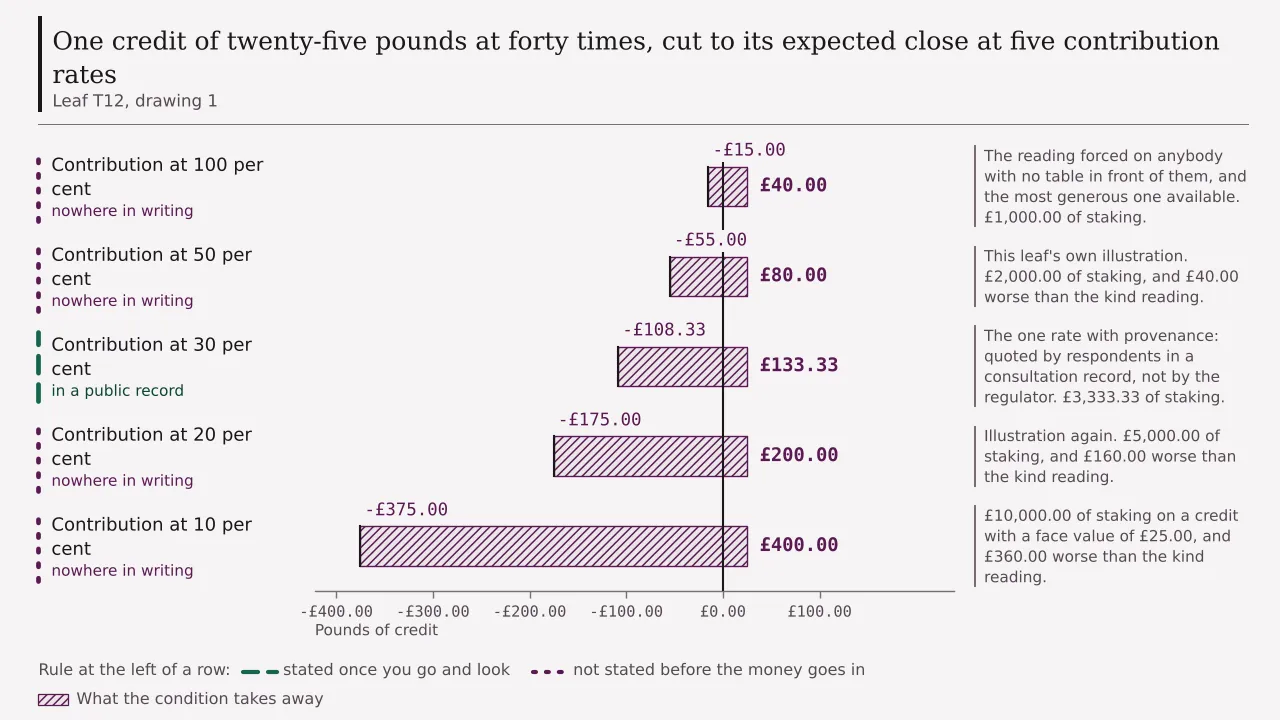
The spacing of those rows is the argument. Staking rises as the reciprocal of g, so the penalty for a low rate is not gradual. Between a hundred per cent and fifty the demand adds £1,000.00. Between twenty per cent and ten it adds £5,000.00. The rates doing the most damage sit furthest down a table, which is also where the categories nobody reads tend to be printed.
4
Why the multiple and the rate are never on one page
Two numbers decide a reel credit and they are kept apart. This is the second finding of this leaf and it is a claim about layout rather than about drafting, so it is worth setting out precisely.
Clause 5 is a sentence. It names the credit, the multiple and the window, and it is written in prose because a reader is expected to read it. The contribution schedule is a table. It names categories of game against percentages, it is often long, and it is written in a format nobody reads end to end. A sentence and a table are different kinds of object and they are typeset in different places almost by reflex.
The consequence is arithmetic that cannot be performed in one place. A reader standing in clause 5 has the numerator and not the denominator. A reader standing in the schedule has a percentage against a category and no idea what it divides. Only somebody holding both can produce the £3,333.33 in part two, and holding both means having opened two documents and understood that they multiply.
| What it gives | Where it is settled | Useful alone? |
|---|---|---|
| The multiple, as a sentence | in clause 5 | Gives £1,000.00 at best |
| The rate, as a table of categories | in a separate table | Divides an unknown |
| Which build the credit runs on | at the cashier | Decides which row applies |
| Whether a category changed mid-offer | nowhere in writing | Not checkable afterwards |
| The licensee standing behind the address | in the public register | Settles an owner, never a rate |
The fourth row is the one with no remedy. A table of categories is a living document on most sites, revised without announcement, and a reader who reads it on a Monday has read Monday’s version. A requirement discharged against Monday’s percentages and audited against Thursday’s is a dispute nobody can evidence, because neither version carries a date a reader can produce.
5
The kindest reading, and why nobody has to correct it
When the rate is missing, arithmetic has to assume something, and there is only one defensible assumption available. Full contribution is the generous end of the range, so a figure computed at g equal to one is the best the offer can possibly be. Any other assumption would be a guess dressed as a finding.
The consequence of that is the sentence this part exists for. Assuming full contribution produces a figure flattering to the offer, so nobody involved in publishing the offer ever has to correct it. An error that runs in the house’s favour generates no complaints, no corrections and no disclosure. The silence is therefore stable, which is a different thing from the silence being deliberate, and this leaf does not need the stronger claim to price the weaker one.
Expected close at the assumed full contribution minus £15.00 Expected close at the 30 per cent on record minus £108.33 The price of the table nobody linked to £93.33
Ninety-three pounds and thirty-three pence is what the absence is worth on a £25.00 credit, using the only contribution figure with any published provenance behind it. It is not a sum anybody gets invoiced for and no statement records it. It is the difference between the arithmetic a reader can do and the arithmetic the system performs, and the whole of it is created by a percentage sitting somewhere other than beside the multiple it divides.
Scale that against what was paid in. The reader handed over £25.00 of their own money to collect £25.00 of credit. The gap between the kind reading and the recorded one is £93.33, which is 3.73 times the payment that opened the account. A reader comparing two offers on their percentages, with no table in front of them, is comparing the smallest term in the arrangement.
6
Where a contribution table sits when it exists at all
Having established what the absence costs, the next question is where the thing would be if it were there. Four positions recur, and they differ in how many taps separate them from the sentence that needs them.
Immediately beneath clause 5, in the same list of promotional terms, is the best case and the rarest. There the rate is in clause 5 for practical purposes, the sum can be done in one place, and a reader who reads the clause has the whole arithmetic.
In a separate schedule the promotional terms refer to by name is the common case. The rate is in a separate table, two or three taps out, and the reader has to know that the reference matters. Most do not, because a cross-reference reads like administration rather than like a figure.
In a help-centre article, reachable through a search box rather than through a link, is the third. The rate exists, it is accurate, and the route to it is a query a reader has to think of composing. A term discoverable only by somebody who already suspects it exists is close to undiscoverable.
And then there is silence, which is the fourth and is extremely common on offers of this kind. The rate bites regardless, since a system enforces it with or without a sentence behind it. That is the distinguishing feature of this term and the reason it sits in place six: an unwritten ceiling does nothing, an unwritten deadline does nothing, and an unwritten contribution rate does everything it would have done had it been published.
| Position | Taps from clause 5 | Where that leaves it | Can the sum be finished? |
|---|---|---|---|
| In the same list of terms | 0 | in clause 5 | Yes, in one place |
| In a named schedule | 2 or 3 | in a separate table | Yes, for whoever follows it |
| In a help article found by searching | Not countable | behind a search box | Only if it is suspected |
| Unpublished | No destination | nowhere in writing | No, and it still applies |
7
What a regulator has actually published about contribution
Very little, and the little that exists is worth stating exactly, because the gap between what is published and what readers assume is published is itself part of this subject.
A ceiling on wagering requirements came into force on 19 January 2026, set at ten times the bonus funds and reaching every licence except the technical and software ones. The consultation record behind it records sixty times as a figure some licensees had been applying, which is the one market multiple on this subject traceable to the regulator itself.
Contribution survived that ceiling untouched. The consultation record carries a worked illustration contributed by respondents rather than by the regulator, in which a £100 bonus at ten times meets a 30 per cent weighting and each staked pound counts 30 pence towards discharging it. The point was noted in the record and nothing was done about weighting. So the arithmetic in this leaf is built against a contribution rate that appears in a published record, and the sums themselves belong to this site rather than to any regulator.
What follows from the ceiling is sharper than it first looks, and it is this leaf’s own working. The ceiling binds the multiple, not the turnover. At ten times and full contribution, a £25.00 credit owes £250.00 of staking and closes at £25.00 multiplied by one less 0.4, which is plus £15.00. At ten times and the 30 per cent on record, the same credit owes £833.33 and closes at minus £8.33. The offer is inside the ceiling in both cases, and in one of them the credit is worth having while in the other it is not.
Solve for the point of indifference and the result is a single number worth carrying away. The expected close hits zero once four pence in the pound, multiplied up by the multiple, has caught the contribution rate. At ten times that gives a rate of 40 per cent, so a credit capped at ten times is worth having only where contribution runs at or above two fifths. At forty times, the same calculation asks for a rate of 160 per cent, which no table can supply, so at a multiple of forty the credit is negative at every contribution rate that exists.
| Multiple | Contribution | Staking demanded | Expected close | Worth having? |
|---|---|---|---|---|
| Ten times, the regulated ceiling | 100 per cent | £250.00 | plus £15.00 | Yes |
| Ten times, the regulated ceiling | 40 per cent | £625.00 | £0.00 | Exactly break-even |
| Ten times, the regulated ceiling | 30 per cent | £833.33 | minus £8.33 | No |
| Forty times, outside the licence | 100 per cent | £1,000.00 | minus £15.00 | No |
| Forty times, outside the licence | 30 per cent | £3,333.33 | minus £108.33 | No |
One more published point belongs here and is routinely misread. The disclosure rule covering what a player may see before committing offers a licensee a choice of four items joined by the word or: a description of how the game runs and how a winner gets picked, the house edge or margin, the return percentage, or the probability of winning events. Satisfying it does not require a return percentage at all. So a page that tells a reader they are entitled to see a figure for the return is wrong, and this leaf’s 96 in the hundred is a house convention rather than an entitlement.
8
The caps written in pounds, and how far they reach
Two limits on this product are written in pounds rather than in percentages, and they behave differently from everything above because they are stated as absolutes. Inside the British licence an individual may stake no more than £5 in a game cycle on an online slot, and no more than £2 where that individual is under 25. Two commencement dates are published, 9 April 2025 carrying the first limit and 21 May 2025 the second, over an instrument dated 25 February 2025.
Their reach is narrower than readers assume. Each is a slot rule, hung on a remote casino licence and aimed at a reel-based game played online, with nothing else in a casino touched by either. The pace floor has the same shape: no licensed build reopens a game cycle inside 2.5 seconds, and that is written for slots too.
Fold the pace floor into this leaf’s own arithmetic and the obligation acquires a length. Ten thousand presses at 10p is £1,000.00 of staking, and at a minimum of 2.5 seconds a cycle that occupies 25,000 seconds, which is 6.94 hours. At the 30 per cent on record the same credit wants 33,333 presses, 83,333 seconds and 23.15 hours. Clearing the second of those inside a single day would need 2.59 seconds a press sustained without a break for a full day, which is inside a rounding error of the floor and outside the realm of anybody’s attention.
6.94 hours of pressing at full contribution, 23.15 hours at the 30 per cent on record
Two further design rules belong beside the caps, since both bear on how long somebody sits at a requirement of this size. Anything that brings a result forward is out, and slam-stop, quick-spin and turbo get listed in the guidance, so the hours above will not compress. And where a return comes back at or under the stake that bought it, a build is barred from celebrating, which is what stops 33,333 presses feeling like 33,333 small successes.
9
Reading an offer of this kind when the rate is missing
The practical part is short. Find the multiple, which will be in a sentence. Then look for a table of categories, and treat finding it as the main event rather than as housekeeping. If the table exists, divide: the multiple times the credit, over the rate for whatever the credit will actually be spent on. If it does not exist, compute at full contribution, write down that the figure is the most generous one available, and treat the offer as unpriced rather than as priced favourably.
Three sentences cover the common mistakes. Comparing two offers on their percentages compares the smallest term in each. Comparing them on their multiples compares the numerator of a fraction whose denominator is missing. And a credit inside the ten-times ceiling is not automatically worth taking, because at ten times a rate below 40 per cent is enough to make it negative.
On the worked offer the figures assemble as follows. £25.00 paid in, £25.00 credited, forty times in clause 5. At full contribution that is £1,000.00 of staking, 10,000 presses, 6.94 hours and minus £15.00. At the 30 per cent on record it is £3,333.33, 33,333 presses, 23.15 hours and minus £108.33. Between those two readings sits £93.33, and the only thing separating them is which table a reader has in front of them.
Reel credits advertised at multiples of this size come from operators holding no British licence, and the losses that matter on a page about contribution are the ones that bound the arithmetic rather than the ones that describe a service. Inside the licence a wagering requirement cannot exceed ten times the bonus funds, which puts a hard roof over the numerator in part two. An individual cannot stake more than £5 in a game cycle on a slot, or more than £2 under the age of 25, which bounds how fast the obligation can be run at. Nothing brings a result forward, with slam-stop, quick-spin and turbo listed in the guidance, so the hours will not compress. And where a return comes back at or under the stake that bought it, celebration is barred, which keeps a long grind from being dressed as a run of wins. Remove the four and the formula in part two loses every one of its bounds at once: the multiple can be forty or sixty, the rate can be a tenth, the staking can run to five figures on a credit of £25.00, and nothing in the arrangement is obliged to say so.
Questions
- What is game weighting and why does it matter more than the multiple?
- It is the proportion of a staked pound credited against a requirement, written here as g. The staking demanded is the multiple times the credit divided by g, so it divides rather than subtracts. Misread the multiple by a factor of two and the answer is out by two; a reader who assumes full contribution when the rate is a fifth is wrong by five, and every figure derived from the staking is wrong by the same factor.
- How much staking does a £25.00 credit at forty times actually demand?
- £1,000.00 at full contribution, which is 10,000 presses at 10p and an expected close of minus £15.00. Set contribution at 30 per cent and the same clause demands £3,333.33, which is 33,333 presses and an expected close of minus £108.33. Neither the credit nor the clause has changed between those two lines. One percentage, sitting in a different document, has moved the expected cost by £93.33.
- Where is the contribution rate written down?
- In one of four places, and the first is the rarest. Directly beneath the clause carrying the multiple, where the sum can be finished in a single place. In a named schedule two or three taps away, which is the common case. In a help article reachable only by searching for something a reader has to suspect exists. Or nowhere at all, in which case the rate still bites, since a system enforces it with or without a sentence behind it.
- Why assume full contribution when the rate is missing?
- Because it is the only defensible assumption and it is the generous end of the range. A figure computed at full contribution is the best the offer can possibly be, so no other setting could be printed as a finding without inventing it. The consequence is that an error of this kind always flatters the arrangement, which means nobody publishing the offer is ever put in a position of having to correct it.
- Does the ten-times cap make a credit safe to take?
- No, and the arithmetic says why. The cap binds the multiple and leaves contribution alone. At ten times and full contribution a £25.00 credit owes £250.00 and closes at plus £15.00. At ten times and the 30 per cent on record it owes £833.33 and closes at minus £8.33. Both sit inside the cap. The expected close hits zero once four pence in the pound, multiplied up by the multiple, has caught the rate, which at ten times means 40 per cent.
- Is there any contribution figure with a source behind it?
- One, and it has to be attributed carefully. A consultation record carries a worked illustration supplied by respondents, not by the regulator, in which a £100 bonus at ten times meets a 30 per cent weighting so that each staked pound counts 30 pence towards discharging it. The point was noted in the record and nothing was done about weighting. Every other rate used on this leaf is illustration, because no current table of game categories is published anywhere citable here.
- Why are the multiple and the rate never printed together?
- Because one is a sentence and the other is a table, and the two get typeset in different places almost by reflex. A reader standing at the clause holds the numerator and not the denominator. A reader standing at the table holds a percentage against a category with no idea what it divides. Only somebody holding both produces the £3,333.33, and holding both means having opened two documents and understood that they multiply.
- How long does a requirement of this size take to work off?
- 6.94 hours at full contribution and 23.15 hours at the 30 per cent on record. Ten thousand presses at a minimum of 2.5 seconds a game cycle occupy 25,000 seconds; 33,333 presses occupy 83,333. Clearing the longer one inside a single day would need 2.59 seconds a press sustained without a break for twenty-four hours, which sits inside a rounding error of the floor a licensed build has to keep.
- Are the two stake limits written in pounds good across a whole casino?
- No. Both attach to online slots, meaning a reel-based game played online under a remote casino licence, and they touch no other casino product. Two commencement dates are published, 9 April 2025 carrying the £5 limit and 21 May 2025 the £2 one that applies under the age of 25, over an instrument dated 25 February 2025. The 2.5-second interval between game cycles is written for slots in the same way.
- Is a site obliged to publish a return percentage for its games?
- No, and this is routinely misread. The disclosure rule offers a licensee a choice of four items joined by the word or: a description of how the game runs and how a winner gets picked, the house edge or margin, the return percentage, or the probability of winning events occurring. Publishing any one of them satisfies it. The 96 in the hundred used throughout this site is a house convention for the arithmetic rather than a figure any reader is entitled to see.