Terms read 19 October 2026 Leaf C12, revision 1
Five pounds has to cross the reels three times before it has paid for itself
One pass of a five pound balance earns the business £0.20, of which gaming duty takes two fifths. Against an assumed handling charge of £0.35 the transaction is still under water, and it stays under water until the balance has gone round 2.92 times. That ratio, and not the reader’s convenience, is what a floor is for.
Stated on the banner £10.00 Five pounds sent in and five pounds matched, which is the sum a reader reads off the offer and the payment page together. Stated, once you go and look £2.00 Forty times on the credited half, written into a separate promotional document, costing £200.00 of staking to satisfy. Not stated before the money goes in 2.92 turnovers How often the balance has to go round before the payment has covered duty and an assumed handling charge, which is the figure the floor was chosen against.
Offers opening at five pounds, with their terms read
Every destination in this file is bought advertising. The site is paid a fee if a reader goes on to register, and no figure printed below moves because of it.
Bonus Spins UK Slip 01
Betportal
Ceiling as a multiple
The drop
€15.00
€1.00 in the euro
The claim reads €15.00. Once the terms beside it have applied, €0.00 of it can leave. The difference is the drop.
7 of the 15 terms on this slip could not be read before the money went in
Spins priced at this site's own 10p a spin, which the operator does not publish
Stated
€15.00
The claim as it is printed, before a single term has been applied to it.
Headline paid as spins
150 spins at 10c each, which is €15.00 of the figure above.
6 Nowhere
What one spin is worth
No unit is published for a spin, so the count is priced at this site's own 10p a spin. At half that price every figure below halves with it.
Match and other credit not priced
300% of three deposits, to a ceiling of €1,000. A share of a deposit nobody has made yet is not a sum, so no figure stands on this line and none is carried below.
Qualified
-€14.40
Written down somewhere, and taking part of the claim back. Each term carries the place it is written and the sum it takes.
2 Written terms at a distance this record does not establish
Play-through -€14.40
Carrying €14.40 through 35 times stakes €504.00 and costs €20.16 of it at 96 per cent return. That prices above the €14.40 there is to charge it against, so the whole of the credit goes and the line is held at that. The multiple sits on the bonus.
2 Written terms at a distance this record does not establish
Game weighting not priced
Slots only count towards the play-through. No contribution percentage is published, so the line above has been worked at full weight, which is the kindest reading there is.
2 Written terms at a distance this record does not establish
Ceiling on the winnings not priced
5x the bonus.
2 Written terms at a distance this record does not establish
Clock on the credit not priced
14 days.
2 Written terms at a distance this record does not establish
Largest stake while it runs not priced
€5.
3 Public record
Licence, and who holds it not priced
Licensed in Anjouan, Comoros, held by BetPortal Gaming Ltd, with Excite Ultra Media Ltd, reference ALSI-202601040-FI2. A register entry settles who holds a licence and what it permits. It does not settle who is running the site this morning.
4 Cashier
Smallest qualifying deposit your money
€20 a stage. That is €20.00 of your own money, and it is never netted into a drop.
5 On the way out
Checks before a withdrawal not priced
Documents before the first withdrawal.
Unstated
-€0.60
Applying without having been published anywhere, and costing money all the same.
6 Nowhere
What a spin hands back -€0.60
Staking a spin returns 96 per cent of it, so that share of the batch is the house's before a reel turns. This site works at that return and the operator publishes none where the claim is made.
6 Nowhere
Forfeited by rule cost unknown
Nothing is published under this heading, and it applies regardless.
6 Nowhere
Charge on the way out cost unknown
No charge on the way out is published as a figure, so nothing comes off this line. A charge that exists unpublished would come straight off whatever survives.
6 Nowhere
Smallest withdrawal allowed cost unknown
No smallest withdrawal is published as a figure. A floor nobody has published is still a floor, and it decides whether a small balance can move at all.
No Great Britain licence
Terms read 19 October 2026
Bonus Spins UK Slip 02
WinBeast
Ceiling as a sum
The drop
€50.00
€1.00 in the euro
The claim reads €50.00. Once the terms beside it have applied, €0.00 of it can leave. The difference is the drop.
8 of the 15 terms on this slip could not be read before the money went in
Spins priced at this site's own 10p a spin, which the operator does not publish
Stated
€50.00
The claim as it is printed, before a single term has been applied to it.
Headline paid as spins
500 spins at 10c each, which is €50.00 of the figure above.
6 Nowhere
What one spin is worth
No unit is published for a spin, so the count is priced at this site's own 10p a spin. At half that price every figure below halves with it.
Match and other credit not priced
50% to 100% of five deposits, each to a ceiling of €1,000, and a €650 free bet. A share of a deposit nobody has made yet is not a sum, so no figure stands on this line and none is carried below.
Qualified
-€48.00
Written down somewhere, and taking part of the claim back. Each term carries the place it is written and the sum it takes.
2 Written terms at a distance this record does not establish
Play-through -€48.00
Carrying €48.00 through 40 times stakes €1,920.00 and costs €76.80 of it at 96 per cent return. That prices above the €48.00 there is to charge it against, so the whole of the credit goes and the line is held at that. The multiple sits on the bonus and the winnings from the spins.
2 Written terms at a distance this record does not establish
Game weighting not priced
Slots, titles vary by country count towards the play-through. No contribution percentage is published, so the line above has been worked at full weight, which is the kindest reading there is.
2 Written terms at a distance this record does not establish
Ceiling on the winnings not priced
€100 a batch of spins.
2 Written terms at a distance this record does not establish
Clock on the credit not priced
7 days, spins 1 day.
3 Public record
Licence, and who holds it not priced
Licensed in Curaçao, holder not named on the site. A register entry settles who holds a licence and what it permits. It does not settle who is running the site this morning.
4 Cashier
Smallest qualifying deposit your money
€20 a stage. That is €20.00 of your own money, and it is never netted into a drop.
5 On the way out
Checks before a withdrawal not priced
Documents before the first withdrawal.
Unstated
-€2.00
Applying without having been published anywhere, and costing money all the same.
6 Nowhere
What a spin hands back -€2.00
Staking a spin returns 96 per cent of it, so that share of the batch is the house's before a reel turns. This site works at that return and the operator publishes none where the claim is made.
6 Nowhere
Largest stake while it runs cost unknown
Nothing is published under this heading, and it applies regardless.
6 Nowhere
Forfeited by rule cost unknown
Nothing is published under this heading, and it applies regardless.
6 Nowhere
Charge on the way out cost unknown
No charge on the way out is published as a figure, so nothing comes off this line. A charge that exists unpublished would come straight off whatever survives.
6 Nowhere
Smallest withdrawal allowed cost unknown
No smallest withdrawal is published as a figure. A floor nobody has published is still a floor, and it decides whether a small balance can move at all.
No Great Britain licence
Terms read 19 October 2026
Bonus Spins UK Slip 03
EliteSpin
Longest spin window
The drop
£50.00
£1.00 in the pound
The claim reads £50.00. Once the terms beside it have applied, £0.00 of it can leave. The difference is the drop.
8 of the 15 terms on this slip could not be read before the money went in
Spins priced at this site's own 10p a spin, which the operator does not publish
Stated
£50.00
The claim as it is printed, before a single term has been applied to it.
Headline paid as spins
500 spins at 10p each, which is £50.00 of the figure above.
6 Nowhere
What one spin is worth
No unit is published for a spin, so the count is priced at this site's own 10p a spin. At half that price every figure below halves with it.
Match and other credit not priced
50% to 100% of five deposits, each to a ceiling of £1,000. A share of a deposit nobody has made yet is not a sum, so no figure stands on this line and none is carried below.
Qualified
-£48.00
Written down somewhere, and taking part of the claim back. Each term carries the place it is written and the sum it takes.
2 Written terms at a distance this record does not establish
Play-through -£48.00
Carrying £48.00 through 40 times stakes £1,920.00 and costs £76.80 of it at 96 per cent return. That prices above the £48.00 there is to charge it against, so the whole of the credit goes and the line is held at that. The multiple sits on the bonus and the winnings from the spins.
2 Written terms at a distance this record does not establish
Game weighting not priced
Slots count towards the play-through. No contribution percentage is published, so the line above has been worked at full weight, which is the kindest reading there is.
2 Written terms at a distance this record does not establish
Ceiling on the winnings not priced
5x the bonus.
2 Written terms at a distance this record does not establish
Clock on the credit not priced
7 days, spins 3 days.
3 Public record
Licence, and who holds it not priced
Licensed in Costa Rica, held by PrimeTier Limited. A register entry settles who holds a licence and what it permits. It does not settle who is running the site this morning.
4 Cashier
Smallest qualifying deposit your money
£20 a stage. That is £20.00 of your own money, and it is never netted into a drop.
5 On the way out
Checks before a withdrawal not priced
Documents before the first withdrawal.
Unstated
-£2.00
Applying without having been published anywhere, and costing money all the same.
6 Nowhere
What a spin hands back -£2.00
Staking a spin returns 96 per cent of it, so that share of the batch is the house's before a reel turns. This site works at that return and the operator publishes none where the claim is made.
6 Nowhere
Largest stake while it runs cost unknown
Nothing is published under this heading, and it applies regardless.
6 Nowhere
Forfeited by rule cost unknown
Nothing is published under this heading, and it applies regardless.
6 Nowhere
Charge on the way out cost unknown
No charge on the way out is published as a figure, so nothing comes off this line. A charge that exists unpublished would come straight off whatever survives.
6 Nowhere
Smallest withdrawal allowed cost unknown
No smallest withdrawal is published as a figure. A floor nobody has published is still a floor, and it decides whether a small balance can move at all.
No Great Britain licence
Terms read 19 October 2026
Bonus Spins UK Slip 04
Crown Jewelz
Multiple unpublished
The drop
NOT WORKED
The multiple is not published in the operator's own terms. Since the sum cannot be worked around it, none is worked.
9 of the 14 terms on this slip could not be read before the money went in
No drop worked
Stated
£15.00
The claim as it is printed, before a single term has been applied to it.
Headline paid as spins
150 spins at 10p each, which is £15.00 of the figure above.
6 Nowhere
What one spin is worth
No unit is published for a spin, so the count is priced at this site's own 10p a spin. At half that price every figure below halves with it.
Match and other credit not priced
200% of the first deposit, then 150% twice, each to a ceiling of £1,000. A share of a deposit nobody has made yet is not a sum, so no figure stands on this line and none is carried below.
Qualified
NOT WORKED
Written down somewhere, and taking part of the claim back. Each term carries the place it is written and the sum it takes.
2 Written terms at a distance this record does not establish
Play-through not priced
40x the bonus, reported rather than published by the operator.
2 Written terms at a distance this record does not establish
Game weighting not priced
Slots count towards the play-through. No contribution percentage is published, so the line above has been worked at full weight, which is the kindest reading there is.
3 Public record
Licence, and who holds it not priced
Licensed in Curaçao, number not verified, holder not named on the site. A register entry settles who holds a licence and what it permits. It does not settle who is running the site this morning.
4 Cashier
Smallest qualifying deposit your money
£20. That is £20.00 of your own money, and it is never netted into a drop.
5 On the way out
Checks before a withdrawal not priced
Documents before the first withdrawal.
Unstated
NOT WORKED
Applying without having been published anywhere, and costing money all the same.
6 Nowhere
Ceiling on the winnings cost unknown
No ceiling is published. Nothing is assumed in its place.
6 Nowhere
Clock on the credit cost unknown
Nothing is published under this heading, and it applies regardless.
6 Nowhere
Largest stake while it runs cost unknown
Nothing is published under this heading, and it applies regardless.
6 Nowhere
Forfeited by rule cost unknown
Nothing is published under this heading, and it applies regardless.
6 Nowhere
Charge on the way out cost unknown
No charge on the way out is published as a figure, so nothing comes off this line. A charge that exists unpublished would come straight off whatever survives.
6 Nowhere
Smallest withdrawal allowed cost unknown
No smallest withdrawal is published as a figure. A floor nobody has published is still a floor, and it decides whether a small balance can move at all.
No Great Britain licence
Terms read 19 October 2026
Every figure in the second and third columns is this site's own working and nothing an operator has published. A claim is priced as printed, then the share a spin hands back at 96 per cent return comes off it, then what playing the multiple through costs at the same return, and then whatever a published ceiling, a charge on the way out or a floor on the smallest withdrawal takes from what has survived. The drop is the difference between the first figure and the last. The two columns add back up to it exactly, so no money leaves a slip without a term and a place beside it.
Which column a term falls in is settled by one question: has anybody written it down. A charge a reader meets at the payment screen is written down, and it stands in the second column with the cashier against it. A condition that binds without ever having been set down stands in the third, whatever it costs. Inside each column the terms run outwards from the banner, so the order itself says how far a reader would have had to go.
A count of spins has no unit until one is supplied. Where an operator publishes what one of its own spins is worth, that figure is used and the first column says it is theirs. Where none is published, this site's own 10p a spin stands in its place and every figure below moves in proportion with it. Where the multiple itself is unpublished, no drop is worked at all, because that is the one figure the sum cannot be done without.
Three words stand where a figure cannot. Not priced is a term that is written down and carries no number the arithmetic can take. Cost unknown is a term nobody has written down, costing something nobody has put a number on. Your money is money of the reader's own, which is never netted into a drop.
None of the operators in this file holds a Great Britain licence, so none of the duties that licence carries reaches them. Each of those duties is published in its own right, which is what makes its absence here something a reader can check rather than take on trust. Every gambling company licensed in Great Britain belongs to Gamstop Online, so a reader who has shut themselves out through the scheme is not shut out here. Social Responsibility Code 5.1.1 has held a play-through to a maximum of ten times the bonus funds since 19 January 2026, and it binds a licence holder and nobody else. Asked in a post of 21 October 2025 what is lost along with the licence, the Gambling Commission's Director of Enforcement and Intelligence answered: "unfair gaming practices, financial loss, and a lack of recourse if things go wrong". The same post puts blocked payouts, and withdrawal limits pitched high enough to be unreachable, among the behaviour the Commission has recorded. Nobody under 18 may hold an account at any of them.
Terms are reproduced in the wording their operator published, and each slip is dated with the day somebody sat down and read them. 19 October 2026 is the oldest of those dates. Anybody claiming an offer is bound by that operator's full terms, which are elsewhere, and never by a line standing here.
1
What a five pound payment is worth to the business that asked for it
Every other page about a payment threshold asks what the reader gets for the money. This one turns the question round and asks what the business gets, because a threshold is set by the business and a figure is easier to understand from the side that chose it. Five pounds is the commonest opening sum on the market. Somebody picked it, and the arithmetic behind the picking is not complicated.
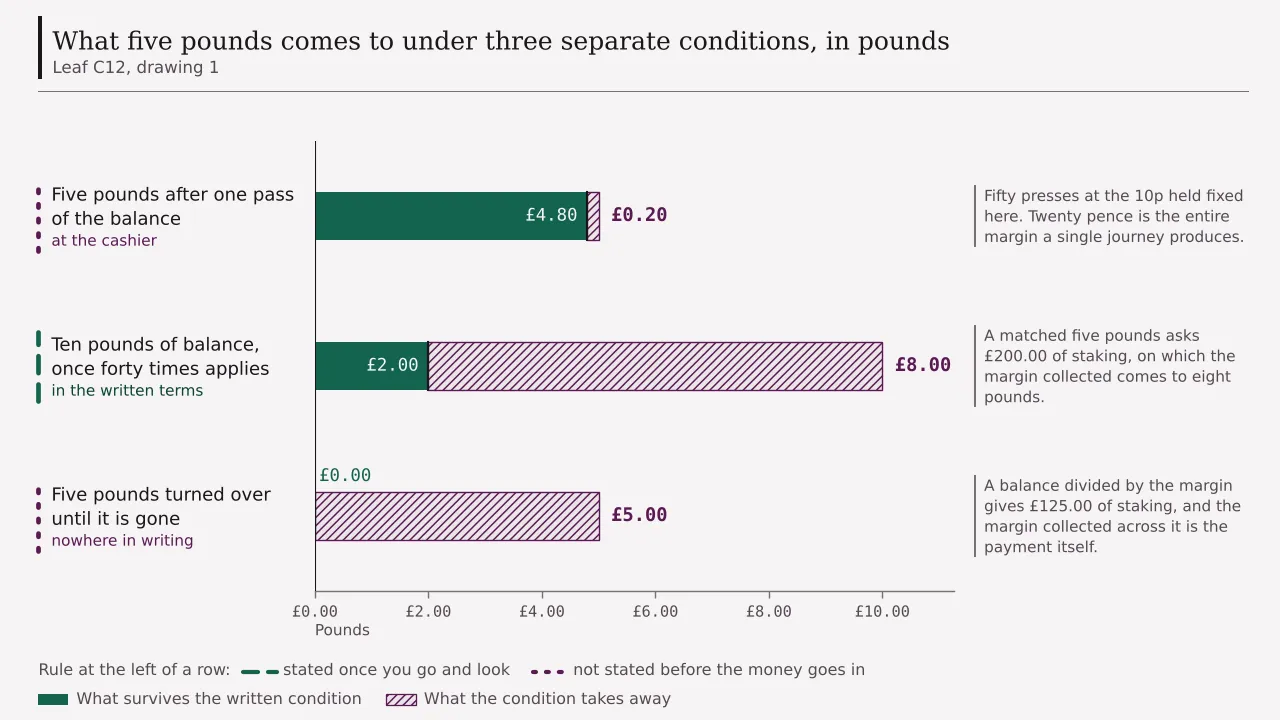
Start where the money starts. Five pounds arrives as fifty presses at the 10p held fixed here. A 96 per cent return hands £4.80 of that back and keeps the remainder, so one complete journey of the balance across the reels earns the business £0.20, with nothing else yet applied.
Twenty pence is the whole of what a single pass produces, and three deductions stand between it and anything a business can keep. Gaming duty is the first and it is published. A charge for handling the payment is the second and this leaf assumes it, since no primary source publishes one. Whatever it costs to put the offer in front of somebody is the third, and that one is unknowable from outside, so this leaf prices the first two and says plainly where the third would go.
Two fifths of a gaming provider’s profit leaves in remote gaming duty, a rate settled in a public record, on or after 1 April 2026, that profit being whatever arrives as stakes set against whatever departs as winnings. Two fifths of twenty pence is eight pence. Twelve pence survives the journey described above, and not a penny has yet gone to whoever moved the money.
That charge carries a property worth printing on its own, because it runs against what a reader assumes about an offshore address. Where the customer ordinarily lives decides it, and not where the operator is licensed. Put remote gambling in front of somebody ordinarily resident in Britain and the charge attaches, whatever licence is or is not held. Two fifths is accordingly not a cost the offshore side avoids. Both sides carry it equally, and it is the only quantity here that stays put when the licence moves.
2
A single turn of the balance, and the handling it fails to cover
Handling has to be assumed, and the assumption is stated here once and carried everywhere below: 25p to accept a payment plus two per cent of its value, which is this leaf’s own figure and not a published tariff. On five pounds that is £0.35. Readers who prefer a different charge can substitute it, and the shape of the result does not move.
Set the two against each other. One pass earns twelve pence after duty. Handling takes thirty-five pence. The payment is therefore twenty-three pence under water the first time the balance goes round, and the business has sold nothing at all. Nothing about that figure is specific to five pounds, which is the point part five works out in full.
So the first finding of this leaf is a negative one and it is the useful one. No payment threshold on the market covers its own handling in a single pass of the balance. Not a pound, not five, not ten. A business wanting each payment to settle its own handling at once would have to name a sum far above anything a payment page prints, so the thresholds actually in use were plainly never chosen on that test.
£0.23 under water after one complete pass of a five pound balance, on an assumed handling charge of £0.35
What follows from the negative is the whole design. If one pass does not pay, the threshold has to be set against how many passes the business expects, and that expectation is a property of the person rather than of the payment. A threshold is consequently a statement about predicted behaviour wearing the costume of a transaction limit.
3
Turning a balance over until there is none of it left
The other end of the range is easy to compute and sets a ceiling on everything else. Divide a balance by the margin and the quotient is the staking it generates before exhaustion, so five pounds carries £125.00 across the reels on the way to nothing. At 10p a press that is 1,250 presses, and the margin collected across them is the five pounds itself.
Five pounds of margin is therefore the absolute ceiling on what a five pound payment can ever be worth to anybody, and no offer, no multiple and no clause raises it. Duty at two fifths removes £2.00 and leaves £3.00. The assumed handling of £0.35 removes a little more and leaves £2.65. That is the most a five pound payment can produce in the best case the business has.
Margin available on a five pound balance played out £5.00 What survives duty at two fifths and an assumed £0.35 of handling £2.65 Taken before the business has kept a penny £2.35
Two pounds sixty-five is a small sum to build a threshold around, and the smallness is the explanation rather than an objection. A business whose best case on a payment is under three pounds cannot be selling the payment. It must be selling something else, and part six names what.
4
What a matched credit costs the side that issues it
Now add the offer that almost always travels with a threshold of this size. Matching the payment in full puts a second five pounds on the account, and forty times is fixed against it in the promotional terms, forty being the band printed out here when anything at all is printed. Forty lots of five pounds send £200.00 over the reels, on which the margin collected comes to £8.00.
Ten pounds of balance less eight pounds of expected leakage is £2.00. The house formula gets there along a different road. Forty applications of a four per cent margin eat 1.6 of the credit; take that from one and minus six tenths remains; six tenths of five pounds going the unhelpful way is minus £3.00; add back a payment that was never credit and two pounds stands. The two roads share their inputs and nothing else.
Balance read off the payment page and the offer together £10.00 Expected close once the forty times condition applies £2.00 The price of a clause in a second document £8.00
Read that block from the issuing side and it says something the reader’s side cannot see. The business received five pounds of cash and gave five pounds of credit, which is an entry rather than a payment. It expects to hand back two pounds and keep three. Against the five pounds it would have kept had the balance simply been played out, the match has cost it £2.00, or £1.20 once duty is taken off that figure as well.
Two pounds is the price of acquiring an account, expressed as the thing the business gave up rather than the thing the reader received, and those two quantities are not the same. The reader was handed five pounds of credit. The business parted with two pounds of expectation. Forty times is the clause that creates the difference, and it converts a five pound gift into a two pound cost.
One honest difficulty belongs in the body and not in small type. Duty is computed on whatever arrives as stakes against whatever departs as winnings, and £200.00 of staking yields a base of £8.00, which stands above the three pounds of cash actually retained. Whether a stake paid for out of credit counts as an arriving stake is a question the guidance citable here does not answer, so the comparison is this leaf’s own reading of a definition and nothing firmer.
5
Moving the threshold and watching the handling eat the difference
Walk the threshold across the sums payment pages accept and two columns matter. One is what the payment can ever be worth after duty and the assumed handling. The other is how far the balance has to travel before it has covered that handling at all, which is the figure a business would actually set a threshold against.
| Smallest payment accepted | Margin once the balance is gone | Left after duty and assumed handling | Staking before handling is covered | Turnovers that takes |
|---|---|---|---|---|
| One pound | £1.00 | £0.33 | £11.25 | 11.25 |
| Three pounds | £3.00 | £1.49 | £12.92 | 4.31 |
| Five pounds | £5.00 | £2.65 | £14.58 | 2.92 |
| Ten pounds | £10.00 | £5.55 | £18.75 | 1.88 |
| Twenty pounds | £20.00 | £11.35 | £27.08 | 1.35 |
Every figure in the last two columns rests on the assumed charge of 25p plus two per cent and on duty at two fifths, and is named as this leaf’s working rather than as anybody’s published tariff. The staking column is handling divided by the margin a pound of staking leaves after duty, which is 2.4 pence. The turnovers column is that staking divided by the payment.
Read the final column downwards and the threshold question answers itself. At one pound the balance has to go round more than eleven times. At five it is under three, and between those two rows sits the whole of the commercial argument. A business choosing five rather than one is not being generous or mean. It is choosing a number at which an ordinarily unremarkable amount of play covers the cost of accepting the money.
The fourth column moves the other way and is worth noticing because it is counter-intuitive. Raising the threshold raises the staking needed to cover the handling, from £11.25 at a pound to £27.08 at twenty, because the proportional part of the charge grows with the payment. What falls is the number of trips round, and the number of trips is what a business can predict. Pounds of staking are not predictable from a payment. Trips round are.
6
Why the figure is not set where the payment pays for itself
Collect the three results. One pass of a five pound balance is twenty-three pence under water. The entire balance played out is worth £2.65 at best. A matched credit removes two pounds of expectation to get the account open. Put together they say that a five pound payment, considered as a sale, is a bad sale, and that nobody sets a threshold with the sale in mind.
What is being bought is the account itself. A funded account is a durable object: it carries an identity, a payment instrument on file, a marketing permission in many cases, and the standing possibility of a second payment that costs nothing to acquire because the first one already paid for the acquiring. The threshold is set at the smallest sum that makes the object worth creating, and five pounds is where a good deal of the market has landed.
That reframes every figure above. Twenty-three pence under water on the first pass is a cost of acquisition, not a loss. Two pounds of match given away is a price paid for an object, not a gift. The £2.65 ceiling is a floor under the value of the object rather than a measure of it, because the object’s real value lies in payments that have not happened yet and cannot be computed from anything published.
The honest limit of this leaf’s arithmetic sits exactly there. Nothing on this page can price a second payment, a tenth payment, or the chance that neither arrives. Those figures exist inside a business and are published by nobody, which puts them nowhere in writing and leaves this leaf able to price only the opening transaction. Saying so is more useful than estimating it.
What can be said with confidence is the direction. A threshold that low only makes sense if the expected number of further payments is greater than one, so a business setting it has already formed a view about repetition. The reader meets a payment page. The payment page has met a great many readers, and the number printed on it is the output of that difference.
7
Rules about growing an account, and what departs with them
Entrances built at five pounds hold no Great Britain licence, and since this leaf argues from the business’s side the duties worth collecting are those restraining how an account may be grown. Four of them bear directly on the arithmetic above, and each is a brake on repetition, repetition being precisely the quantity part five measures.
Pushing somebody towards recovering a loss, towards a larger stake, or towards playing on once they have signalled an intention to stop, is forbidden in a licensed build. Two lines of the guidance beneath it read as though drafted for a threshold page. Money inside a product may be replenished only where the customer picks that option on each separate occasion. And anybody who has walked away is not to be tempted back with a complimentary turn. Hold those beside the 2.92 turnovers in part five, which is the exact mechanism they restrain.
Frequent or repeated taking part is something a promotion is not supposed to encourage, and neither is outlay a person has no business losing. A sum small enough to be sent casually and sent again is exactly the arrangement that advice has in view, and past the licence nothing has it in view at all.
Incentives aimed at customers a business has marked as high value have to square with the licensing objectives, and the licensee has to take account of the regulator’s guidance on them. That is the only British rule written about sorting customers by what they are worth, which makes its absence the sharpest of the four on a page about exactly that sorting.
One published example gives the whole subject a scale, and running it through the figures here is more useful than quoting it. The advertising regulator says a one-off reward after £50 has been wagered can be acceptable, provided a reward at that level is not unusual for the product. Fifty pounds across the reels leaves £2.00 behind at this site’s margin, so the published example describes a reward issued against two pounds of expectation. The matched credit in part four cost the same two pounds and was issued against a five pound payment instead.
Take the four away and nothing in the arithmetic changes. What changes is that the 2.92 turnovers become a target nobody is restrained from pursuing, by any means the business finds effective, and the figure on the payment page stops being a commercial judgement answerable to anything.
8
What a threshold says the reader is, put without flattery
A payment page asking for five pounds is making a statement about the person reading it, and the statement can be reconstructed from the figures. It says the first payment is not expected to pay for itself. It says a second one is expected. It says two pounds of expectation is worth spending to make the first one happen. None of that is written anywhere, and all of it follows from a number printed at the cashier.
Put plainly, at this end of the market the reader is an account rather than a sale. That is not an accusation and it is not hidden malice. It is the only reading of a threshold under which the arithmetic works, and any business that set the figure differently would be doing something the numbers in part five do not support.
The concession this leaf owes is a real one. Five pounds is a genuinely small commitment and a reader who sends it has capped their exposure at five pounds by the act of sending it. Somebody who wants to look at a lobby, who treats the five as spent, and who never attempts the clause in part four has bought fifty presses at a stated price and owes nobody anything. The arithmetic turns only where somebody treats a payment as a position instead.
The practical conclusion is narrow and it costs nothing to act on. Before paying, decide which of the two readings applies, because the payment page cannot tell them apart and the offer attached to it is priced for the second. A reader who has decided in advance has taken the only decision on this leaf that is still theirs to take.
£200.00 of staking asked against a five pound credit that cost its issuer two pounds of expectation
One boundary closes the leaf. Membership of the national self-exclusion scheme follows a British licence and nothing else, so an address without one sits beyond its reach by construction. Anybody who has registered with Gamstop Online arranged for payment pages of this sort to be shut, and a sum as small as five pounds is no exception to that arrangement. The support routes printed below are the destination worth using.
Questions
- Why do casinos set a minimum deposit at all?
- Because one journey of a balance across the reels never covers what the payment cost to accept. Five pounds turned over once earns twenty pence of margin, gaming duty takes two fifths of that, and twelve pence is left against an assumed handling charge of 25p plus two per cent, which comes to £0.35 on five pounds. The transaction is twenty-three pence down. A threshold is accordingly chosen against how often the balance is expected to go round, and not against whether a single payment settles its own costs.
- How much does a five pound deposit actually earn the business?
- Between nothing and £2.65. The ceiling is reached when the balance is played until it is gone, which takes £125.00 of staking at a four per cent margin, and the margin collected across that is the five pounds itself. Duty at two fifths removes £2.00 and the assumed handling removes £0.35, leaving £2.65 in the best case the business has. Every figure below that ceiling depends on how long the reader stays, which is published nowhere.
- What does a 100 per cent match cost the operator?
- Two pounds of expectation, which is a smaller number than the five pounds of credit it hands over. Forty times on a five pound credit asks for £200.00 of staking, four pence in each pound of which is £8.00 of margin, so a £10.00 balance is expected to close at £2.00. The business keeps three pounds of the five it received, against the five it would have kept had the balance simply been played out. The difference is £2.00, or £1.20 once duty is taken off that figure as well.
- Is gaming duty something an offshore site avoids?
- No, and that is the only quantity here which stays put when the licence moves. Two fifths of a gaming provider’s profit goes in remote gaming duty on or after 1 April 2026, the profit being whatever arrives as stakes set against whatever departs as winnings. Where the customer ordinarily lives decides whether the charge attaches, and not where the operator is licensed. Put remote gambling in front of somebody ordinarily resident in Britain and the charge is owed, whatever licence is or is not held.
- How many times does a balance have to go round before the deposit pays for itself?
- At five pounds, 2.92 times, which is £14.58 of staking. At one pound it is 11.25 times, at three pounds 4.31, at ten pounds 1.88 and at twenty pounds 1.35. Those figures divide the assumed handling charge by the 2.4 pence a pound of staking leaves after duty, then divide again by the payment. That charge belongs to this leaf alone, with no tariff anywhere publishing one, and substituting a different figure moves the numbers without altering their order.
- Why is five pounds so much more common than one pound?
- Because the trips round the balance has to make fall from more than eleven at a pound to under three at five, and trips round are the quantity a business can predict from experience. Pounds of staking are not predictable from a payment. A threshold of five is the smallest sum at which an unremarkable amount of play covers the cost of accepting the money, which is a different test from whether the payment is large enough to be worth having.
- What is the reader to a business that asks for five pounds?
- An account rather than a sale. The figures say the first payment is not expected to pay for itself, that a second is expected, and that two pounds of expectation is worth spending to make the first one happen. None of that is written anywhere and all of it follows from a number printed at the cashier. What the account is actually worth depends on payments that have not happened yet, and no business publishes that figure, so this leaf prices the opening transaction and stops.
- What rules would a British licence put around a threshold that low?
- Four brakes on repetition. A licensed build may not push somebody towards recovering a loss, towards a larger stake, or towards playing on once they have signalled an intention to stop, and the guidance beneath that adds two lines: money inside a product may be replenished only where the customer picks that option on each separate occasion, and anybody who has walked away is not to be tempted back with a complimentary turn. Frequent or repeated taking part is something a promotion is not supposed to encourage, and neither is outlay a person has no business losing. Incentives aimed at customers a business has marked as high value have to square with the licensing objectives. Entrances built at five pounds hold no Great Britain licence whatsoever, so not a single duty on that list binds anybody, and the 2.92 turnovers become a target nothing restrains.
- Is a five pound deposit ever the sensible choice?
- On one reading it is, and leaving that out would make the page dishonest. Five pounds buys fifty presses at ten pence apiece, the value this site works to, and sending it caps the exposure at five pounds. Somebody who treats the sum as spent, and who never attempts the condition attached to a matched credit, sets off nothing described above, since every one of these conditions waits on an attempt to take money out. The arithmetic turns only where a payment is treated as a position instead of a price, and that choice is made before the payment page opens.