Terms read 19 October 2026 Leaf C11, revision 1
A pound in, ten pounds out: two floors set on one screen and shown apart
A payment screen accepts £1.00 and releases nothing under an assumed £10.00, which is this leaf’s own figure for the smaller end of that market. Both numbers are fixed by the same party on the same page, and a reader meets the first before registering and the second only after a balance exists. Solve for the payment at which the pair agree and the answer is £25.00.
Stated on the banner £1.00 The smallest sum an account can be opened with, and nothing beside it names the figure waiting at the other end. Stated, once you go and look minus £0.60 Forty times over a matched pound, written into the promotional document, costed at four pence in each pound staked. Not stated before the money goes in £24.00 Two floors share one payment page, the smallest sum it takes and the smallest it will send, and that much further payment separates them.
Offers opening at a single pound, with their terms read
Every destination in this file is bought advertising. The site is paid a fee if a reader goes on to register, and no figure printed below moves because of it.
Bonus Spins UK Slip 01
Betportal
Ceiling as a multiple
The drop
€15.00
€1.00 in the euro
The claim reads €15.00. Once the terms beside it have applied, €0.00 of it can leave. The difference is the drop.
7 of the 15 terms on this slip could not be read before the money went in
Spins priced at this site's own 10p a spin, which the operator does not publish
Stated
€15.00
The claim as it is printed, before a single term has been applied to it.
Headline paid as spins
150 spins at 10c each, which is €15.00 of the figure above.
6 Nowhere
What one spin is worth
No unit is published for a spin, so the count is priced at this site's own 10p a spin. At half that price every figure below halves with it.
Match and other credit not priced
300% of three deposits, to a ceiling of €1,000. A share of a deposit nobody has made yet is not a sum, so no figure stands on this line and none is carried below.
Qualified
-€14.40
Written down somewhere, and taking part of the claim back. Each term carries the place it is written and the sum it takes.
2 Written terms at a distance this record does not establish
Play-through -€14.40
Carrying €14.40 through 35 times stakes €504.00 and costs €20.16 of it at 96 per cent return. That prices above the €14.40 there is to charge it against, so the whole of the credit goes and the line is held at that. The multiple sits on the bonus.
2 Written terms at a distance this record does not establish
Game weighting not priced
Slots only count towards the play-through. No contribution percentage is published, so the line above has been worked at full weight, which is the kindest reading there is.
2 Written terms at a distance this record does not establish
Ceiling on the winnings not priced
5x the bonus.
2 Written terms at a distance this record does not establish
Clock on the credit not priced
14 days.
2 Written terms at a distance this record does not establish
Largest stake while it runs not priced
€5.
3 Public record
Licence, and who holds it not priced
Licensed in Anjouan, Comoros, held by BetPortal Gaming Ltd, with Excite Ultra Media Ltd, reference ALSI-202601040-FI2. A register entry settles who holds a licence and what it permits. It does not settle who is running the site this morning.
4 Cashier
Smallest qualifying deposit your money
€20 a stage. That is €20.00 of your own money, and it is never netted into a drop.
5 On the way out
Checks before a withdrawal not priced
Documents before the first withdrawal.
Unstated
-€0.60
Applying without having been published anywhere, and costing money all the same.
6 Nowhere
What a spin hands back -€0.60
Staking a spin returns 96 per cent of it, so that share of the batch is the house's before a reel turns. This site works at that return and the operator publishes none where the claim is made.
6 Nowhere
Forfeited by rule cost unknown
Nothing is published under this heading, and it applies regardless.
6 Nowhere
Charge on the way out cost unknown
No charge on the way out is published as a figure, so nothing comes off this line. A charge that exists unpublished would come straight off whatever survives.
6 Nowhere
Smallest withdrawal allowed cost unknown
No smallest withdrawal is published as a figure. A floor nobody has published is still a floor, and it decides whether a small balance can move at all.
No Great Britain licence
Terms read 19 October 2026
Bonus Spins UK Slip 02
WinBeast
Ceiling as a sum
The drop
€50.00
€1.00 in the euro
The claim reads €50.00. Once the terms beside it have applied, €0.00 of it can leave. The difference is the drop.
8 of the 15 terms on this slip could not be read before the money went in
Spins priced at this site's own 10p a spin, which the operator does not publish
Stated
€50.00
The claim as it is printed, before a single term has been applied to it.
Headline paid as spins
500 spins at 10c each, which is €50.00 of the figure above.
6 Nowhere
What one spin is worth
No unit is published for a spin, so the count is priced at this site's own 10p a spin. At half that price every figure below halves with it.
Match and other credit not priced
50% to 100% of five deposits, each to a ceiling of €1,000, and a €650 free bet. A share of a deposit nobody has made yet is not a sum, so no figure stands on this line and none is carried below.
Qualified
-€48.00
Written down somewhere, and taking part of the claim back. Each term carries the place it is written and the sum it takes.
2 Written terms at a distance this record does not establish
Play-through -€48.00
Carrying €48.00 through 40 times stakes €1,920.00 and costs €76.80 of it at 96 per cent return. That prices above the €48.00 there is to charge it against, so the whole of the credit goes and the line is held at that. The multiple sits on the bonus and the winnings from the spins.
2 Written terms at a distance this record does not establish
Game weighting not priced
Slots, titles vary by country count towards the play-through. No contribution percentage is published, so the line above has been worked at full weight, which is the kindest reading there is.
2 Written terms at a distance this record does not establish
Ceiling on the winnings not priced
€100 a batch of spins.
2 Written terms at a distance this record does not establish
Clock on the credit not priced
7 days, spins 1 day.
3 Public record
Licence, and who holds it not priced
Licensed in Curaçao, holder not named on the site. A register entry settles who holds a licence and what it permits. It does not settle who is running the site this morning.
4 Cashier
Smallest qualifying deposit your money
€20 a stage. That is €20.00 of your own money, and it is never netted into a drop.
5 On the way out
Checks before a withdrawal not priced
Documents before the first withdrawal.
Unstated
-€2.00
Applying without having been published anywhere, and costing money all the same.
6 Nowhere
What a spin hands back -€2.00
Staking a spin returns 96 per cent of it, so that share of the batch is the house's before a reel turns. This site works at that return and the operator publishes none where the claim is made.
6 Nowhere
Largest stake while it runs cost unknown
Nothing is published under this heading, and it applies regardless.
6 Nowhere
Forfeited by rule cost unknown
Nothing is published under this heading, and it applies regardless.
6 Nowhere
Charge on the way out cost unknown
No charge on the way out is published as a figure, so nothing comes off this line. A charge that exists unpublished would come straight off whatever survives.
6 Nowhere
Smallest withdrawal allowed cost unknown
No smallest withdrawal is published as a figure. A floor nobody has published is still a floor, and it decides whether a small balance can move at all.
No Great Britain licence
Terms read 19 October 2026
Bonus Spins UK Slip 03
EliteSpin
Longest spin window
The drop
£50.00
£1.00 in the pound
The claim reads £50.00. Once the terms beside it have applied, £0.00 of it can leave. The difference is the drop.
8 of the 15 terms on this slip could not be read before the money went in
Spins priced at this site's own 10p a spin, which the operator does not publish
Stated
£50.00
The claim as it is printed, before a single term has been applied to it.
Headline paid as spins
500 spins at 10p each, which is £50.00 of the figure above.
6 Nowhere
What one spin is worth
No unit is published for a spin, so the count is priced at this site's own 10p a spin. At half that price every figure below halves with it.
Match and other credit not priced
50% to 100% of five deposits, each to a ceiling of £1,000. A share of a deposit nobody has made yet is not a sum, so no figure stands on this line and none is carried below.
Qualified
-£48.00
Written down somewhere, and taking part of the claim back. Each term carries the place it is written and the sum it takes.
2 Written terms at a distance this record does not establish
Play-through -£48.00
Carrying £48.00 through 40 times stakes £1,920.00 and costs £76.80 of it at 96 per cent return. That prices above the £48.00 there is to charge it against, so the whole of the credit goes and the line is held at that. The multiple sits on the bonus and the winnings from the spins.
2 Written terms at a distance this record does not establish
Game weighting not priced
Slots count towards the play-through. No contribution percentage is published, so the line above has been worked at full weight, which is the kindest reading there is.
2 Written terms at a distance this record does not establish
Ceiling on the winnings not priced
5x the bonus.
2 Written terms at a distance this record does not establish
Clock on the credit not priced
7 days, spins 3 days.
3 Public record
Licence, and who holds it not priced
Licensed in Costa Rica, held by PrimeTier Limited. A register entry settles who holds a licence and what it permits. It does not settle who is running the site this morning.
4 Cashier
Smallest qualifying deposit your money
£20 a stage. That is £20.00 of your own money, and it is never netted into a drop.
5 On the way out
Checks before a withdrawal not priced
Documents before the first withdrawal.
Unstated
-£2.00
Applying without having been published anywhere, and costing money all the same.
6 Nowhere
What a spin hands back -£2.00
Staking a spin returns 96 per cent of it, so that share of the batch is the house's before a reel turns. This site works at that return and the operator publishes none where the claim is made.
6 Nowhere
Largest stake while it runs cost unknown
Nothing is published under this heading, and it applies regardless.
6 Nowhere
Forfeited by rule cost unknown
Nothing is published under this heading, and it applies regardless.
6 Nowhere
Charge on the way out cost unknown
No charge on the way out is published as a figure, so nothing comes off this line. A charge that exists unpublished would come straight off whatever survives.
6 Nowhere
Smallest withdrawal allowed cost unknown
No smallest withdrawal is published as a figure. A floor nobody has published is still a floor, and it decides whether a small balance can move at all.
No Great Britain licence
Terms read 19 October 2026
Bonus Spins UK Slip 04
Crown Jewelz
Multiple unpublished
The drop
NOT WORKED
The multiple is not published in the operator's own terms. Since the sum cannot be worked around it, none is worked.
9 of the 14 terms on this slip could not be read before the money went in
No drop worked
Stated
£15.00
The claim as it is printed, before a single term has been applied to it.
Headline paid as spins
150 spins at 10p each, which is £15.00 of the figure above.
6 Nowhere
What one spin is worth
No unit is published for a spin, so the count is priced at this site's own 10p a spin. At half that price every figure below halves with it.
Match and other credit not priced
200% of the first deposit, then 150% twice, each to a ceiling of £1,000. A share of a deposit nobody has made yet is not a sum, so no figure stands on this line and none is carried below.
Qualified
NOT WORKED
Written down somewhere, and taking part of the claim back. Each term carries the place it is written and the sum it takes.
2 Written terms at a distance this record does not establish
Play-through not priced
40x the bonus, reported rather than published by the operator.
2 Written terms at a distance this record does not establish
Game weighting not priced
Slots count towards the play-through. No contribution percentage is published, so the line above has been worked at full weight, which is the kindest reading there is.
3 Public record
Licence, and who holds it not priced
Licensed in Curaçao, number not verified, holder not named on the site. A register entry settles who holds a licence and what it permits. It does not settle who is running the site this morning.
4 Cashier
Smallest qualifying deposit your money
£20. That is £20.00 of your own money, and it is never netted into a drop.
5 On the way out
Checks before a withdrawal not priced
Documents before the first withdrawal.
Unstated
NOT WORKED
Applying without having been published anywhere, and costing money all the same.
6 Nowhere
Ceiling on the winnings cost unknown
No ceiling is published. Nothing is assumed in its place.
6 Nowhere
Clock on the credit cost unknown
Nothing is published under this heading, and it applies regardless.
6 Nowhere
Largest stake while it runs cost unknown
Nothing is published under this heading, and it applies regardless.
6 Nowhere
Forfeited by rule cost unknown
Nothing is published under this heading, and it applies regardless.
6 Nowhere
Charge on the way out cost unknown
No charge on the way out is published as a figure, so nothing comes off this line. A charge that exists unpublished would come straight off whatever survives.
6 Nowhere
Smallest withdrawal allowed cost unknown
No smallest withdrawal is published as a figure. A floor nobody has published is still a floor, and it decides whether a small balance can move at all.
No Great Britain licence
Terms read 19 October 2026
Every figure in the second and third columns is this site's own working and nothing an operator has published. A claim is priced as printed, then the share a spin hands back at 96 per cent return comes off it, then what playing the multiple through costs at the same return, and then whatever a published ceiling, a charge on the way out or a floor on the smallest withdrawal takes from what has survived. The drop is the difference between the first figure and the last. The two columns add back up to it exactly, so no money leaves a slip without a term and a place beside it.
Which column a term falls in is settled by one question: has anybody written it down. A charge a reader meets at the payment screen is written down, and it stands in the second column with the cashier against it. A condition that binds without ever having been set down stands in the third, whatever it costs. Inside each column the terms run outwards from the banner, so the order itself says how far a reader would have had to go.
A count of spins has no unit until one is supplied. Where an operator publishes what one of its own spins is worth, that figure is used and the first column says it is theirs. Where none is published, this site's own 10p a spin stands in its place and every figure below moves in proportion with it. Where the multiple itself is unpublished, no drop is worked at all, because that is the one figure the sum cannot be done without.
Three words stand where a figure cannot. Not priced is a term that is written down and carries no number the arithmetic can take. Cost unknown is a term nobody has written down, costing something nobody has put a number on. Your money is money of the reader's own, which is never netted into a drop.
None of the operators in this file holds a Great Britain licence, so none of the duties that licence carries reaches them. Each of those duties is published in its own right, which is what makes its absence here something a reader can check rather than take on trust. Every gambling company licensed in Great Britain belongs to Gamstop Online, so a reader who has shut themselves out through the scheme is not shut out here. Social Responsibility Code 5.1.1 has held a play-through to a maximum of ten times the bonus funds since 19 January 2026, and it binds a licence holder and nobody else. Asked in a post of 21 October 2025 what is lost along with the licence, the Gambling Commission's Director of Enforcement and Intelligence answered: "unfair gaming practices, financial loss, and a lack of recourse if things go wrong". The same post puts blocked payouts, and withdrawal limits pitched high enough to be unreachable, among the behaviour the Commission has recorded. Nobody under 18 may hold an account at any of them.
Terms are reproduced in the wording their operator published, and each slip is dated with the day somebody sat down and read them. 19 October 2026 is the oldest of those dates. Anybody claiming an offer is bound by that operator's full terms, which are elsewhere, and never by a line standing here.
1
Two numbers settled on one screen, and the order they arrive in
A cashier holds two floors. One is the smallest payment it will take; the other is the smallest sum it will send. Both are set by the same party, both live on the same payment page, and neither is printed on an advertisement. A reader meets the first while putting money in, which is early, and the second while trying to take money out, which is late. Nothing in the layout ever shows them together.
Order is what makes the arrangement work. The entry figure is an inducement, so it is shown at the moment it encourages a decision. The exit figure is a condition, so it is shown at the moment it cannot change one. A pound is a trivial commitment and reads as a trivial commitment. Ten pounds held back is not trivial at all, and by the time it appears the pound has already gone.
Both numbers are settled at the cashier, and that is the whole of this leaf’s claim about where they live. Not in the bonus document, which has no reason to carry either. Not in the account agreement, which describes rights rather than tariffs. Not in a public record, which says nothing about what a particular screen will accept. A reader who read every document on the site before registering would still not have the pair.
The £10.00 exit figure worked below belongs to this leaf alone, no published rule anywhere fixing such a sum. It is carried because an exit floor several times the entry floor is the shape that produces the arithmetic below, and because naming a figure makes the arithmetic checkable. Swap it for £5.00 or £20.00 and every result moves in the way part five sets out row by row.
What follows is one subtraction performed four ways. A pound read on its own. A pound once the reels have had it. A pound once a matched credit and its multiple have been applied. And a pound once the exit refuses to move anything under ten. The last of those turns a positive figure into nothing at all, which no clause in any document managed to do.
2
What a single pound buys before anything else is applied
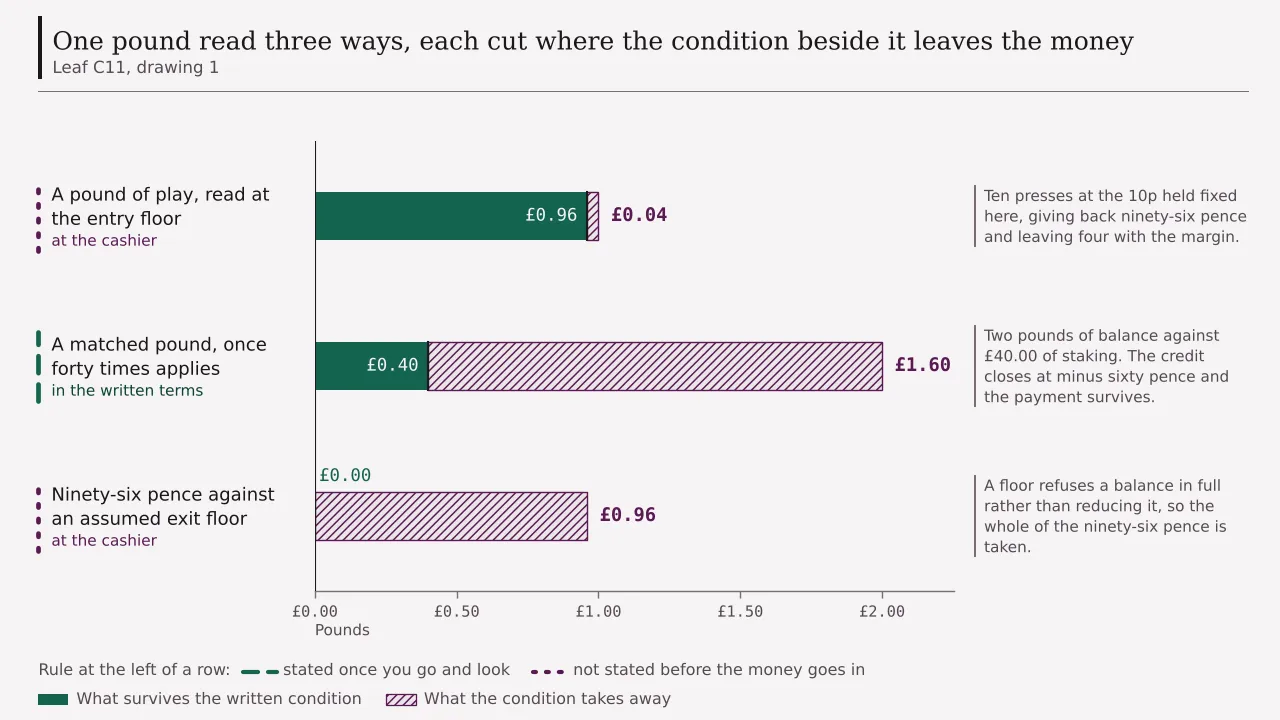
At the 10p a press this site holds fixed, a pound is ten presses. Ninety-six pence in every pound comes back at the rate this site works to, so the ten presses return an expected £0.96 and four pence stays behind. That is the entire arithmetic of a pound taken by itself, and it is the only calculation on this leaf that needs no condition from anywhere.
Let the pound go round rather than stopping after one pass and a second figure appears. A bankroll played until it is gone turns over its own size divided by the margin, so a pound generates an expected £25.00 of staking before it is exhausted, which is 250 presses. The reciprocal of four hundredths is 25, and twenty-five is also the multiple at which a credit has nothing left in it. One division is doing both jobs, which is worth noticing rather than treating as coincidence.
Now add the offer that usually accompanies a payment this small. A match at 100 per cent credits a second pound, and a multiple is attached to it in the promotional terms. At forty times, the figure this leaf works to because it is the band published out here when one is published at all, the credited pound owes £40.00 of staking. Four pence in every pound of that goes to the margin, so £1.60 is expected to leave.
Two pounds of balance less £1.60 of expected leakage is £0.40. The house formula reaches the same place by another road. Forty lots of four hundredths come to 1.6. Subtract that from one and minus six tenths is what remains, and six tenths of a credited pound pointing the wrong way is minus £0.60. The reader’s own pound was never touched, so minus sixty pence and a pound make forty pence. The two calculations share no step and agree exactly.
A pound read at the entry floor alone £0.96 The same pound once an assumed £10.00 exit floor stands over it £0.00 What the second floor removes £0.96
Ninety-six pence looks like a small loss and it is a total one. A balance under a floor is not reduced by the floor. It is refused by it, in full, whether the shortfall is a penny or nine pounds. That property is what separates a floor from every condition in a bonus document, and it is why the figure in the third row of the block above equals the figure in the first.
3
The second floor, and why it never stands beside the first
An exit floor is a threshold under which a payment request is refused rather than charged for. It is not a fee and it does not shrink a balance. It sorts balances into two piles, those that may move and those that may not, and the sorting is done on a single comparison that takes no account of how the balance was built.
Set the assumed £10.00 against the three figures from part two and the result is the same every time. Ninety-six pence does not reach it and is £9.04 short. Forty pence does not reach it and is £9.60 short. A full two pounds of balance, sitting there before a single press, does not reach it either and is £8.00 short. A payment of one pound cannot in any arrangement produce a sum the exit will move, except by a run far better than expectation.
So the honest statement about a pound at an offer carrying an exit floor several times its size is narrow and worth printing plainly. The money can go in. It can be played. It can win. What it cannot do, in expectation, is leave. The entry floor and the exit floor are not two conditions on one transaction. They are the two ends of a one-way valve, and the advertisement describes the end that opens.
Why the pair never appear together is a layout question rather than a drafting one. Nothing requires a payment page to print what a withdrawal page will refuse, and nothing requires a withdrawal page to recall what a payment page accepted. Each screen is accurate. Each screen is incomplete in the same direction. A reader needs both open at once to see the arrangement, and the interface was never built to put them there.
£9.04 of shortfall between an expected ninety-six pence and an assumed £10.00 the exit will not go under
One further asymmetry belongs here. The entry floor is checked against a payment, which the reader controls completely. The exit floor is checked against a balance, which the reader controls not at all once the presses begin. A condition tested against something the reader cannot steer is a condition whose outcome was decided before it was read, and that is the exact property this site exists to put a price on.
4
Solving for the payment at which the pair stop fighting
If the two floors disagree at a pound, there is a payment at which they stop disagreeing, and finding it is a single line of algebra rather than a judgement. Call the payment D and the assumed exit floor F, hold F at £10.00, and ask what D has to be for the expected balance to reach F. The answer depends entirely on what happens to D between arriving and leaving, so there are several answers and each one is honest about its own assumptions.
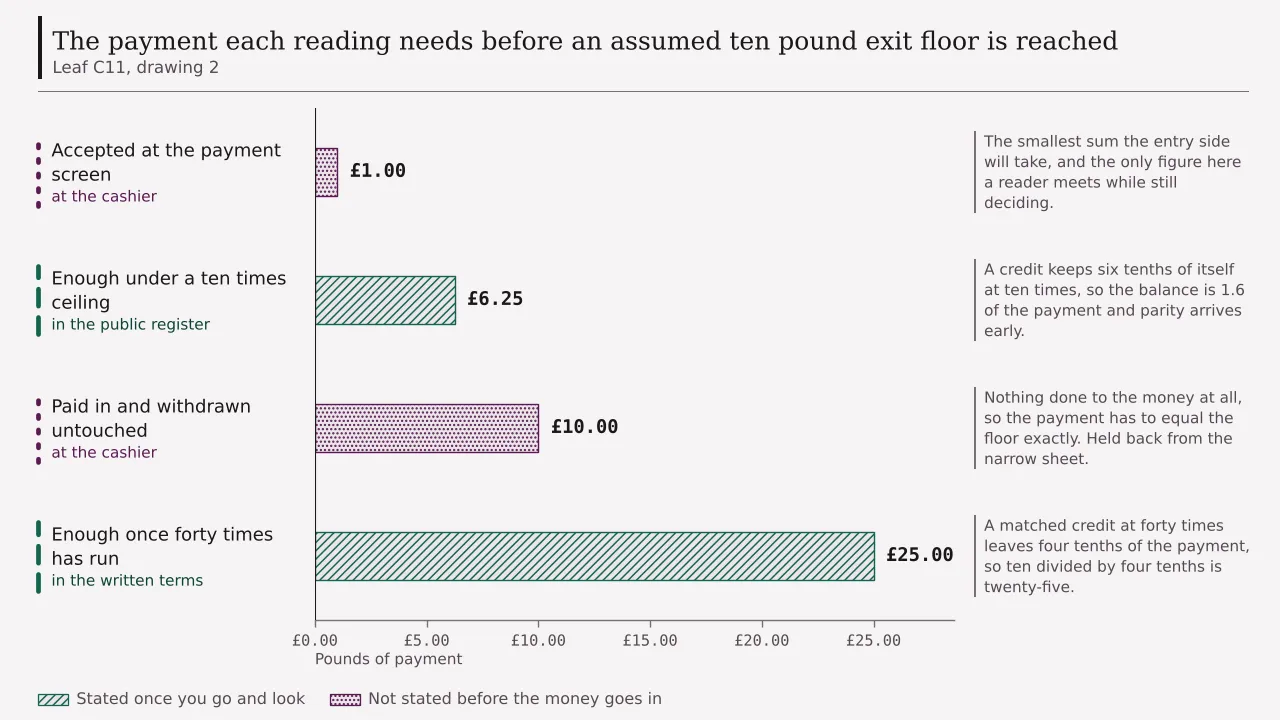
Take the simplest case first. Somebody who sends money in and immediately asks for it back has done nothing to it, so the expected balance is D itself and parity arrives at D equals £10.00. That reading is real but thin, since very little in a cashier’s design encourages it and most offers attach a condition forbidding it outright.
Put the payment across the reels once and the expectation falls to 0.96 of D. Setting 0.96 D equal to ten and dividing gives £10.42 to the nearest penny. Forty-two pence is the entire cost of one pass through a 96 in the hundred return, which is a useful calibration: a single turnover barely moves the parity payment at all.
Now take the offer. A matched credit at forty times leaves 0.4 of D in expectation, since the deposit survives intact and the credit closes at minus 0.6 of itself. Setting 0.4 D equal to ten gives £25.00. Accepting the match therefore multiplies the parity payment by two and a half against the simple case, which runs precisely against the reason anybody accepts an inducement.
Two routes reach that £25.00 and they share nothing but the inputs. By the formula, balance equals D plus B multiplied by one less 1.6, and with B equal to D that collapses to 0.4 D, so D is ten divided by 0.4. By the turnover, a match at forty times asks 40 D of staking, four hundredths of which is 1.6 D of expected leakage, against an opening balance of 2 D, leaving 0.4 D. Ten divided by four tenths is twenty-five in both.
The payment the entry floor asks for £1.00 The payment the exit and a forty times clause between them ask for £25.00 The difference neither screen prints £24.00
Twenty-four pounds is this leaf’s number and it can be checked from the other end. A matched pound is expected to close at forty pence, which is £9.60 under the assumed floor. Every further pound of payment adds forty pence of expected close, because the same 0.4 applies to each. Nine pounds sixty divided by forty pence is twenty-four, so twenty-four further pounds close the gap. The subtraction and the division agree, and they were worked from different starting figures.
One published ceiling moves that answer sharply and is worth folding in rather than describing. Inside Great Britain the multiple written over bonus funds carries a ceiling of ten, settled in a public record and in force from 19 January 2026. At ten times a matched credit keeps 0.6 of itself, so the balance is 1.6 D and parity arrives at £6.25. Between £6.25 and £25.00 sits £18.75, produced by one number in one clause and nothing else.
5
How many times the payment the exit asks for, across the range
Parity is one figure and the shape around it is more useful. Hold the assumed exit floor at £10.00, walk the entry floor across the sums payment pages commonly accept, and the quantity worth watching is how many times the payment the exit demands before anything can move. At a pound that quantity is ten. At five pounds it is two. At ten pounds it is one and the floors agree. Above that the exit stops being the binding constraint and the entry floor takes over.
| Smallest payment accepted | Where that figure is settled | Multiple of it the exit wants | Expected balance after one pass | What has to happen before anything moves |
|---|---|---|---|---|
| Fifty pence | at the cashier | 20 times | £0.48 | A run twenty times better than the expectation, or nineteen further payments of the same size |
| One pound | at the cashier | 10 times | £0.96 | A tenfold run, or topping the account up nine times over |
| Three pounds | at the cashier | 3.33 times | £2.88 | Roughly treble the expectation, or three payments and a little more |
| Five pounds | at the cashier | 2 times | £4.80 | Double the expectation, or a second payment of the same size |
| Ten pounds | at the cashier | 1 time | £9.60 | Forty pence better than expectation, and the two floors have met |
| Twenty pounds | at the cashier | 0.5 times | £19.20 | Nothing; the exit floor stopped binding some way below this |
Every entry figure in that table is a sum payment pages are built to accept and none of them is attributed to anybody. The exit floor is fixed at this leaf’s assumed £10.00 throughout so that one variable moves at a time. The final column is where the table earns its place, because the two arithmetical columns describe the same obstacle twice and the words describe what a reader would actually have to do about it.
Read down the multiple column and the curve is steep at the bottom and flat at the top. Halving the payment doubles the demand on the run. That is why the smallest payments carry the largest advertised offers: the offer has to compensate for an obstacle that grows faster than the payment shrinks, and at fifty pence the obstacle is twenty times the money that was sent.
A second reading of those rows flatters nobody and belongs here. A payment page accepting fifty pence is not offering a cheaper way in. It is offering a way in whose exit is forty times further away than the entrance, measured in multiples of what was sent. Cheapness at one end is purchased with distance at the other, and the two ends are set by the same party on the same screen.
6
Where the route money travels moves a floor without changing it
A floor is published as one number and behaves as several, because the route the money takes can impose a minimum of its own on top. The published figure stays where it is. What changes is the smallest sum a reader can actually send or receive by the route available to them, and the difference is settled at the cashier on the screen where the route is chosen.
Three mechanisms do it. A prepaid voucher is sold in fixed denominations, so a reader wanting to meet a one pound floor buys the smallest denomination on sale and the balance above the floor is simply stranded. A bank card carries no minimum of its own but may be declined under a sum its issuer treats as not worth authorising. A mobile bill carries a rounding step and no return path at all, so the exit floor stops being a threshold and becomes an impossibility for that route.
None of those are terms. They are properties of an instrument, and they are the reason a one pound floor is sometimes a one pound floor and sometimes a ten pound purchase with nine pounds left over. The published figure did not move. The smallest workable payment did, and only the payment page knows which routes it offers.
The exit side is where routing bites hardest, and it does so through a condition that has nothing to do with sums. Where payment may only return to an instrument that previously funded a deposit, a balance built on a route with no return leg has no qualifying destination at all. The reader then faces a choice between abandoning the balance and sending further money by a second route purely to create somewhere for the first to go.
Price that honestly and the figure is not a fee. On a balance expected at ninety-six pence, opening a second route with a payment of a pound costs more than the balance is worth, and the balance still has to clear the assumed £10.00 floor afterwards. The rail decides something here, which is why it appears on this leaf at all, and what it decides is whether the exit exists rather than how much it costs.
7
Rules written about leaving, and the silence about arriving
Entrances priced this low hold no Great Britain licence whatsoever, and every duty departing with the licence sits at one end of the transaction. Four of them govern money travelling outward. None of them governs what may be asked of money travelling inward, and the lopsidedness is itself the result, and not an omission from the list.
First. Britain bars a roof over money leaving a deposit balance, and publishes the shape of clause it has in mind: £50.00 released in a day, £500.00 over a week. Hold that specimen against the ninety-six pence in part two. A roof pitched at £50.00 would never have touched a pound, because the obstacle here is a floor and the published prohibition points the other way entirely. Second. The same page asks that how large a single payment outward may be, and how many a customer may ask for, both stay inside what is reasonable, which is the nearest any British sentence comes to reaching a minimum and it reaches it by a word rather than a figure. Third. Once a request to take money out has been entered, no button may be offered that cancels it, under the standard on product design, whose guidance wants the route outward built with as few obstructions in it as a business can arrange. Fourth. The enforcement side has described this leaf’s own subject in its own words, recording payouts stopped and thresholds for leaving pitched where they will not be met.
Now the silence, which deserves stating as firmly as the duties. No British condition and no technical standard names a smallest permitted payment. A licensed cashier may take a pound or insist on twenty, and both choices are equally compliant. An entry floor is an unregulated quantity on either side of the licence, so a page announcing that a low entrance breaks some rule would be inventing the rule.
Put the duties and the silence together and the shape of what is lost comes out exactly. Both of this leaf’s floors are commercial decisions. Inside the licence one of them is answerable to a reasonableness test and to a regulator who has published what it has seen go wrong at the exit. Outside it neither is answerable to anything, and the party that sets the figure a reader must reach is the same party that decides what counts as reaching it.
One boundary belongs beside that and concerns anybody it applies to. The national self-exclusion scheme reaches operators licensed in Britain, so an offer outside that licence sits outside the scheme as well. Somebody registered with Gamstop Online should read a one pound entrance as out of bounds rather than as an inexpensive exception, and the help routes at the foot of this leaf are the better destination than any payment page.
8
The reading on which a single pound is worth sending
Everything above points one way, and a leaf that stopped there would be leaving out the one case where the arithmetic says something else. A pound buys ten presses, costs a pound, and is expected to hand back ninety-six pence. Somebody who wants to see what a lobby does, who has decided in advance that the pound is spent rather than invested, and who never intends to ask for anything back, has been handed the advertised article at the advertised price.
For that reader not one condition on this leaf is triggered. The exit floor is never tested, because nothing is sent to the exit. The multiple is never tested, because no credit is taken. The routing rules never arise, because no payment goes outward. The whole apparatus described in parts three to six is conditional on an attempt to withdraw, and an attempt that is never made costs nothing.
The arithmetic turns the moment the pound is treated as a stake rather than as a price. A reader who intends to take money out is buying a position behind a £9.04 shortfall, and the sensible response to a shortfall of that size is to notice it before paying rather than after. That is the entire practical content of this leaf, and it costs nothing to act on.
There is also a genuine protection in a low entry floor and it should not be lost in the criticism. One pound is the smallest sum that can be lost in one transaction. A floor at twenty pounds obliges anybody who wants to look at all to commit twenty, and the reader who sends a pound has capped their own exposure at a pound by the act of sending it. That is a real property and it runs the other way from everything else here.
Both readings stand at once, which is unusual and worth saying rather than resolving. A pound is a cheap look and an expensive position, and which of the two it is depends entirely on a decision the reader makes before the payment page opens rather than on anything the payment page says.
9
Reading a pair of floors off any payment page in two minutes
The procedure is four steps and needs no figure from this leaf. Open the payment page and write down the smallest sum it will accept. Open the withdrawal page, which is usually reachable from the same menu before any money has moved, and write down the smallest sum it will send. Divide the second by the first. Then ask what would have to happen for the quotient to be reached.
Step two is where most readers stop, and it is the step that costs nothing. A withdrawal screen can generally be opened on a registered account holding no balance at all, which puts the exit figure within reach before any payment has been made. That fact is worth more than every calculation above, because it converts a condition met after the money goes in into one met before.
Step three produces a single number and the number is the whole diagnosis. A quotient of one means the floors agree. A quotient of two means a second payment of the same size will be wanted. A quotient of ten, which is what a one pound entrance against an assumed £10.00 exit produces, means the entrance was priced for arriving rather than for leaving.
The fourth step is the sum, and the sum does not change from leaf to leaf. Work out what the payment is expected to be worth with nothing applied. Work it out again with the multiple applied and the exit floor standing over the result. Print both figures, rule off the difference, and label every assumption in the sentence that spends it. On a pound at forty times against an assumed £10.00 floor, those figures are ninety-six pence, nothing, and £0.96, with a parity payment of £25.00 sitting behind them.
£40.00 of staking asked of a credit matched against a payment of one pound
Two habits keep the method honest. Record the date beside the pair, because a cashier can change either figure without announcing it and a measurement with no date is a memory. And keep the two numbers written side by side, since the arrangement’s whole effect comes from their never being displayed that way, and a reader who writes them on one line has undone the only thing the layout was doing.
Questions
- Can I really open an account with one pound?
- Yes, and that figure is settled at the cashier rather than on any advertisement. A payment page accepting a pound will take a pound, the account opens, and ten presses at the 10p this site assumes become available. Nothing in the British rulebook fixes a smallest permitted payment, so a floor that low breaches nothing. What the payment page does not show on the same screen is the smallest sum it will send back out, and that second figure is where the arrangement actually sits.
- Why can a one pound balance not be withdrawn?
- Because a withdrawal floor is a refusal rather than a charge. Take this leaf’s assumed £10.00, which is its own figure and not a published rule, and a pound expected to return ninety-six pence falls £9.04 under it. A sum below a floor is worth nothing at the exit however close it got, so the ninety-six pence and the whole £9.04 shortfall have the same consequence. The floor does not reduce a small balance by a little. It refuses the entire thing.
- What payment makes the two floors agree?
- Twenty-five pounds, once a matched credit at forty times is taken. The deposit survives and the credit closes at minus 0.6 of itself, so the expected balance is 0.4 of the payment, and ten divided by four tenths is twenty-five. Without any offer the answer is £10.00 for money withdrawn untouched and £10.42 for money put across the reels once. Accepting an inducement multiplies the parity payment by two and a half.
- Where does the figure of £24.00 come from?
- It is the distance between the payment the entry floor asks for and the payment the exit and the multiple between them ask for, and it arrives twice. Subtract one pound from twenty-five pounds and £24.00 is left. Or start at the other end: a matched pound closes at an expected forty pence, which is £9.60 under the assumed £10.00 floor, and each further pound of payment adds forty pence of expected close, so £9.60 divided by forty pence is twenty-four further pounds. The two workings share only their inputs.
- Does the wagering multiple change the answer much?
- It changes it more than anything else on the page. At the ten times ceiling that applies inside Great Britain from 19 January 2026, a matched credit keeps 0.6 of itself, the expected balance is 1.6 times the payment, and parity arrives at £6.25. At the forty times this leaf works to, parity arrives at £25.00. Between those two figures sits £18.75, and one number in one clause produced all of it.
- Is there a rule setting a smallest deposit?
- No, and that silence is worth stating as firmly as any duty. No British licence condition and no technical standard names a minimum payment, so a licensed cashier may take a pound or insist on twenty and both choices are equally compliant. Every British rule here is written about the far end instead: the roof that may not be put over a deposit balance, the reasonableness asked of how large and how frequent a payment outward may be, and the bar on handing anybody a button that cancels a request already entered.
- How does the payment route change a floor?
- It does not change the published figure and it changes the smallest workable sum. A voucher sold in fixed denominations forces a purchase at the nearest rung above the floor and strands the remainder. A card may be declined under a sum its issuer will not authorise. A charge added to a mobile bill has no return leg, so the exit stops being a threshold and becomes unavailable by that route. Where payment may only return to an instrument that previously funded a deposit, a balance with no qualifying destination needs a further payment purely to create one.
- What does a reader lose by taking an offer like this from outside Great Britain?
- Four duties, every one of them written about money travelling outward. Britain bars a roof over money leaving a deposit balance and publishes the shape of clause it means: £50.00 released in a day, £500.00 over a week. It asks that how large a single payment outward may be, and how many a customer may ask for, both stay inside what is reasonable. It forbids offering a button that cancels a request already entered. And the enforcement side has described this leaf’s own subject in its own words, recording payouts stopped and thresholds for leaving pitched where they will not be met. Outside the licence the party setting the figure a reader must reach also decides what counts as reaching it.
- Is a one pound payment ever the sensible choice?
- Yes, on one reading, and an honest page prints it. A pound buys ten presses, costs a pound, and is expected to hand back ninety-six pence. Somebody who has decided in advance that the pound is spent rather than staked, and who never intends to ask for anything back, triggers none of the conditions on this leaf, because every one of them is conditional on an attempt to withdraw. There is also a real protection in a low floor: a pound is the smallest sum that can be lost in one transaction, and sending it caps the exposure at a pound.
- How do I check the pair before paying anything?
- Open the payment page and note the smallest sum it accepts. Open the withdrawal page, which can usually be reached on a registered account holding no balance at all, and note the smallest sum it will send. Divide the second by the first. A quotient of one means the floors agree, a quotient of two means a second payment of the same size will be wanted, and a quotient of ten means the entrance was priced for arriving rather than for leaving. Write both figures on one line with the date beside them.