Terms read 19 October 2026 Leaf T05, revision 1
Two hundred presses as a timetable, and the quantity nobody ever holds
Two hundred presses at 10p buy £20.00 of turnover and an expected residue of £19.20. Released twenty at a time across ten days, the largest quantity in the account at any moment is £2.00 of turnover, and three lapsed instalments cost £5.76. The count is on the banner. The timetable that decides what the count is worth is not.
Stated on the banner £19.20 Two hundred presses against a qualifying payment of £10.00, with no play-through asserted over whatever they return. Stated, once you go and look 10 appointments A release pattern turning one quantity into a run of separate occasions, each with a window of its own. Not stated before the money goes in Unwritten in five places Nothing is said beforehand about the hour an instalment lands, how long it stays, whether an unused part carries forward, what happens to a sequence if the account pauses, and what a single press is worth.
Instalment offers of this kind, with their timetables read
Every destination in this file is bought advertising. The site is paid a fee if a reader goes on to register, and no figure printed below moves because of it.
Bonus Spins UK Slip 01
Betportal
Ceiling as a multiple
The drop
€15.00
€1.00 in the euro
The claim reads €15.00. Once the terms beside it have applied, €0.00 of it can leave. The difference is the drop.
7 of the 15 terms on this slip could not be read before the money went in
Spins priced at this site's own 10p a spin, which the operator does not publish
Stated
€15.00
The claim as it is printed, before a single term has been applied to it.
Headline paid as spins
150 spins at 10c each, which is €15.00 of the figure above.
6 Nowhere
What one spin is worth
No unit is published for a spin, so the count is priced at this site's own 10p a spin. At half that price every figure below halves with it.
Match and other credit not priced
300% of three deposits, to a ceiling of €1,000. A share of a deposit nobody has made yet is not a sum, so no figure stands on this line and none is carried below.
Qualified
-€14.40
Written down somewhere, and taking part of the claim back. Each term carries the place it is written and the sum it takes.
2 Written terms at a distance this record does not establish
Play-through -€14.40
Carrying €14.40 through 35 times stakes €504.00 and costs €20.16 of it at 96 per cent return. That prices above the €14.40 there is to charge it against, so the whole of the credit goes and the line is held at that. The multiple sits on the bonus.
2 Written terms at a distance this record does not establish
Game weighting not priced
Slots only count towards the play-through. No contribution percentage is published, so the line above has been worked at full weight, which is the kindest reading there is.
2 Written terms at a distance this record does not establish
Ceiling on the winnings not priced
5x the bonus.
2 Written terms at a distance this record does not establish
Clock on the credit not priced
14 days.
2 Written terms at a distance this record does not establish
Largest stake while it runs not priced
€5.
3 Public record
Licence, and who holds it not priced
Licensed in Anjouan, Comoros, held by BetPortal Gaming Ltd, with Excite Ultra Media Ltd, reference ALSI-202601040-FI2. A register entry settles who holds a licence and what it permits. It does not settle who is running the site this morning.
4 Cashier
Smallest qualifying deposit your money
€20 a stage. That is €20.00 of your own money, and it is never netted into a drop.
5 On the way out
Checks before a withdrawal not priced
Documents before the first withdrawal.
Unstated
-€0.60
Applying without having been published anywhere, and costing money all the same.
6 Nowhere
What a spin hands back -€0.60
Staking a spin returns 96 per cent of it, so that share of the batch is the house's before a reel turns. This site works at that return and the operator publishes none where the claim is made.
6 Nowhere
Forfeited by rule cost unknown
Nothing is published under this heading, and it applies regardless.
6 Nowhere
Charge on the way out cost unknown
No charge on the way out is published as a figure, so nothing comes off this line. A charge that exists unpublished would come straight off whatever survives.
6 Nowhere
Smallest withdrawal allowed cost unknown
No smallest withdrawal is published as a figure. A floor nobody has published is still a floor, and it decides whether a small balance can move at all.
No Great Britain licence
Terms read 19 October 2026
Bonus Spins UK Slip 02
WinBeast
Ceiling as a sum
The drop
€50.00
€1.00 in the euro
The claim reads €50.00. Once the terms beside it have applied, €0.00 of it can leave. The difference is the drop.
8 of the 15 terms on this slip could not be read before the money went in
Spins priced at this site's own 10p a spin, which the operator does not publish
Stated
€50.00
The claim as it is printed, before a single term has been applied to it.
Headline paid as spins
500 spins at 10c each, which is €50.00 of the figure above.
6 Nowhere
What one spin is worth
No unit is published for a spin, so the count is priced at this site's own 10p a spin. At half that price every figure below halves with it.
Match and other credit not priced
50% to 100% of five deposits, each to a ceiling of €1,000, and a €650 free bet. A share of a deposit nobody has made yet is not a sum, so no figure stands on this line and none is carried below.
Qualified
-€48.00
Written down somewhere, and taking part of the claim back. Each term carries the place it is written and the sum it takes.
2 Written terms at a distance this record does not establish
Play-through -€48.00
Carrying €48.00 through 40 times stakes €1,920.00 and costs €76.80 of it at 96 per cent return. That prices above the €48.00 there is to charge it against, so the whole of the credit goes and the line is held at that. The multiple sits on the bonus and the winnings from the spins.
2 Written terms at a distance this record does not establish
Game weighting not priced
Slots, titles vary by country count towards the play-through. No contribution percentage is published, so the line above has been worked at full weight, which is the kindest reading there is.
2 Written terms at a distance this record does not establish
Ceiling on the winnings not priced
€100 a batch of spins.
2 Written terms at a distance this record does not establish
Clock on the credit not priced
7 days, spins 1 day.
3 Public record
Licence, and who holds it not priced
Licensed in Curaçao, holder not named on the site. A register entry settles who holds a licence and what it permits. It does not settle who is running the site this morning.
4 Cashier
Smallest qualifying deposit your money
€20 a stage. That is €20.00 of your own money, and it is never netted into a drop.
5 On the way out
Checks before a withdrawal not priced
Documents before the first withdrawal.
Unstated
-€2.00
Applying without having been published anywhere, and costing money all the same.
6 Nowhere
What a spin hands back -€2.00
Staking a spin returns 96 per cent of it, so that share of the batch is the house's before a reel turns. This site works at that return and the operator publishes none where the claim is made.
6 Nowhere
Largest stake while it runs cost unknown
Nothing is published under this heading, and it applies regardless.
6 Nowhere
Forfeited by rule cost unknown
Nothing is published under this heading, and it applies regardless.
6 Nowhere
Charge on the way out cost unknown
No charge on the way out is published as a figure, so nothing comes off this line. A charge that exists unpublished would come straight off whatever survives.
6 Nowhere
Smallest withdrawal allowed cost unknown
No smallest withdrawal is published as a figure. A floor nobody has published is still a floor, and it decides whether a small balance can move at all.
No Great Britain licence
Terms read 19 October 2026
Bonus Spins UK Slip 03
EliteSpin
Longest spin window
The drop
£50.00
£1.00 in the pound
The claim reads £50.00. Once the terms beside it have applied, £0.00 of it can leave. The difference is the drop.
8 of the 15 terms on this slip could not be read before the money went in
Spins priced at this site's own 10p a spin, which the operator does not publish
Stated
£50.00
The claim as it is printed, before a single term has been applied to it.
Headline paid as spins
500 spins at 10p each, which is £50.00 of the figure above.
6 Nowhere
What one spin is worth
No unit is published for a spin, so the count is priced at this site's own 10p a spin. At half that price every figure below halves with it.
Match and other credit not priced
50% to 100% of five deposits, each to a ceiling of £1,000. A share of a deposit nobody has made yet is not a sum, so no figure stands on this line and none is carried below.
Qualified
-£48.00
Written down somewhere, and taking part of the claim back. Each term carries the place it is written and the sum it takes.
2 Written terms at a distance this record does not establish
Play-through -£48.00
Carrying £48.00 through 40 times stakes £1,920.00 and costs £76.80 of it at 96 per cent return. That prices above the £48.00 there is to charge it against, so the whole of the credit goes and the line is held at that. The multiple sits on the bonus and the winnings from the spins.
2 Written terms at a distance this record does not establish
Game weighting not priced
Slots count towards the play-through. No contribution percentage is published, so the line above has been worked at full weight, which is the kindest reading there is.
2 Written terms at a distance this record does not establish
Ceiling on the winnings not priced
5x the bonus.
2 Written terms at a distance this record does not establish
Clock on the credit not priced
7 days, spins 3 days.
3 Public record
Licence, and who holds it not priced
Licensed in Costa Rica, held by PrimeTier Limited. A register entry settles who holds a licence and what it permits. It does not settle who is running the site this morning.
4 Cashier
Smallest qualifying deposit your money
£20 a stage. That is £20.00 of your own money, and it is never netted into a drop.
5 On the way out
Checks before a withdrawal not priced
Documents before the first withdrawal.
Unstated
-£2.00
Applying without having been published anywhere, and costing money all the same.
6 Nowhere
What a spin hands back -£2.00
Staking a spin returns 96 per cent of it, so that share of the batch is the house's before a reel turns. This site works at that return and the operator publishes none where the claim is made.
6 Nowhere
Largest stake while it runs cost unknown
Nothing is published under this heading, and it applies regardless.
6 Nowhere
Forfeited by rule cost unknown
Nothing is published under this heading, and it applies regardless.
6 Nowhere
Charge on the way out cost unknown
No charge on the way out is published as a figure, so nothing comes off this line. A charge that exists unpublished would come straight off whatever survives.
6 Nowhere
Smallest withdrawal allowed cost unknown
No smallest withdrawal is published as a figure. A floor nobody has published is still a floor, and it decides whether a small balance can move at all.
No Great Britain licence
Terms read 19 October 2026
Bonus Spins UK Slip 04
Crown Jewelz
Multiple unpublished
The drop
NOT WORKED
The multiple is not published in the operator's own terms. Since the sum cannot be worked around it, none is worked.
9 of the 14 terms on this slip could not be read before the money went in
No drop worked
Stated
£15.00
The claim as it is printed, before a single term has been applied to it.
Headline paid as spins
150 spins at 10p each, which is £15.00 of the figure above.
6 Nowhere
What one spin is worth
No unit is published for a spin, so the count is priced at this site's own 10p a spin. At half that price every figure below halves with it.
Match and other credit not priced
200% of the first deposit, then 150% twice, each to a ceiling of £1,000. A share of a deposit nobody has made yet is not a sum, so no figure stands on this line and none is carried below.
Qualified
NOT WORKED
Written down somewhere, and taking part of the claim back. Each term carries the place it is written and the sum it takes.
2 Written terms at a distance this record does not establish
Play-through not priced
40x the bonus, reported rather than published by the operator.
2 Written terms at a distance this record does not establish
Game weighting not priced
Slots count towards the play-through. No contribution percentage is published, so the line above has been worked at full weight, which is the kindest reading there is.
3 Public record
Licence, and who holds it not priced
Licensed in Curaçao, number not verified, holder not named on the site. A register entry settles who holds a licence and what it permits. It does not settle who is running the site this morning.
4 Cashier
Smallest qualifying deposit your money
£20. That is £20.00 of your own money, and it is never netted into a drop.
5 On the way out
Checks before a withdrawal not priced
Documents before the first withdrawal.
Unstated
NOT WORKED
Applying without having been published anywhere, and costing money all the same.
6 Nowhere
Ceiling on the winnings cost unknown
No ceiling is published. Nothing is assumed in its place.
6 Nowhere
Clock on the credit cost unknown
Nothing is published under this heading, and it applies regardless.
6 Nowhere
Largest stake while it runs cost unknown
Nothing is published under this heading, and it applies regardless.
6 Nowhere
Forfeited by rule cost unknown
Nothing is published under this heading, and it applies regardless.
6 Nowhere
Charge on the way out cost unknown
No charge on the way out is published as a figure, so nothing comes off this line. A charge that exists unpublished would come straight off whatever survives.
6 Nowhere
Smallest withdrawal allowed cost unknown
No smallest withdrawal is published as a figure. A floor nobody has published is still a floor, and it decides whether a small balance can move at all.
No Great Britain licence
Terms read 19 October 2026
Every figure in the second and third columns is this site's own working and nothing an operator has published. A claim is priced as printed, then the share a spin hands back at 96 per cent return comes off it, then what playing the multiple through costs at the same return, and then whatever a published ceiling, a charge on the way out or a floor on the smallest withdrawal takes from what has survived. The drop is the difference between the first figure and the last. The two columns add back up to it exactly, so no money leaves a slip without a term and a place beside it.
Which column a term falls in is settled by one question: has anybody written it down. A charge a reader meets at the payment screen is written down, and it stands in the second column with the cashier against it. A condition that binds without ever having been set down stands in the third, whatever it costs. Inside each column the terms run outwards from the banner, so the order itself says how far a reader would have had to go.
A count of spins has no unit until one is supplied. Where an operator publishes what one of its own spins is worth, that figure is used and the first column says it is theirs. Where none is published, this site's own 10p a spin stands in its place and every figure below moves in proportion with it. Where the multiple itself is unpublished, no drop is worked at all, because that is the one figure the sum cannot be done without.
Three words stand where a figure cannot. Not priced is a term that is written down and carries no number the arithmetic can take. Cost unknown is a term nobody has written down, costing something nobody has put a number on. Your money is money of the reader's own, which is never netted into a drop.
None of the operators in this file holds a Great Britain licence, so none of the duties that licence carries reaches them. Each of those duties is published in its own right, which is what makes its absence here something a reader can check rather than take on trust. Every gambling company licensed in Great Britain belongs to Gamstop Online, so a reader who has shut themselves out through the scheme is not shut out here. Social Responsibility Code 5.1.1 has held a play-through to a maximum of ten times the bonus funds since 19 January 2026, and it binds a licence holder and nobody else. Asked in a post of 21 October 2025 what is lost along with the licence, the Gambling Commission's Director of Enforcement and Intelligence answered: "unfair gaming practices, financial loss, and a lack of recourse if things go wrong". The same post puts blocked payouts, and withdrawal limits pitched high enough to be unreachable, among the behaviour the Commission has recorded. Nobody under 18 may hold an account at any of them.
Terms are reproduced in the wording their operator published, and each slip is dated with the day somebody sat down and read them. 19 October 2026 is the oldest of those dates. Anybody claiming an offer is bound by that operator's full terms, which are elsewhere, and never by a line standing here.
1
A quantity nobody is ever in possession of
Start with the figure as printed. Two hundred presses, priced at the 10p this site puts on one, buy £20.00 of turnover. A 96 per cent rate leaves an expected £19.20 of that behind, against a qualifying payment of £10.00. Read that far and the arrangement looks straightforwardly good, which is why the count goes on the banner and the rest does not.
The rest is a timetable. Offers of this size are ordinarily paid out in parts rather than handed over whole, and the parts arrive on a schedule written into the promotional conditions. The consequence is easy to state and surprisingly hard to notice: two hundred is a number nobody is ever in possession of. It is a total of ten separate smaller quantities, most of which do not exist yet at any given moment, and some of which will never exist at all.
That distinction between a quantity and a timetable is the whole of this leaf. A quantity sits in an account and waits. A timetable asks somebody to be present on a set of occasions, and presence is a thing that fails. Nothing about the failure is unusual or anybody’s fault, and the arithmetic does not care whose fault it is.
So the sorting runs as follows. The count of two hundred and the qualifying payment of £10.00 are settled . The pattern the count is released on is settled in the promotional conditions, usually in a single line with a number and a period in it. What a press is worth is nowhere in writing. What the smallest payment out of the account will be appears first at the cashier, and what documents are wanted before money leaves appears first on the way out.
One figure is worth putting down at the start because everything else is measured against it. If every press is made, the promotion costs the house the gap between £20.00 of turnover and £19.20 of expected residue, which is 80p. Eighty pence is what two hundred presses are expected to cost whoever is handing them out. Parts three to six are about what a timetable does to that 80p.
2
The release pattern worked here, declared before it is used
Nothing citable here sets out a standard release pattern, a standard instalment size or a standard window, and none of the three is invented as a fact. What follows is an explicit assumption, stated once, carried through every sum on this leaf, and labelled again wherever a figure depends on it.
The pattern assumed is twenty presses a day for ten days. The first instalment lands when the qualifying payment clears. Each later instalment lands at the same hour on each of the nine following days. An instalment stays available for twenty-four hours from the moment it lands, and anything left in it when that window closes is gone rather than carried forward. Nothing here is a report about any live offer.
That shape is chosen because it is the simplest arrangement with the properties worth pricing: equal parts, a regular interval, a window that is shorter than the whole, and no carry-forward. A reader meeting a different pattern can rework every figure below by substituting their own instalment size and window, and part six sets out three other patterns for comparison.
| Setting | Value assumed here | What it decides |
|---|---|---|
| Instalment size | 20 presses | £2.00 of turnover a day |
| Number of instalments | 10 | Occasions to be present |
| Interval between them | 24 hours | Length of the whole run |
| Window on each instalment | 24 hours | Whether a part can lapse |
| Carry-forward of unused presses | None | Whether a lapse is recoverable |
| Value of one press | 10p, this site’s figure | Every sum on this leaf |
Two of those rows do more work than the others and they are the two a banner never carries. The window decides whether an instalment can be lost at all. The carry-forward rule decides whether losing one is permanent. Set the window to the length of the whole run and give unused presses a carry-forward, and the timetable becomes decoration. Set it as assumed here and the timetable becomes the most expensive line in the conditions.
3
What one day’s instalment is worth
Twenty presses at 10p produce £2.00 of turnover. At 96 per cent they are expected to leave £1.92 behind, and they cost the house 8p in expectation. That is the real unit of this promotion, and it is a tenth of the unit the banner names.
Ten of those units, every one of them taken, reassemble the advertised arrangement exactly: £20.00 of turnover, £19.20 expected, 80p of expected cost. Nothing is lost by instalments in themselves. The loss arrives only where an instalment is not collected, and the timetable’s entire effect runs through that single mechanism.
It is worth sitting with the size of the daily unit for a moment, because it explains the design. A reader shown £1.92 as a daily expectation would weigh it against the trouble of opening an account, logging in and spending ten minutes at it. A reader shown two hundred presses weighs something else. The two descriptions are of the same arrangement, and one of them is ten times larger than anything that actually happens on a given day.
£2.00 of turnover a day against a banner figure of £20.00
That ruler is this leaf’s central measurement, and it measures a ratio instead of a sum. Ten to one, between the advertised quantity and the largest holding. On a schedule of twenty instalments the ratio would be twenty to one. The ratio is set entirely by the number of parts and not at all by the size of the offer, which is why a larger headline count tends to come with a longer timetable rather than a bigger daily unit.
4
The price of a single instalment that goes unclaimed
One missed day costs twenty presses, which is £2.00 of turnover and £1.92 of expected residue. Put beside a banner promising two hundred, that is a loss of exactly one tenth, and one tenth of £19.20 is the cleanest figure on this leaf.
Missing is easier than it sounds under the assumed window. An instalment landing at a fixed hour and expiring twenty-four hours later gives a reader one chance per calendar day, with no banked slack. A day away from a connection, a day of work running long, or simply a day of forgetting removes a tenth of the offer and cannot be made up afterwards, because nothing carries forward.
| Instalments collected | Presses made | Turnover | Expected residue | Short of the banner by |
|---|---|---|---|---|
| Every one of the ten | 200 | £20.00 | £19.20 | £0.00 |
| Nine, one lapsed | 180 | £18.00 | £17.28 | £1.92 |
| Eight, two lapsed | 160 | £16.00 | £15.36 | £3.84 |
| Seven, three lapsed | 140 | £14.00 | £13.44 | £5.76 |
| Five, half of them lapsed | 100 | £10.00 | £9.60 | £9.60 |
| Three, seven lapsed | 60 | £6.00 | £5.76 | £13.44 |
The last column is a straight line and that is worth noticing. Each lapsed instalment costs £1.92 and they do not compound, because the presses are independent of one another and none of them is a condition on any other. A timetable of this shape is not a trap with a catch in it. It is simply a quantity divided by ten, with ten chances to lose a tenth.
Expected residue, as the count reads £19.20 With seven instalments of the ten collected £13.44 Cost of three days nobody mentioned £5.76
Seven instalments in ten is an illustration chosen by this leaf and measures nothing at all. It earns its place by being plausible and by producing £5.76, which happens to be the figure a reader can check against the table: three lapses at £1.92 apiece. Any other attendance can be read straight off the same rows.
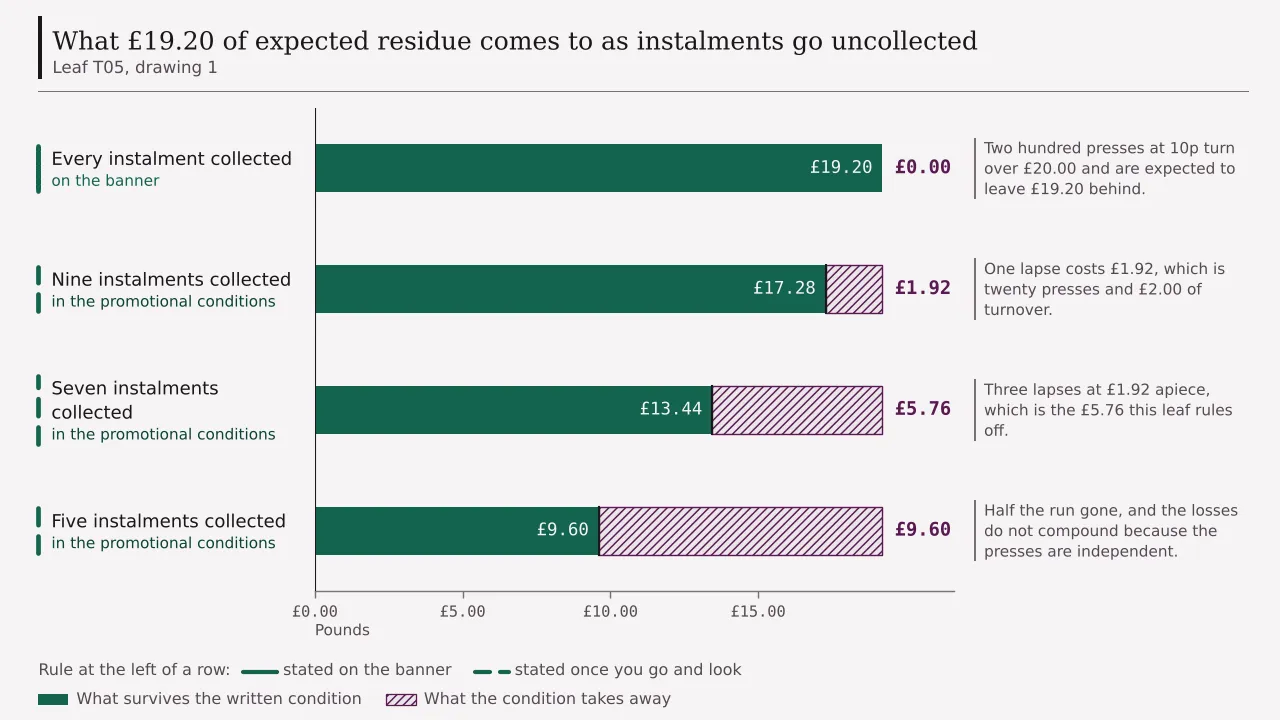
Here is the same arithmetic from the other side of the counter, which is the version that explains why timetables exist. Every press made costs the house 80p across the whole count and 56p across seven instalments. A pattern that loses three tenths of the presses reduces the expected outlay by 24p, or thirty per cent, and leaves the number on the banner exactly where it was. That is the commercial function of a release schedule stated in one sentence.
5
Why a run of occasions can lapse where a sum cannot
A quantity has one way of failing. It expires, once, at a stated moment, and until that moment it sits there whatever anybody does. A run of occasions has one way of failing per occasion, and the ways are independent of each other.
Give that a figure. Suppose a reader turns up for any given instalment nine times in ten, a rate this leaf picks for illustration and does not claim to have observed. Applied to a single grant with a single window, that rate leaves a ninety per cent chance of collecting the whole thing. Applied to ten separate windows it is 0.9 multiplied by itself ten times, which is 34.9 per cent. The same reliability, the same person, the same count, and a collection rate that has fallen by nearly two thirds.
| Chance of making any one instalment | Chance of collecting a single grant | Chance of collecting all ten |
|---|---|---|
| Ninety-five in a hundred | 95.0 per cent | 59.9 per cent |
| Ninety in a hundred | 90.0 per cent | 34.9 per cent |
| Eighty in a hundred | 80.0 per cent | 10.7 per cent |
| Seventy in a hundred | 70.0 per cent | 2.8 per cent |
Every figure in the right-hand column is the figure in the middle column raised to the tenth power, and the two rates in the first row are this leaf’s own settings rather than anybody’s measurement. The column exists to make one structural point: splitting a count into parts multiplies the ways of losing it, and multiplication at exponents of ten turns a small weekly nuisance into a dominant effect.
The expected residue behaves more gently than the all-or-nothing column, because partial collection still pays. At a nine in ten rate the expected number of instalments collected is nine, which is £17.28 of expected residue rather than £19.20. So a reader who asks what they will probably end up with should look at the first column of the table in part four, and a reader who asks whether they will get the advertised offer should look at the right-hand column here. The two questions have very different answers and the banner answers neither.
There is one further asymmetry and it is the reason this part exists. A quantity can be collected late. A sequence cannot be collected late, because each part has a window of its own and the window has nothing to do with the rest. Time is a condition that only a timetable can impose, and a timetable is only ever written in the conditions.
6
Four timetables a figure of this size can carry
A count of two hundred on a banner is consistent with a wide range of timetables, and the banner gives no way of telling which. Here are four, each a shape that recurs, each priced on the same count and the same press value, and all of them this leaf’s own illustrations rather than reports.
| Pattern | Occasions to be present | Payments needed | Largest holding | Expected residue at the attendance shown |
|---|---|---|---|---|
| All at once, one window of seven days | 1 | £10.00 | £20.00 | £19.20 where the window is met |
| Twenty a day over ten days | 10 | £10.00 | £2.00 | £13.44 at seven collected |
| Fifty a week over four weeks | 4 | £10.00 | £5.00 | £14.40 at three collected |
| Twenty for each further £10.00 paid in | 10 | £100.00 | £2.00 | £19.20 where every payment is made |
The first row is the arrangement a reader imagines and it is the only one where the banner figure describes a holding. The second is the one this leaf prices. The third spreads the same count over a longer period with fewer occasions, which is gentler on attendance and harder on patience. The fourth is a different kind of offer altogether wearing the same headline.
That fourth row deserves the sharpest sentence on this leaf. Where each instalment after the first is unlocked by a further payment, the qualifying figure on the banner is £10.00 and the figure needed to collect the advertised count is £100.00. The count has not changed. The payment has been multiplied by ten, and the only place that is said is in the conditions.
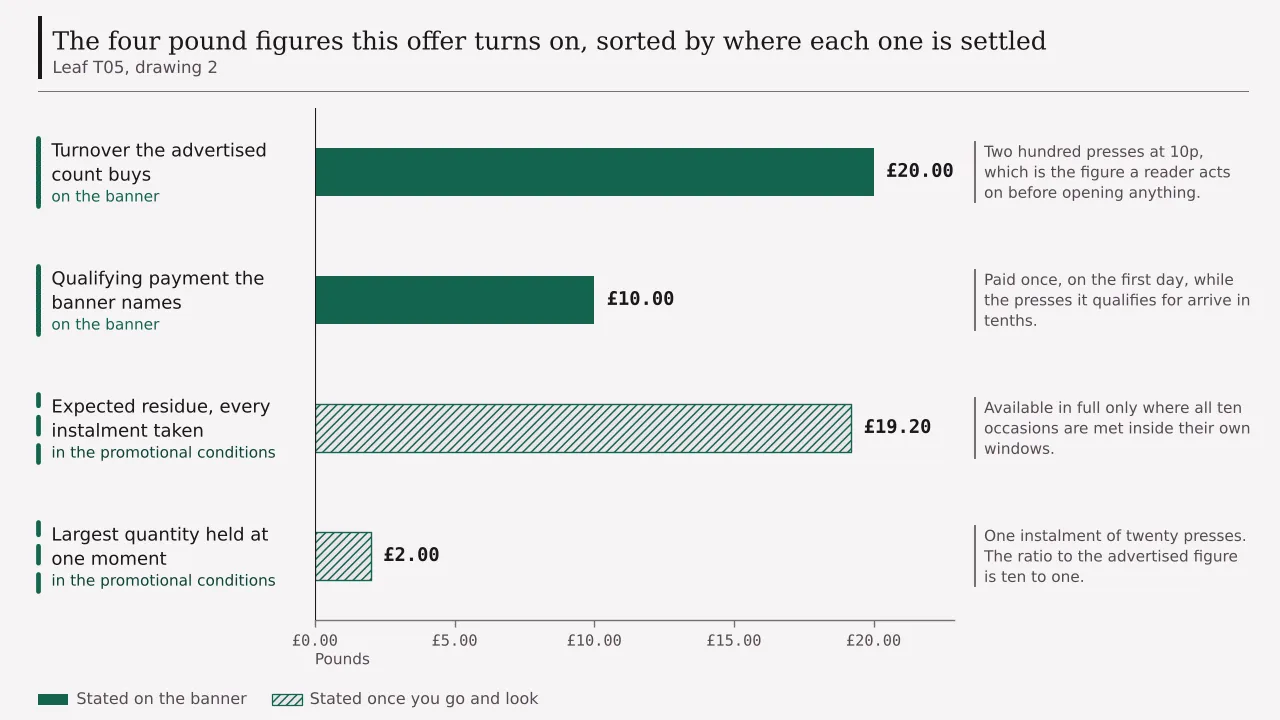
Turnover the advertised count implies at once £20.00 Largest quantity the timetable puts in the account £2.00 Turnover existing only as a future entitlement £18.00
Eighteen pounds is the second number this leaf exists to print, and it is a different kind of quantity from the £5.76 in part four. The £5.76 is money expected to be lost. The £18.00 is money that exists only as a promise about future days, every one of which has its own window and its own way of lapsing. A reader holding £2.00 and an entitlement to £18.00 more is in a different position from a reader holding £20.00, and the banner describes the second one.
7
Ten pounds committed at the start against a benefit reaching day ten
The qualifying payment is the reader’s own money and it does not vanish. It does, however, get committed on day one, while the thing it qualifies for arrives in tenths over the following nine days. That mismatch deserves a sentence of its own because no part of the banner addresses it.
Set the two schedules side by side. £10.00 leaves a bank account once, at the start. £1.92 of expected residue arrives per day, ten times, if every instalment is collected. By the end of day one the reader has paid £10.00 and holds an expectation of £1.92. By the end of day five they hold £9.60 of expectation against the same £10.00. The arrangement does not reach parity until somewhere inside day six.
That matters for a practical reason rather than a theoretical one. A deposit sitting in a gambling account for ten days is a deposit available to be staked for ten days, and the timetable supplies a reason to open the account on each of those days. Nothing in the conditions requires the deposit to be played. The schedule simply puts a person in front of it, ten times, which is the one effect a single grant of two hundred presses would not have.
There is a second consequence at the exit. Whatever residue the presses leave is mixed with whatever remains of the £10.00, and the smallest sum the account will release is settled at the cashier rather than in the promotional conditions. A balance assembled a pound at a time across ten days meets that floor later than a balance assembled in one sitting, and in the meantime the only thing available to do with it is stake it.
None of this requires anybody to have intended it. A timetable that reduces the expected outlay by thirty per cent, keeps the headline figure intact and puts a person in front of their own deposit ten times is a good piece of commercial design, and it is written down in full in a document anybody may open.
8
Where a timetable is published and what a banner can carry
A banner has room for a count, a payment and a denial. It does not have room for a timetable, and that is a fact about typography before it is a fact about anybody’s intentions. Two hundred presses for £10.00 fits in six words. The pattern those presses arrive on takes a sentence with four variables in it.
So a timetable is always in the written conditions and never on the face of the offer. That is the firmest generalisation this part of the site can make about any term, and it holds for a structural reason rather than a behavioural one: a count is one number and a schedule is a function.
| Where a reader is looking | What fits there | Worth on this offer |
|---|---|---|
| The banner | A count, a payment, a denial about play-through | £19.20 implied |
| The promotional conditions | Instalment size, interval, window, carry-forward | £5.76 at the attendance shown |
| The account screen, once registered | What has landed today and what has not | £1.92 at a time |
| The public register | Who holds a licence and what it permits | Nothing about the timetable |
The third row is the one that catches people. An account screen is honest and current and tells a reader exactly what they hold, which is £1.92 of expectation. It does not tell them how many instalments remain, when the next one lands or what happened to the one they missed, because those are properties of the schedule rather than of the balance.
The fourth row is in the table for completeness and because it is the one surface that settles nothing here. What the public register holds is who may lawfully run gambling in Britain and which activities a licence covers. It has nothing to say about instalments, which is worth stating plainly on a site that keeps pointing at registers: a register answers one question well and is silent on everything else.
This leaf’s own measure of distance follows from the same observation. The useful unit here is not how many documents away a condition sits but how many separate occasions it asks a reader to turn up for. One number on a banner becomes ten appointments in a document, and the gap between one and ten is where £5.76 of the £19.20 goes.
9
The timetable a British licence would have put on the account
A promotion paid out in instalments like this one holds no Great Britain licence. Where a leaf’s subject is a schedule, the losses worth naming are themselves periods, and a licensed account would be running several nobody advertises. Every item below is a length of time.
A facility for setting a limit has to offer periods of twenty-four hours, of seven days and of one month as a floor, under the technical standard on financial limits. Those three periods would sit beside the ten-day run this leaf has been pricing, which is the only timetable the offer itself supplies.
Twenty-four hours again, in the other direction. A customer asking to raise a limit waits that long at the least, then returns and confirms the request before anything changes, while a request to lower one is put into effect at once unless something technical prevents it. A promotion running on daily instalments is an invitation to come back daily, and the cooling-off period is the one clock pointing the other way.
Six months is the interval at which an account with activity inside a rolling year has to be prompted to review its own record of play and spending, and a year is the interval at which a customer who has never set a limit has to be asked again. Setting a limit is the default choice on a licensed service, declining it takes a deliberate action, and that refusal has to be collected and recorded before anything is paid in or staked.
Hold those periods against the ten days in part two. The offer’s own timetable asks for attendance on ten consecutive days. The licensed timetable asks, in the opposite direction, for a pause before a limit rises, a prompt twice a year and a default that has to be refused rather than chosen. Strip the second timetable out and the first one runs on its own, which is what the pattern priced on this leaf actually is.
Nothing in that paragraph is a claim about what any particular operator does. It is a claim about which clocks have a rule behind them and which have only a promotion behind them, and on an offer outside the British licence the answer is that the promotion’s clock is the only one with anything compelling it.
10
Three questions to put to any count released in parts
Three questions settle a timetable, and all three are answerable from the written conditions in about a minute. They are set out here in the order that makes the arithmetic quickest.
How many parts. This gives the daily unit and the ratio in part three straight away. Two hundred over ten is twenty presses, £2.00 of turnover and £1.92 of expectation a day, and a ten to one gap between the advertised figure and anything held.
How long each part lasts, and whether anything carries forward. This decides whether a missed occasion costs a tenth or costs nothing. A window equal to the whole run with carry-forward makes the schedule cosmetic. A window of a day with no carry-forward makes each occasion a separate chance to lose £1.92.
What unlocks each part. If the answer is time, the arrangement is the one priced here. If the answer is a further payment, the qualifying figure on the banner is a tenth of the figure needed, and £10.00 becomes £100.00 without the count changing at all.
Run those three against this offer and the whole of it comes out in six figures. £10.00 paid in, £20.00 of turnover advertised, £19.20 expected if every instalment is taken, £2.00 held at the most at any one moment, £13.44 expected at seven instalments of ten, and £5.76 of difference between what the count implies and what the timetable delivers. Five of those six are settled in a document the banner does not display.
The honest close is that none of this makes an instalment offer a bad one. Two hundred presses for £10.00 with no play-through written over the residue is a better arrangement than most things in this corner of the market, and £13.44 of expected residue on a £10.00 payment is still £13.44. The point is narrower and entirely about reading: the number on the banner is a total, the number in the account is a tenth of it, and one sentence in the conditions, carrying four variables, stands between the two.
Questions
- What are 200 free spins for a £10 deposit worth?
- Two hundred presses priced at the 10p this site puts on one buy £20.00 of turnover, and a 96 per cent rate leaves an expected £19.20 of that behind. The qualifying payment of £10.00 stays the reader’s own money. If every press is made the promotion costs the house 80p in expectation, which is the figure a release timetable exists to reduce without altering the number on the banner.
- How are 200 free spins usually released?
- In instalments written into the promotional conditions rather than all at once. This leaf assumes twenty presses a day for ten days, each instalment landing at a fixed hour, staying available for twenty-four hours and carrying nothing forward. That is the leaf’s own stated assumption and not a report, since nothing citable here sets out a standard instalment size, interval or window. Part six prices three other patterns against the same count.
- Does anybody ever hold 200 free spins at once?
- Not under a timetable of this shape. The largest quantity in the account at any one moment is one instalment, which is twenty presses, £2.00 of turnover and £1.92 of expected residue. The advertised figure is the total of ten such quantities, most of which do not exist yet and some of which never will. The ratio between the banner figure and the largest holding is ten to one, and it is set by the number of parts rather than by the size of the offer.
- What does one missed instalment cost?
- £1.92 of expected residue, from twenty presses and £2.00 of turnover, which is exactly one tenth of the advertised arrangement. The losses do not compound, because the presses are independent and none is a condition on any other. Three lapsed instalments cost £5.76, five cost £9.60 and seven cost £13.44, and any attendance can be read off by multiplying the number of lapses by £1.92.
- Why is a schedule worse than a single grant of the same size?
- Because a quantity has one way of failing and a run of occasions has one per occasion. Turning up for any given instalment nine times in ten, a rate this leaf picks for illustration, leaves a ninety per cent chance of collecting a single grant and 0.9 multiplied by itself ten times for the whole run, which is 34.9 per cent. At ninety-five in a hundred it is 59.9 per cent, at eighty it is 10.7 per cent and at seventy it is 2.8 per cent. Same person, same count, very different collection rate.
- Can unused free spins be carried over to the next day?
- Only where the conditions say so, and that single line decides whether a schedule matters at all. With a window as long as the whole run and a carry-forward, a timetable is cosmetic and the count behaves like one quantity. With a window of a day and nothing carried forward, each occasion becomes a separate chance to lose £1.92. Neither arrangement appears on a banner, because a banner has room for a count and not for a function.
- Can an instalment offer end up costing more than the advertised deposit?
- It can where each instalment after the first is unlocked by a further payment rather than by time. On the pattern in part six’s last row, the qualifying figure stays at £10.00 while collecting the whole advertised count needs £100.00. The count has not changed and the payment has been multiplied by ten. The only place that is written is in the promotional conditions, which is why the question of what unlocks each part belongs before any money moves rather than after the second instalment.
- Where is the release schedule written down?
- In the promotional conditions, in a single line carrying an instalment size, an interval, a window and a carry-forward rule. It is never on the banner, for a structural reason rather than a behavioural one: a count is one number and a schedule is a function with four variables in it. An account screen will show what has landed today, which is honest and current, and will not show how many instalments remain or what became of a missed one.
- What protections are missing on an offer paid in instalments?
- Several periods that would otherwise be running on the account. A facility for setting a limit would have to offer periods of twenty-four hours, of seven days and of one month as a floor. A request to raise a limit would wait that long at the least and then need confirming, while a request to lower one would take effect immediately. An account active inside a rolling year would be prompted every six months to review its own record, a customer who had never set a limit would be asked again annually, and setting a limit would be the default, refused only by a deliberate action recorded before anything is paid in or staked. A promotion paid out in instalments like this one holds no Great Britain licence, so its own ten-day timetable is the only clock with anything behind it.
- Is a 200 spin instalment offer worth taking?
- That is a question about the figures rather than about the structure. Two hundred presses for £10.00 with no play-through written over the residue is a better arrangement than a great deal of what sits at this end of the market, and £13.44 of expected residue at seven instalments collected is still £13.44. The narrow point is about reading: the number on the banner is a total, the number in the account is a tenth of it, and one sentence in a document the banner does not display stands between them.