Terms read 19 October 2026 Leaf W03, revision 1
Three hundred presses bought with ten pounds, and the figure that has to join them
Three hundred presses at 10p send £30.00 across the reels, which is treble the payment that bought them, and give back an expected £28.80. A forty times clause on that return asks £1,152.00 of staking and closes at an expected minus £17.28. Two figures are published and the one joining them is not, so this leaf solves for it.
Stated on the banner £10.00 A payment, with a quantity of 300 standing beside it, and nothing printed that turns the quantity into cash. Stated, once you go and look minus £17.28 Forty times laid over the expected winnings, written in a bonus document the quantity does not link to, at the 96 in the hundred assumed here. Not stated before the money goes in 0.14 pence What one press would have to be worth for a single pass of the payment to cover 300 of them, solved on this page because no document anywhere carries the figure.
Offers pairing a payment with a quantity of presses, terms read
Every destination in this file is bought advertising. The site is paid a fee if a reader goes on to register, and no figure printed below moves because of it.
Bonus Spins UK Slip 01
Betportal
Ceiling as a multiple
The drop
€15.00
€1.00 in the euro
The claim reads €15.00. Once the terms beside it have applied, €0.00 of it can leave. The difference is the drop.
7 of the 15 terms on this slip could not be read before the money went in
Spins priced at this site's own 10p a spin, which the operator does not publish
Stated
€15.00
The claim as it is printed, before a single term has been applied to it.
Headline paid as spins
150 spins at 10c each, which is €15.00 of the figure above.
6 Nowhere
What one spin is worth
No unit is published for a spin, so the count is priced at this site's own 10p a spin. At half that price every figure below halves with it.
Match and other credit not priced
300% of three deposits, to a ceiling of €1,000. A share of a deposit nobody has made yet is not a sum, so no figure stands on this line and none is carried below.
Qualified
-€14.40
Written down somewhere, and taking part of the claim back. Each term carries the place it is written and the sum it takes.
2 Written terms at a distance this record does not establish
Play-through -€14.40
Carrying €14.40 through 35 times stakes €504.00 and costs €20.16 of it at 96 per cent return. That prices above the €14.40 there is to charge it against, so the whole of the credit goes and the line is held at that. The multiple sits on the bonus.
2 Written terms at a distance this record does not establish
Game weighting not priced
Slots only count towards the play-through. No contribution percentage is published, so the line above has been worked at full weight, which is the kindest reading there is.
2 Written terms at a distance this record does not establish
Ceiling on the winnings not priced
5x the bonus.
2 Written terms at a distance this record does not establish
Clock on the credit not priced
14 days.
2 Written terms at a distance this record does not establish
Largest stake while it runs not priced
€5.
3 Public record
Licence, and who holds it not priced
Licensed in Anjouan, Comoros, held by BetPortal Gaming Ltd, with Excite Ultra Media Ltd, reference ALSI-202601040-FI2. A register entry settles who holds a licence and what it permits. It does not settle who is running the site this morning.
4 Cashier
Smallest qualifying deposit your money
€20 a stage. That is €20.00 of your own money, and it is never netted into a drop.
5 On the way out
Checks before a withdrawal not priced
Documents before the first withdrawal.
Unstated
-€0.60
Applying without having been published anywhere, and costing money all the same.
6 Nowhere
What a spin hands back -€0.60
Staking a spin returns 96 per cent of it, so that share of the batch is the house's before a reel turns. This site works at that return and the operator publishes none where the claim is made.
6 Nowhere
Forfeited by rule cost unknown
Nothing is published under this heading, and it applies regardless.
6 Nowhere
Charge on the way out cost unknown
No charge on the way out is published as a figure, so nothing comes off this line. A charge that exists unpublished would come straight off whatever survives.
6 Nowhere
Smallest withdrawal allowed cost unknown
No smallest withdrawal is published as a figure. A floor nobody has published is still a floor, and it decides whether a small balance can move at all.
No Great Britain licence
Terms read 19 October 2026
Bonus Spins UK Slip 02
WinBeast
Ceiling as a sum
The drop
€50.00
€1.00 in the euro
The claim reads €50.00. Once the terms beside it have applied, €0.00 of it can leave. The difference is the drop.
8 of the 15 terms on this slip could not be read before the money went in
Spins priced at this site's own 10p a spin, which the operator does not publish
Stated
€50.00
The claim as it is printed, before a single term has been applied to it.
Headline paid as spins
500 spins at 10c each, which is €50.00 of the figure above.
6 Nowhere
What one spin is worth
No unit is published for a spin, so the count is priced at this site's own 10p a spin. At half that price every figure below halves with it.
Match and other credit not priced
50% to 100% of five deposits, each to a ceiling of €1,000, and a €650 free bet. A share of a deposit nobody has made yet is not a sum, so no figure stands on this line and none is carried below.
Qualified
-€48.00
Written down somewhere, and taking part of the claim back. Each term carries the place it is written and the sum it takes.
2 Written terms at a distance this record does not establish
Play-through -€48.00
Carrying €48.00 through 40 times stakes €1,920.00 and costs €76.80 of it at 96 per cent return. That prices above the €48.00 there is to charge it against, so the whole of the credit goes and the line is held at that. The multiple sits on the bonus and the winnings from the spins.
2 Written terms at a distance this record does not establish
Game weighting not priced
Slots, titles vary by country count towards the play-through. No contribution percentage is published, so the line above has been worked at full weight, which is the kindest reading there is.
2 Written terms at a distance this record does not establish
Ceiling on the winnings not priced
€100 a batch of spins.
2 Written terms at a distance this record does not establish
Clock on the credit not priced
7 days, spins 1 day.
3 Public record
Licence, and who holds it not priced
Licensed in Curaçao, holder not named on the site. A register entry settles who holds a licence and what it permits. It does not settle who is running the site this morning.
4 Cashier
Smallest qualifying deposit your money
€20 a stage. That is €20.00 of your own money, and it is never netted into a drop.
5 On the way out
Checks before a withdrawal not priced
Documents before the first withdrawal.
Unstated
-€2.00
Applying without having been published anywhere, and costing money all the same.
6 Nowhere
What a spin hands back -€2.00
Staking a spin returns 96 per cent of it, so that share of the batch is the house's before a reel turns. This site works at that return and the operator publishes none where the claim is made.
6 Nowhere
Largest stake while it runs cost unknown
Nothing is published under this heading, and it applies regardless.
6 Nowhere
Forfeited by rule cost unknown
Nothing is published under this heading, and it applies regardless.
6 Nowhere
Charge on the way out cost unknown
No charge on the way out is published as a figure, so nothing comes off this line. A charge that exists unpublished would come straight off whatever survives.
6 Nowhere
Smallest withdrawal allowed cost unknown
No smallest withdrawal is published as a figure. A floor nobody has published is still a floor, and it decides whether a small balance can move at all.
No Great Britain licence
Terms read 19 October 2026
Bonus Spins UK Slip 03
EliteSpin
Longest spin window
The drop
£50.00
£1.00 in the pound
The claim reads £50.00. Once the terms beside it have applied, £0.00 of it can leave. The difference is the drop.
8 of the 15 terms on this slip could not be read before the money went in
Spins priced at this site's own 10p a spin, which the operator does not publish
Stated
£50.00
The claim as it is printed, before a single term has been applied to it.
Headline paid as spins
500 spins at 10p each, which is £50.00 of the figure above.
6 Nowhere
What one spin is worth
No unit is published for a spin, so the count is priced at this site's own 10p a spin. At half that price every figure below halves with it.
Match and other credit not priced
50% to 100% of five deposits, each to a ceiling of £1,000. A share of a deposit nobody has made yet is not a sum, so no figure stands on this line and none is carried below.
Qualified
-£48.00
Written down somewhere, and taking part of the claim back. Each term carries the place it is written and the sum it takes.
2 Written terms at a distance this record does not establish
Play-through -£48.00
Carrying £48.00 through 40 times stakes £1,920.00 and costs £76.80 of it at 96 per cent return. That prices above the £48.00 there is to charge it against, so the whole of the credit goes and the line is held at that. The multiple sits on the bonus and the winnings from the spins.
2 Written terms at a distance this record does not establish
Game weighting not priced
Slots count towards the play-through. No contribution percentage is published, so the line above has been worked at full weight, which is the kindest reading there is.
2 Written terms at a distance this record does not establish
Ceiling on the winnings not priced
5x the bonus.
2 Written terms at a distance this record does not establish
Clock on the credit not priced
7 days, spins 3 days.
3 Public record
Licence, and who holds it not priced
Licensed in Costa Rica, held by PrimeTier Limited. A register entry settles who holds a licence and what it permits. It does not settle who is running the site this morning.
4 Cashier
Smallest qualifying deposit your money
£20 a stage. That is £20.00 of your own money, and it is never netted into a drop.
5 On the way out
Checks before a withdrawal not priced
Documents before the first withdrawal.
Unstated
-£2.00
Applying without having been published anywhere, and costing money all the same.
6 Nowhere
What a spin hands back -£2.00
Staking a spin returns 96 per cent of it, so that share of the batch is the house's before a reel turns. This site works at that return and the operator publishes none where the claim is made.
6 Nowhere
Largest stake while it runs cost unknown
Nothing is published under this heading, and it applies regardless.
6 Nowhere
Forfeited by rule cost unknown
Nothing is published under this heading, and it applies regardless.
6 Nowhere
Charge on the way out cost unknown
No charge on the way out is published as a figure, so nothing comes off this line. A charge that exists unpublished would come straight off whatever survives.
6 Nowhere
Smallest withdrawal allowed cost unknown
No smallest withdrawal is published as a figure. A floor nobody has published is still a floor, and it decides whether a small balance can move at all.
No Great Britain licence
Terms read 19 October 2026
Bonus Spins UK Slip 04
Crown Jewelz
Multiple unpublished
The drop
NOT WORKED
The multiple is not published in the operator's own terms. Since the sum cannot be worked around it, none is worked.
9 of the 14 terms on this slip could not be read before the money went in
No drop worked
Stated
£15.00
The claim as it is printed, before a single term has been applied to it.
Headline paid as spins
150 spins at 10p each, which is £15.00 of the figure above.
6 Nowhere
What one spin is worth
No unit is published for a spin, so the count is priced at this site's own 10p a spin. At half that price every figure below halves with it.
Match and other credit not priced
200% of the first deposit, then 150% twice, each to a ceiling of £1,000. A share of a deposit nobody has made yet is not a sum, so no figure stands on this line and none is carried below.
Qualified
NOT WORKED
Written down somewhere, and taking part of the claim back. Each term carries the place it is written and the sum it takes.
2 Written terms at a distance this record does not establish
Play-through not priced
40x the bonus, reported rather than published by the operator.
2 Written terms at a distance this record does not establish
Game weighting not priced
Slots count towards the play-through. No contribution percentage is published, so the line above has been worked at full weight, which is the kindest reading there is.
3 Public record
Licence, and who holds it not priced
Licensed in Curaçao, number not verified, holder not named on the site. A register entry settles who holds a licence and what it permits. It does not settle who is running the site this morning.
4 Cashier
Smallest qualifying deposit your money
£20. That is £20.00 of your own money, and it is never netted into a drop.
5 On the way out
Checks before a withdrawal not priced
Documents before the first withdrawal.
Unstated
NOT WORKED
Applying without having been published anywhere, and costing money all the same.
6 Nowhere
Ceiling on the winnings cost unknown
No ceiling is published. Nothing is assumed in its place.
6 Nowhere
Clock on the credit cost unknown
Nothing is published under this heading, and it applies regardless.
6 Nowhere
Largest stake while it runs cost unknown
Nothing is published under this heading, and it applies regardless.
6 Nowhere
Forfeited by rule cost unknown
Nothing is published under this heading, and it applies regardless.
6 Nowhere
Charge on the way out cost unknown
No charge on the way out is published as a figure, so nothing comes off this line. A charge that exists unpublished would come straight off whatever survives.
6 Nowhere
Smallest withdrawal allowed cost unknown
No smallest withdrawal is published as a figure. A floor nobody has published is still a floor, and it decides whether a small balance can move at all.
No Great Britain licence
Terms read 19 October 2026
Every figure in the second and third columns is this site's own working and nothing an operator has published. A claim is priced as printed, then the share a spin hands back at 96 per cent return comes off it, then what playing the multiple through costs at the same return, and then whatever a published ceiling, a charge on the way out or a floor on the smallest withdrawal takes from what has survived. The drop is the difference between the first figure and the last. The two columns add back up to it exactly, so no money leaves a slip without a term and a place beside it.
Which column a term falls in is settled by one question: has anybody written it down. A charge a reader meets at the payment screen is written down, and it stands in the second column with the cashier against it. A condition that binds without ever having been set down stands in the third, whatever it costs. Inside each column the terms run outwards from the banner, so the order itself says how far a reader would have had to go.
A count of spins has no unit until one is supplied. Where an operator publishes what one of its own spins is worth, that figure is used and the first column says it is theirs. Where none is published, this site's own 10p a spin stands in its place and every figure below moves in proportion with it. Where the multiple itself is unpublished, no drop is worked at all, because that is the one figure the sum cannot be done without.
Three words stand where a figure cannot. Not priced is a term that is written down and carries no number the arithmetic can take. Cost unknown is a term nobody has written down, costing something nobody has put a number on. Your money is money of the reader's own, which is never netted into a drop.
None of the operators in this file holds a Great Britain licence, so none of the duties that licence carries reaches them. Each of those duties is published in its own right, which is what makes its absence here something a reader can check rather than take on trust. Every gambling company licensed in Great Britain belongs to Gamstop Online, so a reader who has shut themselves out through the scheme is not shut out here. Social Responsibility Code 5.1.1 has held a play-through to a maximum of ten times the bonus funds since 19 January 2026, and it binds a licence holder and nobody else. Asked in a post of 21 October 2025 what is lost along with the licence, the Gambling Commission's Director of Enforcement and Intelligence answered: "unfair gaming practices, financial loss, and a lack of recourse if things go wrong". The same post puts blocked payouts, and withdrawal limits pitched high enough to be unreachable, among the behaviour the Commission has recorded. Nobody under 18 may hold an account at any of them.
Terms are reproduced in the wording their operator published, and each slip is dated with the day somebody sat down and read them. 19 October 2026 is the oldest of those dates. Anybody claiming an offer is bound by that operator's full terms, which are elsewhere, and never by a line standing here.
1
Two published quantities, and the one that has to join them
An advertisement of this build publishes exactly two numbers. One is a payment of £10.00, settled and requiring no further document. The other is a quantity of 300, settled in the same place and just as firmly. Everything else about the arrangement is somewhere else, and the arithmetic cannot begin until a third number arrives from outside.
That third number is the cash a single press commits. Without it the quantity of 300 is a tally of events rather than a sum of money, and no comparison can be made between this arrangement and any other. The number is nowhere in writing: no rule obliges anybody to state it, and this site assumes 10p throughout rather than reading it anywhere.
Put the assumption in and a first result lands at once. £30.00 of stake crosses the counter, treble the £10.00 the reader sent. Ninety-six pence of each staked pound comes back, a rate this page assumes rather than reads anywhere, so expected winnings reach £28.80, and the 4p missing from every pound is the margin funding everything else here.
Three times the payment is an odd thing for a business to hand over, and the oddity is the whole subject here. A firm giving away £30.00 of stake in return for £10.00 of somebody else’s money has priced that £10.00 against something, and whatever it was priced against is not on the banner. The ratio therefore carries information about a figure nobody printed, whether or not anyone meant it to.
So the question this leaf asks runs backwards from the usual one. Instead of asking what the arrangement is worth to a reader, it asks what one press would have to be worth for the arrangement to make sense to the party offering it. That turns an advertisement into an equation with one unknown, and an equation with one unknown can be solved.
Three constraints bound the solve, and a part apiece is given to them underneath. The payment produces a margin once it is staked. The presses produce an expected payout when they are used. A play-through clause produces a further margin when it is worked off. Set those against each other and the press value either falls out of the sum or turns out not to matter, and which of the two happens is itself the finding.
2
Solving for a press value the advertisement withholds
Begin with the barest version, in which the payment is staked once over and the presses carry no condition whatever. The reels retain 4p from each pound pushed through them at the rate supposed here, so £10.00 going round a single time yields £0.40. That is the whole income this reading generates.
Against it stands the expected payout on the presses. Three hundred presses at a press value of v stake 300v and are expected to give back 288v, since 96 hundredths of the stake comes back. The firm is handing over 288v and collecting £0.40, so the two are equal when 288v equals two fifths of a pound.
Solve that and v comes to 0.14 pence, which is about one seventh of a penny. At any press value above that, the simplest version of the arrangement loses money for whoever offered it, and at 10p it loses a great deal: £28.80 handed over against £0.40 collected, which is seventy-two pounds given away for every pound earned.
0.14 pence a press, the value at which a single pass of £10.00 would cover 300 of them
A seventh of a penny is not a press value anybody runs. It is below the smallest coin in circulation and far below anything a reel would accept as a stake, so the simplest reading can be discarded on arithmetic alone. Something other than one pass of the payment is funding this, and the rest of the leaf is a search for what.
Notice what has already happened to the banner. A ratio of 300 presses to £10.00, read with nothing but a return figure and a note of what a press might cost, has produced a statement about an unpublished quantity: either the press value is a fraction of a penny, or the payment is not the thing paying. The advertisement did not set out to say that. It says it anyway.
3
The multiple at which the unknown drops out of the sum
Now put the play-through clause back. Winnings from presses of this kind ordinarily have to be turned over before they can be taken out, and the clause sits in the bonus terms rather than beside the quantity it governs. Forty times is the figure applied throughout this page, picked because terms drafted beyond the British licence tend to land in that region, and it is an assumption here rather than a reading of any document.
Expected winnings of 288v turned over forty times put 11,520v through the reels, and 4p a pound of it is retained. Margin recovered comes to 460.8v against an outlay of 288v. Divide one by the other and v disappears: recovery is 1.6 times outlay at every press value there is.
That cancellation is the result this leaf exists to print. Work out which multiple makes recovery equal outlay and the answer is 25, because twenty-five lots of 4p make up a whole pound. Twenty-five turns up here on the firm’s side of the ledger, having turned up elsewhere on this site from the reader’s, where it marks the rung at which winnings are expected to have been handed back whole. Two separate calculations, one number, and no step shared between them.
Above twenty-five the arrangement funds itself out of the clause, whatever one press is worth. Below twenty-five it does not, and the press value starts to matter again. The multiple is therefore a switch rather than a dial, and it decides whether the quantity on the banner is constrained by anything at all.
Follow that through and the banner’s quantity stops being evidence of generosity. Where the clause stands above the break-even multiple, 300 costs the firm nothing in expectation, and neither would 500, 1,000 or 3,000. The only ceiling on the quantity is what reads well, which is a fact about advertising and not about value. A sibling leaf on the ratio of quantity to payment takes that ceiling apart across the whole family.
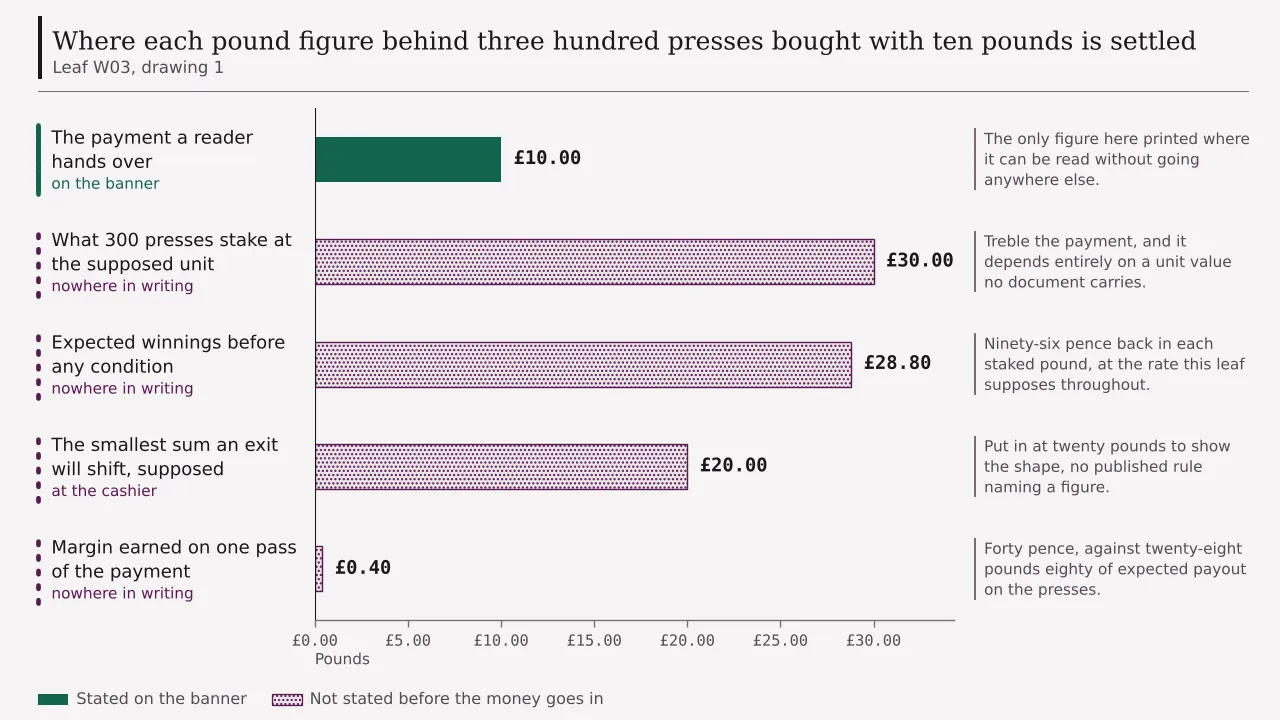
Two of the figures on that drawing are the only ones a reader is handed, and neither is the one that decides the money. The payment is published because it is a condition of entry. A floor on what the exit will shift waits at the cashier, supposed at £20.00 for the drawing, a figure invented to show the shape because nothing published sets one.
4
What the written clause puts back, worked in pounds
Drop the assumed press value back in and the algebra turns into money. Expected winnings stand at £28.80. The clause asks for forty of those, so £1,152.00 has to go through the reels, a sum 115.2 times the payment that started it. At 4p a pound the firm recovers £46.08 from a sentence it drafted and the reader never opened.
Set £46.08 of recovery against £28.80 of outlay and the arrangement clears by £17.28 in expectation, on the presses alone, before the payment is staked at all. The reader’s expected close is minus £17.28. The two figures are the same money seen from opposite ends of the table, which is a check on the arithmetic rather than a coincidence.
Expected off 300 presses, nothing else applied £28.80 The same presses under a forty times clause minus £17.28 What the unopened document is worth £46.08
Forty-six pounds and eight pence arrives twice over, with no step shared. Take the staking demanded and apply the retained 4p a pound: £1,152.00 worked that way gives £46.08. Or take the two ends of the block just printed and subtract, £28.80 less minus £17.28 giving £46.08 again. They agree exactly, a clause of this build having no function beyond handing turnover to the margin at a fixed rate.
One figure in that block is read and the other is solved. The £28.80 follows from the banner plus one assumption about press value. The minus £17.28 follows from a sentence in a second document, and a reader who never opens that document will act on the first figure while the second one governs. The gap between them is the price of the document, and on this arrangement it runs to more than four times the payment.
A ceiling on what a bonus balance may pay out is a separate clause and usually sits in the same document. Where one is written, it does nothing to the expected close, which is already under nought, and takes a great deal out of the single branch where the presses ran well. Pricing it would need a figure, and nothing citable here sets a usual ceiling, so this page declines to supply one.
5
A ladder of candidate values, each one implying a different offer
The press value is unpublished rather than unknowable, so the honest way to carry it is as a band. Below is the same banner read at five candidate values, with the staking the clause demands and the expected close beside each. Every row has identical wording on the advertisement and none of the rows can be told from any other before clicking.
| Press value assumed | Sent across the reels | Expected winnings | Staking the clause demands | Expected close at forty times | What the arrangement would then be |
|---|---|---|---|---|---|
| Five pence | £15.00 | £14.40 | £576.00 | minus £8.64 | A quantity chosen to look large at half the usual unit |
| Ten pence | £30.00 | £28.80 | £1,152.00 | minus £17.28 | The reading this leaf works to throughout |
| Fifteen pence | £45.00 | £43.20 | £1,728.00 | minus £25.92 | Stake worth four and a half payments, handed over |
| Twenty pence | £60.00 | £57.60 | £2,304.00 | minus £34.56 | A giveaway no margin on the payment could cover |
| Twenty-five pence | £75.00 | £72.00 | £2,880.00 | minus £43.20 | Seven and a half payments of stake for one payment in |
Five rows, one advertisement, and a spread of five to one between the top and the bottom. A reader who assumed the middle rung would be out by up to £25.92 in either direction on the expected close, and nothing in the published wording would have told them which rung they were on. The arrangement is accurately described at every value.
Reading the rightmost column from top to bottom shows what is at stake. Every rung is a different commercial proposition wearing identical words, and they grow less plausible as the value climbs, because the outlay climbs with it while the payment stays at £10.00. That is a weak argument for a low press value and it is the only argument the published figures support.
Weak is the right word for it, and the reason is part three. Once the clause stands above twenty-five times, every rung in the table is self-funding, so the implausibility disappears and the ladder stops narrowing anything. The band only tightens where the multiple is low, which is precisely the case the written terms out here do not describe.
6
Making the payment pay for the presses on its own
There is one further way the payment could fund the presses, and it is worth working because it produces a figure the banner implies and never prints. A pass of £10.00 leaves £0.40 behind. The presses cost £28.80 at the house value. Divide and the payment would have to cross the reels seventy-two times.
Seventy-two passes of £10.00 is £720.00 of staking by a reader who was told they were paying ten pounds. That is the quantity the arrangement needs from a payment with no clause attached to it, and it is roughly two thirds of what the forty times clause demands anyway. The two routes to the same funding differ in one respect only: one of them is written down.
Nobody sends £10.00 intending to stake it seventy-two times, which is the point. The deposit route funds the presses only for somebody who intended a great deal of play regardless, and a reader of that description was never the person the quantity on the banner was aimed at. So the deposit route is real but narrow, and it cannot be the general explanation.
| Where the funding would come from | Where it could be settled | What it would take |
|---|---|---|
| One pass of the payment, at 10p a press | nowhere in writing | A press worth 0.14 pence |
| Repeated passes of the payment | nowhere in writing | £720.00 of staking |
| The play-through clause on the winnings | in the bonus terms | £1,152.00 of staking |
Read the middle column and the structure of the arrangement is visible without any further argument. The two routes that would be gentle on a reader are settled in no document whatever, so nobody can be held to them. The route that is written down is the harsh one, and being written down is what makes it the one that actually operates.
A fourth possibility exists and this leaf cannot price it, which is worth saying plainly. The payment may simply be the first of several, with the presses bought as an introduction to a sequence of later payments. Nothing published supports a figure for that, so it is named here and left unpriced rather than filled in with a plausible number.
7
Three answers to the solve, and what each commits an advertiser to
The solve admits three answers, and each is a different statement about a figure nobody published. Setting them side by side is the useful product of this leaf, because a reader cannot tell which applies and can at least know the list is short.
The first answer is a low press value. If one press is worth a fraction of a penny, the quantity of 300 shrinks to a few pence of stake and the ratio on the banner stops being remarkable. This answer is internally consistent and costs the reader almost everything, because a quantity priced that low converts into no meaningful sum at all.
The second answer is the clause. At forty times the recovery is 1.6 times the outlay at any press value, so the firm is indifferent to the press value and the quantity can be set wherever it reads best. This is the answer the published multiples support, and it is the one that makes the banner’s ratio uninformative about generosity.
The third answer is the sequence: the payment is an introduction, and the presses are priced against payments that have not happened yet. This answer makes the arrangement rational without a low press value and without a punitive clause, and nothing on this site can put a figure on it.
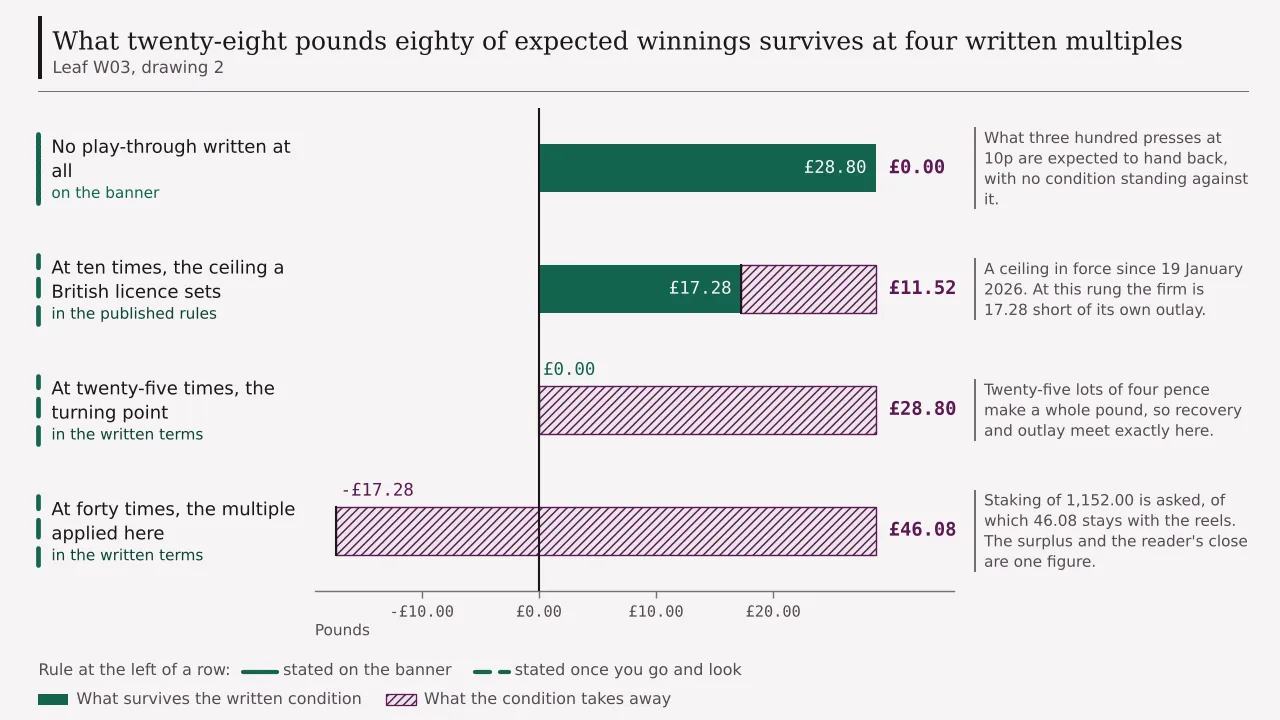
The ten times rung on that drawing is the only one with a published ceiling behind it, and it exists in Great Britain alone. Inside a British licence a play-through requirement on bonus funds may not exceed ten times, a ceiling that took effect on 19 January 2026, the regulator having recorded multiples reaching sixty in places before it arrived.
Worked against this leaf’s figures that ceiling does something specific. At ten times the staking falls to £288.00, the margin recovered is £11.52, and the firm is £17.28 short of its £28.80 outlay. The arrangement stops funding itself, the press value stops cancelling, and the quantity on the banner becomes a real cost to whoever offered it. A ceiling on the multiple is therefore a ceiling on the quantity, by arithmetic rather than by drafting.
8
What arithmetic of this sort leans on, and who is bound to supply it
Every figure above rests on one imported quantity, the 96 in the hundred, and on an assumption that the quantity means what it appears to mean. That assumption is not free, and in Great Britain three published duties hold it up. Outside a British licence none of them binds anybody, which is the loss that bites on a leaf whose method is a solve.
The first duty settles where a return figure can be found at all. Requirement 3C of the technical standards puts whatever would let somebody judge the chances within easy reach before anything is committed, and it offers a choice rather than demanding one disclosure: an account of how a game runs and how prizes get allotted, the return percentage, the house edge, or the odds on whichever events pay. A backwards solve wants the third of those and may be handed whichever the operator prefers.
The second duty is about whether the figure holds while the reels turn. Requirement 7A demands outcomes that are acceptably random, and it bars a compensated build, so nobody may nudge the probabilities by hand or by machine, and a drawn number has to be spent in sequence rather than thrown back for a more convenient one. Without it the ninety-six pence a pound describes a population this page cannot see, and every sum printed here is a guess wearing a decimal point.
The third duty is about what the screen is allowed to imply. Requirement 7C bars designs expected to mislead about the likelihood of results, and it names one practice outright, the swapping of a plain loss for a loss dressed as a narrow one. That rule protects nothing in the ledger and everything in the reading of it, since a sequence that feels close to paying changes how long somebody keeps pressing while every figure tabulated above stays exactly where it was.
Where a payment is paired with a large quantity of presses, the business behind it holds no Great Britain licence, and the three duties just named are the ones a backwards solve leans on, rather than whichever ones a reader would name first. Remove the choice of disclosure and the return figure imported here has no obliged source behind it. Remove the bar on a compensated build and that figure stops describing the reels any particular person meets. Remove the near-miss rule and the tally of presses actually made stops following from the tally the clause asks for. Not one of the three promises an outcome. Together they settle whether the equation in part two is an equation at all.
Two honest concessions belong here. The first is that a rulebook published by one regulator outside Britain was opened for this build, and it does ask for the conditions on a bonus to be stated plainly, so this is not an empty field. The second is that it carries no requirement about randomness, no bar on a compensated build and no rule about what a screen may imply, and that gap is what the three paragraphs above are measuring.
9
Running the solve on any quantity-and-payment pair
The method takes four lines and no special knowledge, and it works on any advertisement pairing a sum with a count. Write down the two published numbers. Take the count, multiply by a candidate press value, and a stake appears. Apply the return to that stake and expected winnings appear. Then ask what the payment would have to earn for those winnings to be affordable.
Step four is where the work is. The payment earns the firm one minus the return for each pound that crosses the reels, so a £10.00 payment staked once earns £0.40 at a 96 per cent return and £1.00 at a 90 per cent one. Dividing the expected winnings by that figure gives the number of passes the payment must make, and a number of passes above about five is a signal that something else is funding the arrangement.
Then apply the clause, which turns the question round. Scale the expected winnings by the multiple for the staking demanded, scale that by the margin per pound for what comes back, and set the result beside the winnings handed over. Above the break-even multiple the recovery exceeds the outlay and the press value drops out of the comparison entirely.
Two habits keep the method honest. Name the press value as an assumption in the same sentence that spends it, every single time, because a figure carried quietly from one line to the next becomes a fact nobody checked. And print the band rather than the middle of it, since the band is the genuine result and the middle is a preference.
Run on this leaf’s own advertisement the method produces six numbers and stops: £30.00 of stake, £28.80 expected, £1,152.00 of staking demanded, £46.08 recovered, minus £17.28 expected to the reader, and a break-even multiple of 25. Of those, two came off the banner and four came from somewhere a reader would have to travel to, which is the measurement this whole site is built to take.
The useful conclusion is narrower than the arithmetic. A ratio of presses to payment tells a reader nothing about value until the press value and the multiple are both known, and once the multiple passes twenty-five it tells them nothing even then. What it does report, reliably and for nothing, is how long the reels will turn, and for somebody who wants exactly that the ratio is the right number to read.
Questions
- What is a deposit 10 get 300 free spins offer actually worth?
- Three hundred presses at the assumed 10p send £30.00 of stake round the reels. Ninety-six pence of every staked pound returns, which puts expected winnings at £28.80. That is the reading before any condition stands against it. Forty times on those winnings demands £1,152.00 of staking and drops the expected close to minus £17.28, leaving £46.08 of difference between the two readings.
- Why are 300 presses worth three times the payment that bought them?
- Because the press value is a commercial choice and nothing published fixes it. At 10p the quantity stakes £30.00 against a £10.00 payment, which looks like a giveaway, and at a fraction of a penny it stakes almost nothing. The ratio on the banner is therefore a statement about an unpublished figure rather than about generosity, and the figure is settled nowhere a reader can reach.
- How do I work out what a free press is worth?
- Solve backwards from what the arrangement earns. At the rate supposed here the reels retain 4p from every pound pushed through them, so a £10.00 payment going round a single time yields £0.40. Set that beside 300 presses at a value of v, expected to pay out 288v, and the two balance at 0.14 pence a press. Anything dearer has to be funded from somewhere other than one pass of the payment.
- Does the wagering requirement pay for the free presses?
- At forty times it more than pays for them, and it does so at any press value. Expected winnings of 288v turned over forty times put 11,520v through the reels, and 4p a pound of that is retained, so margin recovered comes to 460.8v against an outlay of 288v. The ratio stands at 1.6 to one and v vanishes from it altogether.
- At what multiple does the press value stop mattering?
- Twenty-five, the rung at which twenty-five lots of 4p make up a whole pound. Beneath it recovery falls short of outlay and the arrangement costs the firm money, so the press value does constrain how large a quantity can be. From that rung upwards recovery covers outlay whatever one press is worth, so 300 costs nothing in expectation and neither would a far larger tally. The same figure turns up on the reader’s side as the point where winnings are expected to have been handed back whole.
- How much staking does a 300 press offer ask for?
- £1,152.00 on this leaf’s figures, which is 115.2 times the £10.00 payment. Forty lots of £28.80 produce that total, and four pence in each pound of it stays with the reels, giving £46.08 of expected cost. Subtract that from £28.80 and the expected close is minus £17.28, which is the same £46.08 arrived at from the other end of the subtraction.
- Could the deposit itself fund the presses?
- Only if it were staked seventy-two times. £28.80 of expected payout divided by £0.40 of margin a pass gives seventy-two, which is £720.00 of staking from somebody who believes they are paying ten pounds. That route is real for somebody who intended a great deal of play in any event, and such a person was never who a large quantity on a banner is aimed at, so it cannot be the general explanation.
- What does a ten times ceiling do to an offer of this size?
- It stops the arrangement funding itself. In Great Britain a play-through requirement on bonus funds may not exceed ten times, a ceiling that took effect on 19 January 2026, the regulator having recorded multiples reaching sixty in places beforehand. At ten times the staking falls to £288.00 and recovery to £11.52, which leaves the firm £17.28 short of its £28.80 outlay. A ceiling on the multiple is a ceiling on the quantity, reached by arithmetic rather than by drafting.
- Which published rules does this arithmetic depend on?
- Three, and every one of them is British. Requirement 3C of the technical standards puts whatever would let somebody judge the chances within easy reach before anything is committed, offering a choice of disclosure rather than demanding a single one. Requirement 7A wants acceptably random outcomes and bars a compensated build, with a drawn number spent in sequence rather than thrown back. Requirement 7C rules out designs expected to mislead about the likelihood of results, naming the swap of a plain loss for one dressed as narrow. None promises an outcome, and between them they settle whether a solve is possible at all.
- What is lost by taking an arrangement of this shape from outside Great Britain?
- The three duties a backwards solve leans on. Strip out the choice of disclosure and the return figure imported here has no obliged source behind it. Strip out the bar on a compensated build and that figure stops describing the reels a particular person meets. Strip out the near-miss rule and the tally of presses actually made stops following from the tally the clause asks for. A rulebook published by one regulator outside Britain was opened for this build and does ask for the conditions on a bonus to be stated plainly, so this is not an empty field, and it carries nothing about randomness, nothing barring a compensated build and nothing about what a screen may imply.
- How should two offers pairing a payment with a quantity be compared?
- Not by the quantity, and not by the ratio of quantity to payment, until the press value and the multiple behind each one are known. What the ratio reports reliably and for nothing is how long the reels will turn, which is a legitimate thing to want and a different thing from money. Where the multiple sits above twenty-five, a larger quantity is a larger obligation rather than a larger gift.