Terms read 19 October 2026 Leaf T10, revision 1
Four hundred per cent, true up to a payment the banner never names
Quadrupling £10.00 credits £40.00, demands £1,600.00 of turnover and closes at an expected minus £24.00. Somewhere in the written terms a second figure caps the credit outright. Above one particular payment the advertised multiple simply stops holding, and every further pound buys £0.00 of credit. This page solves for that payment, then finds that the band where the headline is true and the band where the obligation is reachable never meet.
Stated on the banner 400% A multiplier printed without the payment range over which it actually holds, which is the omission this page is about. Stated, once you go and look £100.00 of credit A ceiling written into the terms, taken at this figure throughout as an assumption of this page, against which the percentage loses. Not stated before the money goes in £25.00 The payment at which the advertised multiplier quietly stops being accurate, derived below and written on no banner anywhere.
Matched offers, with the written terms read
Every destination in this file is bought advertising. The site is paid a fee if a reader goes on to register, and no figure printed below moves because of it.
Bonus Spins UK Slip 01
Betportal
Ceiling as a multiple
The drop
€15.00
€1.00 in the euro
The claim reads €15.00. Once the terms beside it have applied, €0.00 of it can leave. The difference is the drop.
7 of the 15 terms on this slip could not be read before the money went in
Spins priced at this site's own 10p a spin, which the operator does not publish
Stated
€15.00
The claim as it is printed, before a single term has been applied to it.
Headline paid as spins
150 spins at 10c each, which is €15.00 of the figure above.
6 Nowhere
What one spin is worth
No unit is published for a spin, so the count is priced at this site's own 10p a spin. At half that price every figure below halves with it.
Match and other credit not priced
300% of three deposits, to a ceiling of €1,000. A share of a deposit nobody has made yet is not a sum, so no figure stands on this line and none is carried below.
Qualified
-€14.40
Written down somewhere, and taking part of the claim back. Each term carries the place it is written and the sum it takes.
2 Written terms at a distance this record does not establish
Play-through -€14.40
Carrying €14.40 through 35 times stakes €504.00 and costs €20.16 of it at 96 per cent return. That prices above the €14.40 there is to charge it against, so the whole of the credit goes and the line is held at that. The multiple sits on the bonus.
2 Written terms at a distance this record does not establish
Game weighting not priced
Slots only count towards the play-through. No contribution percentage is published, so the line above has been worked at full weight, which is the kindest reading there is.
2 Written terms at a distance this record does not establish
Ceiling on the winnings not priced
5x the bonus.
2 Written terms at a distance this record does not establish
Clock on the credit not priced
14 days.
2 Written terms at a distance this record does not establish
Largest stake while it runs not priced
€5.
3 Public record
Licence, and who holds it not priced
Licensed in Anjouan, Comoros, held by BetPortal Gaming Ltd, with Excite Ultra Media Ltd, reference ALSI-202601040-FI2. A register entry settles who holds a licence and what it permits. It does not settle who is running the site this morning.
4 Cashier
Smallest qualifying deposit your money
€20 a stage. That is €20.00 of your own money, and it is never netted into a drop.
5 On the way out
Checks before a withdrawal not priced
Documents before the first withdrawal.
Unstated
-€0.60
Applying without having been published anywhere, and costing money all the same.
6 Nowhere
What a spin hands back -€0.60
Staking a spin returns 96 per cent of it, so that share of the batch is the house's before a reel turns. This site works at that return and the operator publishes none where the claim is made.
6 Nowhere
Forfeited by rule cost unknown
Nothing is published under this heading, and it applies regardless.
6 Nowhere
Charge on the way out cost unknown
No charge on the way out is published as a figure, so nothing comes off this line. A charge that exists unpublished would come straight off whatever survives.
6 Nowhere
Smallest withdrawal allowed cost unknown
No smallest withdrawal is published as a figure. A floor nobody has published is still a floor, and it decides whether a small balance can move at all.
No Great Britain licence
Terms read 19 October 2026
Bonus Spins UK Slip 02
WinBeast
Ceiling as a sum
The drop
€50.00
€1.00 in the euro
The claim reads €50.00. Once the terms beside it have applied, €0.00 of it can leave. The difference is the drop.
8 of the 15 terms on this slip could not be read before the money went in
Spins priced at this site's own 10p a spin, which the operator does not publish
Stated
€50.00
The claim as it is printed, before a single term has been applied to it.
Headline paid as spins
500 spins at 10c each, which is €50.00 of the figure above.
6 Nowhere
What one spin is worth
No unit is published for a spin, so the count is priced at this site's own 10p a spin. At half that price every figure below halves with it.
Match and other credit not priced
50% to 100% of five deposits, each to a ceiling of €1,000, and a €650 free bet. A share of a deposit nobody has made yet is not a sum, so no figure stands on this line and none is carried below.
Qualified
-€48.00
Written down somewhere, and taking part of the claim back. Each term carries the place it is written and the sum it takes.
2 Written terms at a distance this record does not establish
Play-through -€48.00
Carrying €48.00 through 40 times stakes €1,920.00 and costs €76.80 of it at 96 per cent return. That prices above the €48.00 there is to charge it against, so the whole of the credit goes and the line is held at that. The multiple sits on the bonus and the winnings from the spins.
2 Written terms at a distance this record does not establish
Game weighting not priced
Slots, titles vary by country count towards the play-through. No contribution percentage is published, so the line above has been worked at full weight, which is the kindest reading there is.
2 Written terms at a distance this record does not establish
Ceiling on the winnings not priced
€100 a batch of spins.
2 Written terms at a distance this record does not establish
Clock on the credit not priced
7 days, spins 1 day.
3 Public record
Licence, and who holds it not priced
Licensed in Curaçao, holder not named on the site. A register entry settles who holds a licence and what it permits. It does not settle who is running the site this morning.
4 Cashier
Smallest qualifying deposit your money
€20 a stage. That is €20.00 of your own money, and it is never netted into a drop.
5 On the way out
Checks before a withdrawal not priced
Documents before the first withdrawal.
Unstated
-€2.00
Applying without having been published anywhere, and costing money all the same.
6 Nowhere
What a spin hands back -€2.00
Staking a spin returns 96 per cent of it, so that share of the batch is the house's before a reel turns. This site works at that return and the operator publishes none where the claim is made.
6 Nowhere
Largest stake while it runs cost unknown
Nothing is published under this heading, and it applies regardless.
6 Nowhere
Forfeited by rule cost unknown
Nothing is published under this heading, and it applies regardless.
6 Nowhere
Charge on the way out cost unknown
No charge on the way out is published as a figure, so nothing comes off this line. A charge that exists unpublished would come straight off whatever survives.
6 Nowhere
Smallest withdrawal allowed cost unknown
No smallest withdrawal is published as a figure. A floor nobody has published is still a floor, and it decides whether a small balance can move at all.
No Great Britain licence
Terms read 19 October 2026
Bonus Spins UK Slip 03
EliteSpin
Longest spin window
The drop
£50.00
£1.00 in the pound
The claim reads £50.00. Once the terms beside it have applied, £0.00 of it can leave. The difference is the drop.
8 of the 15 terms on this slip could not be read before the money went in
Spins priced at this site's own 10p a spin, which the operator does not publish
Stated
£50.00
The claim as it is printed, before a single term has been applied to it.
Headline paid as spins
500 spins at 10p each, which is £50.00 of the figure above.
6 Nowhere
What one spin is worth
No unit is published for a spin, so the count is priced at this site's own 10p a spin. At half that price every figure below halves with it.
Match and other credit not priced
50% to 100% of five deposits, each to a ceiling of £1,000. A share of a deposit nobody has made yet is not a sum, so no figure stands on this line and none is carried below.
Qualified
-£48.00
Written down somewhere, and taking part of the claim back. Each term carries the place it is written and the sum it takes.
2 Written terms at a distance this record does not establish
Play-through -£48.00
Carrying £48.00 through 40 times stakes £1,920.00 and costs £76.80 of it at 96 per cent return. That prices above the £48.00 there is to charge it against, so the whole of the credit goes and the line is held at that. The multiple sits on the bonus and the winnings from the spins.
2 Written terms at a distance this record does not establish
Game weighting not priced
Slots count towards the play-through. No contribution percentage is published, so the line above has been worked at full weight, which is the kindest reading there is.
2 Written terms at a distance this record does not establish
Ceiling on the winnings not priced
5x the bonus.
2 Written terms at a distance this record does not establish
Clock on the credit not priced
7 days, spins 3 days.
3 Public record
Licence, and who holds it not priced
Licensed in Costa Rica, held by PrimeTier Limited. A register entry settles who holds a licence and what it permits. It does not settle who is running the site this morning.
4 Cashier
Smallest qualifying deposit your money
£20 a stage. That is £20.00 of your own money, and it is never netted into a drop.
5 On the way out
Checks before a withdrawal not priced
Documents before the first withdrawal.
Unstated
-£2.00
Applying without having been published anywhere, and costing money all the same.
6 Nowhere
What a spin hands back -£2.00
Staking a spin returns 96 per cent of it, so that share of the batch is the house's before a reel turns. This site works at that return and the operator publishes none where the claim is made.
6 Nowhere
Largest stake while it runs cost unknown
Nothing is published under this heading, and it applies regardless.
6 Nowhere
Forfeited by rule cost unknown
Nothing is published under this heading, and it applies regardless.
6 Nowhere
Charge on the way out cost unknown
No charge on the way out is published as a figure, so nothing comes off this line. A charge that exists unpublished would come straight off whatever survives.
6 Nowhere
Smallest withdrawal allowed cost unknown
No smallest withdrawal is published as a figure. A floor nobody has published is still a floor, and it decides whether a small balance can move at all.
No Great Britain licence
Terms read 19 October 2026
Bonus Spins UK Slip 04
Crown Jewelz
Multiple unpublished
The drop
NOT WORKED
The multiple is not published in the operator's own terms. Since the sum cannot be worked around it, none is worked.
9 of the 14 terms on this slip could not be read before the money went in
No drop worked
Stated
£15.00
The claim as it is printed, before a single term has been applied to it.
Headline paid as spins
150 spins at 10p each, which is £15.00 of the figure above.
6 Nowhere
What one spin is worth
No unit is published for a spin, so the count is priced at this site's own 10p a spin. At half that price every figure below halves with it.
Match and other credit not priced
200% of the first deposit, then 150% twice, each to a ceiling of £1,000. A share of a deposit nobody has made yet is not a sum, so no figure stands on this line and none is carried below.
Qualified
NOT WORKED
Written down somewhere, and taking part of the claim back. Each term carries the place it is written and the sum it takes.
2 Written terms at a distance this record does not establish
Play-through not priced
40x the bonus, reported rather than published by the operator.
2 Written terms at a distance this record does not establish
Game weighting not priced
Slots count towards the play-through. No contribution percentage is published, so the line above has been worked at full weight, which is the kindest reading there is.
3 Public record
Licence, and who holds it not priced
Licensed in Curaçao, number not verified, holder not named on the site. A register entry settles who holds a licence and what it permits. It does not settle who is running the site this morning.
4 Cashier
Smallest qualifying deposit your money
£20. That is £20.00 of your own money, and it is never netted into a drop.
5 On the way out
Checks before a withdrawal not priced
Documents before the first withdrawal.
Unstated
NOT WORKED
Applying without having been published anywhere, and costing money all the same.
6 Nowhere
Ceiling on the winnings cost unknown
No ceiling is published. Nothing is assumed in its place.
6 Nowhere
Clock on the credit cost unknown
Nothing is published under this heading, and it applies regardless.
6 Nowhere
Largest stake while it runs cost unknown
Nothing is published under this heading, and it applies regardless.
6 Nowhere
Forfeited by rule cost unknown
Nothing is published under this heading, and it applies regardless.
6 Nowhere
Charge on the way out cost unknown
No charge on the way out is published as a figure, so nothing comes off this line. A charge that exists unpublished would come straight off whatever survives.
6 Nowhere
Smallest withdrawal allowed cost unknown
No smallest withdrawal is published as a figure. A floor nobody has published is still a floor, and it decides whether a small balance can move at all.
No Great Britain licence
Terms read 19 October 2026
Every figure in the second and third columns is this site's own working and nothing an operator has published. A claim is priced as printed, then the share a spin hands back at 96 per cent return comes off it, then what playing the multiple through costs at the same return, and then whatever a published ceiling, a charge on the way out or a floor on the smallest withdrawal takes from what has survived. The drop is the difference between the first figure and the last. The two columns add back up to it exactly, so no money leaves a slip without a term and a place beside it.
Which column a term falls in is settled by one question: has anybody written it down. A charge a reader meets at the payment screen is written down, and it stands in the second column with the cashier against it. A condition that binds without ever having been set down stands in the third, whatever it costs. Inside each column the terms run outwards from the banner, so the order itself says how far a reader would have had to go.
A count of spins has no unit until one is supplied. Where an operator publishes what one of its own spins is worth, that figure is used and the first column says it is theirs. Where none is published, this site's own 10p a spin stands in its place and every figure below moves in proportion with it. Where the multiple itself is unpublished, no drop is worked at all, because that is the one figure the sum cannot be done without.
Three words stand where a figure cannot. Not priced is a term that is written down and carries no number the arithmetic can take. Cost unknown is a term nobody has written down, costing something nobody has put a number on. Your money is money of the reader's own, which is never netted into a drop.
None of the operators in this file holds a Great Britain licence, so none of the duties that licence carries reaches them. Each of those duties is published in its own right, which is what makes its absence here something a reader can check rather than take on trust. Every gambling company licensed in Great Britain belongs to Gamstop Online, so a reader who has shut themselves out through the scheme is not shut out here. Social Responsibility Code 5.1.1 has held a play-through to a maximum of ten times the bonus funds since 19 January 2026, and it binds a licence holder and nobody else. Asked in a post of 21 October 2025 what is lost along with the licence, the Gambling Commission's Director of Enforcement and Intelligence answered: "unfair gaming practices, financial loss, and a lack of recourse if things go wrong". The same post puts blocked payouts, and withdrawal limits pitched high enough to be unreachable, among the behaviour the Commission has recorded. Nobody under 18 may hold an account at any of them.
Terms are reproduced in the wording their operator published, and each slip is dated with the day somebody sat down and read them. 19 October 2026 is the oldest of those dates. Anybody claiming an offer is bound by that operator's full terms, which are elsewhere, and never by a line standing here.
1
A multiplier and a ceiling pulling against each other
Two numbers govern a quadrupled offer and only one of them is advertised. The first is the multiplier, which says the credit is four times whatever gets paid in. The second is a ceiling, which says the credit stops at some figure however much gets paid in. Each is a complete instruction. Taken together they contradict one another above a certain payment, and the ceiling wins every time.
Start with the small case, where no contradiction arises. A payment of £10.00 draws £40.00 of credit and the account reads £50.00. Forty times the credited sum demands £1,600.00 of turnover. A return of 96 in the hundred retains four hundredths of any turnover, which puts £64.00 of expected cost against forty pounds of credit and leaves minus £24.00 standing.
Credit as the multiplier states it £40.00 Expected close once £1,600.00 of turnover is demanded minus £24.00 Carried by the clause giving the multiple £64.00
Nothing in that paragraph involves the ceiling, because at ten pounds the ceiling is nowhere near. The multiplier is settled and the ceiling is settled in the bonus terms. It generally shares a paragraph with the multiple and generally takes the form of two words and a sum. Every figure below treats that sum as £100.00, which this page assumes and nothing published supports.
Raise the payment and the two instructions start to disagree. At £25.00 the multiplier says £100.00 of credit and the ceiling says £100.00 of credit, so they agree for the last time. At £26.00 the multiplier says £104.00 and the ceiling says £100.00. From that point upward the multiplier describes nothing that happens, while continuing to be the only one of the two printed in large type.
What follows is not a complaint about dishonesty. A ceiling is written down and a reader may find it. The observation is narrower and more useful: a ceiling converts an advertised multiplier from a statement about an offer into a statement about an interval of payments, and the interval is the thing the banner has no room for.
2
Solving for the payment where the multiplier gives out
The solve is one division and it is worth doing before any money is chosen. Credit under the multiplier is the payment times four. Credit under the ceiling is the ceiling. Setting the two equal gives the payment at which they last agree, which is the ceiling divided by four. At £100.00 that is £25.00.
Call that the turning payment. Below it the advertisement is exactly accurate and a reader computing credit from the multiplier gets the right answer. At it the two instructions coincide. Above it the multiplier overstates, and the size of the overstatement grows with every pound paid in, because the credit has stopped moving while the multiplier has not.
| Paid in | Credit the banner implies | Credit the ceiling allows | Multiplier actually delivered | Turnover demanded |
|---|---|---|---|---|
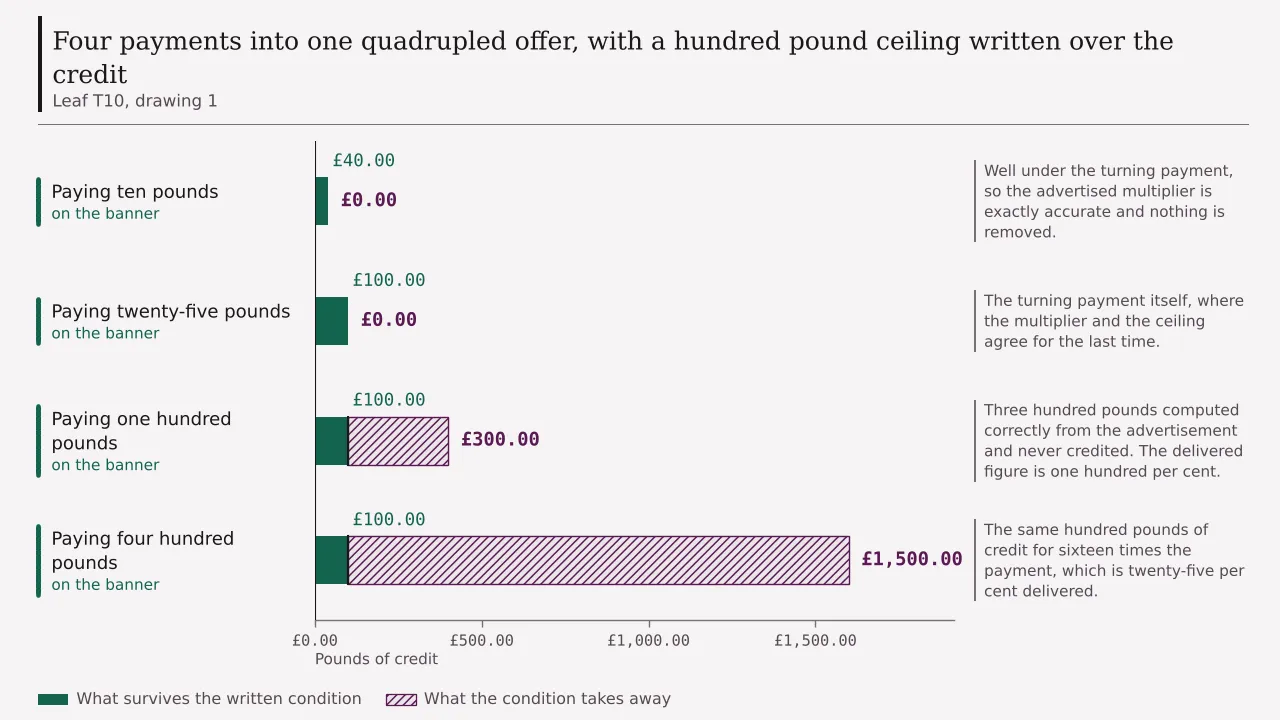
| £10.00 | £40.00 implied | £40.00 credited | Four hundred per cent, exactly as printed | £1,600.00 |
| £25.00 | £100.00 implied | £100.00 credited | Four hundred per cent, for the last time | £4,000.00 |
| £50.00 | £200.00 implied | £100.00 credited | Two hundred per cent | £4,000.00 |
| £100.00 | £400.00 implied | £100.00 credited | One hundred per cent | £4,000.00 |
| £200.00 | £800.00 implied | £100.00 credited | Fifty per cent | £4,000.00 |
| £400.00 | £1,600.00 implied | £100.00 credited | Twenty-five per cent | £4,000.00 |
After the second row three of those columns freeze and one goes on climbing. A ceiling does nothing else, and that picture is the whole of it. Credit stops at the turning payment, turnover stops with it, and so does the expected close. Only the payment keeps rising, dragging the distance between an implied figure and an arriving one along behind it.
Credit a reader computes from the banner on £100.00 £400.00 Credit the written ceiling permits on the same payment £100.00 Removed by one line nobody opened £300.00
Three hundred pounds is the subtraction, and its shape differs from every other subtraction on this part of the site. Elsewhere a written condition reduces what a true claim is worth. Here the written condition decides whether the claim describes the transaction at all, and the £300.00 is the distance between a figure that was computed correctly from the advertisement and a figure that was never going to arrive.
3
The same solve at four written ceilings
One hundred pounds is an assumption, and no argument should rest on it, so the identical division is set out below against a spread of ceilings. Every figure in that spread is an illustrative setting belonging to this page, picked to cover the range rather than to describe anything live. A usual ceiling over promotional credit is published nowhere this site could look.
| Ceiling assumed | Payment where four hundred per cent gives out | Width of the accurate band |
|---|---|---|
| £50.00 | £12.50 | £2.50 wide |
| £100.00 | £25.00 | £15.00 wide |
| £200.00 | £50.00 | £40.00 wide |
| £500.00 | £125.00 | £115.00 wide |
Column three assumes £10.00 as the smallest qualifying payment, a band having to begin somewhere and ten being the shape that recurs at this end of the market. Width is then the turning payment less ten. Under the tightest ceiling on the table the advertisement is accurate across two pounds fifty of payment choices, which is a narrower span than anybody treats a deposit decision as having.
Notice what the ceiling does and does not control. It fixes where accuracy ends. It has no effect whatever on how accurate the claim is below that point, which is perfectly accurate at every ceiling. A reader who pays the smallest qualifying sum receives exactly what the banner said, and would receive exactly what the banner said under any ceiling on the table.
That is why a ceiling is such an unobtrusive clause. It is invisible to the people most likely to test it, because the people most likely to test it are paying the least. Somebody at the floor could use the offer repeatedly for a year and never meet the line. The clause bites only on a decision to pay more, which is the decision an advertised multiplier of this size is designed to encourage.
4
What a pound above the line buys, which is nothing
Price the marginal pound, because that is the question somebody standing at the payment screen is actually asking. Below the turning payment, each extra pound buys four pounds of credit. Above it, each extra pound buys nought. There is no taper, no reduced rate and no partial match. The rate falls from four to zero at a single point.
Every pound paid above £25.00 buys £0.00 of credit while the banner still reads four hundred per cent
Somebody paying £40.00 instead of £25.00 has handed over fifteen pounds more and received the same £100.00. Somebody paying £400.00 has handed over three hundred and seventy-five pounds more and received the same £100.00. The second of those is not a worse deal than the first by degrees. It is the identical deal with a larger sum of the reader’s own money sitting beside it.
One honest qualification belongs here, because this site prints what the arithmetic gives rather than what makes the point cleanly. A pound above the line buys no credit, but it does buy the thing any unmatched payment buys, which is more money in the balance to carry the turnover with. That is worth something, and part six works out exactly how much and at what payment it begins to matter.
It is worth nothing at all in the terms the advertisement is using. The banner offers a multiplier. A reader responding to a multiplier by paying more is buying credit, and above the turning payment there is none to buy. Whatever the extra money does for survivability, it does not do the thing it was paid over to do.
There is also a direction of travel worth naming. The percentage is the inducement to pay more and the ceiling is the clause that makes paying more pointless, and the two sit in different documents with the larger type on the inducement. Nothing about that arrangement requires anybody to have intended it. The arrangement simply has an effect, and the effect is measurable in pounds at every payment above twenty-five.
5
A steeper headline holds over a narrower band
Hold the ceiling at £100.00 and walk down the percentage family instead. The turning payment is the ceiling divided by the multiplier, so a larger multiplier produces a smaller turning payment, and the band over which the advertisement is accurate narrows as the advertised figure grows.
| What the banner says | Accurate up to | Band from a £10.00 floor |
|---|---|---|
| 100 per cent | £100.00 | £90.00 wide |
| 200 per cent | £50.00 | £40.00 wide |
| 300 per cent | £33.33 | £23.33 wide |
| 400 per cent | £25.00 | £15.00 wide |
A factor of six divides the first row from the last. Hold one written ceiling steady and a par match describes the transaction correctly across ninety pounds of payment choices while a quadrupled one manages fifteen. Less room to be right in belongs to the more impressive number, and the relation is exact rather than impressionistic: the band contracts in inverse proportion to the multiplier.
That result inverts the usual reading of a percentage family. Walking up the ladder looks like receiving more. What is also happening, invisibly, is that the range of payments over which the advertisement means what it says contracts by the same factor it grows by. Four times the headline, a quarter of the room.
A reader can turn this into a quick sanity test without opening anything. Take the largest payment seriously being considered and multiply it by the advertised multiplier. Where the answer is a sum a promotional budget would plainly not hand to one person, a ceiling is almost certainly present whether or not it has been found, and the multiplier is not the number governing the outcome.
6
Where it is accurate against where it can be finished
Two separate questions have now been asked of the same payment. The first is whether the advertised multiplier holds, which is answered by the ceiling. The second is whether the turnover demanded is a figure the balance can carry, which is answered by the return. They have different answers and the answers do not overlap.
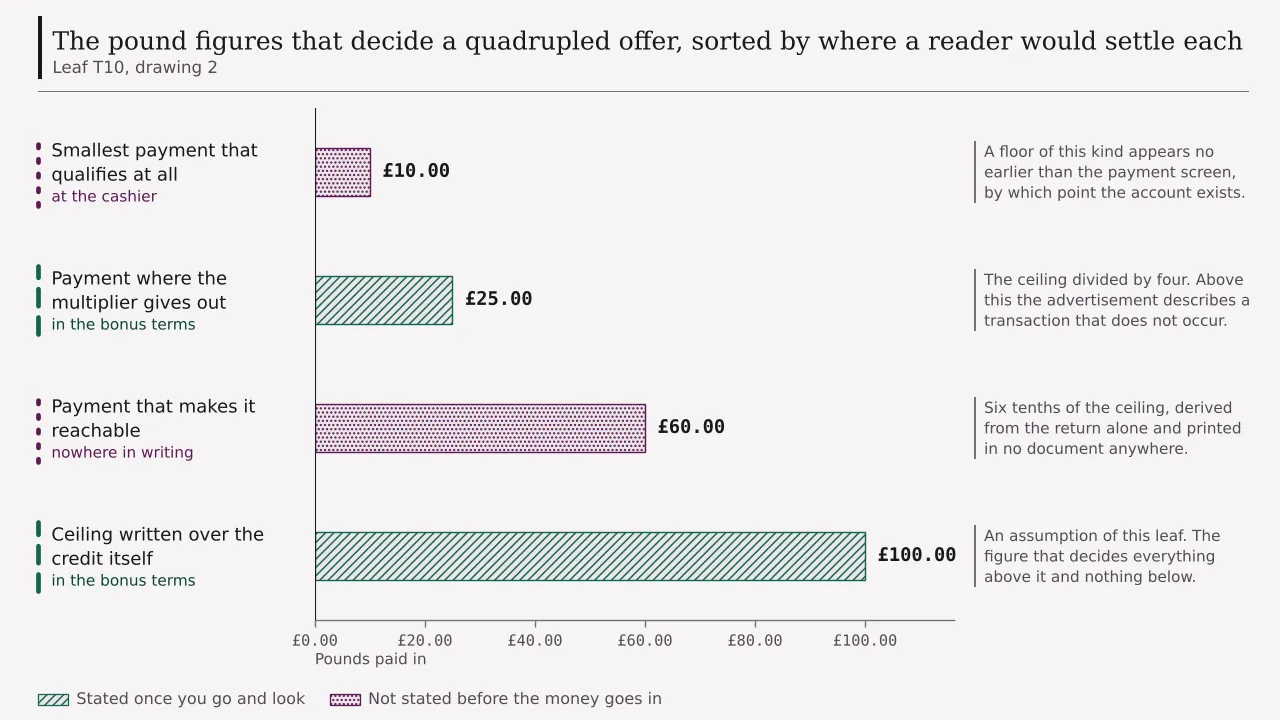
Take the second question properly. The largest turnover a balance is expected to survive is twenty-five multiplied by that balance, the twenty-five arriving by inverting the four pence a pound which 96 in the hundred leaves behind. Paying £25.00 builds a balance of £125.00, which survives £3,125.00 against a demand of £4,000.00. Overshoot: £875.00.
Solve for where the overshoot disappears and the answer is a payment of £60.00. At sixty pounds the balance is £160.00, which stands up to exactly £4,000.00, which is exactly what the ceiling-capped credit demands. Below sixty the money gives out first. At sixty and above it does not.
| Paid in | Is the advertised multiplier accurate | Turnover the balance stands up to | Turnover demanded | Is the requirement expected to be met |
|---|---|---|---|---|
| £10.00 | Yes, exactly | £1,250.00 | £1,600.00 | No, short by £350.00 |
| £25.00 | Yes, at the last payment it holds | £3,125.00 | £4,000.00 | No, short by £875.00 |
| £40.00 | No, it delivers two hundred and fifty | £3,500.00 | £4,000.00 | No, short by £500.00 |
| £60.00 | No, it delivers one hundred and sixty-seven | £4,000.00 | £4,000.00 | Yes, with nothing to spare |
| £100.00 | No, it delivers one hundred | £5,000.00 | £4,000.00 | Yes, with £1,000.00 unused |
Set the two columns of verdicts beside each other and the finding is plain. The multiplier is accurate from the floor up to twenty-five pounds. The requirement is reachable from sixty pounds upwards. Thirty-five pounds of payment choices separate the two bands, and no payment anywhere satisfies both.
None of that is an artefact of the £100.00 assumption. Done in general, the accurate band runs up to the ceiling over the multiplier, while the reachable band opens at six tenths of the ceiling. Those two overlap only when the multiplier is one and two thirds or smaller, which puts the crossing at a headline near 166.67 per cent. A quadrupled offer is above that, so no ceiling of any size brings the bands together.
Stated as a sentence rather than as algebra: on a quadrupled offer there is no payment at which the advertisement is accurate and the requirement is expected to be discharged. One or the other fails at every figure a reader could type into a payment screen, and which one fails depends only on which side of the turning payment they are standing.
7
A condition that changes truth rather than worth
Sort the written conditions on a matched offer by what each one does to the headline and a ceiling lands in a category of its own. A multiple reduces what the headline is worth without touching whether it is correct. A window limits when it can be collected. A press ceiling can remove the balance afterwards. Every one of those leaves the advertised figure standing as a true description of what arrives.
A credit ceiling does something different in kind. Above the turning payment it makes the advertised multiplier describe a transaction that does not occur. The claim has not been devalued. It has been given a domain, and outside that domain it is simply not a description of anything.
| Written condition | Effect on the advertised figure | Where it is settled |
|---|---|---|
| A multiple over the credited sum | Leaves it accurate, reduces its worth | in the bonus terms |
| A window on the unfinished requirement | Leaves it accurate, limits the time | in the bonus terms |
| A ceiling on any single press | Leaves it accurate, risks the balance | in the account agreement |
| A ceiling on the credit itself | Makes it inaccurate above a payment | in the bonus terms |
| The smallest payment a method will take | May put the whole offer out of reach | at the cashier |
| Whatever a build counts for | Multiplies the turnover demanded | nowhere in writing |
The practical consequence of that difference is about reading rather than about arithmetic. A reader who misses the multiple has a correct figure and an incorrect valuation, which more arithmetic will eventually catch. A reader who misses the ceiling has an incorrect figure, and no amount of further arithmetic performed on it will produce a right answer, because the input was wrong from the start.
It also explains why a ceiling is the condition most worth finding first. Everything else on a matched offer operates on a number. The ceiling decides which number is there to operate on, so it has to be read before the multiple rather than after it, which is the reverse of the order the documents put them in.
One last property belongs in this part. The clause remains literally accurate at every payment below the turning point, which is what makes it so difficult to object to and so easy to overlook. A claim that is false everywhere gets noticed. A claim that is true over an interval, and silent about where the interval ends, gets believed by everybody inside it and misread by everybody outside.
8
The other kind of ceiling, written by whoever is paying
Everything above concerns a ceiling an operator writes over what a reader receives. There is a second kind, written by the reader over what they hand across, and on a licensed site it is the machinery that stands between somebody and a payment larger than they meant to make. It is also the duty most precisely aimed at the behaviour an advertised multiplier of this size encourages.
The shape of it repays setting out, the parallel with part four being exact, and all of it settled in a published standard. The standard governing financial limits wants the means of fixing one’s own limit easily reachable, available from registration onward, and wants a prompt put in front of somebody while they register or else as they make a first payment. Three durations have to be among those offered: a month, a week and a single day.
Teeth come from three further provisions. A limit is the default choice, so going without one takes a positive act and a confirmation before anything is paid. Loosening a limit sits out a cooling period of 24 hours at the least, after which the customer has to act again to confirm. Tightening one lands immediately, barring a technical failure.
On overlapping periods the regulator supplies a worked instance, and for a page about ceilings beating headlines it is the sharpest piece of the standard, being the same contest run the other way. Put a ten pound limit on the day alongside a hundred pound limit on the week and the stricter one governs across both, leaving seventy as the week’s permitted total. Restriction wins, just as a credit ceiling wins against a multiplier.
One point of care travels with the standard. The page carrying it states no implementation date for the requirement itself, so a reader should not attach one to it from elsewhere. What it does carry is a publication date and a change history, and the obligations above are the live wording rather than a summary of it.
Offers printing a multiplier of this size hold no Great Britain licence. Missing along with one is the ceiling a reader would otherwise have set over their own payment. Four duties travel with that licence and they leave together. A duty to keep the means of fixing a limit within easy reach from the moment an account exists. A prompt landing while somebody registers, or else as they make a first payment, which is exactly when the question of how far past a turning payment to go is being decided. A default that puts the limit in place unless somebody acts to refuse it, rather than leaving it absent unless somebody acts to ask. And an asymmetry between the two directions, loosening held back by 24 hours and a second confirmation while tightening lands at once. Remove those and one ceiling is left in the whole transaction, the one drafted over the credit, which serves the operator at every payment above twenty-five pounds and serves nobody below it.
9
Four lines to read before any payment is chosen
Open the bonus terms and read the paragraph holding the multiple, because the ceiling is usually in the same one. Look for a short phrase beginning with the words up to, or for the word maximum followed by a sum. That sum is the ceiling. Where no such phrase appears anywhere, treat the absence as a finding rather than as good news, since an uncapped quadrupled offer is an unusual thing to publish.
Then divide. The ceiling over the multiplier gives the turning payment, and that single figure is the only number a reader needs at the payment screen. Pay at or below it and the advertisement is exactly right. Pay above it and the advertisement has stopped applying, whatever is still printed in large type on the page that brought you there.
Two further checks are worth thirty seconds each. Multiply the ceiling by the multiple to get the turnover a capped credit demands, which at £100.00 and forty times is £4,000.00 whatever was paid in. Then multiply the balance by twenty-five to see what that balance stands up to, and compare. Those two numbers decide whether the arrangement can be finished, and the advertisement bears on neither of them.
Two things the method cannot settle. One is whatever a build counts for, which divides into every turnover figure printed above and which this site could find published nowhere. The other is the smallest payment a particular method will accept, which appears at the cashier and may sit above the qualifying floor the offer assumes. Both are recorded here rather than guessed at.
Carried back down the family the method keeps working and gets less interesting, which is itself the finding. At a par match the accurate band under the same ceiling runs to ninety pounds and overlaps the band where the requirement is reachable. At four hundred per cent the two bands are thirty-five pounds apart and cannot be brought together by choosing a different payment, a different ceiling, or a different amount of care.
Questions
- What is the maximum bonus on a 400% deposit bonus?
- Whatever a short phrase in the bonus terms says, usually sitting in the same paragraph as the multiple and usually beginning with the words up to. This page works throughout to a ceiling of £100.00, which is an assumption of the page rather than anything published, and no source consulted here publishes a usual figure. The ceiling is the number that decides the offer, because above one particular payment it is the only one of the two still operating.
- At what deposit does a 400 per cent match stop paying four hundred per cent?
- At the ceiling divided by four. Against a ceiling of £100.00 that is a payment of £25.00, and the arithmetic is one division. Below it the advertisement is exactly accurate and a reader computing credit from the multiplier gets the right answer. At it the two instructions agree for the last time. Above it the credit has stopped moving while the multiplier has not, so the overstatement grows with every further pound.
- What do I get for depositing more than the bonus cap allows?
- No credit at all. Below the turning payment each extra pound buys four pounds of credit; above it each extra pound buys nought, with no taper and no reduced rate in between. Somebody paying £400.00 against a £100.00 ceiling has handed over three hundred and seventy-five pounds more than was needed and holds the same credit. The extra money does buy more balance to carry the turnover with, which is worth something, and it is not what a multiplier was offering.
- Why is a bigger bonus percentage true over a smaller range of deposits?
- Because the turning payment is the ceiling divided by the multiplier, so a larger multiplier gives a smaller turning payment. Holding a ceiling at £100.00 and a qualifying floor at £10.00, a par match is accurate across ninety pounds of payment choices, two hundred per cent across forty, three hundred across £23.33 and four hundred across fifteen. Four times the headline, a quarter of the room, and the relationship is exact rather than approximate.
- How much wagering does a capped 400 per cent bonus actually demand?
- The ceiling multiplied by the multiple, and once the ceiling has bitten nothing a reader pays in alters it. Take £100.00 of capped credit at forty times: the demand is £4,000.00 on a payment of £25.00 and the same £4,000.00 on a payment of £400.00. Underneath the turning payment it does scale. Ten pounds paid in credits forty, demands £1,600.00 of turnover, and closes at an expected minus £24.00.
- Can a 400 per cent bonus with a maximum ever be cleared?
- Not at any payment where the advertised figure is still accurate. The largest turnover a balance is expected to survive is twenty-five multiplied by that balance. Under a £100.00 ceiling the demand of £4,000.00 is met from a payment of £60.00 upward, while the advertised multiplier holds only as far as £25.00. Thirty-five pounds of payment choices lie between the two, and no figure typed into a payment screen satisfies both.
- Is a bonus cap the same thing as a maximum bet or a wagering requirement?
- No, and the difference is about truth rather than about size. A multiple reduces what a headline is worth and leaves it an accurate description. A press ceiling can remove a balance afterwards and still leaves it accurate. A ceiling on the credit makes the advertised figure describe a transaction that does not occur above one payment. Miss a multiple and the figure is right while the valuation is wrong. Miss a ceiling and the figure itself is wrong.
- Where in the terms is the maximum bonus usually written?
- In the bonus terms, most often in the same paragraph as the multiple, as two words and a sum. Sometimes it appears on the advertisement as a phrase beginning up to, which names a ceiling without naming the payment that reaches it, so a reader still has the division to perform. Where no such phrase turns up anywhere, treat the absence as a finding rather than as good news, since an uncapped offer at this steepness is an unusual thing to publish.
- What is the deposit limit rule that would apply under a British licence?
- A ceiling set by whoever is paying rather than by whoever is offering. The standard governing financial limits wants the means of fixing one easily reachable from the moment an account exists, and wants a prompt put in front of somebody during registration or else as a first payment is made. Durations on offer have to include a month, a week and a single day. A limit is the default, so going without takes a positive act. Loosening waits 24 hours and a second confirmation; tightening lands at once.
- Which figure wins when two limits overlap?
- The stricter one governs across both, and the regulator’s worked instance makes it concrete. Ten pounds set on the day alongside a hundred set on the week leaves seventy as the week’s permitted total, since the daily figure binds on each of the seven days. That is this page’s own contest run the other way about: where a multiplier and a ceiling disagree over the credit, the restrictive number is the one that operates.
- What is given up on a quadrupled offer licensed outside Great Britain?
- The ceiling a reader would otherwise have set over their own payment. Offers printing a multiplier of this size hold no Great Britain licence. Four things go along with one. The means of fixing a limit, kept within easy reach from the moment an account exists. A prompt landing during registration or as a first payment is made, which is exactly when the question of how far past a turning payment to go is being decided. The limit as a default rather than an option. And the asymmetry under which loosening is held back and tightening is not.