Terms read 19 October 2026 Leaf T08, revision 1
The ceiling on one press, which no advertisement has ever carried
Two pounds credited for every pound paid turns £10.00 into £20.00 of credit and £800.00 of turnover, closing at an expected minus £12.00. Somewhere in a second document sits a sentence capping what any single press may take while that credit lives. Crossing it once removes the lot. This page finds the sentence, prices the crossing, and says why it is drafted to be crossable.
Stated on the banner £20.00 A payment of ten drawing twice its own size in credit. How large a single press may be goes unmentioned. Stated, once you go and look £5.00 a press A ceiling on any single stake taken while the credit is live, carried in the account agreement and enforced afterwards. Not stated before the money goes in 8,000 chances Presses needed at 10p to work off £800.00, each of them an opportunity to breach a line nobody will stop you crossing.
Matched offers, with the written terms read
Every destination in this file is bought advertising. The site is paid a fee if a reader goes on to register, and no figure printed below moves because of it.
Bonus Spins UK Slip 01
Betportal
Ceiling as a multiple
The drop
€15.00
€1.00 in the euro
The claim reads €15.00. Once the terms beside it have applied, €0.00 of it can leave. The difference is the drop.
7 of the 15 terms on this slip could not be read before the money went in
Spins priced at this site's own 10p a spin, which the operator does not publish
Stated
€15.00
The claim as it is printed, before a single term has been applied to it.
Headline paid as spins
150 spins at 10c each, which is €15.00 of the figure above.
6 Nowhere
What one spin is worth
No unit is published for a spin, so the count is priced at this site's own 10p a spin. At half that price every figure below halves with it.
Match and other credit not priced
300% of three deposits, to a ceiling of €1,000. A share of a deposit nobody has made yet is not a sum, so no figure stands on this line and none is carried below.
Qualified
-€14.40
Written down somewhere, and taking part of the claim back. Each term carries the place it is written and the sum it takes.
2 Written terms at a distance this record does not establish
Play-through -€14.40
Carrying €14.40 through 35 times stakes €504.00 and costs €20.16 of it at 96 per cent return. That prices above the €14.40 there is to charge it against, so the whole of the credit goes and the line is held at that. The multiple sits on the bonus.
2 Written terms at a distance this record does not establish
Game weighting not priced
Slots only count towards the play-through. No contribution percentage is published, so the line above has been worked at full weight, which is the kindest reading there is.
2 Written terms at a distance this record does not establish
Ceiling on the winnings not priced
5x the bonus.
2 Written terms at a distance this record does not establish
Clock on the credit not priced
14 days.
2 Written terms at a distance this record does not establish
Largest stake while it runs not priced
€5.
3 Public record
Licence, and who holds it not priced
Licensed in Anjouan, Comoros, held by BetPortal Gaming Ltd, with Excite Ultra Media Ltd, reference ALSI-202601040-FI2. A register entry settles who holds a licence and what it permits. It does not settle who is running the site this morning.
4 Cashier
Smallest qualifying deposit your money
€20 a stage. That is €20.00 of your own money, and it is never netted into a drop.
5 On the way out
Checks before a withdrawal not priced
Documents before the first withdrawal.
Unstated
-€0.60
Applying without having been published anywhere, and costing money all the same.
6 Nowhere
What a spin hands back -€0.60
Staking a spin returns 96 per cent of it, so that share of the batch is the house's before a reel turns. This site works at that return and the operator publishes none where the claim is made.
6 Nowhere
Forfeited by rule cost unknown
Nothing is published under this heading, and it applies regardless.
6 Nowhere
Charge on the way out cost unknown
No charge on the way out is published as a figure, so nothing comes off this line. A charge that exists unpublished would come straight off whatever survives.
6 Nowhere
Smallest withdrawal allowed cost unknown
No smallest withdrawal is published as a figure. A floor nobody has published is still a floor, and it decides whether a small balance can move at all.
No Great Britain licence
Terms read 19 October 2026
Bonus Spins UK Slip 02
WinBeast
Ceiling as a sum
The drop
€50.00
€1.00 in the euro
The claim reads €50.00. Once the terms beside it have applied, €0.00 of it can leave. The difference is the drop.
8 of the 15 terms on this slip could not be read before the money went in
Spins priced at this site's own 10p a spin, which the operator does not publish
Stated
€50.00
The claim as it is printed, before a single term has been applied to it.
Headline paid as spins
500 spins at 10c each, which is €50.00 of the figure above.
6 Nowhere
What one spin is worth
No unit is published for a spin, so the count is priced at this site's own 10p a spin. At half that price every figure below halves with it.
Match and other credit not priced
50% to 100% of five deposits, each to a ceiling of €1,000, and a €650 free bet. A share of a deposit nobody has made yet is not a sum, so no figure stands on this line and none is carried below.
Qualified
-€48.00
Written down somewhere, and taking part of the claim back. Each term carries the place it is written and the sum it takes.
2 Written terms at a distance this record does not establish
Play-through -€48.00
Carrying €48.00 through 40 times stakes €1,920.00 and costs €76.80 of it at 96 per cent return. That prices above the €48.00 there is to charge it against, so the whole of the credit goes and the line is held at that. The multiple sits on the bonus and the winnings from the spins.
2 Written terms at a distance this record does not establish
Game weighting not priced
Slots, titles vary by country count towards the play-through. No contribution percentage is published, so the line above has been worked at full weight, which is the kindest reading there is.
2 Written terms at a distance this record does not establish
Ceiling on the winnings not priced
€100 a batch of spins.
2 Written terms at a distance this record does not establish
Clock on the credit not priced
7 days, spins 1 day.
3 Public record
Licence, and who holds it not priced
Licensed in Curaçao, holder not named on the site. A register entry settles who holds a licence and what it permits. It does not settle who is running the site this morning.
4 Cashier
Smallest qualifying deposit your money
€20 a stage. That is €20.00 of your own money, and it is never netted into a drop.
5 On the way out
Checks before a withdrawal not priced
Documents before the first withdrawal.
Unstated
-€2.00
Applying without having been published anywhere, and costing money all the same.
6 Nowhere
What a spin hands back -€2.00
Staking a spin returns 96 per cent of it, so that share of the batch is the house's before a reel turns. This site works at that return and the operator publishes none where the claim is made.
6 Nowhere
Largest stake while it runs cost unknown
Nothing is published under this heading, and it applies regardless.
6 Nowhere
Forfeited by rule cost unknown
Nothing is published under this heading, and it applies regardless.
6 Nowhere
Charge on the way out cost unknown
No charge on the way out is published as a figure, so nothing comes off this line. A charge that exists unpublished would come straight off whatever survives.
6 Nowhere
Smallest withdrawal allowed cost unknown
No smallest withdrawal is published as a figure. A floor nobody has published is still a floor, and it decides whether a small balance can move at all.
No Great Britain licence
Terms read 19 October 2026
Bonus Spins UK Slip 03
EliteSpin
Longest spin window
The drop
£50.00
£1.00 in the pound
The claim reads £50.00. Once the terms beside it have applied, £0.00 of it can leave. The difference is the drop.
8 of the 15 terms on this slip could not be read before the money went in
Spins priced at this site's own 10p a spin, which the operator does not publish
Stated
£50.00
The claim as it is printed, before a single term has been applied to it.
Headline paid as spins
500 spins at 10p each, which is £50.00 of the figure above.
6 Nowhere
What one spin is worth
No unit is published for a spin, so the count is priced at this site's own 10p a spin. At half that price every figure below halves with it.
Match and other credit not priced
50% to 100% of five deposits, each to a ceiling of £1,000. A share of a deposit nobody has made yet is not a sum, so no figure stands on this line and none is carried below.
Qualified
-£48.00
Written down somewhere, and taking part of the claim back. Each term carries the place it is written and the sum it takes.
2 Written terms at a distance this record does not establish
Play-through -£48.00
Carrying £48.00 through 40 times stakes £1,920.00 and costs £76.80 of it at 96 per cent return. That prices above the £48.00 there is to charge it against, so the whole of the credit goes and the line is held at that. The multiple sits on the bonus and the winnings from the spins.
2 Written terms at a distance this record does not establish
Game weighting not priced
Slots count towards the play-through. No contribution percentage is published, so the line above has been worked at full weight, which is the kindest reading there is.
2 Written terms at a distance this record does not establish
Ceiling on the winnings not priced
5x the bonus.
2 Written terms at a distance this record does not establish
Clock on the credit not priced
7 days, spins 3 days.
3 Public record
Licence, and who holds it not priced
Licensed in Costa Rica, held by PrimeTier Limited. A register entry settles who holds a licence and what it permits. It does not settle who is running the site this morning.
4 Cashier
Smallest qualifying deposit your money
£20 a stage. That is £20.00 of your own money, and it is never netted into a drop.
5 On the way out
Checks before a withdrawal not priced
Documents before the first withdrawal.
Unstated
-£2.00
Applying without having been published anywhere, and costing money all the same.
6 Nowhere
What a spin hands back -£2.00
Staking a spin returns 96 per cent of it, so that share of the batch is the house's before a reel turns. This site works at that return and the operator publishes none where the claim is made.
6 Nowhere
Largest stake while it runs cost unknown
Nothing is published under this heading, and it applies regardless.
6 Nowhere
Forfeited by rule cost unknown
Nothing is published under this heading, and it applies regardless.
6 Nowhere
Charge on the way out cost unknown
No charge on the way out is published as a figure, so nothing comes off this line. A charge that exists unpublished would come straight off whatever survives.
6 Nowhere
Smallest withdrawal allowed cost unknown
No smallest withdrawal is published as a figure. A floor nobody has published is still a floor, and it decides whether a small balance can move at all.
No Great Britain licence
Terms read 19 October 2026
Bonus Spins UK Slip 04
Crown Jewelz
Multiple unpublished
The drop
NOT WORKED
The multiple is not published in the operator's own terms. Since the sum cannot be worked around it, none is worked.
9 of the 14 terms on this slip could not be read before the money went in
No drop worked
Stated
£15.00
The claim as it is printed, before a single term has been applied to it.
Headline paid as spins
150 spins at 10p each, which is £15.00 of the figure above.
6 Nowhere
What one spin is worth
No unit is published for a spin, so the count is priced at this site's own 10p a spin. At half that price every figure below halves with it.
Match and other credit not priced
200% of the first deposit, then 150% twice, each to a ceiling of £1,000. A share of a deposit nobody has made yet is not a sum, so no figure stands on this line and none is carried below.
Qualified
NOT WORKED
Written down somewhere, and taking part of the claim back. Each term carries the place it is written and the sum it takes.
2 Written terms at a distance this record does not establish
Play-through not priced
40x the bonus, reported rather than published by the operator.
2 Written terms at a distance this record does not establish
Game weighting not priced
Slots count towards the play-through. No contribution percentage is published, so the line above has been worked at full weight, which is the kindest reading there is.
3 Public record
Licence, and who holds it not priced
Licensed in Curaçao, number not verified, holder not named on the site. A register entry settles who holds a licence and what it permits. It does not settle who is running the site this morning.
4 Cashier
Smallest qualifying deposit your money
£20. That is £20.00 of your own money, and it is never netted into a drop.
5 On the way out
Checks before a withdrawal not priced
Documents before the first withdrawal.
Unstated
NOT WORKED
Applying without having been published anywhere, and costing money all the same.
6 Nowhere
Ceiling on the winnings cost unknown
No ceiling is published. Nothing is assumed in its place.
6 Nowhere
Clock on the credit cost unknown
Nothing is published under this heading, and it applies regardless.
6 Nowhere
Largest stake while it runs cost unknown
Nothing is published under this heading, and it applies regardless.
6 Nowhere
Forfeited by rule cost unknown
Nothing is published under this heading, and it applies regardless.
6 Nowhere
Charge on the way out cost unknown
No charge on the way out is published as a figure, so nothing comes off this line. A charge that exists unpublished would come straight off whatever survives.
6 Nowhere
Smallest withdrawal allowed cost unknown
No smallest withdrawal is published as a figure. A floor nobody has published is still a floor, and it decides whether a small balance can move at all.
No Great Britain licence
Terms read 19 October 2026
Every figure in the second and third columns is this site's own working and nothing an operator has published. A claim is priced as printed, then the share a spin hands back at 96 per cent return comes off it, then what playing the multiple through costs at the same return, and then whatever a published ceiling, a charge on the way out or a floor on the smallest withdrawal takes from what has survived. The drop is the difference between the first figure and the last. The two columns add back up to it exactly, so no money leaves a slip without a term and a place beside it.
Which column a term falls in is settled by one question: has anybody written it down. A charge a reader meets at the payment screen is written down, and it stands in the second column with the cashier against it. A condition that binds without ever having been set down stands in the third, whatever it costs. Inside each column the terms run outwards from the banner, so the order itself says how far a reader would have had to go.
A count of spins has no unit until one is supplied. Where an operator publishes what one of its own spins is worth, that figure is used and the first column says it is theirs. Where none is published, this site's own 10p a spin stands in its place and every figure below moves in proportion with it. Where the multiple itself is unpublished, no drop is worked at all, because that is the one figure the sum cannot be done without.
Three words stand where a figure cannot. Not priced is a term that is written down and carries no number the arithmetic can take. Cost unknown is a term nobody has written down, costing something nobody has put a number on. Your money is money of the reader's own, which is never netted into a drop.
None of the operators in this file holds a Great Britain licence, so none of the duties that licence carries reaches them. Each of those duties is published in its own right, which is what makes its absence here something a reader can check rather than take on trust. Every gambling company licensed in Great Britain belongs to Gamstop Online, so a reader who has shut themselves out through the scheme is not shut out here. Social Responsibility Code 5.1.1 has held a play-through to a maximum of ten times the bonus funds since 19 January 2026, and it binds a licence holder and nobody else. Asked in a post of 21 October 2025 what is lost along with the licence, the Gambling Commission's Director of Enforcement and Intelligence answered: "unfair gaming practices, financial loss, and a lack of recourse if things go wrong". The same post puts blocked payouts, and withdrawal limits pitched high enough to be unreachable, among the behaviour the Commission has recorded. Nobody under 18 may hold an account at any of them.
Terms are reproduced in the wording their operator published, and each slip is dated with the day somebody sat down and read them. 19 October 2026 is the oldest of those dates. Anybody claiming an offer is bound by that operator's full terms, which are elsewhere, and never by a line standing here.
1
A ceiling that reads like a limit and behaves like a trap
Somewhere in the paperwork behind a tripled payment is a sentence of about fifteen words. It says that while promotional credit remains unconverted, no single stake may exceed some figure. Read quickly it sounds protective, in the way a speed limit sounds protective. Read properly it is nothing of the kind, because a limit refuses and this does not.
The difference is mechanical. A limit is enforced at the moment of the act: the button declines, the field will not take the number, the stake reverts. A condition of this shape is enforced long afterwards, by removing a balance that has already been built. Nothing stops the press. The press is accepted, the money moves, the reels turn, and the record of it sits there until somebody asks to be paid.
That one structural fact explains everything else about the clause, including why it appears in no advertisement anywhere. An advertisement carries the inducement and the qualifying payment. It does not carry a sentence whose entire function is to supply a reason for keeping the balance, because saying so beside the percentage would undo the percentage.
Throughout this page the worked arrangement is £10.00 paid in at two hundred per cent, so the credited sum is £20.00 and the account reads £30.00. Forty over the credited sum demands £800.00 of turnover, of which four hundredths stays with the house. Thirty-two pounds of expected cost then lands on twenty pounds of credit, closing at minus £12.00. Percentage and payment are both settled , while the ceiling on a press is settled in the account agreement.
Of every condition attached to a matched offer, this is the one that removes the most balances. It is not the largest in money terms, since the multiple decides more. It is the one with a discrete trigger, and a discrete trigger is what a forfeiture needs in order to be defensible when somebody complains about it.
£800.00 of turnover at 10p is 8,000 chances to cross a line, and one crossing is enough
2
The document that carries it, and why that one
Promotional terms are where the multiple lives, a single step away from the percentage, behind the small type under an offer. A press ceiling usually sits further back than that, inside the general account agreement, which is a contract drafted for everybody who holds an account rather than for this promotion, and which a reader normally reaches from the foot of a page.
There is a drafting logic to that placement and it is worth stating without indignation. The ceiling applies to every promotion the operator runs, not only to this one, so putting it in a document that governs all of them is tidier than repeating it. Tidiness for the drafter and distance for the reader are the same decision seen from two sides.
What that placement costs is measurable in a way that does not need a rule to confirm it. A reader who opens the promotional terms, reads the multiple, computes £800.00 and is satisfied has done more work than almost anybody does, and has still not met the clause capable of taking the balance. Diligence of the ordinary kind gets a reader to the multiple and stops there.
Occasionally the ceiling does appear in the promotional terms, usually as a short line near the expiry. Where it does, the figure is often different from the one in the account agreement, because the two documents were written at different times by different people. A reader finding two ceilings should work to the lower, since no clause anywhere says which governs.
The third possibility is that no figure is written at all and the account agreement merely reserves a power to void a balance where play is judged irregular. That is a ceiling with no number, which is harder to price and easier to invoke. Where this leaf needs a figure it posits one and says so in the sentence that carries it.
3
Three ways of writing one ceiling, and the figures each gives
The clause comes in three constructions and they are not equivalent. One names a flat sum of money. One names a proportion of the credited half. One names a proportion of the payment that triggered the match. All three read like a ceiling and all three produce a different number on the identical offer.
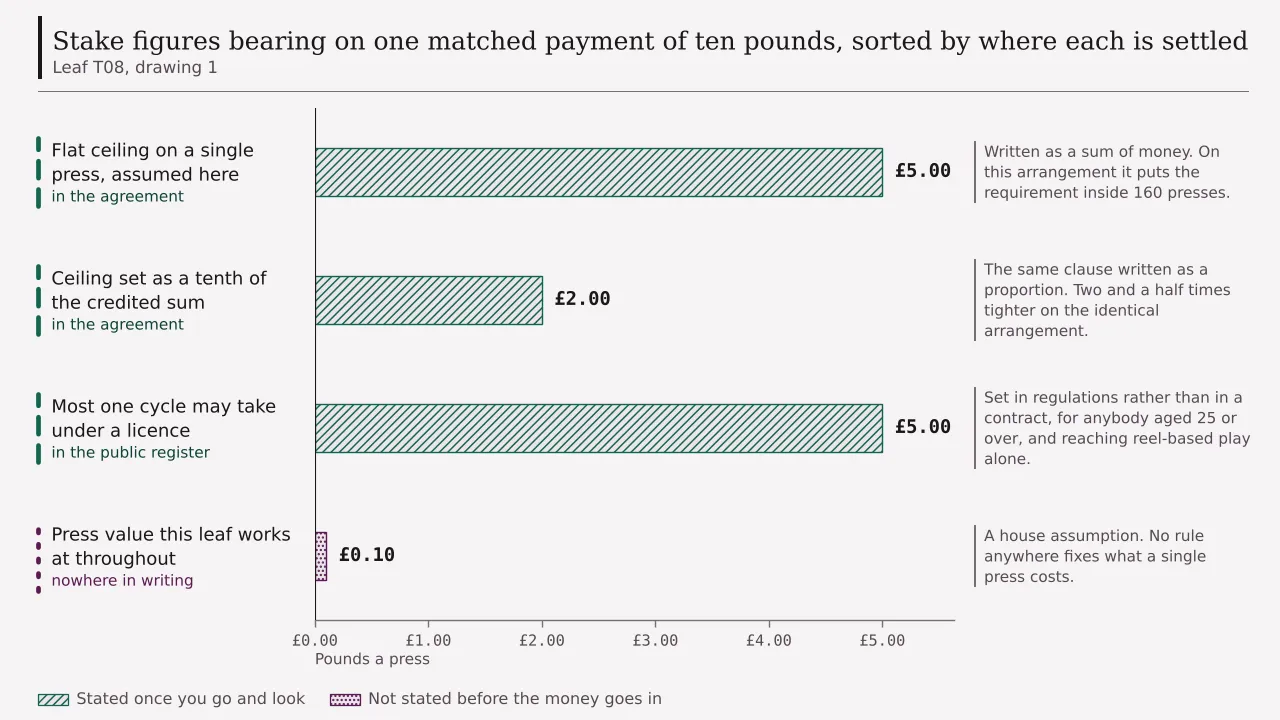
Take the worked arrangement and put each construction through it. A flat sum, taken here at £5.00, caps a press at five pounds. A proportion of the credited half, taken here at one tenth, caps it at £2.00, that being a tenth of the £20.00 credited. A proportion of the payment, taken here at one quarter, caps it at £2.50. Each of those three figures is this page’s own illustrative setting and none of them is published anywhere.
| How the clause is written | Ceiling on this offer | Presses the £800.00 then needs |
|---|---|---|
| A flat sum, assumed here at £5.00 | £5.00 | 160 |
| A quarter of the payment, assumed here | £2.50 | 320 |
| A tenth of the credited half, assumed here | £2.00 | 400 |
| The press value this page works at throughout | £0.10 | 8,000 |
Two and a half times separates the loosest of the three from the tightest, on an offer whose advertisement says the same thing in every case. A reader who has met one construction elsewhere and assumes it applies here is carrying a figure across from a document that has nothing to do with this one.
The proportional constructions have a property the flat one does not, and it runs against what anybody would guess. Tie the ceiling to the credited half and a bigger percentage raises the ceiling: at par on £10.00 a tenth gives £1.00, at triple it gives £2.00, at quintuple it gives £4.00. The headline that enlarges the obligation also enlarges the room to work it off, which is the only respect in which a steeper percentage is kinder than a shallow one.
4
Eight thousand presses against six minutes and forty seconds
At the ten pence this page works to, turnover of £800.00 comes to 8,000 separate presses. Multiply 8,000 by the 2.5 seconds a licensed slot build has to leave between cycles and 20,000 seconds comes out, which is the least the requirement can possibly occupy. On a clock that reads five hours and thirty-three minutes, with twenty seconds on the end, and it assumes nobody pauses.
Put the same requirement through the flat ceiling instead. Sixteen scores of presses at £5.00 reach £800.00, and 160 cycles against the identical floor take 400 seconds, or six minutes and forty seconds. One requirement, discharged in under seven minutes or in most of an evening, and the only thing separating those two outcomes is a stake fifty times larger.
| Stake per press | Presses to reach £800.00 | Least time that can take | Presses the balance funds | Whether the money lasts |
|---|---|---|---|---|
| 10p | 8,000 | 5h 33m 20s | 7,500 | Short by 500 presses |
| £2.00 | 400 | 16m 40s | 375 | Short by 25 presses |
| £2.50 | 320 | 13m 20s | 300 | Short by 20 presses |
| £5.00 | 160 | 6m 40s | 150 | Short by 10 presses |
Column four is where this part earns its place. Divide £30.00 of balance by four hundredths and the answer is £750.00, which is how much turnover that balance carries before exhaustion becomes the expected outcome. Against a requirement of £800.00 the shortfall is fifty pounds, and it stays fifty pounds at every stake size the table lists.
That is the finding worth carrying out of this part, because it reframes the ceiling entirely. Stake size changes how long the attempt takes and changes nothing about whether it succeeds. The rate at which money leaks is four pence in the pound at every press size, so a larger press buys speed and buys nothing else. The ceiling therefore protects nobody from losing the balance. It only governs how quickly the losing happens.
Which raises the obvious question about what the clause is for. If it cannot change the expected outcome, and cannot be enforced at the press, the only thing it reliably produces is a line that can be crossed and a record that it was. Parts six and seven attach a figure to it.
5
Six ways over the line that feel like nothing at all
A reader intending to stay under a ceiling still crosses it, and the crossings have a small number of recognisable shapes. None of them involves carelessness in the way that word is normally meant. Each is an ordinary act that happens to carry a stake larger than the clause permits.
First, a build whose smallest available stake sits above the ceiling. Where the clause caps a press at £2.00 and a lobby entry will not accept less than £2.50, opening it at all is a breach, and nothing on the way in says so. Second, a stake carried over from an earlier session before the promotion existed, which the interface remembers and the clause does not.
Third, a control that multiplies rather than sets. Raising a bet level, a coin value or a count of lines changes the figure the reels take without the number that is on screen ever being typed by anybody. Fourth, a purchased feature, which is a single press priced at many times the base stake and is accounted as one stake for the purpose of a ceiling.
Fifth, a side wager or doubled stake offered as part of the game rather than as a setting, which can lift one press above the line while every other press stays under it. Sixth, a round that stakes more than the press which triggered it, where the clause counts the round rather than the trigger.
What unites the six is that the ceiling is a number in a document and the stake is a number on a screen, and nothing joins them. A reader would have to hold the first in their head and check it against the second eight thousand times, which is not a thing anybody does and not a thing the layout asks for.
A seventh route exists and belongs in a separate sentence because it is not the reader’s doing. Where the ceiling is proportional and the proportion is of a credited half that shrinks as the requirement is worked off, the ceiling itself moves downwards during play. A stake that was compliant at the start stops being compliant later, with no action taken by anybody. Whether a clause works that way is settled by its wording and is frequently nowhere in writing.
6
The one condition a reader breaks by doing something
Sort every condition on a matched offer by what discharges it and an asymmetry appears that nothing in the document announces. The multiple is discharged by money moving. The window is discharged by the calendar. The contribution rate applies whether or not anybody is aware of it. None of the three can be breached, because none of them asks for anything to be done.
The press ceiling is the exception and the only one. It is a prohibition rather than a requirement, which makes it the single condition on the offer that a reader is capable of violating. Everything else either happens or fails to happen. This one is broken, and broken by an act with a timestamp on it.
| Condition | What satisfies it | Can a reader breach it |
|---|---|---|
| Forty times over the credited half | Turnover of £800.00 accumulating | No. It is met or it is unmet. |
| A window on the unfinished requirement | Time passing, with no act required | No. The clock runs by itself. |
| The rate a build counts at | Nothing. It applies on its own. | No. There is nothing to comply with. |
| A ceiling on any single press | Every press staying under a figure | Yes, once, by one press |
That asymmetry explains the drafting rather than merely describing it. A clause permitting a balance to be removed is far easier to stand behind where the customer has done something than where they have simply failed to finish. Fault is what makes a forfeiture look like a consequence instead of a confiscation, and the press ceiling is the only condition on the offer capable of supplying fault.
Read in that light, the clause is working exactly as designed when it is breached by accident. A condition that nobody ever crossed would supply no fault to anybody and would be worth nothing to keep. A condition crossable by an ordinary act, invisible at the moment of crossing and recorded permanently, is worth the whole balance on the occasions it fires.
Structure is what that argument is about, and intentions are not alleged anywhere in it; the mechanics in part eight are what it rests on. How often clauses of the kind actually get invoked is published by no source consulted for this site, so no figure for it appears above or below.
7
Pricing a single press against twenty pounds and eight hundred
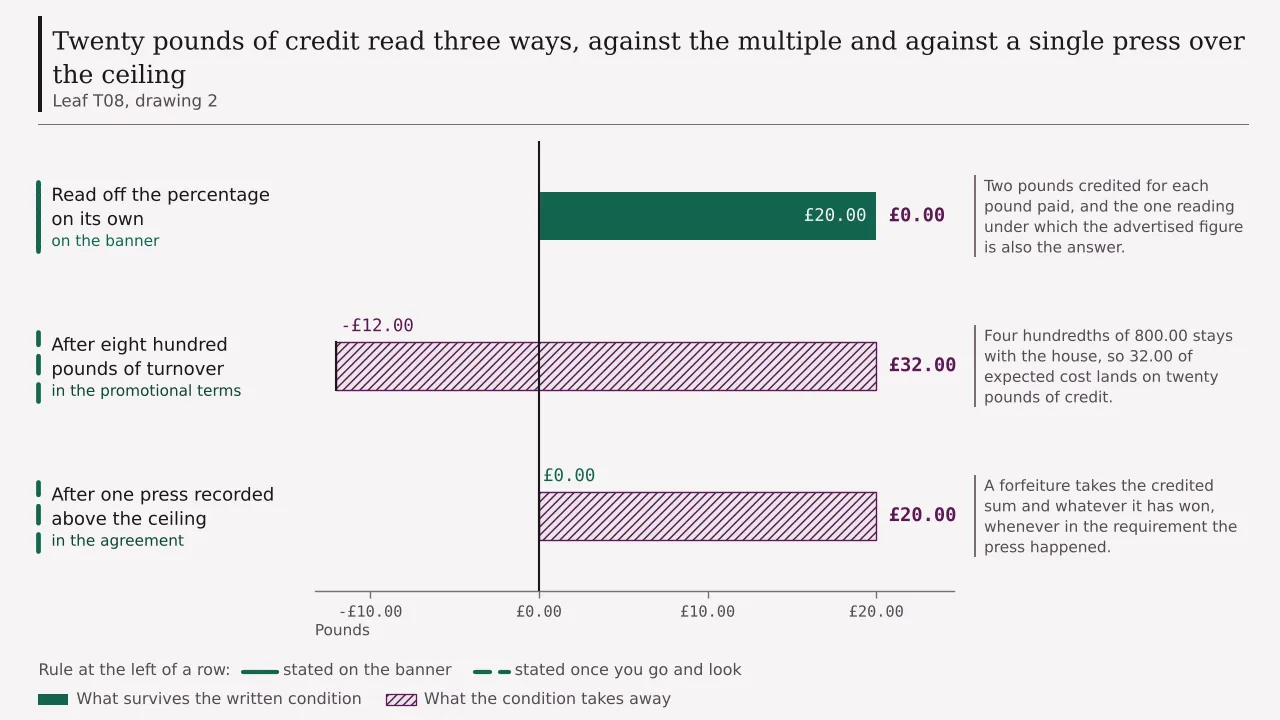
Start from the offer read straight through. Credit of twenty pounds, a multiple of forty, £800.00 of turnover, four pence a pound retained, closing at an expected minus £12.00. Nothing in that subtraction is unusual and this part is not about it, but it has to stand on the page before a breach can be priced against anything.
Credit as the percentage states it £20.00 Expected close once the £800.00 has been worked minus £12.00 Cost of the clause carrying the multiple £32.00
Now the breach. A forfeiture clause of the usual shape removes the credited half and whatever the credited half has won. Invoked on the first evening, that is £20.00 and nothing more. Invoked at the three-quarter mark, after £600.00 of turnover has been worked through, it takes the credit and every pound the run happens to be ahead by, and the balance at that point is whatever the reels have made it.
Credit and its winnings, read off the promotion £20.00 The same, once one press above the ceiling is recorded £0.00 What a single press is capable of costing £20.00
Twenty pounds is the floor on that cost rather than the whole of it. The clause reaches winnings as well as credit, and winnings have no upper bound written into them, so the honest statement is that the exposure is the credit plus whatever has been built on top of it. An expected value cannot be produced, because that would need a probability of breaching that no published source supplies.
What can be stated is the exposure per press, and it is a strange quantity. Divide the minimum loss by the number of presses and a reader working at 10p carries £20.00 of forfeiture risk across 8,000 opportunities, which is a quarter of a penny an opportunity. Work at the £5.00 ceiling and the same £20.00 sits across 160 opportunities, or twelve and a half pence apiece. Fewer presses means less exposure, and fewer presses is exactly what the ceiling forbids.
So the clause raises the number of occasions on which it can be broken by a factor of fifty, while raising nothing whatever besides. No assumption beyond the stake sizes already declared goes into that, which makes it the sharpest thing arithmetic has to say on the subject.
8
Read at the exit rather than refused at the button
A gambling system knows the stake before it accepts it. It has to, because it debits the balance by that figure. A system that knows the stake and knows a ceiling applies could decline the press, or lower it to the permitted figure, or warn once and continue. Every one of those is trivial to build and none of them is what happens.
Instead the press is accepted and the comparison is made later, usually when a withdrawal is requested. That timing is the clause’s defining property and it belongs in a different place from the rest of the offer. The multiple is settled in the promotional terms, but whether the ceiling was ever crossed is settled on the way out, and a reader cannot establish it beforehand by any amount of reading.
For a reader the consequence is narrow and specific. Documents yield every other figure on this page before a penny moves. What decides whether the arithmetic matters at all is instead a fact about eight thousand events already past, kept in a log nobody publishes, and looked at once, at the single moment money is trying to leave.
There is a second consequence that is easy to miss. A breach is not cured by stopping. Where a reader crosses the ceiling at press four hundred and then works the remaining seven thousand six hundred presses flawlessly, the record still carries press four hundred. The clause reaches backwards across turnover already completed, which no other condition on the offer does.
None of that is evidence of bad faith by anybody, and the page should not pretend otherwise. Building a hard refusal into every promotional state of every build is real engineering work, and a contract term costs nothing. The point is narrower: a reader should know that the ceiling is a condition on the balance rather than a brake on the button, because those two things feel identical while reading and behave nothing alike afterwards.
9
Two unlike things both called a maximum stake
The phrase has two meanings in this market and they point in opposite directions. One is a cap set by law on what any press may take, drafted to keep exposure down and built into the machine so that exceeding it is not available. The other is the contractual ceiling this page has been pricing, drafted so that exceeding it is available and costly.
Precision and a date belong to the statutory version, which is settled in a published instrument. Regulations laid in February 2025 fix the most one game cycle may take from a single person. Somebody of 25 or above meets a five pound figure. Anybody younger meets a two pound one. Both attach to a remote casino licence whenever that licence happened to be granted, and a transition of six weeks ran the higher figure for everybody before the lower one arrived.
Two commencement dates stand behind that pair and the regulator publishes them both. Five pounds began on 9 April 2025. Six weeks on, the two pound figure followed, dated 21 May 2025. Scope is published alongside and matters as much: reel-based play on a screen is the whole of what these ceilings touch, so a wheel or a card table sits outside them and always has.
Set the two side by side on the worked arrangement and the contrast is exact. Under the statutory version, a press of £5.10 cannot be taken: the system must not offer it and the balance is never at risk. Under the contractual version, the same press is taken, the balance moves, and twenty pounds of credit becomes removable at the exit. One maximum stake protects the stake. The other protects the balance from the customer.
Matched offers written like the one worked above carry no Great Britain licence, which is what lets the two meanings diverge. Three duties go missing and each bears on a press rather than on a document. There is the statutory ceiling itself, a figure in regulations rather than in a contract, which decides what a press may cost instead of what a breach may cost. There is the standard under which every game cycle needs its own separate act from whoever is playing, which removes the setting most capable of carrying a reader past a ceiling without their noticing. And there is the floor on pace folded into part four, under which the 8,000 presses behind £800.00 cannot be compressed below five and a half hours. Take those three away and the ceiling is a number in a contract, applied to presses that may be any size, taken at any speed, by an account holder of any age, with nothing but the drafting standing behind the figure.
10
Locating the ceiling before anything is pressed
Three searches, in this order, and the whole job takes about two minutes. Open the promotional terms and read for the word maximum in the same paragraph as the multiple. Open the account agreement and read its bonus section for the same word. Where the two disagree, work to the smaller figure, since no sentence resolves a conflict between documents.
Then convert the ceiling into the only form that is useful at the button. Divide the turnover demanded by the ceiling and the answer is the fewest presses the requirement can be built from. Eight hundred pounds against £5.00 is 160. Against £2.00 it is 400. That number is what a reader carries into the lobby, because comparing a count of presses with a lobby’s minimum stake is a check anybody can actually perform.
Last, look at a lobby entry before opening it. Where the smallest stake it will accept stands above the ceiling, that whole build is out of bounds while the promotion runs, whatever anybody meant to do. One comparison disposes of the first and commonest crossing in part five, and reading disposes of no other crossing on that list.
What the method cannot do is tell a reader whether the ceiling has already been crossed, because that is settled at the exit and nowhere earlier. Nor can it supply the probability of crossing, which no published source gives. Those two gaps get recorded rather than filled, which is the whole discipline this site runs on.
Carried to the rest of the percentage family the method holds its shape and changes its figures. A par match asks £400.00 of turnover and a quadrupled one asks £1,600.00, so the count of presses doubles and doubles again while the ceiling frequently does not move at all. The steeper the percentage, the more opportunities there are to cross a line that was written once and applies to everything.
Questions
- What is the maximum bet rule on a 200% deposit bonus?
- A sentence of about fifteen words capping what any single press may take while the credited sum remains unconverted, carried most often by the account agreement and not by the offer. Three constructions exist: a flat figure, a proportion of the credited sum, or a proportion of the payment. Put through £10.00 at two hundred per cent they give £5.00, £2.00 and £2.50 on the illustrative settings used above, and no advertisement anywhere carries any of them.
- What happens if I go over the max bet with bonus money?
- Nothing visible at the time. The press is accepted, the balance moves and the reels turn, because the ceiling is a condition on the promotion rather than a brake on the button. The comparison is made later, usually when a withdrawal is requested, and a forfeiture clause of the usual shape then removes the credited half and whatever it has won. On the worked offer that is £20.00 at the very least, with no upper figure written anywhere.
- Why do casinos put a maximum bet on bonus play at all?
- Sort the conditions by what satisfies them and the reason appears. Turnover is discharged by money moving, a window by time passing, and a contribution rate applies without anybody doing anything, so none of those three can be broken. A press ceiling is a prohibition, which makes it the only condition on the offer that a reader is able to violate. Fault is what makes removing a balance look like a consequence rather than a confiscation.
- How much does a 200 per cent match on ten pounds really come to?
- Minus £12.00 against £20.00 of advertised credit. A multiple of forty over the credited sum demands £800.00 of turnover; 96 pence back in the pound leaves four hundredths of any turnover with the house; and the £32.00 that produces lands on a credited sum of twenty. One further figure belongs beside it. A £30.00 balance carries £750.00 of turnover before exhaustion is the expected outcome, so the requirement overshoots the money by fifty pounds at any stake size.
- Does betting bigger help clear the wagering faster?
- Time changes and nothing else does. At 10p, £800.00 of turnover is 8,000 presses, and the 2.5 seconds a licensed build leaves between cycles puts 20,000 seconds under that count, reading as five hours and thirty-three minutes with twenty seconds on the end. At £5.00 the identical requirement is 160 presses and 400 seconds. Leakage runs at four pence in the pound whatever a press costs, so a bigger stake buys speed alone and the fifty pound shortfall is unmoved.
- How would I break a maximum stake rule without realising?
- Six ordinary routes, none of them careless. A build whose smallest available stake already sits above the ceiling. A stake the interface remembers from a session before the promotion existed. A bet level, coin value or line count that multiplies rather than sets. A purchased feature, which is one press at many times the base stake. A side wager offered inside the game. And a round that stakes more than the press which triggered it.
- Where is the max bet clause written down?
- Most often in the general account agreement, the contract drafted for every customer of the site rather than for this promotion, reached from the foot of a page instead of from the offer. Sometimes it also appears in the promotional terms near the expiry, and where the two documents give different figures the smaller one is the safe reading, because nothing anywhere says which governs. Occasionally no figure is written and only a power to void irregular play is reserved.
- Can a maximum stake rule be broken after the wagering is finished?
- The relevant direction is backwards rather than forwards. Crossing the ceiling at press four hundred and then working the remaining seven thousand six hundred presses perfectly leaves press four hundred on the record, and the clause reaches across turnover already completed. No other condition on a matched offer does that. Stopping does not cure it, and a reader cannot establish beforehand whether it has happened, because the check is run at the exit.
- Is there a legal limit on how much one spin can cost?
- A British licence brings one, and it runs opposite to a contract term. Regulations laid in February 2025 fix what a single game cycle may take: two pounds from anybody under 25, five pounds from anybody older, binding on a remote casino licence however old that licence is. Commencement came in two steps. First the five pound figure, dated 9 April 2025. Then, six weeks behind it, the two pound figure on 21 May 2025. Reel-based play on a screen is all either of them touches.
- What is lost on a matched offer that carries no British licence?
- Three duties, each of them about a press rather than a document. There is the statutory ceiling, which settles what a press may cost rather than what breaking a contract term may cost. There is the standard under which every game cycle needs its own separate act of commitment, removing the setting most likely to carry somebody over a ceiling unnoticed. And there is the pace floor keeping 8,000 presses above twenty thousand seconds. Strip those out and a ceiling is a contract figure standing on nothing.
- Does a bigger percentage make the maximum stake clause worse?
- Usually yes, though the reason sits outside the clause. A ceiling drafted as a flat figure stays where it is while the percentage climbs, and the turnover demanded doubles and doubles again: £400.00 at par, £800.00 here, £1,600.00 at four times. More turnover means more presses, and each press is one more occasion for crossing a line that was written once and governs everything. The exception is a ceiling pegged to the credited sum, which rises as the headline does.