Terms read 19 October 2026 Leaf H02, revision 1
Casino no deposit bonus: a headline in pounds, and the multiple that is not
Ten pounds of credit is a figure anybody can put straight into a calculation. Forty times it is £400.00 of staking and an expected close of minus £6.00, and the forty is nowhere near the ten. A sum on a banner buys a reader exactly one thing, an upper bound of £10.00, and this leaf works out what that is worth against a spin count that cannot even supply that.
Stated on the banner £10.00 A figure already denominated in money, usable in an arithmetic without anything being fetched first. Stated, once you go and look £16.00 of cost Forty times that credit comes to £400.00 of turnover, four hundredths of which stays behind as margin, closing the account at an expected minus £6.00. Not stated before the money goes in Four conditions A floor at the payment screen, documents at the exit, a contribution rate and a swing profile. What is missing from the list is the press value, and that absence is the whole difference.
Offers headlined in money, with their terms read
Every destination in this file is bought advertising. The site is paid a fee if a reader goes on to register, and no figure printed below moves because of it.
Bonus Spins UK Slip 01
Betportal
Ceiling as a multiple
The drop
€15.00
€1.00 in the euro
The claim reads €15.00. Once the terms beside it have applied, €0.00 of it can leave. The difference is the drop.
7 of the 15 terms on this slip could not be read before the money went in
Spins priced at this site's own 10p a spin, which the operator does not publish
Stated
€15.00
The claim as it is printed, before a single term has been applied to it.
Headline paid as spins
150 spins at 10c each, which is €15.00 of the figure above.
6 Nowhere
What one spin is worth
No unit is published for a spin, so the count is priced at this site's own 10p a spin. At half that price every figure below halves with it.
Match and other credit not priced
300% of three deposits, to a ceiling of €1,000. A share of a deposit nobody has made yet is not a sum, so no figure stands on this line and none is carried below.
Qualified
-€14.40
Written down somewhere, and taking part of the claim back. Each term carries the place it is written and the sum it takes.
2 Written terms at a distance this record does not establish
Play-through -€14.40
Carrying €14.40 through 35 times stakes €504.00 and costs €20.16 of it at 96 per cent return. That prices above the €14.40 there is to charge it against, so the whole of the credit goes and the line is held at that. The multiple sits on the bonus.
2 Written terms at a distance this record does not establish
Game weighting not priced
Slots only count towards the play-through. No contribution percentage is published, so the line above has been worked at full weight, which is the kindest reading there is.
2 Written terms at a distance this record does not establish
Ceiling on the winnings not priced
5x the bonus.
2 Written terms at a distance this record does not establish
Clock on the credit not priced
14 days.
2 Written terms at a distance this record does not establish
Largest stake while it runs not priced
€5.
3 Public record
Licence, and who holds it not priced
Licensed in Anjouan, Comoros, held by BetPortal Gaming Ltd, with Excite Ultra Media Ltd, reference ALSI-202601040-FI2. A register entry settles who holds a licence and what it permits. It does not settle who is running the site this morning.
4 Cashier
Smallest qualifying deposit your money
€20 a stage. That is €20.00 of your own money, and it is never netted into a drop.
5 On the way out
Checks before a withdrawal not priced
Documents before the first withdrawal.
Unstated
-€0.60
Applying without having been published anywhere, and costing money all the same.
6 Nowhere
What a spin hands back -€0.60
Staking a spin returns 96 per cent of it, so that share of the batch is the house's before a reel turns. This site works at that return and the operator publishes none where the claim is made.
6 Nowhere
Forfeited by rule cost unknown
Nothing is published under this heading, and it applies regardless.
6 Nowhere
Charge on the way out cost unknown
No charge on the way out is published as a figure, so nothing comes off this line. A charge that exists unpublished would come straight off whatever survives.
6 Nowhere
Smallest withdrawal allowed cost unknown
No smallest withdrawal is published as a figure. A floor nobody has published is still a floor, and it decides whether a small balance can move at all.
No Great Britain licence
Terms read 19 October 2026
Bonus Spins UK Slip 02
WinBeast
Ceiling as a sum
The drop
€50.00
€1.00 in the euro
The claim reads €50.00. Once the terms beside it have applied, €0.00 of it can leave. The difference is the drop.
8 of the 15 terms on this slip could not be read before the money went in
Spins priced at this site's own 10p a spin, which the operator does not publish
Stated
€50.00
The claim as it is printed, before a single term has been applied to it.
Headline paid as spins
500 spins at 10c each, which is €50.00 of the figure above.
6 Nowhere
What one spin is worth
No unit is published for a spin, so the count is priced at this site's own 10p a spin. At half that price every figure below halves with it.
Match and other credit not priced
50% to 100% of five deposits, each to a ceiling of €1,000, and a €650 free bet. A share of a deposit nobody has made yet is not a sum, so no figure stands on this line and none is carried below.
Qualified
-€48.00
Written down somewhere, and taking part of the claim back. Each term carries the place it is written and the sum it takes.
2 Written terms at a distance this record does not establish
Play-through -€48.00
Carrying €48.00 through 40 times stakes €1,920.00 and costs €76.80 of it at 96 per cent return. That prices above the €48.00 there is to charge it against, so the whole of the credit goes and the line is held at that. The multiple sits on the bonus and the winnings from the spins.
2 Written terms at a distance this record does not establish
Game weighting not priced
Slots, titles vary by country count towards the play-through. No contribution percentage is published, so the line above has been worked at full weight, which is the kindest reading there is.
2 Written terms at a distance this record does not establish
Ceiling on the winnings not priced
€100 a batch of spins.
2 Written terms at a distance this record does not establish
Clock on the credit not priced
7 days, spins 1 day.
3 Public record
Licence, and who holds it not priced
Licensed in Curaçao, holder not named on the site. A register entry settles who holds a licence and what it permits. It does not settle who is running the site this morning.
4 Cashier
Smallest qualifying deposit your money
€20 a stage. That is €20.00 of your own money, and it is never netted into a drop.
5 On the way out
Checks before a withdrawal not priced
Documents before the first withdrawal.
Unstated
-€2.00
Applying without having been published anywhere, and costing money all the same.
6 Nowhere
What a spin hands back -€2.00
Staking a spin returns 96 per cent of it, so that share of the batch is the house's before a reel turns. This site works at that return and the operator publishes none where the claim is made.
6 Nowhere
Largest stake while it runs cost unknown
Nothing is published under this heading, and it applies regardless.
6 Nowhere
Forfeited by rule cost unknown
Nothing is published under this heading, and it applies regardless.
6 Nowhere
Charge on the way out cost unknown
No charge on the way out is published as a figure, so nothing comes off this line. A charge that exists unpublished would come straight off whatever survives.
6 Nowhere
Smallest withdrawal allowed cost unknown
No smallest withdrawal is published as a figure. A floor nobody has published is still a floor, and it decides whether a small balance can move at all.
No Great Britain licence
Terms read 19 October 2026
Bonus Spins UK Slip 03
EliteSpin
Longest spin window
The drop
£50.00
£1.00 in the pound
The claim reads £50.00. Once the terms beside it have applied, £0.00 of it can leave. The difference is the drop.
8 of the 15 terms on this slip could not be read before the money went in
Spins priced at this site's own 10p a spin, which the operator does not publish
Stated
£50.00
The claim as it is printed, before a single term has been applied to it.
Headline paid as spins
500 spins at 10p each, which is £50.00 of the figure above.
6 Nowhere
What one spin is worth
No unit is published for a spin, so the count is priced at this site's own 10p a spin. At half that price every figure below halves with it.
Match and other credit not priced
50% to 100% of five deposits, each to a ceiling of £1,000. A share of a deposit nobody has made yet is not a sum, so no figure stands on this line and none is carried below.
Qualified
-£48.00
Written down somewhere, and taking part of the claim back. Each term carries the place it is written and the sum it takes.
2 Written terms at a distance this record does not establish
Play-through -£48.00
Carrying £48.00 through 40 times stakes £1,920.00 and costs £76.80 of it at 96 per cent return. That prices above the £48.00 there is to charge it against, so the whole of the credit goes and the line is held at that. The multiple sits on the bonus and the winnings from the spins.
2 Written terms at a distance this record does not establish
Game weighting not priced
Slots count towards the play-through. No contribution percentage is published, so the line above has been worked at full weight, which is the kindest reading there is.
2 Written terms at a distance this record does not establish
Ceiling on the winnings not priced
5x the bonus.
2 Written terms at a distance this record does not establish
Clock on the credit not priced
7 days, spins 3 days.
3 Public record
Licence, and who holds it not priced
Licensed in Costa Rica, held by PrimeTier Limited. A register entry settles who holds a licence and what it permits. It does not settle who is running the site this morning.
4 Cashier
Smallest qualifying deposit your money
£20 a stage. That is £20.00 of your own money, and it is never netted into a drop.
5 On the way out
Checks before a withdrawal not priced
Documents before the first withdrawal.
Unstated
-£2.00
Applying without having been published anywhere, and costing money all the same.
6 Nowhere
What a spin hands back -£2.00
Staking a spin returns 96 per cent of it, so that share of the batch is the house's before a reel turns. This site works at that return and the operator publishes none where the claim is made.
6 Nowhere
Largest stake while it runs cost unknown
Nothing is published under this heading, and it applies regardless.
6 Nowhere
Forfeited by rule cost unknown
Nothing is published under this heading, and it applies regardless.
6 Nowhere
Charge on the way out cost unknown
No charge on the way out is published as a figure, so nothing comes off this line. A charge that exists unpublished would come straight off whatever survives.
6 Nowhere
Smallest withdrawal allowed cost unknown
No smallest withdrawal is published as a figure. A floor nobody has published is still a floor, and it decides whether a small balance can move at all.
No Great Britain licence
Terms read 19 October 2026
Bonus Spins UK Slip 04
Crown Jewelz
Multiple unpublished
The drop
NOT WORKED
The multiple is not published in the operator's own terms. Since the sum cannot be worked around it, none is worked.
9 of the 14 terms on this slip could not be read before the money went in
No drop worked
Stated
£15.00
The claim as it is printed, before a single term has been applied to it.
Headline paid as spins
150 spins at 10p each, which is £15.00 of the figure above.
6 Nowhere
What one spin is worth
No unit is published for a spin, so the count is priced at this site's own 10p a spin. At half that price every figure below halves with it.
Match and other credit not priced
200% of the first deposit, then 150% twice, each to a ceiling of £1,000. A share of a deposit nobody has made yet is not a sum, so no figure stands on this line and none is carried below.
Qualified
NOT WORKED
Written down somewhere, and taking part of the claim back. Each term carries the place it is written and the sum it takes.
2 Written terms at a distance this record does not establish
Play-through not priced
40x the bonus, reported rather than published by the operator.
2 Written terms at a distance this record does not establish
Game weighting not priced
Slots count towards the play-through. No contribution percentage is published, so the line above has been worked at full weight, which is the kindest reading there is.
3 Public record
Licence, and who holds it not priced
Licensed in Curaçao, number not verified, holder not named on the site. A register entry settles who holds a licence and what it permits. It does not settle who is running the site this morning.
4 Cashier
Smallest qualifying deposit your money
£20. That is £20.00 of your own money, and it is never netted into a drop.
5 On the way out
Checks before a withdrawal not priced
Documents before the first withdrawal.
Unstated
NOT WORKED
Applying without having been published anywhere, and costing money all the same.
6 Nowhere
Ceiling on the winnings cost unknown
No ceiling is published. Nothing is assumed in its place.
6 Nowhere
Clock on the credit cost unknown
Nothing is published under this heading, and it applies regardless.
6 Nowhere
Largest stake while it runs cost unknown
Nothing is published under this heading, and it applies regardless.
6 Nowhere
Forfeited by rule cost unknown
Nothing is published under this heading, and it applies regardless.
6 Nowhere
Charge on the way out cost unknown
No charge on the way out is published as a figure, so nothing comes off this line. A charge that exists unpublished would come straight off whatever survives.
6 Nowhere
Smallest withdrawal allowed cost unknown
No smallest withdrawal is published as a figure. A floor nobody has published is still a floor, and it decides whether a small balance can move at all.
No Great Britain licence
Terms read 19 October 2026
Every figure in the second and third columns is this site's own working and nothing an operator has published. A claim is priced as printed, then the share a spin hands back at 96 per cent return comes off it, then what playing the multiple through costs at the same return, and then whatever a published ceiling, a charge on the way out or a floor on the smallest withdrawal takes from what has survived. The drop is the difference between the first figure and the last. The two columns add back up to it exactly, so no money leaves a slip without a term and a place beside it.
Which column a term falls in is settled by one question: has anybody written it down. A charge a reader meets at the payment screen is written down, and it stands in the second column with the cashier against it. A condition that binds without ever having been set down stands in the third, whatever it costs. Inside each column the terms run outwards from the banner, so the order itself says how far a reader would have had to go.
A count of spins has no unit until one is supplied. Where an operator publishes what one of its own spins is worth, that figure is used and the first column says it is theirs. Where none is published, this site's own 10p a spin stands in its place and every figure below moves in proportion with it. Where the multiple itself is unpublished, no drop is worked at all, because that is the one figure the sum cannot be done without.
Three words stand where a figure cannot. Not priced is a term that is written down and carries no number the arithmetic can take. Cost unknown is a term nobody has written down, costing something nobody has put a number on. Your money is money of the reader's own, which is never netted into a drop.
None of the operators in this file holds a Great Britain licence, so none of the duties that licence carries reaches them. Each of those duties is published in its own right, which is what makes its absence here something a reader can check rather than take on trust. Every gambling company licensed in Great Britain belongs to Gamstop Online, so a reader who has shut themselves out through the scheme is not shut out here. Social Responsibility Code 5.1.1 has held a play-through to a maximum of ten times the bonus funds since 19 January 2026, and it binds a licence holder and nobody else. Asked in a post of 21 October 2025 what is lost along with the licence, the Gambling Commission's Director of Enforcement and Intelligence answered: "unfair gaming practices, financial loss, and a lack of recourse if things go wrong". The same post puts blocked payouts, and withdrawal limits pitched high enough to be unreachable, among the behaviour the Commission has recorded. Nobody under 18 may hold an account at any of them.
Terms are reproduced in the wording their operator published, and each slip is dated with the day somebody sat down and read them. 19 October 2026 is the oldest of those dates. Anybody claiming an offer is bound by that operator's full terms, which are elsewhere, and never by a line standing here.
1
A figure already denominated in money
Ten pounds is published and the publishing is the whole of the event. A reader sees the sign, sees the digits, and holds a quantity in the same unit as everything else they own . No conversion is needed, no second figure has to be fetched, and nothing has to be assumed before the number can be written into a sum. That property sounds trivial and is the entire subject of this leaf.
Compare the alternative shape this section is full of. A quantity of presses is a count of events, not an amount of money, and converting it takes the cash value of one event. That value is a commercial choice and no rule requires it to be printed, which leaves a count on a banner as a number with no unit fastened to it. A sum on a banner turns up with the unit already attached.
What does not follow is that the offer has been made comprehensible. The credit is settled; the obligation attached to it is not. A multiple sits in the bonus terms, a window sits beside it, a ceiling on a single stake sits in a second document, and none of the three is visible from the place the ten pounds is printed. So the reader is handed something computable and denied the thing it would need to be computed against.
That pairing is unusual and worth stating precisely, because it is what makes a money headline different in kind rather than merely different in size. The figure is verifiable, immediate and expressed in sterling. The obligation is invisible until somebody goes looking. A computable headline sitting on top of an uncomputable offer is a more confusing object than a headline that is plainly incomplete, because nothing about it announces that anything is missing.
A count at least signals its own incompleteness to a careful reader. Presses are not pounds, and anybody doing arithmetic on them notices the missing conversion almost at once. Ten pounds signals nothing of the kind. It looks finished. Being able to start a calculation feels very like being able to finish one, and the gap between those two feelings is where this leaf does its work.
Everything that follows holds the house assumptions steady so the comparison stays honest: ten pence a press where presses are counted, a return of 96 in every hundred staked, a play-through of forty, and a contribution of a pound per pound staked unless a line says otherwise. Those are conventions adopted for modelling. Where one of them is varied, the sentence that varies it says so.
2
Two unknowns reduced to one, and what that buys
Take the house arithmetic apart and it has four inputs. There is a base in pounds, there is the multiple that base must be turned over at, there is the proportion of staking the reels give back, and there is the rate at which the chosen game contributes towards the obligation. Expected cash at the close is the base multiplied by one less the multiple times the margin, divided by the contribution rate. Nothing else enters it.
Sort those four inputs by address and the difference between the two headline shapes becomes a matter of counting rather than of opinion. A money headline settles the base at the banner. A count headline settles neither the base nor anything that would produce the base, because the base is the count multiplied by a press value that is nowhere in writing. The multiple is in a document on both. The margin and the contribution rate are identical on both.
So a money headline hands over one of the two quantities a reader needs and a count headline hands over none of them. That is the arithmetical statement of the difference, and everything people say about money headlines being clearer reduces to it. One unknown instead of two is not a small improvement in presentation. It is a change of dimension: a problem with one free variable has a curve for an answer, and a problem with two has a surface.
Put the consequence in pounds. With the base fixed at ten and the multiple free, the expected close runs along a single line, and every point on that line can be read off in a second. With the base free as well, the same multiple produces a different answer for every press value a reader might guess, and guessing is all they can do, since no document anywhere carries the figure.
There is one further gain and it is sharper than it looks. Because the expected close is the base multiplied by a bracket that can never exceed one, a published base is a published ceiling. Ten pounds on a banner says, truthfully, that no arrangement of terms can make this offer worth more than ten pounds. The bracket reaches one only when the multiple is nought, which is to say only when there is no obligation at all.
What the published base does not do is put any floor underneath. Nothing in the arithmetic stops the bracket going arbitrarily negative as the multiple climbs, so the expected close has no lower limit that the banner can establish. A printed sum is therefore an upper bound and nothing else whatsoever. A printed count is not even that, because the quantity the bound would be expressed in has not been supplied.
£10.00 is a ceiling the banner can prove and a floor it cannot
Quantify the saving and it is modest in effort and large in confidence. A reader facing a count has to find or invent a press value, and the four plausible values this section covers span a factor of five, so an answer built on a guess carries a fivefold uncertainty into every later line. A reader facing a sum carries none. The saving is not a step of arithmetic. It is the removal of an error term that otherwise contaminates the whole calculation.
Holding that distinction is most of the value of this leaf. A reader who treats ten pounds as a ceiling has read the banner correctly. A reader who treats it as a value has added a term the publisher never wrote, which is that the multiple is nought, and that term is the one thing the bonus document reliably contradicts.
3
Every answer a ten pound credit can have
Only one input is free, so the entire range of answers fits into a short table. Forty is held steady through this leaf, forty being what a terms document out here tends to ask of a credit, and the remaining rows show what a reader would be holding had some other number been typed into the identical clause.
| Multiple over the credit | Turnover demanded | Margin that turnover feeds | Expected at the close | What fixes the figure |
|---|---|---|---|---|
| None | £0.00 | £0.00 | £10.00 | The banner read entirely on its own |
| Ten times | £100.00 | £4.00 | £6.00 | The ceiling a British licence imposes |
| Twenty times | £200.00 | £8.00 | £2.00 | A clause still inside the reciprocal |
| Twenty-five times | £250.00 | £10.00 | £0.00 | The reciprocal of the margin fixed here |
| Forty times | £400.00 | £16.00 | minus £6.00 | The band this leaf works to |
| Sixty times | £600.00 | £24.00 | minus £14.00 | The practice the ceiling was written against |
Six rows, one banner, and a span of twenty-four pounds between the top entry and the bottom one. Every row is arithmetically correct for a credit of ten pounds, and the advertisement that produced them is identical in every case. Whichever row applies is decided by a number written in a document the advertisement does not display, and the reader cannot narrow the range by looking harder at the banner.
Read off the banner £10.00 Once the forty times clause applies minus £6.00 What the unprinted multiple costs £16.00
Sixteen pounds arrives twice over and the agreement is the check. Multiply £400.00 of turnover by the four hundredths the reels retain and £16.00 comes out as the expected cost of satisfying the clause. Run the price block from its top row to its bottom one and £16.00 appears a second time as the gap. Two unrelated calculations landing on a single figure is not a coincidence: a play-through does nothing at all beyond passing staked money to the margin at a rate already known.
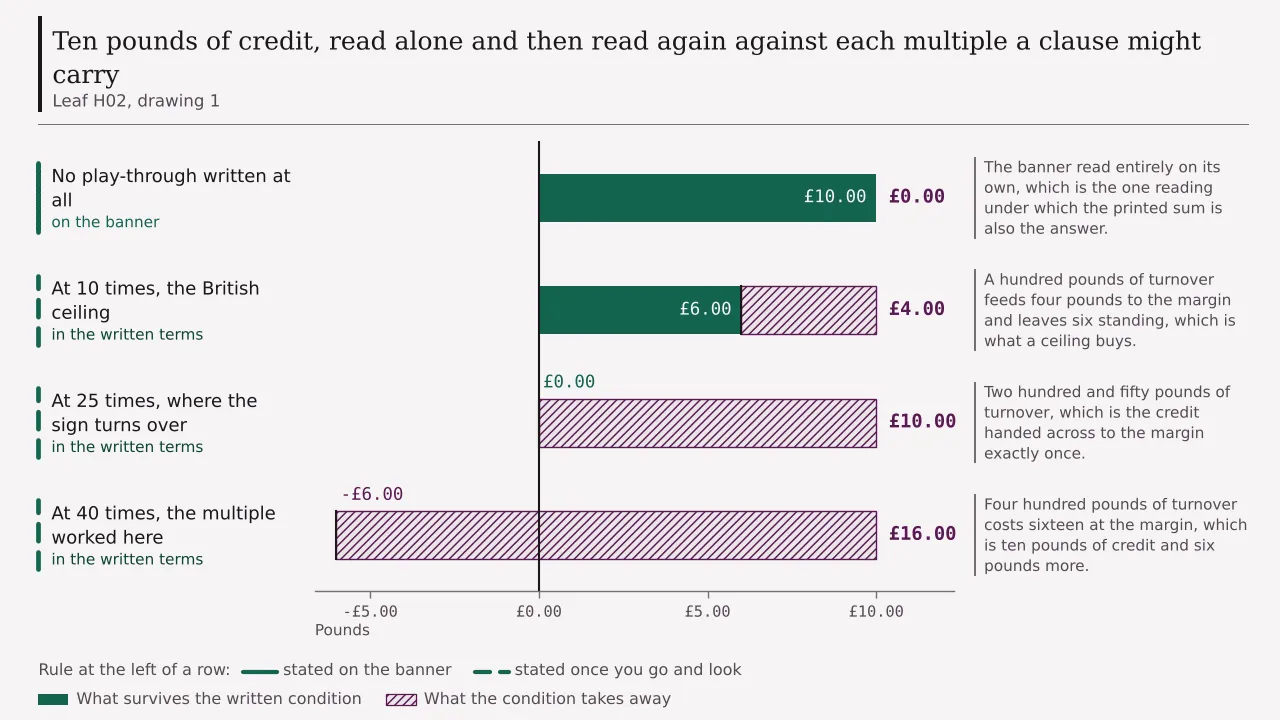
Reading the ladder downwards gives the honest summary of a money headline. The top rung stands where the banner says it stands, each unit added to the multiple costs forty pence, the rung at twenty-five lands on nought, and the one below it does not reach the rule at all. Nothing about that descent shows on the advertisement, and the descent is the only part of the arithmetic that decides anything.
4
Where the two headline shapes stop differing
Six places exist where a term can be settled, and a comparison between two headline shapes is really a comparison of what sits at each. Having established that a money headline delivers one quantity and a count headline delivers none, the next question is how far that difference travels. The answer is that it travels nowhere at all. Past the banner the two shapes are the same object.
| Where a term is settled | A headline printing a count | A headline printing a sum |
|---|---|---|
| A quantity of events, unpriced | A quantity of pounds | |
| in the terms | Multiple, window, stake ceiling, win ceiling | Multiple, window, stake ceiling, win ceiling |
| in the public register | Who holds a licence, for what, at which domains | Who holds a licence, for what, at which domains |
| at the cashier | Exit floor, permitted routes out | Exit floor, permitted routes out |
| on the way out | Documents, source of funds, a hold | Documents, source of funds, a hold |
| nowhere in writing | Press value, contribution rate, swing profile | Contribution rate, swing profile |
Set the banner aside, since the banner is the thing being compared rather than a point of difference, and five addresses remain. The middle four are identical line for line. The last one differs by a single entry. That is the exact sense in which the two shapes differ in one place and agree in the other four, and it is a statement about the structure of an offer rather than a turn of phrase.
Notice where the difference actually lives, because it is not where it appears. It looks like a difference at the banner, since that is where a reader sees it. It is in fact a difference at the sixth address: a money headline leaves one fewer item sitting in the place with no address. The banner is where the change becomes visible; the unwritten pile is where the change happens.
That matters for anyone generalising from this leaf. Improving a headline by printing a sum does not move a term from a distant address to a near one. It deletes a term from the unwritten pile altogether, by making one of its members unnecessary. A press value is not published anywhere when the headline is a sum either; it has simply stopped being needed, because the base it would have produced has been supplied directly.
The second half of that observation is the uncomfortable one. Everything else in the unwritten pile survives intact. A contribution rate below a pound in the pound multiplies the obligation on a money headline exactly as it does on a count, and no published source gives a current figure for it. A swing profile decides whether the balance survives long enough to matter, and no published source gives that either.
Work the contribution rate through and the point stops being abstract. A thirty per cent rate appears on the regulator’s consultation page, quoted there from a respondent rather than asserted by the regulator, and everything after it belongs to this leaf. Forty over a ten pound credit demands £400.00 of contribution; at thirty pence credited per pound staked, reaching that takes £1,333.33 across the reels. Expected close drops from minus £6.00 to minus £43.33, with the banner unchanged at ten pounds.
5
Twenty-four pence between a sum and a count
The two shapes can be run against each other properly, which is a better test than arguing about which reads more clearly. Take a hundred presses at the ten pence this site assumes, and take ten pounds of credit, and put both through the identical clause. The first produces expected winnings of £9.60 as its base. The second has a base of £10.00 handed to it. Forty times each, at the same margin, and the two close at minus £5.76 and minus £6.00.
Twenty-four pence separates them. Two headlines, one of which a reader could work with immediately and one of which they could not, arrive within a quarter of a pound of each other after the clause has done its work. The computable headline is worth fractionally less, because its base is forty pence larger and the clause takes four hundredths of everything it touches.
| Quantity | A hundred presses at 10p | Ten pounds of credit |
|---|---|---|
| Settled before any click | A count, no unit | £10.00 |
| Base the clause attaches to | £9.60 | £10.00 |
| Turnover demanded at forty times | £384.00 | £400.00 |
| Expected cost of the clause | £15.36 | £16.00 |
| Expected at the close | minus £5.76 | minus £6.00 |
There is a tidy relationship hiding inside those two columns and it runs the wrong way round. A ten pound base is forty pence larger than a £9.60 base, and that extra forty pence attracts £1.60 of extra turnover at forty times, costing an extra sixty-four pence at the margin. Subtract and the bigger base closes twenty-four pence worse. Past a multiple of twenty-five, every additional pound of base makes the offer sixty pence worse rather than better, which is the whole arithmetic of a headline that grows while the clause stands still.
So the whole benefit of a computable headline is realised before the terms are opened and has been spent by the time they close. It buys an entry point. It buys the ability to begin. It does not move the destination by any amount a reader would notice, because the destination is fixed by a multiple neither headline prints.
Running the comparison backwards gives a figure worth keeping. For a hundred presses to be worth exactly as much as a ten pound credit, each press would have to be worth 10.42p, since a hundred of them at that value return ten pounds at a 96 per cent rate. A press is not priced in fractions of a penny, so the two headline shapes are never quite the same offer even when they are advertised as though they were.
None of this makes a money headline worse than a count. It makes it better in exactly one respect and identical in the rest, which is a narrower claim than the one usually made for it. A reader who wants to know whether to bother can get further faster with a sum. A reader who wants to know what the offer is worth has to open the same document in both cases, and the document is where the answer has always lived.
6
Which side of twenty-five a reader is standing on
At a multiple of twenty-five a credit is expected to have paid for itself down to the penny. The figure is arithmetic and not market practice, being one divided by the four hundredths the reels retain. Under it, something is expected to remain when the turnover is finished. Over it, the clause demands more margin than the credit holds, and the shortfall is funded from somewhere else.
Of everything on a no-deposit page that threshold is the item most worth memorising, and here comes the awkward part. A printed sum says nothing whatever about which side of it an offer falls on. Ten pounds sits equally comfortably beside ten times and beside sixty. Whatever decides the sign is the figure the banner omitted, and no amount of arithmetic on the ten will recover it.
Hold the credit steady and the sign is a function of the multiple alone. Every unit added to the multiple costs forty pence of expected close on a ten pound credit, four hundredths of ten, constant the whole way along. From ten times to forty is thirty units, which is twelve pounds. From forty to sixty is twenty units, which is eight more. A reader who knows the credit and not the multiple knows the slope and not the position.
Because the slope is constant, the arithmetic can be inverted into something a reader can actually use at a glance. Divide the credit by forty pence and the result is the number of multiple-units the credit can absorb before nothing is expected to be left, which for ten pounds is twenty-five units. The threshold is not a rule of thumb. It falls out of the margin and nothing else, and it is the same twenty-five for every credit at this return.
One consequence runs against intuition and deserves printing. A larger credit does not improve the position, because the threshold does not move. Twenty pounds at forty times closes at minus £12.00 and fifty pounds at forty times closes at minus £30.00, both of them fifteen units past the break-even and both of them worth nothing. Size scales the loss. It never changes the sign.
The relation inverts neatly where a reader wants a target rather than a verdict. For a ten pound credit to be worth a five pound note at the close, the bracket has to equal a half, which puts the multiple at twelve and a half. For it to be worth two pounds the multiple has to stop at twenty. Neither of those is a number a terms document out here commonly carries, and both are easy to test against one the moment it is found.
So the useful reading of a money headline has two steps and only one of them involves the money. Read the sum as a ceiling. Then find the multiple, because the multiple alone decides whether the ceiling is approached or crossed. A reader who has the sum and not the multiple has the less important of the two figures, which is a strange thing to say about the only number anybody is shown.
7
A credit of ten pounds is not ten pounds
A money headline invites one further mistake that a count never does, and it is worth separating from everything above. Pounds of credit and pounds in an account read the same on a screen and behave nothing alike. The first can be staked and cannot be requested back. The second can be requested back and carries no obligation of its own. Only the first is what a no-deposit headline hands over.
Several clauses turn on that distinction and they are the ones most often misread. A ceiling written over a bonus balance is a separate instrument from one written over a deposit balance, and somebody who has sent nothing in holds no deposit balance for the second to govern at all. A clause turning winnings back into credit, where such a clause exists, keeps the obligation alive past the point a reader supposed it had finished.
Expiry acts on a credit and has nowhere to act on a payment. A seven-day window on a £400.00 turnover means £57.14 of staking a day, every day, which on a ten pence press is 571 presses daily. Where the window is three days the same obligation becomes £133.33 a day. Neither figure is on a banner, and the window is the quietest of the clauses because it changes no number in the arithmetic and simply makes the arithmetic unreachable.
A cap on the size of any single stake taken while credit is live behaves differently again. Its only job is to stop a long obligation being squeezed into a short one by pressing larger buttons, and what enforces it is ordinarily forfeiture rather than a refusal at the moment of the press. That makes it the one clause on a money headline whose breach works backwards, reaching across turnover already finished.
Pricing the forfeiture risk honestly means refusing to invent a probability, so this leaf prices its ceiling instead. The most a forfeiture clause can take is everything standing at the moment it bites, which on a £10 credit at forty times is anything up to the full balance including whatever the run was ahead by. Its expected cost cannot be derived from anything published at all, and the correct move is to record the gap rather than fill it.
None of these clauses is unusual and none of them is hidden in any sinister sense. They are written down, in a document, in ordinary language. They are simply written down at an address the advertisement does not reach, and a reader holding a computable figure may feel less need to travel there than a reader holding a count they cannot use at all.
8
A ceiling on the multiple, and the twelve pounds it is worth
Suppose the identical ten pound headline had gone out under a British licence. Ten times the credit is as far as the multiple could then have been taken, that ceiling being item three on a short list of things provision 5.1.1 of the code on social responsibility puts out of bounds. Biting started on 19 January 2026. Among operating licences the exceptions number two, the technical sort and the software sort. Ten lots of ten pounds send £100.00 over the reels, feed £4.00 to the margin, and leave £6.00 expected at the close.
Set that beside the minus £6.00 computed in part three and the licence prices itself at £12.00 on this headline. Nothing else in the offer has been changed to produce the difference. The credit is the same ten pounds, the margin is the same four hundredths, the reader is the same reader. One number in one clause moves, and a figure that was negative becomes positive.
The reason published for writing that ceiling carries the only market multiple in this whole subject with a regulator standing behind it. Up to sixty times was what the regulator recorded some licensees then asking. Sixty over a ten pound credit puts £600.00 across the reels for an expected minus £14.00. From the ceiling to that practice is £20.00 of swing on a banner advertising ten, and removing the swing is what the ceiling was for.
A money headline of this build carries no Great Britain licence, so the ceiling is absent and the multiple is whatever a terms document says it is. The duties worth naming on this subject are the ones that govern how large an obligation may be and what may be done to the credit once it exists. Duties about where a condition must be printed are real and bite elsewhere; here the question is the size of the number.
Three of them are worth setting out. There is the ceiling itself, which limits the multiple and leaves every other term untouched; what a multiple measures is the total staking owed before a balance may leave, and the cap fixes the largest number that total can be built from. There is a companion rule starting the same day, which stops a single incentive reaching across more than one product type. And there is an enforcement outcome on what may be done to a credit after the event, which is the sharpest of the three.
One carve-out in that product rule speaks straight to a headline printed in money. Spendable-anywhere credit falls outside the ban altogether, and the worked instance published beside the rule gives ten pounds that works on betting and on casino alike. The shape this leaf examines is therefore the shape the rule was drafted to leave alone, which is worth establishing before anybody assumes a licence would have rebuilt the offer.
The enforcement outcome is the one to carry away. Dated 3 July 2025, a published penalty of £170,000 attached to one sentence in a set of bonus rules covering new casino promotions. That sentence held in reserve a power to close accounts or withhold winnings. Under the heading of fair and open dealing a licence asks for better, and what the regulator printed beside the figure was that terms drafted this way fall short of transparency and can land a customer with an unfair result. The published outcome is a fine on a licence holder. Nothing published declared the sentence void, and no such claim is entered here.
So there is a published price on the exact clause part seven could not price from the inside. Of everything written into a no-deposit offer’s conditions, a discretionary forfeiture term is the one item carrying an enforcement figure, and the figure reads £170,000. Where nobody holds a licence there is no condition to breach, nobody to find a breach, and the clause simply runs.
One limit on the ceiling is published and should travel with it. The cap is drafted over bonus funds, and whether a requirement reaching a deposit as well as a credit falls inside it has not been addressed anywhere a reader could look up. A credit on a no-deposit headline has no deposit beside it, so the question does not arise here, and the silence gets reported rather than filled.
9
What to do with a headline printed in money
Four moves exhaust the useful reading of a sum on a banner, and they take about two minutes. Treat the figure as a ceiling. Find the multiple. Divide the figure by four hundredths of itself to locate the threshold. Then compare the multiple against the threshold and read the sign off the comparison.
Move one is the discipline that does most of the work. Ten pounds is the most the offer can ever be worth, and the most is not the expectation. Writing the figure down with the word ceiling beside it keeps a reader from doing the thing the layout encourages, which is to carry a number forward as though a condition had already been applied to it.
Move two is a search rather than a calculation and it is the only step that needs leaving the advertisement. The multiple is written down somewhere; it always is, because an obligation nobody wrote cannot be enforced. Where it sits one click away, the search takes seconds. Where it sits behind a second document, a reader has to decide whether the offer is worth that, which is itself a useful question.
Move three never changes and can be memorised. At a return of 96 in the hundred the threshold is twenty-five, for every credit of every size. A reader who has met that number once need not compute it again, and a reader who has not can derive it from the margin in a single division.
Move four is the comparison, and what it yields is a sign rather than a sum, which is about the right precision for a decision taken standing up. Beneath twenty-five, something is expected to remain. Past it, nothing is. Distance from the threshold then supplies the magnitude, four hundredths of the credit per unit, which on ten pounds is forty pence apiece.
Two cautions keep the method from overstating itself. Everything above assumes a contribution of a pound per pound staked, and a lower rate divides into the whole calculation, which part four priced at minus £43.33 on a thirty per cent rate. An expected close also averages over a great many attempts and predicts nothing about a single one, so somebody meeting a floor at the cashier or a demand for documents at the exit may never arrive at the arithmetic at all.
Applied to the wider family, the method keeps its shape and swaps its contents. A count headline wants a press value imported before move one can start. A percentage headline wants a payment before any credit exists to measure. A headline printed in money is the one shape where move one costs nothing, and that single free move is the entire dividend of a banner printed in money rather than in events.
Questions
- What does £10 of no deposit credit come to after the wagering?
- Ten pounds is the ceiling and minus £6.00 is the expectation at the multiple used here. Forty over a ten pound credit demands £400.00 across the reels, of which four hundredths stays behind as margin, so the clause costs an expected £16.00 against a credit of ten. Both figures are correct, and only the second describes what somebody would actually be holding.
- Why is a money headline easier to work with than a count of spins?
- Because it settles one of the two quantities the arithmetic needs. Expected cash at the close is a base multiplied by a bracket built from the multiple and the margin. A sum supplies the base at the banner. A count supplies neither the base nor the press value that would produce it, since no primary source defines what a press is worth. One unknown rather than two is a change of dimension, not a change of presentation.
- Does a printed sum tell me whether the offer clears?
- No, and that is the limit worth knowing. The published figure fixes an upper bound, because the bracket in the arithmetic can never exceed one and reaches one only where there is no obligation at all. Nothing in the banner puts any floor underneath, so the expected close can fall without limit as the multiple climbs. Ten pounds is a ceiling the advertisement can prove and a floor it cannot.
- Where do a spin count and a money headline stop differing?
- Immediately past the banner. Written terms, public register, payment screen and exit carry the identical items on both shapes, line for line. The one address that differs is the unwritten one, where a count leaves a press value that a sum does not need. So the difference looks like a difference at the banner and is really a difference in the pile of things nobody writes down.
- How far apart are a hundred spins and a ten pound credit at the close?
- Twenty-four pence. A hundred presses at ten pence come back with an expected £9.60, and forty over that base wants £384.00 across the reels, which costs £15.36 and closes at minus £5.76. A ten pound credit under the identical clause wants £400.00, costs £16.00 and closes at minus £6.00. Making the two worth precisely the same would need a press priced at 10.42p, and presses are not priced in fractions of a penny.
- What multiple does a £10 credit have to beat to be worth anything?
- Twenty-five, that being one divided by the four hundredths retained at a 96 per cent return. Underneath it a balance is expected to come through the clause with something on it; exactly at it the credit is expected to have paid for itself to the penny; beyond it the demand for margin exceeds what the credit contains. That same twenty-five belongs to a credit of any size, so a larger headline multiplies the loss and never alters the sign.
- Is ten pounds of credit the same as ten pounds in the account?
- No, and the screen does not distinguish them. A credit can be staked and cannot be asked for back, and it carries an obligation of £400.00 at the multiple used here. Money sent from a bank can be asked for back and carries no obligation of its own. A no-deposit headline hands over the first kind only, which is why a ceiling written over a bonus balance and a ceiling written over a deposit balance are separate instruments.
- What would a British licence have done to the multiple?
- Held it to ten times the credit. That ceiling is limb three of social responsibility code 5.1.1, biting from 19 January 2026, and the operating licences outside it are the technical sort and the software sort. Ten lots of ten pounds send £100.00 over the reels, feed £4.00 to the margin and leave £6.00 expected. Against the minus £6.00 at forty times, a licence prices itself at £12.00 on this headline. A money headline of this build carries no Great Britain licence, so nothing holds the multiple down.
- Can an operator take a credit back after it has been played?
- That shape of term is the only item in a no-deposit offer’s conditions carrying a published enforcement figure. Against a date of 3 July 2025 stands a sum of £170,000, levied over a bonus rule that held in reserve a power to close an account or withhold winnings. Named in the finding was the licence condition covering fair and open dealing, and wording of that build was called short of transparency. What got published is a fine on a licence holder rather than a sentence struck down, and this leaf claims nothing beyond that.