Terms read 19 October 2026 Leaf H06, revision 1
20 free no deposit casino: a true claim with nothing at the end of it
Twenty pounds turned over forty times wants £800.00 across the reels and closes at an expected minus £12.00. What is left then meets the smallest sum a payment screen is willing to send, a figure printed in no document anybody can open beforehand. Every word of the advertisement survives this leaf intact.
Stated on the banner £20.00 A sum in sterling, accurate, and the largest figure this offer will ever be worth. Stated, once you go and look £32.00 of cost Twenty pounds turned over forty times wants £800.00 of staking, and the margin keeps four pence of each pound, so the account closes an expected twelve pounds under nought. Not stated before the money goes in Just one figure The smallest sum the payment screen will move, which decides the whole offer and appears for the first time once an account already exists.
Small-face offers of this build, with their terms read
Every destination in this file is bought advertising. The site is paid a fee if a reader goes on to register, and no figure printed below moves because of it.
Bonus Spins UK Slip 01
Betportal
Ceiling as a multiple
The drop
€15.00
€1.00 in the euro
The claim reads €15.00. Once the terms beside it have applied, €0.00 of it can leave. The difference is the drop.
7 of the 15 terms on this slip could not be read before the money went in
Spins priced at this site's own 10p a spin, which the operator does not publish
Stated
€15.00
The claim as it is printed, before a single term has been applied to it.
Headline paid as spins
150 spins at 10c each, which is €15.00 of the figure above.
6 Nowhere
What one spin is worth
No unit is published for a spin, so the count is priced at this site's own 10p a spin. At half that price every figure below halves with it.
Match and other credit not priced
300% of three deposits, to a ceiling of €1,000. A share of a deposit nobody has made yet is not a sum, so no figure stands on this line and none is carried below.
Qualified
-€14.40
Written down somewhere, and taking part of the claim back. Each term carries the place it is written and the sum it takes.
2 Written terms at a distance this record does not establish
Play-through -€14.40
Carrying €14.40 through 35 times stakes €504.00 and costs €20.16 of it at 96 per cent return. That prices above the €14.40 there is to charge it against, so the whole of the credit goes and the line is held at that. The multiple sits on the bonus.
2 Written terms at a distance this record does not establish
Game weighting not priced
Slots only count towards the play-through. No contribution percentage is published, so the line above has been worked at full weight, which is the kindest reading there is.
2 Written terms at a distance this record does not establish
Ceiling on the winnings not priced
5x the bonus.
2 Written terms at a distance this record does not establish
Clock on the credit not priced
14 days.
2 Written terms at a distance this record does not establish
Largest stake while it runs not priced
€5.
3 Public record
Licence, and who holds it not priced
Licensed in Anjouan, Comoros, held by BetPortal Gaming Ltd, with Excite Ultra Media Ltd, reference ALSI-202601040-FI2. A register entry settles who holds a licence and what it permits. It does not settle who is running the site this morning.
4 Cashier
Smallest qualifying deposit your money
€20 a stage. That is €20.00 of your own money, and it is never netted into a drop.
5 On the way out
Checks before a withdrawal not priced
Documents before the first withdrawal.
Unstated
-€0.60
Applying without having been published anywhere, and costing money all the same.
6 Nowhere
What a spin hands back -€0.60
Staking a spin returns 96 per cent of it, so that share of the batch is the house's before a reel turns. This site works at that return and the operator publishes none where the claim is made.
6 Nowhere
Forfeited by rule cost unknown
Nothing is published under this heading, and it applies regardless.
6 Nowhere
Charge on the way out cost unknown
No charge on the way out is published as a figure, so nothing comes off this line. A charge that exists unpublished would come straight off whatever survives.
6 Nowhere
Smallest withdrawal allowed cost unknown
No smallest withdrawal is published as a figure. A floor nobody has published is still a floor, and it decides whether a small balance can move at all.
No Great Britain licence
Terms read 19 October 2026
Bonus Spins UK Slip 02
WinBeast
Ceiling as a sum
The drop
€50.00
€1.00 in the euro
The claim reads €50.00. Once the terms beside it have applied, €0.00 of it can leave. The difference is the drop.
8 of the 15 terms on this slip could not be read before the money went in
Spins priced at this site's own 10p a spin, which the operator does not publish
Stated
€50.00
The claim as it is printed, before a single term has been applied to it.
Headline paid as spins
500 spins at 10c each, which is €50.00 of the figure above.
6 Nowhere
What one spin is worth
No unit is published for a spin, so the count is priced at this site's own 10p a spin. At half that price every figure below halves with it.
Match and other credit not priced
50% to 100% of five deposits, each to a ceiling of €1,000, and a €650 free bet. A share of a deposit nobody has made yet is not a sum, so no figure stands on this line and none is carried below.
Qualified
-€48.00
Written down somewhere, and taking part of the claim back. Each term carries the place it is written and the sum it takes.
2 Written terms at a distance this record does not establish
Play-through -€48.00
Carrying €48.00 through 40 times stakes €1,920.00 and costs €76.80 of it at 96 per cent return. That prices above the €48.00 there is to charge it against, so the whole of the credit goes and the line is held at that. The multiple sits on the bonus and the winnings from the spins.
2 Written terms at a distance this record does not establish
Game weighting not priced
Slots, titles vary by country count towards the play-through. No contribution percentage is published, so the line above has been worked at full weight, which is the kindest reading there is.
2 Written terms at a distance this record does not establish
Ceiling on the winnings not priced
€100 a batch of spins.
2 Written terms at a distance this record does not establish
Clock on the credit not priced
7 days, spins 1 day.
3 Public record
Licence, and who holds it not priced
Licensed in Curaçao, holder not named on the site. A register entry settles who holds a licence and what it permits. It does not settle who is running the site this morning.
4 Cashier
Smallest qualifying deposit your money
€20 a stage. That is €20.00 of your own money, and it is never netted into a drop.
5 On the way out
Checks before a withdrawal not priced
Documents before the first withdrawal.
Unstated
-€2.00
Applying without having been published anywhere, and costing money all the same.
6 Nowhere
What a spin hands back -€2.00
Staking a spin returns 96 per cent of it, so that share of the batch is the house's before a reel turns. This site works at that return and the operator publishes none where the claim is made.
6 Nowhere
Largest stake while it runs cost unknown
Nothing is published under this heading, and it applies regardless.
6 Nowhere
Forfeited by rule cost unknown
Nothing is published under this heading, and it applies regardless.
6 Nowhere
Charge on the way out cost unknown
No charge on the way out is published as a figure, so nothing comes off this line. A charge that exists unpublished would come straight off whatever survives.
6 Nowhere
Smallest withdrawal allowed cost unknown
No smallest withdrawal is published as a figure. A floor nobody has published is still a floor, and it decides whether a small balance can move at all.
No Great Britain licence
Terms read 19 October 2026
Bonus Spins UK Slip 03
EliteSpin
Longest spin window
The drop
£50.00
£1.00 in the pound
The claim reads £50.00. Once the terms beside it have applied, £0.00 of it can leave. The difference is the drop.
8 of the 15 terms on this slip could not be read before the money went in
Spins priced at this site's own 10p a spin, which the operator does not publish
Stated
£50.00
The claim as it is printed, before a single term has been applied to it.
Headline paid as spins
500 spins at 10p each, which is £50.00 of the figure above.
6 Nowhere
What one spin is worth
No unit is published for a spin, so the count is priced at this site's own 10p a spin. At half that price every figure below halves with it.
Match and other credit not priced
50% to 100% of five deposits, each to a ceiling of £1,000. A share of a deposit nobody has made yet is not a sum, so no figure stands on this line and none is carried below.
Qualified
-£48.00
Written down somewhere, and taking part of the claim back. Each term carries the place it is written and the sum it takes.
2 Written terms at a distance this record does not establish
Play-through -£48.00
Carrying £48.00 through 40 times stakes £1,920.00 and costs £76.80 of it at 96 per cent return. That prices above the £48.00 there is to charge it against, so the whole of the credit goes and the line is held at that. The multiple sits on the bonus and the winnings from the spins.
2 Written terms at a distance this record does not establish
Game weighting not priced
Slots count towards the play-through. No contribution percentage is published, so the line above has been worked at full weight, which is the kindest reading there is.
2 Written terms at a distance this record does not establish
Ceiling on the winnings not priced
5x the bonus.
2 Written terms at a distance this record does not establish
Clock on the credit not priced
7 days, spins 3 days.
3 Public record
Licence, and who holds it not priced
Licensed in Costa Rica, held by PrimeTier Limited. A register entry settles who holds a licence and what it permits. It does not settle who is running the site this morning.
4 Cashier
Smallest qualifying deposit your money
£20 a stage. That is £20.00 of your own money, and it is never netted into a drop.
5 On the way out
Checks before a withdrawal not priced
Documents before the first withdrawal.
Unstated
-£2.00
Applying without having been published anywhere, and costing money all the same.
6 Nowhere
What a spin hands back -£2.00
Staking a spin returns 96 per cent of it, so that share of the batch is the house's before a reel turns. This site works at that return and the operator publishes none where the claim is made.
6 Nowhere
Largest stake while it runs cost unknown
Nothing is published under this heading, and it applies regardless.
6 Nowhere
Forfeited by rule cost unknown
Nothing is published under this heading, and it applies regardless.
6 Nowhere
Charge on the way out cost unknown
No charge on the way out is published as a figure, so nothing comes off this line. A charge that exists unpublished would come straight off whatever survives.
6 Nowhere
Smallest withdrawal allowed cost unknown
No smallest withdrawal is published as a figure. A floor nobody has published is still a floor, and it decides whether a small balance can move at all.
No Great Britain licence
Terms read 19 October 2026
Bonus Spins UK Slip 04
Crown Jewelz
Multiple unpublished
The drop
NOT WORKED
The multiple is not published in the operator's own terms. Since the sum cannot be worked around it, none is worked.
9 of the 14 terms on this slip could not be read before the money went in
No drop worked
Stated
£15.00
The claim as it is printed, before a single term has been applied to it.
Headline paid as spins
150 spins at 10p each, which is £15.00 of the figure above.
6 Nowhere
What one spin is worth
No unit is published for a spin, so the count is priced at this site's own 10p a spin. At half that price every figure below halves with it.
Match and other credit not priced
200% of the first deposit, then 150% twice, each to a ceiling of £1,000. A share of a deposit nobody has made yet is not a sum, so no figure stands on this line and none is carried below.
Qualified
NOT WORKED
Written down somewhere, and taking part of the claim back. Each term carries the place it is written and the sum it takes.
2 Written terms at a distance this record does not establish
Play-through not priced
40x the bonus, reported rather than published by the operator.
2 Written terms at a distance this record does not establish
Game weighting not priced
Slots count towards the play-through. No contribution percentage is published, so the line above has been worked at full weight, which is the kindest reading there is.
3 Public record
Licence, and who holds it not priced
Licensed in Curaçao, number not verified, holder not named on the site. A register entry settles who holds a licence and what it permits. It does not settle who is running the site this morning.
4 Cashier
Smallest qualifying deposit your money
£20. That is £20.00 of your own money, and it is never netted into a drop.
5 On the way out
Checks before a withdrawal not priced
Documents before the first withdrawal.
Unstated
NOT WORKED
Applying without having been published anywhere, and costing money all the same.
6 Nowhere
Ceiling on the winnings cost unknown
No ceiling is published. Nothing is assumed in its place.
6 Nowhere
Clock on the credit cost unknown
Nothing is published under this heading, and it applies regardless.
6 Nowhere
Largest stake while it runs cost unknown
Nothing is published under this heading, and it applies regardless.
6 Nowhere
Forfeited by rule cost unknown
Nothing is published under this heading, and it applies regardless.
6 Nowhere
Charge on the way out cost unknown
No charge on the way out is published as a figure, so nothing comes off this line. A charge that exists unpublished would come straight off whatever survives.
6 Nowhere
Smallest withdrawal allowed cost unknown
No smallest withdrawal is published as a figure. A floor nobody has published is still a floor, and it decides whether a small balance can move at all.
No Great Britain licence
Terms read 19 October 2026
Every figure in the second and third columns is this site's own working and nothing an operator has published. A claim is priced as printed, then the share a spin hands back at 96 per cent return comes off it, then what playing the multiple through costs at the same return, and then whatever a published ceiling, a charge on the way out or a floor on the smallest withdrawal takes from what has survived. The drop is the difference between the first figure and the last. The two columns add back up to it exactly, so no money leaves a slip without a term and a place beside it.
Which column a term falls in is settled by one question: has anybody written it down. A charge a reader meets at the payment screen is written down, and it stands in the second column with the cashier against it. A condition that binds without ever having been set down stands in the third, whatever it costs. Inside each column the terms run outwards from the banner, so the order itself says how far a reader would have had to go.
A count of spins has no unit until one is supplied. Where an operator publishes what one of its own spins is worth, that figure is used and the first column says it is theirs. Where none is published, this site's own 10p a spin stands in its place and every figure below moves in proportion with it. Where the multiple itself is unpublished, no drop is worked at all, because that is the one figure the sum cannot be done without.
Three words stand where a figure cannot. Not priced is a term that is written down and carries no number the arithmetic can take. Cost unknown is a term nobody has written down, costing something nobody has put a number on. Your money is money of the reader's own, which is never netted into a drop.
None of the operators in this file holds a Great Britain licence, so none of the duties that licence carries reaches them. Each of those duties is published in its own right, which is what makes its absence here something a reader can check rather than take on trust. Every gambling company licensed in Great Britain belongs to Gamstop Online, so a reader who has shut themselves out through the scheme is not shut out here. Social Responsibility Code 5.1.1 has held a play-through to a maximum of ten times the bonus funds since 19 January 2026, and it binds a licence holder and nobody else. Asked in a post of 21 October 2025 what is lost along with the licence, the Gambling Commission's Director of Enforcement and Intelligence answered: "unfair gaming practices, financial loss, and a lack of recourse if things go wrong". The same post puts blocked payouts, and withdrawal limits pitched high enough to be unreachable, among the behaviour the Commission has recorded. Nobody under 18 may hold an account at any of them.
Terms are reproduced in the wording their operator published, and each slip is dated with the day somebody sat down and read them. 19 October 2026 is the oldest of those dates. Anybody claiming an offer is bound by that operator's full terms, which are elsewhere, and never by a line standing here.
1
What twenty pounds states, and what it stops short of
A sum in sterling is published and nothing further. stand a currency sign, two digits and a denial that any payment is wanted. Those three settle the size of the credit, settle the unit it is measured in, and settle the price of entry at nought. On a figure this small those are useful things to have settled, and they are also the end of what the advertisement does.
Everything deciding what twenty pounds becomes is kept elsewhere, and the places have different owners. A multiple and a window belong to whoever drafted the bonus conditions. A ceiling on a single press while credit is live belongs to a second document behind the first. The smallest sum that may leave belongs to a payment screen that cannot be looked at until an account has been opened in somebody’s name.
This leaf is about the last of those, because on a face of twenty pounds it is the term that decides the outcome, and it is the one term no amount of diligence reaches in advance. A reader who opens every document the operator publishes, reads each line of it and takes notes will still not know the figure, since the figure was never in a document.
Start from the most generous reading available. Suppose no multiple at all, no window, no ceiling on a press, nothing. Twenty pounds of credit staked once and then requested comes to £20.00, which is the upper bound of the offer and an honest reading of the banner read entirely on its own. No arrangement of conditions can push the figure above that, because the bracket the house arithmetic multiplies a base by can never exceed one.
Now suppose a payment screen that will not move anything under twenty pounds. That minimum is this leaf’s own supposition, carried in to make the working concrete, and no rule mentioned anywhere here publishes such a number. Against it, the best possible reading of the offer meets the exit with a margin of exactly nothing. The claim and the floor are the same number, so the offer is on the boundary before a single condition has been applied.
From there the arithmetic can only go one way. Any condition whatever, of any size, drops the expected balance under twenty pounds, and a balance sitting below the line is worth nothing at the exit no matter how narrowly it fell short. That is the whole leaf compressed into one paragraph, and everything after it shows the working.
2
Eight hundred pounds of turnover behind a small face
Forty is the multiple this leaf works to, being the band an offshore conditions document prints when it prints one. Forty lots of twenty pounds come to £800.00 that has to pass over the reels before the balance may be asked for. Cut that into ten penny presses and 8,000 of them appear, each one an individual decision somebody has to make.
What the turnover costs is fixed and small per press and large in total. A return of 96 in the hundred leaves four pence of every pound behind, so £800.00 of staking feeds £32.00 to the margin. Twenty pounds of credit against thirty-two pounds of expected cost gives an expected close of minus £12.00, with weighting held at one throughout so that nothing hides inside it.
The face, read with nothing applied £20.00 With forty times worked all the way through minus £12.00 What that written condition takes £32.00
Thirty-two pounds can be reached from either end and the agreement is worth watching. Eight hundred pounds of turnover at four hundredths gives thirty-two directly. The distance between the first line of the price block and the second gives thirty-two again. A turnover requirement achieves exactly one thing, the steady conversion of what is staked into margin at a proportion known from the start, which is why the two routes are bound to meet.
£800.00 over the reels before a £20.00 face may be requested at all
Where the sign changes is twenty-five, which is one divided by a margin of four in the hundred and is a fact about the arithmetic rather than about anybody’s drafting. Below that multiple something is expected to survive. Exactly on it, the credit has in expectation gone over to the margin one time and no more. Above it, the condition wants more margin than twenty pounds contains, and whatever is short must be funded out of money this offer never handed over.
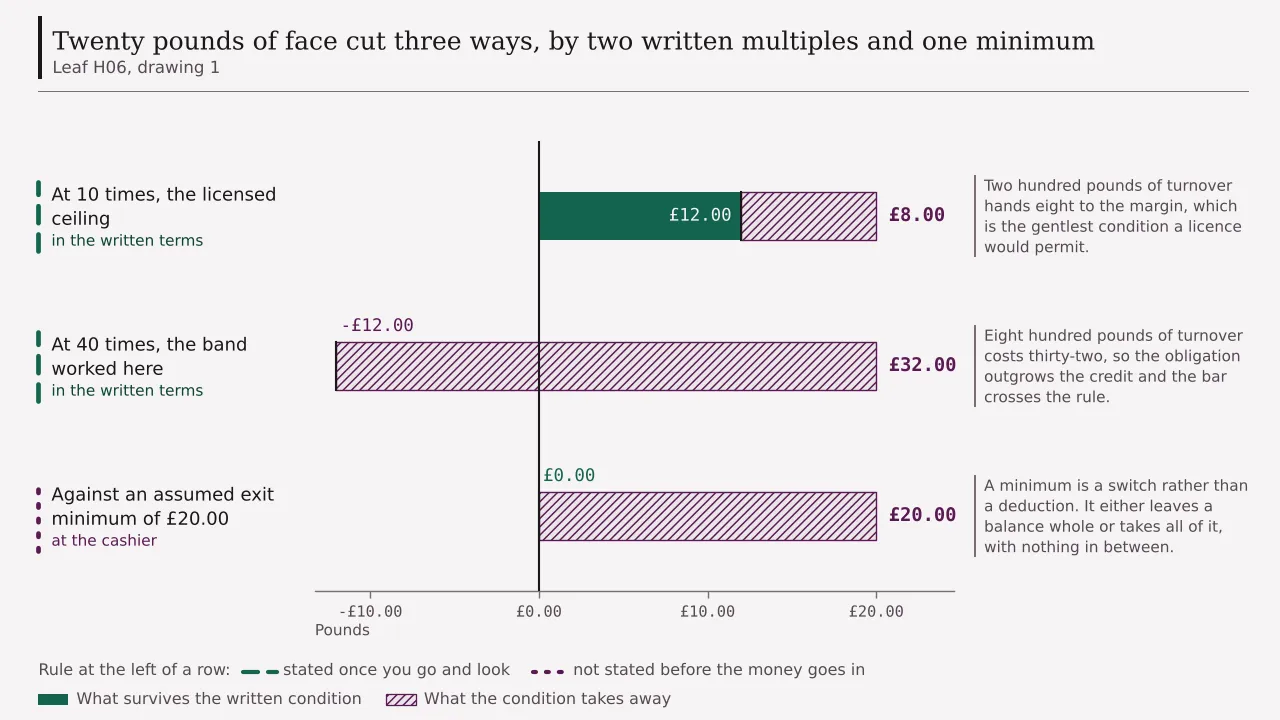
Read the drawing from the top and the two kinds of condition separate themselves. A multiple shortens the bar by an amount that depends on how large the multiple is, so a smaller one leaves more standing. The minimum at the foot does something else entirely: it either leaves the bar alone or removes the whole of it, and nothing in between is available to it.
3
A minimum is a switch and not a discount
The ordinary mental model for a term is that it takes a proportion. A multiple takes a proportion. A charge takes a proportion, or a fixed slice. A game crediting less than a full pound for every pound staked lengthens the work, and the cost with it. Somebody who has met those three naturally expects a withdrawal minimum to behave in the same manner, and it does not.
Set the minimum at twenty pounds, as posited above, and run two balances at it. A balance of £20.00 is worth twenty pounds, in full, with nothing deducted for having only just made it. A balance of £19.99 is worth nought, because the payment screen will not move it, and a sum that cannot be moved is not money the person holding it can spend. One penny of difference in the balance produces twenty pounds of difference in the outcome.
That discontinuity is the reason a small face is a special case rather than a scaled version of a large one. On a face of two hundred pounds the same minimum is a rounding detail, since almost any outcome clears it. On a face of twenty pounds the minimum is the entire question, because the distance between the face and the floor is nil and every condition in the terms moves the balance downwards.
| The multiple written over the credit | Turnover it demands | Expected at the close | Distance under the assumed minimum | What has to happen for the exit to open |
|---|---|---|---|---|
| Nothing asked at all | £0.00 | £20.00 | None | Nothing; the face is level with the minimum |
| Ten times, the ceiling inside a licence | £200.00 | £12.00 | £8.00 | A run eight pounds ahead of expectation |
| Twenty-five times, the reciprocal | £500.00 | £0.00 | £20.00 | A run twenty pounds ahead of expectation |
| Forty times, the band worked here | £800.00 | minus £12.00 | £32.00 | A run thirty-two pounds ahead of expectation |
Read the last column rather than the third and the leaf’s finding becomes visible. The expected close falls steadily as the multiple climbs, which is unremarkable. What the minimum does is convert each of those expected closes into a requirement for an unusually good run, and the size of the run needed grows at exactly the rate the margin takes money away. None of it is concealed. It is merely never totted up anywhere in one place.
One more property of a minimum deserves printing because it runs against intuition. A larger face does not escape it by being larger in proportion. It escapes it by crossing a fixed line, and the line is in pounds rather than in percentages. Two faces separated by a pound can sit on opposite sides of the same minimum and be worth twenty pounds and nothing respectively, which no percentage-based term can ever do.
4
Why reading harder beforehand cannot reach it
Six places exist where a term about an offer can be settled, and the ordering between them is an ordering of commitment rather than of distance. A banner needs nothing. A conditions document needs a click. A public register needs a name and a search. A payment screen needs an account. The way out needs a balance. The sixth place needs nothing because nothing is written there at all.
A withdrawal minimum sits at the cashier, which is the fourth of those, and the consequence is worth stating in its strongest form. No quantity of careful reading performed before registering can establish the figure, since the figure is displayed on a screen that requires an account to reach. Diligence does not help. The ordering is what defeats it, not the effort.
Compare that with the multiple, which is also unstated on the banner and is a wholly different kind of problem. The multiple is written down. It is in a document with an address, published by somebody who intends it to be enforceable, and one click puts it in front of whoever wanted it. Finding it is work. Finding the minimum is not work, it is a sequence that has to be entered.
| The term | Where it is settled | What has to be done first |
|---|---|---|
| The size of the credit | Nothing whatever | |
| The turnover demanded of it | in the bonus terms | One click |
| The period that turnover sits inside | in the bonus terms | One click |
| Who is permitted to run the site | in the public register | A name and a search |
| The smallest sum that may be sent | at the cashier | An account in somebody’s name |
| Any charge taken off the payment | at the cashier | An account in somebody’s name |
| The documents demanded before release | on the way out | A balance worth collecting |
Two rows of that table decide the value of a twenty pound face and both of them sit in the fourth place. That concentration is specific to small faces. On a large face the fourth place contributes a modest charge and a mild inconvenience, and the second place does the arithmetical damage. Here the second place takes the balance below the line and the fourth place decides that being below the line costs everything rather than something.
One caveat keeps this honest. Some operators do publish an exit minimum in the general conditions, where it moves from the fourth place to the second and becomes reachable by reading. Where that happens the complaint in this part falls away entirely and the arithmetic in parts two and three stands unchanged. A reader has no way of knowing in advance which arrangement they are looking at, which is itself a fact about the fourth place.
5
Accurate in every word and worth nothing at the end
It is worth pausing on what has and has not been alleged. Nobody has been accused of printing a false figure. Twenty pounds is twenty pounds. The denial of a payment is accurate, and somebody claiming the offer does receive credit of the stated size without sending anything from a bank. Each sentence of the advertisement would survive a line-by-line examination.
The conditions are equally unremarkable taken one at a time. A multiple is normal. A window is normal. A minimum on what a payment screen will send is normal, and has good operational reasons behind it: moving two pounds costs a payment processor roughly what moving two hundred costs, so a floor is how that cost is kept off the smallest transactions. None of the components is objectionable on its own.
What produces a worthless offer is the combination, and specifically the relationship between two numbers that are set independently by different parts of a business. The face is set by whoever decides what will attract a click. The minimum is set by whoever decides what a payment screen may send. Nothing requires the first to exceed the second by enough to survive the conditions in between, and on a twenty pound face nothing in fact does.
That is the finding this leaf exists to print, and it has a general shape worth carrying away. A claim can be true in every particular and worth nothing in total, provided the term that reduces it to nothing is kept somewhere a reader does not travel to. The usual defence of an advertisement is that each statement in it is accurate. On a small face that defence is complete and entirely beside the point.
Put the two readings beside each other and the gap is the measurement. £20.00 is what the banner supports read alone, and an exit minimum of the same size means that figure is also exactly what the payment screen requires. £0.00 is what an expected balance of minus twelve pounds is worth at that screen. The advertisement is accurate at one end of that sentence and silent at the other.
None of this amounts to saying such an offer should not exist, which is not a question arithmetic settles. It amounts to saying that the figure a reader would act on and the figure the arithmetic supports are twenty pounds apart, and that the term responsible sits in the one place a reader cannot visit before committing their name and their details to a form.
6
What the published withdrawal rule reaches, and what it leaves
Britain does regulate what an operator may do to withdrawals, and the rule turns out to be sharp in one direction and quiet in the other. A ceiling is the thing it forbids. Guidance published by the regulator puts out of bounds any contract term, and any consumer notice, whose object or effect is to cap how much somebody may draw from the balance they paid in themselves. A specimen of exactly that forbidden drafting is printed alongside, capped by the day at fifty pounds and by the week at five hundred.
Three further statements sit on the same page. Money paid in, with winnings on top of it, may be drawn at whatever moment the customer chooses. Restricting the greatest amount available at one time is not permitted. And whatever limit does attach, whether to how large a payment is or to how many are taken, has to be a reasonable one. No publication or revision date appears on the page at all, so it should be cited for what it says and given no freshness it never claimed.
Read that against a minimum and two things follow. The prohibition is written about maxima, so a floor is not the thing it forbids. The requirement of reasonableness does reach a limit on the size of withdrawals, which is language broad enough to touch a minimum, and no published figure or worked example says where reasonable stops. A page that claimed the rule fixes a smallest permitted payment would be inventing one, and this leaf does not.
A second rule bears on the exit from a different angle and is worth putting beside it. Under the standard on responsible product design, once somebody has asked for a payment there must be no option put in front of them to take that request back, and the guidance beside it says the sum under request should not then become available to stake again. The same guidance asks licensees to keep the business of getting money out as free of friction as they can manage.
Frictionless is a word about the journey rather than about the size of the payment, and that is precisely the distinction this leaf needs. A minimum is not friction in that sense. It does not slow a payment down or ask for a further step. It declines the payment, and declining is not on the list of things the standard addresses, nor is it on the list the maximum-withdrawal guidance addresses.
So the published position summarises narrowly. Within a British licence, ceilings on what may be drawn from paid-in money are prohibited, an outstanding payment request may not be handed back for cancelling, and the route out is meant to run as smoothly as the business can arrange. Not one of those three reaches the smallest sum a payment screen is willing to move, and beyond the licence not one of them applies to anything.
7
A balance that cannot move is still somebody’s balance
An amount stranded under a minimum does not evaporate. It sits in an account, visible on a screen, belonging in some sense to the person whose name is on the account and held meanwhile by the business. That raises a question the arithmetic above cannot answer and a British licence answers directly, which is what would happen to it if the business failed.
Anyone licensed to hold a customer’s money owes that customer a written statement of whether it would survive the business going under, how far it would survive, and by what mechanism. Both the ratings and the shape of the statement are prescribed by the regulator rather than chosen. Receipt has to be acknowledged, and nothing may be gambled with until it is, with the statement given on a first payment in and repeated on the first payment after the protection arrangements move.
Four ratings exist and the regulator fixes their names. Two of them open on the words not protected, the first of that pair adding no segregation and the second adding segregation of customer funds. The remaining two read medium protection and high protection. What the regulator has not done, at this stage, is settle the precise form of words in which a business explains whichever rating it carries, so the label is fixed and the explanation around it is the business’s own drafting.
On either of the two unprotected ratings a further obligation runs. Every six months the customer has to be told again that an insolvency would leave the money unprotected, told what is currently being held for them, and asked to acknowledge it before anything more is staked. The paragraph carrying that duty began on 31 October 2025, and the consultation response behind it declined to set any threshold, so a balance of any size attracts the reminder.
A face of this size is advertised from outside the British system by operators holding no Great Britain licence whatsoever, and the chain of disclosure above is what disappears along with it. There is no rating to state. There is no prescribed form to follow. Nothing has to be acknowledged before the money is played with, and no half-yearly notice arrives saying what is being held and how exposed it would be. A stranded balance then sits on terms its holder drafted and nobody examined.
Two companion absences belong next to that one rather than in a list of their own. Being on a public record is the first: a licensed business can be looked up, with its permitted activities beside its name, so a stranded balance at least has a counterparty somebody could write to. Reach of the national scheme for shutting accounts is the second, since that reach is drawn by the British licence and stops where the licence stops.
For anybody registered with Gamstop Online the practical consequence is simple. An offer the scheme cannot reach is out of bounds rather than an exception to be weighed up, the scheme publishes that boundary in its own terms, and the care block closing this leaf points at better destinations than a registration form.
8
Charges and routes, measured against a small sum
Two further things live on a payment screen and both of them are measured as proportions of the balance rather than as absolute amounts, which is why they bite hardest on the smallest faces. The first is a charge taken off the payment. The second is a restriction on which instrument the money may be sent to.
Take a charge of £2.50 on a withdrawal, posited here to show the shape and published in no rule this leaf can point at. Against a balance of exactly twenty pounds that charge is 12.5 per cent of the payment, and it also moves the effective minimum upwards, because a balance now has to reach the floor and carry the charge as well. A reader clearing a twenty pound minimum with twenty pounds exactly would find the payment refused or the balance short.
Against a larger balance the same £2.50 is arithmetically identical and practically trivial. On two hundred pounds it is one and a quarter per cent. The charge has not changed, the offer has not changed, and the proportion has moved by a factor of ten, which is the general property of any fixed cost placed on a variable sum.
The route restriction has no percentage at all and is worse. Where the conditions allow payment only to an instrument that has already sent money in, a balance built from an offer that asked for nothing has no such instrument on record. Resolving that means making a payment, which is the one thing the headline said would not be required, and the sum required may well exceed the balance it is meant to release.
Put all three together on a twenty pound face and the exit has three independent ways of refusing. The minimum refuses a balance that is too small. The charge reduces a balance that only just cleared the minimum. The route restriction refuses a balance with no qualifying instrument behind it. Each is ordinary, each is defensible, and on this face any one of them is sufficient on its own.
A document demand on the way out acts last and acts on whatever survived the other three. Answered, it costs time and nothing else. Left unanswered, it costs whatever was standing, which on the expected figures here is nothing, and which in the one branch where a run went well is the entire amount. Its expected cost is therefore close to nought while its worst case is the lot, and neither of those two sentences contradicts the other.
9
Establishing the minimum before anything else
On a face of this size the order of investigation should be inverted from the usual one. The multiple is the figure everybody looks for and it is not the figure that decides the outcome. Establish the smallest sum the payment screen will send first, because on a small face that number determines whether any of the rest is worth computing.
Three routes exist and they are worth trying in sequence. The general conditions occasionally carry the figure, in which case it has been published and the problem disappears. A help or banking page sometimes carries it as well, and that page can usually be read without an account. Where neither has it, the figure is at the payment screen and nowhere else, and that answer is itself information about how the offer has been arranged.
Once the figure is in hand the test is a single comparison. Take the face, apply the multiple with the house bracket, and ask whether what is expected to survive reaches the minimum. On twenty pounds at forty times the expected survivor is minus twelve, so the comparison fails against a minimum of any size whatsoever, and no further reading is needed.
Where the comparison fails, one honest option remains open and should be stated plainly rather than dressed up. The offer can be taken for what it visibly is, a quantity of play at a price of nothing, with no intention of ever requesting a payment. Everything in this leaf is triggered by the attempt to take money out, and somebody who does not intend to attempt it is unaffected by every word of it.
For anybody else the useful habit is to write the two figures down together and keep them beside one another. The face, and the smallest sum the exit will move. Where the first is not comfortably clear of the second after the conditions have done their work, the arithmetic about multiples is decoration. It describes a balance that the payment screen was never going to send.
The same comparison generalises to any face, and the larger the face the less often it bites, which is the reason this is a leaf about a small one. At two hundred pounds a twenty pound minimum is met by almost any outcome. At twenty pounds it is met by almost none. The term did not change between those two sentences. Only the figure printed on the banner did.
Questions
- What is £20 of no deposit credit worth after wagering?
- An expected minus £12.00 at the multiple this leaf works to. Forty times twenty pounds asks £800.00 across the reels, and a return of 96 in the hundred leaves four pence of every pound behind, so the condition costs an expected £32.00. Twenty pounds against thirty-two pounds of cost closes below nought, and £32.00 is also what separates the first line of the price block from the second.
- Why can a £20 bonus be worth nothing even when every word of it is true?
- Because the term that reduces it to nothing is a minimum rather than a deduction. A payment screen that will not send under twenty pounds pays a balance of £20.00 in full and a balance of £19.99 not at all. The face and the assumed minimum are the same number, so any condition of any size drops the expected balance under the line, and below the line the value is nought however close it came.
- Where does the withdrawal minimum appear?
- At the cashier, which means on a payment screen reached only once an account exists. That is the fourth of the six places a term can be settled, and the consequence is that no amount of reading done beforehand reaches the figure. The multiple is a different kind of problem: it is written in a document with an address, and one click puts it in front of whoever went looking.
- Does the British rule on withdrawal limits reach a minimum?
- It does not: the published rule addresses the maximum. A term, or indeed a notice, whose purpose or whose effect is to cap how much somebody may draw from money they paid in themselves is out of bounds, and the regulator prints a specimen of that forbidden drafting, fifty pounds by the day and five hundred by the week. The same page adds that a limit attaching to how large a payment is, or to how many are taken, has to be a reasonable one, and it publishes no figure fixing where reasonable stops.
- How much does a £20 face have to beat to leave at all?
- Take a minimum of £20.00, supposed by this leaf and printed in no rule it cites. With nothing applied the face is level with it and clears by nothing. At ten times the expected close is £12.00, which is £8.00 under. At twenty-five times it is £0.00, a full twenty pounds under. At forty times it is minus £12.00, which is thirty-two pounds under, and each of those shortfalls is the size of the unusually good run the exit would need.
- Does a withdrawal fee matter on a balance this small?
- It matters far more than on a large one. A charge of £2.50, posited here rather than read anywhere, is 12.5 per cent of a twenty pound payment and one and a quarter per cent of a two hundred pound one. It also lifts the effective minimum, because a balance then has to reach the floor and carry the charge as well, so somebody clearing a twenty pound minimum with exactly twenty pounds finds the payment short.
- What happens to money stuck below the minimum if the business fails?
- Inside a British licence that answer has to be disclosed in advance. Anyone licensed to hold a customer’s money owes a written statement of whether the money would survive the business going under, how far, and by what mechanism, following ratings and a form the regulator prescribes, acknowledged by the customer before anything may be gambled with. Of the four ratings, two open on the words not protected, one of them adding no segregation and the other segregation of customer funds, while the remaining two read medium protection and high protection.
- Is there a reminder if the money is not protected?
- Under a British licence, yes, and at six-month intervals. On either unprotected rating the customer has to be told again that an insolvency would leave the money unprotected, told the value currently held for them, and asked to acknowledge it before anything further is staked. The paragraph carrying that duty began on 31 October 2025, and the consultation response behind it declined to set a threshold, so a balance of any size attracts the reminder.
- Can the payment route itself stop a small balance leaving?
- It can, and it is the least visible of the three refusals. Where the conditions allow payment only to an instrument that has already sent money in, a balance built from an offer that asked for nothing has no instrument on record to be paid to. Resolving that means making a payment, which is the one act the headline said would not be required, and the sum involved may exceed the balance it would release.
- What should be checked first on a small no deposit face?
- The smallest sum the payment screen will send, before the multiple. Try the general conditions, then a banking or help page, and where neither carries it, the figure lives at the payment screen alone. Then apply one comparison: take the face, work the multiple through, and ask whether what is expected to survive reaches that minimum. On twenty pounds at forty times the expected survivor is minus twelve, so the comparison fails against a minimum of any size at all.