Terms read 19 October 2026 Leaf H04, revision 1
A hundred free welcome bonus with no deposit required, read both ways and priced both ways
One line of type carries a word implying a payment and a phrase denying one. Read as credit handed over for nothing, a hundred pounds at forty times asks £4,000.00 across the reels and closes at an expected minus £60.00. Read as a matched welcome arrangement, the identical line asks £100.00 of the reader’s own money before anything begins. Nothing on the face of it decides which.
Stated on the banner £100.00 A figure in sterling, a word suggesting the start of a relationship, and a phrase ruling out a payment. Two of those three pull against each other. Stated, once you go and look minus £60.00 Forty times a hundred pounds of credit, at the return of 96 in the hundred held steady through this leaf, with the entry price settled in a second document and the obligation in a third. Not stated before the money goes in £100.00 of entry Whether the sum at the door is nought or a hundred pounds, which is the single largest unknown any headline in this family carries.
Welcome arrangements of this shape, with their terms read
Every destination in this file is bought advertising. The site is paid a fee if a reader goes on to register, and no figure printed below moves because of it.
Bonus Spins UK Slip 01
Betportal
Ceiling as a multiple
The drop
€15.00
€1.00 in the euro
The claim reads €15.00. Once the terms beside it have applied, €0.00 of it can leave. The difference is the drop.
7 of the 15 terms on this slip could not be read before the money went in
Spins priced at this site's own 10p a spin, which the operator does not publish
Stated
€15.00
The claim as it is printed, before a single term has been applied to it.
Headline paid as spins
150 spins at 10c each, which is €15.00 of the figure above.
6 Nowhere
What one spin is worth
No unit is published for a spin, so the count is priced at this site's own 10p a spin. At half that price every figure below halves with it.
Match and other credit not priced
300% of three deposits, to a ceiling of €1,000. A share of a deposit nobody has made yet is not a sum, so no figure stands on this line and none is carried below.
Qualified
-€14.40
Written down somewhere, and taking part of the claim back. Each term carries the place it is written and the sum it takes.
2 Written terms at a distance this record does not establish
Play-through -€14.40
Carrying €14.40 through 35 times stakes €504.00 and costs €20.16 of it at 96 per cent return. That prices above the €14.40 there is to charge it against, so the whole of the credit goes and the line is held at that. The multiple sits on the bonus.
2 Written terms at a distance this record does not establish
Game weighting not priced
Slots only count towards the play-through. No contribution percentage is published, so the line above has been worked at full weight, which is the kindest reading there is.
2 Written terms at a distance this record does not establish
Ceiling on the winnings not priced
5x the bonus.
2 Written terms at a distance this record does not establish
Clock on the credit not priced
14 days.
2 Written terms at a distance this record does not establish
Largest stake while it runs not priced
€5.
3 Public record
Licence, and who holds it not priced
Licensed in Anjouan, Comoros, held by BetPortal Gaming Ltd, with Excite Ultra Media Ltd, reference ALSI-202601040-FI2. A register entry settles who holds a licence and what it permits. It does not settle who is running the site this morning.
4 Cashier
Smallest qualifying deposit your money
€20 a stage. That is €20.00 of your own money, and it is never netted into a drop.
5 On the way out
Checks before a withdrawal not priced
Documents before the first withdrawal.
Unstated
-€0.60
Applying without having been published anywhere, and costing money all the same.
6 Nowhere
What a spin hands back -€0.60
Staking a spin returns 96 per cent of it, so that share of the batch is the house's before a reel turns. This site works at that return and the operator publishes none where the claim is made.
6 Nowhere
Forfeited by rule cost unknown
Nothing is published under this heading, and it applies regardless.
6 Nowhere
Charge on the way out cost unknown
No charge on the way out is published as a figure, so nothing comes off this line. A charge that exists unpublished would come straight off whatever survives.
6 Nowhere
Smallest withdrawal allowed cost unknown
No smallest withdrawal is published as a figure. A floor nobody has published is still a floor, and it decides whether a small balance can move at all.
No Great Britain licence
Terms read 19 October 2026
Bonus Spins UK Slip 02
WinBeast
Ceiling as a sum
The drop
€50.00
€1.00 in the euro
The claim reads €50.00. Once the terms beside it have applied, €0.00 of it can leave. The difference is the drop.
8 of the 15 terms on this slip could not be read before the money went in
Spins priced at this site's own 10p a spin, which the operator does not publish
Stated
€50.00
The claim as it is printed, before a single term has been applied to it.
Headline paid as spins
500 spins at 10c each, which is €50.00 of the figure above.
6 Nowhere
What one spin is worth
No unit is published for a spin, so the count is priced at this site's own 10p a spin. At half that price every figure below halves with it.
Match and other credit not priced
50% to 100% of five deposits, each to a ceiling of €1,000, and a €650 free bet. A share of a deposit nobody has made yet is not a sum, so no figure stands on this line and none is carried below.
Qualified
-€48.00
Written down somewhere, and taking part of the claim back. Each term carries the place it is written and the sum it takes.
2 Written terms at a distance this record does not establish
Play-through -€48.00
Carrying €48.00 through 40 times stakes €1,920.00 and costs €76.80 of it at 96 per cent return. That prices above the €48.00 there is to charge it against, so the whole of the credit goes and the line is held at that. The multiple sits on the bonus and the winnings from the spins.
2 Written terms at a distance this record does not establish
Game weighting not priced
Slots, titles vary by country count towards the play-through. No contribution percentage is published, so the line above has been worked at full weight, which is the kindest reading there is.
2 Written terms at a distance this record does not establish
Ceiling on the winnings not priced
€100 a batch of spins.
2 Written terms at a distance this record does not establish
Clock on the credit not priced
7 days, spins 1 day.
3 Public record
Licence, and who holds it not priced
Licensed in Curaçao, holder not named on the site. A register entry settles who holds a licence and what it permits. It does not settle who is running the site this morning.
4 Cashier
Smallest qualifying deposit your money
€20 a stage. That is €20.00 of your own money, and it is never netted into a drop.
5 On the way out
Checks before a withdrawal not priced
Documents before the first withdrawal.
Unstated
-€2.00
Applying without having been published anywhere, and costing money all the same.
6 Nowhere
What a spin hands back -€2.00
Staking a spin returns 96 per cent of it, so that share of the batch is the house's before a reel turns. This site works at that return and the operator publishes none where the claim is made.
6 Nowhere
Largest stake while it runs cost unknown
Nothing is published under this heading, and it applies regardless.
6 Nowhere
Forfeited by rule cost unknown
Nothing is published under this heading, and it applies regardless.
6 Nowhere
Charge on the way out cost unknown
No charge on the way out is published as a figure, so nothing comes off this line. A charge that exists unpublished would come straight off whatever survives.
6 Nowhere
Smallest withdrawal allowed cost unknown
No smallest withdrawal is published as a figure. A floor nobody has published is still a floor, and it decides whether a small balance can move at all.
No Great Britain licence
Terms read 19 October 2026
Bonus Spins UK Slip 03
EliteSpin
Longest spin window
The drop
£50.00
£1.00 in the pound
The claim reads £50.00. Once the terms beside it have applied, £0.00 of it can leave. The difference is the drop.
8 of the 15 terms on this slip could not be read before the money went in
Spins priced at this site's own 10p a spin, which the operator does not publish
Stated
£50.00
The claim as it is printed, before a single term has been applied to it.
Headline paid as spins
500 spins at 10p each, which is £50.00 of the figure above.
6 Nowhere
What one spin is worth
No unit is published for a spin, so the count is priced at this site's own 10p a spin. At half that price every figure below halves with it.
Match and other credit not priced
50% to 100% of five deposits, each to a ceiling of £1,000. A share of a deposit nobody has made yet is not a sum, so no figure stands on this line and none is carried below.
Qualified
-£48.00
Written down somewhere, and taking part of the claim back. Each term carries the place it is written and the sum it takes.
2 Written terms at a distance this record does not establish
Play-through -£48.00
Carrying £48.00 through 40 times stakes £1,920.00 and costs £76.80 of it at 96 per cent return. That prices above the £48.00 there is to charge it against, so the whole of the credit goes and the line is held at that. The multiple sits on the bonus and the winnings from the spins.
2 Written terms at a distance this record does not establish
Game weighting not priced
Slots count towards the play-through. No contribution percentage is published, so the line above has been worked at full weight, which is the kindest reading there is.
2 Written terms at a distance this record does not establish
Ceiling on the winnings not priced
5x the bonus.
2 Written terms at a distance this record does not establish
Clock on the credit not priced
7 days, spins 3 days.
3 Public record
Licence, and who holds it not priced
Licensed in Costa Rica, held by PrimeTier Limited. A register entry settles who holds a licence and what it permits. It does not settle who is running the site this morning.
4 Cashier
Smallest qualifying deposit your money
£20 a stage. That is £20.00 of your own money, and it is never netted into a drop.
5 On the way out
Checks before a withdrawal not priced
Documents before the first withdrawal.
Unstated
-£2.00
Applying without having been published anywhere, and costing money all the same.
6 Nowhere
What a spin hands back -£2.00
Staking a spin returns 96 per cent of it, so that share of the batch is the house's before a reel turns. This site works at that return and the operator publishes none where the claim is made.
6 Nowhere
Largest stake while it runs cost unknown
Nothing is published under this heading, and it applies regardless.
6 Nowhere
Forfeited by rule cost unknown
Nothing is published under this heading, and it applies regardless.
6 Nowhere
Charge on the way out cost unknown
No charge on the way out is published as a figure, so nothing comes off this line. A charge that exists unpublished would come straight off whatever survives.
6 Nowhere
Smallest withdrawal allowed cost unknown
No smallest withdrawal is published as a figure. A floor nobody has published is still a floor, and it decides whether a small balance can move at all.
No Great Britain licence
Terms read 19 October 2026
Bonus Spins UK Slip 04
Crown Jewelz
Multiple unpublished
The drop
NOT WORKED
The multiple is not published in the operator's own terms. Since the sum cannot be worked around it, none is worked.
9 of the 14 terms on this slip could not be read before the money went in
No drop worked
Stated
£15.00
The claim as it is printed, before a single term has been applied to it.
Headline paid as spins
150 spins at 10p each, which is £15.00 of the figure above.
6 Nowhere
What one spin is worth
No unit is published for a spin, so the count is priced at this site's own 10p a spin. At half that price every figure below halves with it.
Match and other credit not priced
200% of the first deposit, then 150% twice, each to a ceiling of £1,000. A share of a deposit nobody has made yet is not a sum, so no figure stands on this line and none is carried below.
Qualified
NOT WORKED
Written down somewhere, and taking part of the claim back. Each term carries the place it is written and the sum it takes.
2 Written terms at a distance this record does not establish
Play-through not priced
40x the bonus, reported rather than published by the operator.
2 Written terms at a distance this record does not establish
Game weighting not priced
Slots count towards the play-through. No contribution percentage is published, so the line above has been worked at full weight, which is the kindest reading there is.
3 Public record
Licence, and who holds it not priced
Licensed in Curaçao, number not verified, holder not named on the site. A register entry settles who holds a licence and what it permits. It does not settle who is running the site this morning.
4 Cashier
Smallest qualifying deposit your money
£20. That is £20.00 of your own money, and it is never netted into a drop.
5 On the way out
Checks before a withdrawal not priced
Documents before the first withdrawal.
Unstated
NOT WORKED
Applying without having been published anywhere, and costing money all the same.
6 Nowhere
Ceiling on the winnings cost unknown
No ceiling is published. Nothing is assumed in its place.
6 Nowhere
Clock on the credit cost unknown
Nothing is published under this heading, and it applies regardless.
6 Nowhere
Largest stake while it runs cost unknown
Nothing is published under this heading, and it applies regardless.
6 Nowhere
Forfeited by rule cost unknown
Nothing is published under this heading, and it applies regardless.
6 Nowhere
Charge on the way out cost unknown
No charge on the way out is published as a figure, so nothing comes off this line. A charge that exists unpublished would come straight off whatever survives.
6 Nowhere
Smallest withdrawal allowed cost unknown
No smallest withdrawal is published as a figure. A floor nobody has published is still a floor, and it decides whether a small balance can move at all.
No Great Britain licence
Terms read 19 October 2026
Every figure in the second and third columns is this site's own working and nothing an operator has published. A claim is priced as printed, then the share a spin hands back at 96 per cent return comes off it, then what playing the multiple through costs at the same return, and then whatever a published ceiling, a charge on the way out or a floor on the smallest withdrawal takes from what has survived. The drop is the difference between the first figure and the last. The two columns add back up to it exactly, so no money leaves a slip without a term and a place beside it.
Which column a term falls in is settled by one question: has anybody written it down. A charge a reader meets at the payment screen is written down, and it stands in the second column with the cashier against it. A condition that binds without ever having been set down stands in the third, whatever it costs. Inside each column the terms run outwards from the banner, so the order itself says how far a reader would have had to go.
A count of spins has no unit until one is supplied. Where an operator publishes what one of its own spins is worth, that figure is used and the first column says it is theirs. Where none is published, this site's own 10p a spin stands in its place and every figure below moves in proportion with it. Where the multiple itself is unpublished, no drop is worked at all, because that is the one figure the sum cannot be done without.
Three words stand where a figure cannot. Not priced is a term that is written down and carries no number the arithmetic can take. Cost unknown is a term nobody has written down, costing something nobody has put a number on. Your money is money of the reader's own, which is never netted into a drop.
None of the operators in this file holds a Great Britain licence, so none of the duties that licence carries reaches them. Each of those duties is published in its own right, which is what makes its absence here something a reader can check rather than take on trust. Every gambling company licensed in Great Britain belongs to Gamstop Online, so a reader who has shut themselves out through the scheme is not shut out here. Social Responsibility Code 5.1.1 has held a play-through to a maximum of ten times the bonus funds since 19 January 2026, and it binds a licence holder and nobody else. Asked in a post of 21 October 2025 what is lost along with the licence, the Gambling Commission's Director of Enforcement and Intelligence answered: "unfair gaming practices, financial loss, and a lack of recourse if things go wrong". The same post puts blocked payouts, and withdrawal limits pitched high enough to be unreachable, among the behaviour the Commission has recorded. Nobody under 18 may hold an account at any of them.
Terms are reproduced in the wording their operator published, and each slip is dated with the day somebody sat down and read them. 19 October 2026 is the oldest of those dates. Anybody claiming an offer is bound by that operator's full terms, which are elsewhere, and never by a line standing here.
1
Two claims in one line, and only one of them can hold
Take the published words apart and there are three of them doing work. A quantity in sterling, a hundred. A noun naming the occasion, welcome. A phrase removing a prerequisite, no deposit required. The quantity is unambiguous. The other two are not compatible with each other in the ordinary commercial sense either carries.
A welcome arrangement, as the word is used across this trade, is the thing an account receives when it is opened and funded. The funding is the occasion. Remove the funding and the word has nothing left to attach to, because an account that has never sent anything in has not yet done the thing being welcomed. So the noun implies a payment by implication rather than by statement, and the phrase sitting beside it denies that payment by statement rather than by implication.
That asymmetry is the whole mechanism and it is worth setting out slowly. An implication cannot be quoted back at anybody. A statement can. Whoever drafted the line has put the expensive half of the claim into the half that cannot be quoted, and the cheap half into the half that can. A reader who later complains that a payment was demanded is met with a document; a reader who later complains that no credit arrived without a payment is met with the word welcome.
So the line is not false under either reading, which is the property that keeps it in circulation. Under the first reading a hundred pounds of credit arrives and nothing is sent in, and every published word holds. Under the second a hundred pounds of credit arrives on top of a hundred pounds of the reader’s own, and every published word still holds, because the phrase then qualifies the credit rather than the account. Nothing published chooses between those two jobs for the phrase.
Everything below holds the house figures steady so that the two readings can be set against each other without a second variable moving: a press worth ten pence wherever presses are counted, 96 pence returned in the pound, a play-through of forty, and a pound of contribution for every pound staked. Where any of those is varied the sentence doing the varying says so, and each is a modelling convention of this leaf rather than anything a rule fixes.
One figure settles immediately and it is the only one that does. A hundred pounds is a hundred pounds , in the same unit as a bank balance, needing no conversion and no second quantity fetched from elsewhere. What that hundred pounds is attached to, and what has to happen before it exists, are both settled in the written terms, and this leaf prices the distance.
2
Pricing the reading where nothing is sent first
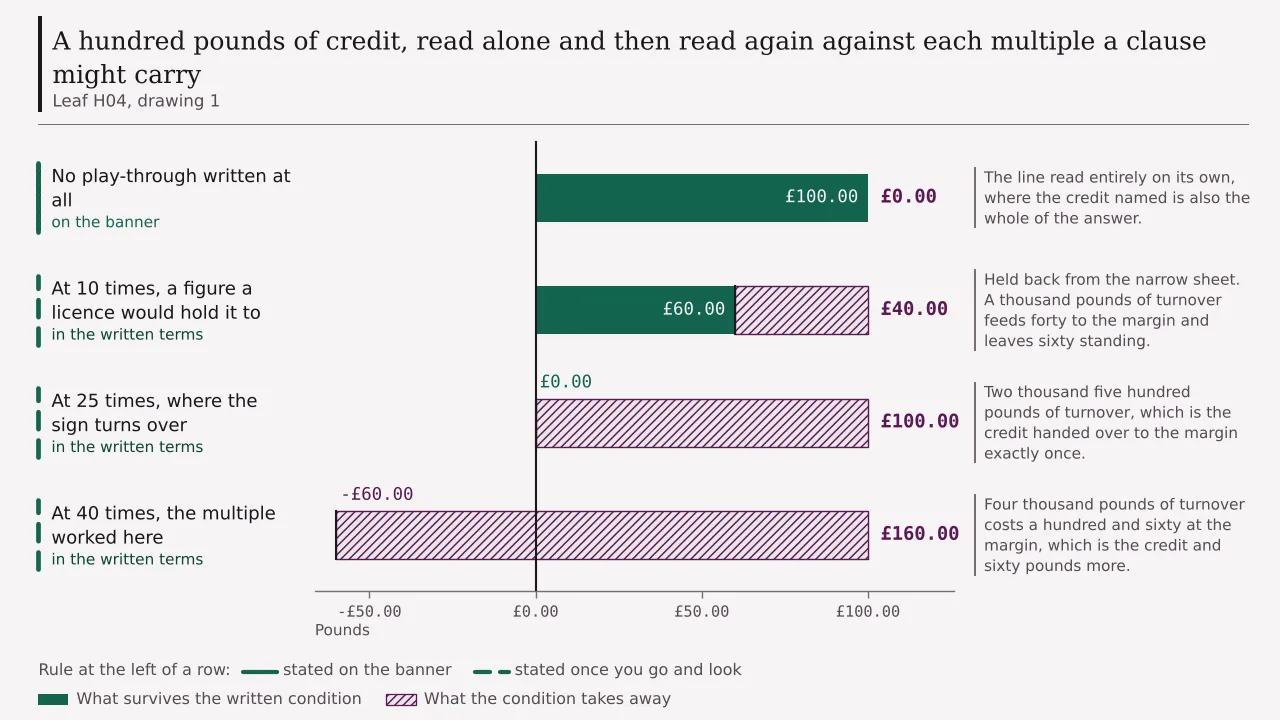
Read the line as credit issued against a registration and nothing else, and the arithmetic runs in four steps with no unknowns imported. The base is a hundred pounds. The multiple is forty, which is the figure a conditions document out here habitually writes against credit of that size, and it is a working convention of this leaf rather than anything anybody is obliged to publish. The margin is four hundredths, which follows from the 96 per cent return held steady here.
Forty lots of a hundred pounds send £4,000.00 across the reels before a balance may leave, and out of that four thousand the reels keep four hundredths, so finishing the clause on a credit of a hundred has an expected price of £160.00. Take the second figure off the first and the account is expected to close at minus £60.00. The bracket reaches the same place faster: a multiple of forty against a margin of four hundredths puts the bracket six tenths under nought, and six tenths of a hundred pounds pointed downwards is sixty.
Read off the banner £100.00 With the written multiple applied minus £60.00 What the unread obligation costs £160.00
Cut the four thousand pounds into ten-penny pieces and 40,000 presses appear, which is what the obligation looks like held in the hand rather than written in a clause, and no banner anywhere carries that quantity. Where a British pace rule governs the build, each press sits behind a floor of 2.5 seconds, so 40,000 of them occupy 100,000 seconds, or twenty-seven hours and forty-seven minutes with no pauses counted at all. Beyond that licence nothing holds the floor down, the pile can be worked faster, and the expected figure improves by not a penny.
Where the sign turns over is twenty-five, which is arithmetic and not practice: invert a margin of four hundredths and twenty-five is what falls out. A hundred pounds of credit at twenty-five times asks £2,500.00 of staking and is expected to have handed itself over in full, leaving nothing behind and owing nothing further. A number written above twenty-five demands margin the credit does not contain, and the missing part is drawn from the reader’s own pocket.
So under this first reading the headline is a hundred pounds that is expected to end as a sixty pound hole, and the entire movement is produced by one number in one clause. Nothing has been hidden, nothing has been misdescribed, and the hundred pounds genuinely arrives. A reader who stops the moment the credit lands and never attempts the clause has been handed exactly what the line said, at exactly the stated entry price of nought.
3
Pricing the reading where a hundred pounds goes in first
Now read the same line as a matched welcome arrangement, where the hundred pounds names what the house will put alongside the reader’s own hundred rather than what it will hand over unprompted. The phrase about a deposit then attaches to the credit, meaning that no further payment is required to release it once the qualifying one has landed. That reading is grammatically available and this leaf makes no claim about which drafter intended which.
The entry price under this reading is £100.00 of the reader’s own money, settled at the cashier in some arrangements and in the written terms in others, and in neither case on the face of the advertisement. Everything that follows attaches to two hundred pounds of balance rather than one, and the two halves behave nothing alike.
Keep the clause over the credit alone and the credit closes where part two put it, at an expected minus sixty pounds, because nothing about the reader’s own hundred changes the arithmetic on the house’s hundred. No published source answers whether a requirement reaching across the payment and the credit together is caught by anything, so this leaf sets out the chain of wording and stops: a clause drafted over both halves would ask forty times two hundred pounds, which is £8,000.00 across the reels, feeding £320.00 to the margin against a balance of two hundred.
Put those two shapes beside each other and the matched reading is worse under both. In the narrow version the reader has a hundred pounds of their own sitting in an account they cannot withdraw from until a clause over somebody else’s hundred is finished. In the broad version the staking doubles and the expected close on the whole balance falls to minus £120.00, of which the first hundred was the reader’s.
| What the step is | Where a reader settles it | Credit issued for nothing | Matched against a payment | Why the two differ here |
|---|---|---|---|---|
| Sum asked before anything starts | at the cashier | £0.00 | £100.00 | The occasion the word welcome names |
| Credit standing in the account | £100.00 | £100.00 | Identical, and the only line that is | |
| Reader’s own money in the account | at the cashier | £0.00 | £100.00 | Nothing can be matched against nought |
| Staking asked at forty times the credit | in the written terms | £4,000.00 | £4,000.00 | The clause bites on the credit either way |
| Staking where the clause reaches both halves | nowhere in writing | £4,000.00 | £8,000.00 | No published source addresses the pairing |
| Expected close on everything held | in the written terms | minus £60.00 | minus £120.00 | Twice the base turned over twice as often |
A seventh row belongs to neither reading in particular and is left out of the table for that reason. A demand for papers arrives on the way out under both readings alike, acting on whatever has survived, and against expected closes of minus £60.00 and minus £120.00 there is in expectation nothing standing for it to act on.
Six rows, and precisely one of them agrees across the two columns. The credit standing in the account is a hundred pounds whichever way the line is read, which is why the line survives reading. Every other row moves, and four of the five that move are settled somewhere a reader cannot reach from the advertisement.
4
What the ambiguity is worth at the door
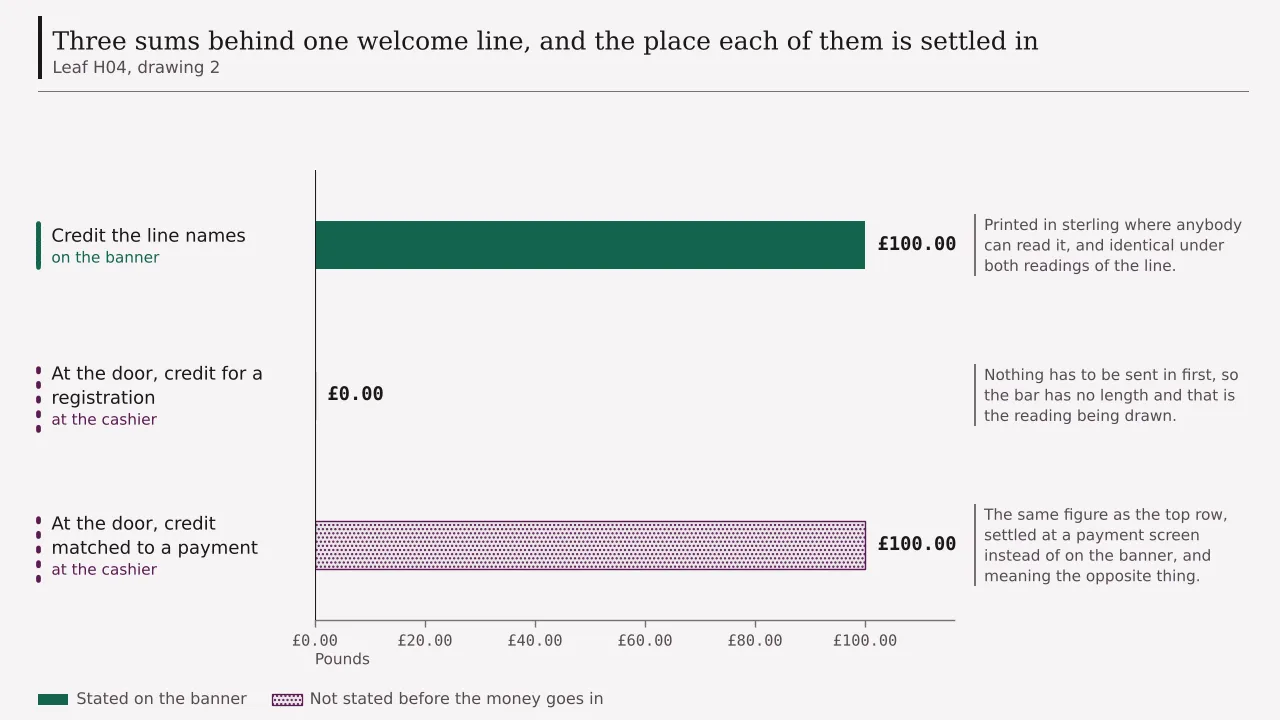
Strip the two readings back to the one quantity a reader has to commit before any of the clauses have anything to act on, and the comparison becomes a single subtraction. Under the first reading the sum at the door is nought. Under the second it is a hundred pounds. The published line supports both, so the price of not knowing which is the gap between them.
£100.00 of entry price turning on which job the phrase about a deposit is doing
A hundred pounds is a larger figure than anything else on this leaf that a reader actually controls. The clause costs a hundred and sixty pounds in expectation, which is larger still, but the clause is only reached by somebody who has already entered. The entry price is the first decision, it is taken on the strength of the banner alone, and on this family of headlines it is the decision with the widest range of possible values.
Consider the reader who acts on the wrong half. Somebody reading the phrase as the operative term registers, waits for a hundred pounds that was never going to arrive unprompted, and has lost nothing except the time. Somebody reading the word as the operative term sends a hundred pounds in to secure a match that was already available for nothing, and has converted a free registration into a funded account with a four thousand pound obligation hanging off it.
Those two mistakes are not symmetrical and nothing in the layout signals the asymmetry. One of them costs a few minutes. The other puts a hundred pounds of the reader’s own money behind a clause they had not yet read, in an account they cannot withdraw from until the clause is finished. Of every ambiguity this section prices, this is the one where the two branches differ most in what they cost the person choosing.
There is a third branch and it is the common one. A reader who cannot tell which applies opens the account, reaches the payment screen, and discovers the answer at the moment the screen asks for a card. That is a discovery made at the cashier, by which point an account exists, an identity has been handed over and a marketing permission has usually been given. The contradiction has been resolved at the reader’s expense even where no money follows.
5
The document that resolves it, and how far out that sits
Distance here is measured by how many documents have to be opened and how much has already been committed, never in pixels or in scroll depth. Nought is the advertisement itself. One is the promotion page it links to. Two is a general conditions document named somewhere inside that promotion page, and the two cannot be swapped round, since nobody learns the second exists without having read the first. A qualifying payment on this headline is habitually settled at the far one of those, two documents out from the claim it reverses.
That placement is doing something specific. A condition sitting at distance one can be reached by a reader who clicked once and read carefully. A condition at distance two requires the reader to notice a cross-reference inside a document they opened for a different reason, and then to follow it. Each additional document is an opportunity to stop, and a qualifying payment is the condition most worth placing behind one.
| The half being read | Where it is settled | Documents from the claim |
|---|---|---|
| The sum, a hundred pounds | None | |
| What the word welcome attaches to | in the general conditions | Two |
| What the phrase about a deposit qualifies | in the general conditions | Two |
| The multiple the credit is turned over at | in the promotion’s terms | One |
| Which activities a licence actually permits | in the public register | A search, no account |
| The smallest payment the screen will take | at the cashier | An account |
Notice which row sits nearest. The multiple, costing a hundred and sixty pounds in expectation, is ordinarily one document away. The qualifying payment, costing a hundred pounds and deciding whether the reader enters at all, is ordinarily two. The more expensive clause is placed nearer the claim than the cheaper one, and the cheaper one is the one a reader has to settle first in order to act at all.
There is a tidy test buried in that table. A reader who has found the multiple and not the entry price has read the second-most expensive condition and skipped the one that governs whether the first applies to them. Reading in the order documents are encountered produces exactly that result, which is why the order documents are encountered is itself a term of the offer, even though nobody writes it down.
6
Where a contradiction can stand with nobody obliged to settle it
This is the finding the leaf exists for, and it is a statement about the first of the six places rather than about anybody’s intentions. A banner is the only address in the whole list where two incompatible claims can sit side by side with no mechanism anywhere compelling a resolution. Every other address has a resolving party built into it.
Work through them. A written term that contradicts another written term is a drafting fault inside a single document, and the document has an author who can be asked which clause governs. A public register row cannot contradict itself, because it is a set of fields with one value each. A payment screen resolves itself by acting: it either takes the money or does not, and the reader watches it happen. The way out resolves itself the same way, by paying or refusing. The sixth address holds nothing written at all, so nothing there can contradict anything.
A banner has none of that. It is read once, by somebody with no account, no correspondent and no standing to ask a question. There is no field to compare it against and no transaction to watch. Two claims can therefore stand on it indefinitely without either being tested, and the only resolution available is for the reader to travel to a document two places out and read the answer in somebody else’s words.
What makes that structural rather than accidental is the direction the travelling runs in. Resolving the contradiction costs the reader two documents of effort. Leaving it unresolved costs the publisher nothing at all and reaches a wider audience, since a line meaning two things is attractive to both sets of readers. Nothing in the arrangement punishes the ambiguity, which is why the ambiguity survives.
The honest version of the finding is therefore narrow and worth stating exactly. Contradictions are not more common at the first address than elsewhere. They are more durable there, because every other address has something in it that forces an answer, and a banner has nothing in it at all beyond the words themselves.
Two documents of travel to settle a contradiction published in one line
7
What the same line costs where somebody is answerable for it
An arrangement advertised in these words is run from outside the British licence, so the duties below are named here as absences rather than as rules the reader can invoke. On a leaf whose subject is a claim that reverses itself, the losses that bite are the ones that bear on what an advertisement may say, and those are a different set from the losses a page about a payout or a register would name.
Start with the one written for exactly this line. The advertising regulator’s advice on bonuses says an incentive ought not be called free when qualifying for it requires the customer’s own funds to be exposed, and it discourages the familiar two-word companion phrase altogether except where nothing belonging to the customer can go. Apply that here and the matched reading and the adjective carried in the headline will not stand together in one advertisement.
The advertising regulator’s published advice on bonuses of this sort fixes which conditions have to be put plainly and visibly wherever leaving one out would be apt to mislead, and its worked list of the significant ones runs to who may take the offer, what has to be paid in or turned over, the time allowed for claiming and for spending it, and any qualifying odds or bet types. A payment at the door is the first of those in substance and the first one absent from this headline in fact.
The second absence is the duty not to mislead at all, which is stated in one line on the British regulator’s advertising page and carries a consequence attached to placement: where a significant condition is not shown with enough prominence, the advertisement is treated as a misleading one. The same page lists the non-broadcast code sections a licensed operator answers to, and the first of them is the section on misleading advertising rather than the one on gambling.
The third is the code provision binding a licence holder to those advertising codes in the first place, which is what turns an advertising finding into a licensing matter rather than a matter between a publisher and a regulator of publishers. Without a licence there is no provision to breach, no licence to act against, and the advertising codes reach a party who never agreed to them.
The fourth is quieter and bears on a reader rather than on an operator. In its own guidance for players on what to examine ahead of gambling, the British regulator names whatever restricts an introductory offer as something to look up, and the instance it gives is a minimum spend standing ahead of the bonus being paid. That points at exactly the quantity this headline withholds, and it is guidance anybody can follow whoever runs the site, which makes it the most portable item in this part.
Price the loss and it comes out as the hundred pounds in part four rather than as a separate number. Where the advertising duties bite, a qualifying payment is a significant condition and belongs where the claim is, which collapses the entry price from an unknown into a stated figure before anybody registers. Where they do not bite, the entry price stays at two documents out and the hundred pound range stands. The duties do not change what the arrangement is worth. They change whether the reader knows what they are entering before they enter it.
A fifth absence is worth separating out because it is about people rather than about pounds. Whether the national self-exclusion scheme reaches a site is decided by whether that site holds the British licence, and a welcome arrangement published outside the licence is published outside the scheme as well. Gamstop Online prints that boundary in the terms it publishes, so nobody need find it out by attempting a registration and watching what happens. Somebody who has already used that protection should read a line of this kind as standing beyond it, and the support numbers below are a better address than any registration form.
8
Separating the two readings before anything is clicked
The two readings can usually be told apart from published material alone, without an account and without a payment, and the tests take a couple of minutes. None of them is a trick. Each one looks for a figure that only one of the two readings needs.
The first test is for a qualifying minimum anywhere in the visible promotion. A matched arrangement has to name the sum it matches against, because a match with no floor under it is an open-ended liability and nobody writes one. A credit issued against a registration needs no such figure and ordinarily carries none. A minimum payment printed anywhere on the page settles the reading immediately.
The second is for a percentage. Matched arrangements are almost always expressed as a proportion of something, and where a page carries both a hundred pounds and a hundred per cent, the second figure is describing how the first is produced. A credit handed over for nothing has no proportion to express, since there is nothing to take a proportion of.
The third is for a ceiling worded as an upper limit rather than as an amount. A matched arrangement writes its headline figure as the most the house will add, which reads as up to a hundred pounds rather than as a hundred pounds. The difference between those two forms of words is the difference between the two readings, and it is visible on the banner where it appears at all.
The fourth is the multiple’s base. Where a clause is written over a sum described as bonus funds, the arrangement has a separate credit balance and the payment, if any, sits beside it untouched. Where the clause is written over deposit and bonus together, a payment is presupposed by the wording of the clause itself, and the contradiction has been resolved inside the obligation rather than inside the definition.
The fifth is the payment screen, which settles it conclusively and costs an account to reach. A screen that offers to credit the hundred pounds with no payment field at all is the first reading. A screen that will not release anything until a card has been accepted is the second. This is the test most readers actually use, and it is the most expensive of the five because the account exists by the time it runs.
Run the cheap tests ahead of the expensive one and the hundred pound range in part four usually collapses with nothing yet committed. Where every one of them comes back silent, the honest conclusion is that the reading remains unsettled rather than that the generous reading governs, and a quantity nobody can settle before committing is the quantity this site prices instead of guessing at.
9
What stays true whichever reading governs
Four things survive the ambiguity intact, and listing them keeps the leaf honest about what it has and has not shown. The credit is a hundred pounds in both readings. The multiple bites on that credit in both. The margin is four pence in the pound in both. And the expected close on the credit alone is minus sixty pounds in both, because the reader’s own money, where there is any, does not change the arithmetic on the house’s share by a penny.
That last point is the useful one to carry away. The contradiction decides the entry price and decides nothing whatever about what the advertised hundred pounds is worth once it exists. A reader who settles the reading has learned what it costs to get in. They have not learned what they are getting, and the second question is answered in the promotion’s own terms at one document out, by a number that is expected to turn a hundred pounds into a sixty pound hole.
So the method this leaf recommends has two moves, and most readers take them in the reverse order. Settle the sum at the door first, since everything else waits on it and since its range is the widest on the page. Settle the multiple second, since that decides what the credit comes to and since it is usually the nearer of the two to hand. Taken the other way about, the work produces a precise answer to a question the reader may turn out not to be asking.
And one honest caveat on the whole exercise. Every pound figure above rests on a play-through of forty and a press value of ten pence, neither of which any rule compels anybody to publish, and both of which this leaf adopts as conventions and labels as such wherever they carry a figure. Change the multiple and every expected close on the leaf moves. The entry price of a hundred pounds does not move, which is why it is the figure the contradiction is actually about.
Questions
- Does a headline reading 100 free welcome bonus, no deposit required, mean I pay nothing?
- The published line supports two answers and settles neither. Read as credit issued against a registration, the sum at the door is nought and a hundred pounds arrives unprompted. Read as a matched welcome arrangement, the hundred pounds names what the house adds to the reader’s own hundred and the sum at the door is £100.00. The occasion-word implies a payment without stating one and the phrase beside it denies a payment by stating so, which leaves the resolution in a general conditions document two documents out from the claim.
- What is £100 of credit worth after a forty times play-through?
- An expected minus £60.00 on the figures used here. Forty lots of a hundred pounds send £4,000.00 across the reels, out of which the reels keep four hundredths, so finishing the clause against a credit of a hundred has an expected price of £160.00. The bracket agrees: a multiple of forty against a four per cent margin lands six tenths under nought, and six tenths of a hundred pounds is sixty. The forty is a convention adopted here rather than a published figure.
- Which reading costs more if I guess wrong?
- The two mistakes are not symmetrical. Treating a matched arrangement as a free one costs the time spent waiting for credit that was never going to arrive unprompted. Treating a free one as matched means sending £100.00 in to secure something already available for nothing, which converts a registration into a funded account carrying a £4,000.00 obligation. A hundred pounds of entry price turns on which job the phrase about a deposit is doing.
- Where is the qualifying payment actually written down?
- Habitually in a general conditions document, which sits two documents from the claim because the promotion page has to be opened before that document is known to exist. The multiple, which costs £160.00 in expectation, ordinarily sits one document out. So the more expensive clause is placed nearer the claim than the cheaper one, and the cheaper one is the condition a reader has to settle first in order to act at all.
- Why can a banner carry two claims that contradict each other?
- Because it is the one address of the six with no resolving party inside it. A written term that clashes with another has an author who can be asked which governs. A register row is a set of fields with one value each. A payment screen and an exit both resolve themselves by acting, taking the money or refusing it. The place with nothing written in it cannot contradict anything. A banner is read once by somebody with no account and no standing to ask, so two incompatible claims stand there untested.
- Can I tell the two readings apart before I register?
- Usually, from published material alone. Look for a qualifying minimum, since a match with no floor under it is an open-ended liability nobody writes. Look for a percentage, since a proportion needs something to take a proportion of. Look for the words up to in front of the figure, which is how a ceiling is worded. And look at what the clause is written over, because a clause covering deposit and bonus together presupposes a payment in its own wording.
- If I do pay the hundred pounds, what happens to my own money?
- It sits in the account behind a clause written over somebody else’s hundred, and cannot be taken out until that clause is finished. Where a clause reaches across the payment and the credit together, the staking doubles to £8,000.00, feeding £320.00 to the margin against a balance of two hundred and closing at an expected minus £120.00, of which the first hundred was the reader’s own. Nothing published addresses whether a requirement drafted over both halves is caught by anything, so this leaf sets out the chain of wording and stops there.
- What multiple would leave the hundred pounds intact?
- Nothing above twenty-five, and twenty-five leaves exactly nothing. Twenty-five is what a margin of four hundredths inverts to, so a hundred pounds of credit at twenty-five times asks £2,500.00 of staking and is expected to have handed itself over in full. Underneath it something survives. Above it the clause demands margin the credit does not contain, and whatever is missing has to be found by the reader.
- Does an advertising rule stop a headline reversing itself?
- Where one applies. The advertising regulator’s advice is that an incentive ought not be called free when qualifying for it requires the customer’s own funds to be exposed, and the British regulator’s advertising page carries the base duty not to mislead together with the consequence that a significant condition given too little prominence makes the advertisement a misleading one. An arrangement advertised in these words holds no Great Britain licence. Nothing therefore binds whoever published it to the advertising codes, no provision exists for anybody to breach, and the sum at the door stays two documents out from the claim.
- What stays the same whichever reading turns out to be right?
- Four things. The credit is a hundred pounds. The clause bites on that credit. The margin is four pence in the pound. And the expected close on the credit alone is minus £60.00, because the reader’s own money, where there is any, does not change the arithmetic on the house’s share. So settling the contradiction tells a reader what it costs to get in and nothing at all about what they are getting.