Terms read 19 October 2026 Leaf A09, revision 1
A no deposit credit worth £10.00 today, and an obligation still being measured
Ten pounds of credit at forty times asks £400.00 to cross the reels and closes at an expected minus £6.00. Put the same credit in a unit that moves an assumed twenty per cent and the staking becomes a band from £320.00 to £480.00. The direction a reader would call good news is the one that enlarges the bill.
Stated on the banner £10.00 A credit with no payment asked for it, written as a sum of pounds on the day the offer is read. Stated, once you go and look £400.00 Forty times the credit, written as a multiple in a bonus document, which is a quantity of units rather than a quantity of pounds. Not stated before the money goes in £160.00 wide What that multiple turns out to have asked for in pounds, settled only once the staking has finished and the unit has stopped moving.
No deposit credits settled in a network unit, with their terms read
Every destination in this file is bought advertising. The site is paid a fee if a reader goes on to register, and no figure printed below moves because of it.
Bonus Spins UK Slip 01
Betportal
Ceiling as a multiple
The drop
€15.00
€1.00 in the euro
The claim reads €15.00. Once the terms beside it have applied, €0.00 of it can leave. The difference is the drop.
7 of the 15 terms on this slip could not be read before the money went in
Spins priced at this site's own 10p a spin, which the operator does not publish
Stated
€15.00
The claim as it is printed, before a single term has been applied to it.
Headline paid as spins
150 spins at 10c each, which is €15.00 of the figure above.
6 Nowhere
What one spin is worth
No unit is published for a spin, so the count is priced at this site's own 10p a spin. At half that price every figure below halves with it.
Match and other credit not priced
300% of three deposits, to a ceiling of €1,000. A share of a deposit nobody has made yet is not a sum, so no figure stands on this line and none is carried below.
Qualified
-€14.40
Written down somewhere, and taking part of the claim back. Each term carries the place it is written and the sum it takes.
2 Written terms at a distance this record does not establish
Play-through -€14.40
Carrying €14.40 through 35 times stakes €504.00 and costs €20.16 of it at 96 per cent return. That prices above the €14.40 there is to charge it against, so the whole of the credit goes and the line is held at that. The multiple sits on the bonus.
2 Written terms at a distance this record does not establish
Game weighting not priced
Slots only count towards the play-through. No contribution percentage is published, so the line above has been worked at full weight, which is the kindest reading there is.
2 Written terms at a distance this record does not establish
Ceiling on the winnings not priced
5x the bonus.
2 Written terms at a distance this record does not establish
Clock on the credit not priced
14 days.
2 Written terms at a distance this record does not establish
Largest stake while it runs not priced
€5.
3 Public record
Licence, and who holds it not priced
Licensed in Anjouan, Comoros, held by BetPortal Gaming Ltd, with Excite Ultra Media Ltd, reference ALSI-202601040-FI2. A register entry settles who holds a licence and what it permits. It does not settle who is running the site this morning.
4 Cashier
Smallest qualifying deposit your money
€20 a stage. That is €20.00 of your own money, and it is never netted into a drop.
5 On the way out
Checks before a withdrawal not priced
Documents before the first withdrawal.
Unstated
-€0.60
Applying without having been published anywhere, and costing money all the same.
6 Nowhere
What a spin hands back -€0.60
Staking a spin returns 96 per cent of it, so that share of the batch is the house's before a reel turns. This site works at that return and the operator publishes none where the claim is made.
6 Nowhere
Forfeited by rule cost unknown
Nothing is published under this heading, and it applies regardless.
6 Nowhere
Charge on the way out cost unknown
No charge on the way out is published as a figure, so nothing comes off this line. A charge that exists unpublished would come straight off whatever survives.
6 Nowhere
Smallest withdrawal allowed cost unknown
No smallest withdrawal is published as a figure. A floor nobody has published is still a floor, and it decides whether a small balance can move at all.
No Great Britain licence
Terms read 19 October 2026
Bonus Spins UK Slip 02
WinBeast
Ceiling as a sum
The drop
€50.00
€1.00 in the euro
The claim reads €50.00. Once the terms beside it have applied, €0.00 of it can leave. The difference is the drop.
8 of the 15 terms on this slip could not be read before the money went in
Spins priced at this site's own 10p a spin, which the operator does not publish
Stated
€50.00
The claim as it is printed, before a single term has been applied to it.
Headline paid as spins
500 spins at 10c each, which is €50.00 of the figure above.
6 Nowhere
What one spin is worth
No unit is published for a spin, so the count is priced at this site's own 10p a spin. At half that price every figure below halves with it.
Match and other credit not priced
50% to 100% of five deposits, each to a ceiling of €1,000, and a €650 free bet. A share of a deposit nobody has made yet is not a sum, so no figure stands on this line and none is carried below.
Qualified
-€48.00
Written down somewhere, and taking part of the claim back. Each term carries the place it is written and the sum it takes.
2 Written terms at a distance this record does not establish
Play-through -€48.00
Carrying €48.00 through 40 times stakes €1,920.00 and costs €76.80 of it at 96 per cent return. That prices above the €48.00 there is to charge it against, so the whole of the credit goes and the line is held at that. The multiple sits on the bonus and the winnings from the spins.
2 Written terms at a distance this record does not establish
Game weighting not priced
Slots, titles vary by country count towards the play-through. No contribution percentage is published, so the line above has been worked at full weight, which is the kindest reading there is.
2 Written terms at a distance this record does not establish
Ceiling on the winnings not priced
€100 a batch of spins.
2 Written terms at a distance this record does not establish
Clock on the credit not priced
7 days, spins 1 day.
3 Public record
Licence, and who holds it not priced
Licensed in Curaçao, holder not named on the site. A register entry settles who holds a licence and what it permits. It does not settle who is running the site this morning.
4 Cashier
Smallest qualifying deposit your money
€20 a stage. That is €20.00 of your own money, and it is never netted into a drop.
5 On the way out
Checks before a withdrawal not priced
Documents before the first withdrawal.
Unstated
-€2.00
Applying without having been published anywhere, and costing money all the same.
6 Nowhere
What a spin hands back -€2.00
Staking a spin returns 96 per cent of it, so that share of the batch is the house's before a reel turns. This site works at that return and the operator publishes none where the claim is made.
6 Nowhere
Largest stake while it runs cost unknown
Nothing is published under this heading, and it applies regardless.
6 Nowhere
Forfeited by rule cost unknown
Nothing is published under this heading, and it applies regardless.
6 Nowhere
Charge on the way out cost unknown
No charge on the way out is published as a figure, so nothing comes off this line. A charge that exists unpublished would come straight off whatever survives.
6 Nowhere
Smallest withdrawal allowed cost unknown
No smallest withdrawal is published as a figure. A floor nobody has published is still a floor, and it decides whether a small balance can move at all.
No Great Britain licence
Terms read 19 October 2026
Bonus Spins UK Slip 03
EliteSpin
Longest spin window
The drop
£50.00
£1.00 in the pound
The claim reads £50.00. Once the terms beside it have applied, £0.00 of it can leave. The difference is the drop.
8 of the 15 terms on this slip could not be read before the money went in
Spins priced at this site's own 10p a spin, which the operator does not publish
Stated
£50.00
The claim as it is printed, before a single term has been applied to it.
Headline paid as spins
500 spins at 10p each, which is £50.00 of the figure above.
6 Nowhere
What one spin is worth
No unit is published for a spin, so the count is priced at this site's own 10p a spin. At half that price every figure below halves with it.
Match and other credit not priced
50% to 100% of five deposits, each to a ceiling of £1,000. A share of a deposit nobody has made yet is not a sum, so no figure stands on this line and none is carried below.
Qualified
-£48.00
Written down somewhere, and taking part of the claim back. Each term carries the place it is written and the sum it takes.
2 Written terms at a distance this record does not establish
Play-through -£48.00
Carrying £48.00 through 40 times stakes £1,920.00 and costs £76.80 of it at 96 per cent return. That prices above the £48.00 there is to charge it against, so the whole of the credit goes and the line is held at that. The multiple sits on the bonus and the winnings from the spins.
2 Written terms at a distance this record does not establish
Game weighting not priced
Slots count towards the play-through. No contribution percentage is published, so the line above has been worked at full weight, which is the kindest reading there is.
2 Written terms at a distance this record does not establish
Ceiling on the winnings not priced
5x the bonus.
2 Written terms at a distance this record does not establish
Clock on the credit not priced
7 days, spins 3 days.
3 Public record
Licence, and who holds it not priced
Licensed in Costa Rica, held by PrimeTier Limited. A register entry settles who holds a licence and what it permits. It does not settle who is running the site this morning.
4 Cashier
Smallest qualifying deposit your money
£20 a stage. That is £20.00 of your own money, and it is never netted into a drop.
5 On the way out
Checks before a withdrawal not priced
Documents before the first withdrawal.
Unstated
-£2.00
Applying without having been published anywhere, and costing money all the same.
6 Nowhere
What a spin hands back -£2.00
Staking a spin returns 96 per cent of it, so that share of the batch is the house's before a reel turns. This site works at that return and the operator publishes none where the claim is made.
6 Nowhere
Largest stake while it runs cost unknown
Nothing is published under this heading, and it applies regardless.
6 Nowhere
Forfeited by rule cost unknown
Nothing is published under this heading, and it applies regardless.
6 Nowhere
Charge on the way out cost unknown
No charge on the way out is published as a figure, so nothing comes off this line. A charge that exists unpublished would come straight off whatever survives.
6 Nowhere
Smallest withdrawal allowed cost unknown
No smallest withdrawal is published as a figure. A floor nobody has published is still a floor, and it decides whether a small balance can move at all.
No Great Britain licence
Terms read 19 October 2026
Bonus Spins UK Slip 04
Crown Jewelz
Multiple unpublished
The drop
NOT WORKED
The multiple is not published in the operator's own terms. Since the sum cannot be worked around it, none is worked.
9 of the 14 terms on this slip could not be read before the money went in
No drop worked
Stated
£15.00
The claim as it is printed, before a single term has been applied to it.
Headline paid as spins
150 spins at 10p each, which is £15.00 of the figure above.
6 Nowhere
What one spin is worth
No unit is published for a spin, so the count is priced at this site's own 10p a spin. At half that price every figure below halves with it.
Match and other credit not priced
200% of the first deposit, then 150% twice, each to a ceiling of £1,000. A share of a deposit nobody has made yet is not a sum, so no figure stands on this line and none is carried below.
Qualified
NOT WORKED
Written down somewhere, and taking part of the claim back. Each term carries the place it is written and the sum it takes.
2 Written terms at a distance this record does not establish
Play-through not priced
40x the bonus, reported rather than published by the operator.
2 Written terms at a distance this record does not establish
Game weighting not priced
Slots count towards the play-through. No contribution percentage is published, so the line above has been worked at full weight, which is the kindest reading there is.
3 Public record
Licence, and who holds it not priced
Licensed in Curaçao, number not verified, holder not named on the site. A register entry settles who holds a licence and what it permits. It does not settle who is running the site this morning.
4 Cashier
Smallest qualifying deposit your money
£20. That is £20.00 of your own money, and it is never netted into a drop.
5 On the way out
Checks before a withdrawal not priced
Documents before the first withdrawal.
Unstated
NOT WORKED
Applying without having been published anywhere, and costing money all the same.
6 Nowhere
Ceiling on the winnings cost unknown
No ceiling is published. Nothing is assumed in its place.
6 Nowhere
Clock on the credit cost unknown
Nothing is published under this heading, and it applies regardless.
6 Nowhere
Largest stake while it runs cost unknown
Nothing is published under this heading, and it applies regardless.
6 Nowhere
Forfeited by rule cost unknown
Nothing is published under this heading, and it applies regardless.
6 Nowhere
Charge on the way out cost unknown
No charge on the way out is published as a figure, so nothing comes off this line. A charge that exists unpublished would come straight off whatever survives.
6 Nowhere
Smallest withdrawal allowed cost unknown
No smallest withdrawal is published as a figure. A floor nobody has published is still a floor, and it decides whether a small balance can move at all.
No Great Britain licence
Terms read 19 October 2026
Every figure in the second and third columns is this site's own working and nothing an operator has published. A claim is priced as printed, then the share a spin hands back at 96 per cent return comes off it, then what playing the multiple through costs at the same return, and then whatever a published ceiling, a charge on the way out or a floor on the smallest withdrawal takes from what has survived. The drop is the difference between the first figure and the last. The two columns add back up to it exactly, so no money leaves a slip without a term and a place beside it.
Which column a term falls in is settled by one question: has anybody written it down. A charge a reader meets at the payment screen is written down, and it stands in the second column with the cashier against it. A condition that binds without ever having been set down stands in the third, whatever it costs. Inside each column the terms run outwards from the banner, so the order itself says how far a reader would have had to go.
A count of spins has no unit until one is supplied. Where an operator publishes what one of its own spins is worth, that figure is used and the first column says it is theirs. Where none is published, this site's own 10p a spin stands in its place and every figure below moves in proportion with it. Where the multiple itself is unpublished, no drop is worked at all, because that is the one figure the sum cannot be done without.
Three words stand where a figure cannot. Not priced is a term that is written down and carries no number the arithmetic can take. Cost unknown is a term nobody has written down, costing something nobody has put a number on. Your money is money of the reader's own, which is never netted into a drop.
None of the operators in this file holds a Great Britain licence, so none of the duties that licence carries reaches them. Each of those duties is published in its own right, which is what makes its absence here something a reader can check rather than take on trust. Every gambling company licensed in Great Britain belongs to Gamstop Online, so a reader who has shut themselves out through the scheme is not shut out here. Social Responsibility Code 5.1.1 has held a play-through to a maximum of ten times the bonus funds since 19 January 2026, and it binds a licence holder and nobody else. Asked in a post of 21 October 2025 what is lost along with the licence, the Gambling Commission's Director of Enforcement and Intelligence answered: "unfair gaming practices, financial loss, and a lack of recourse if things go wrong". The same post puts blocked payouts, and withdrawal limits pitched high enough to be unreachable, among the behaviour the Commission has recorded. Nobody under 18 may hold an account at any of them.
Terms are reproduced in the wording their operator published, and each slip is dated with the day somebody sat down and read them. 19 October 2026 is the oldest of those dates. Anybody claiming an offer is bound by that operator's full terms, which are elsewhere, and never by a line standing here.
1
What is accepted when a credit of this shape is accepted
Two separate things arrive together when a credit is accepted, and a gift is only the first of them. The gift is a sum placed on an account with no payment asked for it. The second is an obligation to put a stated multiple of that sum across the reels before any of it can be collected, and the obligation is larger than the gift by the multiple.
On a conventional offer both halves are fixed at the moment of acceptance. Ten pounds of credit at forty times is ten pounds of credit and four hundred pounds of staking, today, tomorrow and on the day the staking finishes. A reader who understands the multiple knows the size of what they have taken on.
Where the credit is denominated in a unit whose price against the pound is not held steady, that second half stops being fixed. The multiple stays at forty. The number of units stays wherever it was set. What moves is the number of pounds those units represent, and the staking obligation moves with it, in the same proportion and in whichever direction the unit went.
One thing before the arithmetic starts. If the reason this page is open is that accounts have already been closed at a reader’s own request, the figures below are not the point and the help is. GamCare.org.uk and BeGambleAware.org both take people in confidence and charge nothing, and the National Gambling Helpline runs under GamCare and answers on 0808 8020 133 whenever it is called. Registration with Gamstop Online follows a British licence, and the scheme’s own written terms say it cannot act against organisations that are not in it. That sentence marks where a protection stops. It is not a map, nothing below is a map either, and a credit of nought pounds is still an obligation measured in hundreds.
So the size of the thing accepted is not known when it is accepted. It is known when the staking has finished and not one moment earlier, which is what puts this subject on the way out rather than in the bonus terms where the multiple itself sits. The multiple is written down. The bill is not.
Everything below works at the figures this site holds constant throughout: ten pence a press, a weighting of one, forty times as the play-through, and ninety-six pence coming back off each pound that crosses the reels. The movement in the unit is assumed at twenty per cent either way and is this leaf’s own assumption, carried because it is large enough to see and round enough to divide by.
2
Ten pounds at forty times, before anything has moved
Set the unit still for a moment and work the base case, because everything afterwards is this case multiplied by something. A credit of £10.00 at forty times asks for £400.00 of staking, which is forty lots of ten pounds.
Four hundred pounds crossing the reels at ninety-six pence back in the pound leaves four pence of every pound behind. Four hundred multiplied by four hundredths comes to £16.00. Subtract that sixteen pounds from the ten pounds of credit and what is expected to remain is minus £6.00.
Reach it from the other end. Four hundredths of forty is 1.6. Take that away from one and what remains is minus 0.6. Ten pounds carried six tenths past nought arrives at the same minus six pounds. Weighting is held at one all the way through this leaf, so nothing has been hidden inside it, and anything under one pound of contribution per pound staked makes every figure below worse rather than better.
At ten pence a press, four hundred pounds of staking is 4,000 separate presses. That figure is worth carrying, because parts three and six measure the movement in presses as well as in pounds and the press count is the quantity a reader actually experiences.
£400.00 of staking and 4,000 presses asked against a credit whose face reads £10.00
Nothing in that paragraph is special to this subject. It is the arithmetic of any forty times condition on any ten pound credit, and it is printed here as the fixed point everything else gets compared with. What follows is what happens when the ten pounds will not hold still.
3
The same credit after an assumed movement each way
Assume the unit moves twenty per cent while the staking is being worked off, and assume nothing about which way. Twenty per cent of ten pounds is two pounds, so the credit lands at either £8.00 or £12.00 by the end, and the obligation moves in step with it.
| What the unit did | Credit in pounds | Staking asked | Expected cost of it | Expected close | Presses at 10p |
|---|---|---|---|---|---|
| Fell an assumed 20 per cent | £8.00 | £320.00 | £12.80 | minus £4.80 | 3,200 |
| Held exactly still | £10.00 | £400.00 | £16.00 | minus £6.00 | 4,000 |
| Rose an assumed 20 per cent | £12.00 | £480.00 | £19.20 | minus £7.20 | 4,800 |
Not one of those six figures holds still, which is the whole of the finding. The credit moves by four pounds across the band, the staking by £160.00, the expected cost by £6.40, the expected close by £2.40 and the press count by 1,600. A reader accepting the offer is accepting all six bands at once and can read none of them.
£160.00 of staking and 1,600 presses between the two ends of an assumed twenty per cent band
The middle row is the only one anybody could have computed in advance, and it is the one that will not happen. A unit that moves will have moved by the time the staking is done, so the true figure is one of the outer rows or something between them, and which one is settled after the event.
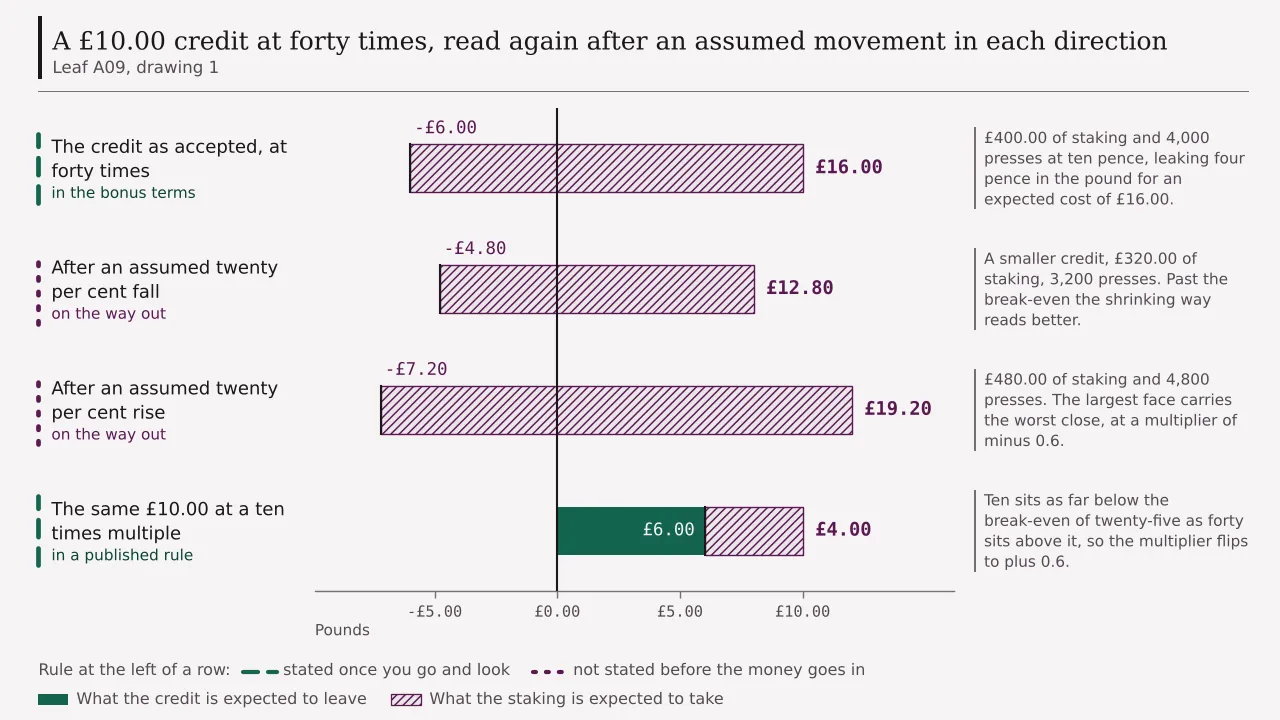
The longest bar on that drawing belongs to the largest credit, and the largest credit has the worst close. That inversion is not a drafting trick or a hidden clause. It falls out of one multiplication, and part four does the multiplication slowly.
4
Why the direction reading as good news costs more
At ninety-six pence back in the pound, a play-through of W leaves a credit of B standing at B times the quantity one minus four hundredths of W. Set W to forty and that quantity comes out at minus 0.6. The credit is therefore being multiplied by a negative number, and multiplying by a negative number reverses the usual relationship between size and benefit.
Run it twice to be certain. Ten pounds against minus 0.6 gives minus six pounds. Twelve pounds against the same minus 0.6 gives minus £7.20. The bigger credit produces the worse expectation, by exactly £1.20, which is two pounds of extra credit multiplied by the same minus 0.6.
Expected close read off the credit as accepted minus £6.00 Once an assumed twenty per cent rise applies minus £7.20 What the direction reading as good news costs £1.20
One pound twenty is the figure this part exists to produce, and the sentence that goes with it has to be read slowly, because it reverses an intuition almost everybody brings. The unit going up is the outcome a reader would be pleased to see reported. At forty times it costs them £1.20 on a ten pound credit, and it costs them more the further the unit climbs.
The mechanism is not mysterious and it is worth saying in plain words. Past the break-even multiple the staking is expected to consume more than the credit is worth, so the credit has become the measure of a shortfall rather than the measure of a benefit. Enlarging a shortfall enlarges the shortfall. The arithmetic simply keeps doing what it was always doing.
The same reasoning runs the other way with equal force. A unit that falls twenty per cent takes the credit to eight pounds and the expected close to minus £4.80, which is £1.20 better than the base case. On these assumptions, and at this multiple, the bad news improves the expectation. That reading is correct, it is also dangerous out of context, and part six puts the context back.
5
The multiple at which a movement changes sign
Everything in part four depended on forty being greater than twenty-five, so the obvious question is what happens at other multiples. The bracket one less four hundredths of W is positive below twenty-five, nought at twenty-five, and negative above it, and the sign of that bracket is the sign of everything downstream.
| Play-through | Multiplier on the credit | £10.00 closes at | £12.00 closes at | What an assumed rise does |
|---|---|---|---|---|
| Nothing asked | 1.00 | £10.00 | £12.00 | Adds £2.00 |
| 10 times | 0.60 | £6.00 | £7.20 | Adds £1.20 |
| 20 times | 0.20 | £2.00 | £2.40 | Adds £0.40 |
| 25 times | 0.00 | £0.00 | £0.00 | Nothing whatever |
| 30 times | minus 0.20 | minus £2.00 | minus £2.40 | Takes £0.40 |
| 40 times | minus 0.60 | minus £6.00 | minus £7.20 | Takes £1.20 |
| 60 times | minus 1.40 | minus £14.00 | minus £16.80 | Takes £2.80 |
The fourth row is the hinge and it is the strangest line on this leaf. At twenty-five times, a movement in the unit does nothing at all in expectation, in either direction, at any size. Multiply anything by nought and the answer is nought, so a credit of eight pounds, ten pounds or twelve pounds all close at the same place.
Above the hinge, a rise takes money and a fall gives it back. Below the hinge, the relationship is the ordinary one: a rise genuinely helps, and at ten times it helps by exactly £1.20 on these assumptions. So the honest answer to which case applies here is that forty times sits above twenty-five, so the enlarging reading is the one that governs, and a page that failed to say which side it was on would have printed the right arithmetic against the wrong offer.
Ten and forty repay being set side by side, for a reason owing nothing at all to anybody’s drafting. Twenty-five less ten is fifteen. Forty less twenty-five is fifteen. The two multiples sit the same distance either side of the hinge, so their multipliers are 0.60 and minus 0.60, and the identical movement is worth exactly £1.20 at both. It helps at one and hurts at the other, and the magnitude never changes.
A £12.00 credit at ten times £7.20 The identical credit at forty times minus £7.20 What the multiple alone decides £14.40
Fourteen pounds forty on a credit whose face reads twelve pounds is the entire argument for reading the multiple ahead of the sum. Nothing about the unit changed between those two rows. Nothing about the credit changed. One number in a bonus document changed, and the expectation moved by more than the credit is worth.
6
The asymmetry stated honestly, in presses and in pounds
Part four produced two figures of equal size and opposite sign, and leaving them there would suggest the two directions are reflections of each other. In expectation they are. In everything else they are not, and this part sets out the differences rather than burying them in a qualification.
The first difference is in length. A rise takes the staking from £400.00 to £480.00, which at ten pence a press is 800 more presses on top of 4,000. A fall takes it down to £320.00 and 3,200 presses. The same twenty per cent therefore moves the work by 1,600 presses from one end of the band to the other, and the direction that improves the expectation is the direction that shortens the work.
The second difference runs the other way and is easy to miss. Assume a withdrawal floor of £20.00. Twenty pounds is put here so that something stands at the exit to be measured against, and no published rule within reach supplies one. A balance built on a twelve pound credit starts nearer that floor than one built on eight pounds, so the direction that enlarges the obligation is also the direction that makes the exit easier to reach if the run goes well.
Set the two together and the honest summary is that each direction carries a leg that hurts, and the legs are different. A rise means a worse expectation and a shorter distance to the exit. A fall means a better expectation and a longer one. Anybody who wanted a single answer to which direction is preferable would have to say which of those two they were optimising, and nothing on an advertisement asks them.
| After an assumed 20 per cent move | What improves | What gets worse |
|---|---|---|
| The unit rises | Distance to an assumed £20.00 floor | Expectation, by £1.20, and 800 more presses |
| The unit falls | Expectation, by £1.20, and 800 fewer presses | Distance to an assumed £20.00 floor |
| The unit holds still | Nothing at all, which is the point of it | Nothing, which is why it will not happen |
A third asymmetry has nothing to do with the figures and is the largest of the three. A reader chooses neither direction, is told neither in advance, and finds out which one happened by having already lived through it. Both columns above describe outcomes nobody selected, which is what separates a moving denomination from every other term on an offer.
One honest limit on all of it. The twenty per cent is this leaf’s own assumption and it is symmetric by construction, which real movement need not be. Nothing here models a movement larger in one direction than the other, because nothing citable here sets out a distribution, and inventing one would put a shape on the page that the arithmetic has not earned.
7
Which of the six places settles each figure here
Running the site’s own sort over this offer puts the pieces in four different places, and the split falls almost exactly along the line between what can be counted and what has to be converted.
| The figure | Where it gets settled | Fixed when the credit is accepted | Worth on this offer |
|---|---|---|---|
| The face of the credit, in units | Yes, permanently | £10.00 on the day | |
| The multiple the staking runs to | in the bonus terms | Yes, permanently | 40 times |
| The staking asked, counted in units | in the bonus terms | Yes, permanently | 40 lots of the face |
| The staking asked, counted in pounds | on the way out | No, it moves throughout | £320.00 to £480.00 |
| The expected close, in pounds | on the way out | No, it moves throughout | minus £4.80 to minus £7.20 |
| The smallest sum the exit will send | at the cashier | No, met after registration | £20.00 assumed |
| The contribution rate on whatever is played | nowhere in writing | No, and never written | Multiplies the staking |
Three rows are fixed and three move, and the three that move are the three a reader would actually use. Nobody decides anything on the strength of knowing that a multiple is forty. Decisions get made on the strength of what forty times costs, and that figure sits two rows down among the things settled after the event.
The pattern is worth naming because it recurs across this part of the site. A term can be perfectly written, perfectly accessible and perfectly clear, and still be unreadable in the only unit that matters. Forty times is a complete sentence. Four hundred pounds is not, because the pounds were never in the sentence.
That also explains why a reader cannot fix the problem by being diligent. Opening the bonus document, reading clause by clause and writing down every figure produces the three fixed rows and gets no closer to the three that move. The diligence is not wasted, and it is not sufficient, and those are different complaints.
8
A ceiling that would have bounded the whole of it
Behind credits of this shape stand operators with not one Great Britain licence between them, and on this particular leaf the duty worth pricing is a ceiling rather than a disclosure. Britain caps the multiple itself, which is the single number every figure above is built on.
Britain holds the multiple to ten, measured against the bonus funds, and that ceiling has run since 19 January 2026 under the code provision covering incentives, reaching every remote casino licence there is. Put ten where this leaf has forty and the shape of the offer turns over. Staking on a ten pound credit drops from £400.00 to £100.00. The multiplier moves from minus 0.60 to plus 0.60. The expected close moves from minus £6.00 to plus £6.00.
That one substitution also answers the question part four put. Under the ceiling the multiple sits below the hinge at twenty-five, so a rise in the unit genuinely helps, by £1.20 on these figures. Over the ceiling it sits above the hinge, so the identical rise costs £1.20. A regulated ceiling is therefore not simply a smaller number. It stands on the far side of the line where the sign turns.
What the ceiling was written against is published as well. When the regulator described the practice it was correcting, the play-through it named ran as high as sixty times. Put sixty through the same bracket and the multiplier is minus 1.40, so a ten pound credit asks for £600.00 of staking and closes at an expected minus £14.00. That is a shortfall forty per cent larger than the credit’s own face.
A second rule arrived the same day and bears on how these offers get assembled. An incentive may not mix more than one type of gambling product where their terms run together and are shared, so one credit cannot be built to straddle two products at once. On a leaf about an obligation of uncertain size the relevance is narrow and real, since one obligation measured against one product is one band to follow instead of two.
A third set bounds how fast the obligation can be discharged, and it is the plainest arithmetic of the three. A statutory ceiling of £5 on a single slots game cycle, with £2 for anybody under twenty-five, took effect on 9 April 2025 for the five pounds and 21 May 2025 for the two, reaching online slots alone and no other casino game. Worked against the figures here, £480.00 of staking will not compress below 96 cycles at the higher ceiling, and £400.00 will not go under 80.
None of the three binds the offers this leaf describes, and the loss is specific rather than general. Without the cap the multiple is whatever a document says, which puts the offer on whichever side of the hinge the drafter chose. Without the product rule one credit may be measured against more than one thing at once. Without the stake ceiling the obligation can be discharged at any size of press, so the band in part three widens at both ends rather than staying where this leaf put it.
9
Reading any obligation written in something that moves
The method is five lines and it works on anything denominated in a unit that does not hold still. Write the obligation in the unit it was written in. Write the multiple. Multiply. Then convert at two prices rather than one, and print the band instead of the midpoint.
The fourth line is where most readings fail, because converting at today’s price feels like the careful thing to do and is the one step that guarantees a wrong answer. A figure converted at the price on the day of acceptance describes an obligation that will be discharged at a different price, and the gap between those two prices is the entire subject.
The fifth line is the sign test and it takes one subtraction. Divide one by the house margin to get the break-even multiple, and ninety-six pence in the pound puts it on twenty-five. Compare it with the multiple in the document. Above it, a rise in the unit costs money. Below it, a rise helps. Nothing else about the offer changes that answer.
Two habits hold the result steady. Carry the press count alongside the pounds, because 4,000 presses and 4,800 presses are the same arithmetic described in the unit a reader experiences rather than the unit a document is written in. And carry the assumed movement as a band through every line rather than resolving it early, since a band resolved in line two is a point estimate by line five and nobody will remember it was ever a band.
Run on this leaf’s own offer the method gives seven figures and a sign. Ten pounds of credit, forty times, £400.00 of staking at the price on the day, a band from £320.00 to £480.00, an expected close between minus £4.80 and minus £7.20, £1.20 as the cost of the direction that reads as good news, and twenty-five as the multiple where that cost becomes a benefit instead. The sign is negative, because forty is on the far side of twenty-five, and that is the one thing a reader could have established before accepting anything.
Questions
- What does a £10 no deposit credit at forty times actually commit me to?
- Four hundred pounds across the reels, and an expectation that closes at minus £6.00. Forty lots of ten pounds is £400.00; at the ninety-six per cent return held constant here, four pence of each pound stays with the reels, so £400.00 leaks £16.00 while £10.00 of credit stands against it. At ten pence a press that is 4,000 separate presses. None of those figures needs the unit to move, and all of them change if it does.
- Why does the size of the obligation change after I have accepted it?
- Because the multiple is written in units and the obligation is felt in pounds. Forty times stays at forty times and the number of units stays where it was set, but the number of pounds those units represent moves with the unit’s price, and so does the staking. On an assumed twenty per cent movement the bill runs from £320.00 to £480.00, a band £160.00 wide on a credit whose face reads ten pounds.
- Which direction of movement is bad news for me?
- At forty times, the one that reads as good news. The credit is multiplied by the quantity one minus four hundredths of forty, which comes to minus 0.6, so a larger credit produces a worse expectation. Twelve pounds multiplied by minus 0.6 is minus £7.20 against ten pounds giving minus £6.00, and the difference of £1.20 is the price of the unit going up. A twenty per cent fall takes the close to minus £4.80, which is £1.20 better.
- Is there a multiple where the movement stops mattering?
- Twenty-five times, exactly, and it is the strangest line in the arithmetic. At twenty-five the bracket one less four hundredths of the multiple comes to nought, and anything multiplied by nought is nought, so a credit of eight pounds, ten pounds or twelve pounds all close in the same place. Below twenty-five a rise genuinely helps. Above it, a rise takes money and a fall hands some back.
- Which side of that line does a forty times offer sit on?
- The far side, so the enlarging reading is the one that governs here and this leaf says so rather than leaving it implied. Forty is fifteen above twenty-five and ten is fifteen below it, so the two multiples sit at equal distances from the hinge and their multipliers are minus 0.60 and plus 0.60. The identical movement is worth £1.20 at both, helping at one and costing at the other.
- If a fall improves my expectation, is a falling unit good for me?
- Only on one of the two legs, which is why this leaf prints both. A fall takes the expected close from minus £6.00 to minus £4.80 and cuts the work from 4,000 presses to 3,200. It also shrinks anything built on the credit, so against an assumed £20.00 withdrawal floor the balance has further to travel. A rise does the opposite on each count. Each direction carries a leg that hurts and the legs are different ones.
- Can I work out the pound obligation before I accept the credit?
- Only at the price on the day, which is the one figure certain not to be the one that applies. Three things are fixed at acceptance: the face in units, the multiple, and the staking counted in units. Three things are not: the staking in pounds, the expected close in pounds, and the least the exit will send. The three that move are the three anybody would actually use to decide.
- Does reading the bonus terms carefully solve this?
- It produces the fixed figures and gets no closer to the moving ones, so the diligence is useful and not sufficient. A term can be perfectly drafted, perfectly reachable and perfectly clear and still be unreadable in the only unit that matters. Forty times is a complete sentence. Four hundred pounds is not, because the pounds were never in the sentence to start with.
- What would a British cap do to these figures?
- Turn the whole shape over. Britain holds the multiple to ten against the bonus funds, a ceiling running since 19 January 2026 and reaching every remote casino licence there is. Put ten in place of forty and the staking on a ten pound credit falls from £400.00 to £100.00, the multiplier moves from minus 0.60 to plus 0.60, and the expected close moves from minus £6.00 to plus £6.00. It also moves the offer to the helpful side of the hinge, so a rise in the unit adds £1.20 instead of taking it.
- How high did multiples go before that cap?
- When the regulator described the practice it was correcting, the play-through it named ran as high as sixty times. Put sixty through the same bracket and the multiplier is minus 1.40, so a ten pound credit asks for £600.00 of staking and closes at an expected minus £14.00. That is a shortfall forty per cent larger than the credit’s own face, produced by one number in one document.
- What is given up by taking a credit of this kind from offshore?
- Three ceilings, none of which is a promise about outcomes. These operators carry no Great Britain licence, so no cap holds the multiple to ten and the drafter picks which side of the break-even an offer sits on; no rule stops one incentive being measured against more than one product where their terms run together and are shared; and no statutory ceiling of £5 on a slots game cycle, or £2 for anybody under twenty-five, bounds how large one press may be. Those took effect on 9 April 2025 for the five pounds and 21 May 2025 for the two, reaching online slots alone and no other casino game.
- How should I read any obligation written in a unit that moves?
- Write it in the unit it was written in, write the multiple, multiply, then convert at two prices rather than one and print the band instead of its midpoint. Then run the sign test: divide one by the house margin to get the break-even multiple, which ninety-six pence in the pound puts on twenty-five, and the multiple in the document is either over it or under it. Above, a rise costs money. Below, a rise helps.