Terms read 19 October 2026 Leaf W09, revision 1
Ten times is worth nothing at two pounds in five, and the five is never written down
A hundred and twenty-five spins at 10p send £12.50 over the reels for expected winnings of £12.00. A clause asking ten times those winnings looks modest and leaves £7.20 standing. Pair the same clause with a contribution rate of three pounds in ten and the obligation becomes £400.00 of staking and the expected close becomes minus £4.00. One of those two numbers is published. This leaf solves for the other.
Stated on the banner £12.50 What 125 spins at 10p put across the reels, the count being published and the 10p standing in for a value no advertisement prints. Stated, once you go and look £7.20 What the winnings are expected to leave under a ten times clause, read at the only contribution rate a reader is ever able to assume. Not stated before the money goes in 40 per cent The contribution rate at which that identical ten times clause is expected to leave precisely nothing standing.
Spin offers on reel games, with their terms read
Every destination in this file is bought advertising. The site is paid a fee if a reader goes on to register, and no figure printed below moves because of it.
Bonus Spins UK Slip 01
Betportal
Ceiling as a multiple
The drop
€15.00
€1.00 in the euro
The claim reads €15.00. Once the terms beside it have applied, €0.00 of it can leave. The difference is the drop.
7 of the 15 terms on this slip could not be read before the money went in
Spins priced at this site's own 10p a spin, which the operator does not publish
Stated
€15.00
The claim as it is printed, before a single term has been applied to it.
Headline paid as spins
150 spins at 10c each, which is €15.00 of the figure above.
6 Nowhere
What one spin is worth
No unit is published for a spin, so the count is priced at this site's own 10p a spin. At half that price every figure below halves with it.
Match and other credit not priced
300% of three deposits, to a ceiling of €1,000. A share of a deposit nobody has made yet is not a sum, so no figure stands on this line and none is carried below.
Qualified
-€14.40
Written down somewhere, and taking part of the claim back. Each term carries the place it is written and the sum it takes.
2 Written terms at a distance this record does not establish
Play-through -€14.40
Carrying €14.40 through 35 times stakes €504.00 and costs €20.16 of it at 96 per cent return. That prices above the €14.40 there is to charge it against, so the whole of the credit goes and the line is held at that. The multiple sits on the bonus.
2 Written terms at a distance this record does not establish
Game weighting not priced
Slots only count towards the play-through. No contribution percentage is published, so the line above has been worked at full weight, which is the kindest reading there is.
2 Written terms at a distance this record does not establish
Ceiling on the winnings not priced
5x the bonus.
2 Written terms at a distance this record does not establish
Clock on the credit not priced
14 days.
2 Written terms at a distance this record does not establish
Largest stake while it runs not priced
€5.
3 Public record
Licence, and who holds it not priced
Licensed in Anjouan, Comoros, held by BetPortal Gaming Ltd, with Excite Ultra Media Ltd, reference ALSI-202601040-FI2. A register entry settles who holds a licence and what it permits. It does not settle who is running the site this morning.
4 Cashier
Smallest qualifying deposit your money
€20 a stage. That is €20.00 of your own money, and it is never netted into a drop.
5 On the way out
Checks before a withdrawal not priced
Documents before the first withdrawal.
Unstated
-€0.60
Applying without having been published anywhere, and costing money all the same.
6 Nowhere
What a spin hands back -€0.60
Staking a spin returns 96 per cent of it, so that share of the batch is the house's before a reel turns. This site works at that return and the operator publishes none where the claim is made.
6 Nowhere
Forfeited by rule cost unknown
Nothing is published under this heading, and it applies regardless.
6 Nowhere
Charge on the way out cost unknown
No charge on the way out is published as a figure, so nothing comes off this line. A charge that exists unpublished would come straight off whatever survives.
6 Nowhere
Smallest withdrawal allowed cost unknown
No smallest withdrawal is published as a figure. A floor nobody has published is still a floor, and it decides whether a small balance can move at all.
No Great Britain licence
Terms read 19 October 2026
Bonus Spins UK Slip 02
WinBeast
Ceiling as a sum
The drop
€50.00
€1.00 in the euro
The claim reads €50.00. Once the terms beside it have applied, €0.00 of it can leave. The difference is the drop.
8 of the 15 terms on this slip could not be read before the money went in
Spins priced at this site's own 10p a spin, which the operator does not publish
Stated
€50.00
The claim as it is printed, before a single term has been applied to it.
Headline paid as spins
500 spins at 10c each, which is €50.00 of the figure above.
6 Nowhere
What one spin is worth
No unit is published for a spin, so the count is priced at this site's own 10p a spin. At half that price every figure below halves with it.
Match and other credit not priced
50% to 100% of five deposits, each to a ceiling of €1,000, and a €650 free bet. A share of a deposit nobody has made yet is not a sum, so no figure stands on this line and none is carried below.
Qualified
-€48.00
Written down somewhere, and taking part of the claim back. Each term carries the place it is written and the sum it takes.
2 Written terms at a distance this record does not establish
Play-through -€48.00
Carrying €48.00 through 40 times stakes €1,920.00 and costs €76.80 of it at 96 per cent return. That prices above the €48.00 there is to charge it against, so the whole of the credit goes and the line is held at that. The multiple sits on the bonus and the winnings from the spins.
2 Written terms at a distance this record does not establish
Game weighting not priced
Slots, titles vary by country count towards the play-through. No contribution percentage is published, so the line above has been worked at full weight, which is the kindest reading there is.
2 Written terms at a distance this record does not establish
Ceiling on the winnings not priced
€100 a batch of spins.
2 Written terms at a distance this record does not establish
Clock on the credit not priced
7 days, spins 1 day.
3 Public record
Licence, and who holds it not priced
Licensed in Curaçao, holder not named on the site. A register entry settles who holds a licence and what it permits. It does not settle who is running the site this morning.
4 Cashier
Smallest qualifying deposit your money
€20 a stage. That is €20.00 of your own money, and it is never netted into a drop.
5 On the way out
Checks before a withdrawal not priced
Documents before the first withdrawal.
Unstated
-€2.00
Applying without having been published anywhere, and costing money all the same.
6 Nowhere
What a spin hands back -€2.00
Staking a spin returns 96 per cent of it, so that share of the batch is the house's before a reel turns. This site works at that return and the operator publishes none where the claim is made.
6 Nowhere
Largest stake while it runs cost unknown
Nothing is published under this heading, and it applies regardless.
6 Nowhere
Forfeited by rule cost unknown
Nothing is published under this heading, and it applies regardless.
6 Nowhere
Charge on the way out cost unknown
No charge on the way out is published as a figure, so nothing comes off this line. A charge that exists unpublished would come straight off whatever survives.
6 Nowhere
Smallest withdrawal allowed cost unknown
No smallest withdrawal is published as a figure. A floor nobody has published is still a floor, and it decides whether a small balance can move at all.
No Great Britain licence
Terms read 19 October 2026
Bonus Spins UK Slip 03
EliteSpin
Longest spin window
The drop
£50.00
£1.00 in the pound
The claim reads £50.00. Once the terms beside it have applied, £0.00 of it can leave. The difference is the drop.
8 of the 15 terms on this slip could not be read before the money went in
Spins priced at this site's own 10p a spin, which the operator does not publish
Stated
£50.00
The claim as it is printed, before a single term has been applied to it.
Headline paid as spins
500 spins at 10p each, which is £50.00 of the figure above.
6 Nowhere
What one spin is worth
No unit is published for a spin, so the count is priced at this site's own 10p a spin. At half that price every figure below halves with it.
Match and other credit not priced
50% to 100% of five deposits, each to a ceiling of £1,000. A share of a deposit nobody has made yet is not a sum, so no figure stands on this line and none is carried below.
Qualified
-£48.00
Written down somewhere, and taking part of the claim back. Each term carries the place it is written and the sum it takes.
2 Written terms at a distance this record does not establish
Play-through -£48.00
Carrying £48.00 through 40 times stakes £1,920.00 and costs £76.80 of it at 96 per cent return. That prices above the £48.00 there is to charge it against, so the whole of the credit goes and the line is held at that. The multiple sits on the bonus and the winnings from the spins.
2 Written terms at a distance this record does not establish
Game weighting not priced
Slots count towards the play-through. No contribution percentage is published, so the line above has been worked at full weight, which is the kindest reading there is.
2 Written terms at a distance this record does not establish
Ceiling on the winnings not priced
5x the bonus.
2 Written terms at a distance this record does not establish
Clock on the credit not priced
7 days, spins 3 days.
3 Public record
Licence, and who holds it not priced
Licensed in Costa Rica, held by PrimeTier Limited. A register entry settles who holds a licence and what it permits. It does not settle who is running the site this morning.
4 Cashier
Smallest qualifying deposit your money
£20 a stage. That is £20.00 of your own money, and it is never netted into a drop.
5 On the way out
Checks before a withdrawal not priced
Documents before the first withdrawal.
Unstated
-£2.00
Applying without having been published anywhere, and costing money all the same.
6 Nowhere
What a spin hands back -£2.00
Staking a spin returns 96 per cent of it, so that share of the batch is the house's before a reel turns. This site works at that return and the operator publishes none where the claim is made.
6 Nowhere
Largest stake while it runs cost unknown
Nothing is published under this heading, and it applies regardless.
6 Nowhere
Forfeited by rule cost unknown
Nothing is published under this heading, and it applies regardless.
6 Nowhere
Charge on the way out cost unknown
No charge on the way out is published as a figure, so nothing comes off this line. A charge that exists unpublished would come straight off whatever survives.
6 Nowhere
Smallest withdrawal allowed cost unknown
No smallest withdrawal is published as a figure. A floor nobody has published is still a floor, and it decides whether a small balance can move at all.
No Great Britain licence
Terms read 19 October 2026
Bonus Spins UK Slip 04
Crown Jewelz
Multiple unpublished
The drop
NOT WORKED
The multiple is not published in the operator's own terms. Since the sum cannot be worked around it, none is worked.
9 of the 14 terms on this slip could not be read before the money went in
No drop worked
Stated
£15.00
The claim as it is printed, before a single term has been applied to it.
Headline paid as spins
150 spins at 10p each, which is £15.00 of the figure above.
6 Nowhere
What one spin is worth
No unit is published for a spin, so the count is priced at this site's own 10p a spin. At half that price every figure below halves with it.
Match and other credit not priced
200% of the first deposit, then 150% twice, each to a ceiling of £1,000. A share of a deposit nobody has made yet is not a sum, so no figure stands on this line and none is carried below.
Qualified
NOT WORKED
Written down somewhere, and taking part of the claim back. Each term carries the place it is written and the sum it takes.
2 Written terms at a distance this record does not establish
Play-through not priced
40x the bonus, reported rather than published by the operator.
2 Written terms at a distance this record does not establish
Game weighting not priced
Slots count towards the play-through. No contribution percentage is published, so the line above has been worked at full weight, which is the kindest reading there is.
3 Public record
Licence, and who holds it not priced
Licensed in Curaçao, number not verified, holder not named on the site. A register entry settles who holds a licence and what it permits. It does not settle who is running the site this morning.
4 Cashier
Smallest qualifying deposit your money
£20. That is £20.00 of your own money, and it is never netted into a drop.
5 On the way out
Checks before a withdrawal not priced
Documents before the first withdrawal.
Unstated
NOT WORKED
Applying without having been published anywhere, and costing money all the same.
6 Nowhere
Ceiling on the winnings cost unknown
No ceiling is published. Nothing is assumed in its place.
6 Nowhere
Clock on the credit cost unknown
Nothing is published under this heading, and it applies regardless.
6 Nowhere
Largest stake while it runs cost unknown
Nothing is published under this heading, and it applies regardless.
6 Nowhere
Forfeited by rule cost unknown
Nothing is published under this heading, and it applies regardless.
6 Nowhere
Charge on the way out cost unknown
No charge on the way out is published as a figure, so nothing comes off this line. A charge that exists unpublished would come straight off whatever survives.
6 Nowhere
Smallest withdrawal allowed cost unknown
No smallest withdrawal is published as a figure. A floor nobody has published is still a floor, and it decides whether a small balance can move at all.
No Great Britain licence
Terms read 19 October 2026
Every figure in the second and third columns is this site's own working and nothing an operator has published. A claim is priced as printed, then the share a spin hands back at 96 per cent return comes off it, then what playing the multiple through costs at the same return, and then whatever a published ceiling, a charge on the way out or a floor on the smallest withdrawal takes from what has survived. The drop is the difference between the first figure and the last. The two columns add back up to it exactly, so no money leaves a slip without a term and a place beside it.
Which column a term falls in is settled by one question: has anybody written it down. A charge a reader meets at the payment screen is written down, and it stands in the second column with the cashier against it. A condition that binds without ever having been set down stands in the third, whatever it costs. Inside each column the terms run outwards from the banner, so the order itself says how far a reader would have had to go.
A count of spins has no unit until one is supplied. Where an operator publishes what one of its own spins is worth, that figure is used and the first column says it is theirs. Where none is published, this site's own 10p a spin stands in its place and every figure below moves in proportion with it. Where the multiple itself is unpublished, no drop is worked at all, because that is the one figure the sum cannot be done without.
Three words stand where a figure cannot. Not priced is a term that is written down and carries no number the arithmetic can take. Cost unknown is a term nobody has written down, costing something nobody has put a number on. Your money is money of the reader's own, which is never netted into a drop.
None of the operators in this file holds a Great Britain licence, so none of the duties that licence carries reaches them. Each of those duties is published in its own right, which is what makes its absence here something a reader can check rather than take on trust. Every gambling company licensed in Great Britain belongs to Gamstop Online, so a reader who has shut themselves out through the scheme is not shut out here. Social Responsibility Code 5.1.1 has held a play-through to a maximum of ten times the bonus funds since 19 January 2026, and it binds a licence holder and nobody else. Asked in a post of 21 October 2025 what is lost along with the licence, the Gambling Commission's Director of Enforcement and Intelligence answered: "unfair gaming practices, financial loss, and a lack of recourse if things go wrong". The same post puts blocked payouts, and withdrawal limits pitched high enough to be unreachable, among the behaviour the Commission has recorded. Nobody under 18 may hold an account at any of them.
Terms are reproduced in the wording their operator published, and each slip is dated with the day somebody sat down and read them. 19 October 2026 is the oldest of those dates. Anybody claiming an offer is bound by that operator's full terms, which are elsewhere, and never by a line standing here.
1
A clause with one of its two numbers missing
Every wagering clause on a spins offer carries two quantities and prints one. The printed one is the multiple, which stands in the written terms and fixes how often the winnings must be sent back over the reels before a balance may leave. The unprinted one is the rate at which a given reel game counts towards that total, and it is the quantity this leaf solves for, because the obligation the pair creates belongs to neither of them alone.
Call the multiple W, the winnings B and the contribution rate g, as the arithmetic across this site does. Demanded staking is W times B over g. At full contribution g equals one, each pound staked knocking a pound off the obligation. Anything below one means a pound staked discharges less than a pound, so the demand rises in exact inverse proportion while the clause on the page reads identically.
Worked right through this leaf is an award of a hundred and twenty-five spins at 10p, that press value being this site’s standing setting rather than anything printed. Those spins send £12.50 across the reels and, on the ninety-six pence in the pound assumed here, come back as an expected £12.00. Twelve pounds is the quantity every clause below bites on, since an offer asking for no payment has issued no credit for a multiple to attach to instead.
Now attach a clause. Ten times £12.00 at full contribution is £120.00 of staking; the margin takes its four hundredths of that, £4.80 in all, for an expected close of £7.20. That is a positive number and it is the figure a careful reader would compute from everything the document actually says. It is also the most generous reading available, and it is the only reading a reader can reach without information nobody has published.
The direction of the error is worth fixing in place now, because it never reverses. No schedule this site has seen described lets a rate exceed one, so any step away from full contribution raises the staking and lowers the close. An arithmetic that assumes full contribution is therefore not neutral. It is an upper bound dressed as an estimate, and nobody anywhere is under an obligation to correct it.
What makes this leaf’s question a backwards one is that the two quantities are not equally hidden. The multiple is written in a sentence a reader can find. The rate is implied by figures a reader can sometimes see, and the whole of parts two and three is the business of getting it out of them. Where it cannot be got out, part nine says so and prices the admission.
2
The single multiple that the pair collapses into
Two quantities that always appear as a ratio are really one quantity, and treating them as two is the mistake this subject runs on. Divide the multiple by the rate and the result is a composite multiple: the number of times the winnings would have to cross the reels if contribution were full. A printed ten against three pounds in ten gives a composite of 33.33, and every figure a reader cares about follows from the composite and from nothing else.
The composite is useful because it slots straight into the arithmetic this site works in. Expected close is the winnings multiplied by one less the composite times four hundredths. At a composite of 25 the bracket is nought and the winnings are expected to have been surrendered exactly. Under 25 something survives. Over 25 the demand for margin outruns what the winnings contain, and the excess is funded out of whatever the account was already carrying.
Twenty-five is the turning point for an arithmetical reason and not a commercial one: it is the reciprocal of what a 96 per cent return leaves with the margin, which is four pence on the pound. Drop the return to 95 and the point moves down to twenty; lift it to 97 and the point moves out to 33.33. This leaf holds 96 throughout and says so in every sentence that spends the figure.
Put the composite beside the printed multiple and a gap opens that no document acknowledges. A clause reading ten times is a clause reading ten times at any rate whatever. What it asks for is 10 at full contribution, 13.33 at three quarters, 20 at a half, 25 at two fifths and 33.33 at three tenths. The sentence on the page has not altered by a letter across that range, and the obligation has more than trebled.
This is also why the composite rather than the multiple is the right thing to compare two offers on. A clause of fifteen times at full contribution asks a composite of 15 and leaves £3.00 of the worked winnings standing. A clause of ten times at two fifths asks a composite of 25 and leaves nothing. The smaller printed figure is the worse offer, and no reading of the two advertisements would tell anybody so.
One point of vocabulary keeps the rest of this leaf straight. Where the composite is named below it always means the printed multiple divided by the rate, never a figure anybody publishes. No document this site has seen described prints a composite, and no rule requires one, which is exactly why solving for it has to be done by the reader.
3
Three ways to get the rate out of what is visible
The rate is unpublished and it is not always unknowable, which is the distinction this part exists to draw. Three routes get at it from quantities a reader can see, and each one gives an exact answer rather than an impression.
The first route runs from a stated total. Some documents give both the multiple and the sum of staking required, usually because a system has to compute the sum anyway for a progress bar. Where a clause says ten times and the account elsewhere shows an obligation of £400.00 on the worked £12.00 of winnings, the composite is £400.00 divided by £12.00, which is 33.33, and the rate is the printed ten divided by that composite, which is three tenths. Two divisions and the unpublished quantity is out.
The second route runs from the counter. Where an account shows progress against the obligation, staking a known sum and reading how far the counter moves gives the rate directly. Push £20.00 across the reels, watch the counter advance by £6.00, and the rate is three tenths. That is a measurement a reader can take in a minute, though it costs the margin on the staking used to take it, which at four hundredths of £20.00 is 80p.
The third route runs from a schedule of game categories where one exists. These are ordinarily a table in a help article the promotional terms defer to, rather than anything in the promotion itself, and where a table exists the rate is simply read off it against whichever category the spins are tied to. A reader who finds that table has done better than a reader who computes the rate, because the table also says what happens if they move to a different reel game part-way through.
| What a reader can see | The operation that gets the rate | What it costs to run |
|---|---|---|
| A stated obligation in pounds | Winnings into the obligation, then the multiple into that | Nothing but arithmetic |
| A counter that advances as staking happens | Movement of the counter over the staking that moved it | 80p of margin on £20.00 of staking |
| A schedule of categories, where one exists | Read the rate against the category the spins attach to | Nothing, once the schedule is found |
| None of the three | No operation produces it, and the gap has to be stated | The whole of part nine |
The fourth row is the ordinary case and it is the reason this leaf prices a band rather than a figure. Where none of the three routes is open, a reader cannot establish the composite at all, and the honest response is to compute the money at several rates and print all of them, which is exactly what part four does.
4
One clause, seven rates, and the money at each
Hold the clause at ten times and the winnings at £12.00, and let the rate run from full contribution down to a tenth. Nothing in the document changes anywhere in the table below. Only the quantity nobody printed changes, and it changes the obligation by a factor of ten and the expected close by £43.20.
| Pounds counted per pound staked | Composite multiple | Staking demanded | Expected close | Whether the winnings survive |
|---|---|---|---|---|
| One pound in one | 10.00 | £120.00 | £7.20 | Comfortably, and this is the reading a document invites |
| Three pounds in four | 13.33 | £160.00 | £5.60 | Yes, with a fifth of the value already gone |
| One pound in two | 20.00 | £240.00 | £2.40 | Barely, and four fifths of the value has gone |
| Two pounds in five | 25.00 | £300.00 | £0.00 | Exactly not, this being the turning point |
| Three pounds in ten | 33.33 | £400.00 | minus £4.00 | No, and the shortfall is funded from elsewhere |
| One pound in five | 50.00 | £600.00 | minus £12.00 | No, at a cost equal to twice the winnings |
| One pound in ten | 100.00 | £1,200.00 | minus £36.00 | No, at a cost equal to three times the winnings |
Read the last column downwards and the clause crosses from harmless to ruinous without a word of it moving. The crossing happens between a half and two fifths, which is a narrow stretch of a quantity nobody has to disclose, and either side of that stretch the arithmetic gives opposite answers to the only question a reader has.
Winnings read off the spin count alone £12.00 Once ten times meets three pounds in ten minus £4.00 Price of a rate the document never carries £16.00
Sixteen pounds comes out twice, from workings with no step in common. Subtract the two readings and £12.00 less minus £4.00 is £16.00. Or forget both readings, take the £400.00 of staking the clause demands at that rate, and keep four hundredths of it for the margin, which is £16.00 again. The agreement is not a coincidence and not a check of the arithmetic only: it is the reason the difference can be attributed to the rate rather than to anything else in the document.
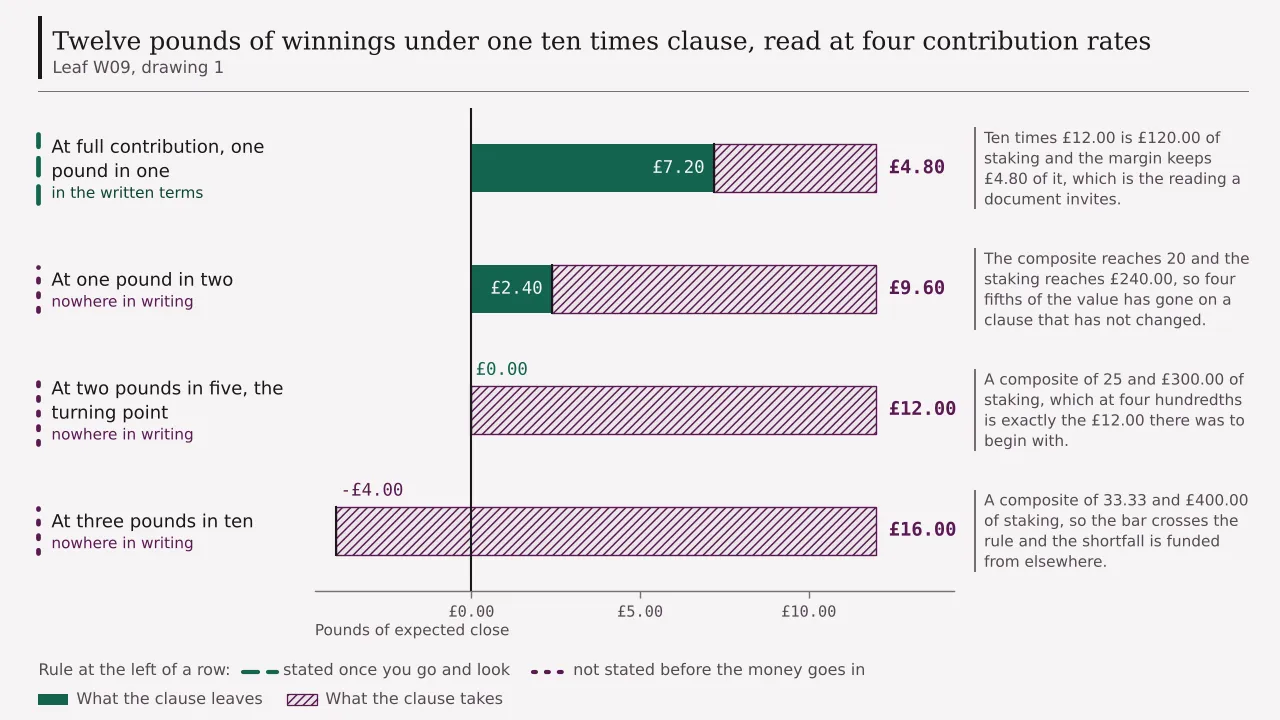
That lowest bar reaches across the rule, the expected close having gone under nought, which is what a composite past the turning point produces by construction. Nothing on that drawing is a penalty, a fee or a forfeiture. It is the ordinary operation of four hundredths applied over and over to a sum of staking that one unpublished percentage quadrupled.
5
Solving for the rate at which a multiple stops paying
Part four fixed the multiple and moved the rate. Turn the solve round and the result is tidier than anything else on this subject. For any printed multiple there is exactly one contribution rate at which the composite reaches 25 and the winnings are expected to be surrendered in full, and the rate is the multiple divided by twenty-five.
That single division answers the question a reader actually has. A clause of ten times fails at two pounds in five. A clause of twenty times fails at four pounds in five. A clause of five times survives down to one pound in five. The arithmetic is one step long and it converts a printed figure into the exact condition under which the printed figure becomes worthless.
| Multiple a clause prints | Rate at which nothing survives | Staking at that rate | How much room the clause leaves |
|---|---|---|---|
| Five times | 20 per cent | £300.00 | Four fifths of the range still safe |
| Ten times | 40 per cent | £300.00 | Three fifths still safe, and the rest is not |
| Fifteen times | 60 per cent | £300.00 | Two fifths safe, with common rates already outside |
| Twenty times | 80 per cent | £300.00 | Only a fifth of the range remains |
| Twenty-five times | 100 per cent | £300.00 | Nothing at all, even at full contribution |
The third column repeats itself, which looks like an error and is the point. Whatever multiple is printed, the staking that exhausts £12.00 of winnings is £300.00, because £300.00 at four hundredths is precisely £12.00. The multiple and the rate are two ways of arriving at one sum, and once the sum is reached it makes no difference which of the two got it there.
£300.00 of staking exhausts £12.00 of winnings, whichever pair of numbers produces it
Read the right-hand column as a measure of how much ignorance a clause can absorb. Five times is robust: a reader assuming full contribution and meeting a quarter would still have something left. Twenty times is fragile: anything below four pounds in five takes it under, and rates below that are ordinary enough that this site has seen one described on a regulator’s own consultation page. Twenty-five times has no room at all.
None of which requires anybody to behave badly. A clause of twenty times written over a category contributing at a half is a clause that cannot be beaten in expectation, and both halves of it may be perfectly accurate, published in the ordinary way and drafted without any intention of that result. The arithmetic does not care, which is the one thing arithmetic is good for here.
6
Multiples already past the line at any rate whatever
Run the division past twenty-five and it produces an answer with no meaning, which itself means something. A multiple of thirty needs a contribution rate of 120 per cent before the composite comes down to the turning point, and no schedule anywhere counts a pound staked as more than a pound. A multiple of forty needs 160 per cent. Both are unreachable, so both clauses are expected to take the entire winnings even where every pound staked counts in full.
A clause asking forty times is in exactly that state, forty being what gets printed out here once no ceiling applies. At full contribution a forty times clause over £12.00 asks £480.00 of staking, of which four hundredths is £19.20, so the expected close is minus £7.20. Drop the rate to three pounds in ten and the demand becomes £1,600.00, the margin takes £64.00 and the close is minus £52.00. Twelve pounds of winnings has produced a fifty-two pound expected hole.
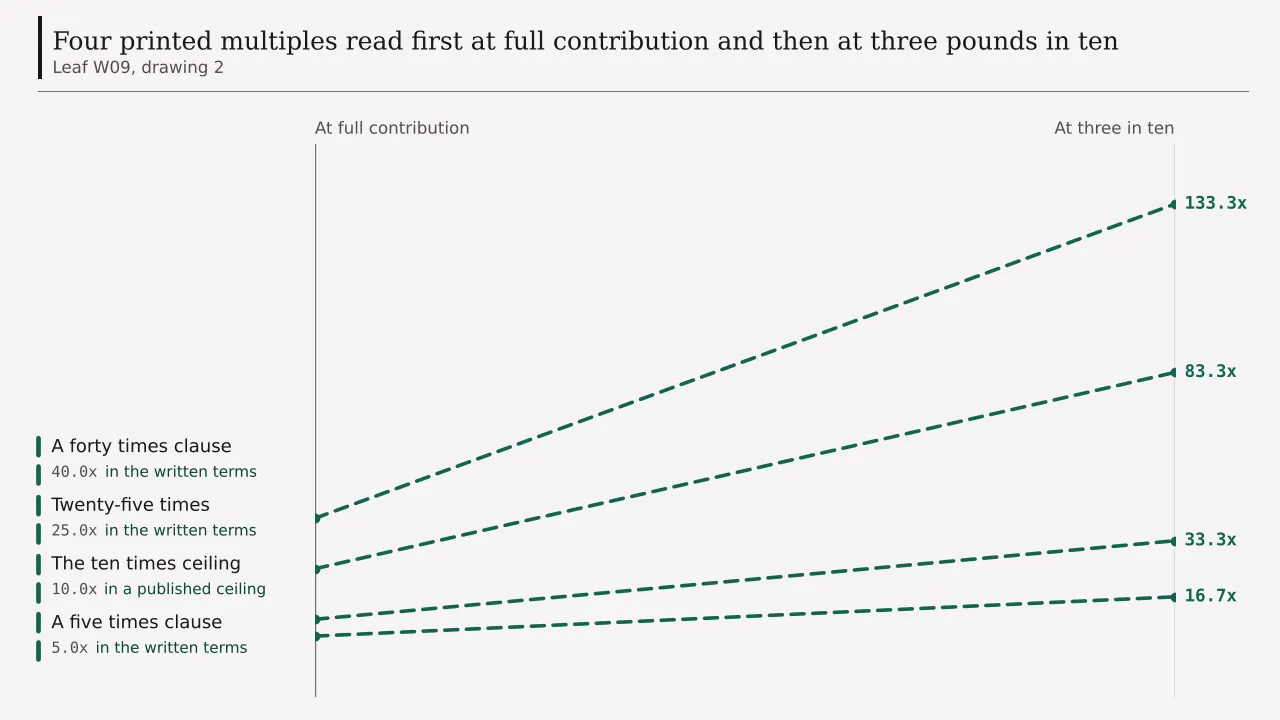
What that drawing shows is a reordering. At full contribution the four clauses sit in the order anybody would expect, and the smallest of them is the only one under the turning point by a wide margin. At three pounds in ten the smallest clause has become a composite of 16.67, which is still under the line, while the ten times clause has passed it. A reader comparing a five times clause against a ten times clause is therefore comparing two things that may be on opposite sides of the only boundary that matters.
Notice which of the two readings a reader is in a position to perform. The left-hand one needs nothing but the advertisement and the terms. The right-hand one needs a quantity published in a schedule the promotion does not link to, or not published at all. So the reading a reader can do is the reading that puts every clause in a flattering order, and the reading that reorders them is the one behind the schedule.
One honest qualification. Nothing above establishes three pounds in ten as a usual rate, and no pretence is made here that it does. The figure is used because it appears in a respondent’s own description on a published consultation page, folded into this leaf’s arithmetic rather than quoted as a market fact, and every table above runs across a band precisely so that no single rate has to carry the argument.
7
The same obligation counted in presses rather than pounds
Pounds of staking understate what a clause asks, because a pound of staking is ten presses at this site’s assumed value and a press takes a measurable length of time. Converting the obligation into presses turns an abstract sum into a quantity of evenings, and the conversion is a single division.
At full contribution the ten times clause on £12.00 asks £120.00, which is 1,200 presses. At one pound in two it asks 2,400. At three pounds in ten it asks 4,000. At a tenth it asks 12,000. Those four press counts describe one identical sentence read against four values of a quantity the sentence never mentions.
Put time against them by folding in the published floor on how soon a licensed reel build may reopen a cycle, after which 4,000 presses cannot be finished in under two hours and forty-seven minutes, while 12,000 presses cannot be finished in under eight hours and twenty minutes. Where a clause also carries a window of a few days, those are the figures that decide whether the window is reachable at all, and the window is ordinarily in the same document as the multiple.
| Pounds counted per pound staked | Staking demanded | Presses at 10p | Shortest possible sitting | What that does to a seven-day window |
|---|---|---|---|---|
| One pound in one | £120.00 | 1,200 | 50 minutes | Comfortable on any single evening |
| One pound in two | £240.00 | 2,400 | 1 hour 40 minutes | Still one evening, with nothing else in it |
| Three pounds in ten | £400.00 | 4,000 | 2 hours 47 minutes | Two or three evenings out of the seven |
| One pound in ten | £1,200.00 | 12,000 | 8 hours 20 minutes | An hour and ten minutes every day of it |
The right-hand column is where the unpublished quantity meets a published one. A window is a term in the promotional document, printed, findable and usually read. A contribution rate is not. Between them they settle whether somebody holding down a job can finish the offer, and at the moment of deciding a reader has just one of the pair.
One caution on the shortest sittings. They assume pressing without a break at the fastest rate a licence leaves room for, which nobody manages, and they assume the floor applies at all, which away from a British licence it does not. The first assumption makes the column an underestimate of real time, and the second can make it an overestimate of the minimum. Both are stated here rather than buried, and neither moves a single money figure on this leaf.
8
What a ceiling on the stated figure does not reach
A British licence puts a ceiling on this clause, and the shape of that ceiling is the most interesting published fact on the subject, because of what it measures and what it leaves alone. The ceiling is written over the multiple. The composite escapes it entirely.
Ten times over is as far as bonus funds may be played through by a licensee, a limit standing in a published ceiling since 19 January 2026. What gets capped is defined in the Commission’s own consultation response: the total value of the wagers owed before funds turn withdrawable. Every licence falls inside the scope line apart from the machine technical sort and the software sort. What the ceiling displaced is published as well, some licensees then applying as much as sixty times, which the regulator put on record.
Work that against part five and the limit of the instrument becomes visible. The cap holds the printed figure at ten. Part five showed that ten becomes worthless at a contribution rate of two fifths. So a licensee may comply with the ceiling exactly, publish a multiple at the lowest figure it has ever been held to, and still have written a clause that is expected to surrender the whole of the winnings, provided the reel the spins attach to counts at two pounds in five or less. Nothing in the cap reaches that, and the Commission recorded the point about weighting in the same response without acting on it.
Spin awards on reel games in this bracket are made by businesses that hold no Great Britain licence. A leaf whose subject is a multiplier owes a narrower list of losses than most, and the narrowness is part of the honesty. Gone is the ceiling that holds a printed multiple to ten, so the figure in the clause is whatever a document says, and the sixty times the regulator once recorded is available again. Gone with it is the definition that makes the capped quantity a definite thing, namely the total staking owed before funds may be withdrawn, which is the sentence that stops a clause being measured in whatever unit suits. Gone is the scope line that sweeps every remote casino licence into the same cap, so nothing establishes that a given offer was ever inside its reach. What is not lost is any rule about contribution, because no such rule exists on either side of the licence, and a leaf that counted weighting among the losses would be claiming a protection that was never there.
Two published gaps belong beside that, because they bound what anybody may honestly say. Whether a free spin’s winnings count as bonus funds when the ceiling is applied has not been published, so the chain a reader can state runs only this far: where such winnings are credited as bonus funds, a requirement over them is held to ten. And no primary source publishes a current schedule of contribution rates at all, which is why every rate on this leaf is a band entry rather than a market figure.
The concession that keeps this fair is short. A rulebook from one offshore regulator, read for this site, does want bonus conditions communicated with clear terms and does forbid promotion pitched at play of an excessive sort. It carries no ceiling over a multiple, and carries nothing at all about contribution, which holds equally of the British rules. On that one quantity the two regimes are as silent as each other, and the whole difference lies in the cap.
9
Three things nobody publishes about any of this
Three quantities have travelled the whole way down this leaf with nothing behind them. Each is labelled where it is spent, and collecting them here is the honest close, because the argument above is only as good as the admissions under it.
First is the contribution rate, which is nowhere in writing across a good many awards and, on the rest, in a help article no promotion bothers to link. No rule compels a schedule, no primary source publishes a typical value, and the three pounds in ten used above comes from a respondent’s own account on a consultation page rather than from any finding about the market. Every figure in parts four to seven inherits that status and the tables are built as bands for exactly that reason.
The second is the press value. Ten pence is this site’s standing setting and nothing fixes it, which matters here in a specific way: the count of presses behind an obligation moves in inverse proportion to it while the pounds of staking do not move at all. At 20p the £400.00 obligation is 2,000 presses rather than 4,000, so a higher press value makes an identical clause faster to work off and no cheaper. That is the only place on this leaf where two columns of the same table move in opposite directions.
The third is whether the clause attaches to the winnings or to something larger. This leaf assumes it bites on the £12.00 of expected winnings, which is the ordinary shape where no payment was asked for, and some documents instead write the requirement over the winnings and a deposit together. Whether a requirement reaching the deposit as well falls inside the published ceiling is not stated anywhere, so this leaf states the chain and stops, and a reader meeting a clause of that shape should treat every figure in part four as a floor.
One further absence carries no number at all and still deserves a name. Where the spins are tied to one named reel game, the rate that game counts at may differ from the rate the account applies once the balance moves elsewhere, and nothing obliges a document to say which applies when. A reader who clears part of an obligation on one game and part on another has an effective rate that is a weighted average of two numbers neither of which they were given.
Not one of those four admissions damages the method. The composite is still the only quantity that decides anything, the turning point is still 25 at the return this leaf holds, and the division in part five still converts a printed multiple into the exact rate at which it fails. What the admissions fix is the width of the answer, and a band honestly drawn is a better object than a point estimate quietly invented.
10
Running the solve on any offer paying spins
Four steps make up the procedure, and the only figure it borrows from this leaf is the turning point. Find the winnings, find the printed multiple, get the rate by one of the three routes in part three, and divide. What comes out is a single number that answers the only question worth asking.
Step one, convert the spin count into money. Count times press value gives the stake crossing the reels, and stake times the return gives expected winnings. On a hundred and twenty-five spins at 10p that is £12.50 and £12.00. Where the press value is missing, and it usually is, say so in the same sentence that uses whatever value is assumed, since the whole of the rest scales with it.
Step two, read the multiple out of the promotional document rather than the advertisement. It is ordinarily in a numbered clause with the window beside it, and the two should be read together because part seven showed how the window and the rate interact.
Step three, get the rate. A stated obligation in pounds gives it by two divisions. A counter gives it by staking £20.00 and watching the movement, at a cost of 80p. A schedule of categories gives it by reading. Where none of those is available, do not guess a rate: run the table at a half, at two fifths and at three tenths, and print all three answers.
Step four, divide the multiple by the rate and compare the result with twenty-five. Under it, the winnings are expected to survive and the arithmetic says by how much. At it, they are expected to be gone exactly. Over it, the demand for margin outruns what the winnings hold, and the shortfall is funded out of whatever the account was already carrying, which is the case an advertisement never describes.
Two habits make the method durable. Always put the two readings side by side and rule off whatever separates them, so that the sum attributable to the unpublished quantity is visible rather than implied. And treat full contribution as a ceiling rather than a default, because the one thing established beyond argument here is that every departure from it runs in the same direction.
Applied to the worked offer the method yields six figures and no adjectives. £12.50 across the reels, £12.00 of expected winnings, a printed multiple of ten, an obligation of £400.00 at three pounds in ten, an expected close of minus £4.00 and a difference of £16.00. Five of the six follow from the document. The sixth is the one that reverses the sign, and it is the one the document does not contain.
Questions
- What is game weighting actually doing to a free spins offer?
- Dividing. The staking a clause demands is the multiple times the winnings divided by the contribution rate, so a rate below one raises the demand in exact inverse proportion while the sentence on the page reads identically. On 125 spins at 10p the expected winnings are £12.00, a ten times clause asks £120.00 of staking at full contribution, and the same clause asks £400.00 where three pounds in ten count. One unpublished percentage, one unchanged clause, and more than three times the obligation.
- What is the effective multiple, and why does only it matter?
- It is the printed multiple divided by the contribution rate, and it is the number every figure a reader cares about follows from. A printed ten against three pounds in ten gives a composite of 33.33. The expected close is the winnings multiplied by one less the composite times four hundredths, so at a composite under twenty-five something survives, at exactly twenty-five the winnings are expected to be surrendered in full, and above it the demand for margin outruns what the winnings contain.
- At what weighting does a ten times wagering requirement become worthless?
- Two pounds in five. The rate at which any printed multiple reaches the turning point is that multiple divided by twenty-five, so ten times fails at 40 per cent, twenty times fails at 80 per cent and five times survives down to 20 per cent. At that rate the ten times clause on £12.00 of winnings asks £300.00 of staking, and £300.00 at four hundredths is precisely £12.00, which is the whole of what there was.
- How can I work out the weighting when nobody publishes it?
- Three routes, each exact. Where the account states an obligation in pounds, divide it by the winnings to get the composite and divide the printed multiple by that to get the rate. Where a counter advances as staking happens, push £20.00 across the reels and read the movement, which costs 80p of margin. Where a schedule of game categories exists in a help article, read the rate off it. Where none of the three is open, run the arithmetic at several rates and print them all.
- Why is twenty-five the number everything is compared against?
- Because it is the reciprocal of what a 96 per cent return leaves with the margin, which is four pence on the pound, and that makes it arithmetic rather than commercial practice. At a composite of twenty-five the expected cost of the staking equals the winnings exactly. Drop the return to 95 and the point moves down to twenty; lift it to 97 and it moves out to 33.33. This leaf holds 96 throughout and says so wherever the figure is spent.
- Does the ten times cap in Great Britain fix this?
- It fixes half of it. Ten times over is as far as bonus funds may be played through by a licensee, and has been since 19 January 2026, with what gets capped defined as the total value of the wagers owed before funds turn withdrawable and every licence falling inside the scope line apart from the machine technical sort and the software sort. The cap is written over the printed figure. A compliant ten times clause written over a reel counting at two pounds in five is still expected to surrender the whole of the winnings, and nothing in the cap reaches that.
- What does a forty times clause look like once weighting is applied?
- Already past the line before weighting is applied at all. A multiple of forty would need a contribution rate of 160 per cent to bring the composite down to twenty-five, and no schedule counts a pound staked as more than a pound. At full contribution forty times over £12.00 asks £480.00 of staking, hands the margin £19.20 and closes at an expected minus £7.20. At three pounds in ten it asks £1,600.00, surrenders £64.00 and closes at minus £52.00.
- How many spins does all that staking actually amount to?
- At 10p a press, the £120.00 a ten times clause asks at full contribution is 1,200 presses, £240.00 at one pound in two is 2,400, £400.00 at three pounds in ten is 4,000 and £1,200.00 at a tenth is 12,000. Fold in the published floor on how soon a licensed reel build may reopen a cycle, after which 4,000 presses cannot be finished in under two hours and forty-seven minutes, while 12,000 cannot be finished in under eight hours and twenty minutes.
- Is a smaller printed multiple always the better offer?
- No, and the comparison fails exactly where it matters. A fifteen times clause at full contribution has a composite of fifteen and leaves £3.00 of the worked winnings standing. A ten times clause at two pounds in five has a composite of twenty-five and leaves nothing. The smaller printed figure is the worse arrangement, and no reading of the two advertisements would tell anybody so, because the quantity that reorders them is in neither.
- Which protections disappear where spins of this shape come from offshore?
- Three things, and the honest list is shorter than usual. Gone is the ceiling holding a printed multiple to ten, so a document may ask whatever it likes and the sixty times a regulator once put on record is available again. Gone is the definition that makes the capped quantity a definite thing, namely the staking owed in total before funds turn withdrawable. Gone is the scope line that sweeps every remote casino licence into the same cap. No rule about contribution is lost, there being none to lose on either side of the licence.
- What should I actually do when the weighting is not stated?
- Convert the spin count to money, read the printed multiple out of the promotional document rather than the advertisement, try the three routes to the rate, and divide the multiple by whatever the rate turns out to be. Where no route is open, do not guess: run the figures at a half, at two fifths and at three tenths and print all three. Then put the two readings side by side and rule off whatever separates them, so that the sum attributable to the unpublished quantity is visible rather than implied.