Terms read 19 October 2026 Leaf T09, revision 1
Keep what you win: three words, one made on the banner and all three defined elsewhere
Thirty presses at 10p put £3.00 across the reels and are expected to leave £2.88 standing. The promise takes one condition off that £2.88 and leaves four in place, none of them written where the promise is made. Against a withdrawal floor of £20.00 the kept sum moves £0.00. Kept is accurate. Paid is a different verb.
Stated on the banner £2.88 Thirty presses, 10p apiece, 96 in the hundred coming back. The count is printed and the pence are not. Stated, once you go and look £0.00 A smallest payment out of £20.00, assumed throughout this leaf, which a residue of £2.88 never reaches. Not stated before the money goes in 3 quantities What one press is worth in pence, what the reels contribute towards anything, and how long a payment sits before it lands.
Spin offers with no payment asked, terms read
Every destination in this file is bought advertising. The site is paid a fee if a reader goes on to register, and no figure printed below moves because of it.
Bonus Spins UK Slip 01
Betportal
Ceiling as a multiple
The drop
€15.00
€1.00 in the euro
The claim reads €15.00. Once the terms beside it have applied, €0.00 of it can leave. The difference is the drop.
7 of the 15 terms on this slip could not be read before the money went in
Spins priced at this site's own 10p a spin, which the operator does not publish
Stated
€15.00
The claim as it is printed, before a single term has been applied to it.
Headline paid as spins
150 spins at 10c each, which is €15.00 of the figure above.
6 Nowhere
What one spin is worth
No unit is published for a spin, so the count is priced at this site's own 10p a spin. At half that price every figure below halves with it.
Match and other credit not priced
300% of three deposits, to a ceiling of €1,000. A share of a deposit nobody has made yet is not a sum, so no figure stands on this line and none is carried below.
Qualified
-€14.40
Written down somewhere, and taking part of the claim back. Each term carries the place it is written and the sum it takes.
2 Written terms at a distance this record does not establish
Play-through -€14.40
Carrying €14.40 through 35 times stakes €504.00 and costs €20.16 of it at 96 per cent return. That prices above the €14.40 there is to charge it against, so the whole of the credit goes and the line is held at that. The multiple sits on the bonus.
2 Written terms at a distance this record does not establish
Game weighting not priced
Slots only count towards the play-through. No contribution percentage is published, so the line above has been worked at full weight, which is the kindest reading there is.
2 Written terms at a distance this record does not establish
Ceiling on the winnings not priced
5x the bonus.
2 Written terms at a distance this record does not establish
Clock on the credit not priced
14 days.
2 Written terms at a distance this record does not establish
Largest stake while it runs not priced
€5.
3 Public record
Licence, and who holds it not priced
Licensed in Anjouan, Comoros, held by BetPortal Gaming Ltd, with Excite Ultra Media Ltd, reference ALSI-202601040-FI2. A register entry settles who holds a licence and what it permits. It does not settle who is running the site this morning.
4 Cashier
Smallest qualifying deposit your money
€20 a stage. That is €20.00 of your own money, and it is never netted into a drop.
5 On the way out
Checks before a withdrawal not priced
Documents before the first withdrawal.
Unstated
-€0.60
Applying without having been published anywhere, and costing money all the same.
6 Nowhere
What a spin hands back -€0.60
Staking a spin returns 96 per cent of it, so that share of the batch is the house's before a reel turns. This site works at that return and the operator publishes none where the claim is made.
6 Nowhere
Forfeited by rule cost unknown
Nothing is published under this heading, and it applies regardless.
6 Nowhere
Charge on the way out cost unknown
No charge on the way out is published as a figure, so nothing comes off this line. A charge that exists unpublished would come straight off whatever survives.
6 Nowhere
Smallest withdrawal allowed cost unknown
No smallest withdrawal is published as a figure. A floor nobody has published is still a floor, and it decides whether a small balance can move at all.
No Great Britain licence
Terms read 19 October 2026
Bonus Spins UK Slip 02
WinBeast
Ceiling as a sum
The drop
€50.00
€1.00 in the euro
The claim reads €50.00. Once the terms beside it have applied, €0.00 of it can leave. The difference is the drop.
8 of the 15 terms on this slip could not be read before the money went in
Spins priced at this site's own 10p a spin, which the operator does not publish
Stated
€50.00
The claim as it is printed, before a single term has been applied to it.
Headline paid as spins
500 spins at 10c each, which is €50.00 of the figure above.
6 Nowhere
What one spin is worth
No unit is published for a spin, so the count is priced at this site's own 10p a spin. At half that price every figure below halves with it.
Match and other credit not priced
50% to 100% of five deposits, each to a ceiling of €1,000, and a €650 free bet. A share of a deposit nobody has made yet is not a sum, so no figure stands on this line and none is carried below.
Qualified
-€48.00
Written down somewhere, and taking part of the claim back. Each term carries the place it is written and the sum it takes.
2 Written terms at a distance this record does not establish
Play-through -€48.00
Carrying €48.00 through 40 times stakes €1,920.00 and costs €76.80 of it at 96 per cent return. That prices above the €48.00 there is to charge it against, so the whole of the credit goes and the line is held at that. The multiple sits on the bonus and the winnings from the spins.
2 Written terms at a distance this record does not establish
Game weighting not priced
Slots, titles vary by country count towards the play-through. No contribution percentage is published, so the line above has been worked at full weight, which is the kindest reading there is.
2 Written terms at a distance this record does not establish
Ceiling on the winnings not priced
€100 a batch of spins.
2 Written terms at a distance this record does not establish
Clock on the credit not priced
7 days, spins 1 day.
3 Public record
Licence, and who holds it not priced
Licensed in Curaçao, holder not named on the site. A register entry settles who holds a licence and what it permits. It does not settle who is running the site this morning.
4 Cashier
Smallest qualifying deposit your money
€20 a stage. That is €20.00 of your own money, and it is never netted into a drop.
5 On the way out
Checks before a withdrawal not priced
Documents before the first withdrawal.
Unstated
-€2.00
Applying without having been published anywhere, and costing money all the same.
6 Nowhere
What a spin hands back -€2.00
Staking a spin returns 96 per cent of it, so that share of the batch is the house's before a reel turns. This site works at that return and the operator publishes none where the claim is made.
6 Nowhere
Largest stake while it runs cost unknown
Nothing is published under this heading, and it applies regardless.
6 Nowhere
Forfeited by rule cost unknown
Nothing is published under this heading, and it applies regardless.
6 Nowhere
Charge on the way out cost unknown
No charge on the way out is published as a figure, so nothing comes off this line. A charge that exists unpublished would come straight off whatever survives.
6 Nowhere
Smallest withdrawal allowed cost unknown
No smallest withdrawal is published as a figure. A floor nobody has published is still a floor, and it decides whether a small balance can move at all.
No Great Britain licence
Terms read 19 October 2026
Bonus Spins UK Slip 03
EliteSpin
Longest spin window
The drop
£50.00
£1.00 in the pound
The claim reads £50.00. Once the terms beside it have applied, £0.00 of it can leave. The difference is the drop.
8 of the 15 terms on this slip could not be read before the money went in
Spins priced at this site's own 10p a spin, which the operator does not publish
Stated
£50.00
The claim as it is printed, before a single term has been applied to it.
Headline paid as spins
500 spins at 10p each, which is £50.00 of the figure above.
6 Nowhere
What one spin is worth
No unit is published for a spin, so the count is priced at this site's own 10p a spin. At half that price every figure below halves with it.
Match and other credit not priced
50% to 100% of five deposits, each to a ceiling of £1,000. A share of a deposit nobody has made yet is not a sum, so no figure stands on this line and none is carried below.
Qualified
-£48.00
Written down somewhere, and taking part of the claim back. Each term carries the place it is written and the sum it takes.
2 Written terms at a distance this record does not establish
Play-through -£48.00
Carrying £48.00 through 40 times stakes £1,920.00 and costs £76.80 of it at 96 per cent return. That prices above the £48.00 there is to charge it against, so the whole of the credit goes and the line is held at that. The multiple sits on the bonus and the winnings from the spins.
2 Written terms at a distance this record does not establish
Game weighting not priced
Slots count towards the play-through. No contribution percentage is published, so the line above has been worked at full weight, which is the kindest reading there is.
2 Written terms at a distance this record does not establish
Ceiling on the winnings not priced
5x the bonus.
2 Written terms at a distance this record does not establish
Clock on the credit not priced
7 days, spins 3 days.
3 Public record
Licence, and who holds it not priced
Licensed in Costa Rica, held by PrimeTier Limited. A register entry settles who holds a licence and what it permits. It does not settle who is running the site this morning.
4 Cashier
Smallest qualifying deposit your money
£20 a stage. That is £20.00 of your own money, and it is never netted into a drop.
5 On the way out
Checks before a withdrawal not priced
Documents before the first withdrawal.
Unstated
-£2.00
Applying without having been published anywhere, and costing money all the same.
6 Nowhere
What a spin hands back -£2.00
Staking a spin returns 96 per cent of it, so that share of the batch is the house's before a reel turns. This site works at that return and the operator publishes none where the claim is made.
6 Nowhere
Largest stake while it runs cost unknown
Nothing is published under this heading, and it applies regardless.
6 Nowhere
Forfeited by rule cost unknown
Nothing is published under this heading, and it applies regardless.
6 Nowhere
Charge on the way out cost unknown
No charge on the way out is published as a figure, so nothing comes off this line. A charge that exists unpublished would come straight off whatever survives.
6 Nowhere
Smallest withdrawal allowed cost unknown
No smallest withdrawal is published as a figure. A floor nobody has published is still a floor, and it decides whether a small balance can move at all.
No Great Britain licence
Terms read 19 October 2026
Bonus Spins UK Slip 04
Crown Jewelz
Multiple unpublished
The drop
NOT WORKED
The multiple is not published in the operator's own terms. Since the sum cannot be worked around it, none is worked.
9 of the 14 terms on this slip could not be read before the money went in
No drop worked
Stated
£15.00
The claim as it is printed, before a single term has been applied to it.
Headline paid as spins
150 spins at 10p each, which is £15.00 of the figure above.
6 Nowhere
What one spin is worth
No unit is published for a spin, so the count is priced at this site's own 10p a spin. At half that price every figure below halves with it.
Match and other credit not priced
200% of the first deposit, then 150% twice, each to a ceiling of £1,000. A share of a deposit nobody has made yet is not a sum, so no figure stands on this line and none is carried below.
Qualified
NOT WORKED
Written down somewhere, and taking part of the claim back. Each term carries the place it is written and the sum it takes.
2 Written terms at a distance this record does not establish
Play-through not priced
40x the bonus, reported rather than published by the operator.
2 Written terms at a distance this record does not establish
Game weighting not priced
Slots count towards the play-through. No contribution percentage is published, so the line above has been worked at full weight, which is the kindest reading there is.
3 Public record
Licence, and who holds it not priced
Licensed in Curaçao, number not verified, holder not named on the site. A register entry settles who holds a licence and what it permits. It does not settle who is running the site this morning.
4 Cashier
Smallest qualifying deposit your money
£20. That is £20.00 of your own money, and it is never netted into a drop.
5 On the way out
Checks before a withdrawal not priced
Documents before the first withdrawal.
Unstated
NOT WORKED
Applying without having been published anywhere, and costing money all the same.
6 Nowhere
Ceiling on the winnings cost unknown
No ceiling is published. Nothing is assumed in its place.
6 Nowhere
Clock on the credit cost unknown
Nothing is published under this heading, and it applies regardless.
6 Nowhere
Largest stake while it runs cost unknown
Nothing is published under this heading, and it applies regardless.
6 Nowhere
Forfeited by rule cost unknown
Nothing is published under this heading, and it applies regardless.
6 Nowhere
Charge on the way out cost unknown
No charge on the way out is published as a figure, so nothing comes off this line. A charge that exists unpublished would come straight off whatever survives.
6 Nowhere
Smallest withdrawal allowed cost unknown
No smallest withdrawal is published as a figure. A floor nobody has published is still a floor, and it decides whether a small balance can move at all.
No Great Britain licence
Terms read 19 October 2026
Every figure in the second and third columns is this site's own working and nothing an operator has published. A claim is priced as printed, then the share a spin hands back at 96 per cent return comes off it, then what playing the multiple through costs at the same return, and then whatever a published ceiling, a charge on the way out or a floor on the smallest withdrawal takes from what has survived. The drop is the difference between the first figure and the last. The two columns add back up to it exactly, so no money leaves a slip without a term and a place beside it.
Which column a term falls in is settled by one question: has anybody written it down. A charge a reader meets at the payment screen is written down, and it stands in the second column with the cashier against it. A condition that binds without ever having been set down stands in the third, whatever it costs. Inside each column the terms run outwards from the banner, so the order itself says how far a reader would have had to go.
A count of spins has no unit until one is supplied. Where an operator publishes what one of its own spins is worth, that figure is used and the first column says it is theirs. Where none is published, this site's own 10p a spin stands in its place and every figure below moves in proportion with it. Where the multiple itself is unpublished, no drop is worked at all, because that is the one figure the sum cannot be done without.
Three words stand where a figure cannot. Not priced is a term that is written down and carries no number the arithmetic can take. Cost unknown is a term nobody has written down, costing something nobody has put a number on. Your money is money of the reader's own, which is never netted into a drop.
None of the operators in this file holds a Great Britain licence, so none of the duties that licence carries reaches them. Each of those duties is published in its own right, which is what makes its absence here something a reader can check rather than take on trust. Every gambling company licensed in Great Britain belongs to Gamstop Online, so a reader who has shut themselves out through the scheme is not shut out here. Social Responsibility Code 5.1.1 has held a play-through to a maximum of ten times the bonus funds since 19 January 2026, and it binds a licence holder and nobody else. Asked in a post of 21 October 2025 what is lost along with the licence, the Gambling Commission's Director of Enforcement and Intelligence answered: "unfair gaming practices, financial loss, and a lack of recourse if things go wrong". The same post puts blocked payouts, and withdrawal limits pitched high enough to be unreachable, among the behaviour the Commission has recorded. Nobody under 18 may hold an account at any of them.
Terms are reproduced in the wording their operator published, and each slip is dated with the day somebody sat down and read them. 19 October 2026 is the oldest of those dates. Anybody claiming an offer is bound by that operator's full terms, which are elsewhere, and never by a line standing here.
1
A promise of three words, taken one word at a time
Three words carry the whole of this offer’s appeal, and each of the three is doing separate work. Keep is a verb about what happens to a sum. What is a quantity, and an unbounded quantity until something bounds it. You win names the base the other two apply to, which is narrower than a balance and is defined somewhere a reader has to go looking for.
The useful observation is not that the phrase is untrue. It is that the document making the promise and the documents defining its terms are not the same document. The promise appears , in three words. The definitions appear in the bonus terms, spread over several clauses, and one of the four conditions that survives the promise is in the account agreement instead, another document again.
So the method of this leaf is literal. Take the phrase apart word by word. For each word, find the clause that fixes its meaning, name which document that clause sits in, and work out what the word is worth once that clause is read. Then set the figure read off the three words against the figure that survives all of them, and subtract. On the numbers below the subtraction comes out at the whole of it.
Four conditions remain standing after the promise has done its work, and the promise touches none of them. A clock runs on the presses themselves. A second clock runs on whatever the presses leave behind. A smallest payment out of the account has to be reached before anything can move. A ceiling sits above the base. Each is written down. None is written beside the words that sell the offer.
2
What the verb is defined to mean, and in which clause
Start with the verb, since it is the word the offer is named after. What keep deletes is one clause and one only: the requirement to stake the winnings a given number of times before they become withdrawable. That clause is ordinarily the longest sentence in the promotional terms, and striking it out is a real concession rather than a cosmetic one.
Price the concession before pricing what it leaves behind, because an honest leaf has to do both. Take the residue of £2.88 established in part three. Had the ordinary forty times applied to it, the staking demanded would be £115.20, and with 96 in the hundred coming back the residue would close at minus £1.73, being £2.88 taken against a factor of minus 0.6. Deleting the clause lifts that figure to plus £2.88. The verb is therefore worth £4.61 in expectation, and that is a genuine figure in a reader’s favour.
Now read what the verb does not say. It says nothing about when the sum may move, what the smallest movement is, how large the sum may grow, or how long it survives if nobody moves it. Those are four separate clauses, and the deletion of a fifth clause leaves every one of them exactly where it was. The offer is not misdescribed. It is described in a document that holds one of its five relevant clauses.
| Clause | Where it is settled | Worth on this offer |
|---|---|---|
| Staking demanded on the winnings | in the bonus terms | Deleted, worth £4.61 |
| Smallest sum that may leave the account | in the bonus terms | £20.00, assumed here |
| Ceiling on what the offer may pay | in the bonus terms | £75.00, assumed here |
| Expiry on the presses | in clause 3 | Binds a return visit |
| Expiry on whatever the presses leave | in the account agreement | Sweeps a stuck balance |
| What one press is worth in pence | nowhere in writing | Decides all of the above |
Both the floor and the ceiling used in that table are figures this leaf invents, and every sentence leaning on either one says so, since nothing citable here sets a standard for the smallest payment out or for the largest sum a promotion pays. They are chosen as plausible shapes, and the working is shown step by step so that it can be rerun against whatever figures a real document carries.
3
Thirty presses, three pounds committed, £2.88 standing
Thirty is the count on the banner and 10p is the value this site works to throughout. Multiplied, the offer commits £3.00 of stake, none of it money the reader put up. With 96 in the hundred coming back, the expected residue once the thirty are finished is £2.88.
The twelve pence between those two figures is the whole of what the promotion costs the house in expectation, before any of the four surviving conditions does anything at all. Twelve pence buys a registered account, a verified identity and a reader who has seen the lobby. Nothing in that sentence is a criticism. It is simply the scale the offer operates at, and it is four hundred times smaller than the ceiling the same terms draw above it.
The press value is the hinge and goes unwritten almost everywhere. At 10p the residue is £2.88. At 20p it is £5.76 and at 5p it is £1.44, so the single unpublished figure moves the answer by a factor of four across that range. A leaf that assumed a value without saying it was assuming would be hiding the most important number on the page inside a decimal point.
£3.00 of stake committed, £2.88 expected back, 12p the whole cost of the promotion
One pace figure is worth folding in here rather than quoting. A licensed slot build cannot let a fresh game cycle open until 2.5 seconds have gone by, so thirty presses occupy 75 seconds of a reader’s day at the very least. That is the floor under the pressing itself, and it matters in part six, where a clock measured in hours turns out not to be a constraint on anything a reader actually does.
4
A floor of twenty pounds under a balance of £2.88
Here is the clause the promise does not reach. A smallest payment out of the account, taken at £20.00 as this leaf’s own assumption, stands between the residue and a bank. The residue reaches 14.4 per cent of that figure and falls £17.12 short.
Four statements hold about £2.88 at the same moment, and an advertisement generally prints the first three. The sum has been won. It belongs to the account. No clause requires it to be staked again. It cannot be moved to a bank. The fourth is settled in the bonus terms, usually in the same list as the three words that sell the offer and several clauses below them.
Kept, read off the three words £2.88 Movable, once the £20.00 floor applies £0.00 The price of the clause the promise leaves standing £2.88
A subtraction that takes away the whole figure reads like an arithmetic slip and is not one. The deleted staking clause was worth £4.61 to a reader; the surviving floor is worth the entire £2.88 to the house. The offer gives with one clause and takes back rather more with another, and both of them sit in the same document, a single tap from the promise.
Two routes lead from £2.88 to a sum that can move, and both are worth pricing because readers take both. The first is to press on. The residue buys £72.00 of further staking before four pence in the pound has consumed it, which is 720 presses at 10p and something over half an hour of pressing at that interval. The most generous bound on touching £20.00 before touching nothing is 2.88 divided by 20, or 14.4 per cent, and that bound assumes no house margin whatever. The margin drags the real figure underneath it.
The second route is to pay the difference in. Adding £17.12 lifts the balance to £20.00, at which point 85.6 per cent of the account came out of a bank and 14.4 per cent was the gift. A payment of that size commonly has to be staked once before it can be taken out again, which is this leaf’s own assumption about ordinary drafting rather than a sourced rule, and a payment is also the event that most reliably starts the identity work. So the route that reaches the floor is the route that puts a queue on the way out.
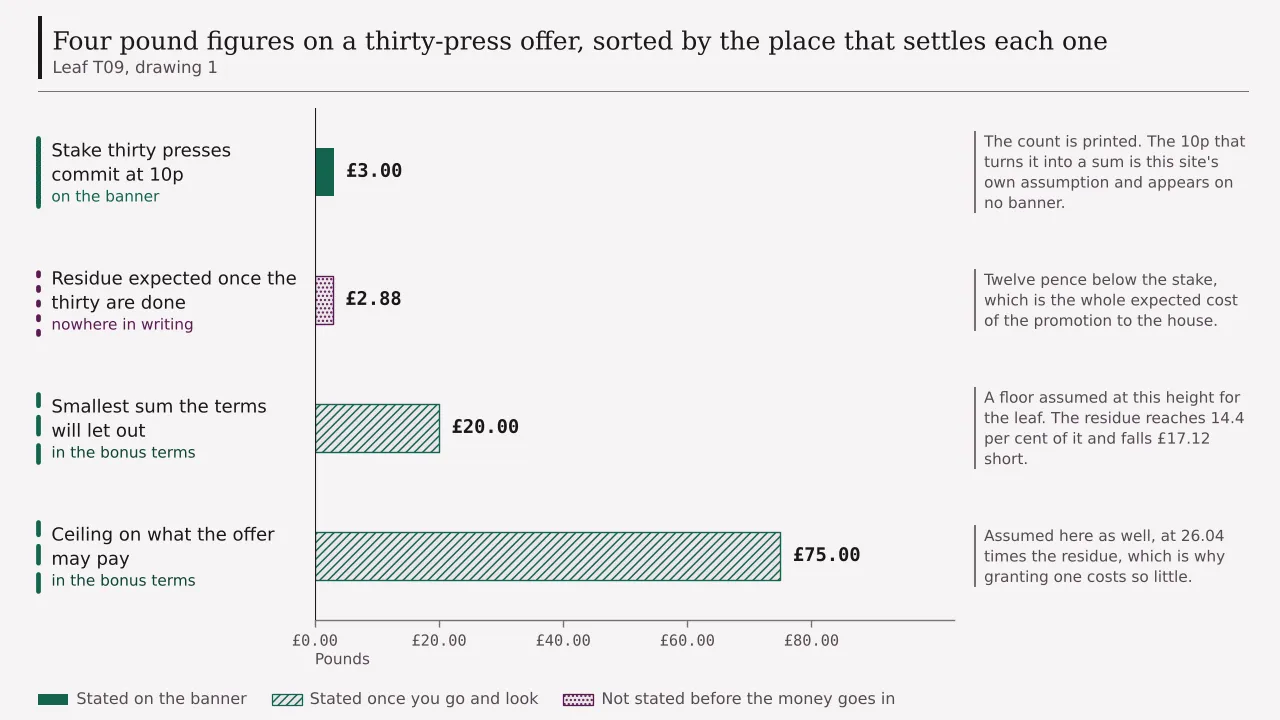
What the drawing shows is a balance sitting in the strip the terms leave unusable. Below the floor nothing moves. The band between £2.88 and £20.00 is where almost every reader of an offer this size finishes, and it is the part of the range neither the floor nor the ceiling was drawn to catch.
5
The second word, and the ceiling drawn above it
The middle word of the phrase is a quantity with nothing attached to it. A reader meeting what you win supplies no upper bound of their own, because the phrase invites none. The terms supply one, and on this leaf it is taken at £75.00 as an assumption, no source this site can cite publishing a standard figure for it.
Set that ceiling against the residue and the proportions are odd. £75.00 is 26.04 times £2.88. The most generous bound on reaching it from the residue, again assuming no house margin at all, is 2.88 divided by 75, which is 3.84 per cent. Granting a ceiling at that height costs almost nothing, because the part of the range it removes is the part almost nobody arrives at.
Set the two bounds against one another and the drafting’s shape shows through. A floor at £20.00 removes the bottom of the range, where close to everybody finishes. A ceiling at £75.00 removes the top, where close to nobody does. Both appear as single lines in the same list of conditions, formatted identically, and one of them decides the offer while the other decorates it.
| Bound | Where it is settled | Figure | Times the residue | Most generous bound on reaching it |
|---|---|---|---|---|
| Smallest sum that may leave | in the bonus terms | £20.00 | 6.94 | 14.4 per cent |
| Largest sum the offer may pay | in the bonus terms | £75.00 | 26.04 | 3.84 per cent |
| Smallest payment the till accepts | at the cashier | Unknown until registered | Not computable | Not computable |
| Documents wanted before payment | on the way out | No figure | Not a sum | Delays, does not reduce |
The third row of that table is the one most likely to be overlooked, because it is a bound that is not a number until a reader is already registered. If the smallest payment a particular method will take exceeds £17.12, the shortfall route in part four is unavailable by that method, and a reader finds out at the payment screen rather than before it.
6
Two clocks in two documents, only one of them binding
An offer of this shape ordinarily runs two deadlines, and they are not the same deadline, do not start together, and are not written in the same place. One governs the presses. The other governs whatever the presses leave behind. This leaf takes 24 hours and 72 hours as its own assumed lengths, since no source it can cite publishes a standard for either.
The clock on the presses binds nothing a reader does inside a single visit. Thirty presses take 75 seconds at that interval and not less, so a day is roughly a thousand times longer than the activity it is supposedly limiting. What the clock really governs is whether the reader comes back, and it is written in clause 3 of the promotional terms where it looks like a restriction on play.
The clock on the residue is the one with money attached, and it is often settled in the account agreement rather than in the promotional terms, two documents from the promise. At 72 hours an unmoved residue is swept. For a reader holding £2.88 under a £20.00 floor, the sweep removes something that was never movable, so its cost is £0.00. For a reader who paid £17.12 in to clear the floor and then let the deadline pass, the sweep costs £20.00, of which £17.12 came out of a bank.
That asymmetry is the finding this part contributes to the subtraction. The deadline is free to whoever did nothing and expensive to whoever acted on the offer as intended, and its position in the furthest document is consistent with which of those two readers it was drafted for. Nothing on the banner distinguishes them.
7
Which of these an advertisement is obliged to carry
A rule does exist requiring the heavy conditions to travel with the claim rather than behind it. Where leaving a condition out would mislead, promotional material has to carry it clearly and prominently. The worked list of what counts covers who qualifies, whether anything has to be paid in, whether anything has to be staked, and deadlines on taking up or using whatever is offered. Three of the four surviving conditions on this offer are deadlines or demands of that kind.
Two decided cases show where the line has been drawn, and both are useful here precisely because neither turns on a wagering multiple. The earlier carries the date 31 July 2024: one way of paying had been shut out of an offer, the shutting out was noted down in small type among the full conditions and nowhere else, and what that gave a significant condition was held to be too little prominence. The later carries 27 August 2025: a voucher for a £5 free bet silently failed on one calendar day, a race meeting being the reason, the advertisement having said nothing of it, and the code was recorded as breached.
Both rulings are about a condition that sat somewhere a reader would not look. Neither is about a condition that was absent. That is the pattern worth carrying away from them, and it is the same pattern this leaf measures in pounds: the question is rarely whether a term exists, and almost always how far it sits from the sentence it qualifies.
Two further duties stand behind the advertising ones, and reach rather than content is what both are about. An inducement’s conditions have to read clearly, have to be transparent, have to be fair, and have to sit somewhere the person offered them can get to. Contract terms have to be transparent in the consumer-law sense and have to be sited where a customer can reach them. How many taps are too many goes unstated in both, which is the gap this leaf measures rather than complains about.
8
What the phrase is worth once the surviving conditions stand
Assemble the figures. The offer commits £3.00 of stake and is expected to leave £2.88. The promise deletes a clause worth £4.61 in expectation. The surviving floor at £20.00 makes the movable sum £0.00. The ceiling at £75.00 removes a band reachable on a most generous bound of 3.84 per cent. The deadline on the residue costs nothing to whoever leaves it alone and £20.00 to whoever cleared the floor and then forgot.
So the phrase is accurate and the arithmetic is unkind, and both of those are true at once. Keep is the right verb for what happens: the sum stays in the account and nobody takes it back. Paid would be the wrong verb, and nothing on the banner uses it. On this offer the distance between the two verbs comes to £2.88, which is the entire quantity the promotion puts into anybody’s hands.
There is one reading on which the offer is worth taking anyway, and an honest leaf states it. A reader who wanted to see a lobby, who was always going to register, and who treats £2.88 as a sample rather than as a balance, gets the sample at a cost of zero and loses nothing when the deadline sweeps it. The arithmetic turns against the reader who treats the residue as money and spends either time or £17.12 trying to turn it into money.
Offers shaped like this one sit outside the British licence, and the protections worth naming here are the ones that work at the exit, because the exit is where this leaf’s whole subtraction happens. Whichever company the account belongs to is a fact settled in the public register, and settled nowhere else whatsoever. A British licence forbids putting any ceiling over the sum a customer draws out of money they themselves paid in, which is a wholly different thing from a ceiling on what a promotion pays, and the two get confused constantly. It forbids an offer to undo a withdrawal after the request has been made. It forbids holding a payment for paperwork there was every chance to request at registration. And it brings the national self-exclusion scheme with it, a scheme whose own terms say plainly that it reaches nobody operating outside it. Take that quartet away and the floor, the ceiling and the sweep in the parts above all stand exactly as drafted, with nothing behind them but the drafting.
Questions
- Which clause does the three-word promise actually delete?
- One, and one only: the demand that the winnings be staked a stated number of times before any of the sum may leave. On a residue of £2.88 an ordinary forty times would demand £115.20 of staking and would drag the expected close down to minus £1.73, so deleting it moves the figure to plus £2.88 and the verb is worth £4.61. Nothing else in the terms is touched. Four conditions carry on standing, and the promise does not mention any of them.
- How much are 30 free spins worth before any condition applies?
- £2.88 in expectation. Thirty presses at the 10p this site works to commit £3.00 of stake, none of it money the reader put up, and each staked pound returns 96 pence. The twelve pence between £3.00 and £2.88 is the entire expected cost of the promotion to the house. The press value is the hinge and it is almost never published: at 20p the residue would be £5.76 and at 5p it would be £1.44.
- Can £2.88 be withdrawn to a bank?
- Not where the smallest sum allowed out stands at £20.00, which is the figure this leaf assumes and flags as an assumption. The residue reaches 14.4 per cent of that and falls £17.12 short. Four things are true at the same moment: the sum has been won, it belongs to the account, no clause asks for it to be staked again, and it cannot move. An advertisement prints the first three and stops.
- What happens if the residue is played up towards the floor?
- It buys £72.00 of further staking before four pence in the pound has eaten it, which is 720 presses at 10p and something over half an hour of pressing, no fresh game cycle being allowed to open until 2.5 seconds have gone by. The most generous bound on touching £20.00 before touching nothing is 2.88 divided by 20, or 14.4 per cent, and that bound assumes no house margin at all. The margin drags the real figure below it.
- Is paying in the shortfall a better route?
- It is the certain route rather than the better one. Adding £17.12 brings the balance to £20.00, after which 85.6 per cent of the account came out of a bank and 14.4 per cent was the gift. A payment of that size commonly has to be staked once before it can leave again, which is this leaf’s assumption about ordinary drafting rather than a sourced rule, and a payment is also the event that most reliably starts the identity work.
- What does a ceiling on the winnings do at this size?
- Very little, which is why it costs the house almost nothing to grant. A ceiling of £75.00, assumed here, stands 26.04 times above a residue of £2.88, and the most generous bound on reaching it is 2.88 divided by 75, or 3.84 per cent. The floor removes the bottom of the range where nearly everybody finishes and the ceiling removes the top where nearly nobody does, and both are printed as single lines in one list.
- Why are there two deadlines rather than one?
- Because the presses and the residue are different things and are governed separately. The deadline on the presses, taken at 24 hours here, binds nothing inside a visit: thirty presses occupy at least 75 seconds, so a day is about a thousand times longer than the activity. The deadline on the residue, taken at 72 hours, is the one with money attached, and it is often written in the account agreement rather than in the promotional terms, two documents from the promise.
- Does the sweep at the end of the window cost anything?
- For a reader holding £2.88 under a £20.00 floor it costs £0.00, because the sum was never movable and the sweep removes a holding rather than money. For a reader who paid £17.12 in to clear the floor and then let the deadline pass it costs £20.00, £17.12 of which came out of a bank. The deadline is free to whoever did nothing and expensive to whoever acted on the offer as it was meant to be acted on.
- Which of these conditions must an advertisement spell out?
- Any whose omission would mislead, carried clearly and prominently rather than parked behind a link. The worked list covers who qualifies, whether anything must be paid in, whether anything must be staked, and deadlines on taking up or using whatever is offered. A ruling dated 31 July 2024 held one shut-out way of paying too faintly flagged where it sat in small type among the full conditions, and one dated 27 August 2025 recorded a breach over a voucher for a £5 free bet that silently failed on a single calendar day.
- What protection is given up by taking this from outside Great Britain?
- Four things that work at the exit. A British licence forbids any ceiling over the sum a customer draws out of money they themselves paid in, which is not the same thing as a ceiling on what a promotion pays. It forbids an offer to undo a withdrawal after the request has been made. It forbids holding a payment for paperwork there was every chance to request at registration. And it brings the national self-exclusion scheme with it, a scheme whose own terms say plainly that it reaches nobody operating outside it.