Terms read 19 October 2026 Leaf H08, revision 1
150 free spins no deposit: a large count, a small sum, and which of them is exact
A hundred and fifty spins at ten pence is £15.00 of staking and an expected £14.40 back. The count is the one figure in the whole arrangement stated to the unit, published in advance and checkable by anybody. It is also the figure that decides least, and this leaf argues that the two facts are the same fact.
Stated on the banner 150 Exact to the unit, honoured in full, and silent about every quantity a reader would need to price it. Stated, once you go and look £14.40 The expected return once a price for a spin is imported, which is one decimal place away from the digits on the face. Not stated before the money goes in £576.00 The staking a forty times clause asks for, recorded a long way from the count in a document no advertisement opens.
Large-count offers, with their terms read
Every destination in this file is bought advertising. The site is paid a fee if a reader goes on to register, and no figure printed below moves because of it.
Bonus Spins UK Slip 01
Betportal
Ceiling as a multiple
The drop
€15.00
€1.00 in the euro
The claim reads €15.00. Once the terms beside it have applied, €0.00 of it can leave. The difference is the drop.
7 of the 15 terms on this slip could not be read before the money went in
Spins priced at this site's own 10p a spin, which the operator does not publish
Stated
€15.00
The claim as it is printed, before a single term has been applied to it.
Headline paid as spins
150 spins at 10c each, which is €15.00 of the figure above.
6 Nowhere
What one spin is worth
No unit is published for a spin, so the count is priced at this site's own 10p a spin. At half that price every figure below halves with it.
Match and other credit not priced
300% of three deposits, to a ceiling of €1,000. A share of a deposit nobody has made yet is not a sum, so no figure stands on this line and none is carried below.
Qualified
-€14.40
Written down somewhere, and taking part of the claim back. Each term carries the place it is written and the sum it takes.
2 Written terms at a distance this record does not establish
Play-through -€14.40
Carrying €14.40 through 35 times stakes €504.00 and costs €20.16 of it at 96 per cent return. That prices above the €14.40 there is to charge it against, so the whole of the credit goes and the line is held at that. The multiple sits on the bonus.
2 Written terms at a distance this record does not establish
Game weighting not priced
Slots only count towards the play-through. No contribution percentage is published, so the line above has been worked at full weight, which is the kindest reading there is.
2 Written terms at a distance this record does not establish
Ceiling on the winnings not priced
5x the bonus.
2 Written terms at a distance this record does not establish
Clock on the credit not priced
14 days.
2 Written terms at a distance this record does not establish
Largest stake while it runs not priced
€5.
3 Public record
Licence, and who holds it not priced
Licensed in Anjouan, Comoros, held by BetPortal Gaming Ltd, with Excite Ultra Media Ltd, reference ALSI-202601040-FI2. A register entry settles who holds a licence and what it permits. It does not settle who is running the site this morning.
4 Cashier
Smallest qualifying deposit your money
€20 a stage. That is €20.00 of your own money, and it is never netted into a drop.
5 On the way out
Checks before a withdrawal not priced
Documents before the first withdrawal.
Unstated
-€0.60
Applying without having been published anywhere, and costing money all the same.
6 Nowhere
What a spin hands back -€0.60
Staking a spin returns 96 per cent of it, so that share of the batch is the house's before a reel turns. This site works at that return and the operator publishes none where the claim is made.
6 Nowhere
Forfeited by rule cost unknown
Nothing is published under this heading, and it applies regardless.
6 Nowhere
Charge on the way out cost unknown
No charge on the way out is published as a figure, so nothing comes off this line. A charge that exists unpublished would come straight off whatever survives.
6 Nowhere
Smallest withdrawal allowed cost unknown
No smallest withdrawal is published as a figure. A floor nobody has published is still a floor, and it decides whether a small balance can move at all.
No Great Britain licence
Terms read 19 October 2026
Bonus Spins UK Slip 02
WinBeast
Ceiling as a sum
The drop
€50.00
€1.00 in the euro
The claim reads €50.00. Once the terms beside it have applied, €0.00 of it can leave. The difference is the drop.
8 of the 15 terms on this slip could not be read before the money went in
Spins priced at this site's own 10p a spin, which the operator does not publish
Stated
€50.00
The claim as it is printed, before a single term has been applied to it.
Headline paid as spins
500 spins at 10c each, which is €50.00 of the figure above.
6 Nowhere
What one spin is worth
No unit is published for a spin, so the count is priced at this site's own 10p a spin. At half that price every figure below halves with it.
Match and other credit not priced
50% to 100% of five deposits, each to a ceiling of €1,000, and a €650 free bet. A share of a deposit nobody has made yet is not a sum, so no figure stands on this line and none is carried below.
Qualified
-€48.00
Written down somewhere, and taking part of the claim back. Each term carries the place it is written and the sum it takes.
2 Written terms at a distance this record does not establish
Play-through -€48.00
Carrying €48.00 through 40 times stakes €1,920.00 and costs €76.80 of it at 96 per cent return. That prices above the €48.00 there is to charge it against, so the whole of the credit goes and the line is held at that. The multiple sits on the bonus and the winnings from the spins.
2 Written terms at a distance this record does not establish
Game weighting not priced
Slots, titles vary by country count towards the play-through. No contribution percentage is published, so the line above has been worked at full weight, which is the kindest reading there is.
2 Written terms at a distance this record does not establish
Ceiling on the winnings not priced
€100 a batch of spins.
2 Written terms at a distance this record does not establish
Clock on the credit not priced
7 days, spins 1 day.
3 Public record
Licence, and who holds it not priced
Licensed in Curaçao, holder not named on the site. A register entry settles who holds a licence and what it permits. It does not settle who is running the site this morning.
4 Cashier
Smallest qualifying deposit your money
€20 a stage. That is €20.00 of your own money, and it is never netted into a drop.
5 On the way out
Checks before a withdrawal not priced
Documents before the first withdrawal.
Unstated
-€2.00
Applying without having been published anywhere, and costing money all the same.
6 Nowhere
What a spin hands back -€2.00
Staking a spin returns 96 per cent of it, so that share of the batch is the house's before a reel turns. This site works at that return and the operator publishes none where the claim is made.
6 Nowhere
Largest stake while it runs cost unknown
Nothing is published under this heading, and it applies regardless.
6 Nowhere
Forfeited by rule cost unknown
Nothing is published under this heading, and it applies regardless.
6 Nowhere
Charge on the way out cost unknown
No charge on the way out is published as a figure, so nothing comes off this line. A charge that exists unpublished would come straight off whatever survives.
6 Nowhere
Smallest withdrawal allowed cost unknown
No smallest withdrawal is published as a figure. A floor nobody has published is still a floor, and it decides whether a small balance can move at all.
No Great Britain licence
Terms read 19 October 2026
Bonus Spins UK Slip 03
EliteSpin
Longest spin window
The drop
£50.00
£1.00 in the pound
The claim reads £50.00. Once the terms beside it have applied, £0.00 of it can leave. The difference is the drop.
8 of the 15 terms on this slip could not be read before the money went in
Spins priced at this site's own 10p a spin, which the operator does not publish
Stated
£50.00
The claim as it is printed, before a single term has been applied to it.
Headline paid as spins
500 spins at 10p each, which is £50.00 of the figure above.
6 Nowhere
What one spin is worth
No unit is published for a spin, so the count is priced at this site's own 10p a spin. At half that price every figure below halves with it.
Match and other credit not priced
50% to 100% of five deposits, each to a ceiling of £1,000. A share of a deposit nobody has made yet is not a sum, so no figure stands on this line and none is carried below.
Qualified
-£48.00
Written down somewhere, and taking part of the claim back. Each term carries the place it is written and the sum it takes.
2 Written terms at a distance this record does not establish
Play-through -£48.00
Carrying £48.00 through 40 times stakes £1,920.00 and costs £76.80 of it at 96 per cent return. That prices above the £48.00 there is to charge it against, so the whole of the credit goes and the line is held at that. The multiple sits on the bonus and the winnings from the spins.
2 Written terms at a distance this record does not establish
Game weighting not priced
Slots count towards the play-through. No contribution percentage is published, so the line above has been worked at full weight, which is the kindest reading there is.
2 Written terms at a distance this record does not establish
Ceiling on the winnings not priced
5x the bonus.
2 Written terms at a distance this record does not establish
Clock on the credit not priced
7 days, spins 3 days.
3 Public record
Licence, and who holds it not priced
Licensed in Costa Rica, held by PrimeTier Limited. A register entry settles who holds a licence and what it permits. It does not settle who is running the site this morning.
4 Cashier
Smallest qualifying deposit your money
£20 a stage. That is £20.00 of your own money, and it is never netted into a drop.
5 On the way out
Checks before a withdrawal not priced
Documents before the first withdrawal.
Unstated
-£2.00
Applying without having been published anywhere, and costing money all the same.
6 Nowhere
What a spin hands back -£2.00
Staking a spin returns 96 per cent of it, so that share of the batch is the house's before a reel turns. This site works at that return and the operator publishes none where the claim is made.
6 Nowhere
Largest stake while it runs cost unknown
Nothing is published under this heading, and it applies regardless.
6 Nowhere
Forfeited by rule cost unknown
Nothing is published under this heading, and it applies regardless.
6 Nowhere
Charge on the way out cost unknown
No charge on the way out is published as a figure, so nothing comes off this line. A charge that exists unpublished would come straight off whatever survives.
6 Nowhere
Smallest withdrawal allowed cost unknown
No smallest withdrawal is published as a figure. A floor nobody has published is still a floor, and it decides whether a small balance can move at all.
No Great Britain licence
Terms read 19 October 2026
Bonus Spins UK Slip 04
Crown Jewelz
Multiple unpublished
The drop
NOT WORKED
The multiple is not published in the operator's own terms. Since the sum cannot be worked around it, none is worked.
9 of the 14 terms on this slip could not be read before the money went in
No drop worked
Stated
£15.00
The claim as it is printed, before a single term has been applied to it.
Headline paid as spins
150 spins at 10p each, which is £15.00 of the figure above.
6 Nowhere
What one spin is worth
No unit is published for a spin, so the count is priced at this site's own 10p a spin. At half that price every figure below halves with it.
Match and other credit not priced
200% of the first deposit, then 150% twice, each to a ceiling of £1,000. A share of a deposit nobody has made yet is not a sum, so no figure stands on this line and none is carried below.
Qualified
NOT WORKED
Written down somewhere, and taking part of the claim back. Each term carries the place it is written and the sum it takes.
2 Written terms at a distance this record does not establish
Play-through not priced
40x the bonus, reported rather than published by the operator.
2 Written terms at a distance this record does not establish
Game weighting not priced
Slots count towards the play-through. No contribution percentage is published, so the line above has been worked at full weight, which is the kindest reading there is.
3 Public record
Licence, and who holds it not priced
Licensed in Curaçao, number not verified, holder not named on the site. A register entry settles who holds a licence and what it permits. It does not settle who is running the site this morning.
4 Cashier
Smallest qualifying deposit your money
£20. That is £20.00 of your own money, and it is never netted into a drop.
5 On the way out
Checks before a withdrawal not priced
Documents before the first withdrawal.
Unstated
NOT WORKED
Applying without having been published anywhere, and costing money all the same.
6 Nowhere
Ceiling on the winnings cost unknown
No ceiling is published. Nothing is assumed in its place.
6 Nowhere
Clock on the credit cost unknown
Nothing is published under this heading, and it applies regardless.
6 Nowhere
Largest stake while it runs cost unknown
Nothing is published under this heading, and it applies regardless.
6 Nowhere
Forfeited by rule cost unknown
Nothing is published under this heading, and it applies regardless.
6 Nowhere
Charge on the way out cost unknown
No charge on the way out is published as a figure, so nothing comes off this line. A charge that exists unpublished would come straight off whatever survives.
6 Nowhere
Smallest withdrawal allowed cost unknown
No smallest withdrawal is published as a figure. A floor nobody has published is still a floor, and it decides whether a small balance can move at all.
No Great Britain licence
Terms read 19 October 2026
Every figure in the second and third columns is this site's own working and nothing an operator has published. A claim is priced as printed, then the share a spin hands back at 96 per cent return comes off it, then what playing the multiple through costs at the same return, and then whatever a published ceiling, a charge on the way out or a floor on the smallest withdrawal takes from what has survived. The drop is the difference between the first figure and the last. The two columns add back up to it exactly, so no money leaves a slip without a term and a place beside it.
Which column a term falls in is settled by one question: has anybody written it down. A charge a reader meets at the payment screen is written down, and it stands in the second column with the cashier against it. A condition that binds without ever having been set down stands in the third, whatever it costs. Inside each column the terms run outwards from the banner, so the order itself says how far a reader would have had to go.
A count of spins has no unit until one is supplied. Where an operator publishes what one of its own spins is worth, that figure is used and the first column says it is theirs. Where none is published, this site's own 10p a spin stands in its place and every figure below moves in proportion with it. Where the multiple itself is unpublished, no drop is worked at all, because that is the one figure the sum cannot be done without.
Three words stand where a figure cannot. Not priced is a term that is written down and carries no number the arithmetic can take. Cost unknown is a term nobody has written down, costing something nobody has put a number on. Your money is money of the reader's own, which is never netted into a drop.
None of the operators in this file holds a Great Britain licence, so none of the duties that licence carries reaches them. Each of those duties is published in its own right, which is what makes its absence here something a reader can check rather than take on trust. Every gambling company licensed in Great Britain belongs to Gamstop Online, so a reader who has shut themselves out through the scheme is not shut out here. Social Responsibility Code 5.1.1 has held a play-through to a maximum of ten times the bonus funds since 19 January 2026, and it binds a licence holder and nobody else. Asked in a post of 21 October 2025 what is lost along with the licence, the Gambling Commission's Director of Enforcement and Intelligence answered: "unfair gaming practices, financial loss, and a lack of recourse if things go wrong". The same post puts blocked payouts, and withdrawal limits pitched high enough to be unreachable, among the behaviour the Commission has recorded. Nobody under 18 may hold an account at any of them.
Terms are reproduced in the wording their operator published, and each slip is dated with the day somebody sat down and read them. 19 October 2026 is the oldest of those dates. Anybody claiming an offer is bound by that operator's full terms, which are elsewhere, and never by a line standing here.
1
Turning a hundred and fifty into fifteen pounds
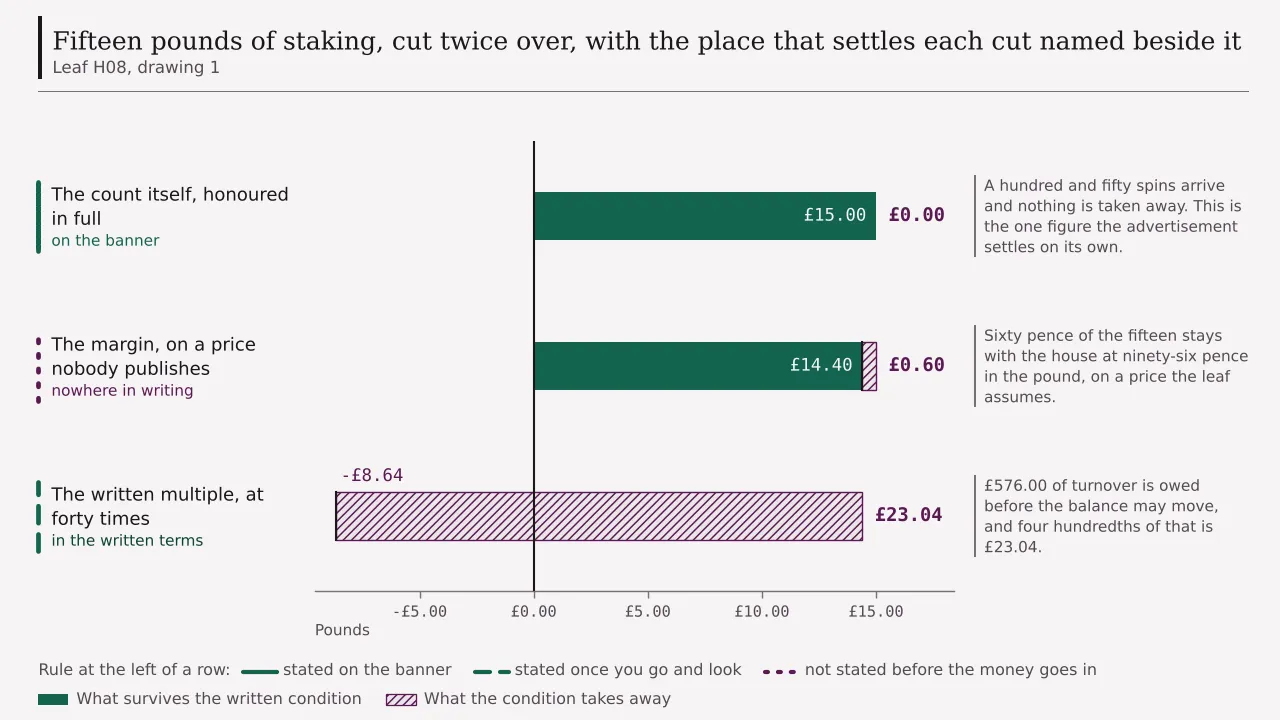
The conversion takes one multiplication and the result is a smaller object than the advertisement suggests. At ten pence for a spin, which is the price assumed across this site, a hundred and fifty of them lay £15.00 on the reels. At ninety-six pence returned for every pound staked, the expectation coming back is £14.40.
Nothing has been taken away to produce that. The promotion is intact, the count is honoured, and the sixty pence of difference between the two figures is the house margin doing what a margin does. A reader who claims the offer and stops when the spins run out has, in expectation, fourteen pounds and forty pence of balance and has sent nothing from a bank to get it.
The written condition is what moves the figure past that. A multiple of forty is the number this leaf works to, being the one most often printed where nothing caps it, and on a promotion that took no payment the multiple attaches to winnings rather than to credit. Forty lots of £14.40 come to £576.00 of staking, or 5,760 presses once the price assumed here is put back in.
Four hundredths of £576.00 stays behind as margin, which is £23.04, so the expected close is £14.40 less £23.04. The break-even multiple is twenty-five, since four hundredths goes into one exactly twenty-five times, and a clause asking forty is therefore fifteen units the wrong side of it.
Expected back from a hundred and fifty spins £14.40 Expected once the written clause has run minus £8.64 What the clause is expected to take £23.04
£576.00 of staking owed against a count advertised as 150
Two of those four figures were read off the advertisement and two were imported. The count was read. The price of nothing was read. The ten pence and the forty were brought in from elsewhere, and the sentence carrying each of them says so. That split is what the leaf is for, and the minus £8.64 is only its illustration.
2
One decimal place between the memory and the money
There is an accident of arithmetic in this family of promotions that is worth pointing at, because it makes the gap easy to hold in the head. At a price of ten pence, a count divided by ten gives the stake in pounds. A hundred and fifty spins becomes fifteen pounds. The digits are the same digits with the point moved one place to the left.
So the number a reader remembers and the number a reader receives are the same number, set in a different unit, and the unit was never printed. That is the entire distance between an impressive headline and an unremarkable sum. Nothing is concealed by it. A decimal point is simply a very easy thing not to notice when nobody has written it down.
The relationship is not a general law, and this leaf is not pretending it is. It holds at ten pence and nowhere else: at five pence the count divides by twenty, and at twenty pence it divides by five. Which is to say that the rule of thumb is a consequence of the assumption rather than a fact about promotions, and it fails silently the moment the assumption is wrong.
It is still worth carrying, because it makes the question a reader should ask concrete. Instead of asking whether a hundred and fifty spins is a lot, ask what a hundred and fifty spins divides down to. If the answer is fifteen pounds, the question becomes whether fifteen pounds of staking is worth an account, a document check and a clause, which is a question anybody can answer in a second.
Phrased that way, large counts stop being impressive and start being legible. A hundred and fifty is three times fifty and a fifteenth of two thousand two hundred and fifty, and none of those comparisons means anything until each has been divided by the same unpublished number. The count is the top half of a fraction whose bottom half is kept off the page.
3
The most exact figure, doing the least work
Here is the claim this leaf is built on. Of every quantity that will eventually decide what a hundred and fifty spins is worth, the count is the only one stated exactly, published in advance and capable of being checked by anybody without an account. It is also the one that decides the least. Those two properties travel together, and the rest of the leaf is an argument that they have to.
Take the exactness first, because it is genuine. The count is an integer. It is not approximate, not a range, not a maximum, not a typical figure. It appears before any click, and a reader who claims the promotion can verify it afterwards by counting. Nothing else in the arrangement carries the whole set.
Now take the work it does. On its own the count settles the number of times a reel will turn, and settles nothing past that. It fixes no sum of money, because the price is elsewhere. It fixes no obligation, because the multiple is elsewhere. It fixes no ceiling, no window, no floor and no route out. Every pound figure printed above came from a number the count does not contain.
A figure can be exact and idle at the same time, and most people’s instinct says otherwise. Exactness reads as seriousness. A banner reading a hundred and fifty looks more carefully worked out than a banner reading about fifteen pounds, and in fact the second one carries more information despite sounding vaguer. Precision in the wrong quantity is worse than imprecision in the right one.
The useful test is to ask what changes if the exact figure changes. Adding ten spins to a hundred and fifty moves the expected return by ninety-six pence. Lifting the price of a spin from ten pence to twenty moves it by £14.40, which is fifteen times as far. The figure set in large type is the one whose movements barely register.
4
Every figure the offer turns on, by how firmly it is fixed
Setting the quantities out in a column makes the inversion visible. The left column is how firmly each figure is stated, the middle is where a reader would settle it, and the right is what it actually decides. The table is ordered by the first column and the third column runs the other way.
| The quantity | How firmly it is stated | The place that settles it | What it decides |
|---|---|---|---|
| How many spins arrive | To the unit, in advance | How many draws there are | |
| What the reader pays to claim | To the penny, and the penny is nought | Nothing after the claim is made | |
| The multiple on the winnings | To the unit, once found | in the bonus terms | Whether anything survives |
| The window the multiple sits inside | In days, once found | in the bonus terms | Whether the clause is reachable |
| The rate a licensed reel returns at | As a percentage, where published | in a public record | The speed of the loss |
| The least an exit will send | To the penny, far too late | at the cashier | Whether the balance moves at all |
| The documents wanted before payment | Not stated in advance | on the way out | Whether the balance is paid |
| The price of one spin | Not stated at all | nowhere in writing | Every pound figure there is |
Read the first and last rows together and the shape is plain. The quantity stated most firmly decides how many times a reel turns. The quantity stated least firmly decides what all of it is worth. Between them the table descends through progressively vaguer statements kept at progressively further addresses, and the consequence climbs as the firmness falls.
One row needs a qualification rather than a claim. The return a reel pays is reachable for a licensed build, because a published standard obliges information about a player’s chances to be within reach before anything is committed, though it is satisfied by a margin figure or an event probability as readily as by a return percentage. Outside that licence the 96 per cent used here has no instrument behind it and is an assumption like the ten pence.
How that table is ordered is this leaf’s own doing, and it is offered as an argument rather than a measurement. What is not an argument is the arithmetic in the last column: the price of a spin multiplies every pound figure on the page, and the count multiplies none of them on its own.
5
Why exactness is granted here and withheld there
The pattern in the table is not an accident of drafting, and a one-sentence explanation covers it. Exactness is offered where being exact costs the publisher nothing, and withheld where being exact would cost something. The count is cheap to fix. The price of a spin is dear to fix. That is the whole of it.
Work out why the count is cheap. Whoever runs the promotion controls the number absolutely, can honour it at a cost it has already budgeted for, and gains from printing it because a large integer reads well. There is no commercial reason to be vague about a figure that flatters and binds nobody to anything beyond handing over some turns of a reel.
Now work out why the price is dear. Printing it converts the headline into a sum, and a sum can be compared with other sums and with the effort of signing up. A promotion advertising fifteen pounds of staking competes against every other fifteen pound proposition a reader has. A promotion advertising a hundred and fifty spins competes against promotions advertising a hundred, which it beats by inspection.
So the division between what is stated exactly and what is not stated at all follows a commercial logic rather than a regulatory one, and that is why no amount of reading a banner more carefully will move it. The information missing from an advertisement is missing because it was expensive to include, and the cheapest information is the information most prominently displayed.
A reader can turn that round and use it. Where a figure is printed large and exact, ask what it costs the publisher to be exact about. Where a figure is absent, ask what printing it would have cost. The answers will not always be unflattering, and on a promotion that genuinely does publish a price for its spins the answer is that somebody decided transparency was worth more than the comparison it invites.
None of which is an accusation. Advertising selects. Every advertisement in every trade prints the flattering figure and keeps the unflattering one for the conditions, and gambling promotions are not unusual in that respect. What is unusual here is that the unflattering figure is not merely unflattering: it is the one the arithmetic cannot be done without, and it is kept nowhere in writing.
6
What happens to a figure somebody wants to argue about
Verifiable has a second meaning and the leaf has been using only the first. A figure is verifiable if a reader can check it beforehand, and it is also verifiable if somebody will adjudicate it afterwards. The count passes both tests trivially. Every other figure in the table fails the first, so the second is the only one left, and the second is a timetable.
Britain writes that timetable down. Acknowledging a complaint carries an outer limit of three working days, with a duty to be quicker wherever that is reasonable, and the limit tightens to one day for a business whose gambling facilities never shut. Eight weeks is the ceiling on the whole of it, escalation inside the business included, counted from the day the thing came in.
| The clock | What starts it | How long it runs | What it is for |
|---|---|---|---|
| Acknowledgement | The complaint arriving | Three working days, or a day where play runs round the clock | Proof that somebody has it |
| The whole process | The same moment | Eight weeks, escalation included | A ceiling on delay |
| The window to complain | The incident itself | Six months at the least | Stopping a term from barring it early |
| A pause in the eight weeks | A reasonable question going unanswered | Seven days before the clock may stop | Restarting where it halted |
| Referral onwards | The final letter | No fixed length, but the route must be explained | Reaching an approved adjudicator |
Two further things are fixed and they matter more than the durations. The letter closing the process has to give reasons, state that the house procedure has ended, and say how the matter goes on to an independent adjudicator. And the dispute body cannot be anybody the licensee fancies: the regulator approves the entities, the approved list runs to eight, and their sector coverage is not uniform, with one of them not listed for remote casino at all.
What the regulator will not do is stated by the regulator in its own words, and a leaf about verification has to print it. On its own pages it rules itself out of the ombudsman’s role, says it can neither settle a gambling complaint nor get money returned, puts a quarrel about a withdrawal or about a fault in a game outside what it decides, and cannot see inside an account at all. The timetable is a duty on the operator, enforced by the regulator, and not a service the regulator performs.
A promotion printing a count this large is sold by a business holding no Great Britain licence of its own, so the timetable is not lengthened but removed. No acknowledgement is owed in three days. No ceiling of eight weeks exists. No window of six months is protected against a term that shortens it. No letter has to point anywhere, and no approved adjudicator stands at the end of the pointing. The count stays exactly as verifiable as it was; everything else in the table loses its second kind of verification along with its first.
7
A dispute smaller than the route that would settle it
A claim that no complaints route exists beyond the British licence would be false, and this leaf will not make it. One offshore regulator publishes a full one. Reading it next to the British timetable is more useful than asserting an absence, and on a promotion worth fourteen pounds and forty pence it produces a finding the sums on this page make unavoidable.
Curaçao’s published framework allows six months, counted from whichever of a bet’s settlement and the incident applies, which is the same window Britain protects, and lodging costs the player nothing. The operator confirms receipt in writing inside a week and answers within four, extendable once by a further four with written notice, so eight weeks again. Complaints about responsible gaming are prioritised, with best efforts inside five working days.
On paper those clocks are the British ones. Where the two part company is in who writes the terms of the step after them. In Britain approval of the dispute bodies rests with the regulator, and nothing outside that approved set may be used. In Curaçao resolution of that kind is required, the operator pays for it, the player is charged nothing, and the policy openly leaves that same operator to fix the terms on which it happens.
One of those parameters is the sentence this leaf exists to put a number beside. The operator may set a minimum claim value below which a dispute is not escalated at all. The regulator says it will weigh the circumstances and that it can understand a concern about low-value claims being misused, while expecting the admission of a self-excluded person to be taken seriously whatever the sum involved.
Now price it. The entire expected balance from a hundred and fifty spins is £14.40 before any clause, and minus £8.64 after one. A floor on a dispute set anywhere above fifteen pounds puts the whole of this promotion out of reach of the route built to settle it. The count is large, the sum is small, and the remedy is sized against the sum.
Two further limits in that framework bind a player and belong beside the figure. A dispute process that has run to its end may not be reopened in front of a second body, and somebody who walks away from one partway through is not expected to be able to raise it again. Both of those make the first attempt the only attempt, which matters a great deal more when the sum at stake is too small to justify careful preparation.
The fair conclusion is narrower than a reader might expect and it is worth stating precisely. The offshore route exists, is free, and runs to a published timetable that matches the British one week for week. What it does not carry is an approved list of adjudicators chosen by somebody other than the operator, and what it expressly permits is a floor that a fifteen pound dispute may sit underneath. For a large balance those differences are modest. For this one they are the difference between a route and no route.
8
What a count settles that a sum of money cannot
Having spent six parts on what a count fails to fix, the leaf owes a part to what it does. The answer is one thing, it is real, and it is the only respect in which a count carries information a sum of the same size does not.
A count settles the number of draws. A hundred and fifty spins is a hundred and fifty separate goes at whatever the top outcome of the reel happens to be. Fifteen pounds of credit staked at a pound a go is fifteen goes at the same outcome, with an identical expected return of £14.40 and a tenth of the attempts. Expectation does not distinguish them and exposure to the tail does.
That matters on a promotion where the expected close is negative and the only interesting branch is the one where something unusual happens. A reader who understands perfectly well that £14.40 is the average and that the clause takes it away is not necessarily being irrational in preferring more draws to fewer. More draws is more chances at the outcome that would make the clause worth attempting.
It cuts the other way too, and honesty requires printing that half. More draws at a smaller stake is a thinner tail as well as a longer one, because the size of the top outcome scales with the stake. A hundred and fifty draws at ten pence and fifteen draws at a pound differ in the shape of the distribution rather than in its favourability, and nothing in print describes the shape for a reel nobody has named.
So the honest form of the point is conditional. Where somebody values the number of attempts for its own sake, a count tells them something a sum does not, and the count is the right figure for them to read. Where somebody wants to know what the promotion is worth, a count tells them nothing until it has been divided by a figure the advertisement withheld. Both readers are looking at the same banner, and only one of them has been given what they came for.
9
Reading a large count as the sum it stands for
Three habits turn a large count into something a reader can use, and the third is the one almost nobody performs. Divide before admiring. Ask what the exactness cost whoever printed it. Then decide whether the sum, rather than the count, is worth the steps it takes to collect.
Dividing before admiring is a thirty-second operation and it reorders the whole field. A hundred and fifty spins at ten pence is fifteen pounds. Two hundred at five pence is ten. Fifty at twenty pence is ten as well. Counts that look ordered on a row of banners stop being ordered the moment each is divided, and the divisor is different for each and printed for none.
Asking what exactness cost is the habit from part five and it generalises past this subject. A figure given to the unit in large type has usually been cheap to fix. A figure given as a range, or in a document, or not at all, has usually been dear. That is a reasonable first guess about any advertisement and it happens to be exactly right about this one.
Deciding on the sum rather than the count means setting fifteen pounds of staking against what collecting it involves: an account, whatever the cashier asks for, a document check on the way out, a clause wanting £576.00 of turnover, and a window the clause has to fit inside. Somebody who would not cross a road for fifteen pounds has an easy decision and a count of a hundred and fifty should not make it harder.
There is a reading on which the promotion is exactly what it says and perfectly worthwhile. Somebody who wants a hundred and fifty turns of a reel, has settled in advance on stopping when the spins are gone, and has no intention of going near the clause gets exactly that, for exactly the nothing advertised. Every figure past the first in this leaf is triggered by trying to take money out.
Carried across the section, the same three habits produce different outputs. A smaller count divides to a smaller sum and the ratio of effort to reward moves against the reader. A sum printed in money needs no division at all. A count printed without a price beside it needs the division most and permits it least. In every case the figure worth writing down is the one after the division, and the one before it is the one in large type.
Questions
- What does 150 free spins no deposit come to in money?
- £15.00 of staking and an expected £14.40 back, with a spin taken at ten pence as this site takes it throughout and the return held at 96 per cent. The sixty pence between those two numbers is the house margin. Neither figure appears on the advertisement, because converting the count into money needs a price for one spin and no primary source defines one.
- Why do operators advertise the spin count instead of the cash value?
- Because exactness is offered where it is cheap and withheld where it is dear. A count is free to be exact about: it is controlled absolutely, costs what it was budgeted to cost, and a large integer reads well. A cash value converts the headline into a sum, and a sum can be compared with every other fifteen pound proposition a reader has. A hundred and fifty beats a hundred by inspection, which a pound figure would not.
- Is the spin count the most reliable figure in the offer?
- It is the most firmly stated and the least consequential, and this leaf argues those are the same fact. The count is an integer, published before any click, honoured in full and checkable by counting. On its own it settles the number of turns a reel takes and nothing else: no sum, no obligation, no ceiling, no window, no floor and no route out. Every pound figure comes from a quantity the count does not contain.
- How much wagering does a 150 spin offer carry?
- £576.00 of staking at the forty times multiple used here, or 5,760 presses once the assumed price is put back in. Four hundredths of that turnover stays behind as margin, which is £23.04, so the expected close is £14.40 less £23.04, or minus £8.64. Twenty-five is where the sign changes, four hundredths going into one exactly twenty-five times, so a clause asking forty sits fifteen units the wrong side of break-even.
- Is a larger spin count a larger offer?
- Only once each count has been divided by its own price, and the prices are not published. A hundred and fifty spins at ten pence is fifteen pounds; two hundred at five pence is ten; fifty at twenty pence is ten as well. Counts that look ordered on a row of banners stop being ordered the moment the division is done, and the divisor differs for each one.
- Is there any complaints route on an offer like this?
- There is one published offshore and saying otherwise would be wrong. Curaçao’s framework allows six months from the incident, costs the player nothing, has receipt confirmed in writing inside a week, and wants an answer within four weeks, extendable once by four more. That timetable matches the British one week for week. The difference is in who writes the terms of the step after it.
- How does a British licence change a complaint?
- A fixed timetable and an adjudicator the operator did not choose. An acknowledgement is due within three working days, tightening to one day where the gambling facilities never shut, and the whole of the process has to finish eight weeks after the complaint came in. The closing letter has to give reasons and point onwards, and the adjudicator it points to has to come off a list the regulator approves, which runs to eight bodies whose sector coverage is not uniform.
- Can a small balance be too small to dispute?
- Yes, and the offshore rulebook writes the possibility down rather than hiding it. An operator there may fix a minimum claim value under which a dispute goes no further, and the regulator says it will weigh up the circumstances and can see why a business might worry about small claims being misused. The whole expected balance here is £14.40 before any clause and minus £8.64 after one, so a floor set above fifteen pounds puts this promotion underneath the route built to settle it.
- What does the spin count tell me that a cash bonus does not?
- The number of draws. A hundred and fifty spins is a hundred and fifty separate attempts at whatever the top outcome of the reel is. Fifteen pounds of credit staked at a pound a go gives fifteen attempts with the identical expected return of £14.40. Expectation cannot tell those apart and exposure to the rare outcome can, though a smaller stake also shrinks the size of that outcome, and nothing published describes the shape for an unnamed reel.
- What does the regulator do if a withdrawal is refused?
- Not what most readers expect. On its own pages it rules itself out of the ombudsman’s role. It can neither settle a gambling complaint nor get money returned, a quarrel about a withdrawal or about a fault in a game falls outside what it decides, and it cannot see inside an account at all. What it does is impose the timetable on the licensee and enforce it. A promotion printing a count this large is sold by a business with no Great Britain licence of its own, so the timetable is deleted rather than lengthened.