Terms read 19 October 2026 Leaf T03, revision 1
Two clauses, one promise, and the one of them a no wager headline answers
Seventy presses at 10p turn over £7.00 and are expected to leave £6.72 behind. A denied multiple would have cost £10.75 of that, which is the larger figure and the one the headline is about. A release floor of £20.00 sitting in a different chapter costs £6.72, which is smaller and decides whether a penny ever moves.
Stated on the banner £6.72 Seventy presses, nothing paid in, and a denial covering one of the two conditions that decide the outcome. Stated, once you go and look £13.28 How far short of the smallest releasable payment the residue is expected to finish, under a floor the headline neither denies nor mentions. Not stated before the money goes in Silent on four points What a press is worth, which chapter the floor is printed under, which payment routes carry a floor of their own, and what documents the exit wants before anything is released.
Spin offers with no play-through, and their exit terms
Every destination in this file is bought advertising. The site is paid a fee if a reader goes on to register, and no figure printed below moves because of it.
Bonus Spins UK Slip 01
Betportal
Ceiling as a multiple
The drop
€15.00
€1.00 in the euro
The claim reads €15.00. Once the terms beside it have applied, €0.00 of it can leave. The difference is the drop.
7 of the 15 terms on this slip could not be read before the money went in
Spins priced at this site's own 10p a spin, which the operator does not publish
Stated
€15.00
The claim as it is printed, before a single term has been applied to it.
Headline paid as spins
150 spins at 10c each, which is €15.00 of the figure above.
6 Nowhere
What one spin is worth
No unit is published for a spin, so the count is priced at this site's own 10p a spin. At half that price every figure below halves with it.
Match and other credit not priced
300% of three deposits, to a ceiling of €1,000. A share of a deposit nobody has made yet is not a sum, so no figure stands on this line and none is carried below.
Qualified
-€14.40
Written down somewhere, and taking part of the claim back. Each term carries the place it is written and the sum it takes.
2 Written terms at a distance this record does not establish
Play-through -€14.40
Carrying €14.40 through 35 times stakes €504.00 and costs €20.16 of it at 96 per cent return. That prices above the €14.40 there is to charge it against, so the whole of the credit goes and the line is held at that. The multiple sits on the bonus.
2 Written terms at a distance this record does not establish
Game weighting not priced
Slots only count towards the play-through. No contribution percentage is published, so the line above has been worked at full weight, which is the kindest reading there is.
2 Written terms at a distance this record does not establish
Ceiling on the winnings not priced
5x the bonus.
2 Written terms at a distance this record does not establish
Clock on the credit not priced
14 days.
2 Written terms at a distance this record does not establish
Largest stake while it runs not priced
€5.
3 Public record
Licence, and who holds it not priced
Licensed in Anjouan, Comoros, held by BetPortal Gaming Ltd, with Excite Ultra Media Ltd, reference ALSI-202601040-FI2. A register entry settles who holds a licence and what it permits. It does not settle who is running the site this morning.
4 Cashier
Smallest qualifying deposit your money
€20 a stage. That is €20.00 of your own money, and it is never netted into a drop.
5 On the way out
Checks before a withdrawal not priced
Documents before the first withdrawal.
Unstated
-€0.60
Applying without having been published anywhere, and costing money all the same.
6 Nowhere
What a spin hands back -€0.60
Staking a spin returns 96 per cent of it, so that share of the batch is the house's before a reel turns. This site works at that return and the operator publishes none where the claim is made.
6 Nowhere
Forfeited by rule cost unknown
Nothing is published under this heading, and it applies regardless.
6 Nowhere
Charge on the way out cost unknown
No charge on the way out is published as a figure, so nothing comes off this line. A charge that exists unpublished would come straight off whatever survives.
6 Nowhere
Smallest withdrawal allowed cost unknown
No smallest withdrawal is published as a figure. A floor nobody has published is still a floor, and it decides whether a small balance can move at all.
No Great Britain licence
Terms read 19 October 2026
Bonus Spins UK Slip 02
WinBeast
Ceiling as a sum
The drop
€50.00
€1.00 in the euro
The claim reads €50.00. Once the terms beside it have applied, €0.00 of it can leave. The difference is the drop.
8 of the 15 terms on this slip could not be read before the money went in
Spins priced at this site's own 10p a spin, which the operator does not publish
Stated
€50.00
The claim as it is printed, before a single term has been applied to it.
Headline paid as spins
500 spins at 10c each, which is €50.00 of the figure above.
6 Nowhere
What one spin is worth
No unit is published for a spin, so the count is priced at this site's own 10p a spin. At half that price every figure below halves with it.
Match and other credit not priced
50% to 100% of five deposits, each to a ceiling of €1,000, and a €650 free bet. A share of a deposit nobody has made yet is not a sum, so no figure stands on this line and none is carried below.
Qualified
-€48.00
Written down somewhere, and taking part of the claim back. Each term carries the place it is written and the sum it takes.
2 Written terms at a distance this record does not establish
Play-through -€48.00
Carrying €48.00 through 40 times stakes €1,920.00 and costs €76.80 of it at 96 per cent return. That prices above the €48.00 there is to charge it against, so the whole of the credit goes and the line is held at that. The multiple sits on the bonus and the winnings from the spins.
2 Written terms at a distance this record does not establish
Game weighting not priced
Slots, titles vary by country count towards the play-through. No contribution percentage is published, so the line above has been worked at full weight, which is the kindest reading there is.
2 Written terms at a distance this record does not establish
Ceiling on the winnings not priced
€100 a batch of spins.
2 Written terms at a distance this record does not establish
Clock on the credit not priced
7 days, spins 1 day.
3 Public record
Licence, and who holds it not priced
Licensed in Curaçao, holder not named on the site. A register entry settles who holds a licence and what it permits. It does not settle who is running the site this morning.
4 Cashier
Smallest qualifying deposit your money
€20 a stage. That is €20.00 of your own money, and it is never netted into a drop.
5 On the way out
Checks before a withdrawal not priced
Documents before the first withdrawal.
Unstated
-€2.00
Applying without having been published anywhere, and costing money all the same.
6 Nowhere
What a spin hands back -€2.00
Staking a spin returns 96 per cent of it, so that share of the batch is the house's before a reel turns. This site works at that return and the operator publishes none where the claim is made.
6 Nowhere
Largest stake while it runs cost unknown
Nothing is published under this heading, and it applies regardless.
6 Nowhere
Forfeited by rule cost unknown
Nothing is published under this heading, and it applies regardless.
6 Nowhere
Charge on the way out cost unknown
No charge on the way out is published as a figure, so nothing comes off this line. A charge that exists unpublished would come straight off whatever survives.
6 Nowhere
Smallest withdrawal allowed cost unknown
No smallest withdrawal is published as a figure. A floor nobody has published is still a floor, and it decides whether a small balance can move at all.
No Great Britain licence
Terms read 19 October 2026
Bonus Spins UK Slip 03
EliteSpin
Longest spin window
The drop
£50.00
£1.00 in the pound
The claim reads £50.00. Once the terms beside it have applied, £0.00 of it can leave. The difference is the drop.
8 of the 15 terms on this slip could not be read before the money went in
Spins priced at this site's own 10p a spin, which the operator does not publish
Stated
£50.00
The claim as it is printed, before a single term has been applied to it.
Headline paid as spins
500 spins at 10p each, which is £50.00 of the figure above.
6 Nowhere
What one spin is worth
No unit is published for a spin, so the count is priced at this site's own 10p a spin. At half that price every figure below halves with it.
Match and other credit not priced
50% to 100% of five deposits, each to a ceiling of £1,000. A share of a deposit nobody has made yet is not a sum, so no figure stands on this line and none is carried below.
Qualified
-£48.00
Written down somewhere, and taking part of the claim back. Each term carries the place it is written and the sum it takes.
2 Written terms at a distance this record does not establish
Play-through -£48.00
Carrying £48.00 through 40 times stakes £1,920.00 and costs £76.80 of it at 96 per cent return. That prices above the £48.00 there is to charge it against, so the whole of the credit goes and the line is held at that. The multiple sits on the bonus and the winnings from the spins.
2 Written terms at a distance this record does not establish
Game weighting not priced
Slots count towards the play-through. No contribution percentage is published, so the line above has been worked at full weight, which is the kindest reading there is.
2 Written terms at a distance this record does not establish
Ceiling on the winnings not priced
5x the bonus.
2 Written terms at a distance this record does not establish
Clock on the credit not priced
7 days, spins 3 days.
3 Public record
Licence, and who holds it not priced
Licensed in Costa Rica, held by PrimeTier Limited. A register entry settles who holds a licence and what it permits. It does not settle who is running the site this morning.
4 Cashier
Smallest qualifying deposit your money
£20 a stage. That is £20.00 of your own money, and it is never netted into a drop.
5 On the way out
Checks before a withdrawal not priced
Documents before the first withdrawal.
Unstated
-£2.00
Applying without having been published anywhere, and costing money all the same.
6 Nowhere
What a spin hands back -£2.00
Staking a spin returns 96 per cent of it, so that share of the batch is the house's before a reel turns. This site works at that return and the operator publishes none where the claim is made.
6 Nowhere
Largest stake while it runs cost unknown
Nothing is published under this heading, and it applies regardless.
6 Nowhere
Forfeited by rule cost unknown
Nothing is published under this heading, and it applies regardless.
6 Nowhere
Charge on the way out cost unknown
No charge on the way out is published as a figure, so nothing comes off this line. A charge that exists unpublished would come straight off whatever survives.
6 Nowhere
Smallest withdrawal allowed cost unknown
No smallest withdrawal is published as a figure. A floor nobody has published is still a floor, and it decides whether a small balance can move at all.
No Great Britain licence
Terms read 19 October 2026
Bonus Spins UK Slip 04
Crown Jewelz
Multiple unpublished
The drop
NOT WORKED
The multiple is not published in the operator's own terms. Since the sum cannot be worked around it, none is worked.
9 of the 14 terms on this slip could not be read before the money went in
No drop worked
Stated
£15.00
The claim as it is printed, before a single term has been applied to it.
Headline paid as spins
150 spins at 10p each, which is £15.00 of the figure above.
6 Nowhere
What one spin is worth
No unit is published for a spin, so the count is priced at this site's own 10p a spin. At half that price every figure below halves with it.
Match and other credit not priced
200% of the first deposit, then 150% twice, each to a ceiling of £1,000. A share of a deposit nobody has made yet is not a sum, so no figure stands on this line and none is carried below.
Qualified
NOT WORKED
Written down somewhere, and taking part of the claim back. Each term carries the place it is written and the sum it takes.
2 Written terms at a distance this record does not establish
Play-through not priced
40x the bonus, reported rather than published by the operator.
2 Written terms at a distance this record does not establish
Game weighting not priced
Slots count towards the play-through. No contribution percentage is published, so the line above has been worked at full weight, which is the kindest reading there is.
3 Public record
Licence, and who holds it not priced
Licensed in Curaçao, number not verified, holder not named on the site. A register entry settles who holds a licence and what it permits. It does not settle who is running the site this morning.
4 Cashier
Smallest qualifying deposit your money
£20. That is £20.00 of your own money, and it is never netted into a drop.
5 On the way out
Checks before a withdrawal not priced
Documents before the first withdrawal.
Unstated
NOT WORKED
Applying without having been published anywhere, and costing money all the same.
6 Nowhere
Ceiling on the winnings cost unknown
No ceiling is published. Nothing is assumed in its place.
6 Nowhere
Clock on the credit cost unknown
Nothing is published under this heading, and it applies regardless.
6 Nowhere
Largest stake while it runs cost unknown
Nothing is published under this heading, and it applies regardless.
6 Nowhere
Forfeited by rule cost unknown
Nothing is published under this heading, and it applies regardless.
6 Nowhere
Charge on the way out cost unknown
No charge on the way out is published as a figure, so nothing comes off this line. A charge that exists unpublished would come straight off whatever survives.
6 Nowhere
Smallest withdrawal allowed cost unknown
No smallest withdrawal is published as a figure. A floor nobody has published is still a floor, and it decides whether a small balance can move at all.
No Great Britain licence
Terms read 19 October 2026
Every figure in the second and third columns is this site's own working and nothing an operator has published. A claim is priced as printed, then the share a spin hands back at 96 per cent return comes off it, then what playing the multiple through costs at the same return, and then whatever a published ceiling, a charge on the way out or a floor on the smallest withdrawal takes from what has survived. The drop is the difference between the first figure and the last. The two columns add back up to it exactly, so no money leaves a slip without a term and a place beside it.
Which column a term falls in is settled by one question: has anybody written it down. A charge a reader meets at the payment screen is written down, and it stands in the second column with the cashier against it. A condition that binds without ever having been set down stands in the third, whatever it costs. Inside each column the terms run outwards from the banner, so the order itself says how far a reader would have had to go.
A count of spins has no unit until one is supplied. Where an operator publishes what one of its own spins is worth, that figure is used and the first column says it is theirs. Where none is published, this site's own 10p a spin stands in its place and every figure below moves in proportion with it. Where the multiple itself is unpublished, no drop is worked at all, because that is the one figure the sum cannot be done without.
Three words stand where a figure cannot. Not priced is a term that is written down and carries no number the arithmetic can take. Cost unknown is a term nobody has written down, costing something nobody has put a number on. Your money is money of the reader's own, which is never netted into a drop.
None of the operators in this file holds a Great Britain licence, so none of the duties that licence carries reaches them. Each of those duties is published in its own right, which is what makes its absence here something a reader can check rather than take on trust. Every gambling company licensed in Great Britain belongs to Gamstop Online, so a reader who has shut themselves out through the scheme is not shut out here. Social Responsibility Code 5.1.1 has held a play-through to a maximum of ten times the bonus funds since 19 January 2026, and it binds a licence holder and nobody else. Asked in a post of 21 October 2025 what is lost along with the licence, the Gambling Commission's Director of Enforcement and Intelligence answered: "unfair gaming practices, financial loss, and a lack of recourse if things go wrong". The same post puts blocked payouts, and withdrawal limits pitched high enough to be unreachable, among the behaviour the Commission has recorded. Nobody under 18 may hold an account at any of them.
Terms are reproduced in the wording their operator published, and each slip is dated with the day somebody sat down and read them. 19 October 2026 is the oldest of those dates. Anybody claiming an offer is bound by that operator's full terms, which are elsewhere, and never by a line standing here.
1
A promise that answers one of the two questions in play
Getting money out of a promotional balance requires two separate questions to be answered, and the answers live in different instruments drafted for different purposes. The first question is how much has to be staked before the balance may be taken. The second is how large the balance has to be before anything can be sent.
Those are not variations on one another. A multiple is a condition on the funds and it is expressed as a ratio: turn over so many times what you hold. A release floor is a condition on the transaction and it is expressed in pounds: reach this sum or nothing leaves. One measures effort, the other measures size, and an offer can carry either, both or neither without any contradiction.
A headline denying a play-through answers the first question and the first question alone. It is silent on the second, and silence is not denial. That gap is the whole subject of this leaf, and it is worth saying plainly at the start that the gap is not a trick. The two conditions were drafted by different people for different reasons and they ended up in different parts of the documentation. Nobody had to hide anything for a reader to conflate them.
The conflation happens because both conditions produce the same experience. A player with winnings they cannot take out cannot tell, from the account screen alone, whether a multiple is outstanding or a sum is short. Both read as money that is there and will not move. Only the documentation distinguishes them, and only one of the two gets a mention where the offer is advertised.
So the sorting runs like this. The count of seventy presses is settled . The absence of a multiple is asserted there too, and confirmed or not in the promotional conditions. The smallest sum that may be released is settled in the payments chapter, which is a different chapter of a different document, and on a good many offers it first becomes visible at the cashier. What a single press is worth is nowhere in writing, and this leaf works to the 10p it assumes everywhere.
2
Seven pounds of turnover and £6.72 expected back
Seventy presses at 10p send £7.00 over the reels. A 96 per cent return turns that £7.00 of turnover into an expected £6.72, so the slice that does not come back is 28p. That 28p is the house’s share of the whole offer and it is worth holding in mind, because every figure that follows is large beside it.
£6.72 is not a sum anybody receives at the outset. It is the expected residue after all seventy presses have been made, and the actual residue will be nothing at all a good deal of the time and several multiples of £6.72 occasionally. The expectation is the figure arithmetic can work with, and the leaf says so each time it leans on it.
Seventy is an awkward count and the awkwardness is informative. It is not a round number, which suggests it was reached by working backwards from a cost rather than forwards from a marketing instinct. Seventy presses cost the house 28p in expectation, which is roughly the price of nothing at all, and that is the first indication that the generosity in the headline is not where the arrangement makes its decisions.
| Quantity | Where it is settled | Figure |
|---|---|---|
| Presses handed over | 70 | |
| Value of one press, assumed here | nowhere in writing | 10p |
| Turnover the presses produce | Follows from the two rows above | £7.00 |
| Expected residue at a 96 per cent return | Follows from the row above | £6.72 |
| Expected cost of the whole offer to the house | Follows from the two rows above | 28p |
Read the last row and the economics of this part of the market stop being mysterious. A promotion costing 28p in expectation can be handed to a very large number of people before it costs anything an accountant would notice, and the conditions that follow exist to decide which of those people ever converts that 28p into a payment.
3
What the denied condition would have cost
Take the denial at its word first and price what it covers. A multiple written over the winnings from promotional presses is the standard instrument, and forty times is the setting this leaf applies, chosen because it recurs in drafting of this shape rather than because any source publishes a market figure.
Forty times £6.72 demands £268.80 of turnover before the £6.72 may be taken. The house keeps fourpence out of each pound crossing the reels, so £268.80 of staking is expected to cost £10.75. Begin at £6.72, remove £10.75, and the position finishes at an expected minus £4.03. The denial therefore lifts an obligation worth £10.75, which exceeds the money it was written over by £4.03.
Expected residue from seventy presses £6.72 The same residue under a forty-times condition minus £4.03 Worth of the condition the headline denies £10.75
The sign turns over at twenty-five, since 0.04 inverts to 25. Below twenty-five something survives. Above it the winnings have notionally gone back across the counter and every further press draws on money the offer never supplied. Forty is well past the turn, which is why £10.75 exceeds £6.72.
In presses rather than pounds, £268.80 of turnover at ten pence each is 2,688 separate presses. The offer supplies seventy. So the denied condition asked for about thirty-eight presses for every one handed over, which is the ratio that makes a play-through on a no-deposit promotion a different animal from a play-through on a deposit match.
2,688 presses demanded of an offer that supplies seventy
None of this is an argument that the denial is worthless. £10.75 is the largest single figure on this leaf and it is genuinely not being asked for. The argument is narrower: the largest figure and the deciding figure are not the same figure, and parts four to eight are about the second one.
4
The condition the headline is silent about
Now the second instrument. A release floor says that no payment will be sent below a stated sum, and it is an ordinary feature of payments documentation rather than anything peculiar to promotions. It exists because sending small sums costs the sender money, and it applies to a balance however that balance arose.
This leaf takes £20.00 as the floor. That is the leaf’s own illustrative setting, chosen because it is a round figure of the usual shape, and nothing this site is able to cite publishes a standard smallest payment or a spread of them. Every figure derived from it below carries the same caveat and should be read as arithmetic on an assumption rather than as a report.
Against an expected residue of £6.72, a £20.00 floor is not a mild inconvenience. The shortfall is £13.28, which is nearly twice the money in the account. To reach the floor at all, seventy presses have to return 2.86 times what they staked, where the expectation is 0.96 times. The floor is cleared only by an outcome running at roughly three times the arithmetic, and the arithmetic is what the whole offer is built on.
Three properties make a floor harder than it reads. It is absolute rather than proportional, so it does not scale down with a small offer. It is all or nothing, so a balance one penny short releases nothing rather than releasing most. And it ordinarily sits with the payment methods rather than with the promotion, so a reader checking the conditions attached to an offer will not meet it where they are looking.
There is a fourth property that only shows up in combination. A floor is indifferent to where the money came from. The same £20.00 governs a balance built from a deposit and a balance built from seventy promotional presses, and the promotional balance is the one that starts at £6.72 with nothing behind it.
5
A balance that exists, is owed, and cannot leave
Put the two figures together and the offer arrives somewhere unusual. There is no multiple outstanding, so nothing has to be played through. The £6.72 is unencumbered, properly credited and entirely the player’s. It also cannot be sent anywhere, because it is £13.28 short of the smallest payment the documentation permits.
That is a different condition from the one the headline denies, and its effect is absolute rather than partial. A forty-times multiple reduces an expected £6.72 to an expected minus £4.03, which is a reduction. A £20.00 floor leaves the £6.72 exactly where it is and makes it worth nothing, which is a cancellation.
Residue after seventy presses, no multiple standing £6.72 Releasable under a £20.00 floor £0.00 Cost of the condition nobody denied £6.72
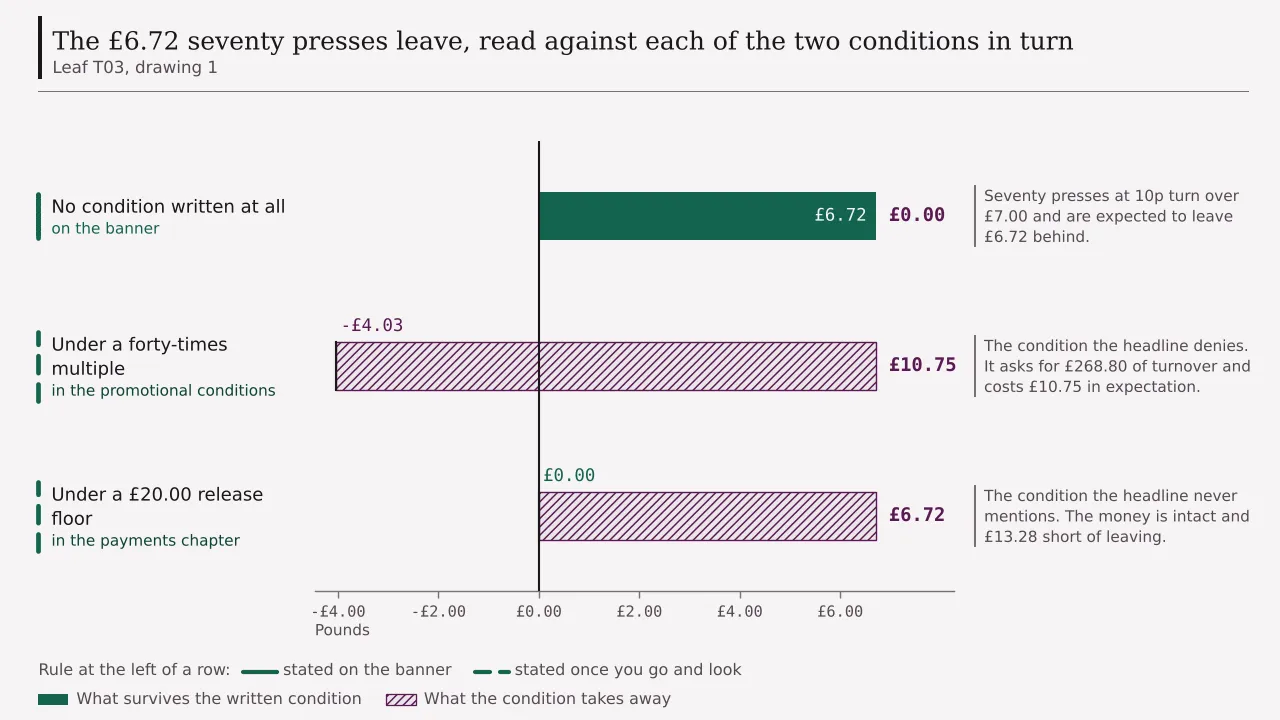
The two shortened bars in that drawing fall for unrelated reasons, and the difference between the reasons matters more than the difference between the endpoints. One line falls because money was staked and lost in the ordinary way. The other falls because a payment was never made at all, and the money is still sitting in the account while the line reads nothing.
A reader who stops here has the important half of the leaf. An offer advertising no play-through on seventy presses can still be worth precisely nothing, by a sentence that is written down, that nobody denies, and that sits in a chapter about payment methods.
6
What a stranded balance is permitted to do next
A balance below a release floor is not frozen. It can be staked. That is the one thing it can always do, and it is the reason a floor is a more interesting instrument than it first appears.
Consider what a player holding £6.72 under a £20.00 floor is actually being asked for. The money will not move until it has roughly trebled, and the only mechanism available for trebling it is the reels. So the floor demands turnover, exactly as a multiple does, by a completely different route and without the word appearing anywhere. It is a play-through written in pounds instead of in multiples, and arrived at sideways.
The arithmetic of that demand is pointed the wrong way. Turning the whole balance over once is expected to leave £6.45. Ten whole turnovers leave an expected £4.47. Thirty leave £1.97. Each pass multiplies by 0.96, so the expected balance falls monotonically while the target stays at £20.00, and the gap widens with every attempt to close it.
| Whole balance staked this many times | Multiplier applied | Expected balance | Still short of £20.00 by | Direction of travel |
|---|---|---|---|---|
| None | 1.0000 | £6.72 | £13.28 | Starting point |
| Once | 0.9600 | £6.45 | £13.55 | Away from the floor |
| Ten times | 0.6648 | £4.47 | £15.53 | Away from the floor |
| Thirty times | 0.2939 | £1.97 | £18.03 | Away from the floor |
The last column is invariant and that is the row’s whole point. There is no number of turnovers that improves the expected position, because the multiplier is below one at every scale. Only variance can close a £13.28 gap, and variance is the thing a reader cannot plan around and the house does not have to.
So a release floor set above a promotional residue converts an unpayable sum into a reason to keep pressing. Nothing in the documentation calls that a wagering requirement and nothing has to. The effect arrives from the shape of the two numbers rather than from any sentence intending it.
7
Four ways the pair can stand, and what each pays
Two conditions, each either written or not, give four arrangements. Setting them out together is the quickest way to see that the advertised arrangement is not the paying one.
| Arrangement | Multiple | Release floor | Expected position | Expected to be paid |
|---|---|---|---|---|
| Neither condition written | None | None | £6.72 | £6.72 |
| Floor alone, which this leaf prices | None | £20.00 | £6.72 | £0.00 |
| Multiple alone | 40 times | None | minus £4.03 | £0.00 |
| Both standing together | 40 times | £20.00 | minus £4.03 | £0.00 |
Three arrangements pay nothing in expectation and the fourth pays £6.72. The headline moves a reader from the bottom row to the second row, which is a real improvement in the expected position, from minus £4.03 to £6.72, and no improvement at all in what is expected to be paid.
That is the central result of this leaf stated as a table rather than as a sentence. A denial attached to one of two conditions moves the arrangement one step along a ladder with two steps left on it. The step it skips is the one that governs whether money leaves.
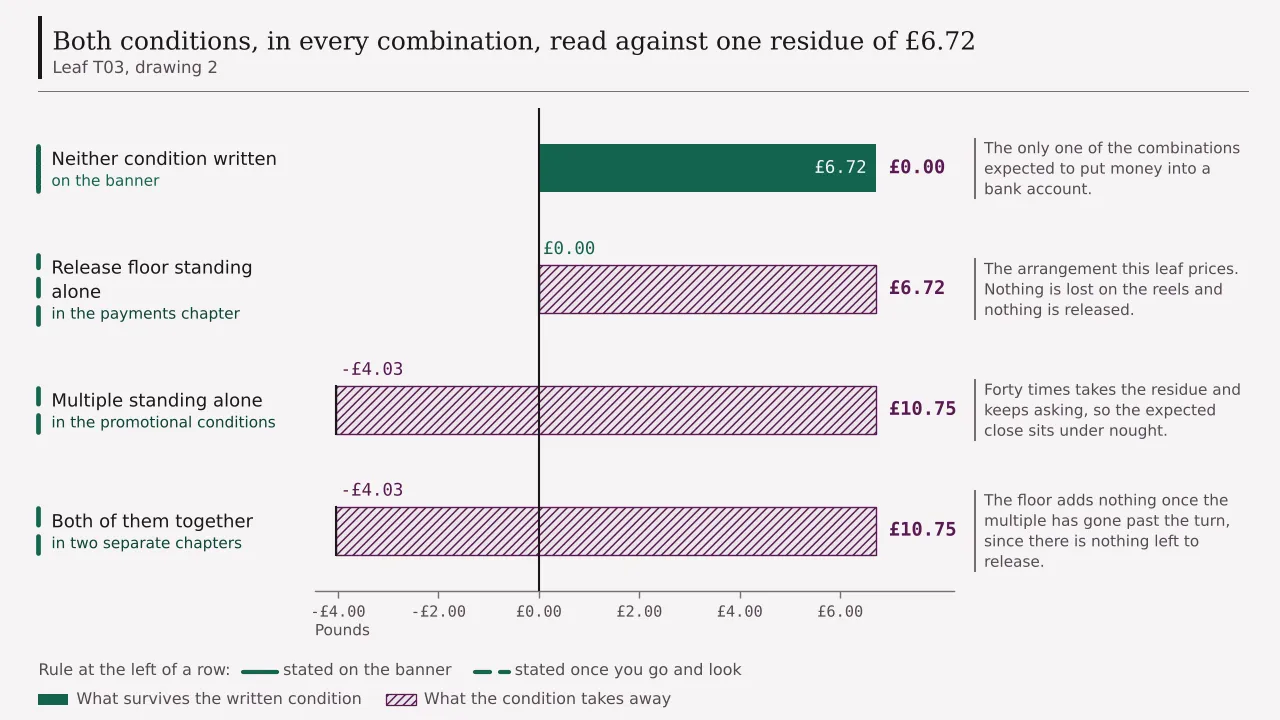
One row in that drawing is worth a second look. The bar for a floor standing on its own opens at the full £6.72 and finishes at nothing, with the whole length hatched. No money was lost on the reels in that row. The sum is intact and undeliverable, and the drawing has no way of distinguishing those two states because a reader’s bank account cannot either.
8
Why the smaller condition is the one that decides
£10.75 against £6.72. The denied condition is worth more in pounds than the surviving one, by £4.03, and the surviving one is nonetheless the binding constraint. Working out why produces a rule that holds well beyond this offer.
A multiple is a tax on a balance and it scales with the balance. Double the winnings and the obligation doubles: £13.44 of residue under forty times asks for £537.60 of turnover and costs £21.50. The proportion is fixed, so a multiple never changes whether an offer pays, only how much of it survives.
A floor is a threshold and it does not scale at all. It sits at £20.00 whatever happens, so it divides every possible outcome into two kinds: those above it, which are paid in full, and those below it, which are paid nothing. An instrument that behaves like a switch dominates one that behaves like a tax, whenever the sums in play sit near the switch and this offer’s sums sit well under it.
The general statement is short. Where a condition’s cost exceeds the money available, that condition decides the outcome regardless of how it compares with any other condition in pounds. £13.28 of shortfall against £6.72 of residue is a cost exceeding the money available. £10.75 of obligation against the same £6.72 is also larger than the money available, which is why the bottom row of part seven pays nothing too, and the two reasons are unrelated.
A reader pricing an offer therefore has to run both calculations and take the worse, not the larger. The larger figure is the one in the advertisement, because the advertisement is about the condition that was removed, and the removed condition was the expensive one precisely because expensive conditions are the ones worth removing in an advertisement.
9
The heading a reader searches under, and the one they never open
Distance is this part of the site’s measurement, and on this leaf the right unit is not a number of documents but a heading. A reader looking for the conditions on a promotion searches under headings about promotions. Everything in this leaf turns on a sentence filed under a heading about payments.
Three headings carry the material between them, and they are reached by different routes. Promotional conditions are reached from the offer, which is the one path the advertisement provides. Payments and banking information is reached from an account menu or a footer, by somebody already registered. General account terms are reached from a footer link drafted for the whole customer base rather than for one promotion.
| Heading a reader would open | What is filed under it | Worth on seventy presses |
|---|---|---|
| The offer itself | Count of presses, and a denial about a multiple | £6.72 claimed |
| Promotional conditions | Eligibility, a window, the build, and the denied multiple confirmed | £10.75 forgone |
| Payments and banking | Release floor, routes available, processing periods | £6.72 stranded |
| General account terms | Verification, discretion, dormancy, closure | The balance, conditionally |
The ordering of that table is the ordering of a reader’s attention and it runs opposite to the ordering of consequence. Reading stops at the second row on a great many sessions, and the third row is where the money is decided. Nothing about the layout is improper and nothing requires the two rows to swap places.
A register entry sits further out again. Which company answers for a given web address is a question for the public register rather than for any of those headings, and what documents will be demanded before a payment is released is ordinarily met on the way out. Neither is a heading anybody opens while deciding whether to claim seventy presses.
So the honest summary of distance on this leaf is that the deciding sentence is one heading away from where a reader is looking, in a chapter whose title gives no sign that a promotion is affected by it. That is a short distance measured in clicks and a long one measured in whether it gets read.
10
Three things a British licence would forbid outright
A seventy-press promotion sold on a denied play-through holds no Great Britain licence. On a subject that ends at an exit, the things worth naming are prohibitions rather than disclosures, and three of them bear on the arrangement priced in parts four to eight. Each is written as something a licensee may not do.
A licensee may not dress a losing result up as an almost. The technical standard governing how outcomes are generated rules out game design liable to leave somebody misjudging the probability of a result, and names two sorts: an ordinary loss swapped for one dressed as a near miss, and the imitation of a physical object at odds it does not carry. The guidance puts it in one line, that a game may not falsely display a near-miss result. Set that beside part six. Somebody £13.28 under a floor is permanently close to it, and the one thing a licensed build may not do is make close look closer.
A licensee may not give a facility a name it has not earned. The technical standard on financial limits defines a gross deposit limit as one restricting the sum a customer may pay in across a stated period, and provides that nothing failing that description may go under the name of a deposit limit. It is the one British rule policing what a condition is allowed to be named, which is the exact failure this leaf has been pricing: wording that covers one instrument and is taken to cover two.
A licensee may not park the condition that decides the outcome where it will not be met. Two advertising findings from July 2024 carry dates. On 17 July a promotion with a deadline the advertisement omitted was treated as leaving out a condition likely to mislead. On 31 July an excluded payment route, buried in small type within the full conditions, was held insufficiently prominent. A release floor shelved under payments is that shape of condition in that shape of place.
Take the three away and nothing on this leaf moves except who can be held to anything. A £20.00 floor is an ordinary payments term, defensible on cost grounds and lawful on either side of the licence. The £6.72 stays where it is in every version. What disappears is the discipline over what a condition may be called, the finding that a deciding condition shelved out of sight is a fault rather than a layout preference, and the rule stopping a screen from making a short balance look nearly long enough.
One thing a licence does not supply is worth stating so the comparison stays honest. No regulator steps into a refused payment and hands the money over. What a licence adds here is an approved route for the argument once the operator has given its own answer, and claiming more than that would misdescribe the gap this leaf has spent ten parts measuring.
Questions
- How much is a 70 spin no wager offer actually worth?
- An expected £6.72. Seventy presses priced at the 10p assumed here put £7.00 over the reels, and a 96 per cent rate turns that into an expected residue of £6.72. The promotion therefore costs the house 28p in expectation. That figure is an expectation rather than a credit: the actual residue is nothing a great deal of the time and several multiples of £6.72 occasionally.
- Does no wager mean the winnings can be withdrawn?
- Not by itself. Two separate conditions decide whether money leaves and a denial covers one of them. A multiple asks how much has to be staked; a release floor asks how large the balance has to be before anything is sent. The first is a condition on the funds, the second a condition on the transaction, and a headline denying a play-through is silent about the second. Silence is not denial.
- What is a minimum withdrawal on a no deposit spins offer?
- A sum below which no payment is sent, written with the payment methods rather than with the promotion. This leaf takes £20.00 as its own illustrative setting, since no source consulted publishes a standard figure or a distribution of them. Against an expected residue of £6.72 that leaves a shortfall of £13.28, so the presses would have to return 2.86 times what they staked where the expectation is 0.96 times.
- How much would a forty times requirement have cost on seventy spins?
- £10.75. Forty times £6.72 demands £268.80 of turnover, the house keeps fourpence out of each pound crossing the reels, and the position would finish at an expected minus £4.03 instead of at £6.72. In presses that is 2,688 of them against the seventy the offer supplies, about thirty-eight demanded for every one handed over. The sign turns over at twenty-five, since 0.04 inverts to 25.
- Why does the smaller condition decide the outcome?
- Because a floor behaves like a switch and a multiple behaves like a tax. A multiple scales with the balance, so it changes how much survives and never whether anything is paid. A floor sits at the same sum whatever happens, so it sorts every outcome into paid in full or paid nothing. Where the money in play sits well under the switch, the switch dominates, and £6.72 against a £20.00 floor sits well under it.
- What can be done with a balance below the minimum withdrawal?
- It can be staked, and that is the only thing it can always do. So a floor set above a promotional residue demands turnover exactly as a multiple does, by a different route and without the word appearing. The arithmetic runs the wrong way: one whole turnover of £6.72 is expected to leave £6.45, ten leave £4.47 and thirty leave £1.97, because each pass multiplies by 0.96 while the target stays at £20.00.
- Where is the minimum withdrawal written down?
- Under a heading about payments and banking, reached from an account menu or a footer by somebody already registered, rather than under the heading about promotions that a reader looking for conditions would open. On a good many offers it first becomes visible at the cashier. That is a short distance measured in clicks and a long one measured in whether it gets read, since the chapter’s title gives no sign that a promotion is affected by it.
- Can an offer with no wagering still pay nothing?
- Yes, and the table of combinations shows how. With neither condition written the expected payment is £6.72. With a floor alone the expected position is still £6.72 and the expected payment is nothing. With a multiple alone, or with both, the expected position is minus £4.03 and the expected payment is nothing. Three arrangements pay nothing and the headline moves a reader between two of them.
- What does a promotion of this shape give up by sitting offshore?
- Three prohibitions. A licensed build may not dress a losing result up as an almost: the standard on generated outcomes rules out the swap of an ordinary loss for one dressed as a near miss, and the imitation of a physical object at odds it does not carry. Nothing may go under the name of a deposit limit unless it restricts the sum a customer may pay in across a stated period, which is the one British rule policing what a condition is allowed to be called. And the condition that decides the outcome may not be shelved where it will not be met, a point two advertising findings dated 17 and 31 July 2024 carry. Nothing of this shape holds a British licence, so the three are inoperative against it.
- Will anybody step in if a payment is refused?
- No regulator steps into a refused payment and hands the money across, and that holds on either side of the licence. A complaint goes to the business first in every case. What a licence supplies is an approved route for the argument once the operator has given its own answer, which is a real thing and a narrower thing than most readers expect. Claiming more than that would misdescribe the gap this leaf measures.
- Which figure should be used to judge an offer of this kind?
- The worse of the two, not the larger. Run the multiple calculation and the floor calculation separately and take whichever leaves less. On seventy presses the multiple is worth £10.75 and the floor is worth £6.72, so the larger figure is the one in the advertisement and the deciding one is not. The advertisement is about the condition that was removed, and expensive conditions are the ones worth removing in an advertisement.