Terms read 19 October 2026 Leaf N01, revision 1
Twenty-five turns at a price nobody prints, and how to prove the price is absent
Twenty-five turns of a reel at the 10p this site holds fixed push £2.50 across the glass and hand back an expected £2.40. Set the same count at 5p and the banner means £1.25 of staking; set it at 20p and it means £5.00. No document states which. This leaf establishes that absence before pricing it, then prices it twice.
Stated on the banner 25 turns A quantity and a price of nothing. The advertisement carries no third item and no unit for the first one. Stated, once you go and look minus £1.44 Where forty times lands on expected winnings of £2.40, on the 96 per cent return held fixed across this site. Not stated before the money goes in Pence, unprinted The price of one turn, which opens a £3.60 gap between the cheapest and the dearest honest reading of an unchanged count.
Registration offers paying a count of turns, with their terms read
Every destination in this file is bought advertising. The site is paid a fee if a reader goes on to register, and no figure printed below moves because of it.
Bonus Spins UK Slip 01
Betportal
Ceiling as a multiple
The drop
€15.00
€1.00 in the euro
The claim reads €15.00. Once the terms beside it have applied, €0.00 of it can leave. The difference is the drop.
7 of the 15 terms on this slip could not be read before the money went in
Spins priced at this site's own 10p a spin, which the operator does not publish
Stated
€15.00
The claim as it is printed, before a single term has been applied to it.
Headline paid as spins
150 spins at 10c each, which is €15.00 of the figure above.
6 Nowhere
What one spin is worth
No unit is published for a spin, so the count is priced at this site's own 10p a spin. At half that price every figure below halves with it.
Match and other credit not priced
300% of three deposits, to a ceiling of €1,000. A share of a deposit nobody has made yet is not a sum, so no figure stands on this line and none is carried below.
Qualified
-€14.40
Written down somewhere, and taking part of the claim back. Each term carries the place it is written and the sum it takes.
2 Written terms at a distance this record does not establish
Play-through -€14.40
Carrying €14.40 through 35 times stakes €504.00 and costs €20.16 of it at 96 per cent return. That prices above the €14.40 there is to charge it against, so the whole of the credit goes and the line is held at that. The multiple sits on the bonus.
2 Written terms at a distance this record does not establish
Game weighting not priced
Slots only count towards the play-through. No contribution percentage is published, so the line above has been worked at full weight, which is the kindest reading there is.
2 Written terms at a distance this record does not establish
Ceiling on the winnings not priced
5x the bonus.
2 Written terms at a distance this record does not establish
Clock on the credit not priced
14 days.
2 Written terms at a distance this record does not establish
Largest stake while it runs not priced
€5.
3 Public record
Licence, and who holds it not priced
Licensed in Anjouan, Comoros, held by BetPortal Gaming Ltd, with Excite Ultra Media Ltd, reference ALSI-202601040-FI2. A register entry settles who holds a licence and what it permits. It does not settle who is running the site this morning.
4 Cashier
Smallest qualifying deposit your money
€20 a stage. That is €20.00 of your own money, and it is never netted into a drop.
5 On the way out
Checks before a withdrawal not priced
Documents before the first withdrawal.
Unstated
-€0.60
Applying without having been published anywhere, and costing money all the same.
6 Nowhere
What a spin hands back -€0.60
Staking a spin returns 96 per cent of it, so that share of the batch is the house's before a reel turns. This site works at that return and the operator publishes none where the claim is made.
6 Nowhere
Forfeited by rule cost unknown
Nothing is published under this heading, and it applies regardless.
6 Nowhere
Charge on the way out cost unknown
No charge on the way out is published as a figure, so nothing comes off this line. A charge that exists unpublished would come straight off whatever survives.
6 Nowhere
Smallest withdrawal allowed cost unknown
No smallest withdrawal is published as a figure. A floor nobody has published is still a floor, and it decides whether a small balance can move at all.
No Great Britain licence
Terms read 19 October 2026
Bonus Spins UK Slip 02
WinBeast
Ceiling as a sum
The drop
€50.00
€1.00 in the euro
The claim reads €50.00. Once the terms beside it have applied, €0.00 of it can leave. The difference is the drop.
8 of the 15 terms on this slip could not be read before the money went in
Spins priced at this site's own 10p a spin, which the operator does not publish
Stated
€50.00
The claim as it is printed, before a single term has been applied to it.
Headline paid as spins
500 spins at 10c each, which is €50.00 of the figure above.
6 Nowhere
What one spin is worth
No unit is published for a spin, so the count is priced at this site's own 10p a spin. At half that price every figure below halves with it.
Match and other credit not priced
50% to 100% of five deposits, each to a ceiling of €1,000, and a €650 free bet. A share of a deposit nobody has made yet is not a sum, so no figure stands on this line and none is carried below.
Qualified
-€48.00
Written down somewhere, and taking part of the claim back. Each term carries the place it is written and the sum it takes.
2 Written terms at a distance this record does not establish
Play-through -€48.00
Carrying €48.00 through 40 times stakes €1,920.00 and costs €76.80 of it at 96 per cent return. That prices above the €48.00 there is to charge it against, so the whole of the credit goes and the line is held at that. The multiple sits on the bonus and the winnings from the spins.
2 Written terms at a distance this record does not establish
Game weighting not priced
Slots, titles vary by country count towards the play-through. No contribution percentage is published, so the line above has been worked at full weight, which is the kindest reading there is.
2 Written terms at a distance this record does not establish
Ceiling on the winnings not priced
€100 a batch of spins.
2 Written terms at a distance this record does not establish
Clock on the credit not priced
7 days, spins 1 day.
3 Public record
Licence, and who holds it not priced
Licensed in Curaçao, holder not named on the site. A register entry settles who holds a licence and what it permits. It does not settle who is running the site this morning.
4 Cashier
Smallest qualifying deposit your money
€20 a stage. That is €20.00 of your own money, and it is never netted into a drop.
5 On the way out
Checks before a withdrawal not priced
Documents before the first withdrawal.
Unstated
-€2.00
Applying without having been published anywhere, and costing money all the same.
6 Nowhere
What a spin hands back -€2.00
Staking a spin returns 96 per cent of it, so that share of the batch is the house's before a reel turns. This site works at that return and the operator publishes none where the claim is made.
6 Nowhere
Largest stake while it runs cost unknown
Nothing is published under this heading, and it applies regardless.
6 Nowhere
Forfeited by rule cost unknown
Nothing is published under this heading, and it applies regardless.
6 Nowhere
Charge on the way out cost unknown
No charge on the way out is published as a figure, so nothing comes off this line. A charge that exists unpublished would come straight off whatever survives.
6 Nowhere
Smallest withdrawal allowed cost unknown
No smallest withdrawal is published as a figure. A floor nobody has published is still a floor, and it decides whether a small balance can move at all.
No Great Britain licence
Terms read 19 October 2026
Bonus Spins UK Slip 03
EliteSpin
Longest spin window
The drop
£50.00
£1.00 in the pound
The claim reads £50.00. Once the terms beside it have applied, £0.00 of it can leave. The difference is the drop.
8 of the 15 terms on this slip could not be read before the money went in
Spins priced at this site's own 10p a spin, which the operator does not publish
Stated
£50.00
The claim as it is printed, before a single term has been applied to it.
Headline paid as spins
500 spins at 10p each, which is £50.00 of the figure above.
6 Nowhere
What one spin is worth
No unit is published for a spin, so the count is priced at this site's own 10p a spin. At half that price every figure below halves with it.
Match and other credit not priced
50% to 100% of five deposits, each to a ceiling of £1,000. A share of a deposit nobody has made yet is not a sum, so no figure stands on this line and none is carried below.
Qualified
-£48.00
Written down somewhere, and taking part of the claim back. Each term carries the place it is written and the sum it takes.
2 Written terms at a distance this record does not establish
Play-through -£48.00
Carrying £48.00 through 40 times stakes £1,920.00 and costs £76.80 of it at 96 per cent return. That prices above the £48.00 there is to charge it against, so the whole of the credit goes and the line is held at that. The multiple sits on the bonus and the winnings from the spins.
2 Written terms at a distance this record does not establish
Game weighting not priced
Slots count towards the play-through. No contribution percentage is published, so the line above has been worked at full weight, which is the kindest reading there is.
2 Written terms at a distance this record does not establish
Ceiling on the winnings not priced
5x the bonus.
2 Written terms at a distance this record does not establish
Clock on the credit not priced
7 days, spins 3 days.
3 Public record
Licence, and who holds it not priced
Licensed in Costa Rica, held by PrimeTier Limited. A register entry settles who holds a licence and what it permits. It does not settle who is running the site this morning.
4 Cashier
Smallest qualifying deposit your money
£20 a stage. That is £20.00 of your own money, and it is never netted into a drop.
5 On the way out
Checks before a withdrawal not priced
Documents before the first withdrawal.
Unstated
-£2.00
Applying without having been published anywhere, and costing money all the same.
6 Nowhere
What a spin hands back -£2.00
Staking a spin returns 96 per cent of it, so that share of the batch is the house's before a reel turns. This site works at that return and the operator publishes none where the claim is made.
6 Nowhere
Largest stake while it runs cost unknown
Nothing is published under this heading, and it applies regardless.
6 Nowhere
Forfeited by rule cost unknown
Nothing is published under this heading, and it applies regardless.
6 Nowhere
Charge on the way out cost unknown
No charge on the way out is published as a figure, so nothing comes off this line. A charge that exists unpublished would come straight off whatever survives.
6 Nowhere
Smallest withdrawal allowed cost unknown
No smallest withdrawal is published as a figure. A floor nobody has published is still a floor, and it decides whether a small balance can move at all.
No Great Britain licence
Terms read 19 October 2026
Bonus Spins UK Slip 04
Crown Jewelz
Multiple unpublished
The drop
NOT WORKED
The multiple is not published in the operator's own terms. Since the sum cannot be worked around it, none is worked.
9 of the 14 terms on this slip could not be read before the money went in
No drop worked
Stated
£15.00
The claim as it is printed, before a single term has been applied to it.
Headline paid as spins
150 spins at 10p each, which is £15.00 of the figure above.
6 Nowhere
What one spin is worth
No unit is published for a spin, so the count is priced at this site's own 10p a spin. At half that price every figure below halves with it.
Match and other credit not priced
200% of the first deposit, then 150% twice, each to a ceiling of £1,000. A share of a deposit nobody has made yet is not a sum, so no figure stands on this line and none is carried below.
Qualified
NOT WORKED
Written down somewhere, and taking part of the claim back. Each term carries the place it is written and the sum it takes.
2 Written terms at a distance this record does not establish
Play-through not priced
40x the bonus, reported rather than published by the operator.
2 Written terms at a distance this record does not establish
Game weighting not priced
Slots count towards the play-through. No contribution percentage is published, so the line above has been worked at full weight, which is the kindest reading there is.
3 Public record
Licence, and who holds it not priced
Licensed in Curaçao, number not verified, holder not named on the site. A register entry settles who holds a licence and what it permits. It does not settle who is running the site this morning.
4 Cashier
Smallest qualifying deposit your money
£20. That is £20.00 of your own money, and it is never netted into a drop.
5 On the way out
Checks before a withdrawal not priced
Documents before the first withdrawal.
Unstated
NOT WORKED
Applying without having been published anywhere, and costing money all the same.
6 Nowhere
Ceiling on the winnings cost unknown
No ceiling is published. Nothing is assumed in its place.
6 Nowhere
Clock on the credit cost unknown
Nothing is published under this heading, and it applies regardless.
6 Nowhere
Largest stake while it runs cost unknown
Nothing is published under this heading, and it applies regardless.
6 Nowhere
Forfeited by rule cost unknown
Nothing is published under this heading, and it applies regardless.
6 Nowhere
Charge on the way out cost unknown
No charge on the way out is published as a figure, so nothing comes off this line. A charge that exists unpublished would come straight off whatever survives.
6 Nowhere
Smallest withdrawal allowed cost unknown
No smallest withdrawal is published as a figure. A floor nobody has published is still a floor, and it decides whether a small balance can move at all.
No Great Britain licence
Terms read 19 October 2026
Every figure in the second and third columns is this site's own working and nothing an operator has published. A claim is priced as printed, then the share a spin hands back at 96 per cent return comes off it, then what playing the multiple through costs at the same return, and then whatever a published ceiling, a charge on the way out or a floor on the smallest withdrawal takes from what has survived. The drop is the difference between the first figure and the last. The two columns add back up to it exactly, so no money leaves a slip without a term and a place beside it.
Which column a term falls in is settled by one question: has anybody written it down. A charge a reader meets at the payment screen is written down, and it stands in the second column with the cashier against it. A condition that binds without ever having been set down stands in the third, whatever it costs. Inside each column the terms run outwards from the banner, so the order itself says how far a reader would have had to go.
A count of spins has no unit until one is supplied. Where an operator publishes what one of its own spins is worth, that figure is used and the first column says it is theirs. Where none is published, this site's own 10p a spin stands in its place and every figure below moves in proportion with it. Where the multiple itself is unpublished, no drop is worked at all, because that is the one figure the sum cannot be done without.
Three words stand where a figure cannot. Not priced is a term that is written down and carries no number the arithmetic can take. Cost unknown is a term nobody has written down, costing something nobody has put a number on. Your money is money of the reader's own, which is never netted into a drop.
None of the operators in this file holds a Great Britain licence, so none of the duties that licence carries reaches them. Each of those duties is published in its own right, which is what makes its absence here something a reader can check rather than take on trust. Every gambling company licensed in Great Britain belongs to Gamstop Online, so a reader who has shut themselves out through the scheme is not shut out here. Social Responsibility Code 5.1.1 has held a play-through to a maximum of ten times the bonus funds since 19 January 2026, and it binds a licence holder and nobody else. Asked in a post of 21 October 2025 what is lost along with the licence, the Gambling Commission's Director of Enforcement and Intelligence answered: "unfair gaming practices, financial loss, and a lack of recourse if things go wrong". The same post puts blocked payouts, and withdrawal limits pitched high enough to be unreachable, among the behaviour the Commission has recorded. Nobody under 18 may hold an account at any of them.
Terms are reproduced in the wording their operator published, and each slip is dated with the day somebody sat down and read them. 19 October 2026 is the oldest of those dates. Anybody claiming an offer is bound by that operator's full terms, which are elsewhere, and never by a line standing here.
1
A quantity, a price of nothing, and the unit that never arrives
Twenty-five is a count. Two pounds fifty is a sum. Getting from the first to the second needs one multiplication by a quantity the advertisement withholds, and this leaf uses 10p for it throughout, an assumption carried in from the house arithmetic rather than a reading taken off any document. Where 96 pence of every staked pound comes back, £2.50 across the glass gives an expected £2.40, and the tenpenny difference is the margin.
What a registration headline settles, it settles for everybody at once and without a click. A quantity of turns is fixed. A price of nothing is fixed. The absence of any payment beforehand is fixed. Those three items sit and the list stops there, which makes the claim short enough to read in full and too short to convert into money.
Nothing above accuses anybody of anything. A person who registers is handed twenty-five turns, and no payment is taken from them at any point beforehand. Every figure printed below leaves that promise standing, because the promise was never the difficulty. The difficulty is that a count without a unit is a number that cannot be acted on, and a reader who acts on it anyway has supplied the unit themselves without noticing.
A coincidence in the figures is worth clearing away before it misleads anybody. The count on this banner happens to be twenty-five. Separately, twenty-five is where a balance ceases to be worth anything at a 96 per cent return, one divided by four hundredths producing it. Nothing joins the pair. An advertising decision and a piece of arithmetic have landed on the same number by accident.
So this leaf has two jobs rather than one. The first is to establish rigorously that the pence figure is genuinely absent, which is harder than it sounds, because showing that something has not been written anywhere is not the same kind of work as reading something that has. The second is to price the absence once it is established, in two separate currencies: the width of the band it opens, and the staking the band moves.
2
Showing that a number is missing rather than merely unfound
An absence needs evidence, and a page that simply asserts one has produced an opinion dressed as a finding. Three separate tests are applied here, and the figure has to survive all three before this leaf will call it unstated. Any one of them failing would mean the quantity was obtainable and merely awkward to obtain, which is a different complaint belonging to a different part of this site.
Test one asks whether anything compels publication. Three published duties stand near the question and not one of them arrives at it. Inside the British licence a build owes a reader three disclosures before any commitment: what the rules are, something bearing on the chances, and what the prizes are or how they get worked out. The middle disclosure is a menu rather than a single item. Four ways of satisfying it stand joined by the word or, among them the margin kept by the house and the percentage returned over the long run, and printing whichever is cheapest discharges the duty in full. A price per turn is on none of those routes, and the separate duty covering incentives wants conditions that are clear and within reach rather than a tariff.
Test two asks whether the figure can be solved from other published quantities. On an offer attached to a payment there are at least two numbers in public, so a reader can set up a ratio and get somewhere. A registration offer publishes one number and asks for no payment, which leaves a single equation carrying two unknowns: the value of a turn and the total the batch is worth. Neither can be recovered from the other, and nothing else on the face of the claim can be brought in to close the system.
Test three asks whether a figure exists at the moment the claim is made. Most pages skip this one, and skipping it changes what the answer means. Where the price of a turn belongs to whatever build the turns run on rather than to the promotion, the quantity has no settled value until the build is chosen, which happens on the far side of a registration form. Part four takes that apart properly.
The regulatory sheet this site works from records the first test having been run and having come back empty. The Commission’s own estate and the licence conditions were searched for anything defining a turn’s cash value, fixing who sets it, or requiring its separate disclosure, and nothing of that description was found. What the sheet records is a gap, deliberately left open rather than filled from a secondary source, and the honest reading of it is that the pence figure is a commercial decision which no rule touches.
A second gap lies beside it and is worth naming, since readers reach for it. Nobody has published whether a promotional turn is itself bonus funds in the sense the British ceiling on multiples uses. Winnings credited as bonus funds do fall under that ceiling. Past that the question stays open, and this leaf neither shuts it nor pretends it is shut.
One limit on all of this deserves printing, since the site’s own standards demand it. A negative established by searching is weaker evidence than a positive established by reading, and it stays weaker however thorough the search was. What the three tests above support is a narrow claim: no rule compels the figure, no arithmetic recovers it, and on a class of offers no figure exists yet to be compelled. That is enough to price. It is not a proof that no operator anywhere has ever written one down.
Which matters, because the useful output of part two is not an accusation. It is a procedure a reader can run in two minutes on any claim at all, and the nowhere in writing label gets attached to a quantity only once the procedure has been run on it rather than as a figure of speech.
3
One unchanged advertisement, read across the whole band
Four readings of the same twenty-five turns are set out below, at values of 5p, 10p, 20p and 25p. Every one of them is an assumption of this leaf’s, chosen to mark out a plausible band rather than to report what anybody charges, and the advertisement standing over every row of them is identical in every character.
| Assumed price of a turn | Which reading this is | Pushed across the glass | Where that sum is settled | Expected back | Staking a forty times clause asks | Expected close |
|---|---|---|---|---|---|---|
| Five pence | The thin end of the band | £1.25 | nowhere in writing | £1.20 | £48.00 | minus £0.72 |
| Ten pence | The figure the house arithmetic holds | £2.50 | nowhere in writing | £2.40 | £96.00 | minus £1.44 |
| Twenty pence | The thick end of the band | £5.00 | nowhere in writing | £4.80 | £192.00 | minus £2.88 |
| Twenty-five pence | Past the band, printed for scale | £6.25 | nowhere in writing | £6.00 | £240.00 | minus £3.60 |
Five times separates the foot of that table from its head. On expected winnings the band runs from £1.20 to £6.00, a width of £4.80, and the narrower band between the two values most often assumed on offers of this sort, 5p and 20p, is £3.60 wide. Take the midpoint of the wider band, £3.60, and act on it: the error is £2.40 whichever direction the truth lies in, and nothing printed anywhere would say which.
Notice what moves and what does not. The sign of the expected close is identical on every row, because a multiple of forty sits beyond twenty-five on all four readings and the sign depends on the multiple alone. What the price of a turn moves is the scale: it decides how much turnover the batch represents, how much staking the clause then demands, and how large the eventual shortfall is. A reader short of the pence figure knows the direction of the arithmetic and not its size.
The staking column is where the band does its real damage, because the numbers there are the ones a reader will spend time on. Forty-eight pounds of required staking at the foot of the table against two hundred and forty at the head is a spread of £192.00, which at 10p a press is 1,920 presses of difference in the obligation attached to an identical banner.
None of this requires anybody to have broken a rule or misdescribed an offer. All four rows describe advertisements that are accurate throughout, and the whole spread is produced by a single quantity that nothing compels anybody to publish. That is the shape this section of the site exists to show, and the pence value of a turn is its plainest instance.
4
One price for the batch, or a fresh price on every build
Two quite different situations hide behind the same silence, and a reader in one of them is facing a different problem from a reader in the other. Separating them is the second half of this leaf’s job, because the remedy differs: in one case a figure exists and was not printed, and in the other no figure existed to print.
Under the first situation the operator fixes one value for the entire batch when the promotion is built. Twenty-five turns at that fixed value are worth a determinate sum from the moment the banner goes up, whether or not anybody writes the sum down. The figure is unpublished. A reader cannot reach it before registering, but somebody could have printed it on the banner without doing any further work, and choosing not to was a choice.
Under the second situation the value of a turn is a property of the build the turns run on, typically its smallest permitted stake, and the offer hands over a quantity rather than a sum. Twenty-five turns then have no single value until an allocation is made between builds, and that allocation happens after registration. Here the figure is not merely unpublished. It is unpublishable in advance, and no amount of good faith on anybody’s part would produce it.
Work the second situation through and the arithmetic stops being a single number. Take a batch split fifteen turns to one build at 10p and ten to another at 20p, an illustration drawn up here and not an arrangement reported anywhere: £1.50 plus £2.00 is £3.50 pushed across the glass, giving an expected £3.36 back. Change the split to twenty turns and five and the same twenty-five turns become £3.00 of turnover and an expected £2.88. One banner, two splits, two answers, and the split did not exist when the banner was written.
A consequence of that runs against the grain of how readers think about advertising. Where the second situation holds, two people who claim the identical offer on the identical day can receive materially different things, without anybody having been treated differently and without any term having been applied inconsistently. The quantity each of them received is the same. The sum each of them received is not.
Saying a figure is unpublishable is a stronger claim than saying it is unpublished, and it carries a correspondingly heavier burden. The argument supporting it is narrow: a value that is a function of a choice not yet made is not a determinate quantity at the moment of the claim, and an advertisement cannot state a quantity that does not yet exist. That argument is sound only where the value really does follow the build. Where an operator has fixed one value and simply left it unwritten, the claim would be false and this leaf does not make it.
Which leaves a reader needing to know which situation they are in before any of the arithmetic above applies to them. That is what part five is for, and it is the most practical passage on this page.
5
Five tells that separate a fixed price from a floating one
Five observable signs distinguish a fixed price from a floating one, and four of them can be checked before an account exists. None is conclusive on its own. Taken together they settle the question often enough to be worth the two minutes, and where they conflict the honest conclusion is that the question remains open.
| What to look for | What seeing it establishes | Where it is settled | Reachable before registering |
|---|---|---|---|
| The claim ties the turns to a single named build | A fixed price can exist, since there is only one build for it to come from | Yes | |
| The conditions give a total in money as well as a count | A fixed price exists and is recoverable: divide the sum by the count | in the bonus terms | Yes |
| The conditions release the turns across a selection of builds | No single price exists in advance, because the allocation comes later | in the bonus terms | Yes |
| A ceiling is written per turn rather than per batch | A fixed price is implied, since a per-turn ceiling needs a per-turn unit | in the general terms | Yes |
| The stake selector will not move while the turns run | A price has been fixed, whatever any document does or does not say | nowhere in writing | No |
The fifth row is the only one requiring an account, and it is also the only one that cannot be argued with, since a locked selector is a fact about the software rather than a statement about it. A reader learns it by effect rather than by reading, which is what puts it at the sixth address despite being perfectly observable.
Rows two and four are the ones worth hunting for, because each of them hands back the missing quantity outright. A total expressed in money turns a count into a price with one division. A ceiling expressed per turn cannot have been drafted without somebody knowing what a turn is worth, so its presence is evidence that the first situation holds even where the figure itself is still withheld.
Row three is the one most readers will actually meet, and it is worth reading carefully rather than quickly. Wording that releases a batch across a selection is not evasive drafting. It is an accurate description of an arrangement in which the price genuinely varies, and the correct response to it is to stop looking for a figure and start working with a band instead.
Running the five tells produces one of three answers, and all three are useful. A fixed price exists and is recoverable, in which case do the division and the leaf’s band collapses to a point. A fixed price exists and is withheld, in which case the band in part three is the honest reading. Or no fixed price exists at all, in which case the band is not an admission of ignorance but a correct description of the offer.
6
What a forty times clause does to two pounds forty
A multiple of forty is the figure used from here on, chosen because it is where this corner of the market tends to settle, and on a claim asking for no payment it fastens to winnings, with no credit issued that it might fasten to instead. Multiply £2.40 by forty and £96.00 has to cross the glass before a balance turns into money. Divide that by 10p and 960 presses appear, stacked behind the twenty-five already handed over.
The close then follows in a line. Set a multiple of forty beside a margin of four hundredths and 1.6 comes out; take that from one and minus 0.6 is left; six tenths of £2.40 pointed the wrong way is minus £1.44. Weighting stays at one from end to end, so nothing has been buried inside it, and the weighting too is an assumption of the house arithmetic and not a figure read anywhere.
Expected off twenty-five turns alone £2.40 The same, once forty times is applied minus £1.44 What the clause costs £3.84
Three pounds eighty-four turns up along two routes with no step in common, which is how this site checks a sum of its own. Route one takes four hundredths of £96.00. Route two removes the expected close from the expected winnings, £2.40 less minus £1.44. Both land on £3.84, as they have to, since a multiple only ever hands the staked pounds over to the margin, at a rate fixed beforehand. A disagreement between the two would indicate a mistake and never a subtlety.
£96.00 of staking asked against an expected £2.40 that no banner ever priced
Pace lends the obligation a length. On a licensed build a game cycle reopens no sooner than two and a half seconds on from the previous one, so 960 presses cannot be finished inside 2,400 seconds, which is forty minutes at the reels before a single other condition has been looked at. That floor belongs to builds covered by the British licence. Beyond it nothing fixes a minimum interval, so the forty minutes marks the fastest a licensed build would allow rather than anything promised out here.
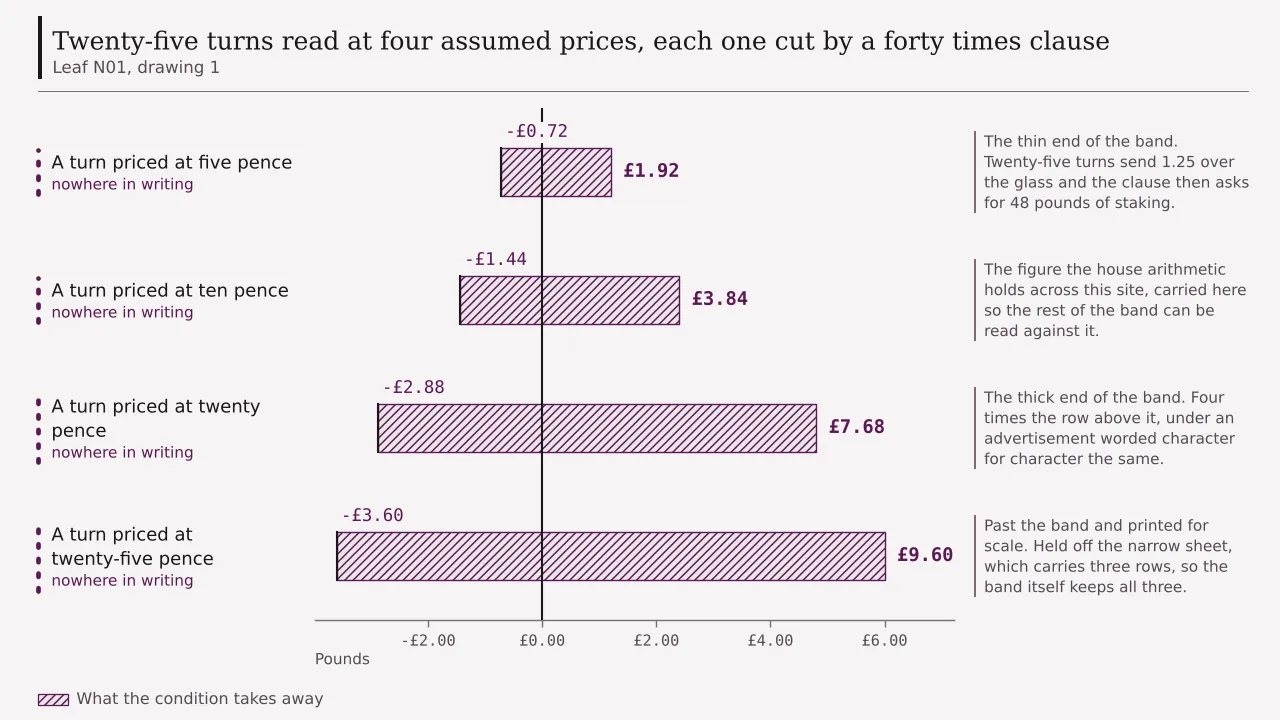
Read the drawing downwards and the proportions hold steady while the sums grow. Every bar loses the same six tenths of itself, because the multiple is the same on each row and only the starting figure differs. That is the structural point behind the whole band: the missing quantity scales the arithmetic without altering its shape, so a reader who does not know it still knows the direction of travel and knows nothing whatever about the distance.
7
Pricing the silence itself, from two directions
Parts three and six priced the clause. This part prices the absence, which is a separate quantity and the one this leaf was commissioned to produce. Two independent methods are used, because a single method would leave the figure resting on whichever assumption that method happened to need.
The first method measures the width of the band directly. Across the pair of readings an offer of this shape most often falls between, expected winnings run from £1.20 to £4.80, and the distance between them is £3.60. That is what a reader is uncertain by on the thing they are receiving. It is three times the smaller figure and three quarters of the larger, so the uncertainty is not a rounding matter but the dominant term in the whole calculation.
The count read at the dearer end of the band £4.80 The same count read at the cheaper end £1.20 What one unprinted quantity is worth £3.60
The second method measures the band in obligation rather than in receipts, and it produces a much larger number from the identical silence. Forty times £1.20 is £48.00 of staking; forty times £4.80 is £192.00. A reader who has not settled the price of a turn therefore cannot say, within £144.00, how much staking the conditions will ask of them. Expressed in presses at 10p, that is 1,440 presses of uncertainty, and in time, against a two and a half second floor, it comes to a full hour at the reels.
Both methods point at the same conclusion and disagree about the figure, which is correct rather than awkward. The absence is worth £3.60 to somebody asking what they received and £144.00 to somebody asking what they are being asked to do, and those are genuinely different questions about the same gap. Printing one and suppressing the other would flatter whichever argument the page preferred.
An exit floor settles the matter from a third direction and the result is blunter than either of the above. Suppose the cashier moves nothing under £10.00, a figure picked here for the arithmetic and sourced to nothing. Expected winnings at the dearer end of the band come to £4.80, leaving £5.20 to find; at the cheaper end they come to £1.20 and leave £8.80. Not a single reading the silence permits arrives at a floor that size.
That produces the finding the whole leaf has been working towards. The price of a turn decides how wrong a reader’s arithmetic is. It does not decide whether anything can leave, because the expected balance fails to clear the exit on every reading the silence permits. Those are separate failures and a reader who conflates them will fix the wrong one.
A concession belongs here and it is a real one. Anybody wanting twenty-five turns of a reel at no charge, meaning to stop once they are gone, and with no intention of going near a multiple has had exactly the advertised article on exactly the advertised terms. For that reader a pence figure is a curiosity. Everything above is written for whoever wants to know what the thing was worth, and that is a different person asking a different question.
8
The disclosures a licence compels, and the pence it still leaves out
No Great Britain licence stands behind a registration claim built this way. What goes with it, on the subject this leaf is about, is a short set of entitlements a reader would otherwise hold before committing anything, plus one rule deciding whether what they were told may be moved afterwards. Other losses are genuine and belong to other pages here. These four requirements are the ones a missing price turns on.
Take them in order. Before a customer commits, the applicable rules have to sit within easy reach, and be complete enough to cover the lot. Something bearing on the chances has to be within reach at that same moment, by any one of four alternatives. So do the prizes and the payouts, or else the method producing them. And once a game is running, its rules, its payouts and the odds behind its outcomes are frozen, with a clause holding back a right to rewrite the rules whenever convenient singled out in the guidance as one that will not do.
Here is the honest part, and it cuts against the reader this leaf was written for. Not a single one of those requirements would hand across the pence value of a promotional turn. A chance statement describes how a build behaves over a long run and says nothing about what an incentive costs. A payout duty is about prizes rather than stakes. A licence improves a reader’s position on this subject considerably while leaving the one quantity that converts a headline into money precisely where it was.
What the set supplies instead is the apparatus around that quantity. A published return percentage converts turnover into an expectation the instant a stake becomes known. A published payout structure says whether the band in part three is even the right band for that build. A frozen rule set means whatever gets established on day one still holds on day ten. Remove all four and a reader missing the pence figure is also missing every instrument for working around missing it.
Strip the set out and the arithmetic in parts three and six stands untouched, which is the part worth sitting with. None of it would have shifted £2.40, £96.00 or minus £1.44 by a penny. What the set decides is whether somebody can establish, ahead of committing, which row of the band they are standing on, and whether that row will still be the right one next week. Beyond the licence neither question has a published answer or any authority behind it, so a reader is left holding a count, a word and a price of nothing, which is where part one began.
A second loss has nothing to do with information. The national self-exclusion scheme reaches whoever holds the British licence, so a sign-up that shuts accounts across licensed operators leaves an unlicensed one standing, and Gamstop Online puts that boundary in its own rules rather than letting anybody find it by experiment. Anyone who has taken that step should count an offer outside the scheme as outside it, and the block underneath is a better destination than a registration form.
9
Reading a registration count before any form is filled in
Everything above compresses into a procedure short enough for a phone, and it leans on none of the figures used here. Five steps, and each one ends in something written down.
Step one, copy the claim out exactly, count and all. Step two, run the three tests from part two on the pence figure: is anybody compelled to publish it, can it be solved from another published number, and does it yet exist. Step three, run the five tells from part five and decide which of the three situations you are in. Step four, if a fixed price turned up, multiply and you are finished; if it did not, build the band and carry both ends of it. Step five, apply whatever multiple the conditions carry to both ends and print the two results side by side.
Two habits keep the procedure honest. Write the assumed price into the same sentence as every figure it produces, on every occasion, because a price carried unlabelled into the next line has quietly become a fact with nobody behind it. And hold both ends of the band until the working is finished rather than collapsing to a midpoint early, since a midpoint has no evidence for it and reads on the page exactly like a figure that does.
Applied to twenty-five turns the procedure gives six numbers and stops. Two pounds fifty of turnover and an expected £2.40 at the assumed middle of the band. Ninety-six pounds of staking at forty times. An expected close of minus £1.44. A band of £3.60 on what is received and £144.00 on what is demanded. None of the six is on any banner, and five of them cannot be reached from one.
Where the procedure ends in the third situation, with no fixed price existing at all, the right conclusion is not that the offer is worse than it looked. It is that the offer is a quantity rather than a sum, and should be evaluated as one. Twenty-five turns of a reel is a perfectly definite thing to receive. It is simply not a price, and a reader who treats it as one has done the publisher’s arithmetic for them in the publisher’s favour.
Which leaves the shortest honest summary of a registration count. It states what it states, it is true, and the quantity deciding what it is worth has no address in any document, no rule compelling it into one, and on some arrangements no determinate value at the moment the claim is made. Everything else on this leaf is arithmetic performed in the dark, carefully labelled as such.
Questions
- What does a registration offer of 25 free spins come to in money?
- Somewhere between £1.20 and £6.00 of expected winnings, settled by a price per turn nobody publishes. At the 10p held fixed across this site, twenty-five turns push £2.50 over the glass and hand back an expected £2.40 on a 96 per cent return. Set the price at 5p and the identical banner means £1.25 of staking and £1.20 expected; set it at 20p and it means £5.00 and £4.80. The count never changes and neither does a character of the advertisement.
- How can anybody show that the value of a spin is unstated?
- By running three tests and requiring the figure to fail all of them. One: does a published duty compel disclosure. The three nearest ask for the rules, something bearing on the chances, and the prizes or how they are worked out, and a price per turn is none of those. Two: can the figure be solved from other published numbers. A registration claim prints one number and asks for no payment, which leaves a single equation carrying two unknowns. Three: does a settled figure exist at all when the claim is made.
- Is the price of a turn always decided in advance?
- No, and the difference changes what a reader should do. Where an operator fixes one value for the whole batch, the figure exists and was simply not printed. Where the value follows whatever build the turns run on, no single figure exists until an allocation is made after registration, so the quantity is unpublishable in advance rather than merely unpublished. A batch split fifteen turns at 10p and ten at 20p stakes £3.50 and returns an expected £3.36, and a split of twenty and five stakes £3.00 and returns an expected £2.88.
- How would I tell which of those two situations I am in?
- Five tells, four of them checkable before an account exists. The claim naming one build means a fixed price can exist. Conditions giving a total in money as well as a count mean a fixed price exists and divides out. Conditions releasing the turns across a selection mean no single price exists in advance. A ceiling written per turn rather than per batch implies somebody knew what a turn was worth. And a stake selector that will not move while the turns run shows a price has been fixed, whatever any document says, though that one needs an account to see.
- What is a forty times clause worth on twenty-five turns?
- £3.84 at the middle reading used here, and the figure turns up along two routes with no step in common. Route one takes four hundredths of the £96.00 that forty times £2.40 demands. Route two removes an expected close of minus £1.44 from an expected £2.40. Both land on £3.84. At 10p that staking is 960 presses, and on a licensed build a cycle reopens no sooner than two and a half seconds on from the previous one, so it occupies forty minutes at least.
- Why is the break-even multiple 25 when the headline count is also 25?
- Coincidence, worth clearing away before it misleads anybody. The count an advertisement of this shape happens to carry is twenty-five. Separately, twenty-five is where a balance ceases to be worth anything at a 96 per cent return, one divided by four hundredths producing it. Nothing joins the pair: an advertising decision and a piece of arithmetic have landed on the same number by accident.
- What is the missing price per turn worth in pounds?
- Two answers, both correct, because they answer different questions. Measured on what a reader receives, the band between 5p and 20p runs from £1.20 to £4.80 of expected winnings, a width of £3.60. Measured on what the conditions then demand, the same band runs from £48.00 to £192.00 of required staking, a width of £144.00. In presses at 10p that second figure is 1,440 presses of uncertainty attached to an unchanged banner.
- Would a British licence make an operator print the spin value?
- No, and saying otherwise overstates the case. Four requirements would apply. Rules within easy reach of a customer before they commit, complete enough to cover the lot. Something bearing on the chances within reach at the same moment, by any one of four alternatives. The prizes and payouts, or the method producing them, within reach as well. And a game’s rules, payouts and outcome odds frozen once it is running, with a clause holding back a right to rewrite the rules whenever convenient named in the guidance as one that will not do. A price per turn is on none of those routes. No Great Britain licence stands behind a claim built this way, so the apparatus around the gap goes too.
- Can the expected winnings on twenty-five turns ever be collected?
- Not on these figures, and the exit settles it rather than the clause. Suppose a cashier that moves nothing under £10.00, a figure picked here for the arithmetic and sourced to nothing. Expected winnings at the dearer end of the band come to £4.80, leaving £5.20 to find; at the cheaper end they come to £1.20 and leave £8.80. No reading the silence permits arrives at a floor that size, so the price of a turn decides how wrong the arithmetic is rather than whether the balance moves.