Terms read 19 October 2026 Leaf A08, revision 1
Three jobs an identity check does out of sight, and who pays when none of them happens
A door held shut over 72 hours is worth £115.20 on the rates this leaf sets out and labels as its own. A name compared against one list every day for a year is worth £292.00. A record settling whose money sits in an account is worth the account, which here is £310.00. Added, the three come to £717.20, and a reader sees none of them happen. Each gets read twice below, once with a licence behind it and once without, and the difference is ruled off.
Stated on the banner Nothing asked The whole of what identity gets settled by an advertisement built this way, which is that none of it is wanted at the start. Stated, once you go and look £717.20 What the three jobs are worth where a published duty makes somebody do them, totalled on this leaf’s own rates. Not stated before the money goes in £310.00 A balance in an account that closes at the exit, with no record anywhere attaching it to a named person.
Offers advertised with no identity step, with their written terms read
Every destination in this file is bought advertising. The site is paid a fee if a reader goes on to register, and no figure printed below moves because of it.
Bonus Spins UK Slip 01
Betportal
Ceiling as a multiple
The drop
€15.00
€1.00 in the euro
The claim reads €15.00. Once the terms beside it have applied, €0.00 of it can leave. The difference is the drop.
7 of the 15 terms on this slip could not be read before the money went in
Spins priced at this site's own 10p a spin, which the operator does not publish
Stated
€15.00
The claim as it is printed, before a single term has been applied to it.
Headline paid as spins
150 spins at 10c each, which is €15.00 of the figure above.
6 Nowhere
What one spin is worth
No unit is published for a spin, so the count is priced at this site's own 10p a spin. At half that price every figure below halves with it.
Match and other credit not priced
300% of three deposits, to a ceiling of €1,000. A share of a deposit nobody has made yet is not a sum, so no figure stands on this line and none is carried below.
Qualified
-€14.40
Written down somewhere, and taking part of the claim back. Each term carries the place it is written and the sum it takes.
2 Written terms at a distance this record does not establish
Play-through -€14.40
Carrying €14.40 through 35 times stakes €504.00 and costs €20.16 of it at 96 per cent return. That prices above the €14.40 there is to charge it against, so the whole of the credit goes and the line is held at that. The multiple sits on the bonus.
2 Written terms at a distance this record does not establish
Game weighting not priced
Slots only count towards the play-through. No contribution percentage is published, so the line above has been worked at full weight, which is the kindest reading there is.
2 Written terms at a distance this record does not establish
Ceiling on the winnings not priced
5x the bonus.
2 Written terms at a distance this record does not establish
Clock on the credit not priced
14 days.
2 Written terms at a distance this record does not establish
Largest stake while it runs not priced
€5.
3 Public record
Licence, and who holds it not priced
Licensed in Anjouan, Comoros, held by BetPortal Gaming Ltd, with Excite Ultra Media Ltd, reference ALSI-202601040-FI2. A register entry settles who holds a licence and what it permits. It does not settle who is running the site this morning.
4 Cashier
Smallest qualifying deposit your money
€20 a stage. That is €20.00 of your own money, and it is never netted into a drop.
5 On the way out
Checks before a withdrawal not priced
Documents before the first withdrawal.
Unstated
-€0.60
Applying without having been published anywhere, and costing money all the same.
6 Nowhere
What a spin hands back -€0.60
Staking a spin returns 96 per cent of it, so that share of the batch is the house's before a reel turns. This site works at that return and the operator publishes none where the claim is made.
6 Nowhere
Forfeited by rule cost unknown
Nothing is published under this heading, and it applies regardless.
6 Nowhere
Charge on the way out cost unknown
No charge on the way out is published as a figure, so nothing comes off this line. A charge that exists unpublished would come straight off whatever survives.
6 Nowhere
Smallest withdrawal allowed cost unknown
No smallest withdrawal is published as a figure. A floor nobody has published is still a floor, and it decides whether a small balance can move at all.
No Great Britain licence
Terms read 19 October 2026
Bonus Spins UK Slip 02
WinBeast
Ceiling as a sum
The drop
€50.00
€1.00 in the euro
The claim reads €50.00. Once the terms beside it have applied, €0.00 of it can leave. The difference is the drop.
8 of the 15 terms on this slip could not be read before the money went in
Spins priced at this site's own 10p a spin, which the operator does not publish
Stated
€50.00
The claim as it is printed, before a single term has been applied to it.
Headline paid as spins
500 spins at 10c each, which is €50.00 of the figure above.
6 Nowhere
What one spin is worth
No unit is published for a spin, so the count is priced at this site's own 10p a spin. At half that price every figure below halves with it.
Match and other credit not priced
50% to 100% of five deposits, each to a ceiling of €1,000, and a €650 free bet. A share of a deposit nobody has made yet is not a sum, so no figure stands on this line and none is carried below.
Qualified
-€48.00
Written down somewhere, and taking part of the claim back. Each term carries the place it is written and the sum it takes.
2 Written terms at a distance this record does not establish
Play-through -€48.00
Carrying €48.00 through 40 times stakes €1,920.00 and costs €76.80 of it at 96 per cent return. That prices above the €48.00 there is to charge it against, so the whole of the credit goes and the line is held at that. The multiple sits on the bonus and the winnings from the spins.
2 Written terms at a distance this record does not establish
Game weighting not priced
Slots, titles vary by country count towards the play-through. No contribution percentage is published, so the line above has been worked at full weight, which is the kindest reading there is.
2 Written terms at a distance this record does not establish
Ceiling on the winnings not priced
€100 a batch of spins.
2 Written terms at a distance this record does not establish
Clock on the credit not priced
7 days, spins 1 day.
3 Public record
Licence, and who holds it not priced
Licensed in Curaçao, holder not named on the site. A register entry settles who holds a licence and what it permits. It does not settle who is running the site this morning.
4 Cashier
Smallest qualifying deposit your money
€20 a stage. That is €20.00 of your own money, and it is never netted into a drop.
5 On the way out
Checks before a withdrawal not priced
Documents before the first withdrawal.
Unstated
-€2.00
Applying without having been published anywhere, and costing money all the same.
6 Nowhere
What a spin hands back -€2.00
Staking a spin returns 96 per cent of it, so that share of the batch is the house's before a reel turns. This site works at that return and the operator publishes none where the claim is made.
6 Nowhere
Largest stake while it runs cost unknown
Nothing is published under this heading, and it applies regardless.
6 Nowhere
Forfeited by rule cost unknown
Nothing is published under this heading, and it applies regardless.
6 Nowhere
Charge on the way out cost unknown
No charge on the way out is published as a figure, so nothing comes off this line. A charge that exists unpublished would come straight off whatever survives.
6 Nowhere
Smallest withdrawal allowed cost unknown
No smallest withdrawal is published as a figure. A floor nobody has published is still a floor, and it decides whether a small balance can move at all.
No Great Britain licence
Terms read 19 October 2026
Bonus Spins UK Slip 03
EliteSpin
Longest spin window
The drop
£50.00
£1.00 in the pound
The claim reads £50.00. Once the terms beside it have applied, £0.00 of it can leave. The difference is the drop.
8 of the 15 terms on this slip could not be read before the money went in
Spins priced at this site's own 10p a spin, which the operator does not publish
Stated
£50.00
The claim as it is printed, before a single term has been applied to it.
Headline paid as spins
500 spins at 10p each, which is £50.00 of the figure above.
6 Nowhere
What one spin is worth
No unit is published for a spin, so the count is priced at this site's own 10p a spin. At half that price every figure below halves with it.
Match and other credit not priced
50% to 100% of five deposits, each to a ceiling of £1,000. A share of a deposit nobody has made yet is not a sum, so no figure stands on this line and none is carried below.
Qualified
-£48.00
Written down somewhere, and taking part of the claim back. Each term carries the place it is written and the sum it takes.
2 Written terms at a distance this record does not establish
Play-through -£48.00
Carrying £48.00 through 40 times stakes £1,920.00 and costs £76.80 of it at 96 per cent return. That prices above the £48.00 there is to charge it against, so the whole of the credit goes and the line is held at that. The multiple sits on the bonus and the winnings from the spins.
2 Written terms at a distance this record does not establish
Game weighting not priced
Slots count towards the play-through. No contribution percentage is published, so the line above has been worked at full weight, which is the kindest reading there is.
2 Written terms at a distance this record does not establish
Ceiling on the winnings not priced
5x the bonus.
2 Written terms at a distance this record does not establish
Clock on the credit not priced
7 days, spins 3 days.
3 Public record
Licence, and who holds it not priced
Licensed in Costa Rica, held by PrimeTier Limited. A register entry settles who holds a licence and what it permits. It does not settle who is running the site this morning.
4 Cashier
Smallest qualifying deposit your money
£20 a stage. That is £20.00 of your own money, and it is never netted into a drop.
5 On the way out
Checks before a withdrawal not priced
Documents before the first withdrawal.
Unstated
-£2.00
Applying without having been published anywhere, and costing money all the same.
6 Nowhere
What a spin hands back -£2.00
Staking a spin returns 96 per cent of it, so that share of the batch is the house's before a reel turns. This site works at that return and the operator publishes none where the claim is made.
6 Nowhere
Largest stake while it runs cost unknown
Nothing is published under this heading, and it applies regardless.
6 Nowhere
Forfeited by rule cost unknown
Nothing is published under this heading, and it applies regardless.
6 Nowhere
Charge on the way out cost unknown
No charge on the way out is published as a figure, so nothing comes off this line. A charge that exists unpublished would come straight off whatever survives.
6 Nowhere
Smallest withdrawal allowed cost unknown
No smallest withdrawal is published as a figure. A floor nobody has published is still a floor, and it decides whether a small balance can move at all.
No Great Britain licence
Terms read 19 October 2026
Bonus Spins UK Slip 04
Crown Jewelz
Multiple unpublished
The drop
NOT WORKED
The multiple is not published in the operator's own terms. Since the sum cannot be worked around it, none is worked.
9 of the 14 terms on this slip could not be read before the money went in
No drop worked
Stated
£15.00
The claim as it is printed, before a single term has been applied to it.
Headline paid as spins
150 spins at 10p each, which is £15.00 of the figure above.
6 Nowhere
What one spin is worth
No unit is published for a spin, so the count is priced at this site's own 10p a spin. At half that price every figure below halves with it.
Match and other credit not priced
200% of the first deposit, then 150% twice, each to a ceiling of £1,000. A share of a deposit nobody has made yet is not a sum, so no figure stands on this line and none is carried below.
Qualified
NOT WORKED
Written down somewhere, and taking part of the claim back. Each term carries the place it is written and the sum it takes.
2 Written terms at a distance this record does not establish
Play-through not priced
40x the bonus, reported rather than published by the operator.
2 Written terms at a distance this record does not establish
Game weighting not priced
Slots count towards the play-through. No contribution percentage is published, so the line above has been worked at full weight, which is the kindest reading there is.
3 Public record
Licence, and who holds it not priced
Licensed in Curaçao, number not verified, holder not named on the site. A register entry settles who holds a licence and what it permits. It does not settle who is running the site this morning.
4 Cashier
Smallest qualifying deposit your money
£20. That is £20.00 of your own money, and it is never netted into a drop.
5 On the way out
Checks before a withdrawal not priced
Documents before the first withdrawal.
Unstated
NOT WORKED
Applying without having been published anywhere, and costing money all the same.
6 Nowhere
Ceiling on the winnings cost unknown
No ceiling is published. Nothing is assumed in its place.
6 Nowhere
Clock on the credit cost unknown
Nothing is published under this heading, and it applies regardless.
6 Nowhere
Largest stake while it runs cost unknown
Nothing is published under this heading, and it applies regardless.
6 Nowhere
Forfeited by rule cost unknown
Nothing is published under this heading, and it applies regardless.
6 Nowhere
Charge on the way out cost unknown
No charge on the way out is published as a figure, so nothing comes off this line. A charge that exists unpublished would come straight off whatever survives.
6 Nowhere
Smallest withdrawal allowed cost unknown
No smallest withdrawal is published as a figure. A floor nobody has published is still a floor, and it decides whether a small balance can move at all.
No Great Britain licence
Terms read 19 October 2026
Every figure in the second and third columns is this site's own working and nothing an operator has published. A claim is priced as printed, then the share a spin hands back at 96 per cent return comes off it, then what playing the multiple through costs at the same return, and then whatever a published ceiling, a charge on the way out or a floor on the smallest withdrawal takes from what has survived. The drop is the difference between the first figure and the last. The two columns add back up to it exactly, so no money leaves a slip without a term and a place beside it.
Which column a term falls in is settled by one question: has anybody written it down. A charge a reader meets at the payment screen is written down, and it stands in the second column with the cashier against it. A condition that binds without ever having been set down stands in the third, whatever it costs. Inside each column the terms run outwards from the banner, so the order itself says how far a reader would have had to go.
A count of spins has no unit until one is supplied. Where an operator publishes what one of its own spins is worth, that figure is used and the first column says it is theirs. Where none is published, this site's own 10p a spin stands in its place and every figure below moves in proportion with it. Where the multiple itself is unpublished, no drop is worked at all, because that is the one figure the sum cannot be done without.
Three words stand where a figure cannot. Not priced is a term that is written down and carries no number the arithmetic can take. Cost unknown is a term nobody has written down, costing something nobody has put a number on. Your money is money of the reader's own, which is never netted into a drop.
None of the operators in this file holds a Great Britain licence, so none of the duties that licence carries reaches them. Each of those duties is published in its own right, which is what makes its absence here something a reader can check rather than take on trust. Every gambling company licensed in Great Britain belongs to Gamstop Online, so a reader who has shut themselves out through the scheme is not shut out here. Social Responsibility Code 5.1.1 has held a play-through to a maximum of ten times the bonus funds since 19 January 2026, and it binds a licence holder and nobody else. Asked in a post of 21 October 2025 what is lost along with the licence, the Gambling Commission's Director of Enforcement and Intelligence answered: "unfair gaming practices, financial loss, and a lack of recourse if things go wrong". The same post puts blocked payouts, and withdrawal limits pitched high enough to be unreachable, among the behaviour the Commission has recorded. Nobody under 18 may hold an account at any of them.
Terms are reproduced in the wording their operator published, and each slip is dated with the day somebody sat down and read them. 19 October 2026 is the oldest of those dates. Anybody claiming an offer is bound by that operator's full terms, which are elsewhere, and never by a line standing here.
1
Seven hundred pounds of work that nobody watches happen
What an advertisement of this kind settles about identity is one thing only, settled : that nothing will be wanted at the start. Identity checking is then argued about from the wrong end. The reader experiences a delay, a request and an inconvenience, and the arguing starts there. What the check is actually for is set out in a duty, the duty names three purposes, and all three of them operate on somebody other than the person doing the uploading. This leaf prices the three and gets £717.20 before it reaches a single sentence about inconvenience.
Some readers come to this phrase with a protection of their own already in place and are weighing whether an absence of checking gets past it. Nothing here helps with that, and the shorter routes are worth having at the top of the page. A free line runs to the National Gambling Helpline, which GamCare keeps answered every hour of the year and which takes calls, live chat and written messages, on 0808 8020 133. Reading routes are GamCare.org.uk and BeGambleAware.org. Device blocking comes to British users at no cost through a route GamCare sets out, pairing a conversation and a block with a registration; its sole primary source bears 12 April 2021 and names no span of time, which is why this page names none.
No part of what follows describes how to satisfy, shorten, avoid or anticipate a check of any kind, and nothing here points at any sort of address as asking for less than another. An account-closing registration, an application that blocks, and a payment the bank or the network declines to carry all belong to one family of instruments, and this leaf prices what happens where one of them is missing rather than mapping a way round any of them. Where the argument would need such a map, the consequence gets printed instead.
Three purposes are named by the British regulator, in three words rather than in a paragraph, and every one of them protects somebody rather than suiting an operator. Age is one. Exclusion status is the second. The third is that the account and the human claiming it are the same. None of the three serves the customer in the moment it happens, and all three serve somebody at a later moment, which is why the thing exists as a duty instead of as a practice.
So the structure of this leaf is a ledger with three rows and a tail. Part two prices the shut door at £115.20. Part three prices the daily comparison at £292.00 across a year. Part four prices the record of ownership at £310.00, which is the worked balance this page carries to the end. Parts five to seven follow that balance out through an account that closes with it inside, and part eight is about the reader for whom the whole apparatus was written in the first place.
One honest statement belongs here before the arithmetic starts. An absence of identity checking is genuinely convenient, and anybody who says otherwise is arguing against the obvious. Seven minutes are not spent, nothing is uploaded, nothing is refused. The whole of this leaf accepts that and asks a different question: who was the seven minutes for, and what happens to that person when nobody spends them.
2
First job: a door that stays shut even where nothing is staked
The first purpose is age, and the British rule is unusually wide in a direction most summaries miss. Verification covers play funded by an incentive quite as much as play funded by a customer, and it reaches as far as the prize-free versions a licensee publishes on its own site, where the absence of a prize keeps them outside gambling in the technical sense. The reason given for reaching that far is plain: no legitimate purpose is seen in children getting at those versions.
Two dates and one gap between them, which needs care. The announcement setting out the current regime carries 7 February 2019. The commencement it names is 7 May, with no year beside it. Only one year closes a gap of that shape, so 7 May 2019 is what this page works to, while recording that the source prints the day and leaves the year out.
What that announcement removed is the figure this part prices. Until then an age check had 72 hours from the opening of an account in which to be completed, so three days could run before anybody established who was using it. Price those 72 hours at this leaf’s own rate of 400 presses an hour, which is one press every nine seconds and an assumption rather than a measurement, and 28,800 presses appear. At 10p apiece that comes to £2,880.00 of turnover, of which four pence in each pound, £115.20 in all, is expected never to come back.
So the shut door is worth £115.20 over a window of three days, on this leaf’s rate, to whoever would otherwise have been behind it. That figure is deliberately not framed as harm. It is the arithmetic of a window, and the window was closed in Britain by moving the check in front of everything including play that stakes nothing.
Where no British licence applies, the window is not three days. It has no stated length at all, because nothing fixes one. An offshore rulebook may require an operator to be satisfied about a player’s age ahead of either a payment or a stake, and the one read for this site requires exactly that, but being satisfied is not the same obligation as checking at a stated hour, and prize-free lobbies fall outside the wording altogether. The quantity has moved from in a public record to nowhere in writing, and a quantity with no address is a quantity nobody can price in advance.
One figure from the self-exclusion side belongs beside this one. Among people under 25 the number registering climbed 26 per cent against the previous year on the scheme’s own reporting, and that group supplies close to a third of registrations overall. The first purpose of the check and the population most likely to have used the second are therefore not separate subjects, which is why part eight exists.
3
Second job: a name, a list, and the comparison that needs one
The second purpose is the one almost nobody attributes to an identity check, and it is the one this part of the site cares about most. A national self-exclusion arrangement is a list of people. An account is a row in an operator’s own system. Nothing connects the two except a verified identity. Without the join, the list is intact, the registration is intact, and neither can be acted upon, because no operator can establish that the person at the keyboard is the person on the list.
How often that join gets used is published. From April 2020 an operator taking business from British residents had to test its whole customer book against the list daily or more often, which makes a registration a repeated test rather than a single event. Over 365 days that is 365 separate comparisons. Over the longest term the scheme sells, 1,826 days, it is 1,826.
Price one comparison and the year follows. Take 200 presses in an evening at 10p, which is £20.00 across the reels and a rate this leaf sets rather than observes. At a 96 per cent return 80p of that stays behind, so one evening prevented is worth 80p. Three hundred and sixty-five of them come to £292.00, and 1,826 come to £1,460.80.
A one-year registration where the join exists £292.00 The identical registration where no name is ever taken £0.00 What the join is worth on its own £292.00
| Term chosen | Comparisons where a licence applies | Comparisons where none does | Expected sum held back | Held back without the join |
|---|---|---|---|---|
| 182 days | 182 | Nil | £145.60 | £0.00 |
| 365 days | 365 | Nil | £292.00 | £0.00 |
| 1,826 days | 1,826 | Nil | £1,460.80 | £0.00 |
Column three carries the argument and it is one word repeated. A registration does not partly work where no identity is ever established. It produces no comparisons at all, because a comparison needs two things and only one of them exists. The right-hand column therefore reads £0.00 whichever term was chosen, and the length of the term makes no difference to it whatsoever.
The scheme publishes its own boundary and the sentence matters here more than anywhere else on this leaf. Its terms of use show 20 May 2026 as a last revision and confine the exclusion to gambling services participating operators offer, adding that anything run by an organisation standing outside cannot be prevented by it. Membership tracks the British licence rather than any choice an operator makes, which is why an absence of identity checking and an absence from the arrangement tend to describe the same address.
4
Third job: settling whose money is sitting in the account
The third purpose is the quietest and the most expensive. A verified identity is what makes a balance belong to somebody. Strip it out and the balance does not disappear, but what it becomes is a number in another party’s ledger with no person fastened to it, and the distinction is invisible until the moment somebody needs to assert ownership.
British licensing has a definition of the money involved, and it is worth reading for what it includes rather than for what it says about protection. Customer funds are the aggregate held to customers’ credit, and the aggregate expressly takes in cleared deposits waiting to be gambled, winnings left sitting on an account, and bonuses that have crystallised without being paid. Every one of those three is money held by one party for another, and holding money for a person is an arrangement that needs the person to be identified.
Price it at the worked balance this leaf carries from here to the end. A reader stands at £310.00. Where a verified identity exists, that £310.00 is a sum held to a named individual’s credit, and every mechanism in parts six and seven has something to attach itself to. Where no verified identity exists, the same £310.00 is a figure on a screen, and the first time anybody asks whose it is will be the first time the question has ever been put.
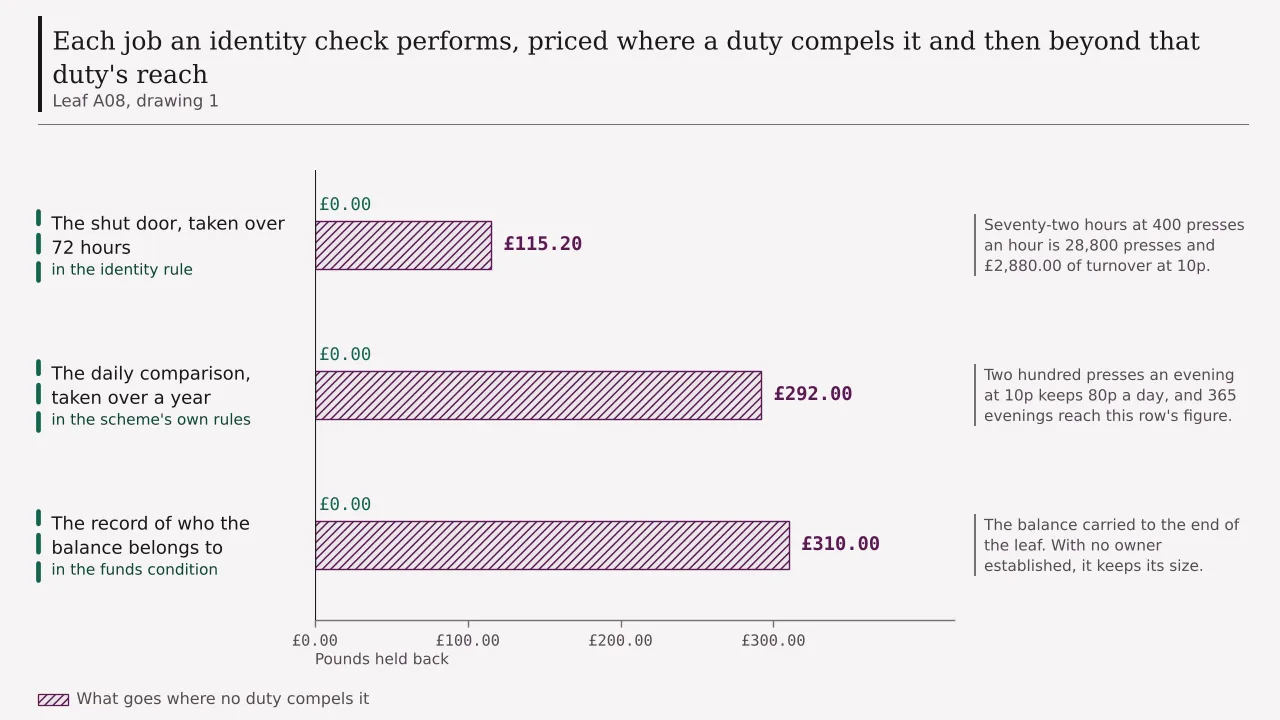
No claim is made there that an unverified balance has been stolen. The claim is that it has no established owner, which is a smaller claim and a more useful one. An established owner is what every later remedy runs through: a complaint is brought by a named customer, a payout is made to a named customer, and a published rating about the safety of customer money describes sums held to the credit of named customers. Remove the name and the remedies do not become harder. They become unaddressed.
So the three rows add to £717.20 and the third row is the one that carries the other two. The shut door protects a person who is not yet a customer. The daily comparison protects a person who has asked to stop being one. The record of ownership protects the person who is one, and it is the only row of the three whose absence a reader discovers personally, which happens in part five.
5
An account shut on the way out with the balance still inside
Here is the event this part of the site exists to price. A reader asks for £310.00 to be sent somewhere. Instead of a payment, the account closes, and the £310.00 closes with it. No rule was published in advance about when that may happen, because the power to do it sits in the account agreement, drafted by one of the two parties, and the moment it is exercised is the first moment the reader has any reason to read that agreement.
A balance read as the account screen shows it £310.00 The same balance once the account closes around it £0.00 What the closure moves £310.00
That is the second subtraction on this leaf and it is worth marking as such. Part three subtracted a registration’s worth where no join exists and produced £292.00. This part subtracts a balance’s worth where an account shuts around it and produces £310.00. Both differences are the whole of the quantity rather than a portion of it, which is the signature of a condition making its first appearance at the exit: the figure is not reduced, the figure’s addressee is removed.
£310.00 standing in an account that no record anywhere attaches to a person
One published enforcement outcome shows the shape of the term behind a closure of that sort. On 3 July 2025 a licensee paid £170,000 over promotional rules written for new casino customers which held back, at the operator’s own discretion, a power over the account and over whatever winnings sat in it. The condition the regulator recorded as broken is the one on fairness and openness. Its published view of such drafting is that it is short on transparency and capable of landing unfairly on consumers, and what followed took in an audit commissioned from a third party. The record stops at the penalty and says nothing about striking the clause down, so a penalty is what this page reports.
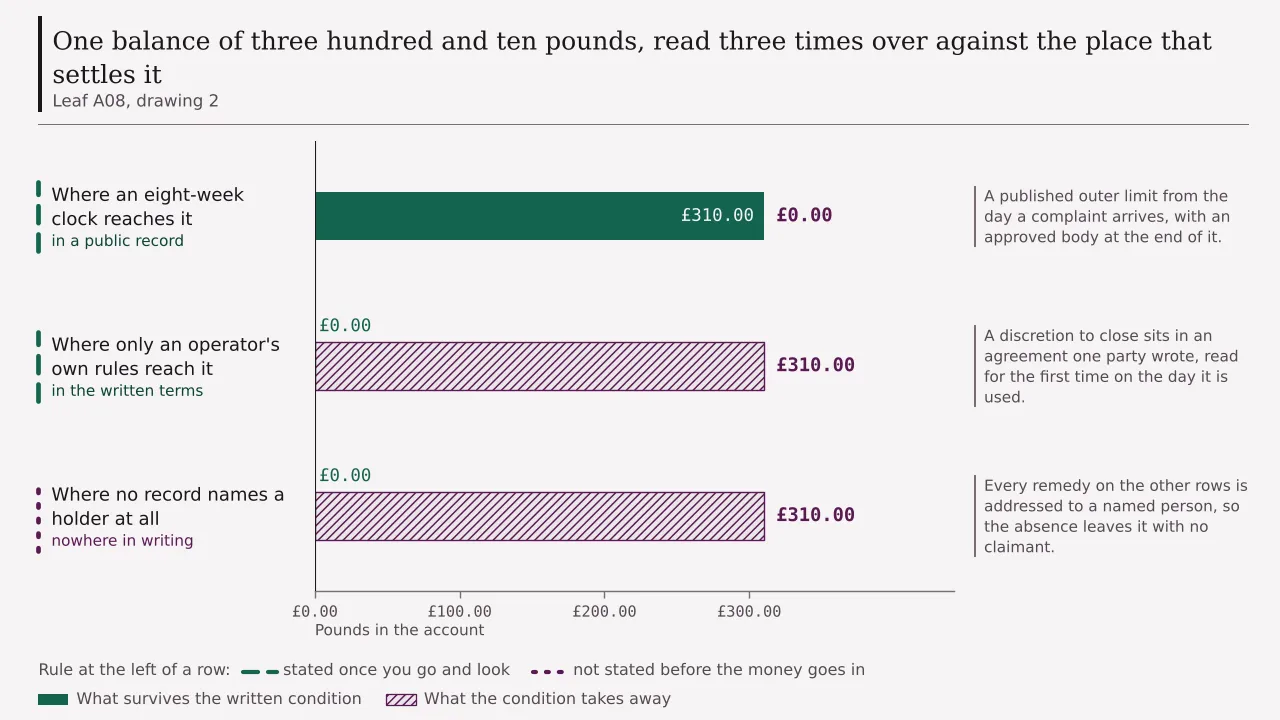
The identical figure in all three rows of that drawing is deliberate and is the whole argument of this site compressed into a picture. Nothing about the money changes between the rows. What changes is which of the six places settles the question of getting it, and on the evidence of the figures the place is worth more than the sum.
6
What recourse survives where no record names a holder
Follow the £310.00 outward and the first thing worth establishing is how short the British route is, the shortness being the useful part of it. The regulator disclaims the ombudsman role in its own words and lists what follows: no power to settle a gambling complaint, none to recover anybody’s money, none over an argument about a payout or a faulty game, and no sight of a customer account at all, so no view of what took place. The player is told instead to put the matter to the business before anything else.
After the business come four clocks. Acknowledgement falls due inside 24 hours at an operation that never shuts and inside three working days anywhere else. Eight weeks is the ceiling on everything, internal escalation included, running from the day of arrival. Six months at minimum runs from an incident, and a complaint raised inside that span has to be accepted. And a pause exists: seven days of silence from a customer on a reasonable request permits those eight weeks to be stopped and later resumed at the point they stopped. Whatever letter ends the process has to say so and set out the escalation.
Escalate to whom is the part this leaf needs. Bodies able to hear such a dispute require the regulator’s approval, and a licensee may go nowhere else. Their coverage differs by sector, so a casino argument needs one listed for remote casino rather than whichever name appears at the top. None of this machinery reaches somebody whose address holds no British licence, the obligation attaching to the licence and to nothing else.
An offshore route may still exist and a page saying otherwise would be inaccurate. The rulebook read for this site requires dispute resolution, requires it free to the player, and makes the operator bear the cost. It also contemplates the operator fixing several of the settings, among them how far a result ties the player’s hands and whether claims under some figure reach escalation at all. Two further limits bind the player directly: once a process is finished it cannot be restarted with a different body, and a player who drops out partway is not expected to be able to revive the dispute later.
Now the sentence this whole leaf has been walking towards. Under that same offshore framework a complaint can be brought only by the registered player, the governing ordinance forbidding a claim against a licence holder to change hands at all, whether by sale, by gift, by rental, by lease, by pawn or by pledge. Read that against part four and the problem states itself: every remedy in this part runs through a registered player, and where registration never established who that player was, the remedy has a shape and no claimant.
So the honest answer to what recourse survives is not none. It is that the recourse available is addressed to a person, and an absence of verification is precisely an absence of that person from the record. The £310.00 is still there. What is missing is the party entitled to ask for it, and that party was supposed to have been created at registration by the seven minutes nobody spent.
7
A published rating that answers a question nobody asked here
British licensing does publish something about the safety of money held in an account, and reading it carefully is the quickest way to see what it does not cover. The obligation falls on a licensee holding customer funds, and it is a disclosure obligation rather than a protection: the terms have to say whether the money would be protected if the business became insolvent, at what level, and by what means.
Specific machinery surrounds that disclosure. A rating system and a form, both of them specified by the regulator, govern how it gets said. It goes to each customer in writing. An acknowledgement has to come back, and until one does the money may not be gambled with. Delivery happens at a first deposit, and once more whenever the protection terms have altered and a deposit follows. Four levels make up the scale: two open with the words not protected, the second of those adding that customer money is nonetheless kept separate, while the other two read as medium and as high protection.
A frequency and a date attach to one paragraph of that condition. Where a not-protected rating is the one in use, a reminder goes out twice a year saying the money would not survive an insolvency, giving the value held for that customer, and collecting an acknowledgement ahead of any gambling with it. 31 October 2025 is when that paragraph took effect. New wording on financial limits carries the same day, the two having emerged from a single consultation response, so the date belongs to both rather than to either by itself. No commencement date exists for the earlier paragraphs or for the ratings themselves, and none is asserted here.
Now the boundary, which is the reason the rating sits in part seven rather than part four. Every word of that machinery is about one event: the business failing. Insolvency is not what happened to the £310.00 in part five. An account closing with a balance inside it is a different event entirely, performed deliberately by a solvent business under a term in its own agreement, and the rating is silent about it. A reader who found a high rating published and concluded that a balance was safe from closure would have read a true statement about the wrong event.
| What happens to the balance | Which published thing speaks to it | Where that is settled | Worth on £310.00 |
|---|---|---|---|
| The business fails owing it | A four-level rating and a written disclosure | in a public record | Stated in advance |
| A payout waits on material being supplied | An eight-week outer limit and an approved body | in a public record | Recoverable, with a clock |
| The account shuts with it inside | A discretion in an account agreement | on the way out | £310.00 at risk |
| Nobody can show whose balance it was | Nothing published anywhere | nowhere in writing | £310.00, unaddressed |
The right-hand column, taken in order, inverts what a reader would guess. The two rows with published instruments behind them are the two rows least likely to be met. The two rows that decide the whole £310.00 are the ones settled in a document written by one party and in no document at all, and the second of those is the row an absence of verification creates.
8
The reader who wants none of it, and the reader it was written for
This part has to be written carefully, because the honest version of it is easy to turn into an accusation and the accusation would be both unfair and useless. The plain statement is this: a search for an absence of identity checking and the population the identity check was built to protect overlap, and the overlap is not an accident of wording.
Inference is not needed, because the regulator has put it in print. A warning notice it put out on 20 January 2025, written about licensed software appearing where nobody held a licence, records that sites without a licence often go after vulnerable customers, and the instance it names is a person who has registered a self-exclusion. The body saying so is the one holding the enforcement record, and what it describes is targeting by operators rather than deception by readers.
Set the published scale of the thing being targeted beside it. At 16 July 2026, 614,738 people stood registered. Sixteen per cent was added across the first six months of that year. A monthly record stands at 12,236, set in May 2026. Over half of everybody registered had taken the longest term available. Among the under-25s the rise against the previous year was 26 per cent, that group supplies close to a third of all registrations, and 38 per cent of them took the shortest term instead of the longest.
That last figure repays a moment, because it is the one that joins this part to part three. A six-month term is 182 comparisons where the join exists and nil where it does not, and a shorter term is chosen by somebody who intends to come back. Coming back to a licensed address means the term runs out and the comparisons stop on a date. Coming back to an address with no identity step means the comparisons never started, which makes the chosen term a document about an intention rather than an arrangement with any effect.
None of that is an argument that a reader searching this phrase has done anything wrong. A great many people want less administration and nothing more complicated than that, and several of this site’s other leaves are written for exactly that reader. What it is, is an argument about who bears the cost of the absence. On the figures above the cost of a missing check falls on the person the check was written for, and that person is sometimes the reader and is sometimes somebody the reader has never met.
The practical conclusion is short and it is the same one part one opened with. Anybody who recognises themselves in the overlap has three free routes available, all of them quicker than completing a registration form, and all of them printed at the top of this page rather than at the bottom. Nothing in the arithmetic below that point argues against using them.
9
Four duties about purpose, and the arithmetic of taking them out
Whoever runs an address advertising an absence of identity work holds no Great Britain licence at all. Four duties state a purpose rather than a procedure, and on a leaf about what the check is for they are the ones to name; and removing them one at a time drops the three figures of parts two to four out in order.
Duty one states the purposes themselves. A check is required for age, for whether the person has excluded themselves, and for confirming identity. That is a published list of reasons, which means a reader can argue about whether a particular demand serves one of them. Where no such list binds anybody, a demand needs no reason and an absence needs no justification, and the £717.20 in part one stops being a claim anybody owes an answer about.
Duty two extends the first beyond staked play. Incentive-funded play and the prize-free versions are covered on the same footing, which is what turns the shut door of part two from a rule about money into a rule about access. Its removal is worth £115.20 over a 72-hour window on this leaf’s own rate, and more than that in a direction the arithmetic does not reach, since a free-to-play lobby has no stake for a figure to attach to.
Duty three is the disclosure about customer money: a written statement of whether the balance would survive an insolvency, at what level, by what means, on a specified rating system, with the customer’s acknowledgement required ahead of any gambling, repeated twice a year wherever the rating in use is a not-protected one. Its removal does not change the £310.00. It removes the only advance statement anybody was obliged to make about what the £310.00 is.
Duty four is the one that gives a dispute somewhere to go: the requirement to use a dispute body the regulator has approved, listed for the sector in question, reached after an eight-week process with a closing letter that explains the escalation. Its removal is what converts part five’s £310.00 from a sum with a clock on it into a sum with a correspondence address and nothing else.
Take all four away together and every figure on this leaf stays exactly where it is. The door is still worth £115.20 over 72 hours, the join is still worth £292.00 across a year, the balance is still £310.00, and the three still total £717.20. What goes is the answer to the question of who owes any of it. A purpose nobody published is a purpose nobody can be held to; an extension nobody published is an access rule with no edge; a disclosure nobody published is a balance with no advance description; and an approved body nobody is obliged to use is an escalation route that ends wherever the operator’s own letter ends. The money is unchanged and the addressee is gone, which on this subject is the whole of the loss.
10
Pricing an absence that nobody is obliged to describe
The method below works on any claimed absence, needs no figure from this leaf, and produces written answers rather than impressions. Four questions, and the fourth is where the pounds appear.
Question one: what was the thing for. Not whether it is convenient, not whether it is intrusive, but which published duty states a purpose, and how many purposes it states. Where three purposes are published, a reader has three separate things to price. Where none is, the absence cannot be argued about at all, which is itself the answer.
Question two: who does each purpose operate on. This is the question the inconvenience framing never reaches. A check performed on a reader may protect a person who is not that reader, a person that reader used to be, or that reader at a later date. All three appear on this leaf, in that order, in parts two, three and four.
Question three: what else depends on the thing having happened. Follow each later mechanism backwards and see whether it needs a named person. A complaint does. A payout does. A published statement about whose money is held does. Anything that needs a named person inherits the absence, which is why one missing step at registration reappears as four missing remedies at the exit.
Question four: price it twice and subtract. Take the figure the mechanism is worth where a duty compels it, take the figure where none does, print both and rule off the gap. On this leaf that produced £115.20 against nothing, £292.00 against nothing, and £310.00 against nothing, which totals £717.20 of difference against a convenience of roughly seven minutes.
Two habits keep the method straight, and they are the same two that keep any absence honest. Name every rate as an assumption inside the sentence that spends it, because 400 presses an hour and 200 presses an evening are this leaf’s figures and nobody else’s. And keep the place beside the figure to the very end, since a quantity settled in a public record and a quantity settled nowhere are different kinds of object even when they happen to carry the same number.
Questions
- What is identity checking there to do?
- Three published purposes, every one of them operating on somebody other than the person uploading anything. Age is one. Exclusion status is the second. The third is that the account and the human claiming it are the same. Priced on this leaf’s own rates those come to £115.20 over a 72-hour window, £292.00 across a year of daily testing, and a worked balance of £310.00 with an established owner, which adds to £717.20.
- Does the British age rule cover free games and bonus play?
- Yes, and the reach is the unusual part. Play funded by an incentive is covered on the same footing as play funded by a customer, and so are the prize-free versions a licensee publishes, where the absence of a prize keeps them outside gambling in the technical sense. The reason given is that no legitimate purpose is served by children getting at them. Two dates bound it: the announcement carries 7 February 2019 and names 7 May as the commencement with no year beside it, and only one year closes that gap.
- How much was the old 72-hour age-check window worth?
- £115.20 on the rate this leaf sets and labels as its own. Before the current regime a licensee had 72 hours from registration to finish an age check. At 400 presses an hour, which is one press every nine seconds and an assumption rather than a measurement, 72 hours is 28,800 presses. At 10p apiece that is £2,880.00 across the reels, and a 96 per cent return leaves £115.20 expected never to come back.
- Why does a self-exclusion registration need an identity check to work?
- Because a registration is a list of people and an account is a row in an operator’s system, and nothing joins the two except a verified identity. Without the join the list is intact and unusable, since no operator can establish that the person at the keyboard is the person on it. From April 2020 an operator taking business from British residents had to test its whole customer book against the list daily or more often, making a registration a repeated test rather than a single event.
- What is a year of self-exclusion worth in money?
- £292.00 where the join exists and £0.00 where no name is ever taken. The working is 200 presses in an evening at 10p, a rate this leaf sets rather than observes, which is £20.00 across the reels and 80p expected to stay behind. Three hundred and sixty-five evenings come to £292.00, 182 come to £145.60, and 1,826 come to £1,460.80. The right-hand figure is £0.00 at every term length, because no comparison happens at all rather than fewer of them happening.
- An account shuts with the balance inside it: then what?
- On the worked case here, £310.00 showing on a screen becomes £0.00 collectable, and the difference is the entire sum rather than a slice of it. Power to close sits in an account agreement drafted by one of the two parties, and the hour it gets used is usually the first hour a reader has any reason to open that agreement. On 3 July 2025 a licensee paid £170,000 over promotional rules keeping back a power of that shape, with fairness and openness recorded as the condition broken.
- Who can complain if a balance is held and no record names the holder?
- That is the difficulty rather than a detail of it. The British route runs to the business first, then an eight-week outer limit counted from the day the complaint arrives, then a dispute body the regulator has approved and listed for the sector. The regulator disclaims the ombudsman role in its own words and holds no power to recover anybody’s money. The offshore framework read for this site requires dispute resolution at no charge to the player but admits a complaint only from the registered player, its governing ordinance forbidding a claim against a licence holder to change hands at all, whether by sale, by gift, by rental, by lease, by pawn or by pledge.
- Does a published customer funds rating protect a balance from closure?
- No, because it answers a different event. The disclosure is about what would happen to money if the business became insolvent, pitched on a four-level scale, given in writing, with the customer’s acknowledgement required before any of the funds may be gambled with, and repeated twice a year wherever a not-protected rating is in use, that twice-yearly paragraph having taken effect on 31 October 2025. An account closed deliberately by a solvent business is not an insolvency, so a high rating is a true statement about something other than the event in question.
- Is a reader looking for no verification doing something wrong?
- Not by searching, and the arithmetic makes no accusation. What the published record does show is an overlap. A warning notice the regulator put out on 20 January 2025 records that sites without a licence often go after vulnerable customers, naming a person who has registered a self-exclusion as its instance, which describes targeting by operators rather than deception by readers. Alongside it, 614,738 people stood registered at 16 July 2026, and among the under-25s the rise against the previous year was 26 per cent.
- What is lost in total when nobody checks who the customer is?
- Four published duties and the addressee of every remedy behind them. The list of purposes goes, so no demand needs a reason and no absence needs a justification. The extension beyond staked play goes, so the access rule loses its edge. The written disclosure about customer money goes, so the balance has no advance description. The requirement to use an approved dispute body goes, so escalation ends at the operator’s own letter. Every figure stays where it was, £115.20 and £292.00 and £310.00 and £717.20, and what disappears is who owes any of it.
- How should a reader price any claimed absence for themselves?
- Four questions. What was the thing for, taken from a published duty rather than from how it feels. Who does each stated purpose operate on, which is often somebody other than the reader. What later mechanism depends on it having happened, since anything needing a named person inherits the absence. And then price it twice: the figure where a duty compels the work, the figure where none does, both printed with the gap ruled off beneath them.