Terms read 19 October 2026 Leaf N09, revision 1
A protection that is never mentioned, and the arithmetic of its absence
Since April 2020 a licensed operator has had to compare its entire customer base against the national scheme at least once every twenty-four hours. Across a five-year registration that is 1,826 comparisons from each of them. Where the licence does not reach, the figure is none, at an interval of never, and no page anywhere says so.
Stated on the banner £4.80 What fifty presses at 10p are expected to hand back, which is the only figure such a page tends to print. Stated, once you go and look minus £2.88 The same winnings after a forty times condition in a bonus document, at a 96 per cent return. Not stated before the money goes in 1,826 checks Comparisons a five-year registration buys inside the licence and does not buy outside it, mentioned by nobody on either side.
Offers of this kind, with their terms read
Every destination in this file is bought advertising. The site is paid a fee if a reader goes on to register, and no figure printed below moves because of it.
Bonus Spins UK Slip 01
Betportal
Ceiling as a multiple
The drop
€15.00
€1.00 in the euro
The claim reads €15.00. Once the terms beside it have applied, €0.00 of it can leave. The difference is the drop.
7 of the 15 terms on this slip could not be read before the money went in
Spins priced at this site's own 10p a spin, which the operator does not publish
Stated
€15.00
The claim as it is printed, before a single term has been applied to it.
Headline paid as spins
150 spins at 10c each, which is €15.00 of the figure above.
6 Nowhere
What one spin is worth
No unit is published for a spin, so the count is priced at this site's own 10p a spin. At half that price every figure below halves with it.
Match and other credit not priced
300% of three deposits, to a ceiling of €1,000. A share of a deposit nobody has made yet is not a sum, so no figure stands on this line and none is carried below.
Qualified
-€14.40
Written down somewhere, and taking part of the claim back. Each term carries the place it is written and the sum it takes.
2 Written terms at a distance this record does not establish
Play-through -€14.40
Carrying €14.40 through 35 times stakes €504.00 and costs €20.16 of it at 96 per cent return. That prices above the €14.40 there is to charge it against, so the whole of the credit goes and the line is held at that. The multiple sits on the bonus.
2 Written terms at a distance this record does not establish
Game weighting not priced
Slots only count towards the play-through. No contribution percentage is published, so the line above has been worked at full weight, which is the kindest reading there is.
2 Written terms at a distance this record does not establish
Ceiling on the winnings not priced
5x the bonus.
2 Written terms at a distance this record does not establish
Clock on the credit not priced
14 days.
2 Written terms at a distance this record does not establish
Largest stake while it runs not priced
€5.
3 Public record
Licence, and who holds it not priced
Licensed in Anjouan, Comoros, held by BetPortal Gaming Ltd, with Excite Ultra Media Ltd, reference ALSI-202601040-FI2. A register entry settles who holds a licence and what it permits. It does not settle who is running the site this morning.
4 Cashier
Smallest qualifying deposit your money
€20 a stage. That is €20.00 of your own money, and it is never netted into a drop.
5 On the way out
Checks before a withdrawal not priced
Documents before the first withdrawal.
Unstated
-€0.60
Applying without having been published anywhere, and costing money all the same.
6 Nowhere
What a spin hands back -€0.60
Staking a spin returns 96 per cent of it, so that share of the batch is the house's before a reel turns. This site works at that return and the operator publishes none where the claim is made.
6 Nowhere
Forfeited by rule cost unknown
Nothing is published under this heading, and it applies regardless.
6 Nowhere
Charge on the way out cost unknown
No charge on the way out is published as a figure, so nothing comes off this line. A charge that exists unpublished would come straight off whatever survives.
6 Nowhere
Smallest withdrawal allowed cost unknown
No smallest withdrawal is published as a figure. A floor nobody has published is still a floor, and it decides whether a small balance can move at all.
No Great Britain licence
Terms read 19 October 2026
Bonus Spins UK Slip 02
WinBeast
Ceiling as a sum
The drop
€50.00
€1.00 in the euro
The claim reads €50.00. Once the terms beside it have applied, €0.00 of it can leave. The difference is the drop.
8 of the 15 terms on this slip could not be read before the money went in
Spins priced at this site's own 10p a spin, which the operator does not publish
Stated
€50.00
The claim as it is printed, before a single term has been applied to it.
Headline paid as spins
500 spins at 10c each, which is €50.00 of the figure above.
6 Nowhere
What one spin is worth
No unit is published for a spin, so the count is priced at this site's own 10p a spin. At half that price every figure below halves with it.
Match and other credit not priced
50% to 100% of five deposits, each to a ceiling of €1,000, and a €650 free bet. A share of a deposit nobody has made yet is not a sum, so no figure stands on this line and none is carried below.
Qualified
-€48.00
Written down somewhere, and taking part of the claim back. Each term carries the place it is written and the sum it takes.
2 Written terms at a distance this record does not establish
Play-through -€48.00
Carrying €48.00 through 40 times stakes €1,920.00 and costs €76.80 of it at 96 per cent return. That prices above the €48.00 there is to charge it against, so the whole of the credit goes and the line is held at that. The multiple sits on the bonus and the winnings from the spins.
2 Written terms at a distance this record does not establish
Game weighting not priced
Slots, titles vary by country count towards the play-through. No contribution percentage is published, so the line above has been worked at full weight, which is the kindest reading there is.
2 Written terms at a distance this record does not establish
Ceiling on the winnings not priced
€100 a batch of spins.
2 Written terms at a distance this record does not establish
Clock on the credit not priced
7 days, spins 1 day.
3 Public record
Licence, and who holds it not priced
Licensed in Curaçao, holder not named on the site. A register entry settles who holds a licence and what it permits. It does not settle who is running the site this morning.
4 Cashier
Smallest qualifying deposit your money
€20 a stage. That is €20.00 of your own money, and it is never netted into a drop.
5 On the way out
Checks before a withdrawal not priced
Documents before the first withdrawal.
Unstated
-€2.00
Applying without having been published anywhere, and costing money all the same.
6 Nowhere
What a spin hands back -€2.00
Staking a spin returns 96 per cent of it, so that share of the batch is the house's before a reel turns. This site works at that return and the operator publishes none where the claim is made.
6 Nowhere
Largest stake while it runs cost unknown
Nothing is published under this heading, and it applies regardless.
6 Nowhere
Forfeited by rule cost unknown
Nothing is published under this heading, and it applies regardless.
6 Nowhere
Charge on the way out cost unknown
No charge on the way out is published as a figure, so nothing comes off this line. A charge that exists unpublished would come straight off whatever survives.
6 Nowhere
Smallest withdrawal allowed cost unknown
No smallest withdrawal is published as a figure. A floor nobody has published is still a floor, and it decides whether a small balance can move at all.
No Great Britain licence
Terms read 19 October 2026
Bonus Spins UK Slip 03
EliteSpin
Longest spin window
The drop
£50.00
£1.00 in the pound
The claim reads £50.00. Once the terms beside it have applied, £0.00 of it can leave. The difference is the drop.
8 of the 15 terms on this slip could not be read before the money went in
Spins priced at this site's own 10p a spin, which the operator does not publish
Stated
£50.00
The claim as it is printed, before a single term has been applied to it.
Headline paid as spins
500 spins at 10p each, which is £50.00 of the figure above.
6 Nowhere
What one spin is worth
No unit is published for a spin, so the count is priced at this site's own 10p a spin. At half that price every figure below halves with it.
Match and other credit not priced
50% to 100% of five deposits, each to a ceiling of £1,000. A share of a deposit nobody has made yet is not a sum, so no figure stands on this line and none is carried below.
Qualified
-£48.00
Written down somewhere, and taking part of the claim back. Each term carries the place it is written and the sum it takes.
2 Written terms at a distance this record does not establish
Play-through -£48.00
Carrying £48.00 through 40 times stakes £1,920.00 and costs £76.80 of it at 96 per cent return. That prices above the £48.00 there is to charge it against, so the whole of the credit goes and the line is held at that. The multiple sits on the bonus and the winnings from the spins.
2 Written terms at a distance this record does not establish
Game weighting not priced
Slots count towards the play-through. No contribution percentage is published, so the line above has been worked at full weight, which is the kindest reading there is.
2 Written terms at a distance this record does not establish
Ceiling on the winnings not priced
5x the bonus.
2 Written terms at a distance this record does not establish
Clock on the credit not priced
7 days, spins 3 days.
3 Public record
Licence, and who holds it not priced
Licensed in Costa Rica, held by PrimeTier Limited. A register entry settles who holds a licence and what it permits. It does not settle who is running the site this morning.
4 Cashier
Smallest qualifying deposit your money
£20 a stage. That is £20.00 of your own money, and it is never netted into a drop.
5 On the way out
Checks before a withdrawal not priced
Documents before the first withdrawal.
Unstated
-£2.00
Applying without having been published anywhere, and costing money all the same.
6 Nowhere
What a spin hands back -£2.00
Staking a spin returns 96 per cent of it, so that share of the batch is the house's before a reel turns. This site works at that return and the operator publishes none where the claim is made.
6 Nowhere
Largest stake while it runs cost unknown
Nothing is published under this heading, and it applies regardless.
6 Nowhere
Forfeited by rule cost unknown
Nothing is published under this heading, and it applies regardless.
6 Nowhere
Charge on the way out cost unknown
No charge on the way out is published as a figure, so nothing comes off this line. A charge that exists unpublished would come straight off whatever survives.
6 Nowhere
Smallest withdrawal allowed cost unknown
No smallest withdrawal is published as a figure. A floor nobody has published is still a floor, and it decides whether a small balance can move at all.
No Great Britain licence
Terms read 19 October 2026
Bonus Spins UK Slip 04
Crown Jewelz
Multiple unpublished
The drop
NOT WORKED
The multiple is not published in the operator's own terms. Since the sum cannot be worked around it, none is worked.
9 of the 14 terms on this slip could not be read before the money went in
No drop worked
Stated
£15.00
The claim as it is printed, before a single term has been applied to it.
Headline paid as spins
150 spins at 10p each, which is £15.00 of the figure above.
6 Nowhere
What one spin is worth
No unit is published for a spin, so the count is priced at this site's own 10p a spin. At half that price every figure below halves with it.
Match and other credit not priced
200% of the first deposit, then 150% twice, each to a ceiling of £1,000. A share of a deposit nobody has made yet is not a sum, so no figure stands on this line and none is carried below.
Qualified
NOT WORKED
Written down somewhere, and taking part of the claim back. Each term carries the place it is written and the sum it takes.
2 Written terms at a distance this record does not establish
Play-through not priced
40x the bonus, reported rather than published by the operator.
2 Written terms at a distance this record does not establish
Game weighting not priced
Slots count towards the play-through. No contribution percentage is published, so the line above has been worked at full weight, which is the kindest reading there is.
3 Public record
Licence, and who holds it not priced
Licensed in Curaçao, number not verified, holder not named on the site. A register entry settles who holds a licence and what it permits. It does not settle who is running the site this morning.
4 Cashier
Smallest qualifying deposit your money
£20. That is £20.00 of your own money, and it is never netted into a drop.
5 On the way out
Checks before a withdrawal not priced
Documents before the first withdrawal.
Unstated
NOT WORKED
Applying without having been published anywhere, and costing money all the same.
6 Nowhere
Ceiling on the winnings cost unknown
No ceiling is published. Nothing is assumed in its place.
6 Nowhere
Clock on the credit cost unknown
Nothing is published under this heading, and it applies regardless.
6 Nowhere
Largest stake while it runs cost unknown
Nothing is published under this heading, and it applies regardless.
6 Nowhere
Forfeited by rule cost unknown
Nothing is published under this heading, and it applies regardless.
6 Nowhere
Charge on the way out cost unknown
No charge on the way out is published as a figure, so nothing comes off this line. A charge that exists unpublished would come straight off whatever survives.
6 Nowhere
Smallest withdrawal allowed cost unknown
No smallest withdrawal is published as a figure. A floor nobody has published is still a floor, and it decides whether a small balance can move at all.
No Great Britain licence
Terms read 19 October 2026
Every figure in the second and third columns is this site's own working and nothing an operator has published. A claim is priced as printed, then the share a spin hands back at 96 per cent return comes off it, then what playing the multiple through costs at the same return, and then whatever a published ceiling, a charge on the way out or a floor on the smallest withdrawal takes from what has survived. The drop is the difference between the first figure and the last. The two columns add back up to it exactly, so no money leaves a slip without a term and a place beside it.
Which column a term falls in is settled by one question: has anybody written it down. A charge a reader meets at the payment screen is written down, and it stands in the second column with the cashier against it. A condition that binds without ever having been set down stands in the third, whatever it costs. Inside each column the terms run outwards from the banner, so the order itself says how far a reader would have had to go.
A count of spins has no unit until one is supplied. Where an operator publishes what one of its own spins is worth, that figure is used and the first column says it is theirs. Where none is published, this site's own 10p a spin stands in its place and every figure below moves in proportion with it. Where the multiple itself is unpublished, no drop is worked at all, because that is the one figure the sum cannot be done without.
Three words stand where a figure cannot. Not priced is a term that is written down and carries no number the arithmetic can take. Cost unknown is a term nobody has written down, costing something nobody has put a number on. Your money is money of the reader's own, which is never netted into a drop.
None of the operators in this file holds a Great Britain licence, so none of the duties that licence carries reaches them. Each of those duties is published in its own right, which is what makes its absence here something a reader can check rather than take on trust. Every gambling company licensed in Great Britain belongs to Gamstop Online, so a reader who has shut themselves out through the scheme is not shut out here. Social Responsibility Code 5.1.1 has held a play-through to a maximum of ten times the bonus funds since 19 January 2026, and it binds a licence holder and nobody else. Asked in a post of 21 October 2025 what is lost along with the licence, the Gambling Commission's Director of Enforcement and Intelligence answered: "unfair gaming practices, financial loss, and a lack of recourse if things go wrong". The same post puts blocked payouts, and withdrawal limits pitched high enough to be unreachable, among the behaviour the Commission has recorded. Nobody under 18 may hold an account at any of them.
Terms are reproduced in the wording their operator published, and each slip is dated with the day somebody sat down and read them. 19 October 2026 is the oldest of those dates. Anybody claiming an offer is bound by that operator's full terms, which are elsewhere, and never by a line standing here.
1
The number that answers at any hour, printed before anything else
Some people reach a page like this one having already closed their own accounts, and that possibility governs how the rest of it is written, so the practical material goes first and the arithmetic waits. One line answers at any hour on any date. It is the National Gambling Helpline, GamCare runs it, nobody is charged for the call, and the number is 0808 8020 133. Ringing it about somebody else is as ordinary there as ringing about oneself.
Two further routes are published and neither is charged for. GamCare sets out a three-part arrangement: its helpline, software that blocks, and the national scheme. Its page states the software is free to whoever has rung that number or taken up GamCare’s support and treatment. The software company’s site, by contrast, advertises a trial lasting seven days and publishes no British route at nought, so the two pages have to be read as a pair and this leaf cites them as one.
A registration with Gamstop Online cannot be cut short, and the scheme’s own terms resort to capital letters to say so, which is unusual in a document of that kind. Nothing comes off before the minimum period has run, and nothing comes off by itself when the period is over. Ending one after that means approaching the scheme’s contact centre, after which a day has to pass with the exclusion still live. Anybody hunting a quicker exit from their own decision is hunting something nobody has built.
The seven years following that step are commonly misread and are worth stating plainly. Across them the scheme passes on a notification rather than a prohibition: operators learn that this person once registered, and nothing obliges them to turn the person away. A record and a protection are different objects, and the door is the second of the two.
This leaf prices an absence and describes no route to anything. It names no site, no address and no category of site that asks for less than another, and it gives no method for reaching anything a reader has shut. A payment that a bank or a card scheme declines to pass to a gambling site belongs to the same family as the scheme itself, and no sentence here helps anybody past one of those either. What is below is arithmetic about what a protection is worth, written for somebody deciding whether to spend it.
2
An absence prints nothing, so it is read off something else
Elsewhere in this section, a page shows that a quantity is unstated by opening whichever documents could have carried it and finding each one addressing something else. The job here is harder, because what is missing is not a number. It is a relationship, and the party it is missing from has neither an occasion to mention it nor any interest in doing so.
Consider what an advertisement of this kind actually contains. A count of presses, a price of nought, a multiple somewhere behind a link, and a payment screen further on. Nowhere in any of that is there a sentence reading that this site takes no part in the national scheme, because no rule obliges such a sentence and no commercial instinct suggests one. The absence is therefore invisible in the ordinary sense: reading the whole site end to end would not reveal it.
It is nevertheless perfectly establishable, and the route runs through the one party that does publish. Membership follows from holding a British operating licence rather than from any choice a site makes, which the scheme states in a single line on its own help pages: a British licence for gambling online brings the scheme along with it. The question to put is therefore not what a site says about the scheme but whether it holds the licence the reach is fastened to, and that is answered in the public register by anybody at all, before an account exists and without putting a question to the site.
The limit gets stated from the far end too, in the scheme’s terms of use rather than in anybody’s advertising. Participating operators are the ones a registered person can be held away from. Where an organisation stands outside that group, the terms say in terms that there is nothing the scheme can do. Both halves are written by the party running the protection, and that party is the only one with no motive to overstate it in either direction.
That pair of published lines does the whole job. One says the reach is set by the licence. The other says what happens beyond the reach. Between them, an absence that no site prints becomes a fact a reader can establish in about ninety seconds, from two documents neither of which belongs to the site in question. An absence read off its own cause is still read.
One honest limit on the method belongs here, since this site prints it wherever a row is leaned on. An entry establishes the holder of a licence and the activities permitted under it. It establishes nothing about who is running a given website this evening. What it does settle, and settles outright, is whether the apparatus in parts four and nine applies at all, so a row behaves like a switch and not like a condition.
3
What a single registration settles, and for how long
Pricing an absence means describing the absent thing exactly first. A single registration shuts off access to accounts at participating gambling websites and applications, and the scheme’s own word for the service is free, quick and easy. A company registered in England at number 10504973, with an address in Harrogate, stands behind it, which is the kind of detail a reader can verify without taking anybody’s word.
Registration offers four durations: six months at the short end, then a year, then five years, then the same five years set to renew themselves, where the renewal can be turned off within the final six months of that five-year run and at no other point. Reaching the end of a minimum period lapses nothing by itself. The person may add six months, a year or five years to it, may ask to deactivate, or may do nothing whatever, and where nothing is done the exclusion simply continues, as much as seven more years of it.
| What the term fixes | How it stands | Where a reader settles it | What it is worth here |
|---|---|---|---|
| Which operators it reaches | Those taking part, which the licence decides | in the public register | Every licensed one |
| How often each of them must look | At least once in twenty-four hours | in the scheme’s own history | 1,826 over five years |
| Whether it can be cut short | Not before the minimum period ends | in the terms of use | 183 days at least |
| What happens if nothing is done | It carries on rather than expiring | in the terms of use | Up to seven more years |
| Whether it reaches anywhere else | It does not, and the scheme says so | in the terms of use | Nothing at all |
Read the last row against the first and the shape of this leaf’s whole subject appears. A protection whose reach is defined by a licence is complete inside that licence and empty outside it, with no partial setting in between and no sliding scale. Nothing degrades gracefully here. The door is either a door or it is not there.
Scale is published too. Figures released on 16 July 2026 put the count of registered people at 614,738, 16 per cent above where it stood six months before, with 12,236 joining during May 2026, which was the heaviest month yet recorded. Over half of those people had picked the five-year length. A quarter of all ages had picked six months, a proportion climbing to 38 per cent once the count is narrowed to the under-25s.
614,738 registrations, none of which reaches past the edge of the licence
4
A whole customer base, compared once a day, by everybody at once
The mechanism underneath all of this is a comparison, and the comparison has a published frequency. The scheme’s own history records that it became a condition of every licence covering British business in March 2020, and that from April 2020 the whole of an operator’s customer list has had to be run against it on a cycle no longer than a day. That interval is the quantity this leaf is really about.
Turn it into a count, which nobody ordinarily does. Over a six-month registration, 183 days on an ordinary calendar, a licensed operator owes at least 183 examinations of its list. Over a year that is 365. Over five years, one leap day included, it is 1,826. Those figures are this leaf’s own arithmetic applied to a published interval, and they are floors rather than estimates, because the duty sets a minimum and permits anything faster.
Now notice what the count is a count of. It is not a count of the times somebody tried to open an account. It is a count of the times a list was read whether anybody tried anything or not, which is a quite different kind of protection. A door that is checked every day is doing its work on the days nobody approaches it, and the value of that is invisible precisely when it is working.
Set the duty against the published population and the ceiling can be computed. With 2,154 operating licences held at 31 March 2026, a single five-year registration would be examined about 3.93 million times if every holder ran its comparison once a day. That is a ceiling rather than a count, because the published total covers every kind of licence rather than only those taking online business from British residents, and this leaf prints it as an upper bound and nothing firmer.
| Length chosen | Days covered | Comparisons owed, at least | Share taking it | Reaching past the licence |
|---|---|---|---|---|
| Six months | 183 | 183 | One in four, and 38 per cent of under-25s | None |
| One year | 365 | 365 | Not published separately | None |
| Five years | 1,826 | 1,826 | More than one in two | None |
| Five years, renewing | 1,826 and onwards | 1,826 and onwards | Inside the half above | None |
The fourth column is where the published statistics land and the fifth is where this leaf’s subject sits. Whichever row a person chose, and whatever proportion of people chose it with them, the final column reads the same. A protection measured in thousands of comparisons on one side of a licence boundary is measured in none on the other, and the boundary is not a matter of degree.
5
None, at an interval of never, and what that difference is
Describing what stands in that position outside the licence takes one sentence and the sentence is empty of content, which is the point. No list is compared, by nobody, at no interval. There is no register to be absent from, no cycle to be late on and no obligation to be in breach of, so a reader looking for the thing that failed will not find one.
Comparisons a five-year registration earns 1,826 Comparisons where the licence does not reach None Examinations that simply do not happen 1,826
That block prices a protection rather than an offer, which is unusual on this site and necessary here. Every other leaf subtracts a worse reading of a claim from a better one. This one subtracts an absent mechanism from a present one, and the units are examinations of a list rather than pounds, because the mechanism has no price and its absence has no fee.
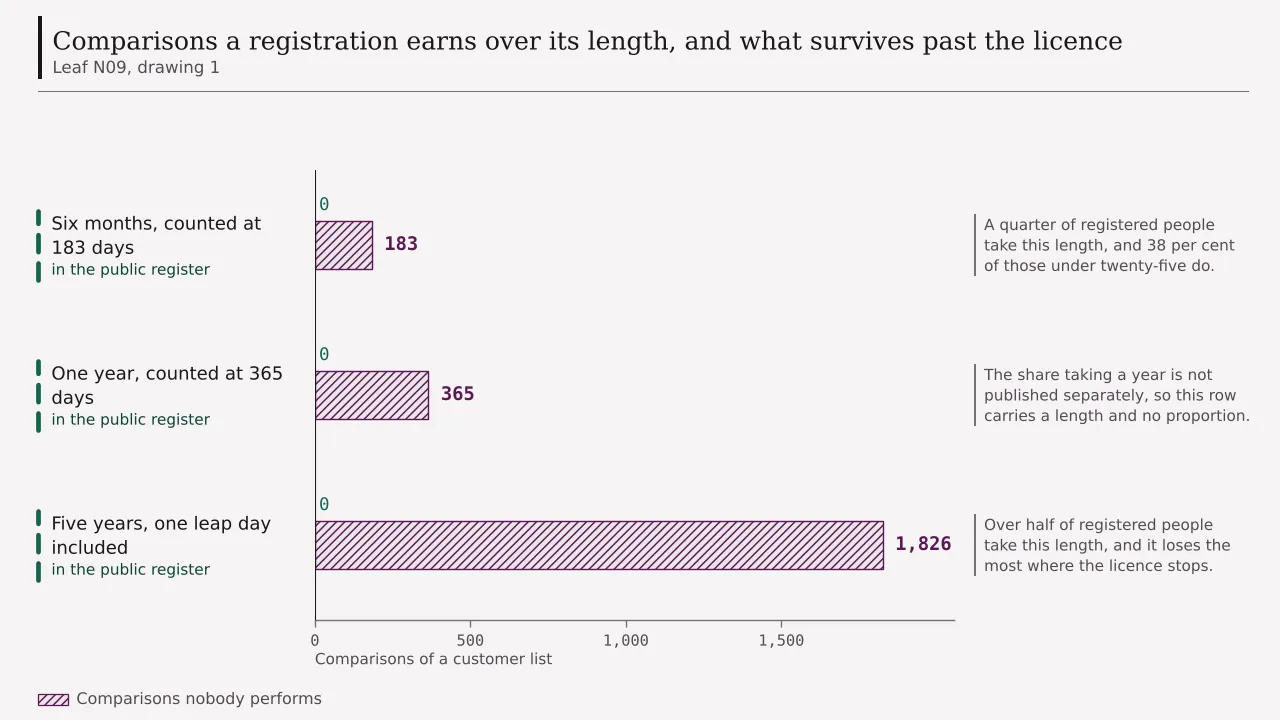
Three bars hatched the whole way across make an unusual drawing for this site and an accurate one. Against a wagering clause the solid length is whatever survives the condition, and there is normally some. Nothing survives here, because what is being applied is not a condition. It is the prior question of whether the apparatus exists, and that question takes two answers rather than a range.
One consequence runs against intuition and deserves its own sentence. The longer the registration somebody chose, the larger the quantity the absence takes away. Somebody who picked five years because six months felt too short has bought 1,643 further examinations inside the licence, and has bought precisely as many outside it as the person who picked six months, which is none. Seriousness of intent buys nothing whatever past that boundary.
6
Pricing fifty presses against a protection already chosen
Money can be put on the other half of the exchange, because offers carrying this search are ordinary enough to compute. Fifty presses at the 10p assumed throughout this site put £5.00 through the reels. Ninety-six hundredths of that comes back in expectation, which is £4.80, and £4.80 is the figure such a page prints when it prints one at all.
Those winnings carry a forty times condition, settled in the bonus terms, which wants £192.00 pushed across the reels. Retention at four hundredths of £192.00 is £7.68, and £4.80 less £7.68 leaves minus £2.88. A second route reaches the identical close without using the staking total: forty fours make 160, so minus 60 per cent of £4.80 remains, and the agreement between the two routes is the check.
Expected return on fifty presses £4.80 Expected close once forty times is served minus £2.88 What the unread condition moves £7.68
Now read both figures through the protection. Inside the licence, a registered person meets a closed door, so neither £4.80 nor minus £2.88 is ever reached: the expected value of the entire arrangement is exactly nought, because no account opens and no press happens. The registration converts an expectation of minus £2.88 into a flat zero, and that conversion is the smallest honest statement of what the protection is worth per offer.
Per offer is the important qualification. Nobody claims one offer. The £2.88 is a unit price on a sequence whose length is decided by whatever happens next, and this leaf will not model that sequence, because doing so would need figures about an individual that no source publishes and this site does not guess at. What can be said exactly is that the sign is negative at every repetition and that the registration sets every term of the sequence to nought at once.
One further reading of the same arithmetic deserves printing, since most readers arrive carrying it. An offer that asks for no payment feels incapable of costing anything, so the protection feels as though it stands between a person and something free. On these figures it stands between a person and an expected minus £2.88, with a payment screen a few clicks further on. Whatever is free about the arrangement is over in the first forty seconds.
7
What stands in that position elsewhere, put fairly
To write that nothing whatever exists out there would be inaccurate, and exactness beats comfort on this site. One offshore regulator at least publishes a responsible gaming rulebook carrying self-exclusion, and at two measurable points that rulebook is tighter than the British floor. Strictness is not where the difference lies. Architecture is.
Self-exclusion under the Curaçao policy is a bar standing between a player and a single operator, covering every domain that operator runs. What it offers for everywhere else is a prompt and not a bar, the player being someone who ought to be urged to repeat the step site by site. Five durations are offered, beginning at a year and running through three, five and ten to a lifetime, so the floor is twelve months against the British six, and a confirmed exclusion stays confirmed until its period has run.
Put the two structures side by side and the arithmetic of part four does the arguing. One registration against a national register is one act covering every licensed operator, examined daily, for as long as the person chose. One registration against an operator-level scheme is one act covering one operator, and reaching the same population would mean repeating the act once per operator, with no central list to repeat it against and no way to know when the list of operators has changed.
That is a structural statement rather than a scored comparison, and this site does not score anything. The honest summary is three lines. A longer minimum period is genuinely stricter. An exclusion that cannot be revoked is genuinely stricter. A protection that has to be arranged separately with every operator in the world is a different object from one arranged once, and the difference is not a matter of degree.
A further sourced point belongs here, because readers routinely assume the opposite. That regulator does publish a complaints route: six months in which to raise a complaint, four weeks in which the operator must answer, one written extension of equal length, and dispute resolution costing the player nothing. Authorship is where the two regimes separate. The British regulator approves the adjudicators itself, while the Curaçao document leaves several parameters of the process to the operator to set.
8
What the phrase typed into the box is really asking for
The search this leaf answers is six or seven words long and it is a search for an absence. Nobody types it wanting a reel. Reels are everywhere, including at every licensed operator in the country, so the quantity being searched for is the second half of the phrase rather than the first, and that half is a negative.
Who gets pursued by sites of that kind has been described by the British regulator, in a notice of warning put to the industry and dated 20 January 2025. Two things it says may be inadequate at such a website: the controls against money laundering, and the social responsibility arrangements. Three exposures it says a customer is left open to: fraud, failures of data privacy, practices that are unfair. One group it says is frequently gone after: vulnerable customers, and the example the notice itself picks is people who have closed their accounts through the national scheme.
A post published on 21 October 2025, by the director responsible there for enforcement and for intelligence, puts the consequences plainly, and three things go missing in it: checking of age, the tools somebody uses to govern their own play, and payment arrangements that are secure. Three further exposures follow in the same post, which are play that is unfair, money lost, and nowhere to take the argument afterwards. Two failure modes are named at the exit specifically, and they are a payout stopped outright and a withdrawal ceiling pitched where nobody reaches it.
Set that last item against part six and the two halves of this leaf meet. A reader computing minus £2.88 is computing the expected close of a condition that assumes the money can leave at the end. Where the exit is the failure mode, the arithmetic is optimistic by construction, because every figure on this site is computed as though the balance behaves. The honest reading is that minus £2.88 is a ceiling rather than an estimate.
Two sentences from the same regulator cut against overconfidence running the other way, and a page aiming at accuracy rather than alarm has to carry both. The revenue at stake, it says, makes complete dismantling of that ecosystem improbable. It also reports a fall of 32 per cent in traffic across 160 sites it had moved against. Neither figure settles anything for one person deciding one thing, which is the reason this leaf prices a mechanism and not a probability.
So the answer to what the phrase is asking for is a protection switched off, and the answer to what it returns is a set of consequences the regulator has published and nobody else has priced. If the reason the phrase was typed is that a registration is in force and feels like a mistake, part one has the two routes that exist, both free, and part three has what the scheme itself says about ending one.
9
Four protections that arrive with a licence and leave with it
Membership of the national scheme is one item on a longer list and is this leaf’s whole subject, so the three set beside it below are the ones built the same way: a default somebody is handed without asking, operating before anything has gone wrong. Reels advertised against this search sit outside the Great Britain licence, which is why the set is written here as a set of arrivals and departures rather than as a set of promises.
The first is the scheme itself. Being in it follows from the licence, so it arrives with the licence, covers every operator that holds one, and is compared against a whole customer base at least once a day.
The second is the apparatus built round a financial limit. Facilities for setting one have to be within reach from the moment of registration onwards; the question has to be put either while somebody is registering or when they first pay in; and the default answer on that screen is a limit, so declining one takes a positive act. Going down is immediate while going up waits a day and then has to be confirmed afresh, and the asymmetry is deliberate.
The third is a check nobody has to ask for. A light-touch look at financial vulnerability sits above a monthly figure for what has been deposited net, and that figure has fallen by 70 per cent across two dates: £500 on 30 August 2024 to begin with, and £150 once 28 February 2025 arrived. Set against part six, £150 is thirty-one times the £4.80 those fifty presses are expected to hand back, which puts the trigger a long way below anything a reader would call heavy going.
The fourth decides who may write to whom. Since 1 May 2025 nobody may be sent direct marketing about gambling online without having said yes to that product and to that channel separately, and the regulator’s own release records that the date was moved from an earlier one. A protection of that shape matters most to somebody who has just stopped, since unsolicited material is precisely what reaches a person who has decided against going looking.
Take the four away together and what is left is a relationship with no defaults in it at all. Nothing is compared, nothing is prompted, no threshold trips, and nothing prevents a message arriving. That is not the same as saying harm follows, and this leaf does not say so. It is saying that every mechanism in the preceding four paragraphs works by acting before a person has to decide anything, and that beyond the licence every one of those decisions is handed back to the person the mechanisms were built for.
Questions
- Why does a site outside the scheme never mention it?
- Because no rule requires the sentence and no instinct rewards it. An advertisement of this kind carries a count of presses, a price of nought, a multiple behind a link, and a payment screen further along. Taking part follows from holding a British operating licence rather than from anything a site chooses, so the absence is a consequence of a licensing position rather than a term somebody drafted, and the place to read it is the public register and not the site.
- How often does a licensed operator actually check the self-exclusion register?
- On a cycle no longer than a day, covering the whole customer list, and that duty has run since April 2020, the scheme itself having become a condition of every licence covering British business a month earlier. Turned into counts, the interval owes a registered person 183 examinations at least over half a year, 365 over a year and 1,826 over five. Those are floors rather than estimates, since a minimum is what the rule sets and anything quicker is permitted.
- What stands in that position at a site the licence does not reach?
- Nothing, at an interval of never. There is no central list to be absent from, no cycle to be late on and no obligation to be in breach of, so a reader looking for the mechanism that failed will not find one. The arithmetic of the absence is therefore the whole of the 1,826 comparisons rather than a reduced version of them, and nothing about the number degrades gradually.
- Does choosing a longer registration help outside the licence?
- Not by a single examination. Picking five years instead of half a year buys 1,643 further comparisons inside the licence and buys, outside it, exactly what half a year buys, which is none. The 16 July 2026 figures show 614,738 people registered, over half of whom had taken the longest length available, so the finding runs against what most of them were trying to purchase.
- What is a typical no-deposit offer of this kind worth in money?
- An expected minus £2.88, arrived at twice over. Fifty presses at 10p put £5.00 through the reels, of which ninety-six hundredths comes back in expectation, which is £4.80. The forty times condition on those winnings wants £192.00 pushed across the reels, retention at four hundredths of that is £7.68, and £4.80 less £7.68 is the close. A second route skips the staking total altogether: forty fours make 160, leaving minus 60 per cent of £4.80.
- What is the registration itself worth per offer, then?
- It turns an expected minus £2.88 into a flat nought, because no account opens and no press happens. That is the smallest honest statement available, and per offer is the important qualification: the £2.88 is a unit price on a sequence whose length depends on facts about one person that no source publishes. The sign is negative at every repetition, and one registration sets every term of the sequence to nought at the same moment.
- Can a registration be ended early if somebody changes their mind?
- No. Capital letters are used in the scheme’s terms of use to say that nothing comes off before the minimum period has run, and nothing comes off by itself once it is over. Ending one after that means approaching the contact centre, after which a day has to pass with the exclusion still live. Across the seven years that follow, the scheme passes on a notification rather than a prohibition: operators learn that the person once registered, and nothing obliges them to turn that person away.
- Is there any self-exclusion at all outside Great Britain?
- Yes, and writing otherwise would be inaccurate. The Curaçao responsible gaming policy requires it, covers every domain the operator runs, offers five durations from a year through three, five and ten to a lifetime, and keeps a confirmed exclusion confirmed until its period has run. At two measurable points that is tighter than the British floor. Architecture is what differs: the bar stands between a player and a single operator, and what the policy offers for everywhere else is a prompt rather than a bar, the player being someone who ought to be urged to repeat the step site by site.
- What has the regulator published about who these sites go after?
- A notice of warning put to the industry and dated 20 January 2025 names two things that may be inadequate at such a website, the controls against money laundering and the social responsibility arrangements; three exposures a customer is left open to, which are fraud, failures of data privacy and practices that are unfair; and one group frequently gone after, vulnerable customers, with its own chosen example being people who have closed their accounts through the national scheme. A post of 21 October 2025 adds what happens at the exit: a payout stopped outright, and a withdrawal ceiling pitched where nobody reaches it.
- Does that change the arithmetic on the page?
- It makes every figure on it a ceiling. Each close computed here assumes the balance behaves and the money can leave at the end, because that is the only assumption the house line can be worked under. Where blocked payouts and unreachable withdrawal limits are among the published failure modes, an expected minus £2.88 is the best case rather than the middle of a range, and the same holds for every other expected close this site prints about offers beyond the licence.
- Which protections are given up along with the scheme?
- Three others built the same way, each a default handed over without being asked for and operating before anything has gone wrong. Facilities for setting a financial limit within reach from registration onwards, the default answer on that screen being a limit, reductions immediate and increases waiting a day and then needing confirmation. A light-touch look at financial vulnerability above a monthly figure for what has been deposited net, which fell by 70 per cent across two dates, £500 on 30 August 2024 to begin with and £150 once 28 February 2025 arrived. And, since 1 May 2025, a separate yes needed for each gambling product and each channel before direct marketing may be sent. Reels advertised against this search sit outside the Great Britain licence, so the set is switched off together.
- Where can somebody get help with a registration that feels like a mistake?
- One line answers at any hour on any date. It is the National Gambling Helpline, GamCare runs it, nobody is charged for the call, and the number is 0808 8020 133. Ringing it about somebody else is as ordinary there as ringing about oneself. GamCare also publishes a three-part arrangement of that helpline, software that blocks, and the national scheme, stating the software is free to whoever has rung that number or taken up GamCare’s support and treatment. The software company’s site advertises a trial lasting seven days and publishes no British route at nought, so the pair has to be read together.