Terms read 19 October 2026 Leaf C18, revision 1
Spend today, settle on day forty-four, and read the total for the first time on day thirty
On a 30-day billing cycle followed by 14 days to pay, both of them figures this leaf declares for itself, a charge made on the first morning of a cycle falls due 43 days later and the average across the month is 28.5 days. Twelve pounds a day over that cycle is £360.00, summed nowhere until a bill sums it. This leaf models the lag, then sets it against the interruptions that would have arrived on days 1 and 13 inside the British licence.
Stated on the banner £12.00 One charge, the size of which is the only part of the arrangement anybody puts in front of a reader. Stated, once you go and look £19.20 gone What a forty times condition takes from £12.00 of credit at the return this site works to throughout. Not stated before the money goes in 43 days The longest gap between a charge being made and the same charge being paid for, on this leaf’s modelled cycle.
Offers of this kind, with their charging terms read
Every destination in this file is bought advertising. The site is paid a fee if a reader goes on to register, and no figure printed below moves because of it.
Bonus Spins UK Slip 01
Betportal
Ceiling as a multiple
The drop
€15.00
€1.00 in the euro
The claim reads €15.00. Once the terms beside it have applied, €0.00 of it can leave. The difference is the drop.
7 of the 15 terms on this slip could not be read before the money went in
Spins priced at this site's own 10p a spin, which the operator does not publish
Stated
€15.00
The claim as it is printed, before a single term has been applied to it.
Headline paid as spins
150 spins at 10c each, which is €15.00 of the figure above.
6 Nowhere
What one spin is worth
No unit is published for a spin, so the count is priced at this site's own 10p a spin. At half that price every figure below halves with it.
Match and other credit not priced
300% of three deposits, to a ceiling of €1,000. A share of a deposit nobody has made yet is not a sum, so no figure stands on this line and none is carried below.
Qualified
-€14.40
Written down somewhere, and taking part of the claim back. Each term carries the place it is written and the sum it takes.
2 Written terms at a distance this record does not establish
Play-through -€14.40
Carrying €14.40 through 35 times stakes €504.00 and costs €20.16 of it at 96 per cent return. That prices above the €14.40 there is to charge it against, so the whole of the credit goes and the line is held at that. The multiple sits on the bonus.
2 Written terms at a distance this record does not establish
Game weighting not priced
Slots only count towards the play-through. No contribution percentage is published, so the line above has been worked at full weight, which is the kindest reading there is.
2 Written terms at a distance this record does not establish
Ceiling on the winnings not priced
5x the bonus.
2 Written terms at a distance this record does not establish
Clock on the credit not priced
14 days.
2 Written terms at a distance this record does not establish
Largest stake while it runs not priced
€5.
3 Public record
Licence, and who holds it not priced
Licensed in Anjouan, Comoros, held by BetPortal Gaming Ltd, with Excite Ultra Media Ltd, reference ALSI-202601040-FI2. A register entry settles who holds a licence and what it permits. It does not settle who is running the site this morning.
4 Cashier
Smallest qualifying deposit your money
€20 a stage. That is €20.00 of your own money, and it is never netted into a drop.
5 On the way out
Checks before a withdrawal not priced
Documents before the first withdrawal.
Unstated
-€0.60
Applying without having been published anywhere, and costing money all the same.
6 Nowhere
What a spin hands back -€0.60
Staking a spin returns 96 per cent of it, so that share of the batch is the house's before a reel turns. This site works at that return and the operator publishes none where the claim is made.
6 Nowhere
Forfeited by rule cost unknown
Nothing is published under this heading, and it applies regardless.
6 Nowhere
Charge on the way out cost unknown
No charge on the way out is published as a figure, so nothing comes off this line. A charge that exists unpublished would come straight off whatever survives.
6 Nowhere
Smallest withdrawal allowed cost unknown
No smallest withdrawal is published as a figure. A floor nobody has published is still a floor, and it decides whether a small balance can move at all.
No Great Britain licence
Terms read 19 October 2026
Bonus Spins UK Slip 02
WinBeast
Ceiling as a sum
The drop
€50.00
€1.00 in the euro
The claim reads €50.00. Once the terms beside it have applied, €0.00 of it can leave. The difference is the drop.
8 of the 15 terms on this slip could not be read before the money went in
Spins priced at this site's own 10p a spin, which the operator does not publish
Stated
€50.00
The claim as it is printed, before a single term has been applied to it.
Headline paid as spins
500 spins at 10c each, which is €50.00 of the figure above.
6 Nowhere
What one spin is worth
No unit is published for a spin, so the count is priced at this site's own 10p a spin. At half that price every figure below halves with it.
Match and other credit not priced
50% to 100% of five deposits, each to a ceiling of €1,000, and a €650 free bet. A share of a deposit nobody has made yet is not a sum, so no figure stands on this line and none is carried below.
Qualified
-€48.00
Written down somewhere, and taking part of the claim back. Each term carries the place it is written and the sum it takes.
2 Written terms at a distance this record does not establish
Play-through -€48.00
Carrying €48.00 through 40 times stakes €1,920.00 and costs €76.80 of it at 96 per cent return. That prices above the €48.00 there is to charge it against, so the whole of the credit goes and the line is held at that. The multiple sits on the bonus and the winnings from the spins.
2 Written terms at a distance this record does not establish
Game weighting not priced
Slots, titles vary by country count towards the play-through. No contribution percentage is published, so the line above has been worked at full weight, which is the kindest reading there is.
2 Written terms at a distance this record does not establish
Ceiling on the winnings not priced
€100 a batch of spins.
2 Written terms at a distance this record does not establish
Clock on the credit not priced
7 days, spins 1 day.
3 Public record
Licence, and who holds it not priced
Licensed in Curaçao, holder not named on the site. A register entry settles who holds a licence and what it permits. It does not settle who is running the site this morning.
4 Cashier
Smallest qualifying deposit your money
€20 a stage. That is €20.00 of your own money, and it is never netted into a drop.
5 On the way out
Checks before a withdrawal not priced
Documents before the first withdrawal.
Unstated
-€2.00
Applying without having been published anywhere, and costing money all the same.
6 Nowhere
What a spin hands back -€2.00
Staking a spin returns 96 per cent of it, so that share of the batch is the house's before a reel turns. This site works at that return and the operator publishes none where the claim is made.
6 Nowhere
Largest stake while it runs cost unknown
Nothing is published under this heading, and it applies regardless.
6 Nowhere
Forfeited by rule cost unknown
Nothing is published under this heading, and it applies regardless.
6 Nowhere
Charge on the way out cost unknown
No charge on the way out is published as a figure, so nothing comes off this line. A charge that exists unpublished would come straight off whatever survives.
6 Nowhere
Smallest withdrawal allowed cost unknown
No smallest withdrawal is published as a figure. A floor nobody has published is still a floor, and it decides whether a small balance can move at all.
No Great Britain licence
Terms read 19 October 2026
Bonus Spins UK Slip 03
EliteSpin
Longest spin window
The drop
£50.00
£1.00 in the pound
The claim reads £50.00. Once the terms beside it have applied, £0.00 of it can leave. The difference is the drop.
8 of the 15 terms on this slip could not be read before the money went in
Spins priced at this site's own 10p a spin, which the operator does not publish
Stated
£50.00
The claim as it is printed, before a single term has been applied to it.
Headline paid as spins
500 spins at 10p each, which is £50.00 of the figure above.
6 Nowhere
What one spin is worth
No unit is published for a spin, so the count is priced at this site's own 10p a spin. At half that price every figure below halves with it.
Match and other credit not priced
50% to 100% of five deposits, each to a ceiling of £1,000. A share of a deposit nobody has made yet is not a sum, so no figure stands on this line and none is carried below.
Qualified
-£48.00
Written down somewhere, and taking part of the claim back. Each term carries the place it is written and the sum it takes.
2 Written terms at a distance this record does not establish
Play-through -£48.00
Carrying £48.00 through 40 times stakes £1,920.00 and costs £76.80 of it at 96 per cent return. That prices above the £48.00 there is to charge it against, so the whole of the credit goes and the line is held at that. The multiple sits on the bonus and the winnings from the spins.
2 Written terms at a distance this record does not establish
Game weighting not priced
Slots count towards the play-through. No contribution percentage is published, so the line above has been worked at full weight, which is the kindest reading there is.
2 Written terms at a distance this record does not establish
Ceiling on the winnings not priced
5x the bonus.
2 Written terms at a distance this record does not establish
Clock on the credit not priced
7 days, spins 3 days.
3 Public record
Licence, and who holds it not priced
Licensed in Costa Rica, held by PrimeTier Limited. A register entry settles who holds a licence and what it permits. It does not settle who is running the site this morning.
4 Cashier
Smallest qualifying deposit your money
£20 a stage. That is £20.00 of your own money, and it is never netted into a drop.
5 On the way out
Checks before a withdrawal not priced
Documents before the first withdrawal.
Unstated
-£2.00
Applying without having been published anywhere, and costing money all the same.
6 Nowhere
What a spin hands back -£2.00
Staking a spin returns 96 per cent of it, so that share of the batch is the house's before a reel turns. This site works at that return and the operator publishes none where the claim is made.
6 Nowhere
Largest stake while it runs cost unknown
Nothing is published under this heading, and it applies regardless.
6 Nowhere
Forfeited by rule cost unknown
Nothing is published under this heading, and it applies regardless.
6 Nowhere
Charge on the way out cost unknown
No charge on the way out is published as a figure, so nothing comes off this line. A charge that exists unpublished would come straight off whatever survives.
6 Nowhere
Smallest withdrawal allowed cost unknown
No smallest withdrawal is published as a figure. A floor nobody has published is still a floor, and it decides whether a small balance can move at all.
No Great Britain licence
Terms read 19 October 2026
Bonus Spins UK Slip 04
Crown Jewelz
Multiple unpublished
The drop
NOT WORKED
The multiple is not published in the operator's own terms. Since the sum cannot be worked around it, none is worked.
9 of the 14 terms on this slip could not be read before the money went in
No drop worked
Stated
£15.00
The claim as it is printed, before a single term has been applied to it.
Headline paid as spins
150 spins at 10p each, which is £15.00 of the figure above.
6 Nowhere
What one spin is worth
No unit is published for a spin, so the count is priced at this site's own 10p a spin. At half that price every figure below halves with it.
Match and other credit not priced
200% of the first deposit, then 150% twice, each to a ceiling of £1,000. A share of a deposit nobody has made yet is not a sum, so no figure stands on this line and none is carried below.
Qualified
NOT WORKED
Written down somewhere, and taking part of the claim back. Each term carries the place it is written and the sum it takes.
2 Written terms at a distance this record does not establish
Play-through not priced
40x the bonus, reported rather than published by the operator.
2 Written terms at a distance this record does not establish
Game weighting not priced
Slots count towards the play-through. No contribution percentage is published, so the line above has been worked at full weight, which is the kindest reading there is.
3 Public record
Licence, and who holds it not priced
Licensed in Curaçao, number not verified, holder not named on the site. A register entry settles who holds a licence and what it permits. It does not settle who is running the site this morning.
4 Cashier
Smallest qualifying deposit your money
£20. That is £20.00 of your own money, and it is never netted into a drop.
5 On the way out
Checks before a withdrawal not priced
Documents before the first withdrawal.
Unstated
NOT WORKED
Applying without having been published anywhere, and costing money all the same.
6 Nowhere
Ceiling on the winnings cost unknown
No ceiling is published. Nothing is assumed in its place.
6 Nowhere
Clock on the credit cost unknown
Nothing is published under this heading, and it applies regardless.
6 Nowhere
Largest stake while it runs cost unknown
Nothing is published under this heading, and it applies regardless.
6 Nowhere
Forfeited by rule cost unknown
Nothing is published under this heading, and it applies regardless.
6 Nowhere
Charge on the way out cost unknown
No charge on the way out is published as a figure, so nothing comes off this line. A charge that exists unpublished would come straight off whatever survives.
6 Nowhere
Smallest withdrawal allowed cost unknown
No smallest withdrawal is published as a figure. A floor nobody has published is still a floor, and it decides whether a small balance can move at all.
No Great Britain licence
Terms read 19 October 2026
Every figure in the second and third columns is this site's own working and nothing an operator has published. A claim is priced as printed, then the share a spin hands back at 96 per cent return comes off it, then what playing the multiple through costs at the same return, and then whatever a published ceiling, a charge on the way out or a floor on the smallest withdrawal takes from what has survived. The drop is the difference between the first figure and the last. The two columns add back up to it exactly, so no money leaves a slip without a term and a place beside it.
Which column a term falls in is settled by one question: has anybody written it down. A charge a reader meets at the payment screen is written down, and it stands in the second column with the cashier against it. A condition that binds without ever having been set down stands in the third, whatever it costs. Inside each column the terms run outwards from the banner, so the order itself says how far a reader would have had to go.
A count of spins has no unit until one is supplied. Where an operator publishes what one of its own spins is worth, that figure is used and the first column says it is theirs. Where none is published, this site's own 10p a spin stands in its place and every figure below moves in proportion with it. Where the multiple itself is unpublished, no drop is worked at all, because that is the one figure the sum cannot be done without.
Three words stand where a figure cannot. Not priced is a term that is written down and carries no number the arithmetic can take. Cost unknown is a term nobody has written down, costing something nobody has put a number on. Your money is money of the reader's own, which is never netted into a drop.
None of the operators in this file holds a Great Britain licence, so none of the duties that licence carries reaches them. Each of those duties is published in its own right, which is what makes its absence here something a reader can check rather than take on trust. Every gambling company licensed in Great Britain belongs to Gamstop Online, so a reader who has shut themselves out through the scheme is not shut out here. Social Responsibility Code 5.1.1 has held a play-through to a maximum of ten times the bonus funds since 19 January 2026, and it binds a licence holder and nobody else. Asked in a post of 21 October 2025 what is lost along with the licence, the Gambling Commission's Director of Enforcement and Intelligence answered: "unfair gaming practices, financial loss, and a lack of recourse if things go wrong". The same post puts blocked payouts, and withdrawal limits pitched high enough to be unreachable, among the behaviour the Commission has recorded. Nobody under 18 may hold an account at any of them.
Terms are reproduced in the wording their operator published, and each slip is dated with the day somebody sat down and read them. 19 October 2026 is the oldest of those dates. Anybody claiming an offer is bound by that operator's full terms, which are elsewhere, and never by a line standing here.
1
A charge made now and settled by somebody later
Paying from a telephone account inverts the usual order of a transaction. Ordinarily money leaves an account and a decision is confirmed by the leaving. Here the decision happens, the value arrives at the far end immediately, and the money moves out of the payer’s hands on some later date fixed by a billing arrangement that had nothing to do with the decision. Nothing about that sequence is concealed. It is simply a sequence in which the confirming step and the deciding step have been pulled apart.
Pulling them apart has an arithmetical consequence, and the whole of this leaf is an attempt to measure it. If a charge is settled 43 days after it is made, then for 43 days the only record of the decision lives on a screen owned by the party that benefited from it. The document produced by somebody with no interest in the outcome arrives at the end, and this leaf argues that the bill is therefore the first candid paper in the chain as well as the last.
Before the modelling, the thing worth more than the modelling. Anybody reading this while a registration with Gamstop Online is still in force is reading about accounts that registration was taken out to stop. Two routes cost nothing and keep what is said private: GamCare.org.uk, which answers 0808 8020 133, the National Gambling Helpline, on every day there is, and BeGambleAware.org. This page describes no route to an operator somebody has excluded themselves from, and none of the figures below is an argument for trying to find one.
A network that refuses to carry gambling charges on a telephone account is doing protective work of the same kind a self-exclusion does, and so is a bank, a card scheme or a wallet that declines the same payment. Each publishes its own policy and each applies it without asking anybody’s permission. What this leaf measures is the consequence of meeting such a refusal, and getting past one is measured nowhere on this page.
One question deserves a straight answer rather than a confident one. Whether a charge of this shape counts as a form of credit is not something this page decides, because nothing citable on this site addresses a telephone account in those terms. What can be stated is the sequence, the lengths of its parts, and what the British rules require of an operator inside the licence, which is what parts two to eight do.
The worked example runs on a charge of £12.00, a matched credit of the same size, a forty times play-through, 96p coming back for every staked pound and a weighting fixed at one. The last three are site-wide. The charge size, the 30-day cycle and the 14-day payment period are set on this leaf for a worked example, and each is named again wherever a sentence spends it.
2
Declaring a cycle and a payment period, then modelling both
Two lengths decide everything on this subject and neither is published by anybody this site can cite, so both are declared here and used consistently. The first is the billing cycle, taken as 30 days. The second is the period between a bill being produced and the money being taken, taken as 14 days. Both are this leaf’s own settings, chosen round so that the arithmetic can be followed, and neither describes any particular arrangement.
With those two in hand the model is a single line. A charge made on day d of a cycle waits until day 30 for the bill, then another 14 days for settlement, so the lag is 44 minus d. On the first day of a cycle that is 43 days. On the last day it is 14. Averaged across a thirty-day month it is 28.5 days, which is the sum of the lags divided by thirty and is the single figure this leaf uses whenever one number is wanted.
Two properties of that line are worth pausing on, because they are not obvious and they matter later. The first is that the lag is longest for the earliest charge, so a reader who begins at the start of a cycle has the greatest distance between decision and consequence. The second is that the lag varies by a factor of just over three across the month, from 14 days to 43, even though every charge is identical in size and in nature.
Lag of 44 minus the day number, running 43 days down to 14, averaging 28.5
Repetition is where the model earns its keep, because a single charge is not the thing anybody worries about. Take a charge of £12.00 on every day of the cycle. The total reaching the bill is £360.00, none of it settled until day 44, and the first thirty of those charges each carry their own lag from 43 days down to 14. One document arrives at the end carrying all thirty, which is the first and only occasion on which they are added together.
3
Working the lag out for every day of a month
A table makes the shape plain and lets a reader place their own habits on it. Every row uses the same two declared lengths, and the right-hand column carries the figure this leaf keeps returning to: how much has been charged, cumulatively, by the day in question, at £12.00 a day.
| Day of the cycle | Days until the bill | Days until settlement | Charged so far at £12.00 a day | What exists in writing by then |
|---|---|---|---|---|
| Day 1 | 29 | 43 | £12.00 | A line in a gambling account |
| Day 7 | 23 | 37 | £84.00 | Seven lines in the same place |
| Day 13 | 17 | 31 | £156.00 | Still nothing from outside it |
| Day 22 | 8 | 22 | £264.00 | Still nothing from outside it |
| Day 30 | 0 | 14 | £360.00 | A bill, listing all thirty |
The fourth column is the one to read downwards. Three hundred and sixty pounds accumulates in thirty identical steps, no single one of which looks like a decision worth a second thought, and the first external document capable of showing the total appears only in the bottom row. That is not a criticism of anybody’s billing. It is the arithmetic of adding up once a month.
Day 13 is marked in that table for a reason that part seven develops. At £12.00 a day the running total passes £150.00 on the thirteenth charge, reaching £156.00, and £150.00 is the monthly figure above which a British licensee has to make a light-touch financial vulnerability check. Inside the licence, then, something happens on day 13. On the modelled cycle, nothing happens on day 13 at all, and nothing happens on day 22 either.
A fair qualification belongs with the whole table. A reader can see every one of those charges at any time by opening the gambling account itself, which keeps its own history, and nobody is hiding anything. What the table measures is not secrecy. It is the interval before any document produced outside that account exists, and the interval is the entire subject.
4
Why the last document in the chain is the first candid one
Rank the documents by how much of the arrangement each one shows and by who wrote it, and the ordering comes out backwards from the order in which they are met. The advertisement shows a figure and is written by the party selling. The payment screen shows a figure and a route, and is written by the same party. The account history shows every charge, and is still written by the same party. The bill shows the total, is written by somebody who sold a telephone service rather than a wager, and arrives last.
That is what makes the bill the candid document rather than a merely accurate one. It has no promotional purpose, no reason to present a sum in instalments, and no interest in whether the reader continues. It also carries the figure the reader would most want to know and is least likely to have computed, which is the total, and it carries it in a form that cannot be scrolled past because the money is attached to it.
Set against the four documents, the reader’s position changes on exactly one day. For 29 days the only writings in existence belong to one party. On day 30 a second party produces a writing, and on day 44 that writing is enforced by the movement of money. So the interval during which the arrangement is described by a single interested source is 29 days on this leaf’s modelled cycle, which is 96.7 per cent of it.
| The document | Where it sits | What it totals |
|---|---|---|
| The advertisement | One figure, chosen | |
| The payment screen | at the cashier | One charge at a time |
| The account’s own history | at the cashier | Every charge, unadded |
| The telephone bill | on the way out | The month, added up |
The third row is the one readers usually have in mind when they say the information was available, and it deserves its own sentence. A list of thirty charges is available and a total of thirty charges is not the same object. Adding is work, the work has to be initiated by whoever has the least reason to want the answer, and nothing in the arrangement performs it until the party outside the arrangement performs it on day 30.
5
The familiar subtraction, done on a single qualifying charge
Before the lag is priced, price the ordinary thing, because it is the larger figure and the one a reader can settle in advance. A qualifying charge of £12.00 drawing a matched credit of the same size meets a play-through of forty times, which asks for £480.00 to cross the reels.
Every staked pound leaves 4p behind, so £480.00 of staking is expected to deliver £19.20 to the margin, and the credit finishes at minus £7.20, which is £12.00 taken six tenths in the wrong direction. The sign turns over at a multiple of 25, one divided by four hundredths, and forty sits sixty per cent further out again.
Credit as the offer presents it £12.00 Expected finish at forty times minus £7.20 Taken by a clause nobody opened £19.20
Nineteen pounds and twenty pence against a charge of twelve is the usual proportion on this site, and it comes out of a sentence standing one document beyond wherever the offer was first seen. Anybody could have read it. What makes this leaf’s subject different is that the charge producing that exposure is not settled for another 43 days, so the decision to accept the clause and the moment of paying for it are separated by six weeks.
Multiply out across the modelled cycle and the shape becomes uncomfortable. Thirty qualifying charges of £12.00 would draw thirty credits of £12.00, carrying £14,400.00 of staking between them and an expected total finish of minus £216.00, against £360.00 of charges that have not yet been paid for. Not every day carries an offer, so treat that as the outer edge of the shape rather than as a description of a month.
6
The second subtraction, which is about a total nobody prints
Now the subtraction this leaf exists to perform, and it is of a different kind from the one above. Take the claim implicit in a month of charging: that the arrangement is visible, because every charge appeared on a screen as it was made. Read alone, the claim is true. Read with everything else applied, the sum that would make the claim useful has been produced nowhere.
Charged against the telephone account by day 30 £360.00 Added up in any document before the bill £0.00 Total the cycle holds back for 29 days £360.00
The subtraction has now been done twice, which is the practice throughout this site, and the two occasions measure unlike things. The first took £19.20 off a credit using a clause that was written down. The second finds that the whole of a £360.00 total sits in the gap between what exists as a list and what exists as a figure. Saying which is which matters, because adding the two would be a category error rather than a larger number.
One honest objection has to be answered rather than dodged. Nobody is prevented from adding the charges up, and a reader who does so on day 22 gets £264.00 and may act on it. The answer is that the arithmetic of the model does not depend on anybody being prevented. It depends on who is obliged, and on what happens when nobody is: a sum that has to be initiated by the person least inclined to want it is a sum that frequently does not get initiated, which is precisely why the British rules in part seven put the obligation somewhere else.
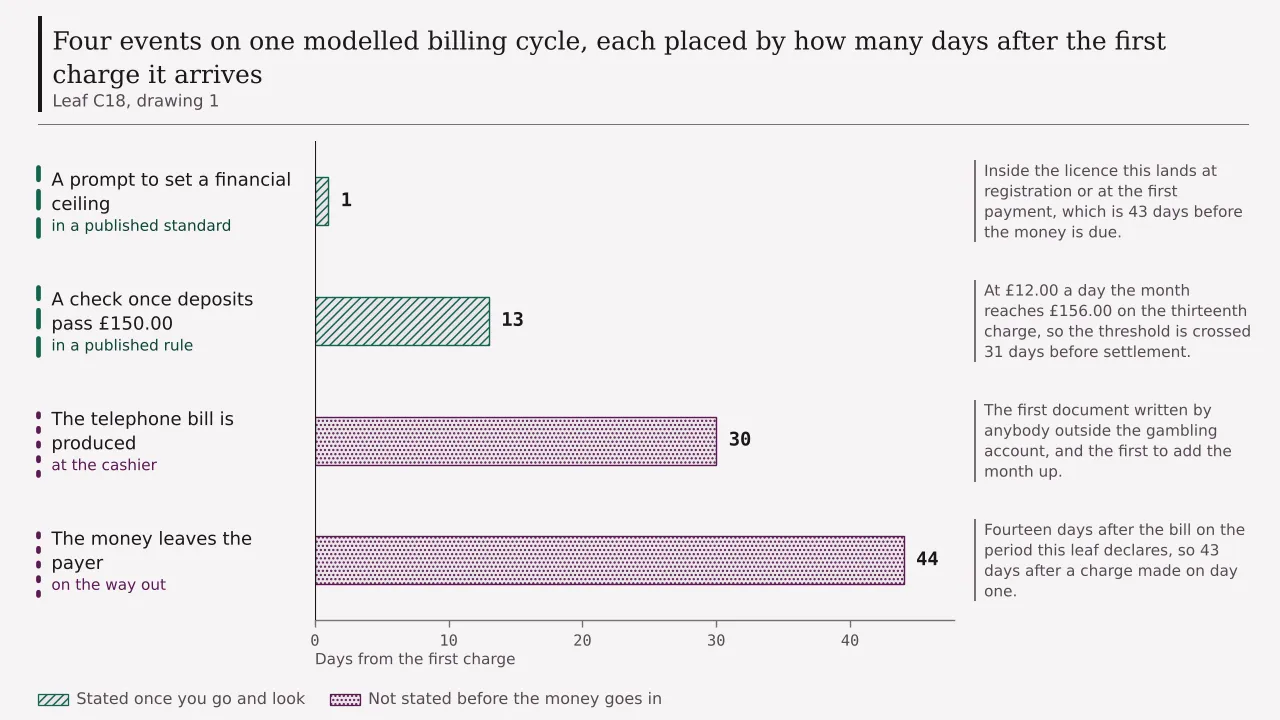
Reading the drawing from left to right compresses this leaf into a single movement. The two marks nearest the start are things a licensed operator has to do. The two furthest out are things a telephone account does by its nature. Remove the first pair and the earliest external event in a reader’s month moves from day 1 to day 30, which is the measurement this page was written to produce.
7
Six interruptions that would have landed before the bill
Arrangements of this kind are run by operations holding no Great Britain licence at any point, and on a leaf about timing the way to state the cost is to name the things that would have happened on particular days and then delete the days. Six do that work, and every one of the six fires during a month rather than at the opening or the close of one.
Day 1 carries three of them. The first is a prompt: on a licensed system the machinery for fixing a personal financial ceiling sits within easy reach from registration onwards, and the customer has to be asked to fix one either while registering or as a first payment goes through. On the modelled cycle that lands 43 days ahead of the money, which is as early as an interruption can possibly be.
The second is a default. Turning a ceiling down is itself an act, and nothing proceeds to a deposit or to a game until that refusal has been taken from the customer. Anybody already holding an account with no ceiling on it has to be put the question again at yearly intervals.
The third is a shape. The figure goes into an open box rather than being picked off somebody else’s menu, it binds the account as a whole and may go finer, and the periods offered run to a day, to seven days and to a month. That last period is the interesting one here, since a monthly ceiling and a 30-day cycle measure nearly the same window from opposite ends: one caps what goes out, the other reports what went.
The fourth is what happens when two periods are set at once: the tighter one governs. The regulator’s own worked case pairs £10 across a day with £100 across a week, and the system must then let through no more than £10 in any day and £70 in any week. Four weeks of that comes to £280.00 rather than the £400.00 somebody reading only the weekly number would expect, so £120.00 goes missing from a reader’s own allowance through two chosen figures meeting each other.
Day 13 carries the fifth. A check of the lighter sort on a customer’s finances is triggered once net deposits across a month go past a stated figure. That figure was £500 of net deposits in a month when it arrived on 30 August 2024, and £150 after 28 February 2025. Twelve pounds a day reaches £156.00 on the thirteenth charge, so inside the licence an external event lands on day 13 and 31 days ahead of settlement.
The sixth runs every day. Since 17 January 2025 a licensee has owed its customer a live figure for net spend and for time spent gambling. That duty puts part six’s total on a screen without anybody asking for it, which is the obligation most directly opposed to what this leaf measures: an arrangement adding up once a month, answered by a figure that never stops adding.
Direction matters as well as timing. Pulling a ceiling down is done immediately, short of a technical failure stopping it, while pushing one up has to wait out a day and then be confirmed again by the customer. A day set against a 43-day lag is 2.3 per cent of it, which looks slight until it is held beside the nought per cent applying where no such asymmetry exists at all.
Take those six away and the modelled month changes shape rather than changing size. The £360.00 is still £360.00 and the thirty charges are still thirty charges. What goes is every event that would have arrived between the first charge and the bill: the prompt on day 1, the default that makes declining an act, the free-text box with its 24-hour, 7-day and monthly durations, the overlap rule worth £120.00 over four weeks on the regulator’s own example, the check at £150.00 on day 13, and the running total on the screen. Remove them and the first thing arriving from outside the gambling account is the bill, which means the earliest external event in the reader’s month moves from day 1 to day 30. Machinery of that sort also has to be reachable straight from a home page and to show up on the payment screens, with the route to it kept as short as the system can make it, so what disappears is the distance as well as the duty.
The self-exclusion position hangs off the same licence and is printed here rather than tucked away. The national scheme reaches operators because a Great Britain licence makes it a condition, so a business holding none sits outside the scheme by construction and a registration shuts nothing there. Anybody who registered precisely to stop this wants the helpline from part one and not a payment screen, and the registration is working exactly as designed.
8
Nine terms, their places, and the day each one lands on
Collect the leaf into one column, sorted as this site sorts everything, with a second mark giving the day of the modelled cycle on which each term becomes visible. The day column is what this page adds to the usual sorting, and it turns a list of terms into a calendar.
| The term | Where it is settled | Day it becomes visible | Worth on this cycle |
|---|---|---|---|
| Size of a single charge | 0 | £12.00 | |
| Multiple the credit has to turn over | in the bonus terms | 0 | £19.20 taken |
| Prompt to set a financial limit | in a published standard | 1, or never | Caps the cycle |
| Check once deposits pass a monthly figure | in a published rule | 13, or never | £150.00 threshold |
| Running net spend on the screen | in a published rule | Every day, or never | Shows £360.00 |
| Largest charge a network will carry | at the cashier | 0 | Unpublished |
| Whether a payout can return this way | at the cashier | At the exit | Not a sum |
| Total of the month’s charges | on the way out | 30 | £360.00 |
| Length of the billing cycle itself | nowhere in writing | Inferred from the bill | 30 days assumed |
Three rows carry the words or never and those three are the whole argument of part seven compressed into a column. Each one is a published British duty carrying a day inside the licence and carrying none outside it, and that difference is not one of degree. A thing that happens on day 1 and a thing that never happens are not close together.
The last row is the quiet one. Nothing in a gambling arrangement states the length of a billing cycle, because the cycle belongs to a different contract altogether, and a reader can discover it only by receiving a bill. So the single length that governs every figure on this leaf is settled nowhere in writing as far as the gambling side is concerned, which is why 30 days had to be declared here rather than cited.
9
Settling the calendar first, and who arrives on this wording
Three things can be established before a first charge is made and none of them costs anything. The length of the billing cycle, which a previous bill answers. The period between a bill and the money leaving, which the same document answers. And whether a public register carries the business, which a search answers in a minute and settles whether any duty in part seven applies at all.
Knowing the first two converts the whole of this leaf into one subtraction a reader can do for themselves: the day of the cycle, subtracted from 44, gives the number of days between a decision and its consequence. A charge on the second day of a cycle carries 42 days. A charge on the twentieth carries 24. Nothing else on this page is needed to produce that figure.
Set out as numbers, the leaf says this. One charge of £12.00 draws a credit asking £480.00 of staking and finishing at an expected minus £7.20, a gap of £19.20. Thirty such charges reach £360.00 on a bill produced on day 30 and settled on day 44, a total added up in no document before then. Inside the British licence the first external event would have been a prompt on day 1 and the second a check on day 13 at a £150.00 threshold, with a running figure on the screen throughout. Outside it the first external event is the bill.
The last paragraph belongs to whoever typed this phrase. Plenty of those who search this wording are carrying a registration with the national scheme that has not yet run out, and for them the modelling above misses the point while one sentence does not: GamCare.org.uk answers 0808 8020 133 on every day there is, BeGambleAware.org is open to anybody too, and a registration not yet run out is a protection performing precisely the task set for it.
Questions
- How long is the gap between a phone deposit and paying for it?
- On this leaf’s declared lengths, a 30-day billing cycle followed by 14 days to settle, the gap is 44 minus the day of the cycle. A charge on the first day waits 43 days, a charge on the last waits 14, and the average across the month is 28.5 days. Both lengths are set here rather than cited, because nothing this site can cite publishes either, and every figure on the page restates that wherever it uses one.
- Why does a bill count as the most honest document in the chain?
- Because of who writes it and what it totals. An advertisement, a payment screen and an account history are all produced by the party selling, and the history lists charges without adding them. A bill is produced by a business that sold a telephone service rather than a wager, it carries the figure a reader is least likely to have computed, and the money is attached to it so it cannot be scrolled past. It is also last, which is why the interval described by one interested source alone runs to 29 of the 30 days.
- How much can accumulate before anything external appears?
- £360.00 on the modelled cycle, at £12.00 of charges a day for thirty days, with the bill arriving on day 30 and the money leaving on day 44. Every one of those thirty charges is visible in the gambling account as it happens. What does not exist before day 30 is any document produced outside that account, and that interval rather than any secrecy is what this leaf measures.
- What does a forty times condition take from twelve pounds of credit?
- £19.20. The clause asks for £480.00 to cross the reels, every staked pound leaves 4p behind, and the credit therefore finishes at an expected minus £7.20, which is £12.00 taken six tenths in the wrong direction. The sign turns over at a multiple of 25, one divided by four hundredths, so a forty times clause sits sixty per cent further out than the multiple at which a credit runs out of value.
- What would have happened on day one inside the British licence?
- A prompt, a default and a shape. On a licensed system the machinery for fixing a personal financial ceiling sits within easy reach from registration onwards, and the customer has to be asked to fix one either while registering or as a first payment goes through. Turning a ceiling down is itself an act, and nothing proceeds to a deposit or a game until that refusal has been taken. The figure then goes into an open box rather than off somebody else’s menu, binds the account as a whole and may go finer, and comes with periods running to a day, to seven days and to a month.
- What would have happened on day thirteen?
- A check of the lighter sort on a customer’s finances, because the running total passes a threshold there. Such a check is triggered once net deposits across a month go past a stated figure, which was £500 of net deposits in a month when it arrived on 30 August 2024, and £150 after 28 February 2025. Twelve pounds a day takes the month to £156.00 on the thirteenth charge, so an external event lands on day 13 and 31 days ahead of settlement. Beyond the licence nothing lands on day 13 at all.
- Is there a rule about seeing a running total?
- Inside the licence there is. Since 17 January 2025 a licensee has owed its customer a live figure for net spend and for time spent gambling. That duty puts what this leaf calls the month’s total onto a screen without anybody asking for it, and it is the obligation most directly opposed to a billing cycle: an arrangement adding up once a month, answered by a figure that never stops adding.
- What does the overlap rule for limits do to the numbers?
- It makes the tighter period govern, which can cut a reader’s own allowance by close to a third. The regulator’s own worked case pairs £10 across a day with £100 across a week, and the system must then let through no more than £10 in any day and £70 in any week. Four weeks of that comes to £280.00 rather than the £400.00 somebody reading only the weekly number would expect, so £120.00 goes missing through two chosen figures meeting each other.
- Can a limit be raised as easily as it is lowered?
- Not inside the licence, and the asymmetry is deliberate. Pulling a ceiling down is done immediately, short of a technical failure stopping it, while pushing one up has to wait out a day and then be confirmed again by the customer after that day has run. Set against a 43-day lag, a day is 2.3 per cent of the interval, which looks slight beside the nought per cent applying where no rule of that shape exists at all.
- Is paying from a telephone account a form of credit?
- This page does not answer that, because nothing citable on this site addresses a telephone account in those terms, and answering it from memory would be the exact failure the site exists to avoid. What can be stated is the sequence and its lengths: value arrives at once, the bill is produced at the end of a cycle, and the money moves 14 days after that on the lengths declared here.
- Does a British self-exclusion stop a charge of this kind?
- No, and the reason lies in how the scheme is built rather than in any technology. The national scheme reaches operators because a Great Britain licence makes it a condition, so a business holding none sits outside the scheme by construction and a registration shuts nothing there. A network that refuses to carry gambling charges on a telephone account is doing protective work of the same kind, as is a bank, a card scheme or a wallet declining the same payment, and this page measures the consequence of meeting such a refusal rather than describing any way past one.