Terms read 19 October 2026 Leaf C15, revision 1
Two numbers both written as ten, standing £1.04 apart at the payment screen
A reader types ten and means £10.00. A payment screen outside the British licence prints ten and may mean €10.00, which on the rates assumed here costs £8.96. The symbol in front of a floor is the one part of the term nobody advertises, the rate converting one into the other is published by no party in the transaction, and this leaf prices the gap twice over: once on the way in and once on the way back.
Stated on the banner Ten A bare quantity, carrying no symbol in front of it and no promise about which money the symbol belongs to. Stated, once you go and look €17.86 gone What a forty times condition costs a credit of €11.16, in the account’s own money, at 96p back per staked unit. Not stated before the money goes in Rates, unquoted The rate pounds are taken in at, the rate they come back out at, and the gap between the pair, which is 5.8 per cent here.
Offers of this kind, with their qualifying payments read
Every destination in this file is bought advertising. The site is paid a fee if a reader goes on to register, and no figure printed below moves because of it.
Bonus Spins UK Slip 01
Betportal
Ceiling as a multiple
The drop
€15.00
€1.00 in the euro
The claim reads €15.00. Once the terms beside it have applied, €0.00 of it can leave. The difference is the drop.
7 of the 15 terms on this slip could not be read before the money went in
Spins priced at this site's own 10p a spin, which the operator does not publish
Stated
€15.00
The claim as it is printed, before a single term has been applied to it.
Headline paid as spins
150 spins at 10c each, which is €15.00 of the figure above.
6 Nowhere
What one spin is worth
No unit is published for a spin, so the count is priced at this site's own 10p a spin. At half that price every figure below halves with it.
Match and other credit not priced
300% of three deposits, to a ceiling of €1,000. A share of a deposit nobody has made yet is not a sum, so no figure stands on this line and none is carried below.
Qualified
-€14.40
Written down somewhere, and taking part of the claim back. Each term carries the place it is written and the sum it takes.
2 Written terms at a distance this record does not establish
Play-through -€14.40
Carrying €14.40 through 35 times stakes €504.00 and costs €20.16 of it at 96 per cent return. That prices above the €14.40 there is to charge it against, so the whole of the credit goes and the line is held at that. The multiple sits on the bonus.
2 Written terms at a distance this record does not establish
Game weighting not priced
Slots only count towards the play-through. No contribution percentage is published, so the line above has been worked at full weight, which is the kindest reading there is.
2 Written terms at a distance this record does not establish
Ceiling on the winnings not priced
5x the bonus.
2 Written terms at a distance this record does not establish
Clock on the credit not priced
14 days.
2 Written terms at a distance this record does not establish
Largest stake while it runs not priced
€5.
3 Public record
Licence, and who holds it not priced
Licensed in Anjouan, Comoros, held by BetPortal Gaming Ltd, with Excite Ultra Media Ltd, reference ALSI-202601040-FI2. A register entry settles who holds a licence and what it permits. It does not settle who is running the site this morning.
4 Cashier
Smallest qualifying deposit your money
€20 a stage. That is €20.00 of your own money, and it is never netted into a drop.
5 On the way out
Checks before a withdrawal not priced
Documents before the first withdrawal.
Unstated
-€0.60
Applying without having been published anywhere, and costing money all the same.
6 Nowhere
What a spin hands back -€0.60
Staking a spin returns 96 per cent of it, so that share of the batch is the house's before a reel turns. This site works at that return and the operator publishes none where the claim is made.
6 Nowhere
Forfeited by rule cost unknown
Nothing is published under this heading, and it applies regardless.
6 Nowhere
Charge on the way out cost unknown
No charge on the way out is published as a figure, so nothing comes off this line. A charge that exists unpublished would come straight off whatever survives.
6 Nowhere
Smallest withdrawal allowed cost unknown
No smallest withdrawal is published as a figure. A floor nobody has published is still a floor, and it decides whether a small balance can move at all.
No Great Britain licence
Terms read 19 October 2026
Bonus Spins UK Slip 02
WinBeast
Ceiling as a sum
The drop
€50.00
€1.00 in the euro
The claim reads €50.00. Once the terms beside it have applied, €0.00 of it can leave. The difference is the drop.
8 of the 15 terms on this slip could not be read before the money went in
Spins priced at this site's own 10p a spin, which the operator does not publish
Stated
€50.00
The claim as it is printed, before a single term has been applied to it.
Headline paid as spins
500 spins at 10c each, which is €50.00 of the figure above.
6 Nowhere
What one spin is worth
No unit is published for a spin, so the count is priced at this site's own 10p a spin. At half that price every figure below halves with it.
Match and other credit not priced
50% to 100% of five deposits, each to a ceiling of €1,000, and a €650 free bet. A share of a deposit nobody has made yet is not a sum, so no figure stands on this line and none is carried below.
Qualified
-€48.00
Written down somewhere, and taking part of the claim back. Each term carries the place it is written and the sum it takes.
2 Written terms at a distance this record does not establish
Play-through -€48.00
Carrying €48.00 through 40 times stakes €1,920.00 and costs €76.80 of it at 96 per cent return. That prices above the €48.00 there is to charge it against, so the whole of the credit goes and the line is held at that. The multiple sits on the bonus and the winnings from the spins.
2 Written terms at a distance this record does not establish
Game weighting not priced
Slots, titles vary by country count towards the play-through. No contribution percentage is published, so the line above has been worked at full weight, which is the kindest reading there is.
2 Written terms at a distance this record does not establish
Ceiling on the winnings not priced
€100 a batch of spins.
2 Written terms at a distance this record does not establish
Clock on the credit not priced
7 days, spins 1 day.
3 Public record
Licence, and who holds it not priced
Licensed in Curaçao, holder not named on the site. A register entry settles who holds a licence and what it permits. It does not settle who is running the site this morning.
4 Cashier
Smallest qualifying deposit your money
€20 a stage. That is €20.00 of your own money, and it is never netted into a drop.
5 On the way out
Checks before a withdrawal not priced
Documents before the first withdrawal.
Unstated
-€2.00
Applying without having been published anywhere, and costing money all the same.
6 Nowhere
What a spin hands back -€2.00
Staking a spin returns 96 per cent of it, so that share of the batch is the house's before a reel turns. This site works at that return and the operator publishes none where the claim is made.
6 Nowhere
Largest stake while it runs cost unknown
Nothing is published under this heading, and it applies regardless.
6 Nowhere
Forfeited by rule cost unknown
Nothing is published under this heading, and it applies regardless.
6 Nowhere
Charge on the way out cost unknown
No charge on the way out is published as a figure, so nothing comes off this line. A charge that exists unpublished would come straight off whatever survives.
6 Nowhere
Smallest withdrawal allowed cost unknown
No smallest withdrawal is published as a figure. A floor nobody has published is still a floor, and it decides whether a small balance can move at all.
No Great Britain licence
Terms read 19 October 2026
Bonus Spins UK Slip 03
EliteSpin
Longest spin window
The drop
£50.00
£1.00 in the pound
The claim reads £50.00. Once the terms beside it have applied, £0.00 of it can leave. The difference is the drop.
8 of the 15 terms on this slip could not be read before the money went in
Spins priced at this site's own 10p a spin, which the operator does not publish
Stated
£50.00
The claim as it is printed, before a single term has been applied to it.
Headline paid as spins
500 spins at 10p each, which is £50.00 of the figure above.
6 Nowhere
What one spin is worth
No unit is published for a spin, so the count is priced at this site's own 10p a spin. At half that price every figure below halves with it.
Match and other credit not priced
50% to 100% of five deposits, each to a ceiling of £1,000. A share of a deposit nobody has made yet is not a sum, so no figure stands on this line and none is carried below.
Qualified
-£48.00
Written down somewhere, and taking part of the claim back. Each term carries the place it is written and the sum it takes.
2 Written terms at a distance this record does not establish
Play-through -£48.00
Carrying £48.00 through 40 times stakes £1,920.00 and costs £76.80 of it at 96 per cent return. That prices above the £48.00 there is to charge it against, so the whole of the credit goes and the line is held at that. The multiple sits on the bonus and the winnings from the spins.
2 Written terms at a distance this record does not establish
Game weighting not priced
Slots count towards the play-through. No contribution percentage is published, so the line above has been worked at full weight, which is the kindest reading there is.
2 Written terms at a distance this record does not establish
Ceiling on the winnings not priced
5x the bonus.
2 Written terms at a distance this record does not establish
Clock on the credit not priced
7 days, spins 3 days.
3 Public record
Licence, and who holds it not priced
Licensed in Costa Rica, held by PrimeTier Limited. A register entry settles who holds a licence and what it permits. It does not settle who is running the site this morning.
4 Cashier
Smallest qualifying deposit your money
£20 a stage. That is £20.00 of your own money, and it is never netted into a drop.
5 On the way out
Checks before a withdrawal not priced
Documents before the first withdrawal.
Unstated
-£2.00
Applying without having been published anywhere, and costing money all the same.
6 Nowhere
What a spin hands back -£2.00
Staking a spin returns 96 per cent of it, so that share of the batch is the house's before a reel turns. This site works at that return and the operator publishes none where the claim is made.
6 Nowhere
Largest stake while it runs cost unknown
Nothing is published under this heading, and it applies regardless.
6 Nowhere
Forfeited by rule cost unknown
Nothing is published under this heading, and it applies regardless.
6 Nowhere
Charge on the way out cost unknown
No charge on the way out is published as a figure, so nothing comes off this line. A charge that exists unpublished would come straight off whatever survives.
6 Nowhere
Smallest withdrawal allowed cost unknown
No smallest withdrawal is published as a figure. A floor nobody has published is still a floor, and it decides whether a small balance can move at all.
No Great Britain licence
Terms read 19 October 2026
Bonus Spins UK Slip 04
Crown Jewelz
Multiple unpublished
The drop
NOT WORKED
The multiple is not published in the operator's own terms. Since the sum cannot be worked around it, none is worked.
9 of the 14 terms on this slip could not be read before the money went in
No drop worked
Stated
£15.00
The claim as it is printed, before a single term has been applied to it.
Headline paid as spins
150 spins at 10p each, which is £15.00 of the figure above.
6 Nowhere
What one spin is worth
No unit is published for a spin, so the count is priced at this site's own 10p a spin. At half that price every figure below halves with it.
Match and other credit not priced
200% of the first deposit, then 150% twice, each to a ceiling of £1,000. A share of a deposit nobody has made yet is not a sum, so no figure stands on this line and none is carried below.
Qualified
NOT WORKED
Written down somewhere, and taking part of the claim back. Each term carries the place it is written and the sum it takes.
2 Written terms at a distance this record does not establish
Play-through not priced
40x the bonus, reported rather than published by the operator.
2 Written terms at a distance this record does not establish
Game weighting not priced
Slots count towards the play-through. No contribution percentage is published, so the line above has been worked at full weight, which is the kindest reading there is.
3 Public record
Licence, and who holds it not priced
Licensed in Curaçao, number not verified, holder not named on the site. A register entry settles who holds a licence and what it permits. It does not settle who is running the site this morning.
4 Cashier
Smallest qualifying deposit your money
£20. That is £20.00 of your own money, and it is never netted into a drop.
5 On the way out
Checks before a withdrawal not priced
Documents before the first withdrawal.
Unstated
NOT WORKED
Applying without having been published anywhere, and costing money all the same.
6 Nowhere
Ceiling on the winnings cost unknown
No ceiling is published. Nothing is assumed in its place.
6 Nowhere
Clock on the credit cost unknown
Nothing is published under this heading, and it applies regardless.
6 Nowhere
Largest stake while it runs cost unknown
Nothing is published under this heading, and it applies regardless.
6 Nowhere
Forfeited by rule cost unknown
Nothing is published under this heading, and it applies regardless.
6 Nowhere
Charge on the way out cost unknown
No charge on the way out is published as a figure, so nothing comes off this line. A charge that exists unpublished would come straight off whatever survives.
6 Nowhere
Smallest withdrawal allowed cost unknown
No smallest withdrawal is published as a figure. A floor nobody has published is still a floor, and it decides whether a small balance can move at all.
No Great Britain licence
Terms read 19 October 2026
Every figure in the second and third columns is this site's own working and nothing an operator has published. A claim is priced as printed, then the share a spin hands back at 96 per cent return comes off it, then what playing the multiple through costs at the same return, and then whatever a published ceiling, a charge on the way out or a floor on the smallest withdrawal takes from what has survived. The drop is the difference between the first figure and the last. The two columns add back up to it exactly, so no money leaves a slip without a term and a place beside it.
Which column a term falls in is settled by one question: has anybody written it down. A charge a reader meets at the payment screen is written down, and it stands in the second column with the cashier against it. A condition that binds without ever having been set down stands in the third, whatever it costs. Inside each column the terms run outwards from the banner, so the order itself says how far a reader would have had to go.
A count of spins has no unit until one is supplied. Where an operator publishes what one of its own spins is worth, that figure is used and the first column says it is theirs. Where none is published, this site's own 10p a spin stands in its place and every figure below moves in proportion with it. Where the multiple itself is unpublished, no drop is worked at all, because that is the one figure the sum cannot be done without.
Three words stand where a figure cannot. Not priced is a term that is written down and carries no number the arithmetic can take. Cost unknown is a term nobody has written down, costing something nobody has put a number on. Your money is money of the reader's own, which is never netted into a drop.
None of the operators in this file holds a Great Britain licence, so none of the duties that licence carries reaches them. Each of those duties is published in its own right, which is what makes its absence here something a reader can check rather than take on trust. Every gambling company licensed in Great Britain belongs to Gamstop Online, so a reader who has shut themselves out through the scheme is not shut out here. Social Responsibility Code 5.1.1 has held a play-through to a maximum of ten times the bonus funds since 19 January 2026, and it binds a licence holder and nobody else. Asked in a post of 21 October 2025 what is lost along with the licence, the Gambling Commission's Director of Enforcement and Intelligence answered: "unfair gaming practices, financial loss, and a lack of recourse if things go wrong". The same post puts blocked payouts, and withdrawal limits pitched high enough to be unreachable, among the behaviour the Commission has recorded. Nobody under 18 may hold an account at any of them.
Terms are reproduced in the wording their operator published, and each slip is dated with the day somebody sat down and read them. 19 October 2026 is the oldest of those dates. Anybody claiming an offer is bound by that operator's full terms, which are elsewhere, and never by a line standing here.
1
A quantity typed without a symbol, and what gets assumed about it
Look at the search phrase as a piece of writing. It carries a number and no unit. People in Britain reading a bare ten in a gambling context supply the missing symbol without noticing they have supplied it, because every price they meet in a week is in pounds, so the number arrives already dressed. A payment screen run from outside the British licence is under no corresponding habit. It prints the number in whichever money the account is denominated in, and the symbol it prints is the first fact about the floor that has ever been stated to anybody.
On the rates this leaf sets out in part three, those two tens are £10.00 and £8.96, which is a difference of £1.04, or a tenth of the figure that was typed. The difference is not a fee, not a penalty and not a mistake by anybody. It is what happens when a quantity travels without its unit, and the entire leaf is an examination of that one gap.
Before the arithmetic goes any further, the other thing has to be said plainly. Somebody searching the words non-Gamstop alongside a deposit figure may be looking for an account their own registration was meant to shut. Support costs nothing and stays confidential: GamCare.org.uk and BeGambleAware.org are both open to anybody, and the helpline GamCare runs on 0808 8020 133 is answered round the clock, weekends and bank holidays included. This page describes no means of reaching an operator a reader has excluded themselves from, and the arithmetic below is not an argument for going anywhere.
A refusal to carry a gambling payment, whoever issues it, is worth treating as a protection rather than an obstruction. Banks, card schemes, wallets and mobile networks all decline such payments under published policies, and a decline of that sort does the same job a self-exclusion does from a different direction. This leaf prices what a reader gives up by meeting one, and at no point suggests a way of not meeting one.
Everything below rests on a single qualifying payment of £10.00, a reference rate of €1.1500 to the pound, a conversion margin of 3 per cent applied to each leg, a forty times play-through, 96p back for each unit staked, and a weighting held at one. Three of those six are fixed site-wide and three belong to this leaf, which picks them to produce a worked example rather than to report a market and names them wherever a sentence spends one.
2
Why a floor is the term whose unit is never advertised
Go through the terms attached to an offer and ask which of them carries a currency symbol where a reader first meets it. A headline sum does, because a headline is written to be read and a symbol makes it readable. A percentage carries no unit by nature. A multiple carries none either, being a pure ratio, and a time limit is measured in days wherever anybody stands. That leaves the floors, and the floors are precisely the terms a reader does not meet until a payment screen has been reached.
So there is a pattern worth naming rather than a coincidence. The terms shown early are the ones whose units are either obvious or absent. The terms shown late are the ones whose units decide what the figures mean. A floor appears at the cashier, and so does the symbol in front of it, which is why the search phrase can be typed in good faith by somebody who will meet a different number entirely.
Two floors matter on an arrangement of this shape and they are usually denominated the same way as each other. The smallest payment the screen accepts decides whether somebody can start. The smallest balance the exit will carry decides whether they can finish. Both are quoted in whatever money the account runs in, and neither is on any banner, so a reader has two unknown quantities rather than one, and the unknown that bites harder is the second.
| The term | Where a reader first meets it | Carries a symbol there |
|---|---|---|
| Headline sum offered | Yes, always | |
| Percentage matched | No unit exists | |
| Play-through multiple | in the bonus terms | No unit exists |
| Days allowed to clear it | in the bonus terms | Days everywhere |
| Smallest payment accepted | at the cashier | First stated there |
| Smallest balance the exit carries | at the cashier | First stated there |
| Rate between the two monies | nowhere in writing | Implied, never printed |
Travel down the right-hand column and an ordering appears without being arranged. Everything settled before a decision is a quantity whose unit is either universal or unnecessary. Everything settled after a decision is a quantity whose unit does the deciding. Nobody had to design that outcome for it to be reliable, because the terms that need a symbol are the terms belonging to the payment machinery, and the payment machinery is the last thing anybody sees.
3
Two conversion rates, neither of them published anywhere
A cashier taking pounds into an account denominated in something else performs a conversion, and a conversion needs a rate. Assume a reference of €1.1500 to the pound, which this leaf states as a round working figure and not as a quotation from any market. Assume a margin of 3 per cent applied to each leg, which this leaf also sets for itself. Those two assumptions produce every figure in parts four, five and six, and they are restated wherever one of them is used.
Taking money in, the applied rate is €1.1155 to the pound, which is the reference less 3 per cent. Paying money out, the applied rate is €1.1845, which is the reference plus the same 3 per cent, and the direction is what makes the second figure larger rather than smaller. Both rates are arithmetic consequences of the pair of assumptions, and neither is a quotation of anything.
The point of printing them is to show the shape of a thing a reader cannot see. A payment screen displays a number of units to be credited. It need not display the rate that produced the number, it need not display the reference it was taken from, and it need not display the margin between the two. All three sit nowhere in writing, and a reader can recover the applied rate only by dividing what arrived by what was sent, which is a calculation available after the payment and never before it.
That asymmetry is worth stating in one line, because it is the sharpest thing on this leaf. Every other term discussed on this site can in principle be read before committing, even if the reading is buried three documents away. The rate cannot be read at all before committing. It is inferred afterwards from two numbers a reader happens to have, which makes it the only term here that is settled by arithmetic rather than by a document.
€1.1155 taking money in, €1.1845 handing it back, and a reference of €1.1500 nobody prints
4
Ten pounds out and nine pounds forty-two back
Work the simplest possible journey, with no play at all in it. A reader sends £10.00. At the inward rate of €1.1155 the account is credited €11.16. At the reference of €1.1500 that same £10.00 would have been €11.50, so the inward leg has already absorbed €0.35, which is £0.30 valued back at the reference.
Now bring it home untouched. Paying out at €1.1845, a balance of €11.16 returns £9.42. Nothing has been staked, nothing has been lost on a reel, no condition has been triggered and no fee has been charged, and £0.58 of the original ten pounds is gone. That is 5.8 per cent, which is 3 per cent taken twice and compounded, since 0.97 divided by 1.03 is 0.9417.
Ten as the search phrase reads it £10.00 The same ten after both conversions £9.42 Price of a rate nobody printed £0.58
Fifty-eight pence is a small number and the wrong one to stop at, for two reasons. The first is that it scales exactly: a payment ten times larger costs £5.80, and the proportion never improves, because a margin expressed as a percentage has no economy of scale in it. The second is that it is charged on the way out as well as the way in, so a reader who moves money across the boundary twice has paid it twice, and most people who deposit intend to do precisely that.
The honest concession belongs here. Somebody who sends £10.00, spends the balance entirely inside the account and never asks for anything back has paid the inward leg only, which on these assumptions is 30p rather than 58p. That is a real saving and it is bought by never collecting anything, which is a strange way to save money and is nonetheless the commonest outcome. The 58p applies to the branch where a reader actually succeeds in leaving with something.
5
Which of the two tens clears a floor, and which does not
Now put the floors in. Suppose the smallest payment the screen will take is ten units of the account’s own money, which is €10.00, and suppose the smallest balance the exit will carry is twenty of the same, which is €20.00. Each of those is a figure this leaf picks so that the shape can be seen, and nothing citable here records how either is distributed in practice.
A payment of £10.00 arrives as €11.16, which clears a €10.00 floor with €1.16 to spare, so the entry floor is met and nothing appears to be wrong. Valued the other way, the €10.00 floor costs £8.96 at the inward rate, which is £1.04 below the figure the reader typed. The two tens differ by that £1.04 and both of them are correct statements of a floor.
The exit floor behaves entirely differently and is the one worth the attention. A balance of €20.00 is what the cashier wants before anything moves, and €20.00 converted at the outward rate is £16.88. A reader holding the whole of their €11.16 therefore holds 55.8 per cent of the sum needed to leave, and the shortfall is €8.84. Nothing has gone wrong at that point either. The payment cleared the floor it had to clear, and the exit has a different floor, measured in the same units and set at twice the level.
| Sent in pounds | Credited at €1.1155 | Clears a €10.00 entry floor | Short of a €20.00 exit floor | Returned at €1.1845 |
|---|---|---|---|---|
| £5.00 | €5.58 | No | €14.42 | £4.71 |
| £10.00 | €11.16 | Yes | €8.84 | £9.42 |
| £18.00 | €20.08 | Yes | None | £16.95 |
| £25.00 | €27.89 | Yes | None | £23.55 |
Of the four rows it is the third that repays attention, and it is round in neither money. £18.00 is the smallest whole pound figure that converts to more than €20.00 at the inward rate, which makes it the smallest payment that could in principle be collected again without a single win. A reader thinking in pounds has no way of arriving at eighteen, because eighteen is not a figure anybody advertises, is not a floor anybody states, and exists only as the solution to a division nobody set out.
That is the whole mechanism in one row. A floor denominated in another money converts into an awkward figure in the reader’s own, the awkward figure is never printed, and the reader therefore budgets against a round number that has no standing at the payment screen.
6
The second subtraction, worked in the account’s own money
The first subtraction, in part four, was 58p of currency margin on a ten pound round trip. The second is far larger, is written down somewhere, and has to be worked in the account’s money rather than in the reader’s, because that is the money the condition is denominated in. Saying which money a subtraction happens in is not pedantry here. It is the only way to keep the two from being added together wrongly.
Take the €11.16 standing in the account and suppose a matched offer credits the same again, so the credit under condition is €11.16. A play-through of forty times asks for €446.40 to cross the reels. With 96p returned per unit staked, 4 units in every hundred stay behind, so €446.40 of staking is expected to leave €17.86 with the margin, and the credit closes at minus €6.70, being €11.16 multiplied by one less 1.6.
Credit as the account states it €11.16 Expected close at forty times minus €6.70 What the written multiple removes €17.86
Brought home at the outward rate, €17.86 is £15.08, and that conversion is itself an act the reader cannot price in advance. So the leaf produces its subtraction twice, as every page on this site does, and here the two subtractions arrive in different monies: 58p of spread denominated in pounds, and €17.86 of condition denominated in the account’s units, which becomes £15.08 only after a third conversion that has its own margin inside it.
€446.40 of staking asked of a balance the reader budgeted as ten pounds
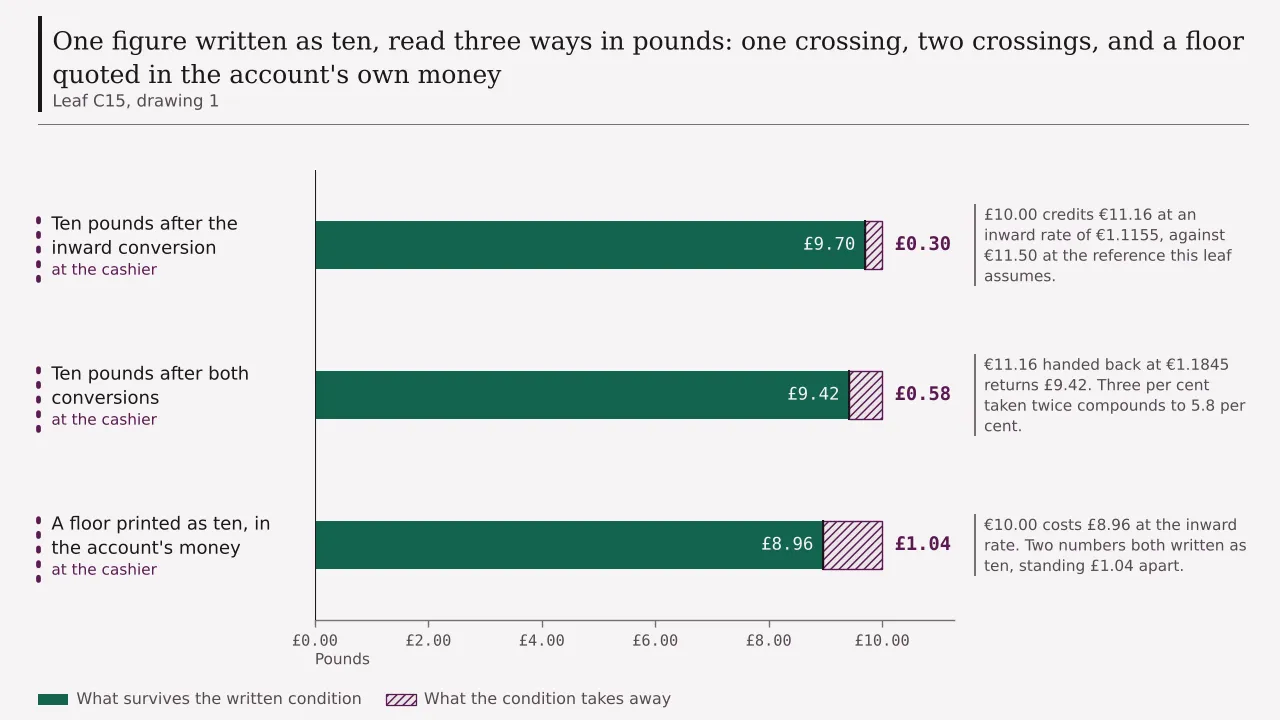
Drawing all three rows in a single money is the only honest way to stack them, and stacking them exposes an ordering. Thirty pence is what one crossing costs. Fifty-eight pence is what two cost. A pound and four pence is what the symbol in front of the floor costs, and it is the largest of the three despite being the one nobody charges for, because it is not a fee at all but a difference between two readings of one number.
7
Every term on this page, with its unit marked beside it
Collect the whole leaf into one column and mark not only where each term is settled but which money it is settled in. The second mark is the addition this page makes to the site’s usual sorting, and on this subject it carries more information than the first does.
| The term | Where it is settled | Money it is quoted in | Worth on this payment |
|---|---|---|---|
| Qualifying payment the reader intends | Assumed to be sterling | £10.00 | |
| Least the screen will take as a payment | at the cashier | The account’s own | €10.00, or £8.96 |
| Rate pounds are taken in at | nowhere in writing | A ratio of the two | €1.1155 assumed |
| Rate pounds are handed back at | nowhere in writing | A ratio of the two | €1.1845 assumed |
| Play-through multiple | in the bonus terms | None; a pure ratio | €17.86 removed |
| Smallest balance the exit carries | at the cashier | The account’s own | €20.00, or £16.88 |
| Paperwork wanted before money leaves | on the way out | None | Not a sum |
| Whether a public record carries the operator | in the public register | None | Binary |
| Duty payable on the operator’s profit | in published tax guidance | Sterling, by statute | 40 per cent |
Four rows of that table are quoted in a money the reader did not choose, and two of the four are rates rather than sums, which means they cannot be met with a round number at all. Three rows are quoted in no unit whatever. Only one row, the first, is in the money the reader was thinking in, and it is the only row the reader supplies rather than receives.
That bottom row travels in the opposite direction to everything above it, which is why it is printed. Where a player’s ordinary home is in the United Kingdom, the business owes remote gaming duty on its profit, and the charge has stood at 40 in the hundred since 1 April 2026, nineteen points above the 21 in the hundred that ran from 1 April 2019, an increase of 90.5 per cent on the earlier level. The obligation is fastened to where the player lives rather than to where the licence is, so it crosses a border the protections do not cross, and part eight sets out what stays behind.
8
What a transparency duty is worth in pence on a ten
Arrangements found by typing this phrase sit outside the British licence. On a leaf about units, the way to count what that costs is to set a pound figure from this page’s own ten against each duty that disappears. Three of them do the relevant work, and between them they govern what a term has to say, how reachable it has to be, and who fields the complaint when a reader is unsatisfied.
The first is the condition on fair and transparent terms and practices, which carries four separate tests. The first test holds the terms and any consumer notice to the fairness standard of the 2015 consumer statute and binds the licensee to what it has written. The second asks for transparency in that same statute’s sense and for the contract terms to be kept easy to get at. The third carries both tests across into any amendment, material ones having to be notified before they start operating. The fourth bars unfair commercial practices, as defined by the 2024 statute on markets, competition and consumers that the limb names, at every point where a licensee deals with consumers at all. Worth on this leaf’s ten: the whole 58p of spread in part four, because a rate that has to be transparent and easily accessible is a rate a reader could have divided out before paying rather than after.
The second is the scope note attached to the same condition, which reaches every operating licence other than the technical and software ones. Scope is worth naming because it is what makes the duty general rather than negotiated: a reader does not have to establish that a particular arrangement signed up to transparency, only that the licence exists. Worth on this leaf’s ten: the £1.04 between the two tens in part five, which is the figure a transparent statement of the unit would have removed outright.
The third is not a duty on an operator but a published limit on the regulator, and it is the one most readers get wrong. The regulator’s own page carries the sentence we are not an ombudsman, and three limits follow from it. Resolving a gambling complaint falls outside its powers. Getting somebody’s money back falls outside them as well. So does deciding who is right about a withdrawal or a technical fault. Its instruction runs the other way, towards the gambling business itself. Worth on this leaf’s ten: nothing at all, which is the point. Even inside the licence the regulator is not the route to a refund, so a reader counting on it as a backstop has miscounted in both directions at once.
Put the three together and the loss on this subject is specific rather than general. Transparency in the statutory sense would have put the applied rate within reach before a payment; easy accessibility would have put it within reach without an account; scope would have made both of those true without anybody negotiating for them. Strip the licence away and all three go together, which leaves the applied rate recoverable only by dividing one figure by another after the money has already moved. The 58p and the £1.04 survive the loss unchanged in size. What changes is that nobody is obliged to let a reader see either of them coming.
The self-exclusion half of the loss follows from a different document and belongs here as well. Taking part in the national scheme was written into the licence in March 2020, for anybody taking business from people living in Britain, and since April 2020 a licensed operator has had to compare its entire customer list with the scheme’s register no less often than once a day. Counted out, that is at least 365 comparisons in a year, and a business without the licence performs none of them, so somebody relying on a registration to shut an account there will find it shuts nothing. The helpline in part one is the better destination than a payment screen.
9
Settling the unit before the sum, and why this phrase is typed
The method this leaf suggests is short and costs nothing. Settle the unit before the figure. Ask which money the account is denominated in, which money the floors are quoted in, and what the applied rate was on the smallest payment that can be tested. Only then compare anything with the number that was typed into a search box, because until the unit is settled the comparison is between two quantities that are not the same kind of thing.
Two of those questions have answers that can be read on a payment screen before money moves, which makes them cheaper than anything else on this page. The third cannot be answered in advance at all, and the honest instruction is therefore to treat the applied rate as unknown and to assume it is worse than a reference rate by some margin, because a cashier that converts at no margin would have no reason to keep the margin unquoted.
Collected into figures, this leaf says six things about one ten pound payment. It arrives as €11.16. It returns as £9.42 if nothing happens to it. It clears an assumed €10.00 entry floor and falls €8.84 short of an assumed €20.00 exit floor. A matched credit of €11.16 carries €446.40 of staking and closes at minus €6.70. The condition removes €17.86, which is £15.08 brought home. And the two numbers both written as ten stand £1.04 apart.
The last word goes to whoever typed the phrase. A good share of the traffic that lands on wording of this kind comes from people whose registration with the national scheme is still live, and for them the currency arithmetic above is beside the point. The useful destination is GamCare.org.uk, BeGambleAware.org or the helpline on 0808 8020 133, and a registration still running is a protection operating exactly as intended rather than a problem to be solved.
Questions
- Is a ten pound deposit really ten pounds at an offshore cashier?
- Not necessarily, because the figure and the symbol are separate facts and only the figure travels with the search phrase. Where an account is denominated in another money, a floor printed as ten means ten of that money. On the rates this leaf assumes, a reference of €1.1500 to the pound and a margin of 3 per cent each way, a floor of €10.00 costs £8.96, so the two numbers both written as ten stand £1.04 apart. Neither statement of the floor is wrong, and the reader was never told which one was being quoted.
- Where is the exchange rate written down?
- Nowhere a reader can reach before paying. A payment screen shows how many units will be credited. It need not show the rate that produced the number, the reference that rate was taken from, or the margin between them. The applied rate can be recovered only by dividing the credited figure by the figure sent, which is arithmetic available after the payment and never before it, and that makes it the one term on this site settled by calculation rather than by a document.
- How much does the conversion margin cost on a round trip?
- 58p on ten pounds, on this leaf’s assumptions, with no play of any kind involved. £10.00 at an inward rate of €1.1155 credits €11.16; that balance at an outward rate of €1.1845 returns £9.42. The loss is 5.8 per cent, which is 3 per cent taken twice and compounded, since 0.97 divided by 1.03 is 0.9417. The proportion is the same at every size, so a hundred pound round trip on identical assumptions costs £5.80.
- Why is a deposit floor the term whose currency is never advertised?
- Because of what the other terms are made of. A headline sum is written to be read, so it carries a symbol. A percentage and a multiple are pure ratios with no unit to carry. A time limit is in days wherever anybody stands. That leaves the floors, and floors are properties of the payment machinery rather than of the offer, so they are first stated at a payment screen along with the symbol in front of them. The pattern is structural rather than deliberate.
- Does a ten pound payment clear an offshore deposit floor?
- On this leaf’s assumed figures it does, and that is not the end of the matter. £10.00 credits €11.16, which clears an assumed entry floor of €10.00 with €1.16 to spare. The assumed exit floor of €20.00 is the one that bites: the same balance is €8.84 short of it, so a reader holds 55.8 per cent of what the cashier wants before anything may move. Entry floors and exit floors are separate terms quoted in the same unknown money, and the second is usually the larger.
- What is the smallest payment that could be collected again without a win?
- £18.00 on these assumed rates and floors, because £18.00 credits €20.08 and the assumed exit floor is €20.00. Eighteen is not a round number in either money, is advertised by nobody, and appears on no banner or payment screen, because it is the answer to a division that nobody sets out. A reader thinking in pounds has no route to it, which is the mechanism this leaf exists to describe.
- How large is the wagering condition beside the currency spread?
- About twenty-six times larger on these figures, and it is denominated in different money. A matched credit of €11.16 at forty times asks for €446.40 of staking; 4 units in every hundred staked stay behind, so €17.86 goes to the margin and the credit closes at minus €6.70. Brought home at the outward rate, the €17.86 is £15.08, against 58p of currency spread. One is a cost of moving money and the other is a cost of keeping it.
- Which British duties would have made the rate visible?
- Two of the four tests inside the licence condition on fair and transparent terms and practices, plus its scope note. One test asks for transparency in the sense the 2015 consumer statute gives the word; another asks that contract terms be kept easy to get at; between them they put an applied rate within reach ahead of a payment instead of after one. The scope note reaches every operating licence bar the technical and software kinds, so nobody has to bargain for any of it. Measured on this page’s ten, that is the 58p of spread and the £1.04 between the two tens.
- Can the Gambling Commission recover money from an offshore cashier?
- It cannot, and the same holds for licensed operators. The regulator’s own page carries the sentence we are not an ombudsman, and three limits follow from it: resolving a gambling complaint falls outside its powers, so does getting somebody’s money back, and so does deciding who is right about a withdrawal or a technical fault. Its instruction runs the other way, towards the gambling business itself. Anybody treating the regulator as a backstop has therefore misread the position inside the licence as well as outside it.
- Does a British self-exclusion register stop an account opening offshore?
- No. Taking part in the national scheme was written into the licence in March 2020, for anybody taking business from people living in Britain, and since April 2020 a licensed operator has compared its entire customer list with the scheme’s register no less often than once a day. Counted out, that is at least 365 comparisons in a year, and a business without the licence performs none of them. That marks a limit on what the protection can reach rather than an invitation, and the next step worth taking is the helpline rather than a payment screen.