Terms read 19 October 2026 Leaf R08, revision 1
Two rulebooks set side by side, row by row, with each one’s own figures taken from it
A credit of £50.00 closes at an expected minus £30.00 under a forty times condition, which the island rulebook permits since it puts no ceiling on a multiple anywhere, against £30.00 under the ceiling Britain now sets. That same rulebook makes a raised deposit limit wait seven days where Britain makes it wait one. The finding is a shape, not a verdict.
Stated on the banner £50.00 A credit of that size read off the claim, which exhausts what an advertisement of this shape settles. Stated, once you go and look £80.00 The gap between that credit read alone and where it closes after forty times, at the 96 in the hundred held fixed across this site, since the island rulebook caps no multiple. Not stated before the money goes in Six extra days How much longer a raised deposit limit waits under the island policy than under the British one. It is the row where the offshore rule is the tighter, and no advertisement at either end mentions it.
Offers run from outside Britain, with their written terms read
Every destination in this file is bought advertising. The site is paid a fee if a reader goes on to register, and no figure printed below moves because of it.
Bonus Spins UK Slip 01
Betportal
Ceiling as a multiple
The drop
€15.00
€1.00 in the euro
The claim reads €15.00. Once the terms beside it have applied, €0.00 of it can leave. The difference is the drop.
7 of the 15 terms on this slip could not be read before the money went in
Spins priced at this site's own 10p a spin, which the operator does not publish
Stated
€15.00
The claim as it is printed, before a single term has been applied to it.
Headline paid as spins
150 spins at 10c each, which is €15.00 of the figure above.
6 Nowhere
What one spin is worth
No unit is published for a spin, so the count is priced at this site's own 10p a spin. At half that price every figure below halves with it.
Match and other credit not priced
300% of three deposits, to a ceiling of €1,000. A share of a deposit nobody has made yet is not a sum, so no figure stands on this line and none is carried below.
Qualified
-€14.40
Written down somewhere, and taking part of the claim back. Each term carries the place it is written and the sum it takes.
2 Written terms at a distance this record does not establish
Play-through -€14.40
Carrying €14.40 through 35 times stakes €504.00 and costs €20.16 of it at 96 per cent return. That prices above the €14.40 there is to charge it against, so the whole of the credit goes and the line is held at that. The multiple sits on the bonus.
2 Written terms at a distance this record does not establish
Game weighting not priced
Slots only count towards the play-through. No contribution percentage is published, so the line above has been worked at full weight, which is the kindest reading there is.
2 Written terms at a distance this record does not establish
Ceiling on the winnings not priced
5x the bonus.
2 Written terms at a distance this record does not establish
Clock on the credit not priced
14 days.
2 Written terms at a distance this record does not establish
Largest stake while it runs not priced
€5.
3 Public record
Licence, and who holds it not priced
Licensed in Anjouan, Comoros, held by BetPortal Gaming Ltd, with Excite Ultra Media Ltd, reference ALSI-202601040-FI2. A register entry settles who holds a licence and what it permits. It does not settle who is running the site this morning.
4 Cashier
Smallest qualifying deposit your money
€20 a stage. That is €20.00 of your own money, and it is never netted into a drop.
5 On the way out
Checks before a withdrawal not priced
Documents before the first withdrawal.
Unstated
-€0.60
Applying without having been published anywhere, and costing money all the same.
6 Nowhere
What a spin hands back -€0.60
Staking a spin returns 96 per cent of it, so that share of the batch is the house's before a reel turns. This site works at that return and the operator publishes none where the claim is made.
6 Nowhere
Forfeited by rule cost unknown
Nothing is published under this heading, and it applies regardless.
6 Nowhere
Charge on the way out cost unknown
No charge on the way out is published as a figure, so nothing comes off this line. A charge that exists unpublished would come straight off whatever survives.
6 Nowhere
Smallest withdrawal allowed cost unknown
No smallest withdrawal is published as a figure. A floor nobody has published is still a floor, and it decides whether a small balance can move at all.
No Great Britain licence
Terms read 19 October 2026
Bonus Spins UK Slip 02
WinBeast
Ceiling as a sum
The drop
€50.00
€1.00 in the euro
The claim reads €50.00. Once the terms beside it have applied, €0.00 of it can leave. The difference is the drop.
8 of the 15 terms on this slip could not be read before the money went in
Spins priced at this site's own 10p a spin, which the operator does not publish
Stated
€50.00
The claim as it is printed, before a single term has been applied to it.
Headline paid as spins
500 spins at 10c each, which is €50.00 of the figure above.
6 Nowhere
What one spin is worth
No unit is published for a spin, so the count is priced at this site's own 10p a spin. At half that price every figure below halves with it.
Match and other credit not priced
50% to 100% of five deposits, each to a ceiling of €1,000, and a €650 free bet. A share of a deposit nobody has made yet is not a sum, so no figure stands on this line and none is carried below.
Qualified
-€48.00
Written down somewhere, and taking part of the claim back. Each term carries the place it is written and the sum it takes.
2 Written terms at a distance this record does not establish
Play-through -€48.00
Carrying €48.00 through 40 times stakes €1,920.00 and costs €76.80 of it at 96 per cent return. That prices above the €48.00 there is to charge it against, so the whole of the credit goes and the line is held at that. The multiple sits on the bonus and the winnings from the spins.
2 Written terms at a distance this record does not establish
Game weighting not priced
Slots, titles vary by country count towards the play-through. No contribution percentage is published, so the line above has been worked at full weight, which is the kindest reading there is.
2 Written terms at a distance this record does not establish
Ceiling on the winnings not priced
€100 a batch of spins.
2 Written terms at a distance this record does not establish
Clock on the credit not priced
7 days, spins 1 day.
3 Public record
Licence, and who holds it not priced
Licensed in Curaçao, holder not named on the site. A register entry settles who holds a licence and what it permits. It does not settle who is running the site this morning.
4 Cashier
Smallest qualifying deposit your money
€20 a stage. That is €20.00 of your own money, and it is never netted into a drop.
5 On the way out
Checks before a withdrawal not priced
Documents before the first withdrawal.
Unstated
-€2.00
Applying without having been published anywhere, and costing money all the same.
6 Nowhere
What a spin hands back -€2.00
Staking a spin returns 96 per cent of it, so that share of the batch is the house's before a reel turns. This site works at that return and the operator publishes none where the claim is made.
6 Nowhere
Largest stake while it runs cost unknown
Nothing is published under this heading, and it applies regardless.
6 Nowhere
Forfeited by rule cost unknown
Nothing is published under this heading, and it applies regardless.
6 Nowhere
Charge on the way out cost unknown
No charge on the way out is published as a figure, so nothing comes off this line. A charge that exists unpublished would come straight off whatever survives.
6 Nowhere
Smallest withdrawal allowed cost unknown
No smallest withdrawal is published as a figure. A floor nobody has published is still a floor, and it decides whether a small balance can move at all.
No Great Britain licence
Terms read 19 October 2026
Bonus Spins UK Slip 03
EliteSpin
Longest spin window
The drop
£50.00
£1.00 in the pound
The claim reads £50.00. Once the terms beside it have applied, £0.00 of it can leave. The difference is the drop.
8 of the 15 terms on this slip could not be read before the money went in
Spins priced at this site's own 10p a spin, which the operator does not publish
Stated
£50.00
The claim as it is printed, before a single term has been applied to it.
Headline paid as spins
500 spins at 10p each, which is £50.00 of the figure above.
6 Nowhere
What one spin is worth
No unit is published for a spin, so the count is priced at this site's own 10p a spin. At half that price every figure below halves with it.
Match and other credit not priced
50% to 100% of five deposits, each to a ceiling of £1,000. A share of a deposit nobody has made yet is not a sum, so no figure stands on this line and none is carried below.
Qualified
-£48.00
Written down somewhere, and taking part of the claim back. Each term carries the place it is written and the sum it takes.
2 Written terms at a distance this record does not establish
Play-through -£48.00
Carrying £48.00 through 40 times stakes £1,920.00 and costs £76.80 of it at 96 per cent return. That prices above the £48.00 there is to charge it against, so the whole of the credit goes and the line is held at that. The multiple sits on the bonus and the winnings from the spins.
2 Written terms at a distance this record does not establish
Game weighting not priced
Slots count towards the play-through. No contribution percentage is published, so the line above has been worked at full weight, which is the kindest reading there is.
2 Written terms at a distance this record does not establish
Ceiling on the winnings not priced
5x the bonus.
2 Written terms at a distance this record does not establish
Clock on the credit not priced
7 days, spins 3 days.
3 Public record
Licence, and who holds it not priced
Licensed in Costa Rica, held by PrimeTier Limited. A register entry settles who holds a licence and what it permits. It does not settle who is running the site this morning.
4 Cashier
Smallest qualifying deposit your money
£20 a stage. That is £20.00 of your own money, and it is never netted into a drop.
5 On the way out
Checks before a withdrawal not priced
Documents before the first withdrawal.
Unstated
-£2.00
Applying without having been published anywhere, and costing money all the same.
6 Nowhere
What a spin hands back -£2.00
Staking a spin returns 96 per cent of it, so that share of the batch is the house's before a reel turns. This site works at that return and the operator publishes none where the claim is made.
6 Nowhere
Largest stake while it runs cost unknown
Nothing is published under this heading, and it applies regardless.
6 Nowhere
Forfeited by rule cost unknown
Nothing is published under this heading, and it applies regardless.
6 Nowhere
Charge on the way out cost unknown
No charge on the way out is published as a figure, so nothing comes off this line. A charge that exists unpublished would come straight off whatever survives.
6 Nowhere
Smallest withdrawal allowed cost unknown
No smallest withdrawal is published as a figure. A floor nobody has published is still a floor, and it decides whether a small balance can move at all.
No Great Britain licence
Terms read 19 October 2026
Bonus Spins UK Slip 04
Crown Jewelz
Multiple unpublished
The drop
NOT WORKED
The multiple is not published in the operator's own terms. Since the sum cannot be worked around it, none is worked.
9 of the 14 terms on this slip could not be read before the money went in
No drop worked
Stated
£15.00
The claim as it is printed, before a single term has been applied to it.
Headline paid as spins
150 spins at 10p each, which is £15.00 of the figure above.
6 Nowhere
What one spin is worth
No unit is published for a spin, so the count is priced at this site's own 10p a spin. At half that price every figure below halves with it.
Match and other credit not priced
200% of the first deposit, then 150% twice, each to a ceiling of £1,000. A share of a deposit nobody has made yet is not a sum, so no figure stands on this line and none is carried below.
Qualified
NOT WORKED
Written down somewhere, and taking part of the claim back. Each term carries the place it is written and the sum it takes.
2 Written terms at a distance this record does not establish
Play-through not priced
40x the bonus, reported rather than published by the operator.
2 Written terms at a distance this record does not establish
Game weighting not priced
Slots count towards the play-through. No contribution percentage is published, so the line above has been worked at full weight, which is the kindest reading there is.
3 Public record
Licence, and who holds it not priced
Licensed in Curaçao, number not verified, holder not named on the site. A register entry settles who holds a licence and what it permits. It does not settle who is running the site this morning.
4 Cashier
Smallest qualifying deposit your money
£20. That is £20.00 of your own money, and it is never netted into a drop.
5 On the way out
Checks before a withdrawal not priced
Documents before the first withdrawal.
Unstated
NOT WORKED
Applying without having been published anywhere, and costing money all the same.
6 Nowhere
Ceiling on the winnings cost unknown
No ceiling is published. Nothing is assumed in its place.
6 Nowhere
Clock on the credit cost unknown
Nothing is published under this heading, and it applies regardless.
6 Nowhere
Largest stake while it runs cost unknown
Nothing is published under this heading, and it applies regardless.
6 Nowhere
Forfeited by rule cost unknown
Nothing is published under this heading, and it applies regardless.
6 Nowhere
Charge on the way out cost unknown
No charge on the way out is published as a figure, so nothing comes off this line. A charge that exists unpublished would come straight off whatever survives.
6 Nowhere
Smallest withdrawal allowed cost unknown
No smallest withdrawal is published as a figure. A floor nobody has published is still a floor, and it decides whether a small balance can move at all.
No Great Britain licence
Terms read 19 October 2026
Every figure in the second and third columns is this site's own working and nothing an operator has published. A claim is priced as printed, then the share a spin hands back at 96 per cent return comes off it, then what playing the multiple through costs at the same return, and then whatever a published ceiling, a charge on the way out or a floor on the smallest withdrawal takes from what has survived. The drop is the difference between the first figure and the last. The two columns add back up to it exactly, so no money leaves a slip without a term and a place beside it.
Which column a term falls in is settled by one question: has anybody written it down. A charge a reader meets at the payment screen is written down, and it stands in the second column with the cashier against it. A condition that binds without ever having been set down stands in the third, whatever it costs. Inside each column the terms run outwards from the banner, so the order itself says how far a reader would have had to go.
A count of spins has no unit until one is supplied. Where an operator publishes what one of its own spins is worth, that figure is used and the first column says it is theirs. Where none is published, this site's own 10p a spin stands in its place and every figure below moves in proportion with it. Where the multiple itself is unpublished, no drop is worked at all, because that is the one figure the sum cannot be done without.
Three words stand where a figure cannot. Not priced is a term that is written down and carries no number the arithmetic can take. Cost unknown is a term nobody has written down, costing something nobody has put a number on. Your money is money of the reader's own, which is never netted into a drop.
None of the operators in this file holds a Great Britain licence, so none of the duties that licence carries reaches them. Each of those duties is published in its own right, which is what makes its absence here something a reader can check rather than take on trust. Every gambling company licensed in Great Britain belongs to Gamstop Online, so a reader who has shut themselves out through the scheme is not shut out here. Social Responsibility Code 5.1.1 has held a play-through to a maximum of ten times the bonus funds since 19 January 2026, and it binds a licence holder and nobody else. Asked in a post of 21 October 2025 what is lost along with the licence, the Gambling Commission's Director of Enforcement and Intelligence answered: "unfair gaming practices, financial loss, and a lack of recourse if things go wrong". The same post puts blocked payouts, and withdrawal limits pitched high enough to be unreachable, among the behaviour the Commission has recorded. Nobody under 18 may hold an account at any of them.
Terms are reproduced in the wording their operator published, and each slip is dated with the day somebody sat down and read them. 19 October 2026 is the oldest of those dates. Anybody claiming an offer is bound by that operator's full terms, which are elsewhere, and never by a line standing here.
1
What a second rulebook is, and what reading one honestly costs
Two figures come out of this leaf and they point opposite ways. Six days is how much longer a raised deposit limit sits waiting under the island policy than under the British one, which puts that row offshore and tighter. £80.00 is the gap between a £50.00 credit read off a claim and the expected close of it after a forty times condition, which that policy permits because it sets no ceiling on a multiple anywhere. A comparison printing both is worth more than one printing either.
Support first, plainly, because some readers arriving here have already registered with the national scheme and are now looking past it. A conversation costs nothing and stays private: the helpline run by GamCare takes calls at any hour, the free number being 0808 8020 133, while GamCare.org.uk and BeGambleAware.org suit anybody who would sooner not ring. The scheme’s own terms of use state that it has no power over services run by organisations which do not take part, so a registration taken out to put a stop to things does not stop these. The island rulebook points the same way, requiring a licence holder’s footer to link to gambling addiction support and naming those same two as its examples.
The body on the other side exists and has a history worth three lines. It calls itself a foundation, with 19 April 1999 as its date of incorporation, created to regulate that island’s whole gaming industry and arising out of a mutual evaluation report published in 1998 by the region’s financial action task force. Its own pages describe it as the regulator for online gaming there.
Its governing law is a national ordinance covering games of chance, which designated that body as the gaming authority. The regulator’s online gaming page dates the ordinance’s entry into force to 24 December 2024, with the process behind it opening in November 2023. One complication belongs in the text rather than a footnote. On its own introductory page the same regulator says the ordinance was enacted on a date in December 2025, the twenty-fourth, and in a separate passage there gives entry into force as December 2024. Two statements of the three back the earlier year, so this leaf works to 24 December 2024 and records that the regulator’s introductory page carries a 2025 date as well.
That disagreement is a measurement rather than a debating point. A commencement date arguing with itself on the issuer’s own website is a direct reading on how much weight that issuer’s publications carry. The British record has a comparable fault, recorded in part eight, and neither is a reason to stop reading either rulebook.
What follows is row by row. Each row prints what both rulebooks say and attaches a figure wherever one can honestly be produced, with rows that only one of them addresses marked rather than scored.
2
Complaints, clock by clock, with both timetables printed
Complaints come first because the usual assumption is that no route exists offshore, and that assumption is simply wrong. A player complaints policy published under the island ordinance settles them in a public rulebook, and its clocks sit closer to the British ones than most people expect. Both are in the table below, with the tighter side named in the fourth column.
| The clock | Island policy | British rules | Tighter side |
|---|---|---|---|
| Window to raise one | Six months, counting from the bet or the incident | Six months minimum, counting from the incident | Level |
| Acknowledgement | Written, inside a week | Three working days, cut to a day where the doors never shut | Britain, by several days |
| The whole process | Four weeks, once extendable by four more on written notice | Eight weeks from arrival, internal escalation counted in | Level at the outer edge |
| Pausing the clock | Not written in those terms | Permitted after a week of silence on a reasonable request | Different in kind |
| Safer gambling cases | Given priority, with five working days the target | No separate track appears | The island policy |
| Who settles adjudication terms | Compulsory, free, the operator paying and setting parameters | Only an entity the regulator has approved may be used | Different in kind |
The safer gambling row has no British counterpart written in those terms. Cases of that kind go to the front of the queue under the island policy, aiming to resolve inside five working days, with receipt acknowledged inside two, delay capped at two weeks, and two more available where the player is slow to answer. A faster track for one category of complaint is a real feature and it is written down.
Both regulators step back from individual disputes in almost identical language. Neither will resolve an argument about a transaction and neither will recover anybody’s money; the British one disclaims the ombudsman role outright and cannot look inside a customer’s account. The island regulator uses what complaints tell it to support supervision instead, and leaves a decision by an operator or an adjudicator standing unless the handling of it is judged inadequate.
The parting of the ways is over who writes the adjudication terms. British approval of the entity is a precondition. Offshore it is compulsory, costs the player nothing, is paid for by the operator, and the policy expressly lets that operator set parameters: whether it has to be attempted before going to law, whether the player is bound by what it decides, and whether a claim too small is a claim too small to escalate. The regulator adds that circumstances will be weighed, that a concern over misuse is understandable where sums are small, and that somebody already excluded being let in is not a case where the amount should decide how seriously it is taken.
Two limits bind the player and both are written plainly. An adjudication completed once cannot be restarted elsewhere by either side. Walking away from one already begun should leave the dispute closed rather than revivable. And complaining is confined to the registered player, since the ordinance forbids selling, giving away, renting, pawning or pledging a claim held against a licence holder.
3
Rows where the island rule is the tighter of the two
A comparison running one way only is an argument. Several rows run the other way, and the first of them yields this leaf’s second figure.
Deposit limits travel at unequal speeds up and down in both rulebooks, which is the point of having them. Reductions take effect at once in both. An increase waits a week offshore. In Britain it waits out 24 hours at minimum and then needs the customer to act again to confirm.
Price the gap on a worked limit. Suppose a daily figure of £20.00 and a request to lift it to £50.00, both figures chosen here rather than taken from anywhere. What the two rulebooks disagree over is six days of the £30.00 difference, which is £180.00 the island waiting period keeps out of an account and the British one allows in.
£180.00 kept out by six days of waiting that one rulebook demands and the other does not
| The row | Island policy | British rules | Worked difference |
|---|---|---|---|
| Raising a deposit limit | Held seven days before it applies | Held a day, then confirmed again | £180.00 kept out |
| Taking a break | Four lengths, one click, immediate, by product type | Not written as a menu of that sort | No money figure |
| Pressure not to take one | Questioning, reassurance and promotions all barred | No equivalent clause | No money figure |
| Affiliate conduct | Operator answerable, by contract, audit and penalty | Addressed only on where advertising is placed | No money figure |
The break-taking row earns a sentence to itself. Four lengths are required offshore, the shortest a day and the longest a quarter of a year, each reachable through one button without an email exchange or anybody’s approval, immediate and selectable by type of product. Britain’s financial-limit standard sets durations for limits rather than for breaks, a different instrument answering a different question.
Pressure is dealt with as a separate obligation. An operator offshore must not talk a player out of a break. Questioning the decision is barred, so is reassurance offered to delay it, and so is holding out a promotion as a reason to keep going. A rule naming the third of those is unusual anywhere, and it bears directly on the kind of offer this site reads.
On affiliates the island policy reaches further than the British advertising material does. It makes the operator answerable for affiliate compliance and requires that answerability to be backed with contracts, with audits and with penalties. Its marketing bars cover anything misleading or aggressive, anything aimed at people already excluded or in financial difficulty, anything selling gambling as a route to money or dressing chance up as skill, anything built to appeal to children, and anything landing during an active break. British guidance addresses third parties mainly in terms of where advertisements are placed.
4
Rows where nothing at all is written, priced on one credit
The island policy lists what it makes mandatory on responsible gaming, and the list runs to age checking, information a player can reach, self-assessment, tracking of behaviour, player-run breaks and exclusions, deposit limits, training for staff and for the partners who market on an operator’s behalf, and principles covering advertising. That list is the whole of it. What is missing from it is this part’s subject.
Nothing there caps a wagering multiple. Nothing caps a stake. The speed at which one cycle may follow the last is nowhere in writing. Automatic play is not addressed, nor are features that bring a result forward, nor what may be celebrated on screen when a return fails to beat the stake that produced it. Bonuses get two lines and no more: terms set out transparently, and no pushing of excessive play through aggressive promotion. No ten-times rule, no bar on mixing products within one incentive, no published list of which conditions are significant enough to print beside a claim.
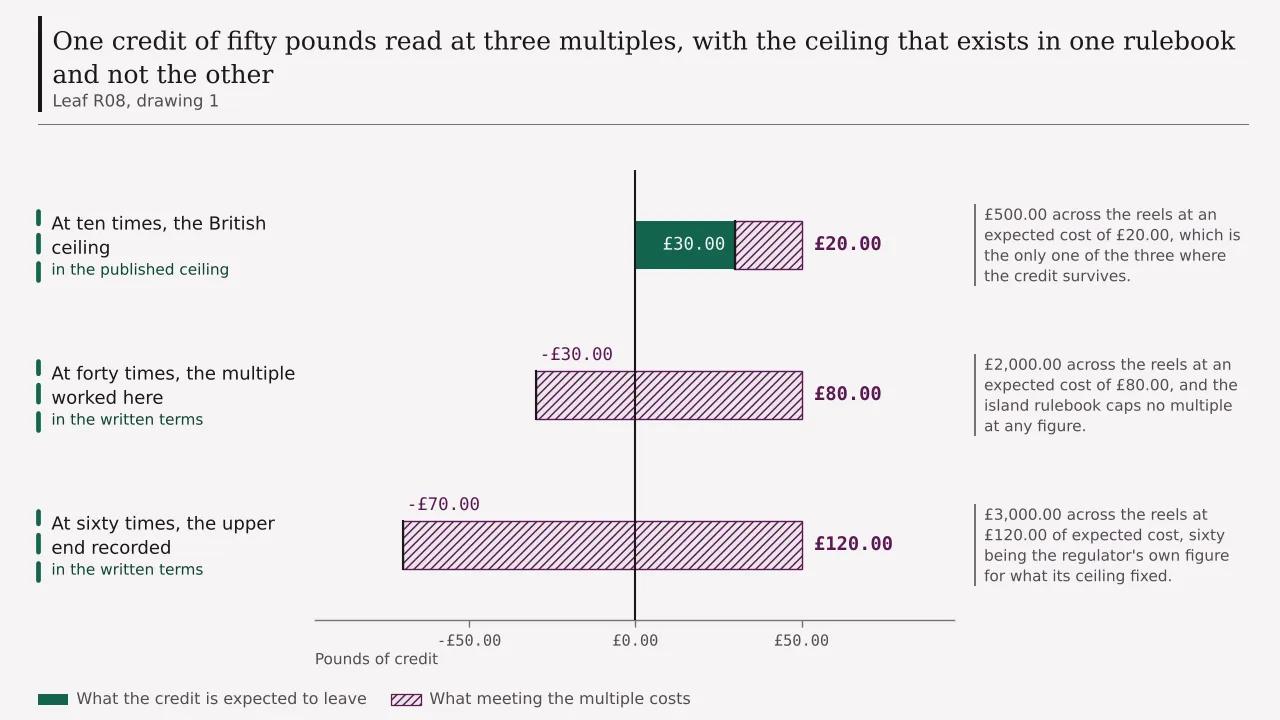
Price the first of those absences. Take £50.00 of credit against the forty times multiple this site works to. Forty lots of £50.00 is £2,000.00 pushed across the reels, four pence of each pound staked stays behind as margin, and £80.00 is therefore the expected cost of meeting the condition. Subtract it from the credit and what remains is an expected minus £30.00.
Reach the same answer from the far end, with no staking total computed. Four hundredths leak out of each pound staked where 96 pence returns; forty rounds of that leak take 1.6 of the credit; one less 1.6 leaves minus 0.6; six tenths of £50.00 pointed the wrong way is minus £30.00. Both routes agree because the condition only moves staked money to the margin at a fixed rate.
Read off the credit £50.00 Once a forty times condition applies minus £30.00 The price of a ceiling nobody set £80.00
Now bring the British ceiling alongside. There the most a wagering requirement may ask is ten times the bonus funds, a rule running since 19 January 2026. Ten lots of £50.00 is £500.00 across the reels, costing an expected £20.00, so an identical credit closes at a positive £30.00. Measured as the distance between the two expected closes, the ceiling is worth £60.00 on a credit this size. Break-even at a 96 per cent return falls at 25, sitting between the two multiples.
One figure in that comparison belongs to the British regulator and not to this leaf. Explaining what the ten-times ceiling was fixing, it recorded that some licensees were at that point asking sixty times. Run sixty through the same arithmetic: £3,000.00 of staking, £120.00 of expected cost, and £50.00 of credit closing at an expected minus £70.00. That is the only market multiple on this subject attributable to a regulator rather than to anybody’s guess.
Two absences bite at the exit instead of on a bonus. A British licence holder may not hand a customer the chance to cancel a payment request after making it, and may not put any ceiling over what a customer draws from money they paid in themselves, the regulator having printed an example of the wording it forbids. Neither rule has a counterpart in the island policy read for this leaf, so both questions are settled in the written terms by whoever drafts them.
5
The shape the comparison makes, which is not a score
Lay parts two to four over each other and a pattern shows that neither a defence nor a dismissal would produce. The island policy is strongest on the exchange between a business and a player: how a complaint gets received, how quickly it is answered, how a break is taken, how a limit is raised, what an affiliate may say. It goes quiet on the machine and on the money: how fast a game may turn, how large a stake may be, how many times a credit must be turned over, what may be celebrated on a screen.
In one sentence: one rulebook governs the conversation, and the other governs the conversation plus the arithmetic underneath it. That is a shape rather than a score, and it is more useful than a score, because it predicts which questions will have a published answer. An argument about process has a written route offshore. An argument about whether a condition was too large to be fair has no written standard offshore to be measured against, none having been drafted.
| Subject of the rule | Island policy | British rules | Worth on £50.00 of credit |
|---|---|---|---|
| Ceiling over a wagering multiple | Silent | Ten times the bonus funds | £60.00 |
| Wait before a limit rises | Seven days | A day, then a second confirmation | £180.00 kept out |
| Floor under a game cycle | Silent | Two and a half seconds on reel-based play | 13 hours 53 minutes |
| Ceiling over a single stake | Silent | £5, and £2 under 25, on online slots alone | Bounds the row above |
| Menu of breaks | Four lengths, one click, immediate | Not written as a menu | No money figure |
| Affiliate conduct | Contract, audit and penalty | Chiefly about placement | No money figure |
Two rows carry no money figure and that blank is a finding rather than a gap. A menu of breaks and an affiliate contract both change what a player meets rather than what a sum becomes, so pricing either would mean inventing a probability nobody has published. A row with an honest blank is worth more than a row with a plausible-looking number in it.
One more property deserves naming before the comparison is put down. Every row where the island policy is tighter costs an operator a delay. Every row where it stays quiet costs an operator revenue. That is an observation about a pattern rather than a claim about motives, and a reader may weigh it against the chance that the pattern is accidental.
6
One row that will not line up with its British counterpart
Exclusion lengths look comparable and the comparison is misleading, which matters more than the lengths do. Offshore, excluding yourself means barring yourself from some or all gaming with one named business. That business then has to keep you off every domain it runs, and the policy adds that the player ought to be encouraged to do the same elsewhere. That last clause is the whole difference, stated by the rulebook about itself: no cross-operator register exists, and encouragement is its answer to every other address.
The British arrangement is built the other way up. Taking part follows from holding a licence, so a single registration shuts accounts across the licensed market without the player approaching anybody. Two mechanisms wear one name. One is an instruction to a business about its own customers. The other is a list every business in a jurisdiction has to consult.
The consequence, stated rather than worked around, is the honest thing to print. An exclusion lodged with a single business reaches that business and its domains and stops. A registration with the national scheme reaches the licensed market and stops where the licence stops, which the scheme sets out in its own terms rather than leaving anybody to find out. Somebody who registered and is now reading about addresses past the licence is reading about places the registration never covered, and part one has the routes that help.
Two smaller features run against expectation. The shortest offshore period is twelve months where the shortest British one is six, so taking the minimum there is a longer commitment than taking the minimum here. And an exclusion offshore cannot be lifted before its period expires, matching the British position. Neither touches the reach, and reach decides whether an exclusion does anything at a given address.
One asymmetry from part two belongs here as well. The island regulator names the admission of a player who has excluded themselves as a complaint category it treats as serious whatever the sum. That is a published statement that the category matters. It still arrives after the event rather than ahead of it.
7
Duties about the machine, and what their absence is worth
Sites of this description hold no Great Britain licence. Where two rulebooks are being compared, the duties worth naming govern the machine rather than the paperwork. Each is a constraint on what software may do while somebody is playing, and none of them appears in the island policy read for this leaf.
Six constraints of that kind. A wagering requirement held to ten times the bonus funds, running since 19 January 2026. A stake held to £5 in one game cycle on online slots, and to £2 for a player under 25, from April and May of 2025 respectively. Two and a half seconds at minimum between cycles on reel-based play, and five seconds where the game is a casino game but not a slot, with poker played between customers left out, the second of those effective from 17 January 2025. A bar on automatic play, so every cycle takes its own deliberate press. A bar on features that bring a result forward, and on making a celebration out of a return that comes back no bigger than its stake. And a prohibition on designs misleading a player about how likely a result is, with a near miss substituted for an ordinary loss as the named instance. Delete the six and the conversation rules of parts two and three carry on working, while nothing governs the arithmetic the conversation is about.
The pace floor folds into this leaf’s own figures rather than being quoted at them. A forty times condition on £50.00 of credit asks £2,000.00 across the reels, and at 10p a press that is 20,000 presses. Two and a half seconds each puts 50,000 seconds underneath the obligation, which runs to 13 hours and 53 minutes, plus 20 seconds. Nothing else has been counted yet. Where no floor is written, the obligation can be compressed as far as the software will go.
Stake ceilings bound the same row from the other side. With £5 the most one cycle may carry, those 20,000 presses cannot be collapsed into 400 larger ones, and the £2 figure for players under 25 tightens it again. Both are slots rules fastened to remote casino licences and they reach no other casino game, a boundary worth stating exactly rather than widening.
Part four priced the wagering ceiling at £60.00 on this credit. The bans on automatic play and on shortened waits price in a unit this site does not convert into money: they change how long an obligation takes to work off and how deliberate each step has to be, which is a fact about a player’s time. Putting pounds on either would mean inventing the conversion, so the entry stays as it is.
Sharpest of the six, and carrying no price at all, is the rule about misleading design. A licensed build may not be put together so as to mislead a player about how likely a result is, and swapping an ordinary losing outcome for one that looks like a near miss is named in terms. Nothing in the island policy says what a losing outcome may look like on a screen, so that question is answered by whoever wrote the software and by no rulebook at either end.
8
A rulebook that exists against one that reaches an address
Everything above concerns what two rulebooks say. This part concerns the gap between a rulebook existing and one reaching the address in front of a reader. Both records share a limit and it belongs at the front of any check. An entry in the public register establishes that a permission went to a named holder, and how far it runs. It does not establish that the party behind a given address this week is that holder, and a licence number settles nothing about it either. Matching a number to an entry establishes that a number matches an entry; the step from there to who is taking the payment belongs to whoever takes it.
Three things could not be established at source while this site’s fact sheet was put together, and each is recorded as a gap instead of filled in. No primary source says which licence any named trading brand holds, so none is attributed anywhere here. No count of how many businesses hold a licence from that body could be cited with a date attached. And no published aggregate of complaint numbers could be found, even though operators have to report them on 15 January and 15 June each year, 2026 bringing the first, and the report covers totals, how many were upheld and rejected, how many remain open, their categories, how many went to adjudication, and how many reached a court.
An observation about the issuer’s own infrastructure belongs with those gaps rather than as a complaint. When the fact sheet behind this site was compiled, that regulator’s site reported its online gaming portal as being offline. A reader trying to verify a licence number at a moment when that holds finds the verification route unavailable, which is a property of the check rather than of the licence and should be recorded as one.
Run the same test against the British record and it fails differently, which keeps this part from reading as an attack on one side. No date appears on the public register page and no guidance appears there on reading what it shows, so no published interpretation of a domain written against a licence exists. A penalty is dated one way on the regulator’s published enforcement list and another way on the licensee’s own entry. Neither record anywhere is a live statement about who operates what this morning.
A third jurisdiction shows the difference between a rulebook that can be read and one that cannot. One issuing body of this general kind is published at a commercial web address and not at a governmental one, points at no ordinance, statute or regulation in any of its material, and advertises a player complaint process whose page returned an error when it was fetched. So this leaf can say that the body advertises a complaint route and a list of adjudicators, and can say nothing at all about what either holds: no time limit, no statement on whether a decision binds an operator, no account of what remedies exist. That is why the island rulebook is the one taken apart here. It can be read.
9
What the comparison leaves a reader holding
Four figures and one shape. £80.00 separates a £50.00 credit read off a claim from its expected close under forty times. £60.00 is what a ten-times ceiling is worth on that same credit. £180.00 is what six extra days of waiting keep out of an account on a limit lifted from £20.00 to £50.00. And a two-and-a-half-second cycle puts almost fourteen hours under 20,000 presses, wherever such a floor is written.
The shape is that one rulebook covers the exchange between a business and a player while the other covers that and the arithmetic beneath it. Rows where the offshore policy is tighter concern timing, access or conduct. Rows where it says nothing concern a number. Hold that sentence and the rest is predictable without opening either document again.
Two concessions belong at the end. A published complaint timetable offshore is a real thing and calling it absent would be plainly wrong: six months to raise one, eight weeks at the outer edge, adjudication compulsory and paid for by the operator. Its parameters, though, may be set by that same operator, so the route exists while its shape sits partly with the party being complained about.
What no comparison of rulebooks can supply is the thing part eight named. Neither record states who stands behind an address this morning; one body’s verification route was reported offline when the underlying check was made; and that body’s own pages disagree about the year its governing ordinance took effect. Those are facts about how far a check can get, and they sit above every row in every table here.
If this is being read by somebody unwinding a decision already made about their own gambling, the routes in part one stay the useful ones: a helpline answering at any hour, two written addresses, and a registration whose coverage is fixed by a licence and written into the scheme’s own terms.
Questions
- Is there any complaints route at a site licensed on the island?
- Yes, and calling it absent would be plainly wrong. A player complaints policy is published under the governing ordinance. A complaint may be raised free of charge up to six months after the bet is settled or the incident happens. Receipt has to be acknowledged in writing inside a week. The operator then assesses and answers inside four weeks, and one further four-week extension is available on written notice, totalling eight.
- How does that timetable sit against the British one?
- Level at the outer edge. Britain puts eight weeks on the whole thing, any escalation within the business included, running from the day the complaint lands, and requires a customer to be able to raise one for six months at minimum. Britain acknowledges faster: three working days, or one day at an operation that never closes, against a week offshore. Britain also permits the clock to be paused after a week of silence on a reasonable request, which the island policy does not write in those terms.
- Where is the offshore rule tighter than the British one?
- On a request to raise a deposit limit, among others. The island policy holds an increase for seven days before applying it, where Britain holds one for 24 hours at minimum and then wants the customer to confirm again. Reductions apply at once in both. On a daily figure lifted from £20.00 to £50.00, both of them this leaf’s own, six extra days keep £180.00 out of an account that the British rule would have let in.
- What else does the island rulebook demand that Britain does not?
- A menu of breaks: four lengths running from a day to a quarter of a year, each reachable through one button, with no email exchange and no approval from the operator, taking effect immediately and selectable by type of product. The operator is then forbidden from talking a player out of one, by questioning the decision, by offering reassurance to delay it, or by dangling a promotion. It also holds the operator answerable for what its affiliates do, backed with contracts, audits and penalties.
- What does a forty times condition do to a £50.00 credit?
- Takes it to an expected minus £30.00, leaving a difference of £80.00. Forty lots of £50.00 asks £2,000.00 across the reels, four pence of each pound staked stays behind as margin, and £80.00 is the expected cost of meeting the condition. The same answer arrives without a staking total: four hundredths leak out of each pound staked where 96 pence returns, forty rounds of that take 1.6 of the credit, one less 1.6 leaves minus 0.6, and six tenths of £50.00 pointed the wrong way is minus £30.00.
- What is a wagering ceiling worth, then?
- £60.00 on a credit that size. In Britain the most a wagering requirement may ask is ten times the bonus funds, a rule running since 19 January 2026. Ten lots of £50.00 is £500.00 across the reels, costing an expected £20.00, so the same credit closes at a positive £30.00 instead of minus £30.00. Break-even at a 96 per cent return falls at 25, between the two multiples. Nothing in the island policy caps a multiple at any figure.
- Does excluding yourself offshore work the same way?
- No, and the lengths are the least important part. Excluding yourself there means barring yourself from some or all gaming with one named business, which then has to keep you off every domain it runs, with the policy adding that the player ought to be encouraged to do the same elsewhere. That last clause is the difference: no cross-operator register exists, so an exclusion reaches one business and stops.
- Are the offshore exclusion periods longer?
- The shortest one is. Twelve months is the minimum there, with further choices at three years, at five and at ten, plus a lifetime option, and once confirmed a player cannot lift it before it expires. The national British scheme sells six months, a year, or five years, the last of those with automatic renewal available. A longer floor and a lifetime choice are both real. Neither touches the reach, and reach is the quantity deciding whether an exclusion does anything at a given address.
- Which British duties have no counterpart in that rulebook?
- Six governing the machine. A wagering requirement held to ten times the bonus funds. A stake held to £5 in one game cycle on online slots, and to £2 for a player under 25. Two and a half seconds at minimum between cycles on reel-based play, and five seconds at a casino game which is not a slot, poker played between customers excluded. A bar on automatic play. A bar on features that bring a result forward, and on celebrating a return that came back no larger than its stake. And a prohibition on designs misleading a player about how likely a result is.
- How long would a forty times condition take at the British pace floor?
- Thirteen hours, 53 minutes and 20 seconds. That is before a single other condition is counted. £2,000.00 across the reels at 10p a press comes to 20,000 presses; at two and a half seconds each that is 50,000 seconds underneath the obligation. Where no floor is written, the same obligation can be compressed as far as the software will go.
- Does a licence number tell me who is behind the website?
- No. An entry establishes that a permission was granted to a named holder, and how far the permission runs. It does not establish that the party behind a given address this week is that holder, and a licence number settles nothing about it either. The British public register shares that limit, carries no date of its own, and publishes no guidance on how a domain set against a licence should be read.
- Does the regulator’s own paperwork agree with itself?
- Not entirely, and the disagreement is worth knowing about. Its online gaming page dates the governing ordinance’s entry into force to 24 December 2024. Its introductory page says the ordinance was enacted on a date in December 2025, the twenty-fourth, and in a separate passage gives entry into force as December 2024. Two statements of the three back the earlier year, so this leaf works to 24 December 2024 and records the other. That same site also reported its online gaming portal offline when the underlying check was made.