Terms read 19 October 2026 Leaf R03, revision 1
An online casino UK address, checked against the public record in four steps and three minutes
A credit of £40.00 drags £1,600.00 of staking behind it at the multiple this end of the market writes, and closes at an expected minus £24.00. Under the ceiling a British licence imposes the same credit drags £400.00 and closes at £24.00. Which of those two readings applies is decided by one row in a public record, and this leaf times the walk to it.
Stated on the banner £40.00 A credit figure and the word licensed, which is a word and not a row. Stated, once you go and look minus £24.00 Where a forty times condition is written against that credit, worked where each pound sent over the reels gives back ninety-six pence of itself. Not stated before the money goes in Neither is written Which company answers for the address this morning, fixed by no record anywhere, and what proportion of each pound staked on a given build is credited against the condition, published by nobody.
Offers of this build, with their written terms read
Every destination in this file is bought advertising. The site is paid a fee if a reader goes on to register, and no figure printed below moves because of it.
Bonus Spins UK Slip 01
Betportal
Ceiling as a multiple
The drop
€15.00
€1.00 in the euro
The claim reads €15.00. Once the terms beside it have applied, €0.00 of it can leave. The difference is the drop.
7 of the 15 terms on this slip could not be read before the money went in
Spins priced at this site's own 10p a spin, which the operator does not publish
Stated
€15.00
The claim as it is printed, before a single term has been applied to it.
Headline paid as spins
150 spins at 10c each, which is €15.00 of the figure above.
6 Nowhere
What one spin is worth
No unit is published for a spin, so the count is priced at this site's own 10p a spin. At half that price every figure below halves with it.
Match and other credit not priced
300% of three deposits, to a ceiling of €1,000. A share of a deposit nobody has made yet is not a sum, so no figure stands on this line and none is carried below.
Qualified
-€14.40
Written down somewhere, and taking part of the claim back. Each term carries the place it is written and the sum it takes.
2 Written terms at a distance this record does not establish
Play-through -€14.40
Carrying €14.40 through 35 times stakes €504.00 and costs €20.16 of it at 96 per cent return. That prices above the €14.40 there is to charge it against, so the whole of the credit goes and the line is held at that. The multiple sits on the bonus.
2 Written terms at a distance this record does not establish
Game weighting not priced
Slots only count towards the play-through. No contribution percentage is published, so the line above has been worked at full weight, which is the kindest reading there is.
2 Written terms at a distance this record does not establish
Ceiling on the winnings not priced
5x the bonus.
2 Written terms at a distance this record does not establish
Clock on the credit not priced
14 days.
2 Written terms at a distance this record does not establish
Largest stake while it runs not priced
€5.
3 Public record
Licence, and who holds it not priced
Licensed in Anjouan, Comoros, held by BetPortal Gaming Ltd, with Excite Ultra Media Ltd, reference ALSI-202601040-FI2. A register entry settles who holds a licence and what it permits. It does not settle who is running the site this morning.
4 Cashier
Smallest qualifying deposit your money
€20 a stage. That is €20.00 of your own money, and it is never netted into a drop.
5 On the way out
Checks before a withdrawal not priced
Documents before the first withdrawal.
Unstated
-€0.60
Applying without having been published anywhere, and costing money all the same.
6 Nowhere
What a spin hands back -€0.60
Staking a spin returns 96 per cent of it, so that share of the batch is the house's before a reel turns. This site works at that return and the operator publishes none where the claim is made.
6 Nowhere
Forfeited by rule cost unknown
Nothing is published under this heading, and it applies regardless.
6 Nowhere
Charge on the way out cost unknown
No charge on the way out is published as a figure, so nothing comes off this line. A charge that exists unpublished would come straight off whatever survives.
6 Nowhere
Smallest withdrawal allowed cost unknown
No smallest withdrawal is published as a figure. A floor nobody has published is still a floor, and it decides whether a small balance can move at all.
No Great Britain licence
Terms read 19 October 2026
Bonus Spins UK Slip 02
WinBeast
Ceiling as a sum
The drop
€50.00
€1.00 in the euro
The claim reads €50.00. Once the terms beside it have applied, €0.00 of it can leave. The difference is the drop.
8 of the 15 terms on this slip could not be read before the money went in
Spins priced at this site's own 10p a spin, which the operator does not publish
Stated
€50.00
The claim as it is printed, before a single term has been applied to it.
Headline paid as spins
500 spins at 10c each, which is €50.00 of the figure above.
6 Nowhere
What one spin is worth
No unit is published for a spin, so the count is priced at this site's own 10p a spin. At half that price every figure below halves with it.
Match and other credit not priced
50% to 100% of five deposits, each to a ceiling of €1,000, and a €650 free bet. A share of a deposit nobody has made yet is not a sum, so no figure stands on this line and none is carried below.
Qualified
-€48.00
Written down somewhere, and taking part of the claim back. Each term carries the place it is written and the sum it takes.
2 Written terms at a distance this record does not establish
Play-through -€48.00
Carrying €48.00 through 40 times stakes €1,920.00 and costs €76.80 of it at 96 per cent return. That prices above the €48.00 there is to charge it against, so the whole of the credit goes and the line is held at that. The multiple sits on the bonus and the winnings from the spins.
2 Written terms at a distance this record does not establish
Game weighting not priced
Slots, titles vary by country count towards the play-through. No contribution percentage is published, so the line above has been worked at full weight, which is the kindest reading there is.
2 Written terms at a distance this record does not establish
Ceiling on the winnings not priced
€100 a batch of spins.
2 Written terms at a distance this record does not establish
Clock on the credit not priced
7 days, spins 1 day.
3 Public record
Licence, and who holds it not priced
Licensed in Curaçao, holder not named on the site. A register entry settles who holds a licence and what it permits. It does not settle who is running the site this morning.
4 Cashier
Smallest qualifying deposit your money
€20 a stage. That is €20.00 of your own money, and it is never netted into a drop.
5 On the way out
Checks before a withdrawal not priced
Documents before the first withdrawal.
Unstated
-€2.00
Applying without having been published anywhere, and costing money all the same.
6 Nowhere
What a spin hands back -€2.00
Staking a spin returns 96 per cent of it, so that share of the batch is the house's before a reel turns. This site works at that return and the operator publishes none where the claim is made.
6 Nowhere
Largest stake while it runs cost unknown
Nothing is published under this heading, and it applies regardless.
6 Nowhere
Forfeited by rule cost unknown
Nothing is published under this heading, and it applies regardless.
6 Nowhere
Charge on the way out cost unknown
No charge on the way out is published as a figure, so nothing comes off this line. A charge that exists unpublished would come straight off whatever survives.
6 Nowhere
Smallest withdrawal allowed cost unknown
No smallest withdrawal is published as a figure. A floor nobody has published is still a floor, and it decides whether a small balance can move at all.
No Great Britain licence
Terms read 19 October 2026
Bonus Spins UK Slip 03
EliteSpin
Longest spin window
The drop
£50.00
£1.00 in the pound
The claim reads £50.00. Once the terms beside it have applied, £0.00 of it can leave. The difference is the drop.
8 of the 15 terms on this slip could not be read before the money went in
Spins priced at this site's own 10p a spin, which the operator does not publish
Stated
£50.00
The claim as it is printed, before a single term has been applied to it.
Headline paid as spins
500 spins at 10p each, which is £50.00 of the figure above.
6 Nowhere
What one spin is worth
No unit is published for a spin, so the count is priced at this site's own 10p a spin. At half that price every figure below halves with it.
Match and other credit not priced
50% to 100% of five deposits, each to a ceiling of £1,000. A share of a deposit nobody has made yet is not a sum, so no figure stands on this line and none is carried below.
Qualified
-£48.00
Written down somewhere, and taking part of the claim back. Each term carries the place it is written and the sum it takes.
2 Written terms at a distance this record does not establish
Play-through -£48.00
Carrying £48.00 through 40 times stakes £1,920.00 and costs £76.80 of it at 96 per cent return. That prices above the £48.00 there is to charge it against, so the whole of the credit goes and the line is held at that. The multiple sits on the bonus and the winnings from the spins.
2 Written terms at a distance this record does not establish
Game weighting not priced
Slots count towards the play-through. No contribution percentage is published, so the line above has been worked at full weight, which is the kindest reading there is.
2 Written terms at a distance this record does not establish
Ceiling on the winnings not priced
5x the bonus.
2 Written terms at a distance this record does not establish
Clock on the credit not priced
7 days, spins 3 days.
3 Public record
Licence, and who holds it not priced
Licensed in Costa Rica, held by PrimeTier Limited. A register entry settles who holds a licence and what it permits. It does not settle who is running the site this morning.
4 Cashier
Smallest qualifying deposit your money
£20 a stage. That is £20.00 of your own money, and it is never netted into a drop.
5 On the way out
Checks before a withdrawal not priced
Documents before the first withdrawal.
Unstated
-£2.00
Applying without having been published anywhere, and costing money all the same.
6 Nowhere
What a spin hands back -£2.00
Staking a spin returns 96 per cent of it, so that share of the batch is the house's before a reel turns. This site works at that return and the operator publishes none where the claim is made.
6 Nowhere
Largest stake while it runs cost unknown
Nothing is published under this heading, and it applies regardless.
6 Nowhere
Forfeited by rule cost unknown
Nothing is published under this heading, and it applies regardless.
6 Nowhere
Charge on the way out cost unknown
No charge on the way out is published as a figure, so nothing comes off this line. A charge that exists unpublished would come straight off whatever survives.
6 Nowhere
Smallest withdrawal allowed cost unknown
No smallest withdrawal is published as a figure. A floor nobody has published is still a floor, and it decides whether a small balance can move at all.
No Great Britain licence
Terms read 19 October 2026
Bonus Spins UK Slip 04
Crown Jewelz
Multiple unpublished
The drop
NOT WORKED
The multiple is not published in the operator's own terms. Since the sum cannot be worked around it, none is worked.
9 of the 14 terms on this slip could not be read before the money went in
No drop worked
Stated
£15.00
The claim as it is printed, before a single term has been applied to it.
Headline paid as spins
150 spins at 10p each, which is £15.00 of the figure above.
6 Nowhere
What one spin is worth
No unit is published for a spin, so the count is priced at this site's own 10p a spin. At half that price every figure below halves with it.
Match and other credit not priced
200% of the first deposit, then 150% twice, each to a ceiling of £1,000. A share of a deposit nobody has made yet is not a sum, so no figure stands on this line and none is carried below.
Qualified
NOT WORKED
Written down somewhere, and taking part of the claim back. Each term carries the place it is written and the sum it takes.
2 Written terms at a distance this record does not establish
Play-through not priced
40x the bonus, reported rather than published by the operator.
2 Written terms at a distance this record does not establish
Game weighting not priced
Slots count towards the play-through. No contribution percentage is published, so the line above has been worked at full weight, which is the kindest reading there is.
3 Public record
Licence, and who holds it not priced
Licensed in Curaçao, number not verified, holder not named on the site. A register entry settles who holds a licence and what it permits. It does not settle who is running the site this morning.
4 Cashier
Smallest qualifying deposit your money
£20. That is £20.00 of your own money, and it is never netted into a drop.
5 On the way out
Checks before a withdrawal not priced
Documents before the first withdrawal.
Unstated
NOT WORKED
Applying without having been published anywhere, and costing money all the same.
6 Nowhere
Ceiling on the winnings cost unknown
No ceiling is published. Nothing is assumed in its place.
6 Nowhere
Clock on the credit cost unknown
Nothing is published under this heading, and it applies regardless.
6 Nowhere
Largest stake while it runs cost unknown
Nothing is published under this heading, and it applies regardless.
6 Nowhere
Forfeited by rule cost unknown
Nothing is published under this heading, and it applies regardless.
6 Nowhere
Charge on the way out cost unknown
No charge on the way out is published as a figure, so nothing comes off this line. A charge that exists unpublished would come straight off whatever survives.
6 Nowhere
Smallest withdrawal allowed cost unknown
No smallest withdrawal is published as a figure. A floor nobody has published is still a floor, and it decides whether a small balance can move at all.
No Great Britain licence
Terms read 19 October 2026
Every figure in the second and third columns is this site's own working and nothing an operator has published. A claim is priced as printed, then the share a spin hands back at 96 per cent return comes off it, then what playing the multiple through costs at the same return, and then whatever a published ceiling, a charge on the way out or a floor on the smallest withdrawal takes from what has survived. The drop is the difference between the first figure and the last. The two columns add back up to it exactly, so no money leaves a slip without a term and a place beside it.
Which column a term falls in is settled by one question: has anybody written it down. A charge a reader meets at the payment screen is written down, and it stands in the second column with the cashier against it. A condition that binds without ever having been set down stands in the third, whatever it costs. Inside each column the terms run outwards from the banner, so the order itself says how far a reader would have had to go.
A count of spins has no unit until one is supplied. Where an operator publishes what one of its own spins is worth, that figure is used and the first column says it is theirs. Where none is published, this site's own 10p a spin stands in its place and every figure below moves in proportion with it. Where the multiple itself is unpublished, no drop is worked at all, because that is the one figure the sum cannot be done without.
Three words stand where a figure cannot. Not priced is a term that is written down and carries no number the arithmetic can take. Cost unknown is a term nobody has written down, costing something nobody has put a number on. Your money is money of the reader's own, which is never netted into a drop.
None of the operators in this file holds a Great Britain licence, so none of the duties that licence carries reaches them. Each of those duties is published in its own right, which is what makes its absence here something a reader can check rather than take on trust. Every gambling company licensed in Great Britain belongs to Gamstop Online, so a reader who has shut themselves out through the scheme is not shut out here. Social Responsibility Code 5.1.1 has held a play-through to a maximum of ten times the bonus funds since 19 January 2026, and it binds a licence holder and nobody else. Asked in a post of 21 October 2025 what is lost along with the licence, the Gambling Commission's Director of Enforcement and Intelligence answered: "unfair gaming practices, financial loss, and a lack of recourse if things go wrong". The same post puts blocked payouts, and withdrawal limits pitched high enough to be unreachable, among the behaviour the Commission has recorded. Nobody under 18 may hold an account at any of them.
Terms are reproduced in the wording their operator published, and each slip is dated with the day somebody sat down and read them. 19 October 2026 is the oldest of those dates. Anybody claiming an offer is bound by that operator's full terms, which are elsewhere, and never by a line standing here.
1
Four steps, three minutes, and the one sentence they produce
The British regulator sets out one short drill for anybody about to hand money to a gambling website, and it fits in four questions. Is a Commission licence held by the business. Does a licensed status appear on the site. Can that status be followed through to a row anybody may read. Do the permissions and the web addresses on that row agree with the site standing in front of you. The page carrying those questions is dated 20 September 2020, with a revision stamped 23 August 2021, and nothing longer has been issued.
Four steps, then, and each one has a different failure mode. Step one fails where no name is printed anywhere on the site. Step two fails where a badge is an image rather than a link. Step three fails where the link goes to a holding page rather than to a row. Step four fails where a row exists, is genuine, and does not list the address the reader is standing on. Only the last of those is interesting, because the first three announce themselves and the fourth does not.
This leaf assigns a duration to each step, and the durations are its own estimate rather than a measurement anybody published: thirty seconds to find a name at the foot of a page, sixty to search the register for it, forty to read the activity list, fifty to read the domain list against the address in the browser bar. Added, that is 180 seconds. Three minutes is the number the rest of this leaf prices, and every figure derived from it inherits the assumption.
What the three minutes buy is one sentence and nothing more. On a stated date, a company of a stated name held a licence of a stated kind, permitting a stated list of activities, with a stated list of web addresses recorded against it. Every clause in that sentence is checkable by somebody else, which is the property that makes it worth writing down. No clause in it names who is answering the server today.
That last restriction governs the whole leaf and the eight leaves grouped beside it. An entry in a licence record fixes the identity of the holder and the scope of what the holder may do. It does not fix who is running a particular website on a particular morning, because the record is a list of permissions rather than a list of operators of addresses, and nothing in it is dated to this morning. A reader who treats the row as an answer to who am I dealing with has asked it a question it was never built to take.
Everything after this part does one of two jobs. Parts two to five take the four steps apart field by field and say what each field settles. Parts six to nine convert the result into money on this leaf’s own worked credit. Part ten compresses the whole of it back into something that fits on a phone, for an address nobody has written about.
2
Which record this is, and what a single row of it carries
More than one record sits behind an address, and reaching for the wrong one wastes the minute step two is allotted. Four are published together: businesses, the individuals who hold personal licences, regulatory actions taken, and premises. Three of those can be put through a search box or taken away entire, those three being businesses, personal licences and premises. Public statements and freedom of information answers are posted on the same route. Step two wants the first of the four, since the register of individuals lists people rather than companies and will settle nothing about a web address.
A business row is a short object. It carries the licensee’s registered name, an account number that is the register’s own handle for that licensee, the licences held, the activities those licences permit, any trading names recorded, and any domain names recorded. Those fields are the entire raw material of the check, and three of the four steps live inside them.
Count the record before reading it, because the size of it changes what a reader expects to find. The annual statistics released on 17 September 2026 put 3,097 permitted activities against 2,154 licensees as things stood on 31 March 2026. Dividing the larger figure by the smaller gives 1.44 permissions apiece, and that division is this leaf’s own working on two published counts. A permission is therefore an enumerated list rather than an emblem, and on average the list runs past one line.
That ratio is the reason step three exists at all. If every licensee held exactly one permission there would be nothing to read after the name was found. At 1.44 the question permitted to do what has a genuine answer, and the answer differs between rows. A company may be permitted to run remote betting and not remote casino. It may hold a software permission and no permission to take a customer’s money at all. Reading the name and stopping there answers the easy half of a two-part question.
One property of the record is easy to miss and decides how a date is handled further down. The register’s own page carries no publication date and no last-updated stamp of any kind, which is recorded on this site’s fact sheet against the register page as read on 15 October 2026. There is therefore no published statement of how current any row is. A reader who looks at a row knows what the row says, and knows the date they looked, and knows nothing whatever about when the row last moved.
So the date of the check belongs in the result, and this leaf puts it there. Any figure or conclusion below that leans on the record carries 15 October 2026, which is the date the register page and the player guidance behind step four were read for this site’s fact sheet. A conclusion from a dateless source with no date of its own attached is not a weaker conclusion. It is an unfalsifiable one, which is worse.
3
The permitted activities, read instead of the company name
Step three is where most of the value of the whole exercise sits, and it is the step readers skip, because a name matching feels like an answer and a list does not. The licence is a permission to carry on named activities. Everything the British rulebook imposes is imposed through the licence that permits an activity, so an activity absent from the list is an activity none of those duties reach.
The scope lines printed on the conditions themselves show this plainly, and a reader can check each one without taking anybody’s word for it. Condition 7.1.1 on fair and transparent terms reaches every operating licence bar two, the technical one written for gaming machines and the one written for gambling software. Condition 17.1.1 on identity starts from all remote licences and then subtracts five kinds: software, host, the machine-technical one, and a pair of ancillary remote permissions, one for casino and one for bingo. The code provision carrying the ceiling on a play-through starts from everything and subtracts the same technical and software pair. Three conditions, three different carve-outs, each keyed to a kind of permission rather than to a company.
Read those three scope lines together and a rule falls out that is worth more than any single fact on this leaf. The duties a player would actually want attach to the permission to take the player’s money. They do not attach to a permission to write the software, host the equipment or supply a build. So a row found at step two establishes the duties that bind only once step three has read which permissions the row actually holds.
Put against this leaf’s worked credit, the activity list is the line deciding which of two arithmetics applies. The ceiling is ten times, measured against the bonus funds, and it began to bind on 19 January 2026, the response carrying it being dated 26 March 2025 with a revision of 27 January 2026. A credit of £40.00 under that ceiling permits £400.00 across the reels and not a pound more. Where it does not reach, the multiple is whatever a terms document sets, and this leaf works at forty times, which is where drafting at this end of things tends to land. Forty applied to £40.00 is £1,600.00.
| The step | Where its answer is settled | What it rules out when it fails |
|---|---|---|
| Find the licensee name printed on the site | Nothing is ruled out; a name may be absent and a licence held | |
| Search the businesses register for that name | in the public register | No row means no British licence under the name given |
| Read the activities the licence permits | in the public register | No remote casino permission means the casino duties do not bind |
| Match the browser address against the domains recorded | in the public register | An unrecorded address leaves the licence unconnected to the page |
| Establish which company is serving the page today | nowhere in writing | Not reachable by any of the four steps, at any price |
The fifth row in that table is not a fifth step. It is the question the four steps are regularly asked to answer and cannot, placed at the bottom so that it is impossible to read the first four without meeting it. Three of the four steps terminate inside one public record, which is why the whole exercise costs three minutes rather than an afternoon.
4
A web address recorded against a licensee, and the exact claim that supports
Step four is the one with a trapdoor in it. The guidance asks a reader to confirm that the website domain names match the record, and a reader doing that finds either a match or no match. What neither outcome means is the thing the record itself declines to say.
Here is the precise limit, and it comes off the record’s own page rather than out of anybody’s opinion. That page carries no reading instructions whatever. No note explains what it means for a web address to sit under a licensee, and no note explains the word printed in the status column. Work from this data and the date of looking belongs in the result, with no suggestion that the regulator has issued a reading it never issued. This leaf looked on 15 October 2026 and claims nothing past the face of the fields.
So what does a match actually support. It supports this: on the date of the check, the address in the browser bar appeared in the list of domain names recorded against a company that held the licences shown. It does not support the proposition that the company serves the page, that the company wrote the terms, that the company holds the balance, or that the arrangement recorded has not changed since the row was last touched. Those four propositions are what a reader usually wants, and the row carries none of them.
Matching has to be done on the host and not on the look of the thing, which is this leaf’s own rule rather than a published one. Compare everything up to the first dot. An address differing from a recorded one by a prefix, a suffix, a hyphen or a country ending is a different address, and the resemblance is not evidence. That discipline costs nothing and is the difference between step four doing work and step four producing a comfortable feeling.
A match failing is worth more than a match succeeding, which runs against intuition. A successful match leaves the reader where the sentence in part one left them, holding a dated statement about permissions. A failed match is a concrete, checkable fact about the page they are on: the address is not among the domains recorded against the company whose name appears on the page. That fact has consequences the rest of this leaf prices.
Fifty seconds of comparing a browser address against a list, against £48.00 of difference it decides
One further structural point. Several licensed arrangements put a well-known front end in front of a licence held by somebody with a different name, so the name on the page and the name on the row can diverge entirely while everything remains in order. That is why step four is a check on the address and not on the brand. An address either appears in the list or does not appear in it, and that comparison survives any arrangement behind it.
5
Active, inactive, and a word the publisher never defines
A row carries a status, and the status is the field most likely to be taken for a verdict. It is not a verdict. Its publisher has defined neither of the two usual words on the page the field is printed on, which this site’s fact sheet records against that page as read on 15 October 2026. Anybody looking at the word is reading a label whose meaning its own printer has not set out.
Three readings of an inactive label all sit comfortably with the printed field, and nothing chooses between them. An arrangement may have been wound up. A permission may have been surrendered while the company carries on under another one. A row may simply be old. The field does not say which, and a reader assuming the first has supplied a proposition the field withheld, which is the failure part four described in a different column.
Here is the asymmetry that makes the field usable anyway. An active label is weak evidence and an absent row is strong evidence. Absence from a searchable, downloadable record is a fact about the record, checkable by anybody, and it is the one outcome of the four steps that supports a flat conclusion. Presence supports a dated, hedged conclusion. The check is therefore much better at finding nothing than at confirming something, and a reader who understands that will not be disappointed by it.
Regulatory actions sit on the same route and behave the same way. Actions and public statements are published, so a reader who has found a row can read what has been recorded against it. An empty action record means nothing has been recorded in those registers, which is not the same proposition as nothing having happened. Reading an absence as a clean sheet is the single commonest misreading of a public record, and it is the misreading the next leaf in this section takes apart in detail.
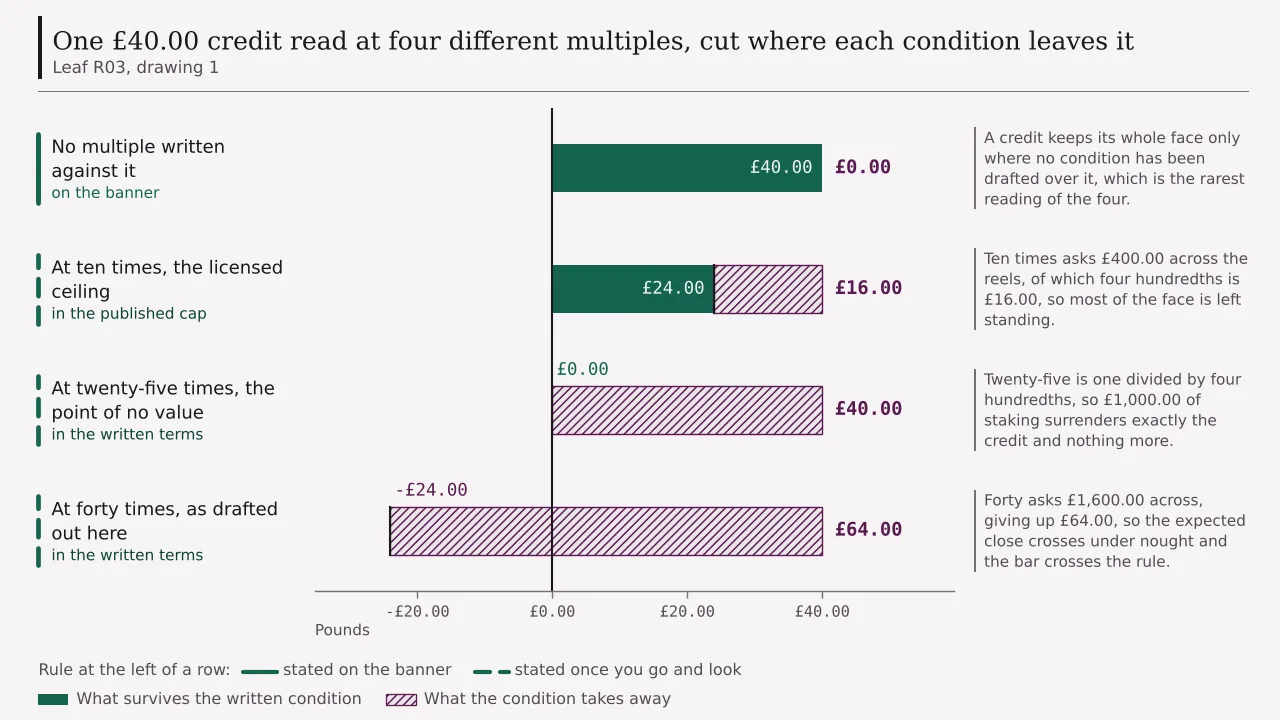
Two of the four rows in that drawing are reachable from the record and two are not. The ten times rung is a published ceiling that binds a holder of the right permission, so a reader who completed steps two and three knows whether it applies. The twenty-five rung is pure arithmetic, being one divided by four hundredths, and binds nobody. The forty rung is a drafting choice. The top rung is the advertisement.
6
Writing out the conclusion in full, with its date attached
Here is the sentence the four steps produce, written out at full length so that nothing can be smuggled into it later. On 15 October 2026, a company named in the businesses register held the licences shown against its account number, those licences permitted the activities listed, and the address typed into the browser appeared among the domain names recorded against that company. That is all of it. Every clause can be rechecked by a stranger in three minutes.
And here is what the sentence does not reach, which is the paragraph every leaf in this part of the site is obliged to carry and the reason the part exists. A record of this kind proves who holds a permission and what that permission allows. It proves nothing about who is operating a given website today. The two are different questions, the record answers only the first, and a reader who collapses them has converted a dated statement about a company into an undated statement about a server.
Three ordinary things break the link between a row and a page without anybody behaving improperly. A deal placing one company’s brand over another company’s permission can be unwound. A business can change hands. A line entered at one point can sit untouched while the facts underneath it move, the record carrying no date against which staleness could be measured. None of that is concealment. It is the ordinary distance between a schedule of permissions and a service that is running.
The honest way to carry the limit is to keep it inside the conclusion rather than beside it. Writing a licence is held by X and the address is recorded against X is accurate. Writing the site is operated by X adds a proposition the row does not support, and the added proposition is the one most likely to be relied on. A conclusion that cannot be over-read is better than a stronger conclusion that can.
There is a positive version of all this and it deserves equal space. For a reader deciding whether a whole apparatus of duties applies, the sentence above is sufficient. Nothing in that decision requires knowing which individual sits behind the server. It requires knowing whether a permission exists and reaches the address, and that is precisely what the four steps establish. The question the record answers badly is not the question most readers need answered.
So the limit is narrow, and naming it exactly is what keeps the check useful. A reader who knows the row cannot identify today’s operator, and uses the row for what it does settle, is better placed than one who distrusts the whole record because one field disappointed them. The record is not weak. It is specific.
7
Three minutes priced against forty pounds of credit
Everything so far has been procedure. This part converts it into money on the house arithmetic used across this site: a press worth ten pence, ninety-six pence returning out of every pound sent across the reels, weighting held at one, and forty times where no ceiling bites. The credit under examination is £40.00, a size a sign-up offer in this bracket prints often.
Take the uncapped reading first. Forty times a £40.00 credit is £1,600.00 needing to go across the reels before the balance converts. The margin keeps four hundredths of everything crossing, so £1,600.00 surrenders £64.00. Set £64.00 against the credit and the expected close lands at minus £24.00.
Now arrive at that same figure without touching the staking total, because two routes landing together is the only audit available on arithmetic nobody else is running. Scale the credit by the multiple and the margin multiplied: forty by four hundredths gives 1.6, so the condition expects to swallow 1.6 credits where exactly one exists. The shortfall is six tenths of a credit, which on £40.00 is £24.00 to be found elsewhere. Staking route and scaling route land on the identical number, as they must, the condition doing nothing except handing staked pounds over to the margin at one fixed rate.
The credit as the advertisement gives it £40.00 Expected close once a forty times condition is worked minus £24.00 What the written condition removes £64.00
Sixty-four pounds is what the margin takes out of £1,600.00, and it is equally the drop from £40.00 to minus £24.00. One number arrived at twice, along paths sharing no step, and that agreement is the whole of the verification available. A leaf printing one path and withholding the other would be asking to be believed.
Set that £64.00 beside the 180 seconds from part one and the rate becomes visible. Three minutes is a twentieth of an hour, so a difference of £64.00 settled inside it prices the reader’s time at £1,280.00 an hour. The 180 seconds is this leaf’s own estimate and carries no source, so the rate inherits that status and is an order of magnitude rather than a measurement. Even allowing a factor of three in either direction, no other three minutes anywhere in this transaction pays at that rate.
| Multiple written against the credit | Where that multiple comes from | Staking it asks | Expected cost of the staking | Expected close on £40.00 |
|---|---|---|---|---|
| None at all | Rare, and the advertisement is then the arithmetic | £0.00 | £0.00 | £40.00 |
| Ten times, the licensed ceiling | A published code provision, in force 19 January 2026 | £400.00 | £16.00 | £24.00 |
| Twenty-five times, the point of no value | Arithmetic, being one divided by four hundredths | £1,000.00 | £40.00 | £0.00 |
| Forty times, this leaf’s working band | A drafting choice, bound by nothing out here | £1,600.00 | £64.00 | minus £24.00 |
Follow the final column from the top down and five figures carry the whole subject. A credit is worth its face only where nothing is attached to it. The published ceiling leaves most of the face standing. Twenty-five wipes the face exactly. Beyond twenty-five the condition is hungrier than the credit is large, and the shortfall gets funded from a balance the offer never supplied.
8
Why this answer behaves as a switch and never as a term
Every other condition this site prices shifts a figure by some amount. A multiple takes a measurable bite in the bonus terms. A floor met on leaving refuses a balance under it at the cashier. A demand for paperwork lands on the way out and can hold up the lot. A ceiling on a payout truncates one tail. The outcome of the four steps does none of those things, because it is not a term at all. It decides which rulebook the terms are drafted under, and that is a binary with two complete arithmetics behind it.
Price the binary directly. Under the published ceiling the £40.00 credit is expected to close at £24.00. Outside it, at forty times, the same credit is expected to close at minus £24.00. The spread is £48.00 on a face of £40.00, which is to say the answer to one register search moves more money than the credit itself contains.
Check that spread along a second path, as before. Thirty multiples separate the two readings. Thirty on a £40.00 credit drags £1,200.00 of further staking across, and the margin’s four hundredths of that comes to £48.00. Subtraction and multiplication reach the same place, which is why the figure gets printed rather than estimated.
Expected close where the published ceiling binds £24.00 Expected close where nothing caps the multiple minus £24.00 What one search of the record decides £48.00
Forty-eight pounds settled in 180 seconds prices the walk to the record at £960.00 an hour, on this leaf’s own timing assumption. That rate is lower than the £1,280.00 in part seven, and the difference is instructive rather than untidy. Reading the written condition is worth more per minute than checking the record, because the condition is always there and the ceiling only sometimes is. The record tells a reader which of two worlds they are in. The terms tell them what the world costs.
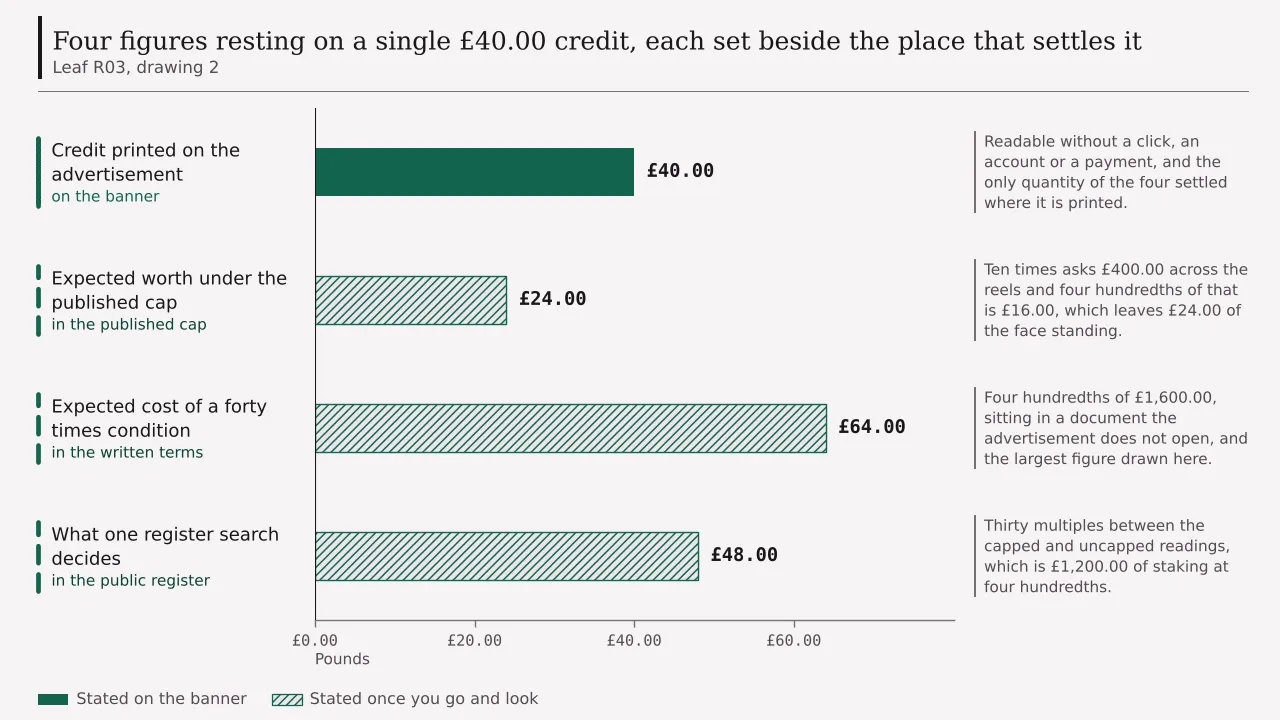
Two of those four figures come out of a public record and two do not, and the arrangement of the drawing is the argument. The largest single figure, £64.00, sits behind a document the advertisement does not open. The second largest, £48.00, sits behind a search needing no account, no payment and no permission. One of those two is free and one is not, and the free one is the one most readers skip.
9
What a missing row costs, taken duty by duty
Offers assembled the way the ones in this bracket are assembled come from companies holding no Great Britain licence, so step two returns nothing and the remaining steps never run. On a leaf whose whole subject is the act of looking something up, the protections worth naming are the ones that are themselves documents a stranger may read. Deprivations of other kinds are real and get priced elsewhere under this section heading.
First to go is a written statement about the safety of a balance. Under licence condition 4.2.1 a holder of customer money owes its terms three statements: does an insolvency leave that money intact, to what degree, and through what arrangement. The answer follows a rating scheme and a layout the regulator lays down, goes to each customer in writing on a first deposit, and wants an acknowledgement back before a penny of it is gambled with. Customer money there is the aggregate standing to customers’ credit, cleared deposits, winnings left behind and crystallised bonuses included. That condition was read for this site’s fact sheet on 17 October 2026.
Four rating names exist and they are fixed strings rather than descriptions. On two of them the opening words are not protected, with one of those two closing on no segregation while the other closes on segregation of customer funds. The remaining pair read medium protection and high protection. No exact phrasing has been laid down at this stage for explaining a rating in prose, so the explanation is drafted by the operator while the label is not.
Second to go is the repeat of that statement on a clock. Paragraph 3 of the same condition puts an operator carrying a not protected label under a duty to tell the customer, twice a year, that insolvency would leave the money unprotected, to state what is being held for that person, and to take an acknowledgement before the money is gambled with. 31 October 2025 is the day that paragraph began to bind, and the response behind it took the option with no threshold, so no balance is slight enough for the reminder to pass it by. Fresh wording elsewhere in the rulebook carries the same date, both having come out of one response dated 4 February 2025, so neither owns it.
Third to go is a name at the end of a complaint. Where a licensee’s internal process closes, the final letter has to set out the route onward to an independent adjudicating body, and that body is not a free choice: only entities carrying the regulator’s approval may be used. Beyond the licence no approved list exists, which is not the same as no adjudicator existing. It means whoever adjudicates, and on what terms, is settled by the party the complaint is against.
Fourth to go is the history of what has already gone wrong. Actions taken and statements issued are posted on the same route as the businesses record, so a licensed company’s findings are legible to anybody inside the sixty seconds step two already costs. Beyond the licence nothing of that sort is published by a third party, and a reader hunting for it is reading whatever the company has chosen to say about itself.
Price those four against the figures above and the shape is unusual. Not a single item on that list moves the £64.00 or the £48.00 by a penny, none of them being a term. What they do is make the £48.00 question answerable at all: the rating, the reminder clock, the adjudicator and the history can each be looked up because somewhere a record exists to look them up in. Take the record away and parts seven and eight stand exactly as printed, with nothing underneath that anybody could be compelled to confirm.
One further deprivation sits beneath that quartet and deserves its own sentence. The national scheme that shuts accounts across operators is reached through the British licence, so its coverage ends at precisely the line step two is testing for. Gamstop Online writes that boundary into its own conditions of use rather than leaving anybody to discover it by trying. Somebody who has registered with it can read a failure at step two as confirmation that the protection does not extend to the address, and the helpline details printed under this leaf are where to go next.
10
Running the same four steps on an address nobody has met
The drill below is the reusable part of this leaf and it is set out so that the eight leaves grouped beside it can lean on the procedure rather than restate it. It needs no account, no payment and nothing installed, and on a phone it fits inside the three minutes part one allotted.
Step one, scroll to the foot of the page and copy the company name and any account number printed there, exactly as typed. Step two, open the businesses record and search that name rather than the brand on the masthead, since brand and licensee are frequently different names and the record holds the second of them. Step three, read the activities the licence permits and write down whether remote casino stands among them. Step four, compare the address in the browser bar, up to the first dot, with the web addresses recorded under that company.
Then write the conclusion in the form part six insisted on, with the date on it, and stop there. Resist the fifth step a reader always wants to take, which is to convert a row into a statement about who is running the service. The row does not carry that, and a conclusion that overreaches by one clause is harder to correct later than one that stops short.
Two habits keep the drill honest over repeated use. Record the date every time, because the source carries none and a dateless note about a dateless record is worthless within a month. And record a failure as a result rather than as an inconvenience: no row found is the strongest outcome the four steps can produce, and it is the outcome that changes the arithmetic by £48.00 on a £40.00 credit.
Applied to the worked credit, this leaf as a whole produces five figures and no opinions. A face of £40.00, then at forty times £1,600.00 crossing the reels, then £64.00 of expected cost, then an expected close of minus £24.00, then £48.00 of spread between the capped reading and the uncapped one. Arithmetic on a published condition covers four of the five. The remaining figure is the multiple, which varies by drafting alone, and it is the one quantity the record will never settle.
One reader is owed a plain statement that none of this fires for them. Somebody looking at a lobby for the artwork, with no intention of opening an account, is handed nothing by the four steps and loses nothing by skipping them, since every figure here is triggered by a deposit and by nothing before one. Three minutes pays £960.00 an hour to a reader about to commit money and pays exactly nought to a reader who is not, and every calculation printed above is aimed at the first of those two.
Questions
- What are the four steps for checking an online casino against the UK public register?
- Ask whether a Commission licence is held by the business, whether a licensed status appears on the site, whether that status can be followed through to a row anybody may read, and whether the permissions and web addresses on that row agree with the site standing in front of you. Those four questions come off the regulator’s own page for players, which is dated 20 September 2020 with a revision stamped 23 August 2021. This leaf allows 30, 60, 40 and 50 seconds for them in turn, an estimate of its own rather than a measurement, totalling 180 seconds.
- Which register should I be searching, and what does one row contain?
- The one covering businesses. Four records are published together, the others being individuals who hold personal licences, actions taken by the regulator, and premises, with three of them searchable or downloadable entire. A business row gives the licensee’s registered name, an account number, the licences held, the activities those licences permit, any trading names and any web addresses recorded. The record of individuals lists people rather than companies and settles nothing about an address.
- Why read the activity list rather than stopping at the company name?
- Because every British duty arrives through a licence permitting an activity, and the scope lines show it without anybody’s interpretation. Condition 7.1.1 on fair and transparent terms covers operating licences generally and then lifts out two, the machine-technical permission and the software permission. Condition 17.1.1 on identity starts from all remote licences and subtracts five kinds. The code provision carrying the play-through ceiling starts from everything and subtracts the same technical and software pair. Statistics released on 17 September 2026 put 3,097 permitted activities against 2,154 licensees at the end of March 2026, which is 1.44 apiece on this leaf’s own division, so a permission is an enumerated list and not an emblem.
- What does it actually prove if the website address appears against a licensee?
- That on the day of looking, the address stood among the web addresses recorded under a company holding the licences shown. It proves nothing about whether that company serves the page, drafted the terms, holds the balance, or whether anything has moved since the line was last touched. Compare on the host up to the first dot, which is this leaf’s own discipline rather than a published one, since a prefix, a hyphen or a different country ending makes a wholly different address.
- What does an active or inactive status mean on a register entry?
- Neither word has been defined by its publisher on the page the field is printed on, which this site’s fact sheet records against that page as read on 15 October 2026. An inactive label sits comfortably with a wound-up arrangement, a surrendered permission alongside others still held, or a line that is simply old, and nothing chooses between them. The useful asymmetry runs this way: a missing row is strong evidence and an active label is weak evidence, so the drill is far better at finding nothing than at confirming something.
- What is the single conclusion the whole check supports?
- That on a stated date a named company held licences of a stated kind, permitting a stated list of activities, with a stated list of web addresses recorded against it. Every clause can be rechecked by a stranger in three minutes. The limit that governs this entire part of the site is the next sentence: a record of this kind proves who holds a permission and what that permission allows, and proves nothing about who is operating a given website today.
- What is a forty times condition worth against a forty pound credit?
- £64.00 on the figures worked here. Forty times a £40.00 credit is £1,600.00 that has to cross the reels, the margin keeps four hundredths of everything crossing, so £64.00 is surrendered and the expected close is minus £24.00. Scaling reaches the same place: forty by four hundredths gives 1.6, the condition expects to swallow 1.6 credits where one exists, and the six tenths of a credit missing is £24.00 to be found elsewhere. Two paths sharing no step land on one number, which is the only audit available.
- How much money does one register search actually decide?
- £48.00 on a credit of £40.00. Where the published ceiling of ten times binds, that credit is expected to close at £24.00. Where nothing caps the multiple and forty times is drafted, it closes at an expected minus £24.00. Taken the other way, thirty multiples separate the readings, thirty on £40.00 drags £1,200.00 of further staking across, and the margin’s four hundredths of that comes to £48.00. Settled inside 180 seconds, that prices the walk to the record at £960.00 an hour on this leaf’s own timing.
- What records does a reader lose when no row exists at all?
- Four documents a stranger could otherwise read. A written statement answering three things about a balance: does an insolvency leave it intact, to what degree, and through what arrangement. That sits under licence condition 4.2.1 and carries one of four fixed rating labels. A repeat of that statement twice a year wherever the label is a not protected one, with the sum held stated and acknowledged, binding since 31 October 2025. A final letter setting out the route to an adjudicating body carrying the regulator’s approval. And a posted history of actions taken and statements issued. Not a single item on that list moves the £64.00 or the £48.00, none being a term; what they do is make those questions answerable by somebody other than the party being asked.
- Is there anybody this whole exercise does not help?
- Yes, and saying so is part of the method. Somebody looking at a lobby for the artwork, with no intention of opening an account, is handed nothing by the four steps and loses nothing by skipping them, because every figure here is triggered by a deposit and by nothing before one. Three minutes pays £960.00 an hour to a reader about to commit money and pays exactly nought to a reader who is not.