Terms read 19 October 2026 Leaf A03, revision 1
A payment with nothing behind it that could ever be undone
Fifty pounds pushed across a public network is £50.00 that nobody can call back: not whoever sent it, not whoever received it, not a bank, not a scheme, not at any hour of any day. Every ordinary route carries a stretch of time during which a wrong payment can be undone by somebody. This leaf prices three such stretches, then prices the missing one, and the missing one is met leaving rather than arriving.
Stated on the banner 10 minutes A wait, taken at ten minutes throughout as this leaf’s own assumption. It is the single length any advertisement of this build prints. Stated, once you go and look 0 days How long a finality sentence allows for second thoughts, where written terms hold such a sentence. The payment goes past recall entire. Not stated before the money goes in Nought parties How many bodies can put a confirmed transfer back. Behind that nought sit a review of unstated length, a route with no return leg and a charge fixed at the hour of sending.
Offers taking payment by public network, with their terms read
Every destination in this file is bought advertising. The site is paid a fee if a reader goes on to register, and no figure printed below moves because of it.
Bonus Spins UK Slip 01
Betportal
Ceiling as a multiple
The drop
€15.00
€1.00 in the euro
The claim reads €15.00. Once the terms beside it have applied, €0.00 of it can leave. The difference is the drop.
7 of the 15 terms on this slip could not be read before the money went in
Spins priced at this site's own 10p a spin, which the operator does not publish
Stated
€15.00
The claim as it is printed, before a single term has been applied to it.
Headline paid as spins
150 spins at 10c each, which is €15.00 of the figure above.
6 Nowhere
What one spin is worth
No unit is published for a spin, so the count is priced at this site's own 10p a spin. At half that price every figure below halves with it.
Match and other credit not priced
300% of three deposits, to a ceiling of €1,000. A share of a deposit nobody has made yet is not a sum, so no figure stands on this line and none is carried below.
Qualified
-€14.40
Written down somewhere, and taking part of the claim back. Each term carries the place it is written and the sum it takes.
2 Written terms at a distance this record does not establish
Play-through -€14.40
Carrying €14.40 through 35 times stakes €504.00 and costs €20.16 of it at 96 per cent return. That prices above the €14.40 there is to charge it against, so the whole of the credit goes and the line is held at that. The multiple sits on the bonus.
2 Written terms at a distance this record does not establish
Game weighting not priced
Slots only count towards the play-through. No contribution percentage is published, so the line above has been worked at full weight, which is the kindest reading there is.
2 Written terms at a distance this record does not establish
Ceiling on the winnings not priced
5x the bonus.
2 Written terms at a distance this record does not establish
Clock on the credit not priced
14 days.
2 Written terms at a distance this record does not establish
Largest stake while it runs not priced
€5.
3 Public record
Licence, and who holds it not priced
Licensed in Anjouan, Comoros, held by BetPortal Gaming Ltd, with Excite Ultra Media Ltd, reference ALSI-202601040-FI2. A register entry settles who holds a licence and what it permits. It does not settle who is running the site this morning.
4 Cashier
Smallest qualifying deposit your money
€20 a stage. That is €20.00 of your own money, and it is never netted into a drop.
5 On the way out
Checks before a withdrawal not priced
Documents before the first withdrawal.
Unstated
-€0.60
Applying without having been published anywhere, and costing money all the same.
6 Nowhere
What a spin hands back -€0.60
Staking a spin returns 96 per cent of it, so that share of the batch is the house's before a reel turns. This site works at that return and the operator publishes none where the claim is made.
6 Nowhere
Forfeited by rule cost unknown
Nothing is published under this heading, and it applies regardless.
6 Nowhere
Charge on the way out cost unknown
No charge on the way out is published as a figure, so nothing comes off this line. A charge that exists unpublished would come straight off whatever survives.
6 Nowhere
Smallest withdrawal allowed cost unknown
No smallest withdrawal is published as a figure. A floor nobody has published is still a floor, and it decides whether a small balance can move at all.
No Great Britain licence
Terms read 19 October 2026
Bonus Spins UK Slip 02
WinBeast
Ceiling as a sum
The drop
€50.00
€1.00 in the euro
The claim reads €50.00. Once the terms beside it have applied, €0.00 of it can leave. The difference is the drop.
8 of the 15 terms on this slip could not be read before the money went in
Spins priced at this site's own 10p a spin, which the operator does not publish
Stated
€50.00
The claim as it is printed, before a single term has been applied to it.
Headline paid as spins
500 spins at 10c each, which is €50.00 of the figure above.
6 Nowhere
What one spin is worth
No unit is published for a spin, so the count is priced at this site's own 10p a spin. At half that price every figure below halves with it.
Match and other credit not priced
50% to 100% of five deposits, each to a ceiling of €1,000, and a €650 free bet. A share of a deposit nobody has made yet is not a sum, so no figure stands on this line and none is carried below.
Qualified
-€48.00
Written down somewhere, and taking part of the claim back. Each term carries the place it is written and the sum it takes.
2 Written terms at a distance this record does not establish
Play-through -€48.00
Carrying €48.00 through 40 times stakes €1,920.00 and costs €76.80 of it at 96 per cent return. That prices above the €48.00 there is to charge it against, so the whole of the credit goes and the line is held at that. The multiple sits on the bonus and the winnings from the spins.
2 Written terms at a distance this record does not establish
Game weighting not priced
Slots, titles vary by country count towards the play-through. No contribution percentage is published, so the line above has been worked at full weight, which is the kindest reading there is.
2 Written terms at a distance this record does not establish
Ceiling on the winnings not priced
€100 a batch of spins.
2 Written terms at a distance this record does not establish
Clock on the credit not priced
7 days, spins 1 day.
3 Public record
Licence, and who holds it not priced
Licensed in Curaçao, holder not named on the site. A register entry settles who holds a licence and what it permits. It does not settle who is running the site this morning.
4 Cashier
Smallest qualifying deposit your money
€20 a stage. That is €20.00 of your own money, and it is never netted into a drop.
5 On the way out
Checks before a withdrawal not priced
Documents before the first withdrawal.
Unstated
-€2.00
Applying without having been published anywhere, and costing money all the same.
6 Nowhere
What a spin hands back -€2.00
Staking a spin returns 96 per cent of it, so that share of the batch is the house's before a reel turns. This site works at that return and the operator publishes none where the claim is made.
6 Nowhere
Largest stake while it runs cost unknown
Nothing is published under this heading, and it applies regardless.
6 Nowhere
Forfeited by rule cost unknown
Nothing is published under this heading, and it applies regardless.
6 Nowhere
Charge on the way out cost unknown
No charge on the way out is published as a figure, so nothing comes off this line. A charge that exists unpublished would come straight off whatever survives.
6 Nowhere
Smallest withdrawal allowed cost unknown
No smallest withdrawal is published as a figure. A floor nobody has published is still a floor, and it decides whether a small balance can move at all.
No Great Britain licence
Terms read 19 October 2026
Bonus Spins UK Slip 03
EliteSpin
Longest spin window
The drop
£50.00
£1.00 in the pound
The claim reads £50.00. Once the terms beside it have applied, £0.00 of it can leave. The difference is the drop.
8 of the 15 terms on this slip could not be read before the money went in
Spins priced at this site's own 10p a spin, which the operator does not publish
Stated
£50.00
The claim as it is printed, before a single term has been applied to it.
Headline paid as spins
500 spins at 10p each, which is £50.00 of the figure above.
6 Nowhere
What one spin is worth
No unit is published for a spin, so the count is priced at this site's own 10p a spin. At half that price every figure below halves with it.
Match and other credit not priced
50% to 100% of five deposits, each to a ceiling of £1,000. A share of a deposit nobody has made yet is not a sum, so no figure stands on this line and none is carried below.
Qualified
-£48.00
Written down somewhere, and taking part of the claim back. Each term carries the place it is written and the sum it takes.
2 Written terms at a distance this record does not establish
Play-through -£48.00
Carrying £48.00 through 40 times stakes £1,920.00 and costs £76.80 of it at 96 per cent return. That prices above the £48.00 there is to charge it against, so the whole of the credit goes and the line is held at that. The multiple sits on the bonus and the winnings from the spins.
2 Written terms at a distance this record does not establish
Game weighting not priced
Slots count towards the play-through. No contribution percentage is published, so the line above has been worked at full weight, which is the kindest reading there is.
2 Written terms at a distance this record does not establish
Ceiling on the winnings not priced
5x the bonus.
2 Written terms at a distance this record does not establish
Clock on the credit not priced
7 days, spins 3 days.
3 Public record
Licence, and who holds it not priced
Licensed in Costa Rica, held by PrimeTier Limited. A register entry settles who holds a licence and what it permits. It does not settle who is running the site this morning.
4 Cashier
Smallest qualifying deposit your money
£20 a stage. That is £20.00 of your own money, and it is never netted into a drop.
5 On the way out
Checks before a withdrawal not priced
Documents before the first withdrawal.
Unstated
-£2.00
Applying without having been published anywhere, and costing money all the same.
6 Nowhere
What a spin hands back -£2.00
Staking a spin returns 96 per cent of it, so that share of the batch is the house's before a reel turns. This site works at that return and the operator publishes none where the claim is made.
6 Nowhere
Largest stake while it runs cost unknown
Nothing is published under this heading, and it applies regardless.
6 Nowhere
Forfeited by rule cost unknown
Nothing is published under this heading, and it applies regardless.
6 Nowhere
Charge on the way out cost unknown
No charge on the way out is published as a figure, so nothing comes off this line. A charge that exists unpublished would come straight off whatever survives.
6 Nowhere
Smallest withdrawal allowed cost unknown
No smallest withdrawal is published as a figure. A floor nobody has published is still a floor, and it decides whether a small balance can move at all.
No Great Britain licence
Terms read 19 October 2026
Bonus Spins UK Slip 04
Crown Jewelz
Multiple unpublished
The drop
NOT WORKED
The multiple is not published in the operator's own terms. Since the sum cannot be worked around it, none is worked.
9 of the 14 terms on this slip could not be read before the money went in
No drop worked
Stated
£15.00
The claim as it is printed, before a single term has been applied to it.
Headline paid as spins
150 spins at 10p each, which is £15.00 of the figure above.
6 Nowhere
What one spin is worth
No unit is published for a spin, so the count is priced at this site's own 10p a spin. At half that price every figure below halves with it.
Match and other credit not priced
200% of the first deposit, then 150% twice, each to a ceiling of £1,000. A share of a deposit nobody has made yet is not a sum, so no figure stands on this line and none is carried below.
Qualified
NOT WORKED
Written down somewhere, and taking part of the claim back. Each term carries the place it is written and the sum it takes.
2 Written terms at a distance this record does not establish
Play-through not priced
40x the bonus, reported rather than published by the operator.
2 Written terms at a distance this record does not establish
Game weighting not priced
Slots count towards the play-through. No contribution percentage is published, so the line above has been worked at full weight, which is the kindest reading there is.
3 Public record
Licence, and who holds it not priced
Licensed in Curaçao, number not verified, holder not named on the site. A register entry settles who holds a licence and what it permits. It does not settle who is running the site this morning.
4 Cashier
Smallest qualifying deposit your money
£20. That is £20.00 of your own money, and it is never netted into a drop.
5 On the way out
Checks before a withdrawal not priced
Documents before the first withdrawal.
Unstated
NOT WORKED
Applying without having been published anywhere, and costing money all the same.
6 Nowhere
Ceiling on the winnings cost unknown
No ceiling is published. Nothing is assumed in its place.
6 Nowhere
Clock on the credit cost unknown
Nothing is published under this heading, and it applies regardless.
6 Nowhere
Largest stake while it runs cost unknown
Nothing is published under this heading, and it applies regardless.
6 Nowhere
Forfeited by rule cost unknown
Nothing is published under this heading, and it applies regardless.
6 Nowhere
Charge on the way out cost unknown
No charge on the way out is published as a figure, so nothing comes off this line. A charge that exists unpublished would come straight off whatever survives.
6 Nowhere
Smallest withdrawal allowed cost unknown
No smallest withdrawal is published as a figure. A floor nobody has published is still a floor, and it decides whether a small balance can move at all.
No Great Britain licence
Terms read 19 October 2026
Every figure in the second and third columns is this site's own working and nothing an operator has published. A claim is priced as printed, then the share a spin hands back at 96 per cent return comes off it, then what playing the multiple through costs at the same return, and then whatever a published ceiling, a charge on the way out or a floor on the smallest withdrawal takes from what has survived. The drop is the difference between the first figure and the last. The two columns add back up to it exactly, so no money leaves a slip without a term and a place beside it.
Which column a term falls in is settled by one question: has anybody written it down. A charge a reader meets at the payment screen is written down, and it stands in the second column with the cashier against it. A condition that binds without ever having been set down stands in the third, whatever it costs. Inside each column the terms run outwards from the banner, so the order itself says how far a reader would have had to go.
A count of spins has no unit until one is supplied. Where an operator publishes what one of its own spins is worth, that figure is used and the first column says it is theirs. Where none is published, this site's own 10p a spin stands in its place and every figure below moves in proportion with it. Where the multiple itself is unpublished, no drop is worked at all, because that is the one figure the sum cannot be done without.
Three words stand where a figure cannot. Not priced is a term that is written down and carries no number the arithmetic can take. Cost unknown is a term nobody has written down, costing something nobody has put a number on. Your money is money of the reader's own, which is never netted into a drop.
None of the operators in this file holds a Great Britain licence, so none of the duties that licence carries reaches them. Each of those duties is published in its own right, which is what makes its absence here something a reader can check rather than take on trust. Every gambling company licensed in Great Britain belongs to Gamstop Online, so a reader who has shut themselves out through the scheme is not shut out here. Social Responsibility Code 5.1.1 has held a play-through to a maximum of ten times the bonus funds since 19 January 2026, and it binds a licence holder and nobody else. Asked in a post of 21 October 2025 what is lost along with the licence, the Gambling Commission's Director of Enforcement and Intelligence answered: "unfair gaming practices, financial loss, and a lack of recourse if things go wrong". The same post puts blocked payouts, and withdrawal limits pitched high enough to be unreachable, among the behaviour the Commission has recorded. Nobody under 18 may hold an account at any of them.
Terms are reproduced in the wording their operator published, and each slip is dated with the day somebody sat down and read them. 19 October 2026 is the oldest of those dates. Anybody claiming an offer is bound by that operator's full terms, which are elsewhere, and never by a line standing here.
1
What cannot be undone, and where to go if that sentence worries you
Somebody who has reached this page looking for a way past a protection of their own making should go no further down it. Ring 0808 8020 133, answered free of charge by GamCare at every hour of every day, or open GamCare.org.uk or BeGambleAware.org in another tab. Nothing on this page describes how to obtain, keep or move any unit, nothing here names a route that asks less of anybody, and nothing here would be of the slightest use to somebody looking for a way past their own registration with Gamstop Online. What follows is arithmetic about what a payment stops being once it has gone.
Take £50.00 as the worked payment throughout, a sum large enough to be felt and commonplace enough not to be unusual. Send it by debit card and it enters a dispute procedure written by a card scheme. Send it by bank transfer and it enters a recall procedure written by banks. Send it through a wallet and it enters whatever procedure that wallet publishes. Push it across a public network and it enters nothing at all, because after the confirming step there is no procedure, no counter-party and no authority with power over it.
That is the whole of the subject. One property separates a chain transfer from every other way of moving fifty pounds, and the property is an absence rather than a feature. Speed is not it. Charges are not it. Whether anybody asks for documents is not it. The property is that no instrument exists, anywhere, under which the payment can be put back, and no length of time changes that, because the thing missing is not a deadline but the machinery a deadline would run on.
Offers settled down this route hold no Great Britain licence. Among everything that absence removes, what bites on the present subject is a small group of published rules that fasten a length of time to a sum of money. Part seven takes them one at a time and names the length each one fastens, instead of listing protections in the abstract, because a length is precisely the quantity a confirmed transfer does not have.
A sentence worth fixing before any figure is printed: this leaf is not saying that a reversible payment comes back. A dispute procedure is a procedure, and procedures are refused as often as they are allowed. What a procedure supplies is a forum, a clock and a decider, and the whole of the argument below rests on the difference between holding a weak claim somewhere and holding no claim anywhere. Those are not degrees of the same thing. One of them has an address.
So the question this leaf asks is the one the whole section asks. Could a reader have known, before the money moved, that nothing stood behind it. The honest answer is that the fact is public, famous and entirely findable, and that an offshore payment page states none of it, which is why the discovery happens where it happens.
2
Three ordinary routes and the period each one stays contestable
Every figure in this part is this leaf’s own assumption, stated once here and restated wherever it carries a sum, because nothing in the regulatory material this site works from sets out a dispute period, a recall window or a wallet’s internal timetable. The lengths taken are a hundred and twenty days for a card scheme, twenty working days for a bank recall, and forty-five days for a wallet procedure. They are chosen to be plausible and ordinary. Nothing below depends on their exact size, only on the fact that each one is a positive number and the fourth is not.
A card scheme’s dispute procedure is the sturdiest of the three because it was built for a cardholder rather than for the two businesses at either end. At the assumed hundred and twenty days, a payment of £50.00 made on the first of a month stays contestable until roughly the end of the fourth month after it. Nothing has to be agreed with whoever received the money for the procedure to begin. That is the feature worth naming: the forum belongs to neither side of the transaction.
A bank recall runs on a narrower footing. At the assumed twenty working days it closes about four weeks after the payment leaves, and the mechanism is a request made by the sending bank to the receiving bank rather than a power exercised over it. The money returns where the receiving side consents or where a rule compels consent, and the honest description of the gap between those two is that this leaf cannot source it and is not going to invent a rate for it.
A wallet’s own procedure is narrower again and different in kind, because the party writing the procedure is also the party holding the money. At the assumed forty-five days a wallet decides its own disputes under rules it drafted, which puts it closer to the written terms of the offer itself than to the scheme procedure above it. The period is real. Its independence is thinner.
| How the fifty pounds travels | Who settles the period | Assumed period |
|---|---|---|
| Debit card, through a scheme procedure | in a published rule | 120 days |
| Bank transfer, through a recall request | in a published rule | 20 working days |
| Wallet, under the wallet’s own procedure | in a wallet’s own rules | 45 days |
| Public network, after the confirming step | on the way out | None, at any hour |
Read the middle column rather than the right-hand one and the structure of the subject appears. Two of the periods are settled by a body that is party to nothing, one is settled by a business that is party to the payment, and the fourth is settled by nobody because there is nothing to settle. The right-hand column changes if a scheme revises a rulebook tomorrow. The middle column does not, and it is the column this site exists to print.
One further asymmetry belongs here and is easy to miss. The first three periods begin automatically. Nobody has to opt into a dispute procedure, ask for a recall facility or agree to a wallet’s rules a second time, because all three attach to the route and not to the transaction. A reader who chooses a route has therefore chosen a period without ever reading about one, which is exactly what makes its absence elsewhere so quiet.
3
Putting pounds on a period during which money can come back
A period of cover is priced here the way this site prices everything else, by computing one figure twice. Read on its own, a payment of £50.00 sent in error is £50.00 that might come back, because a procedure exists, a forum exists and a decider exists. Read once finality has applied, the identical payment is £0.00 that might come back. The difference is the whole face of the payment, which is unlike almost every other term this site takes apart.
A wrong £50.00 inside an assumed scheme period £50.00 The same £50.00 once a chain settlement is confirmed £0.00 What the missing period is worth £50.00
Fifty pounds is reachable from a second direction, and the two have to agree or something above is wrong. Spread the cover across the days it runs for and a hundred and twenty days of protection on £50.00 is 41.67 pence of contestable value held open each day. Multiply 41.67 pence by 120 and £50.00 comes back. The daily figure is the useful one, because it makes the comparison with a chain rail arithmetical rather than rhetorical: 41.67 pence a day against nought pence a day, for as long as anybody cares to count.
Both routes land on £50.00 and they are genuinely separate calculations. The first subtracts an end state from a start state. The second integrates a daily rate across a length of time and never mentions the end state at all. Agreement between them is what tells a reader that the period, and not some property of the money, is the thing being measured.
41.67 pence a day of contestable value on an assumed 120-day period, against nought pence a day for as long as anybody counts
Now the harder half, stated plainly because the alternative is to overclaim. A period of cover is not £50.00 of money. It is £50.00 of claim, and a claim is worth its face multiplied by the chance it succeeds. No body of regulatory fact this site may draw on carries that chance for any route, and no figure for it is invented here. What the arithmetic above establishes is an upper bound on one side and an exact figure on the other: a scheme period is worth something between nought and £50.00, and the absence of a period is worth exactly nought, with no range around it at all.
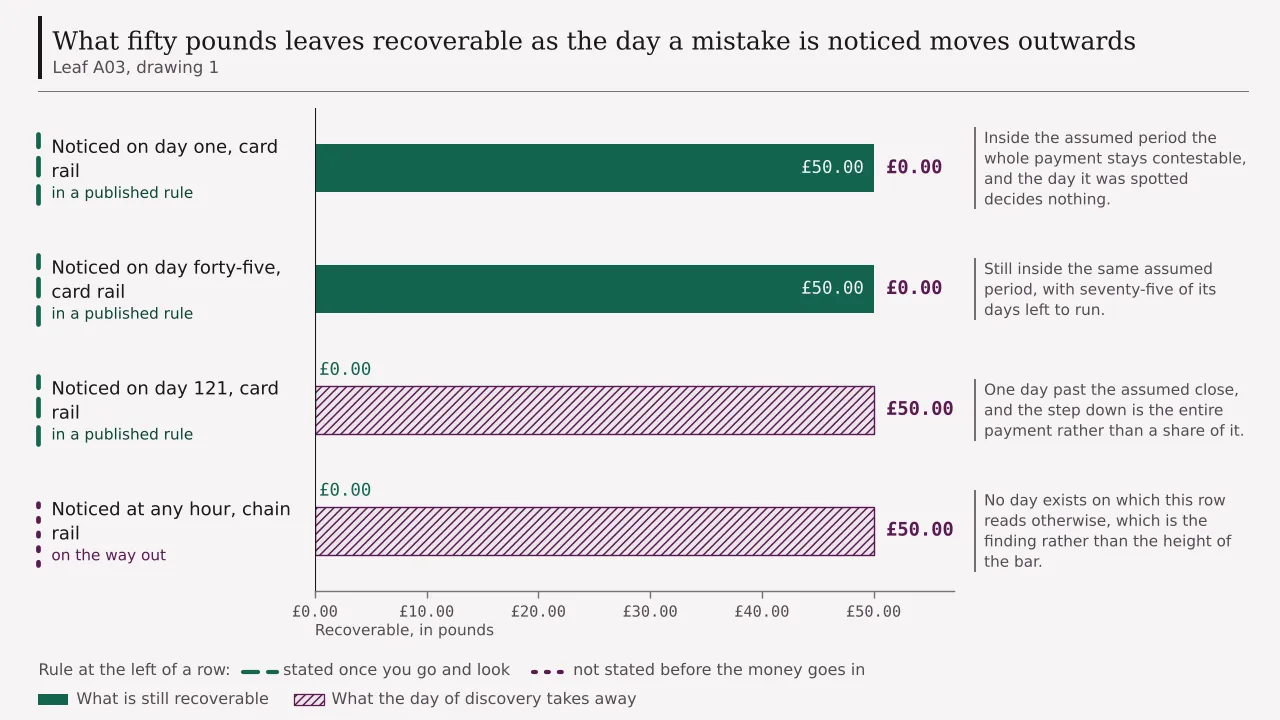
The ladder in that drawing says something a single pair of figures cannot. On an ordinary route the recoverable sum is a step function of one variable, the day the trouble is spotted, and a reader who notices early keeps everything while a reader who notices late keeps nothing. On a chain route the variable has been removed from the equation. There is no early. Noticing within one second of the confirming step produces the same answer as noticing in four years, and that flatness is the finding rather than the height of any individual bar.
4
The term in this chain that neither side wrote down
Pull apart everything that decides what £50.00 does between a reader’s hand and a balance, and each piece has an author. The percentage, the multiple and the window are drafted by whoever runs the offer. The sum sent, the moment of sending and the decision to send at all belong to the reader. The identity rules belong to a regulator where one exists. Sort the whole list by author and one line refuses to sit anywhere: whether the payment can be undone.
Neither party settles that. An operator cannot grant a reversal period on a public network, however willing, because the network has no facility for one and the operator has no authority over a confirmed transfer it did not send. A reader cannot reserve one, because nothing in the act of sending creates a right over the thing sent. The period’s existence is a property of the rail, fixed before either of them arrived, and that is what makes it structurally different from every clause in the written terms.
Follow the consequence through and it is sharper than it first looks. A condition granted by one party can be withdrawn by that party, negotiated with that party or complained about to that party. A condition granted by neither can be complained about to nobody. Choosing the rail is therefore not choosing a cheaper or quicker version of the same arrangement. It is removing a term from the arrangement, and removing a term neither side had the power to put there.
Nowhere else on this site does a term behave that way. A multiple of forty is in the written terms and was drafted by somebody. A floor on the smallest sum that will move is at the cashier and was drafted by somebody. A document check is on the way out and was drafted by somebody. The reversal period sits nowhere in writing on a chain rail, not because anybody suppressed it, but because the thing a clause would describe has no existence to describe.
Which cuts both ways, and the honest reading has to carry the other half. An operator on this rail genuinely cannot claw a paid-out balance back either. Finality is not a term pointed at the reader. It points at whoever is holding the money, whoever that is, in both directions equally. The asymmetry is not in the rule. It is in which direction the money usually travels and which party usually wants a payment undone, and on those two questions the record is not even close.
One British rule does speak to the undoing of a payment, and it points the other way. Under remote technical standard 14B a licensed system may put nothing in front of a customer that would retract a payout they have already asked for, and the guidance beside it adds that the requested sum may not come back as something to stake. So the single published British sentence on reversing a payment removes one, and removes it to keep somebody clear of their own second thoughts. Reversal of the sort priced here is not its subject, and the route priced here supports neither kind.
5
Why the finding arrives at the exit and not at the entrance
A fair objection to everything above is that none of it is secret. Finality is the advertised property of a public network and has been described in public since long before any offer used one. So why does this page sit in a section about conditions met leaving rather than in one about conditions met at a payment screen.
Because the test this section applies is not whether a fact is findable. It is whether a reader meets the fact at a point where it changes what they do. Finality on the way in costs nothing and feels like nothing: the payment leaves, the balance appears, and the property that will matter later has done no work at all. Nothing on the screen that takes the money has any occasion to mention it, because at that moment it is doing no harm to anybody.
The property becomes a live term at precisely one moment. Something has to go wrong with the leg out. A balance is refused, a condition surfaces that was not read, an account goes quiet, or a payment is sent to the wrong place. Only then does a reader go looking for the party who could put it back, and only then does the answer turn out to be that the list of such parties is empty. That is the structure of every page in this section: a term that existed the whole time and did nothing until the exit was attempted.
Which puts a figure on the timing itself. On the house arithmetic, £50.00 of credit at forty times asks for £2,000.00 to cross the reels, that being 40 multiplied by 50, and closes at an expected minus £30.00. Four pence in the pound, levied across forty turnovers, reaches 1.6 of the credit; subtract 1.6 from one and minus 0.6 is what remains, which on £50.00 gives the figure. Weighting is held at unity throughout. A reader reaches the exit, if they reach it at all, having already spent 20,000 presses getting there, and the term they are about to meet was fixed before the first of them.
Compare that with where the same term would sit on an ordinary route and the section assignment settles itself. On a card rail the reversal period is running from the moment of payment, visible in a statement, attached to a procedure a reader has probably used for something else. It is a live, usable thing on day one. On this rail it is a thing that does not exist, and the non-existence of something nobody has needed yet is indistinguishable, at the entrance, from its existence.
That indistinguishability is the whole cost. A reader is not deceived at the payment screen. They are simply in a position where two different states of the world look identical, and they go on looking identical for as long as nothing goes wrong, which on these figures is most of the time. The term reveals itself only in the branch where it is already too late to act on it.
6
A hundred and twenty days against fourteen hours of pressing
A period of cover is only useful if it outlasts whatever the reader is doing inside it, so the two lengths are worth setting side by side. The obligation first. At 10p a press, £2,000.00 of staking is 20,000 presses. A reel inside a British licence runs no quicker than one turn every 2.5 seconds, so twenty thousand turns occupy fifty thousand seconds at the very least, which is thirteen hours and fifty-three minutes with twenty seconds left over.
Now the cover. A hundred and twenty days, this leaf’s assumption throughout, is 10,368,000 seconds, being 120 multiplied by 86,400. Divide one by the other and the assumed scheme period covers the entire obligation 207.36 times over. A reader could work the whole clause through, twice a week, from the day of payment until the period closed, and still be inside it.
The same ratio can be reached without converting anything into seconds, which is the check that the figure is about the two lengths rather than about the arithmetic. Pegged at 2.5 seconds apiece, 10,368,000 seconds will carry 4,147,200 turns of a reel. Divide that by the 20,000 a forty times clause wants and 207.36 returns unchanged. Two routes, one counted in time and one counted in presses, arriving at the same multiple.
Two cautions attach to that fourteen hours. The pacing rule is a term of a British licence and reaches only a build holding one, so an offshore reel is held to nothing and may run the twenty thousand presses a good deal quicker, which shortens the obligation and widens the ratio instead of narrowing it. And nobody presses for fourteen hours on end, so the realistic elapsed stretch runs to days or weeks rather than hours. That is the comparison worth making, and it still sits well inside a hundred and twenty days.
| What is being measured | Where the length comes from | In seconds | In game cycles | Against the obligation |
|---|---|---|---|---|
| Staking a forty times clause asks for | House arithmetic on £50.00 | 50,000 | 20,000 | 1.00 |
| Assumed scheme period of 120 days | This leaf’s own assumption | 10,368,000 | 4,147,200 | 207.36 |
| Assumed recall period of 20 working days | This leaf’s own assumption | 2,419,200 | 967,680 | 48.38 |
| Confirmed settlement on a public network | A property of the rail | 0 | 0 | 0.00 |
Only the last row carries a nought, and that nought is not a rounding. Twenty working days is 2,419,200 seconds and covers the obligation 48.38 times. A hundred and twenty days covers it 207.36 times. Confirmed settlement covers it nought times, and would cover a one-press obligation nought times as well, because the quantity on the left is not small. It is absent, and absence does not scale.
What that buys an ordinary route is room to be slow. A reader on a card rail can take three months to notice, a fortnight to work out what happened and a week to write it down, and still be inside the assumed period. A reader on this rail has no such allowance to spend, which means the practical difference between the routes is not really about outcomes at all. It is about how much slowness a reader is permitted before the outcome becomes fixed.
7
British rules that fasten a length of time to a sum of money
Britain regulates money by tying periods to it, and that is the connection worth drawing here, because a period is exactly what a confirmed transfer has none of. One standard supplies three measures: a delay, a weekly sum and a menu of durations. A licence condition then removes a whole route on a date rather than timing it. And a charge follows the money across a border a licence does not cross, which makes it the only item of the group with any purchase on this market.
Start with the clearest. Under remote technical standard 12D a customer who wants a financial limit raised gets it only on asking, only once at least 24 hours of cooling off have gone by, and only after taking a fresh positive step at the end of that interval to say the request still stands. A reduction runs the other way and is put into effect at once. So a decision to spend more carries a minimum of 86,400 seconds of enforced delay, and a decision to spend less carries nought seconds. Direction decides the length, deliberately.
The same standard does arithmetic of its own, which is unusual in a rulebook and useful here. Where somebody sets limits that overlap, the tightest governs, so a worked case of ten pounds in a day standing beside a hundred in a week comes out at seven tens, which is £70.00 across the week rather than the £100.00 written. Durations of one day, of seven days and of one month must sit among those offered. Set the seven tens against the £50.00 of part three and the shape is plain, since a weekly ceiling there would have refused a second and a third payment of £50.00 in the same week before either left anybody’s hand. That is a protection acting while the money can still be got back.
Next, a date rather than a duration. Since 14 April 2020 a licence holder has been forbidden to settle gambling on credit, and the same bar swallows that payment where a money service business ferries it along. Read against part two that rule took out of the British market the very route carrying the widest cover, because a lending route that funds play was judged worse than its own procedure was worth. Neither party to a payment could have struck that balance. A regulator did.
Last, a charge following residence rather than licensing. Remote Gaming Duty reaches whatever a gaming provider makes where the player’s usual home lies in the United Kingdom, wherever the provider itself sits, and the rate stands at 40 per cent for gaming on or after the first day of April 2026, having been 21 per cent since the same date seven years earlier. A cashier sited abroad that takes money from a player living in Britain is thus within the reach of a British duty, licence or no licence. That is the single line in this part crossing the border, it attaches to a provider’s profit and not to anybody’s payment, and it shifts not one figure printed anywhere above.
An offer settled across a public network holds no Great Britain licence, so each of those lengths collapses and it is worth watching them go one at a time. The 24 hours owed before a limit may be raised becomes nought hours, and the asking and the raising happen in one breath. The seven tens that overlapping limits would have made become whatever a payment page will accept. The bar dated 14 April 2020 becomes no bar, which returns the lending route without returning its procedure, since a scheme does not follow a payment into a cashier it has nothing to do with. The nought that standard 14B sets on purpose stays at nought and stops being anybody’s choice. Only the duty charge still reaches, and it reaches a provider’s profit rather than a reader’s fifty pounds. The pattern underneath is that a British licence spends most of its effort putting time between a decision and its consequence, while the defining property of this route is that it puts none there at all.
Not a single item above is a promise about how a session turns out, and saying so matters because the opposite claim is the commonest thing written about this subject. Each is a statement about where a reader stands in relation to a sum that has stopped being theirs to direct, measured in hours, in pounds a week, or in a date. That is the same quantity parts three to six have been pricing, which is why this group belongs on this page and would sit awkwardly on most others.
8
A refusal to carry a payment is doing a job, not blocking one
A reader who meets a declined gambling payment at a bank, a card issuer or a network usually experiences it as an obstacle. It is better understood as the same kind of thing as everything part seven described: a decision taken by a party that is not the operator and not the reader, acting on money before it becomes irretrievable.
The British regulator records that consequence in its own words when it describes what follows from operating without a licence, where it notes that the large payment systems organisations are able to pull a business’s payment facilities, giving one card network by name as an instance. Service pulled in that fashion is not an inconvenience a bank thought up on its own. Of the consequences the regulator sets down, that is one, and it bites for the plain reason that a route with somebody standing on it can be shut from the middle.
Which supplies a sharp way of reading the whole page. A rail with a reversal period is a rail with somebody standing on it, and anybody standing on a rail can also decline to carry something. The two properties come together, because both are consequences of there being a party with discretion in the middle. A rail with no reversal period has nobody in the middle, so it declines nothing and recovers nothing, and those are not two facts but one fact described twice.
A reader who has set a block, registered with Gamstop Online or asked a bank to refuse gambling payments has deliberately put a party in the middle. Its own terms of use put the boundary plainly: the scheme reaches the gambling services of operators taking part in it, and cannot keep anybody away from services run by bodies sitting outside it. Membership follows from holding a British licence, so the protection stops exactly where the licence stops. That limit is a fact about the scheme’s reach, not an invitation, and anybody reading it as a map should go back to the first part of this page.
Put the two halves of this part together and the arithmetic of part three reads differently. The £50.00 was not priced as the cost of a mistake. It was priced as the value of having somebody in the middle, and the same somebody also carries the capacity to say no. A reader choosing a route is choosing both at once, in whichever direction, and no page can honestly offer one of the two without the other.
9
Payment in to payment out, assembled as one descending column
Everything priced so far stacks into one column, which is how this site reassembles a claim once it has been taken apart. The column starts with £50.00 chosen by a reader and ends with what the arithmetic supports, and each step carries the place its condition is settled at.
| Step | Where it is settled | Running figure | Recoverable if wrong |
|---|---|---|---|
| £50.00 chosen and sent | at the cashier | £50.00 | £0.00 |
| Confirmation on a public network | £50.00 | £0.00 | |
| Forty times applied to the credit | in the written terms | minus £30.00 | £0.00 |
| A review of unstated length before paying out | on the way out | Unchanged | £0.00 |
| The party who could undo any of it | nowhere in writing | None exists | £0.00 |
What the right-hand column does is this page’s subject, and no column anywhere else on the site behaves like it: the figure never moves. Elsewhere a quantity shrinks a step at a time as each condition lands. Here the second row sets it at nought and the rows underneath cannot touch it, which is what it means for a protection to be structural rather than contractual.
Scale the payment and that property shows itself. A multiple takes a fixed fraction of whatever it is applied to, so doubling a credit doubles the loss and halving it halves the loss. A floor takes everything below a threshold and nothing above it. A missing reversal period takes the entire face at every size at once, because the thing taken away is the way back to the whole sum and not a fraction of it.
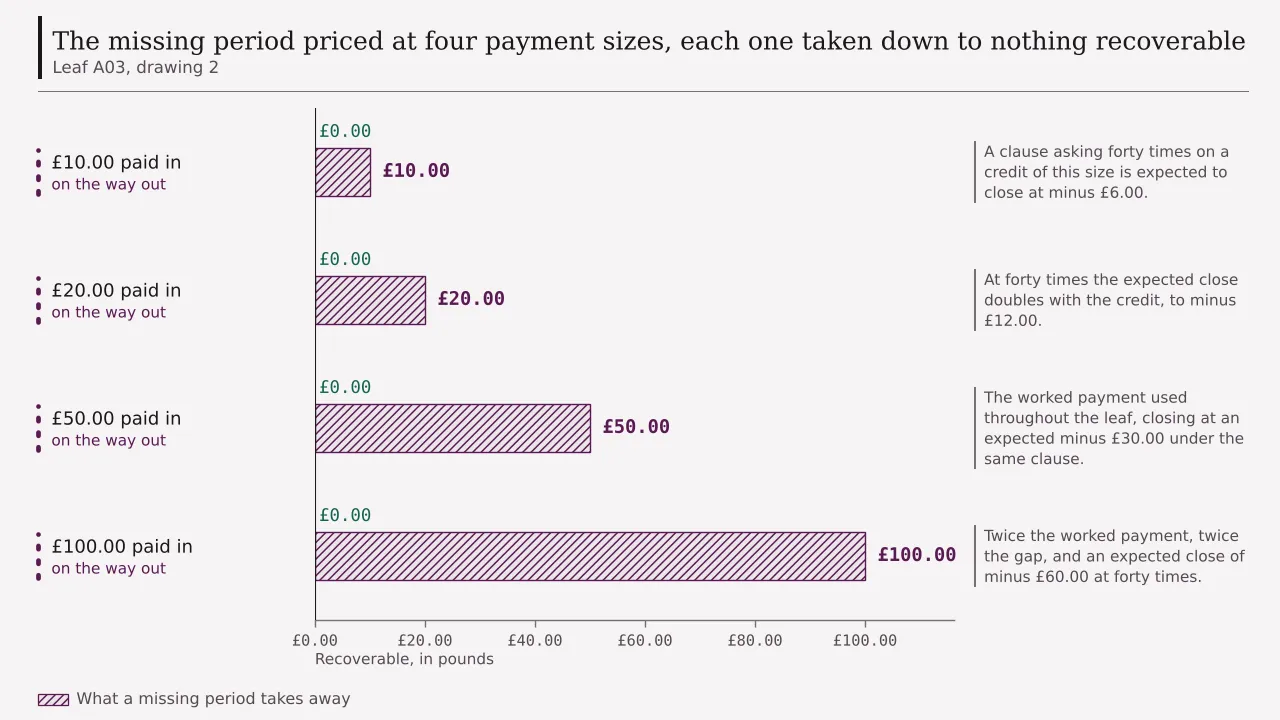
£100.00 paid in, read before anything applies £100.00 Recoverable once settlement is confirmed £0.00 The price of the period that is not there £100.00
Doubling the worked payment doubles the difference exactly, which no other term on this site does in a straight line. A forty times clause on £100.00 closes at an expected minus £60.00 and the gap it opens is £160.00, a figure built from a proportion. The gap here is £100.00 and is built from nothing except the size of the payment, so the two scale in unlike ways, and adding one to the other as a single quantity would misread the shape of both.
10
What can be settled before anything moves anywhere
The practical content of this leaf fits in a short sequence, and it is deliberately about the moment before a payment rather than about anything afterwards, because afterwards is the stretch that holds no instrument of any sort.
First, decide which property of the route actually matters to the decision being taken. Speed is the property every advertisement prints and the one that changes the least: the difference between ten minutes and a working day is a working day. Reversibility is the property no advertisement prints and the one that changes everything, because it decides whether a mistake has a forum or has nothing.
Second, write down the sum rather than the percentage. A reversal period’s value on a payment is the payment, in full, and no proportion of it. On £20.00 the missing period is worth £20.00. On £500.00 it is worth £500.00. That is the only quantity on this site that can be computed without opening a single document, since it needs no multiple, no return figure, no weighting and no floor.
Third, note that the two readings on this page never meet in the middle. Most pages here produce a stated figure, a smaller figure once a condition applies, and a sensible number in between for somebody who reads half the terms. Here a reader is in one of two states: a procedure exists or it does not. There is no partial period, no reduced period and no period that applies to some of the money.
Fourth, keep the direction of the finding straight. Nothing above says a payment on a public network goes wrong. It says that if one goes wrong, the set of parties who could put it right is empty, and that the emptiness is discovered by the small proportion of readers who reach an exit and meet trouble there. Most readers never test it, which is exactly why it never comes up at the payment screen.
Fifth, and against the whole grain of this leaf, the honest concession. Finality is a real feature and it protects somebody. A payment that cannot be reversed also cannot be reversed against the person who received it, so a reader who is paid out holds money that nobody can take back by procedure. That is worth something, and on the rails where a reversal period exists the person who most often loses by it is the merchant rather than the customer. The argument on this page is not that finality is bad. It is that finality is a term, it was settled by neither side, nobody states it before the money goes in, and its price is the whole of the payment.
Questions
- Can a payment made on a public network be reversed by anybody at all?
- No, at any time and by any party. Once settlement is confirmed there is no procedure to begin, no forum to begin it in and no decider standing over it, so the recoverable sum is £0.00 from the first second and stays £0.00 whatever happens afterwards. That is unlike a card scheme’s dispute procedure, a bank recall or a wallet’s own process, each of which runs for a period during which a party that is not the operator can act.
- What is a reversal period actually worth in pounds?
- On a worked payment of £50.00 it is worth £50.00, which is the whole face rather than a share of it. Read alone, a wrong £50.00 inside an assumed hundred and twenty day scheme period is £50.00 that might come back. Read once finality applies, the identical payment is £0.00 that might come back. The same figure arrives a second way: 41.67 pence of contestable value a day, multiplied by 120 days, is £50.00 again.
- Why is the absence of a reversal period a condition met on the way out?
- Because it does no work at the entrance. On the way in the payment leaves, a balance appears and finality changes nothing a reader can observe, so a payment screen has no occasion to mention it. The property becomes a live term only when a balance is refused, an account goes quiet or money reaches the wrong place, at which point the reader goes looking for the party who could put it back and finds that the list is empty.
- Who decides whether a payment route has a reversal period?
- Neither side of the arrangement, which is what makes it structurally different from every other term on this site. An operator cannot grant one on a public network because the network has no facility for it, and a reader cannot reserve one because sending creates no right over the thing sent. A multiple is drafted by somebody, a floor is drafted by somebody, a document check is drafted by somebody. This is settled by the rail before either party arrives.
- Does a British licence contain any rule about undoing a payment?
- One sentence, pointing the other way. Under remote technical standard 14B a licensed system may put nothing in front of a customer that would retract a payout already asked for, and the guidance beside it adds that the requested sum may not come back as something to stake. That removes a reversal in order to keep somebody clear of their own second thoughts. Reversal of a payment going in is not its subject, and this route supports neither kind.
- How long does the assumed cover run compared with working off a wagering clause?
- Far longer, on this leaf’s own assumptions. £50.00 of credit at forty times wants £2,000.00 of staking, which is 20,000 presses at 10p, and a reel inside a British licence runs no quicker than one turn every 2.5 seconds, so twenty thousand turns occupy fifty thousand seconds at the very least. A hundred and twenty days holds 10,368,000 seconds, so the assumed cover spans that obligation 207.36 times over. Counted in turns of a reel instead of in seconds, 207.36 returns unchanged.
- Which British rules fasten a length of time to a sum of money?
- One standard supplies three measures, a licence condition fixes a date, and a charge crosses a border. Standard 12D gives a customer wanting a limit raised a cooling interval of at least 24 hours, or 86,400 seconds, plus a fresh positive step at the end of it, while a reduction takes effect at once. The same standard turns ten pounds in a day standing beside a hundred in a week into seven tens, or £70.00 across the week. Licence condition 6.1.2 has forbidden the settling of gambling on credit since 14 April 2020. Standard 14B sets a length of nought on purpose. Remote Gaming Duty follows the player’s residence rather than the provider’s licence.
- What does a reader lose where an offer is settled across a public network?
- An offer settled that way holds no Great Britain licence, so every one of those lengths collapses. The 24 hours owed before a limit may be raised falls to nought hours, and asking and raising happen in one breath. The seven tens that overlapping limits would have produced become whatever a payment page will take. The bar dated 14 April 2020 becomes no bar, which brings the lending route back without bringing its procedure. Only the duty charge still reaches, and it reaches a provider’s profit rather than anybody’s fifty pounds.
- Is a bank or a network refusing to carry a gambling payment a protection?
- Yes, and of exactly the kind described above: a decision taken by a body that is neither the operator nor the reader, acting while the money can still be retrieved. The British regulator records that the large payment systems organisations are able to pull a business’s payment facilities where it operates unlicensed. A route carrying a reversal period is a route with somebody standing in the middle of it, and whoever stands there can decline to carry something as well. Those are one fact put two ways.
- Does finality ever work in a reader’s favour?
- Yes, and the page would be dishonest without the point. A payment that cannot be reversed also cannot be reversed against whoever received it, so money paid out to a reader cannot be taken back by any procedure. Where a reversal period exists, the party that most often loses by it is the business rather than the customer. The argument here is narrower: finality is a term, neither side settled it, nothing states it before the money goes in, and its price is the entire payment.
- Does the price of the missing period change with the size of the payment?
- It scales one for one, which no other term on this site does. A multiple takes a fixed fraction, so a forty times clause on £100.00 closes at an expected minus £60.00 and opens a gap of £160.00. A floor takes everything below a threshold and nothing above it. A missing reversal period takes £10.00 out of £10.00, £50.00 out of £50.00 and £100.00 out of £100.00, since the thing taken away is the way back to the whole sum and not a fraction of it.
- What can be settled before any payment is made?
- Which property of the route the decision actually turns on. Speed is printed on every advertisement and changes least, the difference between ten minutes and a working day being a working day. Reversibility is printed on none and changes everything, because it decides whether a mistake has a forum or has nothing. The sum at stake needs no multiple, no return figure, no weighting and no floor to compute: it is the payment, in full.