Terms read 19 October 2026 Leaf R01, revision 1
A phrase that asks for something no record contains, and the price of what the record would have held
Six months of registration with the national scheme buys at least 182 separate comparisons of one name against one list, which at 300 presses a day and 10p a press lifts an expected £218.40 of loss away. Beyond the British licence that same registration buys nil comparisons at no interval, and lifts away £0.00. This leaf prints both readings and subtracts.
Stated on the banner £0.00 What an advertisement of this shape settles about who was granted a permission, which is nothing at any price. Stated, once you go and look 182 comparisons What a six-month registration is worth where the licence reaches, at the daily cycle set out in the scheme’s own corporate history. Not stated before the money goes in Nothing, at no interval What occupies that position where no British licence stands behind an address, priced at £218.40 over one six-month period and at £2,191.20 over the longest the scheme sells.
Offers advertised from beyond the national scheme, with their written terms read
Every destination in this file is bought advertising. The site is paid a fee if a reader goes on to register, and no figure printed below moves because of it.
Bonus Spins UK Slip 01
Betportal
Ceiling as a multiple
The drop
€15.00
€1.00 in the euro
The claim reads €15.00. Once the terms beside it have applied, €0.00 of it can leave. The difference is the drop.
7 of the 15 terms on this slip could not be read before the money went in
Spins priced at this site's own 10p a spin, which the operator does not publish
Stated
€15.00
The claim as it is printed, before a single term has been applied to it.
Headline paid as spins
150 spins at 10c each, which is €15.00 of the figure above.
6 Nowhere
What one spin is worth
No unit is published for a spin, so the count is priced at this site's own 10p a spin. At half that price every figure below halves with it.
Match and other credit not priced
300% of three deposits, to a ceiling of €1,000. A share of a deposit nobody has made yet is not a sum, so no figure stands on this line and none is carried below.
Qualified
-€14.40
Written down somewhere, and taking part of the claim back. Each term carries the place it is written and the sum it takes.
2 Written terms at a distance this record does not establish
Play-through -€14.40
Carrying €14.40 through 35 times stakes €504.00 and costs €20.16 of it at 96 per cent return. That prices above the €14.40 there is to charge it against, so the whole of the credit goes and the line is held at that. The multiple sits on the bonus.
2 Written terms at a distance this record does not establish
Game weighting not priced
Slots only count towards the play-through. No contribution percentage is published, so the line above has been worked at full weight, which is the kindest reading there is.
2 Written terms at a distance this record does not establish
Ceiling on the winnings not priced
5x the bonus.
2 Written terms at a distance this record does not establish
Clock on the credit not priced
14 days.
2 Written terms at a distance this record does not establish
Largest stake while it runs not priced
€5.
3 Public record
Licence, and who holds it not priced
Licensed in Anjouan, Comoros, held by BetPortal Gaming Ltd, with Excite Ultra Media Ltd, reference ALSI-202601040-FI2. A register entry settles who holds a licence and what it permits. It does not settle who is running the site this morning.
4 Cashier
Smallest qualifying deposit your money
€20 a stage. That is €20.00 of your own money, and it is never netted into a drop.
5 On the way out
Checks before a withdrawal not priced
Documents before the first withdrawal.
Unstated
-€0.60
Applying without having been published anywhere, and costing money all the same.
6 Nowhere
What a spin hands back -€0.60
Staking a spin returns 96 per cent of it, so that share of the batch is the house's before a reel turns. This site works at that return and the operator publishes none where the claim is made.
6 Nowhere
Forfeited by rule cost unknown
Nothing is published under this heading, and it applies regardless.
6 Nowhere
Charge on the way out cost unknown
No charge on the way out is published as a figure, so nothing comes off this line. A charge that exists unpublished would come straight off whatever survives.
6 Nowhere
Smallest withdrawal allowed cost unknown
No smallest withdrawal is published as a figure. A floor nobody has published is still a floor, and it decides whether a small balance can move at all.
No Great Britain licence
Terms read 19 October 2026
Bonus Spins UK Slip 02
WinBeast
Ceiling as a sum
The drop
€50.00
€1.00 in the euro
The claim reads €50.00. Once the terms beside it have applied, €0.00 of it can leave. The difference is the drop.
8 of the 15 terms on this slip could not be read before the money went in
Spins priced at this site's own 10p a spin, which the operator does not publish
Stated
€50.00
The claim as it is printed, before a single term has been applied to it.
Headline paid as spins
500 spins at 10c each, which is €50.00 of the figure above.
6 Nowhere
What one spin is worth
No unit is published for a spin, so the count is priced at this site's own 10p a spin. At half that price every figure below halves with it.
Match and other credit not priced
50% to 100% of five deposits, each to a ceiling of €1,000, and a €650 free bet. A share of a deposit nobody has made yet is not a sum, so no figure stands on this line and none is carried below.
Qualified
-€48.00
Written down somewhere, and taking part of the claim back. Each term carries the place it is written and the sum it takes.
2 Written terms at a distance this record does not establish
Play-through -€48.00
Carrying €48.00 through 40 times stakes €1,920.00 and costs €76.80 of it at 96 per cent return. That prices above the €48.00 there is to charge it against, so the whole of the credit goes and the line is held at that. The multiple sits on the bonus and the winnings from the spins.
2 Written terms at a distance this record does not establish
Game weighting not priced
Slots, titles vary by country count towards the play-through. No contribution percentage is published, so the line above has been worked at full weight, which is the kindest reading there is.
2 Written terms at a distance this record does not establish
Ceiling on the winnings not priced
€100 a batch of spins.
2 Written terms at a distance this record does not establish
Clock on the credit not priced
7 days, spins 1 day.
3 Public record
Licence, and who holds it not priced
Licensed in Curaçao, holder not named on the site. A register entry settles who holds a licence and what it permits. It does not settle who is running the site this morning.
4 Cashier
Smallest qualifying deposit your money
€20 a stage. That is €20.00 of your own money, and it is never netted into a drop.
5 On the way out
Checks before a withdrawal not priced
Documents before the first withdrawal.
Unstated
-€2.00
Applying without having been published anywhere, and costing money all the same.
6 Nowhere
What a spin hands back -€2.00
Staking a spin returns 96 per cent of it, so that share of the batch is the house's before a reel turns. This site works at that return and the operator publishes none where the claim is made.
6 Nowhere
Largest stake while it runs cost unknown
Nothing is published under this heading, and it applies regardless.
6 Nowhere
Forfeited by rule cost unknown
Nothing is published under this heading, and it applies regardless.
6 Nowhere
Charge on the way out cost unknown
No charge on the way out is published as a figure, so nothing comes off this line. A charge that exists unpublished would come straight off whatever survives.
6 Nowhere
Smallest withdrawal allowed cost unknown
No smallest withdrawal is published as a figure. A floor nobody has published is still a floor, and it decides whether a small balance can move at all.
No Great Britain licence
Terms read 19 October 2026
Bonus Spins UK Slip 03
EliteSpin
Longest spin window
The drop
£50.00
£1.00 in the pound
The claim reads £50.00. Once the terms beside it have applied, £0.00 of it can leave. The difference is the drop.
8 of the 15 terms on this slip could not be read before the money went in
Spins priced at this site's own 10p a spin, which the operator does not publish
Stated
£50.00
The claim as it is printed, before a single term has been applied to it.
Headline paid as spins
500 spins at 10p each, which is £50.00 of the figure above.
6 Nowhere
What one spin is worth
No unit is published for a spin, so the count is priced at this site's own 10p a spin. At half that price every figure below halves with it.
Match and other credit not priced
50% to 100% of five deposits, each to a ceiling of £1,000. A share of a deposit nobody has made yet is not a sum, so no figure stands on this line and none is carried below.
Qualified
-£48.00
Written down somewhere, and taking part of the claim back. Each term carries the place it is written and the sum it takes.
2 Written terms at a distance this record does not establish
Play-through -£48.00
Carrying £48.00 through 40 times stakes £1,920.00 and costs £76.80 of it at 96 per cent return. That prices above the £48.00 there is to charge it against, so the whole of the credit goes and the line is held at that. The multiple sits on the bonus and the winnings from the spins.
2 Written terms at a distance this record does not establish
Game weighting not priced
Slots count towards the play-through. No contribution percentage is published, so the line above has been worked at full weight, which is the kindest reading there is.
2 Written terms at a distance this record does not establish
Ceiling on the winnings not priced
5x the bonus.
2 Written terms at a distance this record does not establish
Clock on the credit not priced
7 days, spins 3 days.
3 Public record
Licence, and who holds it not priced
Licensed in Costa Rica, held by PrimeTier Limited. A register entry settles who holds a licence and what it permits. It does not settle who is running the site this morning.
4 Cashier
Smallest qualifying deposit your money
£20 a stage. That is £20.00 of your own money, and it is never netted into a drop.
5 On the way out
Checks before a withdrawal not priced
Documents before the first withdrawal.
Unstated
-£2.00
Applying without having been published anywhere, and costing money all the same.
6 Nowhere
What a spin hands back -£2.00
Staking a spin returns 96 per cent of it, so that share of the batch is the house's before a reel turns. This site works at that return and the operator publishes none where the claim is made.
6 Nowhere
Largest stake while it runs cost unknown
Nothing is published under this heading, and it applies regardless.
6 Nowhere
Forfeited by rule cost unknown
Nothing is published under this heading, and it applies regardless.
6 Nowhere
Charge on the way out cost unknown
No charge on the way out is published as a figure, so nothing comes off this line. A charge that exists unpublished would come straight off whatever survives.
6 Nowhere
Smallest withdrawal allowed cost unknown
No smallest withdrawal is published as a figure. A floor nobody has published is still a floor, and it decides whether a small balance can move at all.
No Great Britain licence
Terms read 19 October 2026
Bonus Spins UK Slip 04
Crown Jewelz
Multiple unpublished
The drop
NOT WORKED
The multiple is not published in the operator's own terms. Since the sum cannot be worked around it, none is worked.
9 of the 14 terms on this slip could not be read before the money went in
No drop worked
Stated
£15.00
The claim as it is printed, before a single term has been applied to it.
Headline paid as spins
150 spins at 10p each, which is £15.00 of the figure above.
6 Nowhere
What one spin is worth
No unit is published for a spin, so the count is priced at this site's own 10p a spin. At half that price every figure below halves with it.
Match and other credit not priced
200% of the first deposit, then 150% twice, each to a ceiling of £1,000. A share of a deposit nobody has made yet is not a sum, so no figure stands on this line and none is carried below.
Qualified
NOT WORKED
Written down somewhere, and taking part of the claim back. Each term carries the place it is written and the sum it takes.
2 Written terms at a distance this record does not establish
Play-through not priced
40x the bonus, reported rather than published by the operator.
2 Written terms at a distance this record does not establish
Game weighting not priced
Slots count towards the play-through. No contribution percentage is published, so the line above has been worked at full weight, which is the kindest reading there is.
3 Public record
Licence, and who holds it not priced
Licensed in Curaçao, number not verified, holder not named on the site. A register entry settles who holds a licence and what it permits. It does not settle who is running the site this morning.
4 Cashier
Smallest qualifying deposit your money
£20. That is £20.00 of your own money, and it is never netted into a drop.
5 On the way out
Checks before a withdrawal not priced
Documents before the first withdrawal.
Unstated
NOT WORKED
Applying without having been published anywhere, and costing money all the same.
6 Nowhere
Ceiling on the winnings cost unknown
No ceiling is published. Nothing is assumed in its place.
6 Nowhere
Clock on the credit cost unknown
Nothing is published under this heading, and it applies regardless.
6 Nowhere
Largest stake while it runs cost unknown
Nothing is published under this heading, and it applies regardless.
6 Nowhere
Forfeited by rule cost unknown
Nothing is published under this heading, and it applies regardless.
6 Nowhere
Charge on the way out cost unknown
No charge on the way out is published as a figure, so nothing comes off this line. A charge that exists unpublished would come straight off whatever survives.
6 Nowhere
Smallest withdrawal allowed cost unknown
No smallest withdrawal is published as a figure. A floor nobody has published is still a floor, and it decides whether a small balance can move at all.
No Great Britain licence
Terms read 19 October 2026
Every figure in the second and third columns is this site's own working and nothing an operator has published. A claim is priced as printed, then the share a spin hands back at 96 per cent return comes off it, then what playing the multiple through costs at the same return, and then whatever a published ceiling, a charge on the way out or a floor on the smallest withdrawal takes from what has survived. The drop is the difference between the first figure and the last. The two columns add back up to it exactly, so no money leaves a slip without a term and a place beside it.
Which column a term falls in is settled by one question: has anybody written it down. A charge a reader meets at the payment screen is written down, and it stands in the second column with the cashier against it. A condition that binds without ever having been set down stands in the third, whatever it costs. Inside each column the terms run outwards from the banner, so the order itself says how far a reader would have had to go.
A count of spins has no unit until one is supplied. Where an operator publishes what one of its own spins is worth, that figure is used and the first column says it is theirs. Where none is published, this site's own 10p a spin stands in its place and every figure below moves in proportion with it. Where the multiple itself is unpublished, no drop is worked at all, because that is the one figure the sum cannot be done without.
Three words stand where a figure cannot. Not priced is a term that is written down and carries no number the arithmetic can take. Cost unknown is a term nobody has written down, costing something nobody has put a number on. Your money is money of the reader's own, which is never netted into a drop.
None of the operators in this file holds a Great Britain licence, so none of the duties that licence carries reaches them. Each of those duties is published in its own right, which is what makes its absence here something a reader can check rather than take on trust. Every gambling company licensed in Great Britain belongs to Gamstop Online, so a reader who has shut themselves out through the scheme is not shut out here. Social Responsibility Code 5.1.1 has held a play-through to a maximum of ten times the bonus funds since 19 January 2026, and it binds a licence holder and nobody else. Asked in a post of 21 October 2025 what is lost along with the licence, the Gambling Commission's Director of Enforcement and Intelligence answered: "unfair gaming practices, financial loss, and a lack of recourse if things go wrong". The same post puts blocked payouts, and withdrawal limits pitched high enough to be unreachable, among the behaviour the Commission has recorded. Nobody under 18 may hold an account at any of them.
Terms are reproduced in the wording their operator published, and each slip is dated with the day somebody sat down and read them. 19 October 2026 is the oldest of those dates. Anybody claiming an offer is bound by that operator's full terms, which are elsewhere, and never by a line standing here.
1
A search that names a record and then asks what is missing from it
£218.40 is where this leaf finishes, so it may as well open there. That sum is the expected loss a six-month registration with the national scheme lifts away from a reader inside the British licence, worked at 300 presses a day, 10p a press, and 96 pence handed back out of every pound staked. Those three quantities are this leaf’s own assumptions and get labelled again in every sentence that spends them. Beyond that licence the identical registration lifts away £0.00, there being no obligation out there to compare anybody against anything at any frequency whatsoever.
Support belongs at the top rather than at the foot, because a share of the people who reach a phrase like this one have already settled something about their own gambling and are now in the middle of unsettling it. Speaking to somebody costs nothing and stays private: GamCare keeps the National Gambling Helpline staffed at every hour of the year, free, on 0808 8020 133. Written routes run through GamCare.org.uk and BeGambleAware.org for anybody who would rather not telephone. Blocking software has a British route that costs nothing, published not by the software house but by GamCare, under an arrangement pairing the conversation, the blocking and the registration. Its only primary source is dated to the twelfth of April in 2021 and fixes no span for the free access at all, so neither does this leaf. The software house’s own pages offer seven days on trial and name no free British route anywhere, which is precisely why the free one is worth knowing by name.
The scheme is blunt about where its own protection stops, and reading that sentence beats discovering it. Its terms of use, last revised 20 May 2026, say that it can shut off gambling services run by the operators taking part, and that services from organisations outside the arrangement are beyond what it can prevent anybody reaching. That is a limit on a protection rather than a hole in a product. Somebody who registered in order to be stopped should read an offer outside the arrangement as something the registration was never built to stop, and the routes in the paragraph above are better placed to help than a sign-up form is.
Not everybody arriving here has registered. Some readers want a market outside Britain for reasons unconnected with any scheme, and the honest position is that both groups reach the same words and get the same results back. This leaf therefore does the one thing that serves both at once: it reconstructs what the public record would have held, what the scheme’s machinery would have done on finding it, and what each of those is worth in pounds. A reader of the first kind gets a price on something they already own. A reader of the second kind gets a price on something about to be given up.
The subject is unusual for this site because the thing being priced is printed in no document anywhere. Most leaves on this domain measure how far a condition sits from the claim that needs it. Here the claim is the missing entry itself, so there is no clause to walk to, no document to open and no payment screen to reach. What stands in their place is a question with a yes and a no in it, and the no is the whole of the answer a reader receives.
So the method changes shape. Instead of opening documents, this leaf rebuilds the contents of the row that is not there: what would have been recorded in it, who would then have been obliged to do what, and how often. Each rebuilt item then gets a figure in pounds set beside it. That is the only honest way to price an absence, since an absence has no text of its own to quote.
2
Who decides whether an operator belongs to the national scheme
The answer is short, and it is not the operator. Belonging follows from holding a British operating licence. The scheme’s help centre puts the rule in a line, which is that a British licence to gamble online makes taking part compulsory. Nobody joins for the look of it and nobody leaves for commercial convenience. Membership is settled in the public register, by whether a licence exists, and by nothing else at all.
That single fact is why a phrase built around the scheme is in truth a phrase about licensing. A reader asking which addresses sit outside the arrangement is asking, without intending to, which addresses hold no British permission. One line draws both sets, and an operator cannot stand on one side of it for the register and on the other for the scheme.
The scheme’s own corporate history supplies three dates, and they read better as a sequence than as a founding story. June 2017: the arrangement comes into being, built by the Remote Gambling Association on a request from the regulator and from the department then holding culture and media. March 2020: it stops being optional for anybody taking business from British residents, by becoming a condition of their licences and sitting alongside whatever schemes those operators already ran themselves. April 2020: the condition acquires a frequency, and the frequency is the quantity part three of this leaf turns into money.
The naming has moved too, so a reader searching will meet two forms of it. November 2025 brought a refreshed identity, Gamstop Online, together with a new website, replacing a form written in capitals that most search phrases still use. The company behind the arrangement carries 10504973 as its number, and a registered name that spells out the function: national, online, self-exclusion, scheme. A reader who wants to know who sits at the far end of a registration can establish it from a public source, free, before committing anything.
One distinction belongs here before anybody leans on a registration further than it reaches. Shutting online accounts and shutting access to betting shops are two different arrangements, the shop-facing one having been founded in 2016 as a multi-operator scheme and joined this group only in July 2023. Asking for one does not deliver the other, and anybody wanting both has to ask twice.
Put the structure together and it is unusually clean for this subject. Taking part is compulsory and is decided by a licence; the licence is recorded in a public register; the register costs nothing to search. Those are three facts, each checkable before an account exists, and between them they settle whether the arrangement reaches an address at all. Everything after this part is the price of that answer coming back negative.
3
Once a day, against the whole list, and what sits there instead
April 2020 gave the obligation a clock. From that month, an operator has had to match its whole customer base against the registrations the scheme holds, no less often than every 24 hours, which the corporate history states in those terms. Two words carry the weight. Whole rules out sampling, so a registration bites on an account opened years earlier and long forgotten. No less often makes 24 hours a ceiling on the gap rather than a target to aim at, so a quicker cycle satisfies the duty and a slower one breaches it.
Count the cycle across a registration and it turns into an ordinary quantity. The periods sold at registration are six months, twelve months, sixty months, or sixty months renewing themselves unless somebody intervenes in the final six. A registration also cannot be cut short: the terms of use say, in capitals of their own, that nobody may switch one off until its minimum period has expired. Six months taken as 182 days is therefore at least 182 comparisons. Twelve months is at least 365. Sixty months, taken as 1,826 days to allow for a leap year, is at least 1,826.
Now ask what occupies that same position where no British licence stands behind an address. The answer is not a looser cycle, not a monthly one and not a voluntary one. No duty means no frequency, and no frequency means there is nothing for an interval to be an interval of. A reader accustomed to thinking about protection in degrees has to notice that this one carries no degrees whatever.
| What needs settling | Which place settles it | What comes back |
|---|---|---|
| Whether an operator has to take part | in the public register | A licence, or no licence |
| How often a customer base gets compared | in the scheme’s own history | No less often than every 24 hours |
| How long a registration runs for | in the terms of use | Six, twelve or sixty months |
| Whether it can be cut short | in the terms of use | Not before the minimum expires |
| Which routes money may leave by | at the cashier | Nothing about any of this |
| Which papers get demanded before payment | on the way out | Nothing about any of this |
| The comparison frequency beyond the licence | nowhere in writing | No duty, therefore no interval |
Two of those rows are there to be ruled out rather than read. Neither a payment screen nor a demand for papers has anything to say about a national list of registrations, and a reader assuming that an identity check at the exit would catch somebody excluded has run two pieces of machinery together. One compares a customer base against names held elsewhere. The other confirms that somebody is the person they say they are. Clearing the second tells nobody anything about the first.
The bottom row is the one this leaf prices. It is not a term, it is not a clause, and it has no address, which is exactly why it drops out of any comparison made by reading documents. An obligation that does not exist writes nothing down, so a reader setting two offers side by side will never catch it missing. Absence is not a sentence.
4
Turning an interval into pounds, by two routes that have to agree
An interval is not money until something is hung on it, so hang the smallest honest thing: one day of ordinary play. Take 300 presses in a day at 10p each. That is £30.00 crossing the reels, and 96 pence in every pound staked comes back, so the expected sum returning is £28.80 and one day of it costs an expected £1.20. Press count, press value and return are all assumptions of this leaf’s own, declared here and carried unaltered through every figure below.
A comparison that shuts an account removes a day of exactly that kind. A six-month registration contains at least 182 of them, and 182 lots of £1.20 come to £218.40. That is the first route.
The second route never mentions a day. Three hundred presses repeated over 182 days is 54,600 presses. At 10p apiece that is £5,460.00 crossing the reels, and the margin keeps four hundredths of whatever crosses it, which on £5,460.00 is £218.40. The two routes share no step except the three assumptions, and they agree to the penny. They have to, since the margin takes a fixed share of the turnover however the arithmetic is grouped.
What six months of registration lifts away inside the licence £218.40 What it lifts away where no licence stands behind the address £0.00 The price of the missing entry £218.40
A difference equal to the whole of the first figure is unusual on this site, and it is not a slip. Most subtractions on these leaves shrink a number, because a written condition takes a share of a stated figure. This one empties it, because what has been removed is the condition that produced the figure to begin with. A duty nobody holds has no partial version.
| Period chosen at registration | Days it runs | Comparisons, at the very least | Turnover taken out | Expected loss taken out |
|---|---|---|---|---|
| Six months | 182 | 182 | £5,460.00 | £218.40 |
| Twelve months | 365 | 365 | £10,950.00 | £438.00 |
| Sixty months | 1,826 | 1,826 | £54,780.00 | £2,191.20 |
| Beyond the British licence | Any | None | £0.00 | £0.00 |
£218.40 of expected loss resting on a comparison the person protected by it never pays for
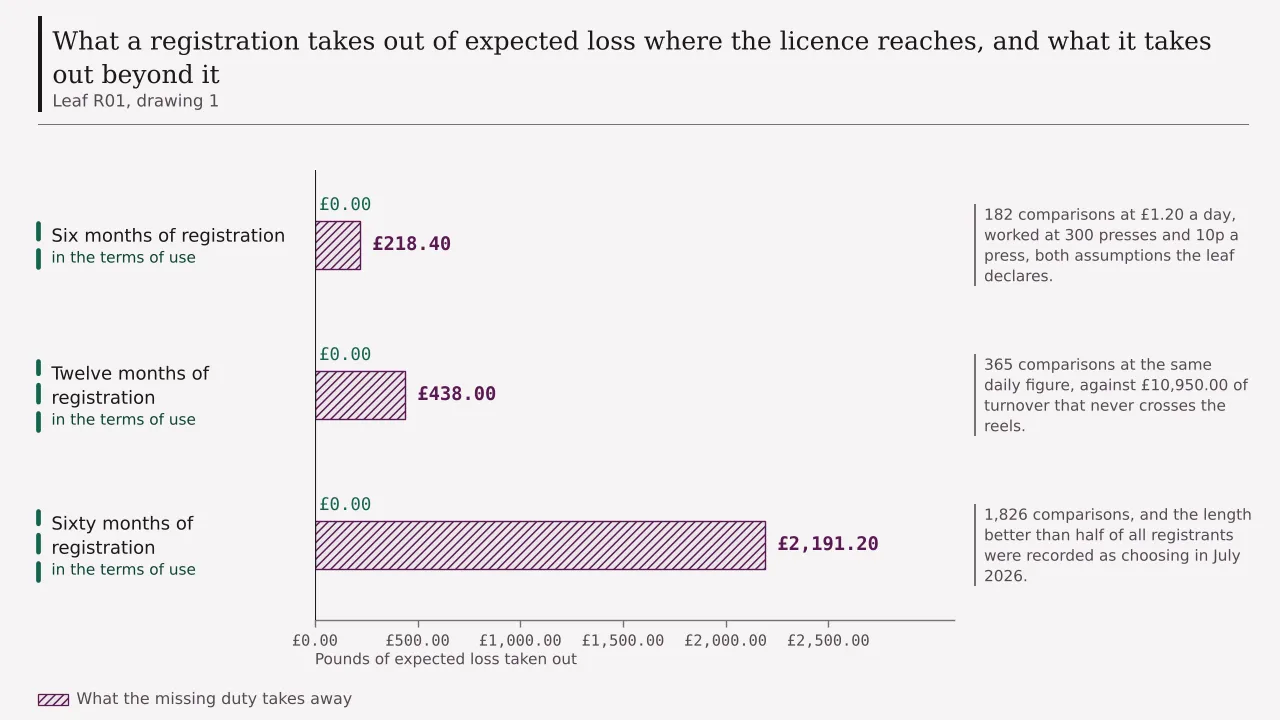
Scale the arithmetic either way and only the size moves. A reader pressing half as often halves every entry in that table; a reader pressing at 20p doubles them. What no rescaling touches is the shape, which is a positive quantity on one side of a licensing boundary and an exact nought on the other, with nothing between the two for a careful reader to aim at.
5
One row of a public record, and the single question it answers
What the British regulator actually publishes is four things, and only the first is the business list everybody means by the word: businesses, the individuals holding personal licences, premises, and a record of regulatory actions, with public statements and answers to freedom of information requests alongside. Any of the first three can be searched where it stands or taken away whole. None of it costs money, needs an account or wants a name, which makes it the one place in this subject whose wording the described business had no hand in.
A row in the business list fixes two things and then stops. It fixes who was granted a permission, and it fixes the activities that permission runs to. Whether the party taking a payment at a web address this morning is that same holder is not a question the row undertakes to answer, and the register page carries no note telling anybody how a domain written against a licence ought to be read. So a search coming back empty has established that nothing was granted under the name searched, and a search coming back full has established rather less than most readers take from it.
The regulator does say what to do with an entry once found. Its guidance to players asks for four checks, each of them free: that a licence is held, that the status shown on the site says so, that a click arrives at the register, and that the activities and the domain names on the site agree with the entry. That guidance carries two dates, 20 September 2020 when it went up and 23 August 2021 when it was last revised, and a page leaning on it ought to print both. The same page states plainly that gambling offered without a Commission licence is illegal, and names a consequence landing on the business rather than on anybody else: the large payment systems organisations may withdraw its means of taking payment.
Set beside this leaf’s arithmetic, the record shifts none of the figures and decides every one of them. £1.20 a day is £1.20 a day whether a row turns up or not. £218.40 over six months is that sum either way. What the row decides is whether the comparison removing those days happens at all, so the register behaves as a switch and not as a term, making it the only quantity anywhere in this subtraction with exactly two values.
One asymmetry deserves printing on its own. A reader can run the search before opening an account, before surrendering a name and before any money moves, which puts it at nought units of commitment. Everything else priced on this leaf sits behind at least one decision already taken. Nothing else in this subject costs nothing, takes one search and comes back with a definite answer, and it is open to somebody who intends to do nothing further at all.
No date appears on the register page itself, and no instructions appear there for reading what it shows, which is why a page using it has to publish the day it looked. This leaf prints that day at the head and at the foot. Anything read beyond the plain content of a row is the reader’s own inference rather than the regulator’s publication, and this leaf draws none.
6
Why a superlative will not fasten onto a missing entry
The phrase a reader types carries a superlative in it, and the superlative is the part that cannot be honoured. A superlative is a claim about an ordering, and an ordering needs a field whose members differ by some measurable quantity. The property on offer in this phrase is a missing licence entry, which has no magnitude: an entry is there or it is not, and two addresses lacking one are not ordered by how absent their entries are.
That would be a merely verbal objection if the other measurable quantities survived, and the point of this part is that they do not. What could order a field of gambling businesses with any rigour is exactly what a licence record carries: the identity of the holder, the activities permitted, the domains written against it, the date the permission began, and the published history of regulatory action taken against the holder. Every one of those is published by the regulator whose record the field has been defined by standing outside. Take the record away and the ordering loses not one of its columns but the lot at once.
What remains to order by is material written by the party being ordered. A reader can compare advertised figures, advertised multiples and advertised payout times, all of them settled and in no second place. Each of those is a claim rather than a measurement; each was drafted by whoever benefits from how it reads; and none can be checked against anything. An ordering built on that is an ordering of advertisements, which is a real thing to measure and is not what the superlative in this phrase is taken to promise.
This publisher therefore prints no score of its own anywhere on this domain. A number invented by a site whose whole argument is that uncheckable figures are worth less than checkable ones would be the worst sentence it could publish, and the temptation to produce one bites hardest precisely where the checkable material has run out. Where this leaf has nothing to measure it says so, and prints the arithmetic it does have.
Five orderable quantities, every one of them published by the record this phrase is defined by standing outside
An honest question sits underneath the superlative and deserves separating out. A reader may be asking which conditions an offer of this kind usually carries, how those conditions price out, and what somebody gives up by accepting them. Those are answerable, and this leaf answers them. The unanswerable version is the one asking for a ranked field, since the field was defined by deleting every published column that could rank it.
7
The protection a reader paid for before arriving at this phrase
A registration is not a setting. Three of its properties read as rules rather than as features, and all three are in the terms of use. It does not finish early: deactivation is unavailable before the minimum period has run. It does not finish by itself, since nothing lifts automatically when that period ends, and doing nothing extends the exclusion by as much as seven further years. And it does not finish quickly: ending one means contacting the scheme itself, then sitting out a day at minimum while the exclusion stays live. A seven-year tail follows, during which operators learn that this person excluded themselves once, while carrying no duty at all to shut them out.
So what a reader already owns, on arriving at this phrase, is a decision built not to be undone in an afternoon. Pricing it beats arguing about it. At this leaf’s daily figure of £1.20, six months of that decision is £218.40 of expected loss taken out, twelve months is £438.00, and sixty months is £2,191.20. None of those is an estimate of harm and none is a saving in the ordinary sense. They are the expected cost of the days the comparison removes, at the three assumptions carried down from part four.
The scheme’s own published figures for 2026 give the size of the decision and its shape. 614,738 consumers stood registered on 16 July 2026. Growth across the first half of that year came to 16 per cent, with the busiest single month on record, May 2026, bringing in 12,236. Better than half of the 614,738 took the longest single period, priced two paragraphs up at £2,191.20 each. A quarter took the shortest. Among people under 25 the shortest period takes 38 per cent, that age group having grown by 26 per cent over a year and now standing at close to a third of everybody registered.
The two figures sit awkwardly together and the awkwardness is the finding. A six-month choice buys the smallest of the three sums and is the commonest choice among the youngest registrants, who are also the fastest-growing group. A phrase promising places beyond the arrangement is, for somebody in that position, a phrase promising to undo £218.40 of a decision they could not undo by asking.
A second thing being given up has no figure attached and belongs here anyway. One act of registering reaches every operator licensed in Britain. Nothing outside that licence behaves the same way, because the reach was never a property of the registration at all: it was a property of the licence condition standing behind it. Anybody relying on a single registration to cover an address that no British licence stands behind is relying on a reach the scheme has already denied in writing.
If any of that is landing uncomfortably, the routes named in part one are the ones worth taking rather than the form at the end of an advertisement. The helpline answers at every hour, the blocking software has a free British route published by GamCare, and both are open to somebody who has decided nothing yet.
8
Duties that look at a person rather than at a product
Offers reached through this phrase hold no Great Britain licence. Where the subject is a register of people, the duties worth naming point at a customer and not at a game. Each is a duty to examine the same person more than once, and each leaves with the licence that imposed it.
Four duties of that kind. A comparison of the whole customer base against national registrations no less often than every 24 hours, running since April 2020. Identity obtained and checked before any gambling begins, which licence condition 17.1.1 requires, putting three items in front of the first press rather than behind it. The same front-loading extended to play funded by an incentive and to demonstration versions of games, so that nothing can be tried first and identified afterwards. And a financial check of the light-touch kind, once net deposits in a month cross a threshold. No duty in that group binds anybody at an address holding no British permission, and the loss is not a weaker version of each one: it is the removal of any obligation to look twice.
The first of those four is what part four already priced, at £1.20 a day and £218.40 over six months. The second is what makes the first possible, and the connection gets drawn far too rarely. A comparison against a list of names is worth no more than the names are, so a regime permitting an account under an unchecked identity has an exclusion list with nothing reliable to match against. Checking who somebody is before play, and comparing the customer base against registrations, are two halves of one mechanism; disable either and both stop working.
The three items condition 17.1.1 puts in front of the first press are what a customer is called, where a letter would reach them, and when they were born. The information has to be obtained and verified, and gambling may not begin until it is. The same condition also shuts the far end of the process, so nothing a reasonable licensee would have sought at the start may be demanded at the moment of a withdrawal request.
Extending that to play which costs the customer nothing is the half bearing directly on offers of this kind. The regulator’s announcement of the current regime carries the age check across to a bonus or a free bet, and then further again to the demonstration versions of games sitting on a licensee’s site. The announcement is dated 7 February 2019, commences the rules on 7 May and prints no year at all, so 2019 is what its own date leaves available rather than what its text states. Before that regime, 72 hours of grace ran from registration for finishing an age check, and the grace is gone.
The fourth duty measures a person against a threshold instead of against a list. In this leaf’s units, £150 a month of net deposits is 1,500 presses at 10p, which is five days of the 300-press day costed in part four. Crossing that figure sets off a light-touch financial check on an online customer. The threshold has moved once: a month’s net deposits of £500 from 30 August 2024, and £150 once 28 February 2025 came round, which in presses is a fall from 5,000 to 1,500. Heavier assessments behind it remain a pilot with no live environment to run in, and the regulator records that neither exercise reaches a consumer’s credit rating.
What the regulator publishes about the far side of that line is worth carrying in figures rather than in adjectives. A industry warning notice carrying 20 January 2025 lists what an unlicensed website may be short of, which is control over money laundering and over social responsibility, and then what its customers are left open to, which is fraud, unfair practice and trouble over data privacy. It finishes by naming who such websites often go after, and the example given is somebody who has registered with the national scheme already. That is a published regulatory finding about who the traffic behind this phrase is worth something to, and it is not a figure this leaf invented.
9
What a missing row does not establish, stated carefully
A leaf pricing an absence has to be as careful about what the absence fails to prove as about what it proves, or it stops being arithmetic and turns into advertising pointed the other way. Four things do not follow from an empty search, and they are worth separating out.
The first concerns the reader’s own position. Section 33 of the 2005 Act describes a provider and nobody else. Supplying facilities for gambling without the licence that authorises them, and without running the activity under that licence’s terms, is what the section makes an offence of; the penalty attached reaches 51 weeks inside, or a fine at the fifth level of the standard scale, or both at once, and in Scotland those 51 weeks are read as six months. No partner offence exists for the person placing the bet, the Act simply not creating one. Read that as a statement about liberty rather than about safety, since everything priced above is protection rather than prosecution.
The second concerns money leaving the country, and it runs the opposite way from what most readers expect. Remote Gaming Duty attaches by reference to a customer’s usual residence, and not to the place an operator is licensed, so money taken from somebody who normally lives here falls inside the charge wherever the operator sits. The rate stands at 40 per cent of a provider’s profits from 1 April 2026 onwards, where 21 per cent applied before, and the charge is computed on stakes taken in less winnings handed back. The guidance addresses the operator throughout and sets out no charge on the player anywhere.
The third concerns the player’s own tax position, which HMRC’s manual settles by absence instead of by any charging provision. Gambling, taken by itself, is not a trade, so no trading income arises for a charge to fasten on, and the case law behind that position holds that running a system or living off the proceeds makes no difference to it. The honest formulation is the one just given. It is not that any page anywhere declares winnings free of tax, and nobody should print the second as though it were the first.
The fourth concerns scale, and it cuts against over-confidence in either direction. A post of 21 October 2025, signed by whoever directs enforcement and intelligence for the regulator, names what tends to be missing where no licence is held: checks on age, tools for safer gambling, and secure payment. It names two failure modes at the exit, payouts blocked and withdrawal ceilings pitched too high to be reached, and it records serious concern about data protection. Two of its sentences are worth keeping together. Traffic to 160 websites picked out for enforcement is recorded as falling by 32 per cent, and the same post says the sums of revenue at stake make a complete dismantling of that ecosystem unlikely.
Putting the four together gives the careful version of this leaf’s finding. An empty search does not make a reader an offender, does not put the money beyond British duty, and does not alter HMRC’s published position on trading. What it does is remove a set of obligations owed to the reader, and the one measured on this leaf runs no less often than every 24 hours against a list the reader asked to be put on.
10
Running the same subtraction against any record that holds nothing
The method in parts two to four repeats against any protection defined by a list, and it needs none of the assumptions used above. Name the obligation. Find its frequency. Multiply the frequency by the expected cost of whatever the obligation interrupts. Write the same figure for the case where no obligation exists, which is always nought, and subtract.
Naming the obligation is the hard step, because protections get described by their effect rather than by their mechanism. A reader told that registering shuts accounts across operators has been handed the effect. The mechanism is a comparison of a customer base against a list of registrations, performed by the operator, at a frequency fixed by a licence condition. Only the mechanism has a number in it, and only a number can go into a subtraction.
Finding the frequency means taking the published wording exactly as it stands. No less often than every 24 hours is a ceiling on a gap, not a daily routine. A reader who writes down daily has rounded a maximum into a habit, and that is the kind of rounding that makes a later comparison wrong in the direction nobody checks.
The unit cost is where every assumption on a page should be declared out loud. This leaf declared 300 presses, 10p and a 96 per cent return, and those three produce £1.20. Anybody whose habits differ should substitute their own figures rather than borrow these, the arithmetic being the point and the numbers being illustrations of it.
Then the subtraction, whose fourth line is the one worth printing. Inside the licence, £218.40 across six months. Outside it, £0.00. Difference, £218.40. On the sixty-month option the same three lines read £2,191.20, £0.00 and £2,191.20. In both cases the difference equals the whole of the first reading, which is the signature of a protection with no partial version of itself.
Applied across this part of the site the method keeps throwing up the same shape with different contents. A page about a start date subtracts a published date from no published date. A page about ownership subtracts one record’s answers from another record’s silence. A page about an offshore rulebook subtracts one timetable from another, which at least leaves two positive numbers to work with. This leaf is the extreme case, because what stands on the far side of its subtraction is not a smaller quantity but the absence of a quantity, and the honest way to print that is as a nought with the working beside it.
One closing concession, since the arithmetic has earned it. Somebody with no registration, no history and no intention of leaning on the arrangement loses nothing from £218.40 by looking at an offer beyond it, the comparison having had nothing of theirs to find. For that reader the loss sits elsewhere, among the duties named in part eight and the ones priced on neighbouring leaves. For everybody else the figure in part four is the figure, and it was bought and paid for before the search began.
Questions
- What does a site being outside the national scheme actually tell me?
- That no Great Britain licence stands behind it, since taking part follows from the licence rather than from a choice. The scheme’s help centre puts the rule in a line: a British licence to gamble online makes taking part compulsory. So a phrase about addresses outside the arrangement is a phrase about addresses holding no British permission, and that is settled in the public register, free, before an account exists.
- How often does a licensed operator compare its customers against the registrations?
- No less often than every 24 hours, against the whole customer base, under an obligation the scheme’s corporate history dates to April 2020. Two words carry the weight. Whole rules out sampling, so an account opened years earlier is still caught. No less often makes 24 hours the largest permitted gap rather than a routine, so a quicker cycle satisfies the duty and a slower one breaches it.
- What occupies that position where there is no British licence?
- Nothing, at no interval. The honest answer is not a looser cycle, not a monthly one and not a voluntary one. No duty means no frequency, and no frequency means there is nothing for an interval to be an interval of. A reader accustomed to thinking about protection in degrees has to notice that this one carries no degrees whatever, only two settings with no scale between them.
- What is six months of registration worth in pounds?
- £218.40 on this leaf’s declared assumptions, which are 300 presses a day, 10p a press, and a margin keeping four pence in each pound that is staked. One day of that play sends £30.00 across the reels and costs an expected £1.20, and 182 days of it come to £218.40. The same sum arrives without mentioning a day at all: 54,600 presses at 10p is £5,460.00 crossing the reels, and the margin keeps four hundredths of that, which is £218.40.
- How do the longer registration periods price out?
- Twelve months is 365 days at £1.20, which is £438.00. Sixty months taken as 1,826 days is £2,191.20. Beyond the British licence each of those readings becomes £0.00, so the difference in every case equals the whole of the first figure. The scheme’s published figures for 2026 record that better than half of its 614,738 registrants took the longest single period available.
- Can the public register tell me who is running a website today?
- No. A row fixes who was granted a permission and which activities that permission runs to, and there it stops. Whether the party taking a payment at an address this morning is that same holder is not a question the row undertakes to answer, and the register page carries no note on how a domain written against a licence ought to be read. An empty search establishes that nothing was granted under the name searched.
- Why is there no ranked list of addresses outside the arrangement?
- Because a superlative is a claim about an ordering, and an ordering needs a field whose members differ measurably. The property in this phrase is a missing licence entry, which has no magnitude. What could order such a field with any rigour is the holder, the permitted activities, the domains written against it, the date the permission began, and the published history of regulatory action, and every one of those is published by the record the field was defined by standing outside.
- If I have already registered, what am I giving up by looking beyond the arrangement?
- The daily comparison, priced above, and a reach that was never a property of the registration itself. One act of registering covers every operator licensed in Britain because a licence condition makes it so, and the terms of use say in writing that services from organisations outside the arrangement are beyond what it can prevent anybody reaching. A registration also cannot be cut short, and does not lift itself when the minimum period ends.
- Which British duties disappear, on a page about a register of people?
- Four aimed at a customer rather than at a game. The comparison of a whole customer base against national registrations. Identity obtained and checked before any gambling begins, which licence condition 17.1.1 requires, putting what a customer is called, where a letter would reach them and when they were born in front of the first press. The same front-loading carried across to incentive-funded play and to demonstration versions of games. And a light-touch financial check once net deposits in a month cross £150, a threshold standing at £500 until 28 February 2025.
- Does an empty register search mean a reader is breaking the law?
- No. Section 33 of the 2005 Act describes a provider and nobody else, and the Act creates no partner offence for the person placing the bet. Two other things also stay put: Remote Gaming Duty attaches by a customer’s usual residence instead of by an operator’s licence, so money from a British resident falls inside the charge whatever the paperwork says, and HMRC’s manual settles its position by absence, gambling taken by itself not amounting to a trade. Everything priced above is protection rather than prosecution.