Terms read 19 October 2026 Place A, revision 1
What shows only afterwards, and the one position in the order with no decision left in it
Ten leaves sit under this place and their findings add to £1,121.78. Somebody could have put £1,110.40 of that in front of a reader while a choice still existed. The other £11.38 could not have been put anywhere, resting as it does on quantities that do not exist until a balance does. This place is about the 98.99 per cent, and about the distance between where a fact is known and where it would have been any use.
Stated on the banner 1 of 10 Leaves where an advertisement prints any figure at all about what happens once a balance exists, and that figure covers a fifth of what it describes. Stated, once you go and look £1,110.40 The share of the total known to somebody while the reader was still choosing, and kept away from where the choosing happened. Not stated before the money goes in £11.38 The share resting on quantities that had not yet come into existence, spread over three leaves and amounting to 1.01 per cent here.
Offers whose last conditions arrive at the exit, with their terms read
Every destination in this file is bought advertising. The site is paid a fee if a reader goes on to register, and no figure printed below moves because of it.
Bonus Spins UK Slip 01
Betportal
Ceiling as a multiple
The drop
€15.00
€1.00 in the euro
The claim reads €15.00. Once the terms beside it have applied, €0.00 of it can leave. The difference is the drop.
7 of the 15 terms on this slip could not be read before the money went in
Spins priced at this site's own 10p a spin, which the operator does not publish
Stated
€15.00
The claim as it is printed, before a single term has been applied to it.
Headline paid as spins
150 spins at 10c each, which is €15.00 of the figure above.
6 Nowhere
What one spin is worth
No unit is published for a spin, so the count is priced at this site's own 10p a spin. At half that price every figure below halves with it.
Match and other credit not priced
300% of three deposits, to a ceiling of €1,000. A share of a deposit nobody has made yet is not a sum, so no figure stands on this line and none is carried below.
Qualified
-€14.40
Written down somewhere, and taking part of the claim back. Each term carries the place it is written and the sum it takes.
2 Written terms at a distance this record does not establish
Play-through -€14.40
Carrying €14.40 through 35 times stakes €504.00 and costs €20.16 of it at 96 per cent return. That prices above the €14.40 there is to charge it against, so the whole of the credit goes and the line is held at that. The multiple sits on the bonus.
2 Written terms at a distance this record does not establish
Game weighting not priced
Slots only count towards the play-through. No contribution percentage is published, so the line above has been worked at full weight, which is the kindest reading there is.
2 Written terms at a distance this record does not establish
Ceiling on the winnings not priced
5x the bonus.
2 Written terms at a distance this record does not establish
Clock on the credit not priced
14 days.
2 Written terms at a distance this record does not establish
Largest stake while it runs not priced
€5.
3 Public record
Licence, and who holds it not priced
Licensed in Anjouan, Comoros, held by BetPortal Gaming Ltd, with Excite Ultra Media Ltd, reference ALSI-202601040-FI2. A register entry settles who holds a licence and what it permits. It does not settle who is running the site this morning.
4 Cashier
Smallest qualifying deposit your money
€20 a stage. That is €20.00 of your own money, and it is never netted into a drop.
5 On the way out
Checks before a withdrawal not priced
Documents before the first withdrawal.
Unstated
-€0.60
Applying without having been published anywhere, and costing money all the same.
6 Nowhere
What a spin hands back -€0.60
Staking a spin returns 96 per cent of it, so that share of the batch is the house's before a reel turns. This site works at that return and the operator publishes none where the claim is made.
6 Nowhere
Forfeited by rule cost unknown
Nothing is published under this heading, and it applies regardless.
6 Nowhere
Charge on the way out cost unknown
No charge on the way out is published as a figure, so nothing comes off this line. A charge that exists unpublished would come straight off whatever survives.
6 Nowhere
Smallest withdrawal allowed cost unknown
No smallest withdrawal is published as a figure. A floor nobody has published is still a floor, and it decides whether a small balance can move at all.
No Great Britain licence
Terms read 19 October 2026
Bonus Spins UK Slip 02
WinBeast
Ceiling as a sum
The drop
€50.00
€1.00 in the euro
The claim reads €50.00. Once the terms beside it have applied, €0.00 of it can leave. The difference is the drop.
8 of the 15 terms on this slip could not be read before the money went in
Spins priced at this site's own 10p a spin, which the operator does not publish
Stated
€50.00
The claim as it is printed, before a single term has been applied to it.
Headline paid as spins
500 spins at 10c each, which is €50.00 of the figure above.
6 Nowhere
What one spin is worth
No unit is published for a spin, so the count is priced at this site's own 10p a spin. At half that price every figure below halves with it.
Match and other credit not priced
50% to 100% of five deposits, each to a ceiling of €1,000, and a €650 free bet. A share of a deposit nobody has made yet is not a sum, so no figure stands on this line and none is carried below.
Qualified
-€48.00
Written down somewhere, and taking part of the claim back. Each term carries the place it is written and the sum it takes.
2 Written terms at a distance this record does not establish
Play-through -€48.00
Carrying €48.00 through 40 times stakes €1,920.00 and costs €76.80 of it at 96 per cent return. That prices above the €48.00 there is to charge it against, so the whole of the credit goes and the line is held at that. The multiple sits on the bonus and the winnings from the spins.
2 Written terms at a distance this record does not establish
Game weighting not priced
Slots, titles vary by country count towards the play-through. No contribution percentage is published, so the line above has been worked at full weight, which is the kindest reading there is.
2 Written terms at a distance this record does not establish
Ceiling on the winnings not priced
€100 a batch of spins.
2 Written terms at a distance this record does not establish
Clock on the credit not priced
7 days, spins 1 day.
3 Public record
Licence, and who holds it not priced
Licensed in Curaçao, holder not named on the site. A register entry settles who holds a licence and what it permits. It does not settle who is running the site this morning.
4 Cashier
Smallest qualifying deposit your money
€20 a stage. That is €20.00 of your own money, and it is never netted into a drop.
5 On the way out
Checks before a withdrawal not priced
Documents before the first withdrawal.
Unstated
-€2.00
Applying without having been published anywhere, and costing money all the same.
6 Nowhere
What a spin hands back -€2.00
Staking a spin returns 96 per cent of it, so that share of the batch is the house's before a reel turns. This site works at that return and the operator publishes none where the claim is made.
6 Nowhere
Largest stake while it runs cost unknown
Nothing is published under this heading, and it applies regardless.
6 Nowhere
Forfeited by rule cost unknown
Nothing is published under this heading, and it applies regardless.
6 Nowhere
Charge on the way out cost unknown
No charge on the way out is published as a figure, so nothing comes off this line. A charge that exists unpublished would come straight off whatever survives.
6 Nowhere
Smallest withdrawal allowed cost unknown
No smallest withdrawal is published as a figure. A floor nobody has published is still a floor, and it decides whether a small balance can move at all.
No Great Britain licence
Terms read 19 October 2026
Bonus Spins UK Slip 03
EliteSpin
Longest spin window
The drop
£50.00
£1.00 in the pound
The claim reads £50.00. Once the terms beside it have applied, £0.00 of it can leave. The difference is the drop.
8 of the 15 terms on this slip could not be read before the money went in
Spins priced at this site's own 10p a spin, which the operator does not publish
Stated
£50.00
The claim as it is printed, before a single term has been applied to it.
Headline paid as spins
500 spins at 10p each, which is £50.00 of the figure above.
6 Nowhere
What one spin is worth
No unit is published for a spin, so the count is priced at this site's own 10p a spin. At half that price every figure below halves with it.
Match and other credit not priced
50% to 100% of five deposits, each to a ceiling of £1,000. A share of a deposit nobody has made yet is not a sum, so no figure stands on this line and none is carried below.
Qualified
-£48.00
Written down somewhere, and taking part of the claim back. Each term carries the place it is written and the sum it takes.
2 Written terms at a distance this record does not establish
Play-through -£48.00
Carrying £48.00 through 40 times stakes £1,920.00 and costs £76.80 of it at 96 per cent return. That prices above the £48.00 there is to charge it against, so the whole of the credit goes and the line is held at that. The multiple sits on the bonus and the winnings from the spins.
2 Written terms at a distance this record does not establish
Game weighting not priced
Slots count towards the play-through. No contribution percentage is published, so the line above has been worked at full weight, which is the kindest reading there is.
2 Written terms at a distance this record does not establish
Ceiling on the winnings not priced
5x the bonus.
2 Written terms at a distance this record does not establish
Clock on the credit not priced
7 days, spins 3 days.
3 Public record
Licence, and who holds it not priced
Licensed in Costa Rica, held by PrimeTier Limited. A register entry settles who holds a licence and what it permits. It does not settle who is running the site this morning.
4 Cashier
Smallest qualifying deposit your money
£20 a stage. That is £20.00 of your own money, and it is never netted into a drop.
5 On the way out
Checks before a withdrawal not priced
Documents before the first withdrawal.
Unstated
-£2.00
Applying without having been published anywhere, and costing money all the same.
6 Nowhere
What a spin hands back -£2.00
Staking a spin returns 96 per cent of it, so that share of the batch is the house's before a reel turns. This site works at that return and the operator publishes none where the claim is made.
6 Nowhere
Largest stake while it runs cost unknown
Nothing is published under this heading, and it applies regardless.
6 Nowhere
Forfeited by rule cost unknown
Nothing is published under this heading, and it applies regardless.
6 Nowhere
Charge on the way out cost unknown
No charge on the way out is published as a figure, so nothing comes off this line. A charge that exists unpublished would come straight off whatever survives.
6 Nowhere
Smallest withdrawal allowed cost unknown
No smallest withdrawal is published as a figure. A floor nobody has published is still a floor, and it decides whether a small balance can move at all.
No Great Britain licence
Terms read 19 October 2026
Bonus Spins UK Slip 04
Crown Jewelz
Multiple unpublished
The drop
NOT WORKED
The multiple is not published in the operator's own terms. Since the sum cannot be worked around it, none is worked.
9 of the 14 terms on this slip could not be read before the money went in
No drop worked
Stated
£15.00
The claim as it is printed, before a single term has been applied to it.
Headline paid as spins
150 spins at 10p each, which is £15.00 of the figure above.
6 Nowhere
What one spin is worth
No unit is published for a spin, so the count is priced at this site's own 10p a spin. At half that price every figure below halves with it.
Match and other credit not priced
200% of the first deposit, then 150% twice, each to a ceiling of £1,000. A share of a deposit nobody has made yet is not a sum, so no figure stands on this line and none is carried below.
Qualified
NOT WORKED
Written down somewhere, and taking part of the claim back. Each term carries the place it is written and the sum it takes.
2 Written terms at a distance this record does not establish
Play-through not priced
40x the bonus, reported rather than published by the operator.
2 Written terms at a distance this record does not establish
Game weighting not priced
Slots count towards the play-through. No contribution percentage is published, so the line above has been worked at full weight, which is the kindest reading there is.
3 Public record
Licence, and who holds it not priced
Licensed in Curaçao, number not verified, holder not named on the site. A register entry settles who holds a licence and what it permits. It does not settle who is running the site this morning.
4 Cashier
Smallest qualifying deposit your money
£20. That is £20.00 of your own money, and it is never netted into a drop.
5 On the way out
Checks before a withdrawal not priced
Documents before the first withdrawal.
Unstated
NOT WORKED
Applying without having been published anywhere, and costing money all the same.
6 Nowhere
Ceiling on the winnings cost unknown
No ceiling is published. Nothing is assumed in its place.
6 Nowhere
Clock on the credit cost unknown
Nothing is published under this heading, and it applies regardless.
6 Nowhere
Largest stake while it runs cost unknown
Nothing is published under this heading, and it applies regardless.
6 Nowhere
Forfeited by rule cost unknown
Nothing is published under this heading, and it applies regardless.
6 Nowhere
Charge on the way out cost unknown
No charge on the way out is published as a figure, so nothing comes off this line. A charge that exists unpublished would come straight off whatever survives.
6 Nowhere
Smallest withdrawal allowed cost unknown
No smallest withdrawal is published as a figure. A floor nobody has published is still a floor, and it decides whether a small balance can move at all.
No Great Britain licence
Terms read 19 October 2026
Every figure in the second and third columns is this site's own working and nothing an operator has published. A claim is priced as printed, then the share a spin hands back at 96 per cent return comes off it, then what playing the multiple through costs at the same return, and then whatever a published ceiling, a charge on the way out or a floor on the smallest withdrawal takes from what has survived. The drop is the difference between the first figure and the last. The two columns add back up to it exactly, so no money leaves a slip without a term and a place beside it.
Which column a term falls in is settled by one question: has anybody written it down. A charge a reader meets at the payment screen is written down, and it stands in the second column with the cashier against it. A condition that binds without ever having been set down stands in the third, whatever it costs. Inside each column the terms run outwards from the banner, so the order itself says how far a reader would have had to go.
A count of spins has no unit until one is supplied. Where an operator publishes what one of its own spins is worth, that figure is used and the first column says it is theirs. Where none is published, this site's own 10p a spin stands in its place and every figure below moves in proportion with it. Where the multiple itself is unpublished, no drop is worked at all, because that is the one figure the sum cannot be done without.
Three words stand where a figure cannot. Not priced is a term that is written down and carries no number the arithmetic can take. Cost unknown is a term nobody has written down, costing something nobody has put a number on. Your money is money of the reader's own, which is never netted into a drop.
None of the operators in this file holds a Great Britain licence, so none of the duties that licence carries reaches them. Each of those duties is published in its own right, which is what makes its absence here something a reader can check rather than take on trust. Every gambling company licensed in Great Britain belongs to Gamstop Online, so a reader who has shut themselves out through the scheme is not shut out here. Social Responsibility Code 5.1.1 has held a play-through to a maximum of ten times the bonus funds since 19 January 2026, and it binds a licence holder and nobody else. Asked in a post of 21 October 2025 what is lost along with the licence, the Gambling Commission's Director of Enforcement and Intelligence answered: "unfair gaming practices, financial loss, and a lack of recourse if things go wrong". The same post puts blocked payouts, and withdrawal limits pitched high enough to be unreachable, among the behaviour the Commission has recorded. Nobody under 18 may hold an account at any of them.
Terms are reproduced in the wording their operator published, and each slip is dated with the day somebody sat down and read them. 19 October 2026 is the oldest of those dates. Anybody claiming an offer is bound by that operator's full terms, which are elsewhere, and never by a line standing here.
1
The step after which a reader has nothing left to decide
Six steps make up the whole of an arrangement like this. Read the claim, open an account, send money, play, ask for the money back, be paid. A reader holds a choice at each of the first three and a dwindling one at the fourth. By the fifth there is nothing to choose between: the money is already across, and the options remaining are to comply with whatever has just appeared or to walk away from a balance. The conditions gathered in this place are the ones appearing at the fifth step.
That is the asymmetry the place turns on, and it is the thing separating it from every other address on this site. Elsewhere a reader who had known the condition could have done something different: not clicked, not registered, not deposited, picked another arrangement, stopped at the cashier. Here, by construction, they could not. The knowledge arrives after the last moment at which knowing it would have altered anything, so the usual remedy of reading more carefully has nowhere to be applied.
Nothing in this place is a failure of reach. Somebody held every one of these facts, or could have computed it in advance, with three exceptions costing £11.38 between them. The complaint here is about position in an order and about nothing else, which is narrower and sharper than the complaint a record’s edge produces two doors along.
British rules notice the property and legislate it directly, which is the clearest evidence that it is real rather than rhetorical. A licensed system may not put the cancelling of a withdrawal request in front of the customer once the request has been entered, while the guidance beside it asks operators to keep the route out clear of obstruction. That rule says nothing about what any condition contains. It is about one step of the order refusing to run backwards, and about who may invite a reader to try.
2
Ten leaves, and what each one found waiting at the end
Ten rows, each carrying a finding rather than a subject, then whichever of six addresses decided the finding, then the sum its leaf closes on. The order runs from the heaviest down to the lightest, which is roughly the order of how much of each could have been said earlier.
- Non Gamstop casinos no deposit bonus An arrangement with no payment leg takes four minutes to enter and nothing at all to enter again, and the repeating rather than the entering is what reaches £416.00 over half a year. On the way out £416.00
- No verification casinos Of three jobs an identity check does out of sight, the one biting here is the record of whose money it is, without which £310.00 can sit in an account that closes around it. On the way out £310.00
- No KYC casinos Seven minutes of paperwork shifted to the far end of an account is still seven minutes, and what the shift changes is the £240.00 standing behind them when they land. On the way out £240.00
- Crypto casino Every ordinary route keeps a stretch of time in which a wrong payment can be undone by somebody, and £100.00 is what the missing stretch costs on a sum of that size. On the way out £100.00
- Fast withdrawal casinos Four days of an eight-day wait come off for nothing if the paperwork is settled at sign-up, which on that leaf’s own rate is £40.00 paid for the ordering alone. On the way out £40.00
- Ethereum casino A charge fixed by how busy a network is at the instant of leaving has no schedule behind it, and the top of the assumed band takes £9.60 out of a £25.00 balance. Nowhere in writing £9.60
- Best bitcoin casino Just one stretch of a payout can be confirmed by a stranger, running ten minutes of an assumed 1,810, and £2.40 is the part of the balance that stretch says nothing about. In the public register £2.40
- USDT casino Holding one unit’s price still takes an assumed £2.00 of movement off a £25.00 balance and leaves £27.40 of other exposure exactly where it stood. On the way out £2.00
- Crypto casino no deposit bonus An obligation accepted at one size is discharged at another, and the movement a reader would greet as good news is the direction adding £1.20 to the bill. Nowhere in writing £1.20
- Bitcoin slots A stake denominated in something that wanders needs a second term in the subtraction, worth £0.58 across an hour and carrying no address whatever. Nowhere in writing £0.58
- Ten leaves, the seven that could have been said sooner and the three that could not £1,121.78
£1,121.78 across ten findings, every one of them met after the last step a reader could have taken differently
Seven rows carry the exit label, two carry no address at all, and one is decided by a public record, which is an odd entry in a place like this and earns a sentence. That leaf found the only confirmable stretch of a payout to be the stretch that was never holding anything up. Its finding is written down in a record and is still met leaving, which is a reminder that where a thing is recorded and when a reader meets it are two separate measurements.
3
Adding ten findings that were never drawn to one scale
Each leaf rules off a difference and the shelf carries that difference ten times. Eight of the ten rule off twice rather than once, so a rule was needed, and the rule is that the figure carried here is the subtraction met on the way out. Three times that meant leaving a larger number behind. Comparing a name against a list is a job done at the front door, so its £292.00 gave way to the £310.00 an account closure moves at the exit. A multiple decides £14.40 and sits in a document, so it gave way to the £1.20 a movement adds afterwards. A verified draw leaves £11.52 unsettled and is checkable at any hour, so it gave way to the £0.58 a drift contributes across an hour.
Two of the ten rule off in time rather than in money. One prints seven minutes of paperwork moved and the other prints eight days and fifteen minutes of waiting left uncounted. Minutes and pounds do not add, so neither enters the total. Both leaves also rule off in sterling, at £240.00 and £40.00, and the sterling block is the one carried. The time findings are reported in the prose here and kept out of the sum, which is the only honest treatment available.
One figure carries a period where the rest carry an event. The £416.00 at the head of the shelf accumulates across half a year of weekly repetition, while the other nine describe a single occasion. Taking it out leaves £705.78 over the remaining nine and lifts the share nobody could have stated earlier from 1.01 per cent to 1.61 per cent. Both readings stand, and anybody comparing one arrangement against one afternoon wants the second.
With those three handlings in place the subtraction can be reached twice. Route one adds the seven findings somebody could have put in front of a reader while a decision still existed: £416.00, £310.00, £240.00, £100.00, £40.00, £2.40 and £2.00, which come to £1,110.40. Route two never adds those seven. It starts from the shelf total of £1,121.78 and removes three figures rebuilt from their own working: 38.4 per cent of a £25.00 balance taken by an assumed charge at the top of its band, which is £9.60; a fifth added to an expected close of minus £6.00 by a movement in the unit an obligation is written in, which is £1.20; and a drift running from nothing to a fifth across an hour, averaging a tenth of the £5.76 that hour was expected to cost, which is £0.58. Those three come to £11.38, and £1,121.78 less £11.38 is £1,110.40 again.
4
One condition, priced at the front of the order and at the back
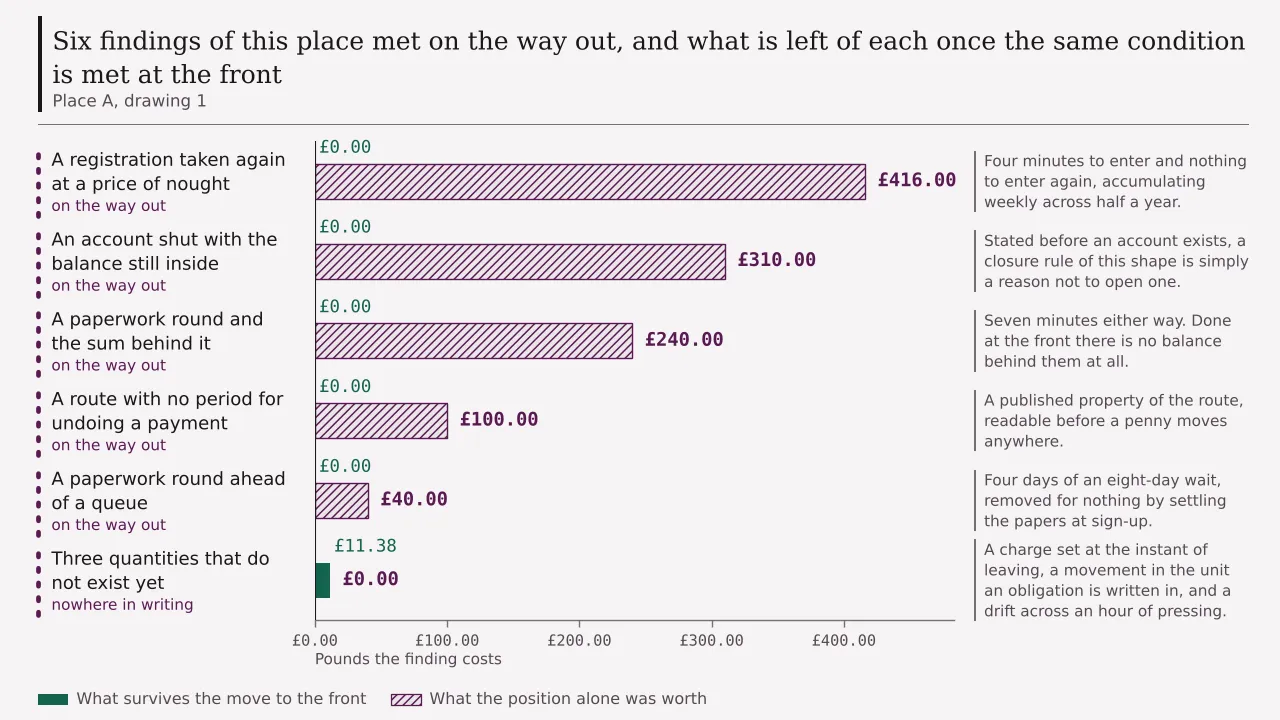
This place’s arithmetic is a single operation applied ten times. Take each finding, leave its words completely alone, and ask what survives of it if the identical condition is met before any money moves instead of after. Nothing about the condition changes. Only its position does.
Ten findings, met where this place meets them £1,121.78 The same ten, each met before any money goes in £11.38 What the position by itself is worth £1,110.40
Seven of the ten survive the move at nought. A paperwork round done at registration takes the same seven minutes and has no balance standing behind it, so the leverage is not reduced, it is absent. A rule permitting an account to be shut with money inside it is, stated before an account exists, simply a reason not to open one. A payment route with no period in which anything can be undone is a published property of that route, readable before a penny moves. The three remaining findings survive the move intact, for reasons set out two parts below.
| The condition | Earliest moment the figure could exist | Where it is met | Money |
|---|---|---|---|
| A registration taken again at a price of nought | Before the first one is taken | on the way out | £416.00 |
| A record of whose money is in the account | Before the account exists | on the way out | £310.00 |
| A paperwork round and the sum behind it | Before the account exists | on the way out | £240.00 |
| A route with no period for undoing a payment | Before anything is sent | on the way out | £100.00 |
| A paperwork round standing in front of a queue | Before the queue is joined | on the way out | £40.00 |
| A charge set by demand at the moment of leaving | Not until the balance tries to leave | nowhere in writing | £9.60 |
| A payout stretch an open record confirms | Before a payout is asked for | in the public register | £2.40 |
| A promise covering one variable out of seven | Before the promise is accepted | on the way out | £2.00 |
| A movement in the unit an obligation is written in | Not until the obligation is worked off | nowhere in writing | £1.20 |
| A drift in the price of a stake across an hour | Not until the hour has been played | nowhere in writing | £0.58 |
Read the middle column alone and the place reduces to one sentence. Seven of the ten figures could have existed before a reader finished deciding, and three could not. The first seven are a choice about layout. The last three are a property of the world.
5
Why the same words are worth more parked where they are
A condition met at the front is a condition that can be declined. Met at the back it can only be complied with or abandoned, and abandoning it means abandoning a balance. Those are two prices for one set of words, and whoever chooses where the words go collects the difference. Across this place the difference is £1,110.40, and not a syllable of any condition had to be untrue to produce it.
A second property compounds it. Eight of these ten findings need a balance to exist before they bite at all, and most balances do not survive that far. A condition placed at the exit therefore charges whoever drafted it nothing in the common case, and collects in the uncommon one, which makes it cheaper to write than the same condition placed at the front, where every reader sees it and some walk away.
The clearest demonstration is the leaf finding four days of an eight-day wait disappearing for nothing. Same paperwork, same documents, same reviewer, moved from after the request to before the first deposit, and four days come off a wait. Nobody saves money by it and nobody is inconvenienced more. Where a free improvement is available and goes untaken, the ordering is doing work for somebody, and the £40.00 that leaf prices is what the work is worth on its own assumed rate. None of which requires an accusation: a condition can sit late for an ordinary commercial reason, or out of indifference, or because whoever wrote the form was not whoever wrote the terms. The arithmetic measures the placement and says nothing about the motive.
6
Eleven pounds and thirty-eight pence nobody could have said sooner
Three of the ten findings could not have been given to a reader earlier at any price, and pricing them as though somebody chose to withhold them would be dishonest. They come to £11.38, which is 1.01 per cent of this place, and each fails for the same structural reason: the number does not exist at the moment of deciding.
The first is a charge fixed by how busy a public network happens to be at the instant a balance tries to leave. Nobody holds that figure in advance, not because nobody will say it, but because it has not been produced yet. The second is a movement in the unit an obligation is denominated in, between the moment the obligation is accepted and the moment it is discharged, which by definition has not happened at the first of those two moments. The third is the path a stake’s price takes across an hour of pressing, and a path does not exist until it has been walked.
The concession has a limit in the other direction and the limit matters. What could not be supplied in advance is three numbers. The shape of all three was perfectly statable at the front: that a charge has no schedule behind it, that an obligation is written in something that moves, and that a stake is not a fixed stake. A reader told those three things before depositing would have had everything except the digits, which is a great deal more than nothing and costs whoever says it precisely nothing.
So the honest division is three ways rather than two. Seven findings are a number that existed and was placed late. Three are a number that did not exist, wrapped in a description that did. Only the digits in the middle of that third group are genuinely unavailable, and they are worth £11.38 of £1,121.78.
7
Three leaves in ten against one penny in a hundred
The same concession reads two entirely different ways depending on what is counted. By leaves, three of the ten findings rest on quantities that did not exist in time, which is 30 per cent of the place. By money they are £11.38 of £1,121.78, which is 1.01 per cent. The two readings stand almost thirty times apart, and printing one of them alone would be a choice about what a reader is meant to conclude.
1.01 pence in every pound here genuinely unavailable at the moment of deciding, and 98.99 of it merely somewhere else
The gap has a plain cause. The three findings that could not be advanced all sit on small balances over short periods: a £25.00 balance, an hour of pressing, a single obligation of £10.00. The seven that could be advanced sit on whole balances, on half-years and on account closures, which are objects an order of magnitude larger. The un-advanceable class is frequent and small, and the advanceable class is rarer and enormous.
Which reading applies depends on the question. Anybody meeting one arrangement meets one leaf, so the count reading matches a single encounter: roughly a third of what turns up at an exit was genuinely not knowable sooner. Anybody asking what this position in the order costs across the market wants the money reading, because the money is where the position does its work. Both are printed above and neither is the summary. One caution on the count: three leaves is a small enough number that a single leaf crossing the line would shift it by ten points, whereas one of the three findings would have to grow a hundredfold before 1.01 per cent reached five.
8
Duties whose whole content is a moment rather than a rule
Arrangements built the way these are carry no Great Britain licence at all. Which obligations are worth naming at this position are the ones made entirely of timing, since timing is the subject here, and four of them fasten a moment to something a reader does.
First, a withdrawal request may not be handed back: once it has gone in, the licensed system is forbidden to invite its cancellation, and the route out is to be kept as clear as the operator can manage. Second, since 17 January 2025 two running figures have had to stay in front of whoever is playing, while the playing goes on: the money gone in less the money come back, and the time elapsed. That settles when a number appears and leaves what it says alone. Third, a window of at least six months stays open for raising a complaint, counted from the incident, and where a reasonable information request goes seven days without an answer, the clock can be stopped, picking up afterwards at the point it reached rather than at the beginning. Fourth, consent for direct marketing has to be given product by product and channel by channel, in force from 1 May 2025, a date the regulator’s own release notes was shifted out of January, so a permission taken at the front governs what may arrive later.
Take the licence away and what goes is the ordering rather than the substance. Nothing then stops a request being handed back to somebody who has just asked for their money. No figure has to be put in front of anybody while play is going on. No window is promised in which a complaint can still be raised, and no rule says a halted clock resumes where it halted rather than at nought. Each of those four losses is a loss about position, which is why they are the right ones to name in this place and the wrong ones to name anywhere else on this site.
The honest half is that a published route can exist beyond the British licence, and any page claiming the opposite has it wrong. One offshore rulebook read for this site sets a six-month window for bringing a complaint and a timetable of four weeks, extendable once by a further four, with receipt acknowledged in writing inside a week. Where it stops short is on who fixes the terms of the route: its own policy leaves the licensee to settle whether an outcome binds anybody and whether a claim must clear a floor before escalation is available. On a place about sequence that is the sharpest difference of the lot, since the timetable exists while one side of the dispute writes the terms it runs on.
9
Which questions move forward, and which will not move at all
The test is one question long and needs none of this place’s figures. Take any condition you have met at an exit and ask on what date the fact behind it became true. If the answer is some date before you sent money, the condition was advanceable and its position was somebody’s choice. If the answer is a date after, it was not, and no amount of disclosure would have produced the number.
Four conditions pass that first test every time and are worth asking about at registration rather than at the end. What papers will be wanted, and when. What would cause an account to be shut with a balance in it. Which route the money can leave by, and whether that route carries a payment backwards. What queue stands between a request and a payment, and who is in it. The four were all true before the account existed, and are all routinely first met months afterwards.
Three conditions fail it, and the right response differs. A charge with no schedule, an obligation written in a unit that moves, and a stake that is not a fixed number of pence are all cases where the digits cannot be produced in advance. Ask for the shape instead: whether any schedule exists, what the unit is, and what band the figure has moved in lately. A description supplied in advance is worth having even where the number cannot be.
Then do the usual subtraction, which here is a subtraction about position rather than about content. Price the condition as you met it. Price the identical condition met before you had committed anything. Rule off the difference, and what is left is what you were charged for the ordering. Where the two prices come out the same, the condition belongs where it stands and nobody owes you an earlier answer, which on these ten leaves was true of £11.38 and of nothing else.
Questions
- What counts as a condition that shows only afterwards?
- One a reader meets for the first time at the fifth step of six: read the claim, open an account, send money, play, ask for the money back, be paid. A condition arriving at the fifth step arrives after the third, and the third is the one refusing to run backwards. The test here is whether the reader could have acted differently had they known, and by construction they could not.
- Why does the timing matter if the condition itself is fair?
- Because the same words carry two prices. Met at the front a condition can be declined. Met at the back it can only be complied with or abandoned, and abandoning it means abandoning a balance. Across the ten leaves here that difference comes to £1,110.40, and no part of any condition had to be untrue or unreasonable for it to arise.
- How much of this could have been told to a reader earlier?
- £1,110.40 of £1,121.78, which is 98.99 per cent. Seven findings rest on facts that existed before the account did: what papers are wanted, what shuts an account, whether a route carries a payment backwards, what a repeated registration costs over half a year, and what queue stands in front of a payment. Only £11.38 rests on quantities not yet in existence.
- Which conditions genuinely cannot be settled in advance?
- Three, and they total £11.38. A charge fixed by how busy a public network is at the instant a balance tries to leave, because the figure has not been produced yet. A movement in the unit an obligation is written in, between acceptance and discharge, which has not happened at the first of those moments. And the path a stake’s price takes across an hour, because a path does not exist until it has been walked.
- If three of ten cannot be advanced, is that thirty per cent or one per cent?
- Both, and they answer different questions. By leaves it is three in ten, the reading matching a single encounter with a single arrangement. By money it is £11.38 of £1,121.78, or 1.01 per cent, the reading matching what the position costs across the market. The three un-advanceable findings sit on small balances and short periods, while the seven advanceable ones sit on whole balances and half-years.
- Does a British licence fix when a condition has to appear?
- In four places it fixes a moment rather than a rule. A withdrawal request may not be handed back once it has been entered. Since 17 January 2025 the money gone in less the money come back, and the time elapsed, have to stay in front of whoever is playing. A window of at least six months stays open for raising a complaint, and a clock stopped over an unanswered request picks up at the point it reached. Consent for direct marketing has to be given product by product and channel by channel, from 1 May 2025.
- What stops applying once no Great Britain licence covers the address?
- The ordering stops being governed, while the substance was never the point. Nothing then stops a request being handed back to somebody who has just asked for their money, nothing requires a figure to be shown while play is going on, no window is promised for raising a complaint, and no rule says a stopped clock picks up where it stopped rather than at nought.
- Is there any complaints route at all outside the British licence?
- Yes, and any page claiming the opposite has it wrong. One offshore rulebook read for this site sets a six-month window for bringing a complaint and a timetable of four weeks, extendable once by a further four, with receipt acknowledged in writing inside a week. Where it stops short is on who fixes the terms: its own policy leaves the licensee to settle whether an outcome binds anybody and whether a claim must clear a floor before escalation.
- Why do most of these conditions cost nothing most of the time?
- Because eight of the ten need a balance to exist before they bite, and most balances do not survive to the exit. A condition placed there therefore charges whoever drafted it nothing in the common case, and collects in the uncommon one. That is what makes it cheaper to write than the same condition placed at the front, where every reader sees it and some decline.
- How do I test a condition I have just met at an exit?
- Ask on what date the fact behind it became true. If that date is before you sent money, the condition was advanceable and its position was a choice, so price it twice and rule off the difference. If the date is after, no disclosure would have produced the number, and the thing to ask for instead is the shape: whether any schedule exists, what unit the figure is in, and what band it has moved in lately.