Terms read 19 October 2026 The front leaf, revision 1
Stated and Unstated: every claim about an offer is settled somewhere, and the address is worth money
A banner offering a hundred and seventy-five presses at a price of nothing is expected to hand back £16.80, once somebody supplies the pence a single press costs. One sentence, filed in a document that banner does not link to, is expected to take £26.88 away and close the claim at minus £10.08. Six addresses settle conditions of that sort between them. Which address a condition sits at decides how many readers have subtracted it before they click, and that is the whole subject here.
Stated on the banner £0.00 What an advertisement settles unaided, before a reader has done any arithmetic on it. A headline prints a quantity and withholds whatever converts that quantity into money. Stated, once you go and look 2 of 6 Addresses in this scheme a stranger may still reach: a written condition, and a public record. One is drafted by the party gaining from the claim and one by a body with nothing riding on it. Not stated before the money goes in 3 of 6 Addresses opening only once a reader has spent something no refund gives back, the last of those three being no address at all and therefore unreadable at any price.
Offers written about here, with their terms read
Every destination in this file is bought advertising. The site is paid a fee if a reader goes on to register, and no figure printed below moves because of it.
Bonus Spins UK Slip 01
Betportal
Ceiling as a multiple
The drop
€15.00
€1.00 in the euro
The claim reads €15.00. Once the terms beside it have applied, €0.00 of it can leave. The difference is the drop.
7 of the 15 terms on this slip could not be read before the money went in
Spins priced at this site's own 10p a spin, which the operator does not publish
Stated
€15.00
The claim as it is printed, before a single term has been applied to it.
Headline paid as spins
150 spins at 10c each, which is €15.00 of the figure above.
6 Nowhere
What one spin is worth
No unit is published for a spin, so the count is priced at this site's own 10p a spin. At half that price every figure below halves with it.
Match and other credit not priced
300% of three deposits, to a ceiling of €1,000. A share of a deposit nobody has made yet is not a sum, so no figure stands on this line and none is carried below.
Qualified
-€14.40
Written down somewhere, and taking part of the claim back. Each term carries the place it is written and the sum it takes.
2 Written terms at a distance this record does not establish
Play-through -€14.40
Carrying €14.40 through 35 times stakes €504.00 and costs €20.16 of it at 96 per cent return. That prices above the €14.40 there is to charge it against, so the whole of the credit goes and the line is held at that. The multiple sits on the bonus.
2 Written terms at a distance this record does not establish
Game weighting not priced
Slots only count towards the play-through. No contribution percentage is published, so the line above has been worked at full weight, which is the kindest reading there is.
2 Written terms at a distance this record does not establish
Ceiling on the winnings not priced
5x the bonus.
2 Written terms at a distance this record does not establish
Clock on the credit not priced
14 days.
2 Written terms at a distance this record does not establish
Largest stake while it runs not priced
€5.
3 Public record
Licence, and who holds it not priced
Licensed in Anjouan, Comoros, held by BetPortal Gaming Ltd, with Excite Ultra Media Ltd, reference ALSI-202601040-FI2. A register entry settles who holds a licence and what it permits. It does not settle who is running the site this morning.
4 Cashier
Smallest qualifying deposit your money
€20 a stage. That is €20.00 of your own money, and it is never netted into a drop.
5 On the way out
Checks before a withdrawal not priced
Documents before the first withdrawal.
Unstated
-€0.60
Applying without having been published anywhere, and costing money all the same.
6 Nowhere
What a spin hands back -€0.60
Staking a spin returns 96 per cent of it, so that share of the batch is the house's before a reel turns. This site works at that return and the operator publishes none where the claim is made.
6 Nowhere
Forfeited by rule cost unknown
Nothing is published under this heading, and it applies regardless.
6 Nowhere
Charge on the way out cost unknown
No charge on the way out is published as a figure, so nothing comes off this line. A charge that exists unpublished would come straight off whatever survives.
6 Nowhere
Smallest withdrawal allowed cost unknown
No smallest withdrawal is published as a figure. A floor nobody has published is still a floor, and it decides whether a small balance can move at all.
No Great Britain licence
Terms read 19 October 2026
Bonus Spins UK Slip 02
WinBeast
Ceiling as a sum
The drop
€50.00
€1.00 in the euro
The claim reads €50.00. Once the terms beside it have applied, €0.00 of it can leave. The difference is the drop.
8 of the 15 terms on this slip could not be read before the money went in
Spins priced at this site's own 10p a spin, which the operator does not publish
Stated
€50.00
The claim as it is printed, before a single term has been applied to it.
Headline paid as spins
500 spins at 10c each, which is €50.00 of the figure above.
6 Nowhere
What one spin is worth
No unit is published for a spin, so the count is priced at this site's own 10p a spin. At half that price every figure below halves with it.
Match and other credit not priced
50% to 100% of five deposits, each to a ceiling of €1,000, and a €650 free bet. A share of a deposit nobody has made yet is not a sum, so no figure stands on this line and none is carried below.
Qualified
-€48.00
Written down somewhere, and taking part of the claim back. Each term carries the place it is written and the sum it takes.
2 Written terms at a distance this record does not establish
Play-through -€48.00
Carrying €48.00 through 40 times stakes €1,920.00 and costs €76.80 of it at 96 per cent return. That prices above the €48.00 there is to charge it against, so the whole of the credit goes and the line is held at that. The multiple sits on the bonus and the winnings from the spins.
2 Written terms at a distance this record does not establish
Game weighting not priced
Slots, titles vary by country count towards the play-through. No contribution percentage is published, so the line above has been worked at full weight, which is the kindest reading there is.
2 Written terms at a distance this record does not establish
Ceiling on the winnings not priced
€100 a batch of spins.
2 Written terms at a distance this record does not establish
Clock on the credit not priced
7 days, spins 1 day.
3 Public record
Licence, and who holds it not priced
Licensed in Curaçao, holder not named on the site. A register entry settles who holds a licence and what it permits. It does not settle who is running the site this morning.
4 Cashier
Smallest qualifying deposit your money
€20 a stage. That is €20.00 of your own money, and it is never netted into a drop.
5 On the way out
Checks before a withdrawal not priced
Documents before the first withdrawal.
Unstated
-€2.00
Applying without having been published anywhere, and costing money all the same.
6 Nowhere
What a spin hands back -€2.00
Staking a spin returns 96 per cent of it, so that share of the batch is the house's before a reel turns. This site works at that return and the operator publishes none where the claim is made.
6 Nowhere
Largest stake while it runs cost unknown
Nothing is published under this heading, and it applies regardless.
6 Nowhere
Forfeited by rule cost unknown
Nothing is published under this heading, and it applies regardless.
6 Nowhere
Charge on the way out cost unknown
No charge on the way out is published as a figure, so nothing comes off this line. A charge that exists unpublished would come straight off whatever survives.
6 Nowhere
Smallest withdrawal allowed cost unknown
No smallest withdrawal is published as a figure. A floor nobody has published is still a floor, and it decides whether a small balance can move at all.
No Great Britain licence
Terms read 19 October 2026
Bonus Spins UK Slip 03
EliteSpin
Longest spin window
The drop
£50.00
£1.00 in the pound
The claim reads £50.00. Once the terms beside it have applied, £0.00 of it can leave. The difference is the drop.
8 of the 15 terms on this slip could not be read before the money went in
Spins priced at this site's own 10p a spin, which the operator does not publish
Stated
£50.00
The claim as it is printed, before a single term has been applied to it.
Headline paid as spins
500 spins at 10p each, which is £50.00 of the figure above.
6 Nowhere
What one spin is worth
No unit is published for a spin, so the count is priced at this site's own 10p a spin. At half that price every figure below halves with it.
Match and other credit not priced
50% to 100% of five deposits, each to a ceiling of £1,000. A share of a deposit nobody has made yet is not a sum, so no figure stands on this line and none is carried below.
Qualified
-£48.00
Written down somewhere, and taking part of the claim back. Each term carries the place it is written and the sum it takes.
2 Written terms at a distance this record does not establish
Play-through -£48.00
Carrying £48.00 through 40 times stakes £1,920.00 and costs £76.80 of it at 96 per cent return. That prices above the £48.00 there is to charge it against, so the whole of the credit goes and the line is held at that. The multiple sits on the bonus and the winnings from the spins.
2 Written terms at a distance this record does not establish
Game weighting not priced
Slots count towards the play-through. No contribution percentage is published, so the line above has been worked at full weight, which is the kindest reading there is.
2 Written terms at a distance this record does not establish
Ceiling on the winnings not priced
5x the bonus.
2 Written terms at a distance this record does not establish
Clock on the credit not priced
7 days, spins 3 days.
3 Public record
Licence, and who holds it not priced
Licensed in Costa Rica, held by PrimeTier Limited. A register entry settles who holds a licence and what it permits. It does not settle who is running the site this morning.
4 Cashier
Smallest qualifying deposit your money
£20 a stage. That is £20.00 of your own money, and it is never netted into a drop.
5 On the way out
Checks before a withdrawal not priced
Documents before the first withdrawal.
Unstated
-£2.00
Applying without having been published anywhere, and costing money all the same.
6 Nowhere
What a spin hands back -£2.00
Staking a spin returns 96 per cent of it, so that share of the batch is the house's before a reel turns. This site works at that return and the operator publishes none where the claim is made.
6 Nowhere
Largest stake while it runs cost unknown
Nothing is published under this heading, and it applies regardless.
6 Nowhere
Forfeited by rule cost unknown
Nothing is published under this heading, and it applies regardless.
6 Nowhere
Charge on the way out cost unknown
No charge on the way out is published as a figure, so nothing comes off this line. A charge that exists unpublished would come straight off whatever survives.
6 Nowhere
Smallest withdrawal allowed cost unknown
No smallest withdrawal is published as a figure. A floor nobody has published is still a floor, and it decides whether a small balance can move at all.
No Great Britain licence
Terms read 19 October 2026
Bonus Spins UK Slip 04
Crown Jewelz
Multiple unpublished
The drop
NOT WORKED
The multiple is not published in the operator's own terms. Since the sum cannot be worked around it, none is worked.
9 of the 14 terms on this slip could not be read before the money went in
No drop worked
Stated
£15.00
The claim as it is printed, before a single term has been applied to it.
Headline paid as spins
150 spins at 10p each, which is £15.00 of the figure above.
6 Nowhere
What one spin is worth
No unit is published for a spin, so the count is priced at this site's own 10p a spin. At half that price every figure below halves with it.
Match and other credit not priced
200% of the first deposit, then 150% twice, each to a ceiling of £1,000. A share of a deposit nobody has made yet is not a sum, so no figure stands on this line and none is carried below.
Qualified
NOT WORKED
Written down somewhere, and taking part of the claim back. Each term carries the place it is written and the sum it takes.
2 Written terms at a distance this record does not establish
Play-through not priced
40x the bonus, reported rather than published by the operator.
2 Written terms at a distance this record does not establish
Game weighting not priced
Slots count towards the play-through. No contribution percentage is published, so the line above has been worked at full weight, which is the kindest reading there is.
3 Public record
Licence, and who holds it not priced
Licensed in Curaçao, number not verified, holder not named on the site. A register entry settles who holds a licence and what it permits. It does not settle who is running the site this morning.
4 Cashier
Smallest qualifying deposit your money
£20. That is £20.00 of your own money, and it is never netted into a drop.
5 On the way out
Checks before a withdrawal not priced
Documents before the first withdrawal.
Unstated
NOT WORKED
Applying without having been published anywhere, and costing money all the same.
6 Nowhere
Ceiling on the winnings cost unknown
No ceiling is published. Nothing is assumed in its place.
6 Nowhere
Clock on the credit cost unknown
Nothing is published under this heading, and it applies regardless.
6 Nowhere
Largest stake while it runs cost unknown
Nothing is published under this heading, and it applies regardless.
6 Nowhere
Forfeited by rule cost unknown
Nothing is published under this heading, and it applies regardless.
6 Nowhere
Charge on the way out cost unknown
No charge on the way out is published as a figure, so nothing comes off this line. A charge that exists unpublished would come straight off whatever survives.
6 Nowhere
Smallest withdrawal allowed cost unknown
No smallest withdrawal is published as a figure. A floor nobody has published is still a floor, and it decides whether a small balance can move at all.
No Great Britain licence
Terms read 19 October 2026
Every figure in the second and third columns is this site's own working and nothing an operator has published. A claim is priced as printed, then the share a spin hands back at 96 per cent return comes off it, then what playing the multiple through costs at the same return, and then whatever a published ceiling, a charge on the way out or a floor on the smallest withdrawal takes from what has survived. The drop is the difference between the first figure and the last. The two columns add back up to it exactly, so no money leaves a slip without a term and a place beside it.
Which column a term falls in is settled by one question: has anybody written it down. A charge a reader meets at the payment screen is written down, and it stands in the second column with the cashier against it. A condition that binds without ever having been set down stands in the third, whatever it costs. Inside each column the terms run outwards from the banner, so the order itself says how far a reader would have had to go.
A count of spins has no unit until one is supplied. Where an operator publishes what one of its own spins is worth, that figure is used and the first column says it is theirs. Where none is published, this site's own 10p a spin stands in its place and every figure below moves in proportion with it. Where the multiple itself is unpublished, no drop is worked at all, because that is the one figure the sum cannot be done without.
Three words stand where a figure cannot. Not priced is a term that is written down and carries no number the arithmetic can take. Cost unknown is a term nobody has written down, costing something nobody has put a number on. Your money is money of the reader's own, which is never netted into a drop.
None of the operators in this file holds a Great Britain licence, so none of the duties that licence carries reaches them. Each of those duties is published in its own right, which is what makes its absence here something a reader can check rather than take on trust. Every gambling company licensed in Great Britain belongs to Gamstop Online, so a reader who has shut themselves out through the scheme is not shut out here. Social Responsibility Code 5.1.1 has held a play-through to a maximum of ten times the bonus funds since 19 January 2026, and it binds a licence holder and nobody else. Asked in a post of 21 October 2025 what is lost along with the licence, the Gambling Commission's Director of Enforcement and Intelligence answered: "unfair gaming practices, financial loss, and a lack of recourse if things go wrong". The same post puts blocked payouts, and withdrawal limits pitched high enough to be unreachable, among the behaviour the Commission has recorded. Nobody under 18 may hold an account at any of them.
Terms are reproduced in the wording their operator published, and each slip is dated with the day somebody sat down and read them. 19 October 2026 is the oldest of those dates. Anybody claiming an offer is bound by that operator's full terms, which are elsewhere, and never by a line standing here.
1
Six addresses, and what a reader has spent by the time each opens
Three of the six addresses below are open to a complete stranger at no charge. The other three unlock only for somebody who has handed over something no refund returns, and that ordering, rather than the wording of any clause, is what the £26.88 in part four is made of.
Take them as a reader meets them. First comes the advertisement: no click, no account, no name, drafted entire by whoever is making the offer, and settling exactly what its author elected to print, which on a claim counting events rather than pounds is a quantity and not a sum. Second comes whatever writing the advertisement defers to, by the same author. Getting there costs minutes and, worse, costs knowing the writing is there to be got, a condition parked in a schedule nothing links to having been filed and put out of reach in one movement.
Third is a public record, the only one of the six addresses composed by a party with nothing riding on the answer. Searching what the British regulator publishes costs a name typed into a box: businesses, individuals and premises each have a register, readable whole without an account. What it declines to settle is who is taking payments at a given web address this morning, the question most readers turn up holding.
Fourth is the payment screen, which unlocks once an account exists, a registration being the cheapest irreversible act in the sequence and the first that cannot be called back. Fifth is the moment a balance is asked for, where whatever waits is met by somebody who has already sent money, staked it and finished ahead, so the price of standing there is the whole balance on the account.
Sixth is not an address. Some quantities deciding the money are settled by somebody and published by nobody: what one press costs in pence, how much of a staked pound counts against a requirement, how violently outcomes swing. Reading reaches none of those, and marking a line unreachable is a result rather than a shortfall.
| The address | Who drafted what stands there | What a reader has already spent | Quantities of the worked claim |
|---|---|---|---|
| Whoever is making the offer | Nothing at all | 1 | |
| in the written terms | The same party, a document along | Minutes, plus knowing the document is there | 1 |
| in the public register | A regulator, with nothing riding on it | One name typed into a free search | 1 |
| at the cashier | Whoever will be holding the money | An account, which exists from then on | 1 |
| on the way out | Whoever decides when papers get asked for | A balance that has already crossed | 1 |
| nowhere in writing | Somebody, who publishes nothing | More than anybody has | 3 |
Read the right-hand column first. Eight quantities decide the worked claim in part four; the address charging a reader nothing settles one of them, and three sit where nobody reaches at any price. A page listing an offer’s conditions without naming which of these six rows each belongs to has left out the part that costs money.
2
Nothing here was watched, and every figure was worked
This belongs at the front rather than in a note at the bottom, because every total below rests on it. Nobody connected with this domain has opened an account with an operator, claimed an incentive, pressed a reel, accumulated a balance or applied to have one paid out, and no offer has been timed, sampled or entered into. Those sentences are not modesty. They describe the method exactly.
So where a page states that a condition costs £26.88, the claim is narrow and ought to be read narrowly. It means £26.88 is the answer when a published rule and a declared quantity go through a calculation printed beside the result. It does not mean £26.88 left anybody’s account, and nothing here could establish that it had.
Two kinds of input go in and there is no third. One is a rule somebody else published and anybody else can open: a licence condition, a technical standard, an advertising code, a row in a register. Those carry a link to the document, so a reader doubting a figure can read what it was built out of. The other is a quantity nobody publishes, which this site supplies, and part six names each with the reason it was picked. A sentence spending one says so inside the sentence.
A real limit follows. A worked example says what a condition does to a sum under stated conditions. It says nothing about what has happened to anybody, what will happen to whoever is reading, or what any operator settles in practice, and a figure treated as one of those three would do damage the arithmetic cannot carry. The proper use of a number here is comparison: one subtraction, run identically every time, over claims that look nothing like one another.
3
Four duties that come loose at the edge of a British licence
Not one offer written about on this domain holds a Great Britain licence. They run under permissions granted elsewhere, and what that costs is specific here rather than general. A licence does not improve an offer and promises nobody an outcome. It fastens a published word to a party who can be asked about it, and answerability of that exact kind is this leaf’s subject. Four duties do the fastening, and all four duties let go once the licence is gone.
The first governs what a sentence may do. Inside a British licence, a clause putting a ceiling on withdrawals from somebody’s own deposit balance cannot be written in, acted on or leaned on afterwards, and the regulator’s illustration of the forbidden shape is a daily figure paired with a weekly one. A cap on the size of a payment out, or on how many may be made, is permitted only where it is reasonable, and the page setting that down prints no publication date, so none is invented for it here. Beside part four the rule costs nothing in expectation, minus £10.08 sitting below any ceiling anybody would bother drafting. It bites on the balance a reader would have been delighted to hold, which is where ceilings of that shape are built to bite.
The second governs where a condition stands, and three published adjudications say so one after another. A ten pound free bet carried a reply-by time the advertisement left out. An excluded payment method, set down correctly among a set of full conditions, was still held to be standing too quietly. A five pound voucher did not work on one day of a racing calendar and did not say which day, and of those three that is the one where the word breach gets used. Nothing was false in any of them: a sentence that existed had been filed where the person it bore upon was not, which is this site’s whole subject with a published outcome attached.
The third governs what a claim may argue: the non-broadcast advertising code stops a gambling advertisement offering itself as an answer to money trouble, a replacement for earning a living, or a route to being financially secure. The fourth governs whether a claim reaches a particular person at all. Social responsibility provision 5.1.11 wants a specific, informed agreement in hand before any direct electronic marketing goes out, barring a statute saying otherwise, so an uninvited claim in an inbox has an address one step earlier than the banner this scheme opens at.
Take the licence away and the writing is untouched. A multiple is still written down. An excluded method is still excluded. What disappears is the party who could be asked why a sentence sits where it sits, and the £26.88 in part four becomes a figure with nowhere at all that it can be raised.
A reader already signed up to the national scheme should assume it does not reach an offer of this build. That registration shuts accounts held with British licence holders, and out here there is no licence for it to act upon. The support addresses at the foot are the ones worth having.
4
A hundred and seventy-five presses, taken the whole way through
One specimen, carried from advertisement to exit with every step printed: a banner offering a hundred and seventy-five presses to anybody opening an account, with no payment needed first. Nothing in it is unusual and nothing in it is untrue.
Begin where the money would have to come from. A press count counts events, and events turn into money only once a price gets fastened to one of them. Nobody fastens one. This site puts 10p on a press, which is its own figure and is declared here because this line is spending it. At that price, a hundred and seventy-five presses send £17.50 across the reels.
Next, what comes back. Reels are taken throughout to give back 96 pence in the pound, once more this site’s own figure and once more named in the line using it, so £17.50 of staking is expected to return £16.80. That is what a reader would act on having read the advertisement and nothing else, and it is already half an assumption.
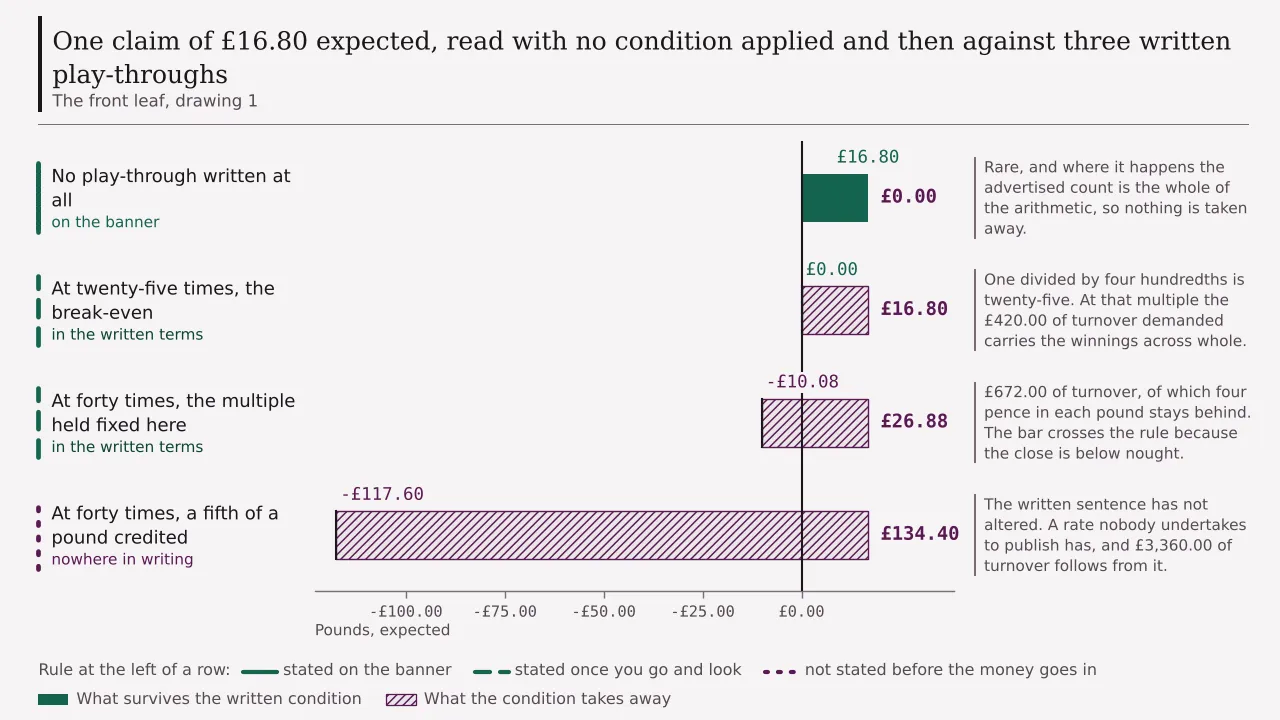
Now the document. A play-through of forty times, the multiple held fixed throughout this domain, applies to what the presses return rather than to what they staked. Forty lots of £16.80 comes to £672.00 of turnover standing between the balance and the exit, which at ten pence a press is 6,720 further presses. At 96 in the hundred four pence of every pound crossing stays behind, so £672.00 gives up £26.88, and £16.80 less £26.88 is an expected minus £10.08.
A hundred and seventy-five presses, read exactly as advertised £16.80 The identical presses, written condition applied minus £10.08 What stopping at the advertisement is worth here £26.88
£26.88 standing between a press count read off a banner and the same count after one filed sentence
Three further addresses get visited and none moves that subtraction by a penny. A record settles who holds a permission over the web address and what it covers, which decides whether a complaint later has anywhere to go. A payment page carries the smallest amount an exit will move, taken as £20.00 here and published in no rule this site could cite; against an expected close of minus £10.08 that floor is £30.08 out of reach, so it alters nothing in the expectation and decides instead whether a reader finishing ahead may leave with it. Paperwork at the exit behaves the same way: minutes for somebody holding the right documents, and the whole account for somebody who is not.
An honest reading survives all that and should be printed. Somebody wanting a hundred and seventy-five turns of a reel for no money, meaning to enjoy them and walk off, has been handed exactly what the banner described at exactly the price it named. Not one item in the machinery above comes into play until a payment out is asked for.
5
The same difference reached a second time, by another road
A subtraction done once is a subtraction nobody has checked. The £26.88 above came out of two columns, the claim read alone and the claim with the clause run against it. Here it is again, by a road sharing no step with the first.
This site works to one expression, printed in full here because this is the page that teaches it. Write B for what a claim is expected to return, W for the play-through, RTP for the proportion a reel hands back and g for the share of a staked pound credited. The expected close is then E = B × (1 − W × (1 − RTP) ∕ g). Putting forty, 96 hundredths and a whole pound into those three slots turns the bracket into minus six tenths. Six tenths of £16.80 the wrong way round is £10.08, and one and six tenths of it is £26.88. Neither figure went near the columns in part four.
The two roads are obliged to agree rather than merely happening to. A play-through clause has one effect and no others: it hands staked money over at a rate settled in advance. Applied to a turnover or apportioned out of a difference, the same margin does the work, so the answers land on the same penny. When they do not, an unlabelled quantity went in between them.
One divided by four hundredths is twenty-five, and the sign turns there. At twenty-five the claim is expected to finish at precisely nothing, which on this specimen means £420.00 of turnover and a balance of nought. Beneath that figure a balance keeps something back; past it, the difference is money the player puts in, and the forty in the terms sits at 1.6 times the turning point.
Letting the unpublished weighting move shows what the sixth address is worth. Credit a fifth of each staked pound instead of all of it and the turnover demanded becomes £3,360.00, the margin keeps £134.40, and the close falls to minus £117.60. Not a word of the written sentence has altered. Only a rate nobody is obliged to print has, and it moved the subtraction by £107.52.
£134.40 of difference where a fifth of each staked pound counts, against £26.88 where every penny of it does
6
Four quantities held still, and the reason each one was picked
Four numbers run through all hundred pages here, and holding them steady is what lets a press count and a percentage match be compared at all. Each is this site’s own choice, none is a reading of anything, and a page departing from one says so in the line that departs.
A press is taken at 10p. It is here because the subtraction will not start without it and because nothing anybody publishes supplies it: the pence fastened to one turn of a reel is a trading decision, and the rulebooks settling how a game must behave say nothing about what a turn costs. The figure sits at the modest end of ordinary practice deliberately, so totals built on it come out low rather than flattering.
The return is held at 96 per cent. It is here because what the house keeps then comes to four pence in a pound, which anybody can follow without reaching for a calculator, and not because anything measured says this market gathers at that number. The one general claim resting on it is structural, and it is the twenty-five in part five.
The play-through is held at 40 times. It is here because it is a round multiple comfortably past the turning point, and because one number everywhere means any difference between two pages is a difference between two claims instead of between two guesses. A page needing another multiple prints it and does the sum again.
The weighting is held at g = 1, meaning each penny staked counts in full against the requirement. It is here because it is the most generous reading going, which makes every figure on this domain a best case. Part five priced what happens to the specimen when it shifts, and the answer was £107.52, so this is the mildest of the four assumptions on its face and the most powerful underneath it.
7
Seven places, and the figure each of them reached
Every page here belongs to one of seven places, and a place is named for the address its class of condition is settled at. One line to a place. The sentence says what that place found, the label says which of the six addresses settles its class, and the figure is the one ruled off at the foot of its own shelf.
- What the headline states Fourteen advertised figures put through one multiple, and the half that turns a count into money is printed on none of them. £526.53
- What the terms state Nothing concealed and nothing drafted wrongly, and half of what the writing moves lies three documents out from the claim it governs. In the written terms £225.49
- What the register shows A free search answers four questions about a permission exactly, and the question a reader turns up holding has no field anywhere that could answer it. In the public register £845.40
- What only the cashier shows A floor, a charge or a refusal costs nothing to print early and is worth a great deal kept back until a payment screen, where most of the money is still in hand. At the cashier £556.24
- What shows only afterwards Conditions first met at an exit were nearly all knowable at the door, and shifting them to the end of the order is what made them dear. On the way out £1,121.78
- What nobody states Nine sums in sterling, of which a written clause produced £26.11 and defaults nobody ever wrote down produced the other £188.10. Nowhere in writing £214.21
- What the figures give away Ten answers reworked out of numbers already in print, with nine tenths of the money resting on figures somebody had put on paper. In the written terms £1,184.35
- Seven places, each entered at the figure ruled off on its own shelf £4,674.00
£4,674.00 across seven places, assembled out of seven shelves no single page of this domain could add
That total stands over the whole site and no page except this one can produce it. The place named for the headline is the sharpest case underneath it: its shelf carries fourteen findings and not one of those findings is settled where the claim was advertised. A reader here can see, before opening anything, which places finish at a figure somebody prints and which at a figure nobody does.
8
Why identical words cost more filed further from the claim
Here is the argument the whole domain exists to make, and it goes as a product of two terms. What a condition costs a reader is what the condition does, multiplied by the chance that reader had not already subtracted it. Filing it further from the claim leaves the first term where it was and drives the second down.
Run it on the specimen. The forty times clause removes £26.88 whether it is set in letters across the banner, parked in a promotional document two taps along, or lodged in a schedule that document mentions once. In all three arrangements the operator has written it down accurately and broken no rule a page here could name. What differs is how many readers did the subtraction while a decision was still theirs to take, and whoever decides the filing is not whoever pays for it.
That asymmetry explains something readers meet constantly and rarely name. A condition at the front loses its author every person who reads it and walks away. The same words at the back are paid for only by the few whose balances grew large enough for them to matter, which makes late filing the cheaper arrangement and is why it keeps happening with nobody behaving badly.
It also explains why this site sorts before it subtracts. Two offers carrying word for word the same conditions, one with the multiple on the face and one with it three documents out, differ in the only sense that reaches a bank account, and no list of terms can tell them apart. A list answers what applies. The six addresses answer who had a fair chance of knowing, and the money is in the second answer.
A concession belongs here as well. Separation is lawful, ordinary and frequently sensible, an advertisement carrying every clause on its face being unreadable, and the party doing the filing is often filing from habit. Figures here assert no intention: they measure a distance and price it, and the price is identical whoever put the sentence where it sits.
9
One sheet of paper, four lines on it
Nothing above depends on the specimen, and a claim can be priced on one side of a sheet in about two minutes. Four lines go on it.
Line one. Copy the claim out word for word, tidying nothing. A claim naming a sum of money can be multiplied the instant it has been read; a claim naming a count of events cannot, and whoever supplies the missing price has quietly written a term the advertiser never wrote.
Line two. List every quantity the answer turns on and write one of the six addresses beside each. Unreachable is an answer and belongs on the sheet, because the lines marked that way are the ones most worth a figure.
Line three. Read the claim alone, read it again with everything reachable applied, and subtract. Print both readings, never only the second, since a difference without its two parents is a number nobody can check.
Line four. Reach that same difference by a road sharing no step with the third, most easily from the turnover a clause demands and the share a margin keeps out of it. Two roads landing together is the only evidence anybody has that the working holds, and two roads disagreeing means a quantity went in without a label.
Questions
- What does this site actually do with a bonus or free spins offer?
- It sorts the offer’s conditions by where a reader could have found each one, then prices what the sorting turns up. The addresses it sorts into number six: a banner, a filed document, a register open to anybody, a payment screen, the moment a balance gets asked for, and no address whatsoever. Each page then prints the claim read alone, the claim with everything applied, and the difference.
- Where is a wagering requirement usually written down?
- In a document the advertisement defers to rather than on the advertisement itself. That is a filing decision and not a trick, the condition being drafted accurately and sitting in public. The cost is the distance: the chance a reader subtracted the clause while a decision was still theirs falls with every document they would have to open first.
- Why is a count of free spins not a quantity of money?
- Because a count counts events, and events turn into money only once a price gets fastened to one of them, which no published rule anywhere does. What a turn of a reel costs is a trading decision. This site puts 10p on it, declared in every line spending the figure, so a hundred and seventy-five presses send £17.50 across for an expected £16.80 back, both pounds resting on an assumption.
- What are the six places a claim can be settled at?
- On the banner, free to read and drafted by whoever makes the offer. In the written terms, costing minutes plus knowing the document is there. In the public register, costing a name typed into a free search, and the only one of the six written by a party with nothing riding on it. At the cashier, costing an account. On the way out, costing a balance already across. And nowhere in writing, unreachable at any price.
- How is the difference on each page worked out?
- By subtracting two readings of one claim, then reaching the same answer along another road. On the worked specimen, £16.80 read alone against an expected minus £10.08 once the written multiple applies gives £26.88. Separately, forty lots of £16.80 is £672.00 of required staking, and a house keeping four pence of each pound crossing it takes £26.88. Roads sharing no step have to land together, or something unlabelled went in.
- Why assume 10p a press, 96 per cent and forty times?
- Because the arithmetic will not start without them and nobody publishes them for a given offer. Ten pence is a round figure at the modest end of ordinary practice, so totals come out low rather than flattering. A 96 per cent return puts the house share at four hundredths, which keeps the subtraction legible. Forty times is a round multiple comfortably past the turning point, and weighting is held at a whole pound credited, the most generous reading going.
- What does a play-through of forty times do to an advertised sum?
- It scales the sum by six tenths the wrong way round. Forty lots of four hundredths comes to 1.6, so the close is the sum less 1.6 of itself and the two readings finish 1.6 sums apart. Twenty-five is one over four hundredths, the multiple where the sign turns, and everything past it is paid for by the person at the reels.
- Do the offers written about here hold a British licence?
- No. They run under permissions granted somewhere other than Great Britain and hold no Great Britain licence. Four duties about published words let go with it: a clause capping withdrawals from a reader’s own deposit balance cannot be written in or acted on; a condition filed where a reader is not has been adjudicated against three separate times; an advertisement may not offer gambling as an answer to money trouble; and electronic marketing needs agreement before it is sent. None of those four duties attaches out here.
- Has anybody here played the offers these figures describe?
- No, and no figure here rests on anyone having done so. Nobody connected with this domain has opened an account, claimed an incentive, pressed a reel, built a balance or applied for a payout. Every number is arithmetic run over a published rule, which is linked, or over a declared assumption, named in the sentence spending it. A worked example says nothing about what happened to anybody.
- How do I price an offer myself before signing up to anything?
- Copy the claim out word for word. List every quantity the answer turns on and write one of the six addresses beside each, marking the unreachable ones as unreachable. Read the claim alone, read it again with everything reachable applied, and print both readings with the difference ruled off. Then reach that difference along a second road, from the turnover the clause demands and the share the margin keeps.